Easy
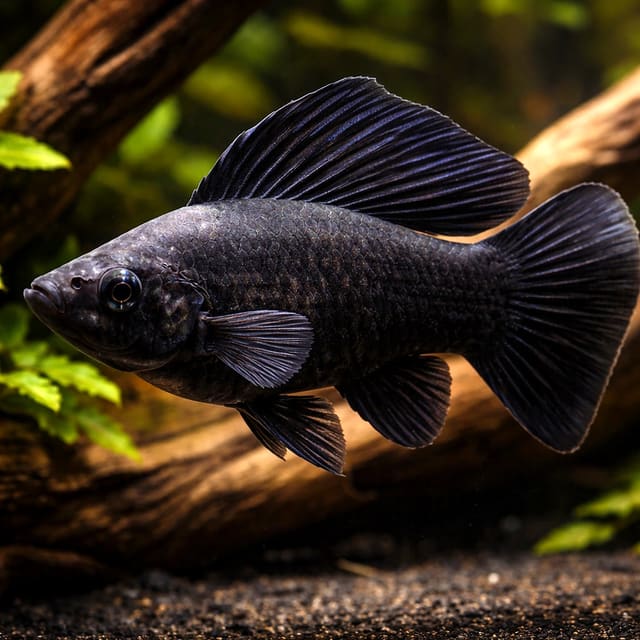
Black Molly (Poecilia sphenops black molly)
21–28°C · pH 7–8.5 · 81L
£3.99
Molly Lyra Mixed is a long-finned Poecilia sphenops trade form supplied as one approximately 4 cm fish per purchase. Plan a mature, well-filtered planted aquarium with hard, neutral-to-alkaline water, open swimming room and other fish that share those conditions. Sex is not guaranteed on this listing.
Poecilia sphenops
Shoaling fish: kept in a group they feel safer, stay calmer and show their best colour.
Molly Lyra Mixed is a long-finned Poecilia sphenops trade form supplied as one approximately 4 cm fish per purchase. Plan a mature, well-filtered planted aquarium with hard, neutral-to-alkaline water, open swimming room and other fish that share those conditions. Sex is not guaranteed on this listing.
Maintain these water conditions for optimal health and vibrant colors
Molly Lyra Mixed is the trade name used for this Lyra-form Poecilia sphenops. The word ‘Lyra’ describes the extended, lyre-like shape of the tail rather than a separate species. The ‘mixed’ part means individual fish can vary in colour and pattern. That distinction is useful when you are choosing a fish for a display: the characteristic tail is the theme, while colour and markings can vary from one animal to another.
One purchase supplies one live fish. The fish is supplied at approximately 4 cm, which is the dispatch size rather than an adult-size promise.
The accepted species identity is Poecilia sphenops, a poeciliid livebearer native from Mexico south to Colombia according to FishBase. It occurs naturally in fresh and brackish environments, but a home aquarium should be planned around stable husbandry rather than the full range of conditions recorded in the wild. For everyday aquarium care, the species profile recommends hard, neutral-to-alkaline water, a planted layout and enough horizontal room for active swimming.
FishBase records 7.5 cm standard length for a male/unsexed record, while the aquarium profile gives 8 cm standard length as its planning figure. Standard length, abbreviated SL, stops at the base of the tail and does not include the caudal fin. That matters especially for a Lyra-form molly because the extended tail makes the complete fish look longer. These are therefore useful planning measurements, not an exact total-length guarantee for every animal.
A sensible setup is built around the species profile’s 90 × 30 cm base and approximately 81-litre example, with more room when the group or community grows. Footprint matters because it gives mollies usable swimming length and makes it easier for fish to move away from one another. The mature volume also helps slow swings in temperature and water chemistry, although it never replaces regular testing and maintenance.
This molly best suits a keeper who knows their tap water or is willing to test it. Its central requirement is not an unusual food or specialised décor; it is mineral-rich water that remains stable. Soft, acidic water is a poor match even if the temperature looks right. If you do not yet know your pH and general hardness, establish those values before choosing tank mates or adjusting the aquarium.
It can work in a peaceful community whose members genuinely share those water needs. Other Poecilia, some rainbowfish, and hard-water-tolerant barbs or tetras are the types named by the species profile, but each proposed companion still needs its own adult-size, temperament and feeding check. ‘Community fish’ is not a universal compatibility label.
For more colours and forms, browse the current molly collection. Close product alternatives appear separately and should not be assumed to be tank mates.
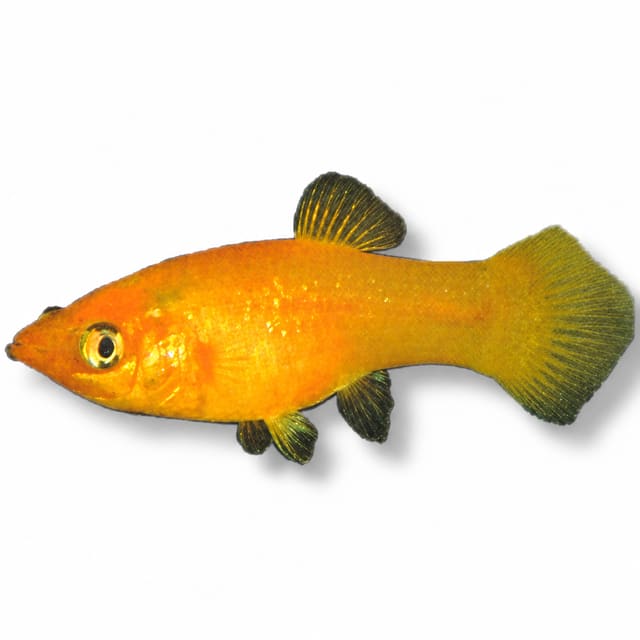
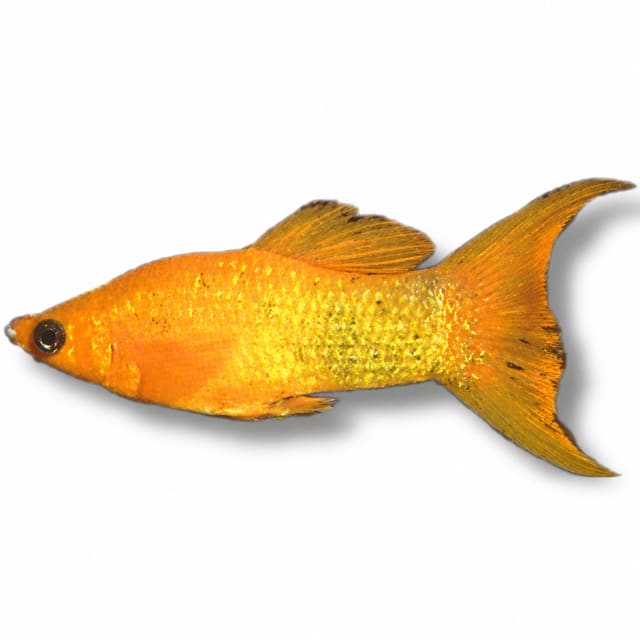
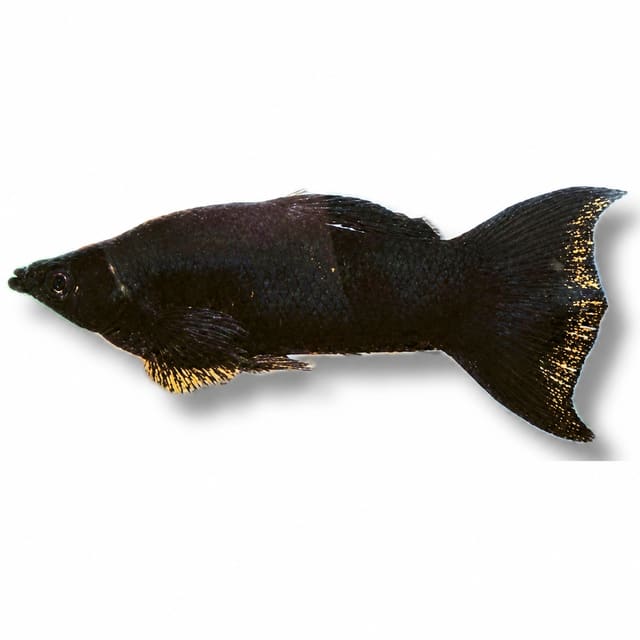
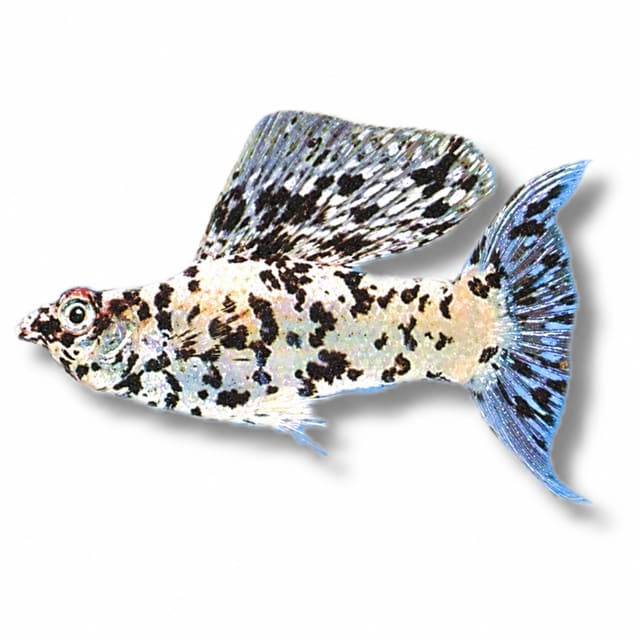
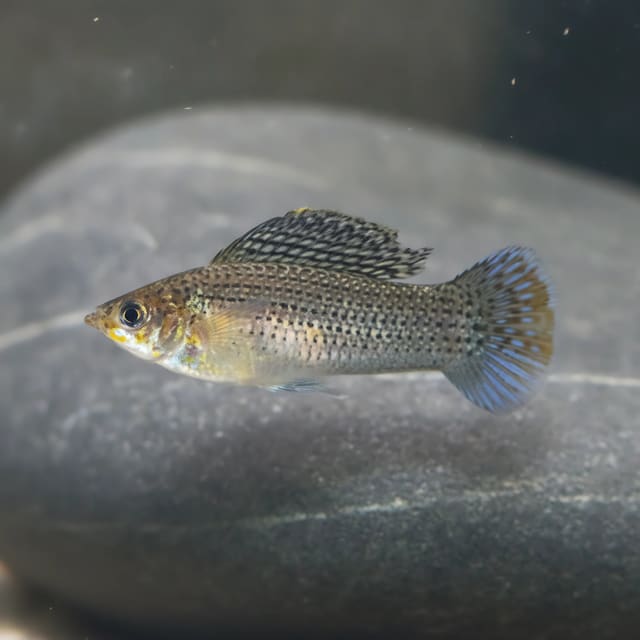
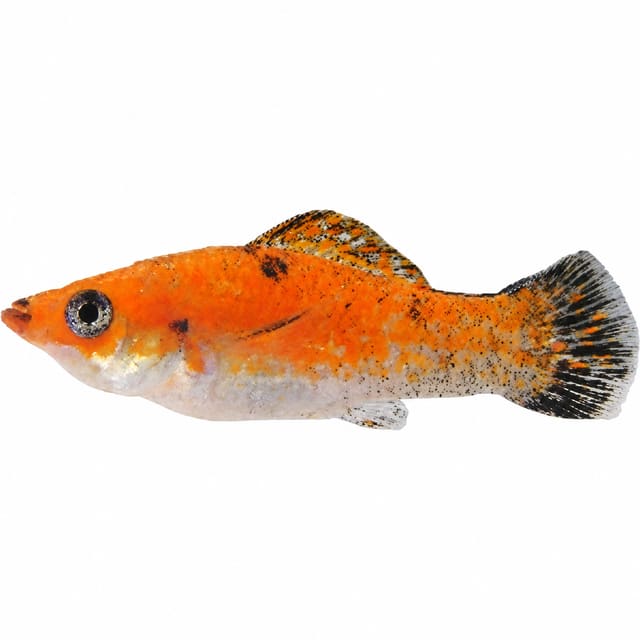
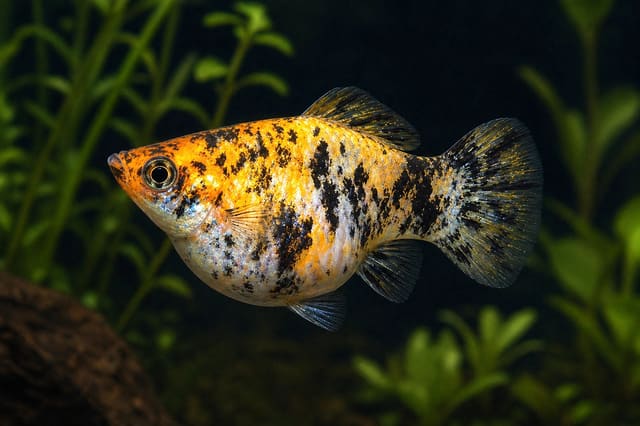
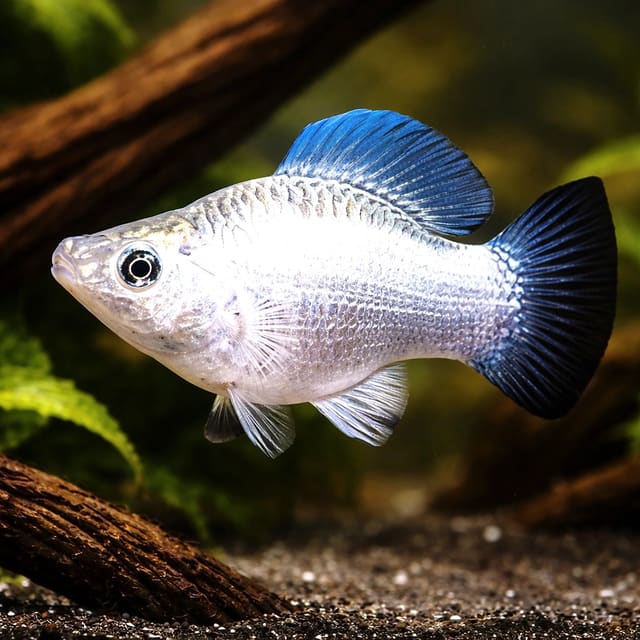
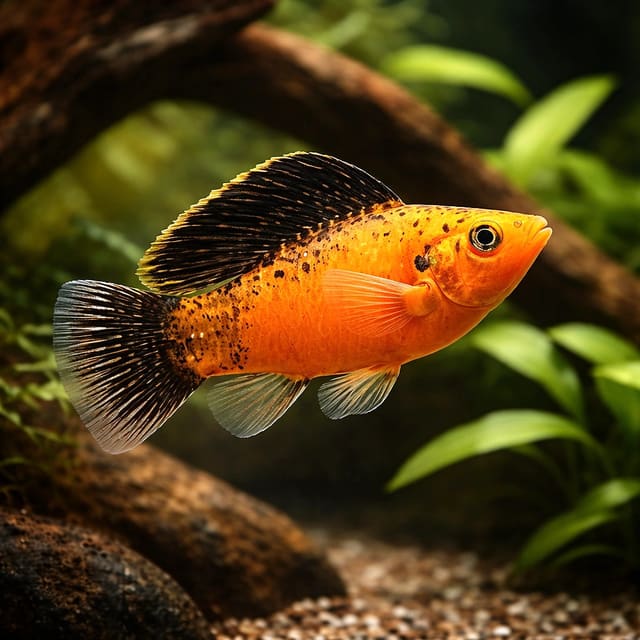
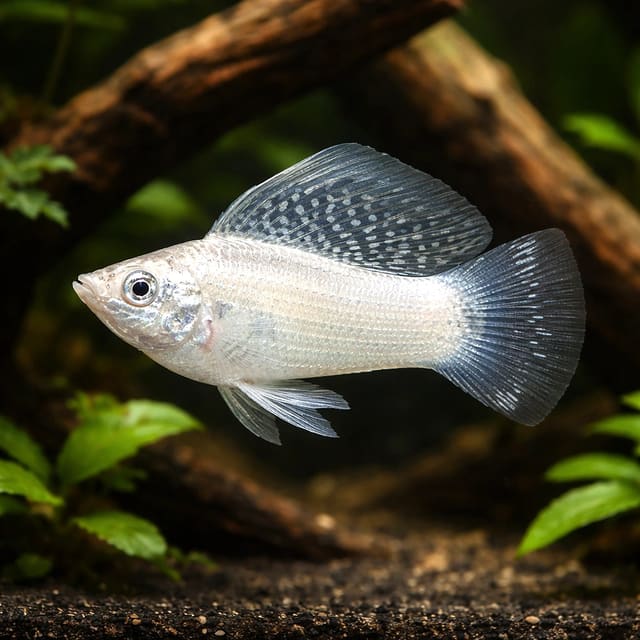
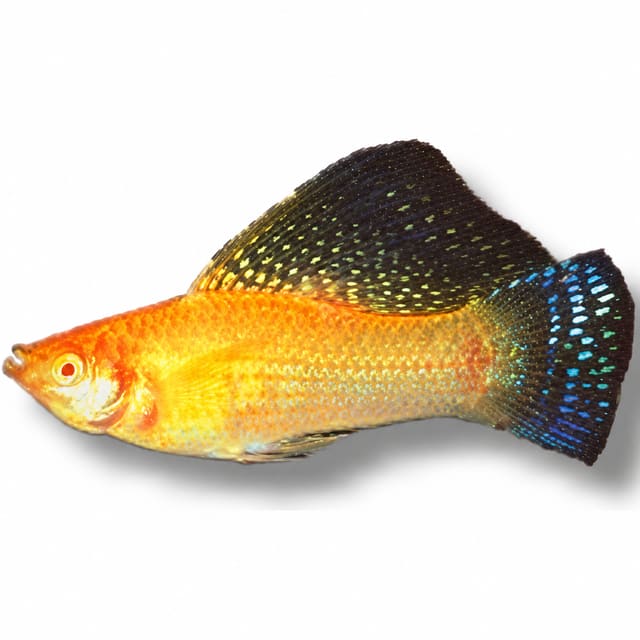
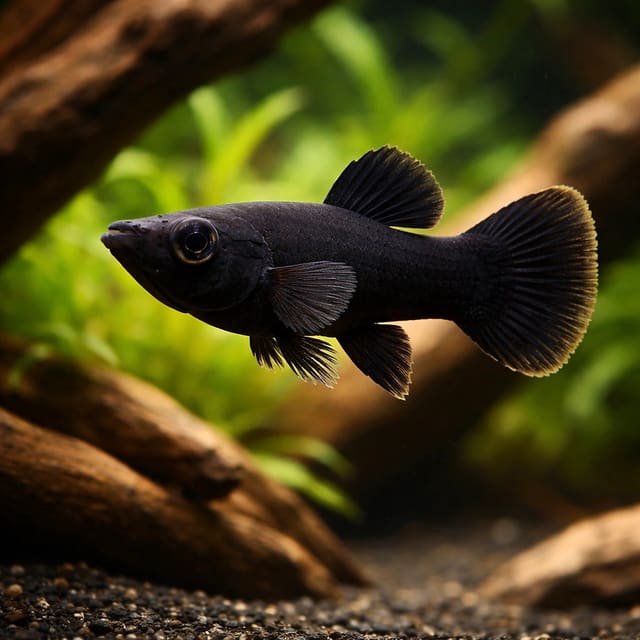
The gallery image shows one silver-and-black speckled fish with a long forked lyre-shaped tail, orange-yellow detail across the dorsal area and face, and a planted aquarium background with wood and gravel. Gallery images have been digitally enhanced to improve image quality. Natural colour, pattern, size and maturity can vary between live animals. The image is useful for seeing the overall tail form and mixed finish, while colour and fine markings can vary.
| Accepted species | Poecilia sphenops |
|---|---|
| Sold unit | One live fish, supplier grade approximately 4 cm |
| Adult-length records | 7.5 cm SL male/unsexed record; 8 cm SL aquarium planning figure |
| Routine aquarium temperature | 21–28 °C |
| Routine aquarium pH | 7.0–8.5 |
| Routine hardness | 15–30 dGH |
| Planning footprint | 90 × 30 cm; profile example approximately 81 litres |
| Diet | Omnivorous, with a substantial vegetable or algae-based component |
| Social planning | Keep with companions; broad OATA guidance suggests at least three and more females than males |
The water, footprint and 8 cm SL figures above are species-level aquarium guidance from Seriously Fish. The 7.5 cm SL record is from FishBase. The social number comes from OATA’s broader guppy-and-molly sheet, so it is group guidance rather than a species-specific optimum.
Do not add this molly to a newly filled tank. Fish continually release waste, and the biological filter needs an established population of beneficial bacteria to convert toxic ammonia first to nitrite and then to the safer nitrate. The filter must be running, the cycle must be proven with tests, and both ammonia and nitrite should be zero before livestock is introduced. If this is your first setup, the first tropical tank guide explains the preparation sequence.
The 90 × 30 cm base and roughly 81-litre example are good starting references for this species. Use them as planning dimensions, not permission to fill every available space with fish. Stocking capacity depends on the complete community, filtration, adult body size, feeding and maintenance. A longer tank gives active livebearers more uninterrupted swimming room and more ways to avoid persistent attention.
Plants are valuable because they break up sight lines, provide shelter and create calmer edges around open water. Keep a clear swimming lane through the middle and front rather than filling every centimetre with hardscape. Choose smooth décor and avoid sharp plastic edges that could catch the extended tail. A secure lid is sensible around active fish, and all equipment should be protected so fins cannot be pulled against an exposed intake.
For routine aquarium keeping, aim for 21–28 °C, pH 7.0–8.5 and 15–30 dGH. Those values come from the species profile, which also warns that P. sphenops does poorly in soft, acidic water. The issue is not a need for routine aquarium salt: the important part is the dissolved hard-water minerals, particularly calcium and magnesium. Salt should not be treated as a substitute for suitable general hardness.
FishBase records a broader environmental range of 18–28 °C, pH 7.5–8.2 and 11–30 dH from species records. That wild range helps describe where the species has been found, but it is not the same as a recommended home-aquarium target. Use the narrower husbandry plan consistently rather than chasing the endpoints of every published record.
Test the actual aquarium, not only the water company’s annual average. pH says how acidic or alkaline the water is; general hardness reflects mineral content; carbonate hardness helps indicate buffering. The aquarium water parameters guide explains what these readings mean. You can then use the water parameter matcher to compare your measured values with the stated range.
Avoid rapid correction. A stable value near one end of the care range is usually easier on fish than repeated large chemical swings. If your tap water is naturally very soft, decide whether you can remineralise it accurately and consistently before buying. Any mineral product should be measured, dissolved and checked; adding an uncertain amount at each water change creates avoidable instability.
Choose a filter that provides reliable biological capacity and steady circulation without turning the aquarium into a torrent. The species profile’s worked example for an approximately 81-litre aquarium uses a turnover around four to five times the tank volume per hour, or about 325–405 litres per hour. Treat this as a sizing illustration: media volume, real flow after media is fitted, stocking and maintenance all affect performance.
Keep the surface moving so gas exchange remains effective, particularly toward the warm end of the temperature range where water holds less oxygen. Check that all fish can feed and rest without fighting a powerful outlet. Plants, wood and the tank walls can be used to create both moving and quieter zones. Clean blocked pre-filters and intakes promptly, but never sterilise all biological media at once.
Wild P. sphenops records include worms, crustaceans, insects and plant matter. In aquaria, the species accepts dried food and grazes green algae. A practical routine is therefore a good-quality staple flake or small granule, backed by an algae- or vegetable-based food. Blanched spinach is one example named by the species profile; offer only a small clean portion and remove what is left before it decays.
Small live or frozen foods can add variety. OATA names daphnia, small bloodworm and tubifex for guppies and mollies as a group. Select pieces that this fish can swallow easily. Feed modest amounts and watch every fish take food. The useful measure is not a fixed pinch but whether the portion disappears within a few minutes without leaving fragments to rot.
Overfeeding is one of the quickest ways to undermine otherwise suitable water. Uneaten food and excess waste increase the load on the filter, while rich feeding can distort body condition. If food remains, reduce the next portion and siphon debris rather than adding another cleanup animal as a remedy.
OATA’s group sheet strongly recommends a weekly partial water change of around 25%, with weekly testing for ammonia and nitrite. That is a sound starting routine, but use your test results and stocking level to decide whether the aquarium needs more frequent attention. Treat replacement tap water for chlorine or chloramine before it contacts fish or biological media, and match its temperature closely enough to avoid a sudden shock.
If the filter needs cleaning, do not run it under the tap; rinse it lightly in the aquarium water removed during a water change. Replace only media that genuinely expires, and avoid replacing all mature media at once because that can remove much of the aquarium’s nitrifying capacity.
Record results rather than relying on memory. A short log of temperature, pH, hardness, ammonia, nitrite, nitrate, water-change volume and any unusual behaviour makes trends visible. If fish begin shimmying, clamping fins or losing condition, test water first. Those signs are not a diagnosis, but the species profile specifically associates soft or acidic conditions with weakened mollies.
Be present to receive live fish. Keep the parcel closed until you can follow the arrival steps without interruption, then inspect the fish while the bag remains sealed. Float the sealed bag for 20–30 minutes as stated in the store policy, and avoid pouring transport water into the aquarium. Give the fish quiet time to settle after transfer.
For a Live Arrival Guarantee claim, the evidence is a continuous unboxing video that starts with the parcel still sealed, shows the outer box and opening, and shows the fish still inside the sealed bag. Contact the store on the day of arrival with the order number. Those steps are claim evidence, not a biological care ritual. Read the current delivery and Live Arrival Guarantee policy before the delivery day.
The species profile describes Poecilia sphenops as peaceful, but immediately qualifies that description: companions must tolerate the same water conditions. This is the first compatibility filter. A fish that needs soft, acidic water is a poor match even if neither species is aggressive. Forcing a compromise in the middle can leave both animals outside their proper range.
Types named as possible companions include other Poecilia, some rainbowfish, and hard-water-tolerant barbs and tetras. Those are starting categories, not a guaranteed list. Check the exact species for adult size, temperature overlap, swimming pace, fin-nipping risk, feeding competition and group needs. The extended Lyra tail deserves particular care around confirmed fin nippers and sharp décor, even though not every barb or tetra has the same temperament.
OATA’s broad guppy-and-molly guidance suggests keeping at least three, with two females for each male, to reduce pressure on females. The species profile similarly recommends several females to each male because males can pursue them persistently. Because sex cannot be chosen here, do not assume a purchase quantity will produce the desired ratio. If the ratio matters, plan how you will identify and manage the group as the fish mature.
Dense planting and broken sight lines give fish a way to leave a pursuer’s view. They do not make an imbalanced group harmless, but they reduce continuous exposure. Observe the entire group at feeding time and during quieter periods. Repeated chasing, a fish hiding constantly, clamped fins, missed meals or weight loss all deserve investigation.
Mollies are livebearers. Mixed-sex groups may produce fry, and adult fish may eat some young. Dense plants provide cover, but these fish are not supplied as a sexed breeding group. Decide before purchase whether you can house increasing numbers or separate sexes later. Do not release surplus fish into the wild or move them to another keeper without confirming suitable care.
The species profile notes that P. sphenops and P. latipinna can interbreed, and recommends keeping only one if hybridisation is to be avoided. That is a lineage-management point rather than an aggression warning. Other Poecilia may share water preferences, yet the possibility of crosses still needs consideration.
Add new fish gradually so the biological filter can adjust to the extra waste. Watch interactions closely through the first week, but continue observing after the initial novelty has passed. Problems can emerge later as fish mature, establish territories or compete more strongly for food.
A useful care routine begins with knowing what normal looks like in your own aquarium. Watch where the mollies spend time, how they approach food, whether each fish can feed without being driven away, how the fins are held and how quickly the gill covers move. Look from the front as well as the side; a fish that appears normal in profile may be losing body condition when viewed head-on.
OATA advises keepers to notice changes in swimming, colour, breathing, hiding, body weight, fin or scale condition and appetite. None of those signs identifies one cause by itself. The practical first step is to test temperature, ammonia, nitrite, nitrate and the relevant mineral-water values, compare them with recent records and correct any confirmed husbandry problem steadily. Avoid adding a treatment merely because a single symptom resembles a photograph online.
Carry out partial water changes on a regular schedule and adjust the frequency to the measured nitrate trend and the demands of the complete aquarium. Prepare replacement water before it enters the tank: treat chlorine or chloramine, bring the temperature reasonably close and confirm that any remineralisation produces the intended hardness. Large, repeated changes in mineral content can be stressful even when both the starting and finishing numbers appear somewhere in a published range.
If the filter needs cleaning, do not run it under the tap; rinse it lightly in aquarium water removed during a water change. This protects the established bacteria that process ammonia and nitrite. Clean an obstructed intake promptly, but avoid replacing all mature media at the same time. A filter is a living treatment system as well as a pump, so a strong outlet alone does not prove that the biological capacity is healthy.
Check temperature with a separate thermometer rather than relying only on a heater dial. Position the heater where circulation distributes warmth and inspect it after water changes. Surface movement is especially valuable toward the warm end of the care range because warmer water carries less dissolved oxygen. The aim is steady warmth and effective gas exchange, not the strongest possible current.
An established filter has adapted to the waste it normally receives. Adding many fish at once can increase that load faster than the bacterial population can respond. Add livestock in planned stages, test ammonia and nitrite after a meaningful change and be prepared to make safe partial water changes. The same caution applies when feeding rises because a growing group or newly born fry increases demand.
Sex is guaranteed only when the selected option explicitly states male or female. This Molly Lyra Mixed listing has no sex-guaranteed option. That matters when planning a female-to-male ratio: the broad guidance remains useful, but the present offer cannot promise the outcome. Provide enough room and cover to manage the group you actually receive, and have a plan for separating fish if persistent chasing develops.
Review the layout as the fish mature. Plants may need trimming to preserve an open swimming lane, while new growth can create valuable sheltered edges. Check décor for rough points, keep equipment secure and make sure no intake can trap an extended fin. Stability is produced by many small, repeatable actions: measured water, modest feeding, regular observation, gentle filter care and stocking decisions made before the aquarium becomes crowded.
Keep a simple notebook beside the test kit. Writing down the date, water values, amount changed, filter work and anything unusual makes gradual drift easier to spot. It also helps another household member follow the same routine, so the fish do not receive double feeds or conflicting adjustments when the usual keeper is away.
FishBase records 7.5 cm standard length for a male/unsexed Poecilia sphenops, while the aquarium profile uses 8 cm standard length. Standard length excludes the tail, so a Lyra-form fish can look longer once its extended caudal fin is included. Treat these as scoped planning records, not one guaranteed total-length maximum.
The species profile uses a 90 × 30 cm base and an example volume of about 81 litres. That footprint is more informative than litres alone because it provides swimming length and room to avoid persistent attention. Increase space for a larger group or community, and keep the aquarium mature and effectively filtered.
OATA’s broader guidance for guppies and mollies suggests at least three, with two females for each male, and the species profile also advises several females per male. Sex cannot be chosen here, so do not assume a purchase quantity will create that ratio; plan to monitor and manage the group.
It can suit a careful beginner whose water is naturally hard and neutral to alkaline, or who can prepare and test suitable water consistently. It is a poor choice for an untested soft, acidic aquarium. Learn the nitrogen cycle, mature the filter and confirm the water before buying rather than trying to correct it around the fish.
Use a quality dried staple and make a meaningful part of the diet vegetable- or algae-based. The species profile names blanched spinach or vegetable flake, and OATA’s group sheet adds suitable small live or frozen foods such as daphnia and small bloodworm. Feed only what is eaten within a few minutes.
For routine aquarium care, use 21–28 °C and pH 7.0–8.5, with hard water around 15–30 dGH. Those are species-level husbandry values from Seriously Fish. FishBase’s environmental record is broader and describes recorded habitats, so it should not be used to push an aquarium repeatedly between extremes.
The species profile describes Poecilia sphenops as peaceful, but males can pursue females persistently. Use a sensible sex ratio when known, plants and broken sight lines, and watch for repeated chasing. This molly is described as peaceful, but companions that nip its extended tail are unsuitable.
The species profile names other Poecilia, some rainbowfish, and hard-water-tolerant barbs and tetras. Each exact species still needs a separate check for adult size, temperament, fin-nipping, feeding and water overlap. Avoid fish requiring soft, acidic water, and consider hybridisation before mixing related molly species.
Tropical Fish Co hand-packs livestock in oxygenated bags inside an insulated box, adding a heat pack when conditions call for one, and uses a tracked licensed live-animal courier. Someone must be present to receive the parcel. A same-day claim needs the order number and a continuous unboxing video beginning with the sealed parcel and showing the fish still sealed in the bag.
Water values from a wild distribution record and values intended for routine aquarium husbandry answer different questions. This guide labels those scopes instead of blending them into one uncare range.
No reviews for this item yet. Bought one? Honest reviews only, good or bad.
What customers say about ordering from us
Easy website plenty of info on fish your buying great to pick a time slot
TRACEY DURRANT · 7 Oct 2026
Got some lovely fish thank you
Kevin Mackie · 7 Oct 2026
Reviews of our shop, collected by Judge.me, an independent third-party review collector. Newest first.