Easy
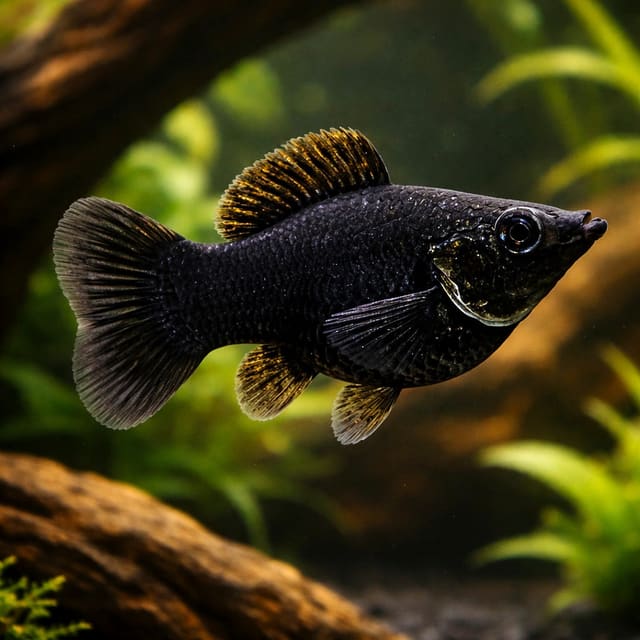
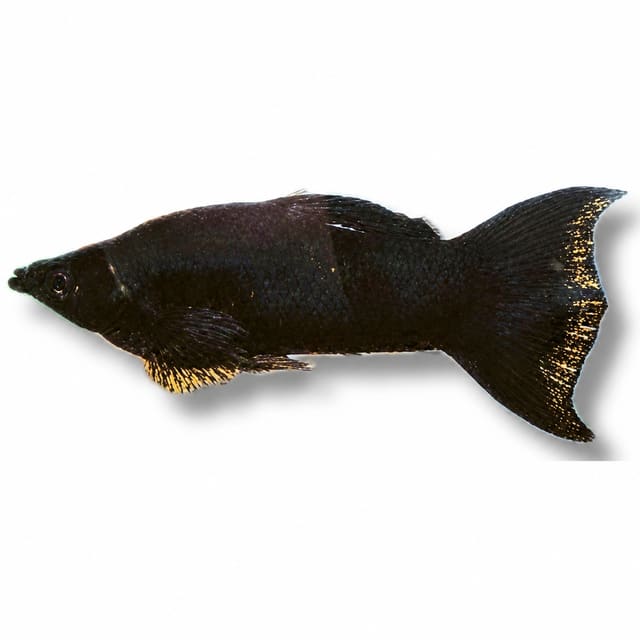
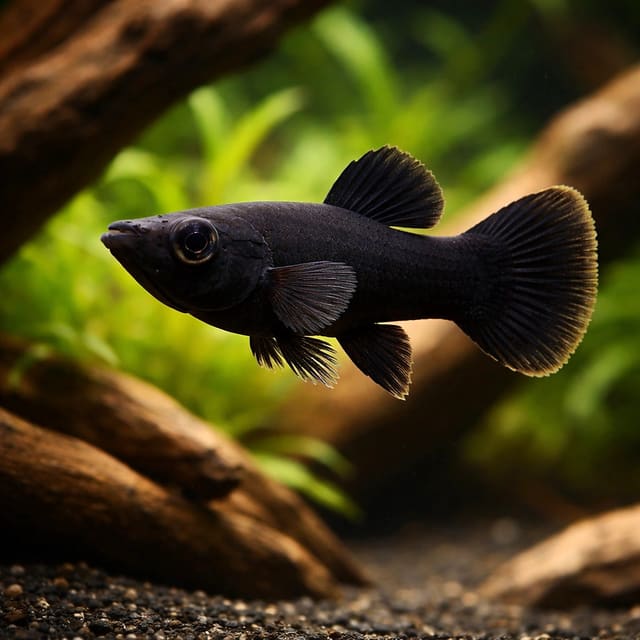
Black Molly (Poecilia sphenops black molly)
21–28°C · pH 7–8.5 · 81L
£3.29
Poecilia latipinna ballon molly silver (Poecilia latipinna) is a poeciliid livebearer native from the Cape Fear drainage in North Carolina to Veracruz, Mexico, and reaches 15 cm. It suits a hard, basic-water aquarium of around 87 litres or more; OATA suggests at least three mollies, while the Seriously Fish and OATA overlap is 21–26°C, pH 7.0–8.0 and 15–18 dGH. Sold individually at a dispatch size of 2.5–3 cm.
Adult size is the maximum length this species reaches at full maturity (scientific sources). The livestock you receive will be younger and smaller. Product-photo provenance and any image-specific limitations are stated on the listing.
Poecilia latipinna
Shoaling fish: kept in a group they feel safer, stay calmer and show their best colour.
Poecilia latipinna ballon molly silver (Poecilia latipinna) is a poeciliid livebearer native from the Cape Fear drainage in North Carolina to Veracruz, Mexico, and reaches 15 cm. It suits a hard, basic-water aquarium of around 87 litres or more; OATA suggests at least three mollies, while the Seriously Fish and OATA overlap is 21–26°C, pH 7.0–8.0 and 15–18 dGH. Sold individually at a dispatch size of 2.5–3 cm.
Adult size is the maximum length this species reaches at full maturity (scientific sources). The livestock you receive will be younger and smaller. Product-photo provenance and any image-specific limitations are stated on the listing.
Maintain these water conditions for optimal health and vibrant colors
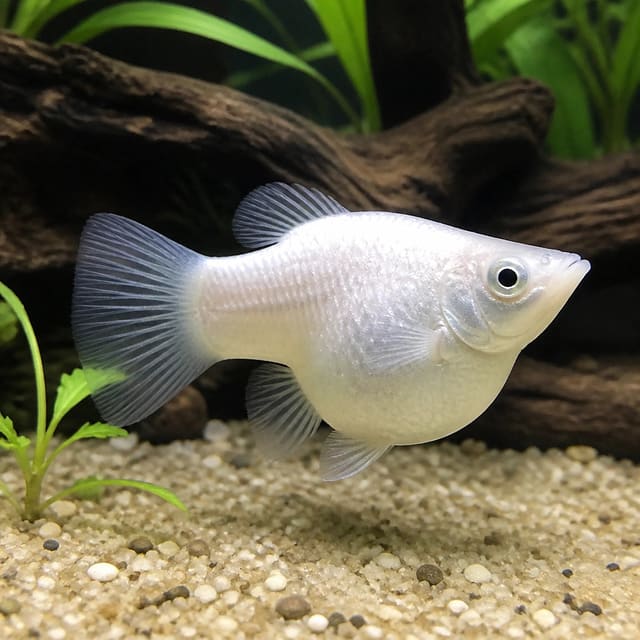
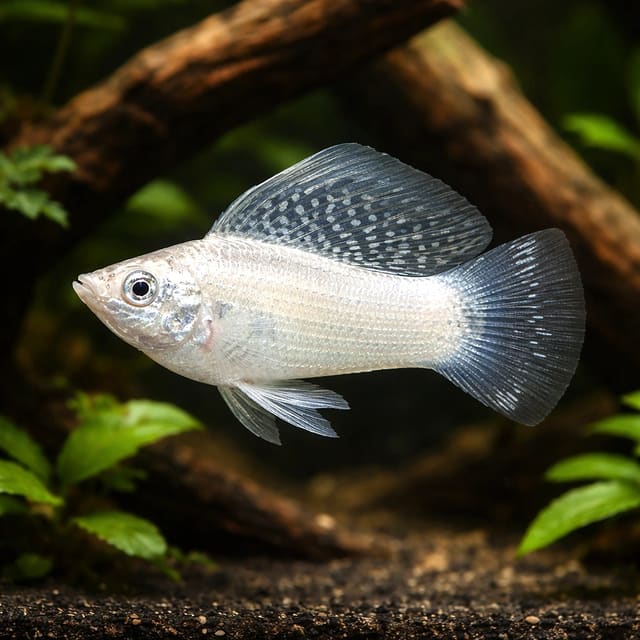
The silver balloon molly (Poecilia latipinna) is a poeciliid livebearer whose species is native from the Cape Fear drainage in North Carolina, USA, to Veracruz, Mexico. FishBase records a maximum adult size of 15 cm total length. This rounded silver form suits a keeper who can provide hard, basic water, a filtered aquarium planned for its adult size and companions that will not be intimidated as the fish matures.
Wild sailfin mollies inhabit still or gently flowing warm water, including creeks, drains, ponds, lakes, sloughs, vegetated backwaters, tidal ditches and brackish canals. That varied natural setting does not make aquarium water chemistry optional: the practical aquarium target is hard, basic freshwater with stable temperature and low waste. A planted layout with open swimming room reflects the combination of cover and open water recommended for aquarium care.
| Suits | Not suited to |
|---|---|
| Hard, basic freshwater | Soft or acidic water |
| Around 87 litres with a 76 × 38 cm base | Aquariums planned only around dispatch size |
| A small molly group planned around sex ratio | A setup unable to accommodate companionship |
| A hard-water community screened by adult size and temperament | Timid fish or unchecked smaller companions |
| Dense planting plus open swimming space | An unfiltered or unstable aquarium |
Choose this fish for the water and space you can maintain throughout its life, not simply for its compact rounded outline. The decisive questions are whether your aquarium can hold 21–26°C, pH 7.0–8.0 and 15–18 dGH, whether its footprint gives an adult room to swim, and whether every companion shares those conditions.
Plan for a 15 cm adult from the beginning. FishBase gives that maximum total length, while Seriously Fish gives 12.5 cm standard length. Use the larger 15 cm figure for aquarium and community planning so the mature fish, its group and the biological filter are not constrained by a layout chosen for a smaller animal.
The species aquarium dimensions are a 76 × 38 cm base with a volume of around 87 litres. Treat the footprint and volume as a combined decision: litres help with environmental stability, while the base creates swimming room and space for plants, shelter and companions. A taller aquarium with a narrow base may hold a similar number of litres without providing the same usable layout.
| Decision | Planning figure |
|---|---|
| Adult length | 15 cm |
| Aquarium base | 76 × 38 cm |
| Aquarium volume | Around 87 litres |
| Routine water | 21–26°C, pH 7.0–8.0, 15–18 dGH |
| Social plan | OATA suggests at least three mollies |
Choose a larger aquarium when adding more mollies or other fish. More animals create more waste and consume more swimming space, so a volume suitable for the basic species plan is not an unlimited stocking allowance. Map the adult footprint of the complete community before adding the first animal.
The rounded balloon body is more than a colour feature. Seriously Fish warns that this body form may experience swim-bladder and digestive problems and may die prematurely. That makes stable water, measured feeding and daily observation especially important. It also means buoyancy, posture, appetite and body condition deserve attention rather than being dismissed as normal consequences of the rounded shape.
Sold individually, with each purchase supplying one live fish. The dispatch size is 2.5–3 cm; this is the size prepared for dispatch, not the 15 cm adult planning size. Build the aquarium around the mature fish before it arrives rather than intending to move it only after it outgrows a smaller setup.
Sex is guaranteed only when the selected option explicitly states male or female. This Poecilia latipinna ballon molly silver listing has no sex-guaranteed option. Plan any eventual group ratio after considering the sexes of every molly in the aquarium, because males may pursue females and may be aggressive towards one another.
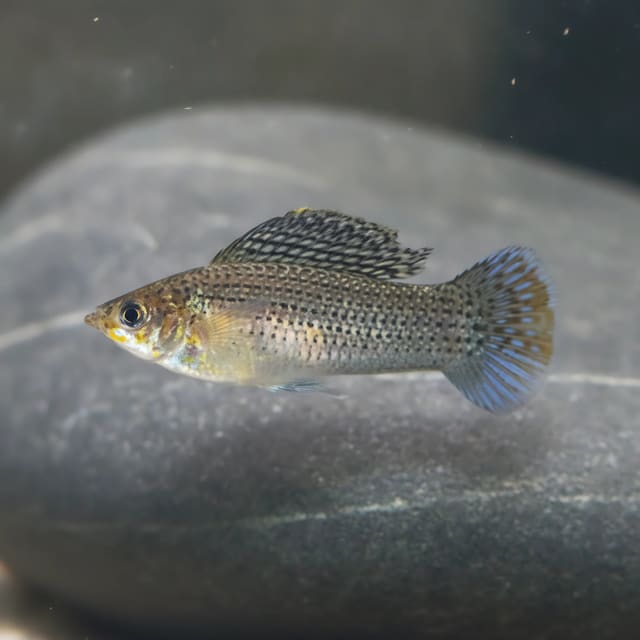
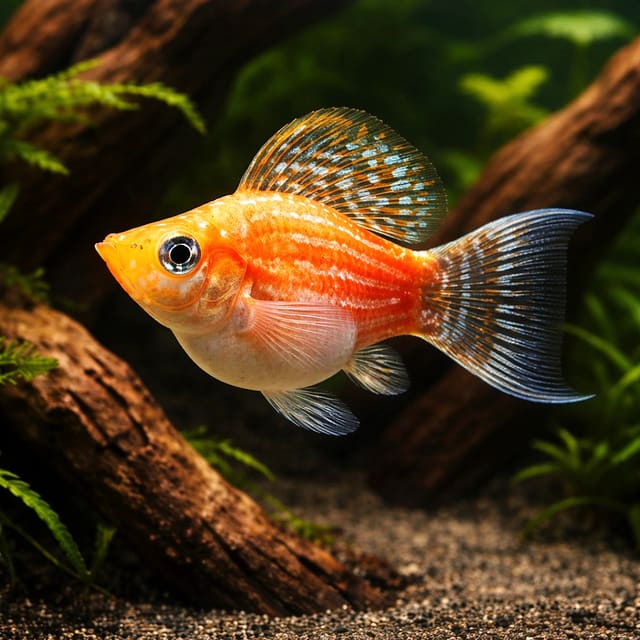
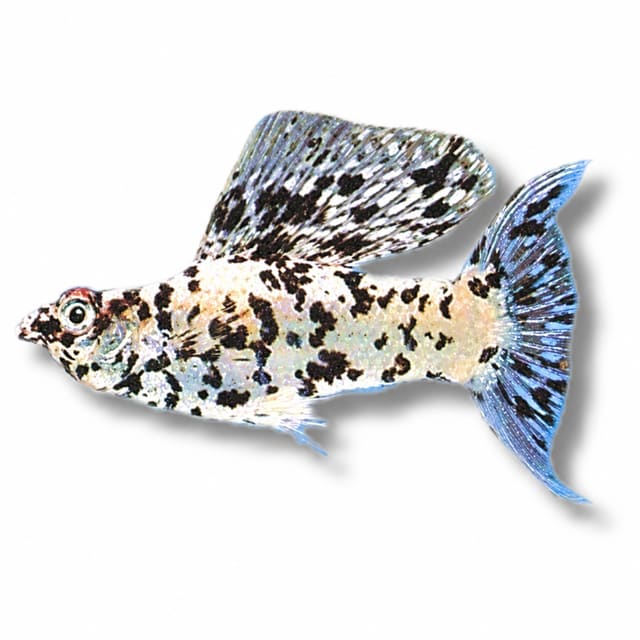
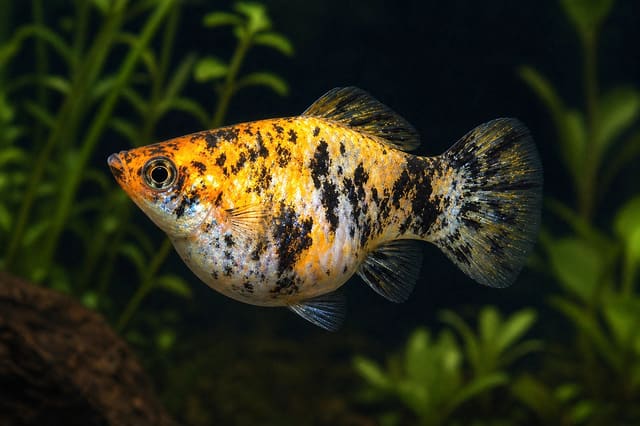
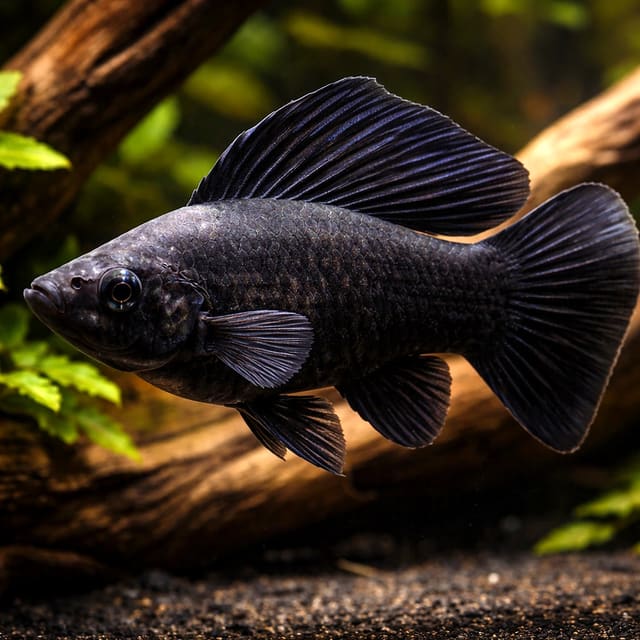
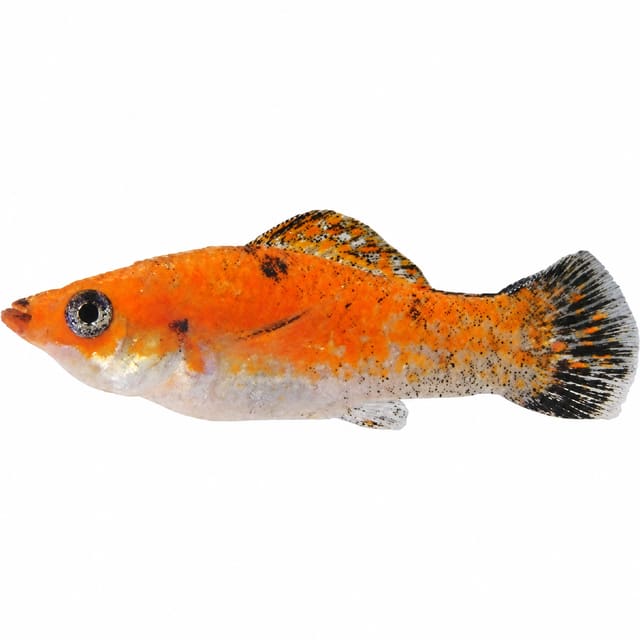
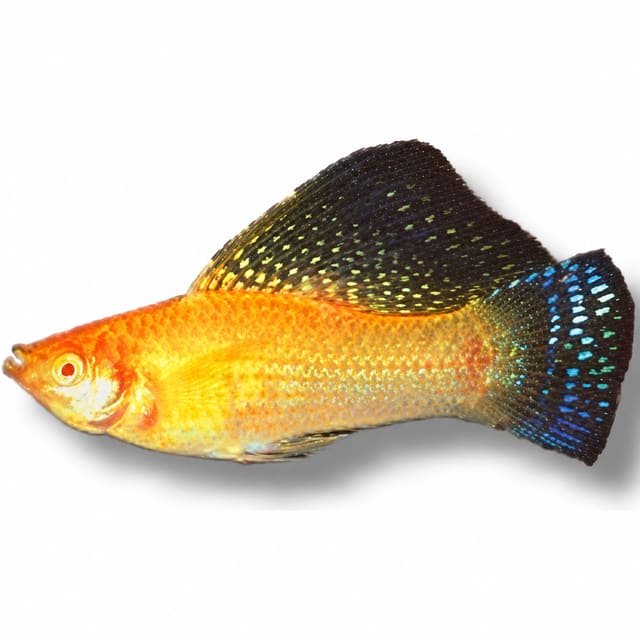
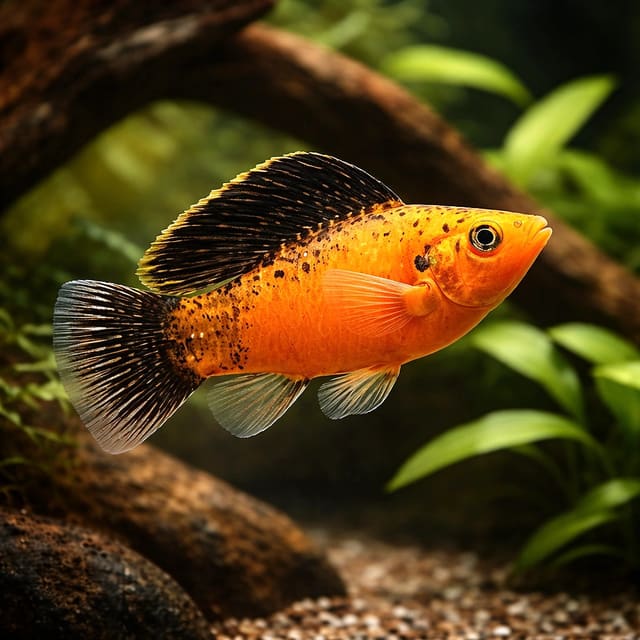
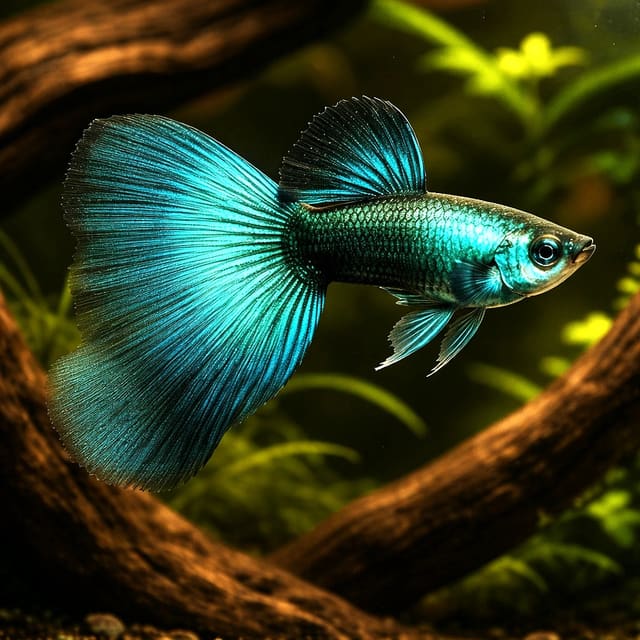
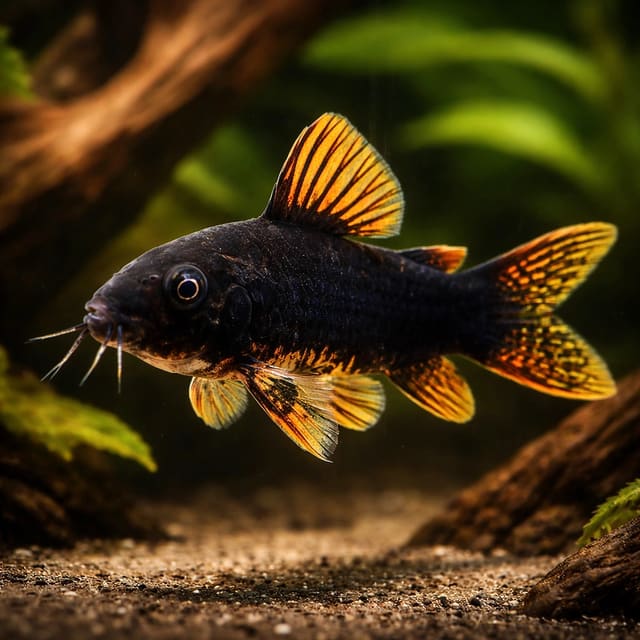
Some gallery images have been digitally enhanced to improve image quality. They show the listed type of animal rather than guaranteeing the exact markings of the individual supplied, so natural colour and pattern can vary. The illustrations show the intended rounded silver form and dark fins, but use the written identity and care requirements when deciding whether the fish suits your aquarium.
This animal belongs with mollies rather than being treated as a general-purpose community fish. You can browse the current molly fish collection when comparing related forms, but do not combine different molly species.
Use a densely planted aquarium while preserving open space for swimming. Place taller planting and shelter towards the back and sides, then leave a clear central or front area. This gives the fish cover without filling the entire 76 × 38 cm base with décor.
Gravel or sand can be used on the bottom. Plants, suitable ornaments, plant pots or model caves can create shelter, but the layout must still accommodate the adult fish and its companions. Check every ornament and artificial plant for edges that could damage extended fins. A secure layout is preferable to one that shifts when maintenance equipment or a siphon is used.
This species eats substantial plant material and may damage soft-leaved plants. Use robust planting where practical and expect tender growth to be grazed. Allowing some common green algae to remain provides an additional food source; the aim is controlled natural growth, not letting waste or poor maintenance accumulate.
Plant cover does not replace swimming space. If the fish must weave through dense stems everywhere it moves, thin or reposition the planting. If the aquarium looks bare and every fish remains exposed, add cover around the edges while keeping the open zone intact.
Use a mature biological filter and stabilise temperature and water chemistry before adding livestock. Our first tropical aquarium guide explains how to prepare and mature the setup. Increase the population slowly so the beneficial bacteria can respond to additional waste and feeding.
Salt is not necessary for routine care. Although wild sailfin mollies occur in freshwater, brackish and coastal environments, the aquarium can be freshwater provided it remains hard and basic. Calcium and magnesium hardness, rather than routine salt addition, is central to long-term care.
Keep the aquarium at 21–26°C, pH 7.0–8.0 and 15–18 dGH. These routine values are the overlap of Seriously Fish species guidance—21–26°C, pH 7.0–8.5 and 15–35 dGH—and OATA's broad guppy-and-molly guidance—20–28°C, pH 7.0–8.0 and 8–18 dGH. OATA also gives 5–15 dKH for the group.
Hardness and pH are practical selection criteria, not figures to consider after purchase. Seriously Fish warns that soft or acidic water can weaken this species rapidly, with shimmying, fungal growth or clamped fins among the possible signs. Test the source water and aquarium rather than judging hardness from clarity or appearance.
| Reading | Action |
|---|---|
| Below 21°C | Correct the temperature before introduction |
| Above 26°C | Return it gradually to the routine range |
| Below pH 7.0 | Do not add the fish to acidic water |
| Below 15 dGH | Resolve the hardness mismatch first |
| Within all ranges | Confirm stability before stocking |
Learn what each measurement represents with our aquarium water chemistry guide. Record actual test results, including the units used by the kit, then use the water matcher to compare them with this care range.
A single reading inside the range is only a starting point. Test again after maintenance, changes to stocking or any altered swimming, breathing or feeding behaviour. Aim for consistency within the range instead of moving the water repeatedly towards a precise midpoint.
Run a mature filter continuously and size it for the complete adult community. The RSPCA explains that biological filtration supports bacteria that convert toxic ammonia to nitrite and then to safer nitrate. An aquarium without a well-established and maintained filter is not suitable for this fish.
For an aquarium of around 87 litres, Seriously Fish gives a turnover of four to five times the aquarium volume each hour. That corresponds to a filter rating of about 350–435 litres per hour. Use this as a practical equipment range while accounting for the filter's real flow once media, pipework and normal use affect output.
Beneficial bacteria need time to increase whenever fish numbers and feeding rise. Add animals gradually and verify ammonia and nitrite after each stocking change. If either becomes detectable, treat that result as a sign that waste processing is not keeping pace and pause further additions while water quality is corrected.
Place the outlet so water moves around planting and décor rather than leaving stagnant pockets. At the same time, preserve areas where the fish can swim without constantly fighting the strongest current. The species occurs naturally in still or gently flowing water, so effective filtration does not require turning the entire aquarium into a high-flow channel.
At least once every week, change 25% of the aquarium water, using a siphon to remove solid waste from the substrate where needed. Treat replacement tap water with conditioner before it enters the aquarium so chlorine or chloramine does not damage fish or filter bacteria.
Test ammonia and nitrite at least once per week and keep both at zero. Include nitrate, pH, hardness and temperature in the routine so the hard, basic conditions remain stable. Write the results down; a sequence of readings makes gradual change easier to spot than relying on memory.
Do not combine every disruptive job by default. Excessive cleaning of media, substrate and décor at the same time can remove or disturb more of the established biological community than intended. The objective is to remove accumulated waste while preserving the bacteria that process ammonia and nitrite.
If ammonia or nitrite rises above zero, check recent additions, feeding, blockages and filter operation before increasing the fish population. If pH or hardness falls outside the routine range, resolve the source-water or aquarium mismatch before introducing another animal. When temperature changes unexpectedly, check both the heater and the reading with care rather than adjusting repeatedly from a single uncertain result.
A larger aquarium generally gives more environmental stability, but volume does not replace maintenance. Keep the weekly change, testing and filter checks in the calendar even when the water looks clear.
Use a good-quality dried food with a high algae content as the main aquarium diet. FishBase records wild Poecilia latipinna feeding mainly on algae while also consuming rotifers, small crustaceans and aquatic insects. Seriously Fish similarly recommends a quality dried product, an algae-based food and regular vegetable matter.
Feed only what the fish can finish within a few minutes, once a day. Watch each animal eat rather than relying on a fixed pinch, because body size, group size and the food's density change how much is appropriate. Stop adding food when active feeding slows and remove persistent excess before it breaks down into waste.
Vegetable matter is an essential part of the feeding plan. Seriously Fish notes that insufficient green food may impair development of the male dorsal fin. A varied diet still needs an algae-rich foundation rather than being assembled only from animal-based treats.
Overfeeding affects more than body condition. Uneaten food decomposes and contributes to toxic waste, increasing pressure on the biological filter. If food remains after a few minutes, reduce the next portion and check ammonia and nitrite rather than continuing the same amount.
Note whether the fish approaches food, maintains position while eating and swallows normally. A sudden reduction in intake, repeated inability to reach food or a change in body condition calls for a water test and closer observation. The rounded balloon form may experience digestive or buoyancy problems, so a feeding change should be assessed alongside posture, swimming and waste control.
Prepare the mature aquarium before the parcel arrives. Confirm 21–26°C, pH 7.0–8.0, 15–18 dGH, zero ammonia and zero nitrite, and make sure the filter is running normally.
Tropical Fish Co packs live fish in pure oxygen inside an insulated poly box, with a heat pack when the weather calls for it. Be present to receive the parcel because live fish cannot be left unattended. Read the current delivery and Live Arrival Guarantee policy before the delivery day.
Film every delivery from the sealed parcel onward. The continuous sequence establishes the parcel's condition before opening and the fish's condition while it remains in the sealed bag. Keep the video and order number together until the fish has been inspected.
If there is a Live Arrival Guarantee concern, contact us the same day with the order number and continuous unboxing video. The video should show the sealed parcel, the opening and the fish inside the sealed bag. Follow the current policy for the claim process rather than releasing the fish before its condition has been documented.
Check swimming, breathing, colour, fins, scales, appetite and body condition every day. Learn the fish's normal posture and activity after settling so a genuine change stands out. A brief daily check is most useful when paired with recorded water results rather than assumptions based on appearance alone.
| What you see | What to do first |
|---|---|
| Hanging at the surface or sitting on the bottom | Test temperature, ammonia and nitrite |
| Erratic swimming or altered buoyancy | Check all water values and observe posture |
| Faster or slower gill movement | Test water immediately and inspect filter flow |
| Darker or paler colour | Compare behaviour, water and social interactions |
| Clamped or damaged fins | Check chemistry, décor and tank-mate behaviour |
| White spots, fluffy growths, ulcers or bumps | Test water and seek prompt health guidance |
| Reduced appetite or changing body condition | Review food intake and water quality |
Soft or acidic water is a particular concern for this species. Shimmying, fungal growth and clamped fins can accompany weakening in unsuitable chemistry. If any of these appear, measure pH and general hardness alongside ammonia, nitrite and temperature instead of addressing only the visible symptom.
The balloon body may be associated with swim-bladder and digestive problems. Do not assume persistent floating, sinking, loss of balance or feeding difficulty is simply how a rounded molly behaves. Record what changed, isolate the relevant water readings and contact us for health guidance if the problem continues.
Social stress can also alter hiding, aggression and feeding. Watch which fish initiates chasing, which fish loses access to food and whether the behaviour is continuous or limited to brief interactions. Use those observations in the compatibility decision rather than moving or adding animals without a clear plan.
OATA suggests keeping at least three guppies or mollies together, using two females for each male to reduce stress on females and other inhabitants. More can be kept when the same ratio and the aquarium's adult capacity are maintained. This is a suggested group plan, not permission to exceed the space or filtration available.
Plan the whole group before making additions. A basic worked example is one male with two females; a larger group can extend that ratio while the aquarium is enlarged for the extra adult fish. Do not treat three as a maximum, and do not treat the ratio as a substitute for checking water, floor space, filtration and temperament.
Males may be aggressive towards one another, especially around spawning, and can be vigorous in pursuing females. Watch for one fish being chased repeatedly, excluded from feeding or kept in a small part of the aquarium. The suggested female-biased ratio is intended to spread male attention rather than leaving one female to receive it continuously.
Mollies are livebearers and mixed-sex groups may produce young. Include that possibility in the stocking plan before the aquarium reaches its intended adult population. Extra fish increase waste and space requirements, so the filter and aquarium should not be planned only around the starting headcount.
keep only one molly species in the aquarium. Poecilia latipinna may interbreed with other molly species, and Seriously Fish specifically notes crossing with Poecilia sphenops. Colour differences do not create a reproductive barrier.
Check whether all fish can reach food, use open water and retreat into cover. Repeated chasing, hiding, fin damage or loss of condition means the social plan needs reassessment. Add fish gradually so the biological filter can respond to the increased waste at the same time as you evaluate group behaviour.
Use this silver balloon molly in a hard-water community only after checking adult size, temperament, water requirements and feeding behaviour for every species. Seriously Fish suggests other livebearers and some catfish, but those categories are starting points rather than universal approvals. Each candidate still needs to tolerate 21–26°C, pH 7.0–8.0 and 15–18 dGH.
Other livebearers and some catfish can be considered only when their own adult needs fit the same aquarium. Do not assume that every livebearer or catfish accepts hard, basic water, the available footprint or this molly's mature behaviour. Invertebrate companions are not named in the compatibility guidance, so assess them individually rather than treating them as an automatic match.
Beyond the named categories, the outcome depends on the exact species and aquarium. Contact us with the aquarium dimensions, measured water values, present stock and intended adult group for a stocking assessment.
It reaches 15 cm total length according to FishBase. Plan the aquarium and community around that adult figure rather than its 2.5–3 cm dispatch size.
Plan around a 76 × 38 cm base and approximately 87 litres, increasing the aquarium size for a larger group or additional fish.
OATA suggests at least three mollies, with two females for each male. More can be kept when the same ratio, adult space and filtration capacity are maintained.
It suits a beginner who can maintain hard, basic water, mature filtration and a planned social group while watching the rounded body form for buoyancy or digestive problems.
Use a quality dried food with a high algae content as the staple, include vegetable flake or blanched spinach, and feed only what it finishes within a few minutes once daily.
Keep it at 21–26°C and pH 7.0–8.0, with 15–18 dGH. These routine values are the overlap of Seriously Fish species guidance and OATA's guppy-and-molly guidance.
It is generally peaceful but may pick on smaller fish as it matures. Males may also be aggressive towards one another, particularly around spawning.
Seriously Fish suggests other livebearers and some catfish that share its hard, basic water. Avoid timid fish and screen every candidate by adult size, temperament and water needs.
Tropical Fish Co packs the fish in pure oxygen inside an insulated poly box, using a heat pack when the weather calls for it. Receive the parcel in person, film continuously from the sealed parcel, inspect it the same day and float the bag for 20–30 minutes before release.
No reviews for this item yet. Bought one? Honest reviews only, good or bad.
What customers say about ordering from us
Easy website plenty of info on fish your buying great to pick a time slot
TRACEY DURRANT · 7 Oct 2026
Got some lovely fish thank you
Kevin Mackie · 7 Oct 2026
Reviews of our shop, collected by Judge.me, an independent third-party review collector. Newest first.