Easy
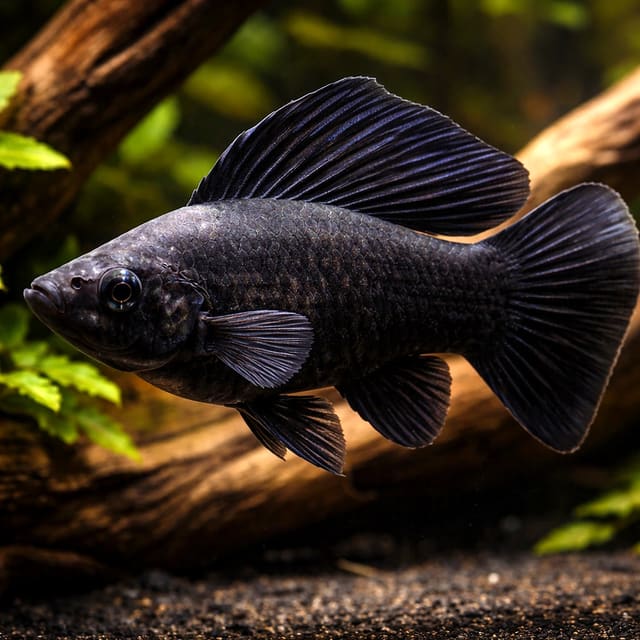
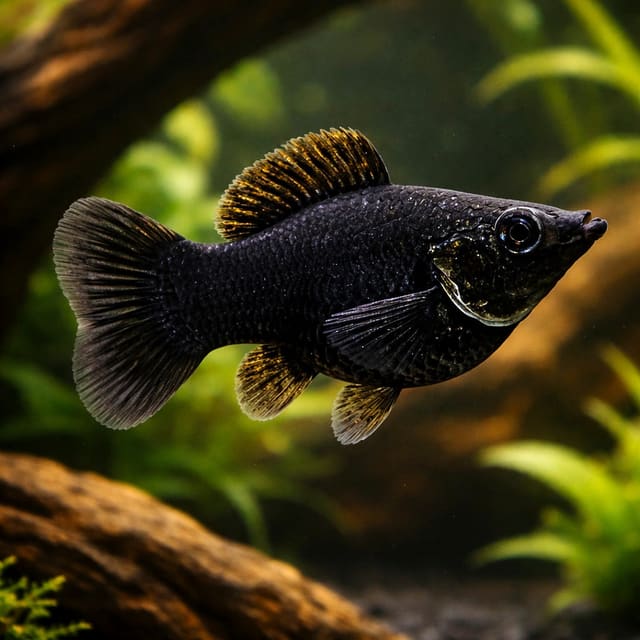
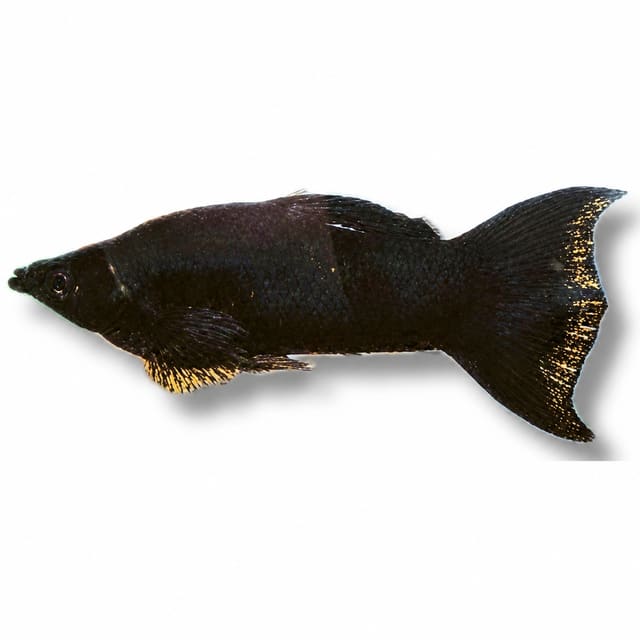
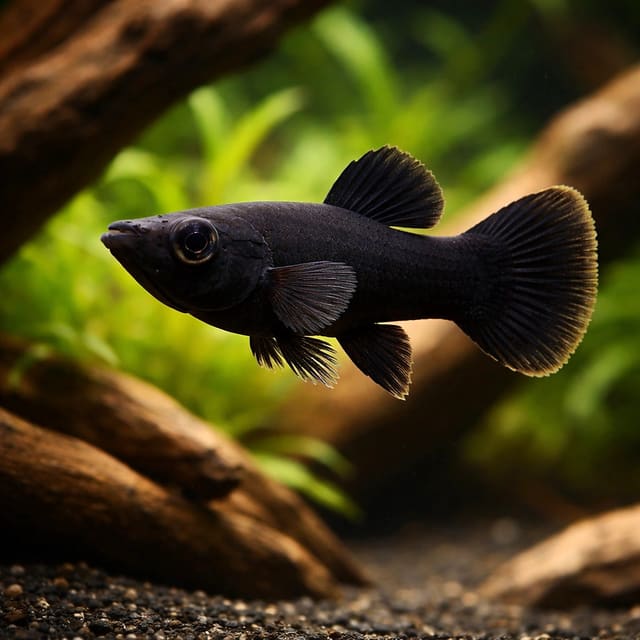
Black Molly (Poecilia sphenops black molly)
21–28°C · pH 7–8.5 · 81L
£3.29
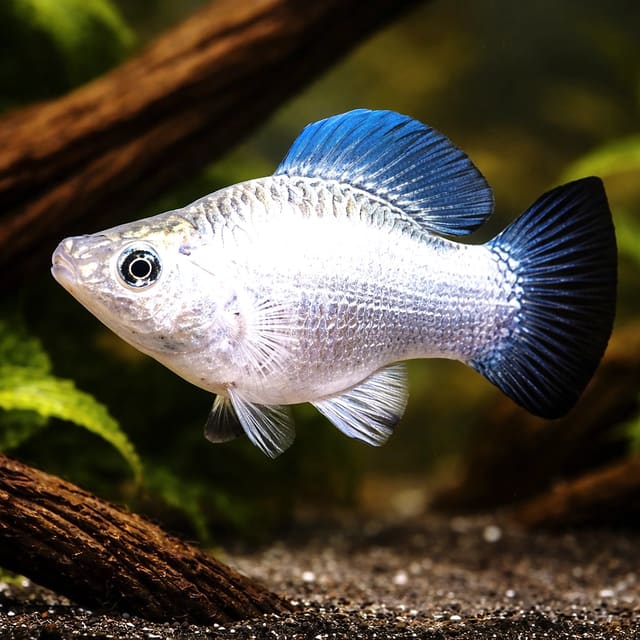
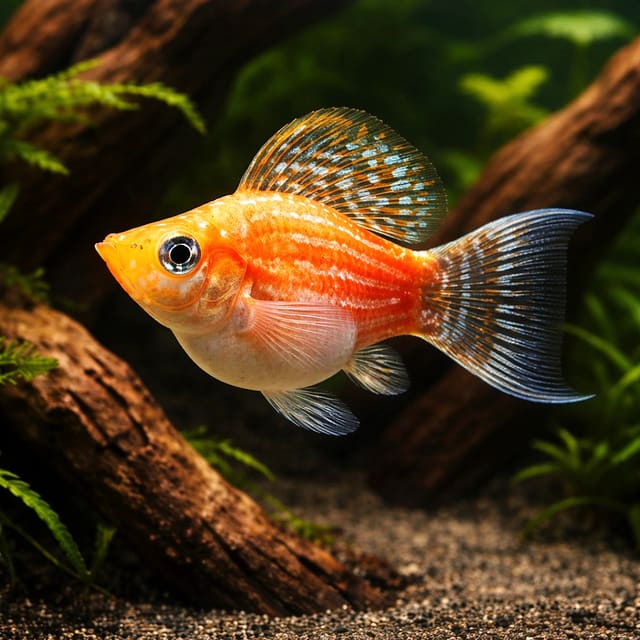
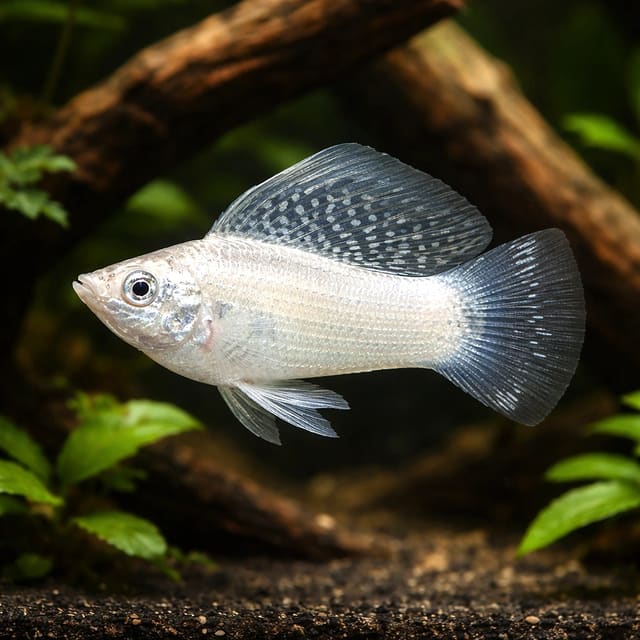
Poecilia latipinna ballon snow is a white, balloon-bodied aquarium form of the sailfin molly, sold as one young fish of about 2.5–3 cm. It needs hard, alkaline water and a mature aquarium of about 80 litres or more, and its rounded body shape is linked to swim bladder and digestive problems, so it suits a keeper who will watch it closely.
Adult size is the maximum length this species reaches at full maturity (scientific sources). The livestock you receive will be younger and smaller. Product-photo provenance and any image-specific limitations are stated on the listing.
Poecilia latipinna
Shoaling fish: kept in a group they feel safer, stay calmer and show their best colour.
Poecilia latipinna ballon snow is a white, balloon-bodied aquarium form of the sailfin molly, sold as one young fish of about 2.5–3 cm. It needs hard, alkaline water and a mature aquarium of about 80 litres or more, and its rounded body shape is linked to swim bladder and digestive problems, so it suits a keeper who will watch it closely.
Adult size is the maximum length this species reaches at full maturity (scientific sources). The livestock you receive will be younger and smaller. Product-photo provenance and any image-specific limitations are stated on the listing.
Maintain these water conditions for optimal health and vibrant colors
Poecilia latipinna ballon snow is a white, balloon-bodied aquarium form of the sailfin molly, Poecilia latipinna. "Snow" describes the pale colour of this line, and "ballon" is the trade spelling of balloon: a strain bred for a rounded, balloon-like body rather than the normal outline of the species. It is a livebearer, so females give birth to live young instead of laying eggs.
Two things decide whether this fish is right for your aquarium. The first is water. This is a hard-water molly that needs alkaline conditions with plenty of dissolved calcium and magnesium; in soft or acidic water it weakens fairly rapidly. If your tap water is soft, plan how you will harden it before you order. The second is the body shape itself. The rounded balloon form is linked to swim bladder and digestive problems, and it can shorten a fish's life. It suits a keeper who is happy to watch a fish closely every day and who will keep water quality steady.
It is a good choice if:
Think again, or choose a standard-bodied molly, if:
In practice, keeping this fish well comes down to four habits: hard water that you test every week, a plant-rich diet fed in small meals, a group with more females than males, and calm companions of a similar size. The care and compatibility sections below explain each one in turn.
| Suits | Keepers with hard, alkaline water and a mature community aquarium of about 80 litres or more |
|---|---|
| Species | Poecilia latipinna, family Poeciliidae |
| Adult size | Up to 15 cm total length recorded for the species |
| Water | 21–26 °C, pH 7.0–8.5, 15–35 dGH |
| Diet | Plant-rich omnivore: algae-based foods and vegetable matter, with some small live or frozen foods |
| Social needs | Trios of one male to two females; one molly species per aquarium |
| Main caution | Balloon body shape linked to swim bladder and digestive problems |
Each purchase supplies one live fish. It is sent as a young fish of about 2.5–3 cm, well below adult size, so plan your aquarium for the fish it will become rather than the one that arrives. FishBase records a maximum of 15 cm total length for the species, and even a rounded balloon form needs room to turn, feed and rest without being crowded.
Because each purchase is one fish, order with your group in mind. OATA suggests keeping at least three mollies together, and if your aquarium has only recently matured, add fish gradually so the filter can cope with the extra waste.
Sex is guaranteed only when the selected option explicitly states male or female. This Poecilia latipinna ballon snow listing has no sex-guaranteed option. Mollies are sexed by the anal fin: males carry a gonopodium, a modified anal fin used in mating, and in this species males also grow a large, long, sail-like dorsal fin. Because the listing is not sexed, a group bought together can turn out to have any mix of males and females.
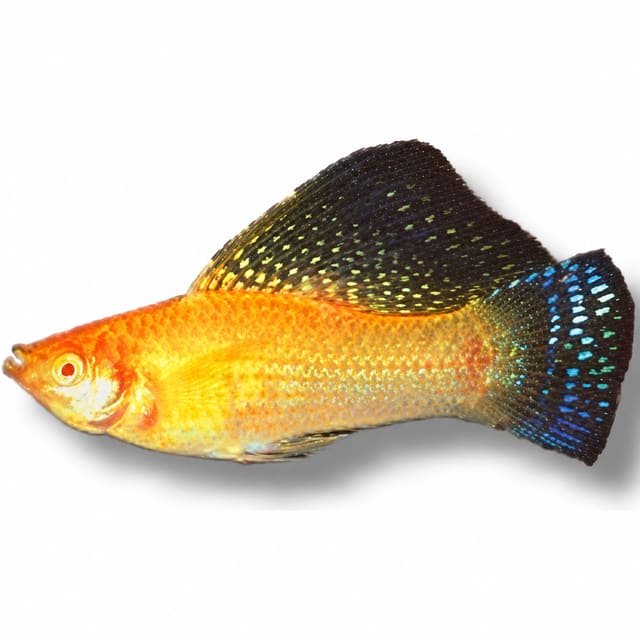
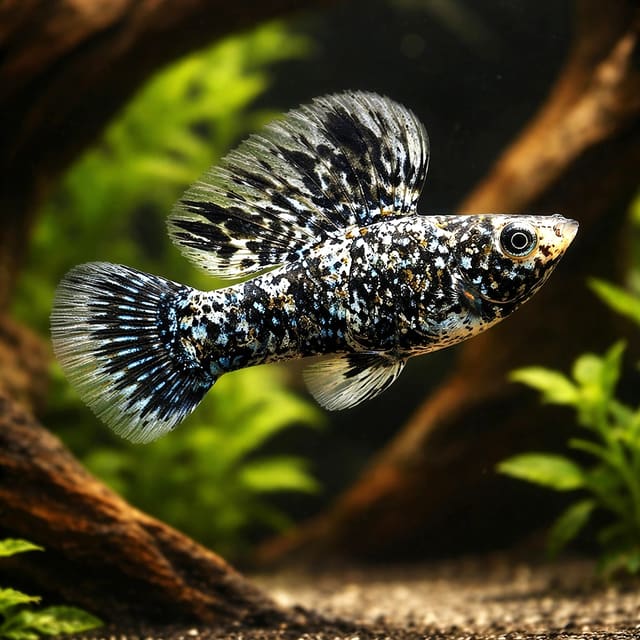
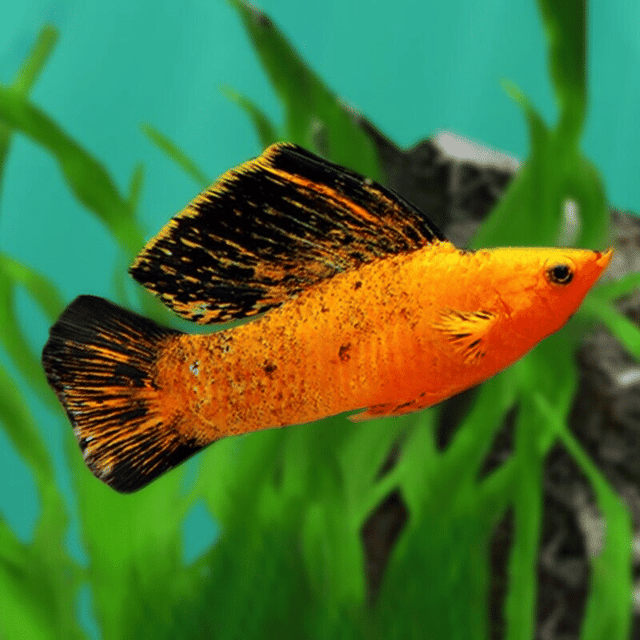
Gallery images have been digitally enhanced to improve image quality. Natural colour, pattern, size and maturity can vary between live animals. Expect the fish you receive to differ in detail from the photograph.
If you would like to compare other livebearers before choosing, browse our livebearer range, which brings our livebearing fish together in one place.
Poecilia latipinna is a North American livebearer. FishBase places its native range from the Cape Fear drainage in North Carolina, USA, to Veracruz in Mexico, including the coast of the Gulf of Mexico. Adults live in still or gently flowing warm water: small creeks and drains, ponds, lakes, sloughs, and quiet, often vegetated backwaters and pools of streams. The species is also found in coastal waters and is abundant in tidal ditches and brackish canals, and FishBase records it in fresh, brackish and marine water.
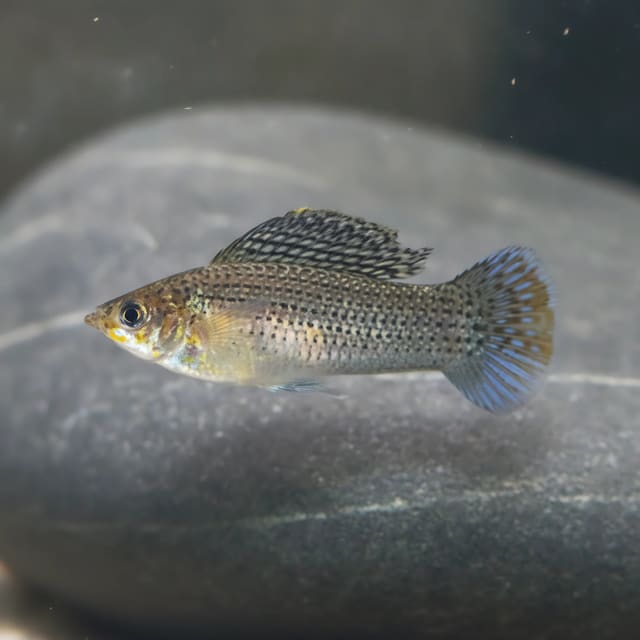
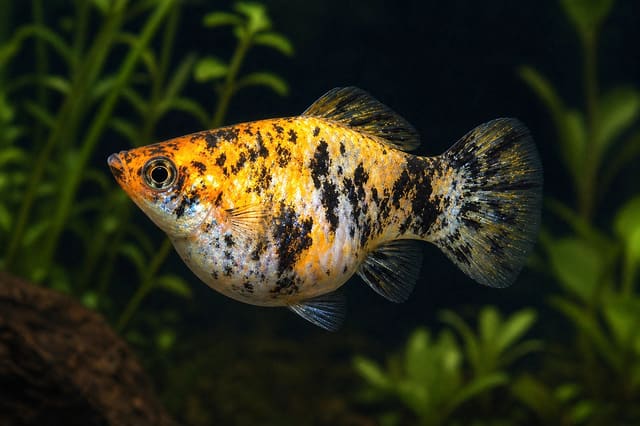
Wild fish show several different types of patterning, although wild-type sailfin mollies are rarely seen in the aquarium trade. The fish sold for aquariums have been selectively bred into many colour forms, and the species has been crossed with other mollies, particularly Poecilia sphenops. A white, balloon-bodied fish such as this one sits at the far end of that domestic breeding history.
FishBase lists the species as Least Concern on the IUCN Red List, and OATA notes that most mollies in the aquarium trade are now captive bred.
Most problems with sailfin mollies start before the fish arrives, with water that is too soft or an aquarium that is too young. Work through this list first.
If every point is in place, a hard-water molly settles far more easily, and you will spot any problem with the balloon body shape against a background of good water rather than confusing the two.
Balloon mollies divide opinion among fishkeepers, and it is fair to be clear about why. Seriously Fish describes the balloon variety of Poecilia latipinna as having a rounded body that gives a balloon-like appearance, and warns that the condition can cause swim bladder and digestive problems and may bring about premature death. The white colouring is simply the colour of this line; it is the body shape that changes how you should keep it.
You cannot change the shape of the fish, but you can remove the extra pressures that make any fish struggle. Keep the water hard and alkaline, because soft or acidic water weakens this species fairly rapidly. Feed a plant-rich diet in modest amounts rather than heavy meals, which also protects water quality. Choose calm companions of a similar size so the fish is not pushed away from food, and keep the tank mature and stable rather than making large, sudden changes.
If you would prefer a molly without these risks, a standard-bodied form of the same or a related species is the straightforward alternative. If you choose the balloon form, go in knowing that it asks for a little more attention than a typical molly, and that close daily observation is part of keeping it well.
Water chemistry matters more for this fish than for many community species. Seriously Fish's species profile states that Poecilia latipinna must be kept in moderately hard or harder water with a basic pH. In soft or acidic water the fish weakens fairly rapidly, and the frequent signs are shimmying, fungus and clamped fins.
| Temperature | 21–26 °C |
|---|---|
| pH | 7.0–8.5 |
| General hardness | 15–35 dGH |
| Ammonia and nitrite | Zero |
| Nitrate | No more than 20 mg per litre above your tap water level |
The temperature, pH and hardness in the table are the species values from Seriously Fish. The ammonia, nitrite and nitrate limits come from OATA's care sheet for guppies and mollies, which also gives broader group guidance of 20–28 °C, pH 7.0–8.0 and medium-hard water of 8–18 °dH. For this species, aim for the harder end: Seriously Fish places the lower limit at 15 dGH.
General hardness (GH or dGH) measures the dissolved calcium and magnesium this molly relies on. Carbonate hardness (KH) measures the carbonates that help hold pH steady. OATA's guidance for mollies gives medium-hard water of 5–15 °dKH carbonate hardness. Keep both readings in mind: a tank with high GH but very low KH can see its pH drift downwards between water changes, which is exactly the direction this species dislikes.
Sailfin mollies are often described as brackish fish, and in the wild they do live in brackish canals and tidal ditches as well as fresh water. FishBase records the species in marine, brackish and fresh water. In the aquarium, though, Seriously Fish is clear that salt is not necessary: it is the hard minerals, calcium and magnesium, that are crucial to the long-term health of the species, and the fish lives perfectly well in fresh water provided it is not soft or acidic.
FishBase gives 20–28 °C for the species' natural environment. That is a record of the waters wild fish inhabit, not a target to set your heater to. For a home aquarium, 21–26 °C is the working range, and a steady temperature within it is better than swings between the extremes.
Test general hardness, carbonate hardness and pH before you buy, not after the fish arrives. Our guide to aquarium water parameters explains what each test measures and why it matters. Once you have your readings, the water parameter matcher lets you compare them with the values above, so you can see straight away whether your tap water suits a hard-water molly or needs adjusting.
Seriously Fish recommends an aquarium base of at least 76 × 38 cm for this species, which is roughly 87 litres at 30 cm deep. OATA's care sheet recommends at least 80 litres for sailfin mollies and notes that more groups need more volume. Both figures point the same way: this is not a fish for a small starter tank, even though it arrives small. A larger aquarium also holds its temperature and water quality more steadily, which helps a balloon-bodied fish.
Every aquarium needs a well set up and maintained filter. Fish release ammonia, which is toxic; a working biological filter carries bacteria that convert ammonia to nitrite, which is also toxic, and then to nitrate, which is safer. The RSPCA's aquarium environment guidance explains this cycle and why no fish should live without a filter. For an aquarium of about 87 litres, Seriously Fish suggests a filter rated at 350–435 litres per hour, a turnover of four to five times the volume each hour, and a heater of roughly 50–75 W in a room at around 20 °C.
Wild sailfin mollies live in still or gently flowing water, so good filtration does not need to mean a strong current.
If you are setting up from scratch, our guide to setting up a tropical fish tank walks through filtration, heating and maturing the aquarium before any fish are added.
Diet deserves real attention with this species. According to FishBase, wild Poecilia latipinna feed mainly on algae and also take animal material such as rotifers, small crustaceans and aquatic insects. Seriously Fish describes wild fish as almost exclusively herbivorous. Aquarium-bred fish are far removed from their wild ancestors and accept most foods, but vegetable matter should stay part of every week's feeding.
Greens matter beyond general health. Seriously Fish notes that if too little green food is provided, the development of the male's dorsal fin may be impaired, so a plant-poor diet can hold back the sail that gives the sailfin molly its name.
A well-fed sailfin molly grazes plants and décor between meals, comes readily to food and holds a steady body condition from week to week. Food left lying after a few minutes means the portion was too large, and a fish that stops grazing or loses interest in food deserves a water test and a closer look. In males, a well-developed dorsal fin is one sign that the diet contains enough greens.
OATA advises feeding guppies and mollies only what they can eat within a few minutes once a day. Uneaten food breaks down and releases toxic waste, so small, measured portions protect water quality as well as the fish. For a balloon-bodied molly, modest meals are the sensible habit: watch that it reaches the food, and remove anything left after a few minutes.
Your fish is hand-bagged in pure oxygen and packed in an insulated poly box, with a heat pack when the weather calls for it. We email you the tracking number and your confirmed delivery date, and a licensed live-animal courier carries the parcel. Full details are on our delivery and Live Arrival Guarantee page.
Only add a new fish to a mature aquarium in which ammonia and nitrite read zero. The filter's bacteria need time to grow every time more fish are added and feeding increases, so build up stock slowly. Adding too many fish too quickly can cause new tank syndrome, in which ammonia and nitrite rise to harmful levels.
OATA's description of a healthy fish is a good first-week checklist: clear, bright eyes, undamaged fins, intact scales, no ulcers or bumps, and normal swimming. For a balloon molly, pay particular attention to how it holds itself in the water and whether it feeds.
Stable, clean water is the foundation of keeping any molly well, and it matters even more for a fish whose body shape already asks a lot of it. OATA's care sheet for guppies and mollies notes that guppies and mollies can be stressed by even the smallest amounts of ammonia, and it sets out a simple routine.
OATA lists the changes that often come before a health problem: swimming behaviour, colour, temperament, breathing, appearance (white spots, fluffy growths, lost fins or scales), body condition and feeding. If you notice any of them, OATA's advice is to test your water quality first and then seek advice.
In this species, soft or acidic water shows up as shimmying, fungus and clamped fins. If you see those signs, check hardness and pH as well as ammonia and nitrite.
Seriously Fish rates breeding as easy: the species reproduces in the usual livebearer fashion. Sex cannot be chosen on this listing, so whether your fish breed depends on the mix of males and females you end up with.
Seriously Fish notes that wild-type fish are much less likely to eat their offspring than the domestic forms, so a domestic colour form such as this one is best separated from its fry. Keeping two females to each male spreads the males' attention and reduces the pressure on any one female.
Mollies of different species interbreed readily, which is one more reason to keep only one molly species in the aquarium.
Seriously Fish describes Poecilia latipinna as generally suitable for a hard-water community, with two important caveats: it may pick on smaller fish as it matures, and males can be aggressive to one another, particularly when spawning. OATA adds that sailfin mollies should not be kept with timid fish species. Choose companions with those points in mind, and always check that they need the same hard, alkaline water.
| Good choices | Other livebearers that are not mollies, and some catfish, provided they share hard, alkaline water |
|---|---|
| Use caution | Much smaller fish, and more than one male in a small group |
| Avoid | Timid fish species, and other molly species |
Aquarium mollies have been bred into many colour forms, and Poecilia latipinna has also been crossed with other molly species, particularly Poecilia sphenops. Because mollies interbreed readily in the aquarium, keep only one molly species per tank.
If you are adding this molly to an established aquarium, check that the tank has room and that ammonia and nitrite read zero, then add fish gradually rather than all at once so the filter can keep up. Watch the first days closely. A new, round-bodied fish should be able to reach food and rest without being chased, and a maturing male should not be allowed to harry smaller fish constantly. If either happens, rethink the mix rather than hoping it settles.
Temperament is only half of compatibility. A peaceful fish that prefers soft, acidic water will do badly beside a hard-water molly, and the molly will do badly if the water is softened to suit its neighbour. Start with water, then look at size and temperament.
Sailfin mollies need company. OATA advises keeping at least three guppies or mollies together, in a ratio of two females to each male, to reduce stress on the females and other tank inhabitants. Seriously Fish gives the same advice for Poecilia latipinna, recommending trios of two females to a single male because males can be quite vigorous in their pursuit of mates. You can keep more fish, as long as you add them in the same ratio and the aquarium is large enough.
Because this listing is not sexed, buying three fish does not guarantee one male and two females. As your fish grow, males become recognisable by the gonopodium and the tall dorsal fin. Add any further fish in the two-females-to-one-male ratio, and if males outnumber females and chasing becomes constant, rebalance the group with more females or separate the extra males.
FishBase records a maximum of 15 cm total length for Poecilia latipinna, and Seriously Fish gives 12.5 cm standard length for the species. Plan the aquarium around that adult size rather than the size of a young fish.
Seriously Fish recommends an aquarium base of at least 76 × 38 cm, roughly 87 litres, and OATA recommends at least 80 litres for sailfin mollies. A larger, mature aquarium keeps temperature and water quality more stable.
Keep at least three. Seriously Fish recommends trios of two females to one male because males pursue females vigorously, and OATA gives the same ratio of two females to each male. Sex cannot be chosen when you order, so watch the balance as the fish mature and males show their gonopodium.
It can suit a careful beginner who has hard, alkaline water and a mature aquarium, and OATA describes most mollies as undemanding. The balloon body is the reason for caution: Seriously Fish notes that this rounded shape can cause swim bladder and digestive problems and may bring about premature death, so check its swimming, appetite and body condition every day.
Build the diet on plant matter: a quality flake or granule with a high algae content, or an algae-based food, plus vegetable matter such as blanched spinach or vegetable flake. Small live or frozen foods such as daphnia or small bloodworm add variety. Feed only what the fish eat within a few minutes once a day.
Seriously Fish gives 21–26 °C, pH 7.0–8.5 and a hardness of 15–35 dGH for the species. The calcium and magnesium in hard water matter more than salt, and in soft or acidic water this molly weakens fairly rapidly.
It is generally suitable for a hard-water community, but it may pick on smaller fish as it matures, and males can be aggressive to one another, particularly when spawning. Give it companions of a similar size and enough room for a group.
Seriously Fish suggests other livebearers and some catfish, chosen from those that share hard, alkaline water. Keep only one molly species in the aquarium because mollies interbreed readily, and OATA advises against keeping sailfin mollies with timid fish.
It is hand-bagged in pure oxygen, packed in an insulated poly box with a heat pack when the weather calls for it, and carried by a tracked, licensed live-animal courier. Someone must be at the address to receive it. Open and inspect it the same day while filming a continuous unboxing video from the sealed parcel to the fish still in its bag, which the Live Arrival Guarantee needs for any claim, then float the bag for 20–30 minutes before releasing the fish and never pour the bag water into your tank.
No reviews for this item yet. Bought one? Honest reviews only, good or bad.
What customers say about ordering from us
Easy website plenty of info on fish your buying great to pick a time slot
TRACEY DURRANT · 7 Oct 2026
Got some lovely fish thank you
Kevin Mackie · 7 Oct 2026
Reviews of our shop, collected by Judge.me, an independent third-party review collector. Newest first.