
 By Tom Whitfield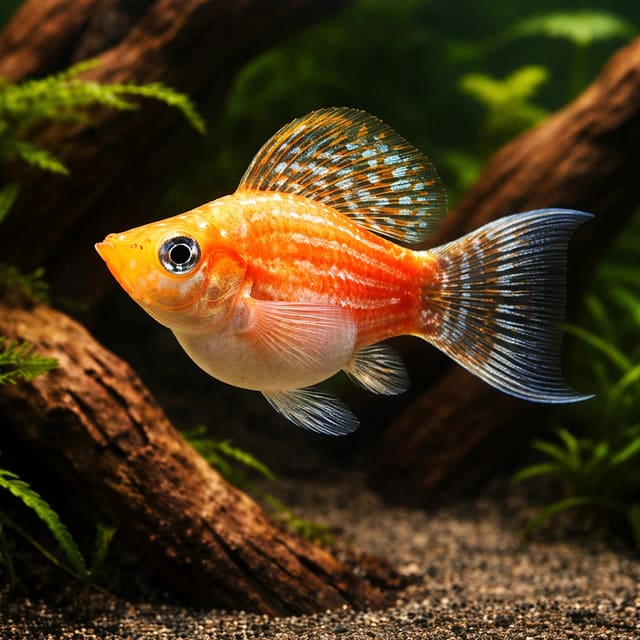
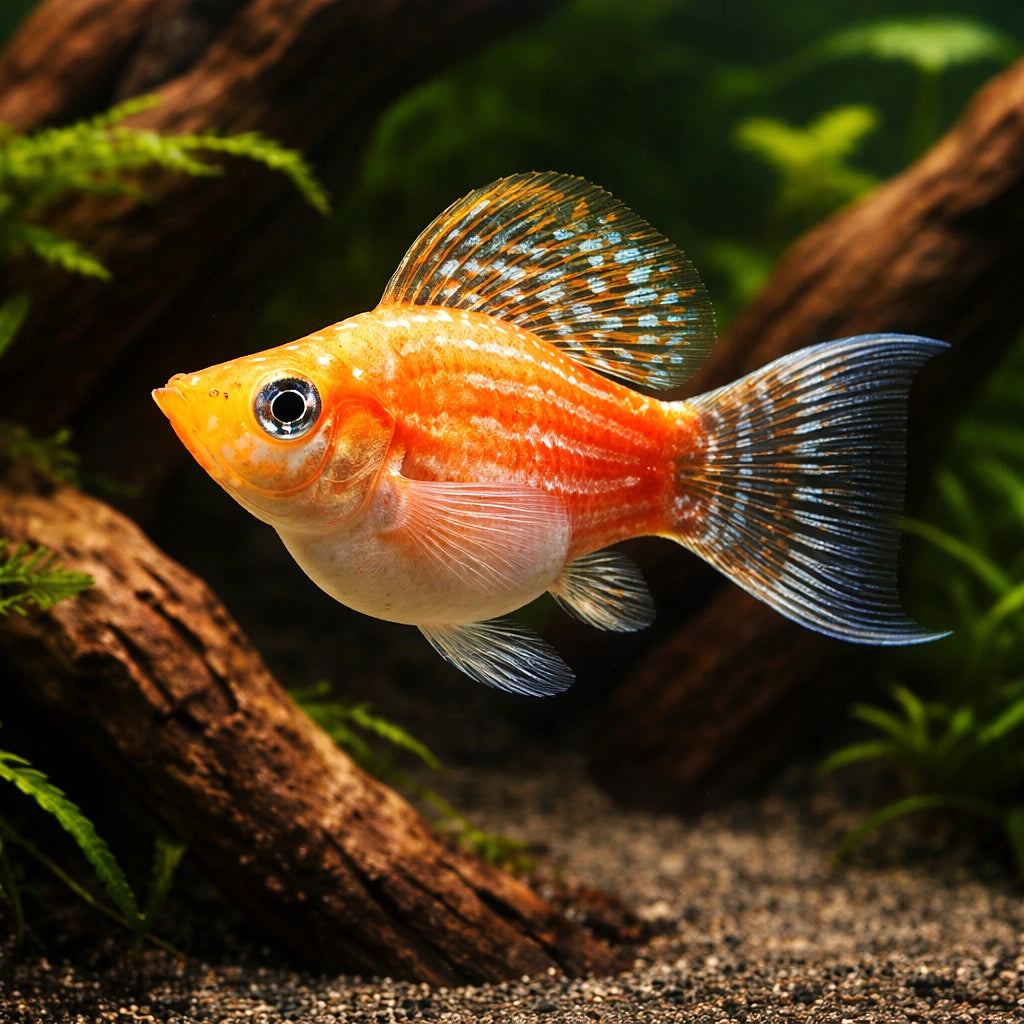
Assorted Balloon Molly (Poecilia cf. latipinna)
20–28°C · pH 7–8
£6.99
Molly Fish · Buying Guide
Honest UK balloon molly guide — what the round body really is, the welfare facts, lifespan, hard-water care & in-stock fish. Read or listen first.
5 products in stock today
Live prices and stock. Every fish covered by our Live Arrival Guarantee.
20–28°C · pH 7–8
21–26°C · pH 7–8 · 87L

21–26°C · pH 7–8.5 · 87L
21–26°C · pH 7–8.5
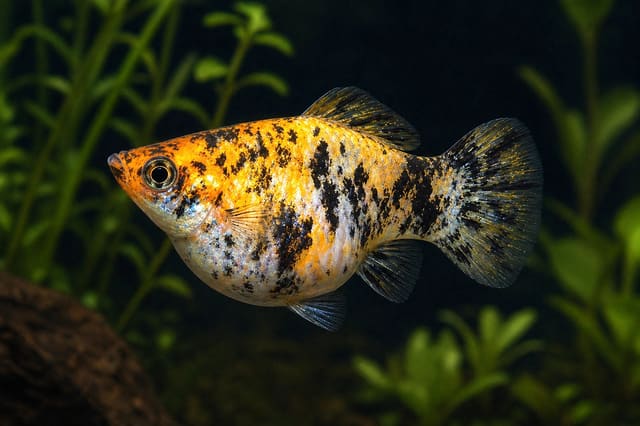
21–26°C · pH 7–8.5 · 87L
The shaded band shows the range balloon molly is comfortable in. Match it to your tap water before you buy.
Our trained assistant knows this balloon molly page inside out. Ask it anything — water parameters, tank mates, how many to buy — or have it read the guide aloud while you set up your tank.
You searched "balloon molly", so you've seen the fish — that round, pot-bellied little molly that looks permanently inflated. It's genuinely charming, and I understand the appeal. But this is the one guide on our site where I'm going to slow you right down before the buy button, because there's a welfare question here that most listings quietly skip.
I'm Tom Whitfield. I run a nano-tank YouTube channel from a flat in Edinburgh, and I write our beginner guides on the theory that someone six years into the hobby still remembers what's confusing — and what gets glossed over. The thing that gets glossed over with balloon mollies is what the body shape actually is. So this guide gives you the honest facts first, the care second, and lets you make an informed decision either way. My channel motto is "tiny tanks, slow pace, fewer dead fish" — and the honest extension of that is fewer fish bought on impulse.
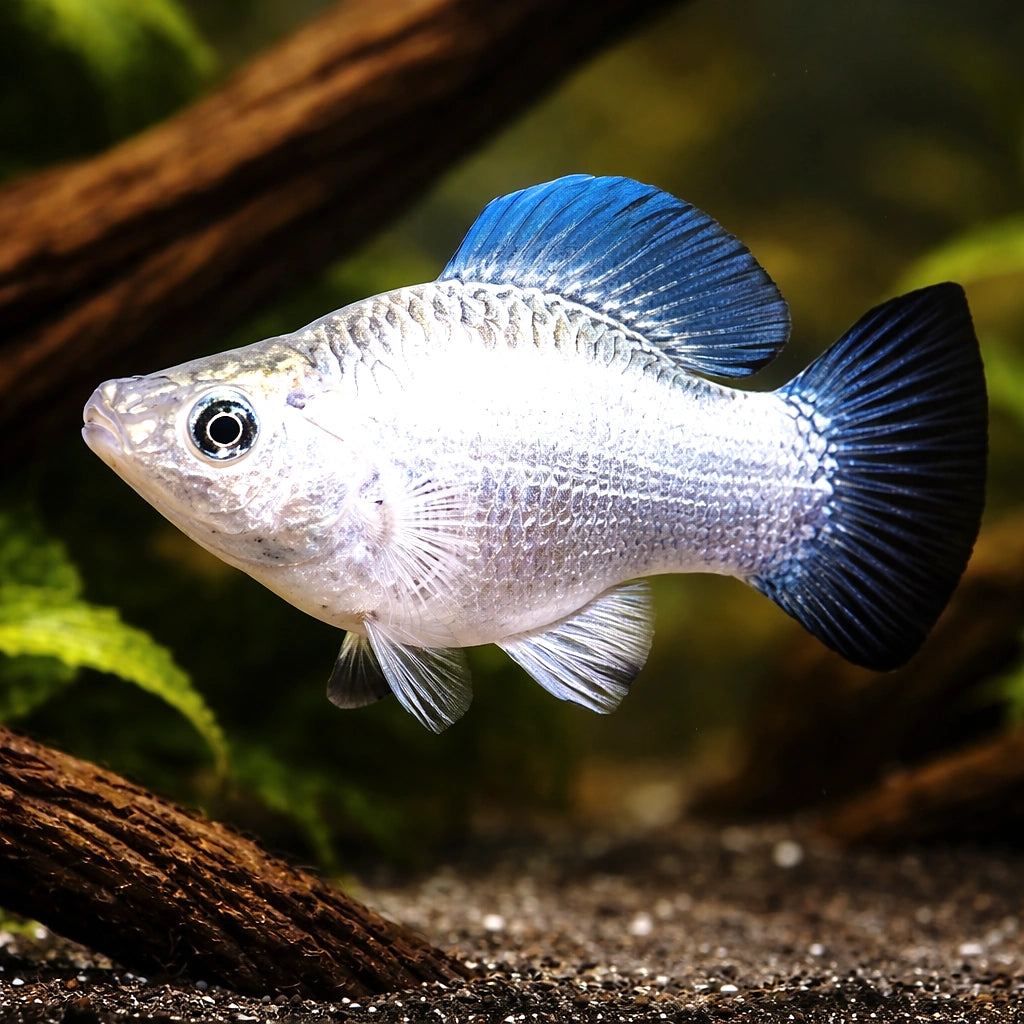
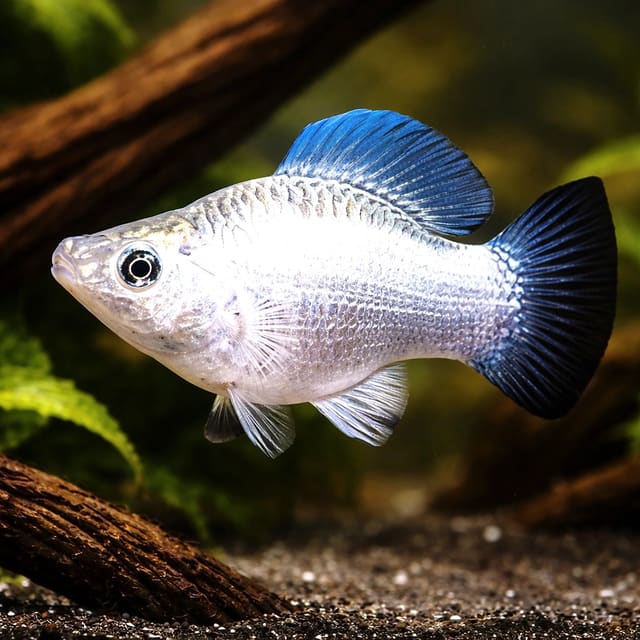
A silver balloon molly seen side-on. That steep, rounded profile isn't a well-fed belly or a pregnant female — it's the defining feature of the morph, produced by a bred curvature and shortening of the spine. Knowing that is the whole point of this page. Product photo · our warehouse.
I'm going to lay this out plainly, because you deserve the real version, not a sales pitch and not scaremongering either.
The balloon body is a deformity by design — a deliberately line-bred curved, shortened spine [3], linked in hobby sources to swim-bladder problems and a shorter life [4]. A controlled study of suffering in this specific morph hasn't been published, so I won't pretend the science is settled. What I'll say plainly: the welfare concern is reasonable, and if it sits badly with you, the standard-bodied molly is the honest alternative — same fish underneath, natural spine, longer life.
If you're weighing the two, here's the straight comparison. This isn't me talking you out of a balloon molly — it's giving you the same information I'd want before I spent my money.
| What matters | Standard molly | Balloon molly |
|---|---|---|
| Body / spine | Natural, straight spine | Bred curved, shortened spine (scoliosis) |
| Typical lifespan | 3+ years with good care | Often 1–2 years cited |
| Swim-bladder risk | Normal | Higher — crowded body cavity |
| Swimming ability | Agile | Slower, less agile |
| Care difficulty | Easy | Same care, but a harder-to-keep-well body |
| Welfare debate | None | Real, ongoing — decide with eyes open |
| Colours available | Full range | Full range (silver, calico, snow, gold) |
If you want the look and you'll commit to the best possible care, a balloon molly can live a reasonable life — and ours are kept properly. If the welfare question bothers you, choose a standard molly [1].
These are the same care as any molly underneath — hard water, greens, careful feeding. The colour names (silver, calico, snow, golden marble) are trade strains layered onto the short-body morph:
The balloon's biggest practical weakness is its compressed gut and swim bladder, so feeding is where you can genuinely help. Feed little and often, weighted heavily toward vegetable matter — algae wafers, blanched courgette and de-stalked spinach — and go easy on protein and dried flake, which swell in the gut and trigger constipation-related floating. A weekly fasting day does balloon mollies more good than it does most fish. Don't overfeed a fish whose body shape already crowds its insides.
Whatever you decide on the welfare question, a balloon molly is kept exactly like any molly. The two things that decide whether it thrives are water hardness and diet.
Mollies flip the usual UK fishkeeping headache. Most popular tropicals want soft, acidic water, so hard-water-area keepers fight their tap supply. Mollies — balloon or standard — are the opposite: they evolved in hard, mineral-rich water and prefer it [1].
Thames Water and most suppliers across the chalk-and-limestone belt of southern and eastern England classify their supply as hard to very hard [5]. For a molly keeper, that's an asset — near-perfect water straight from the cold tap once it's dechlorinated.
Search your postcode on your water company's website (Thames Water, Severn Trent, Anglian, Affinity, etc.) for a hardness figure in mg/l CaCO₃ or °Clarke. Hard-water area? Mollies are a great fit straight from the tap. Soft-water area (much of Scotland, Wales, Cornwall, the Lake District)? Add crushed coral to your filter or use a remineraliser before stocking.
A balloon molly is a slower, less agile swimmer than a standard molly because of its body shape, so the rule is doubly important: peaceful, slow enough not to out-compete it at feeding, and matched to hard alkaline water.
Avoid: fin-nippers (barbs, some tetras), fast boisterous fish that out-swim a balloon at feeding time, and aggressive cichlids.
Transcript / what you're seeing (0:00–0:20): a heavily planted tropical aquarium with fish cruising calmly through open mid-water and resting among the plants. The pace here is the point: a balloon molly, with its shortened, rounded body, swims less powerfully than a standard molly, so it does best in a calm, planted tank with gentle flow and tank mates that don't barge it off its food. A bare, high-flow tank full of fast fish is the opposite of what this morph needs.
Sexing is the same as any molly. Males are slimmer with a gonopodium — the anal fin modified into a narrow rod used to fertilise the female; females are rounder (rounder still in the balloon morph) with a normal fan-shaped anal fin. They breed readily as livebearers [6].
A word of honesty on breeding, though: because the balloon body is a bred spinal deformity [3], deliberately breeding more balloon mollies is exactly the practice the welfare debate is about. If you end up with fry, that's the nature of keeping livebearers — but I wouldn't set out to mass-produce the morph. If you want to breed mollies as a project, the standard body is the kinder line to work with.
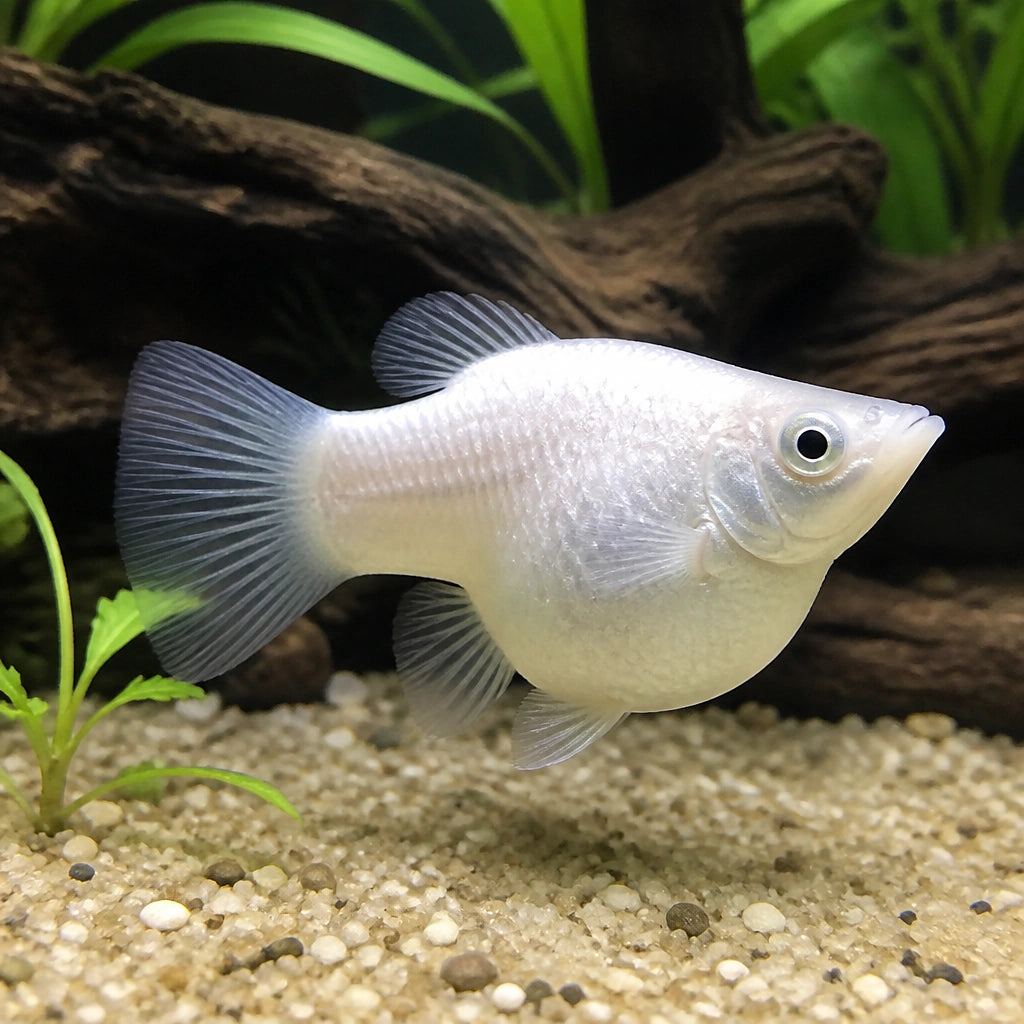
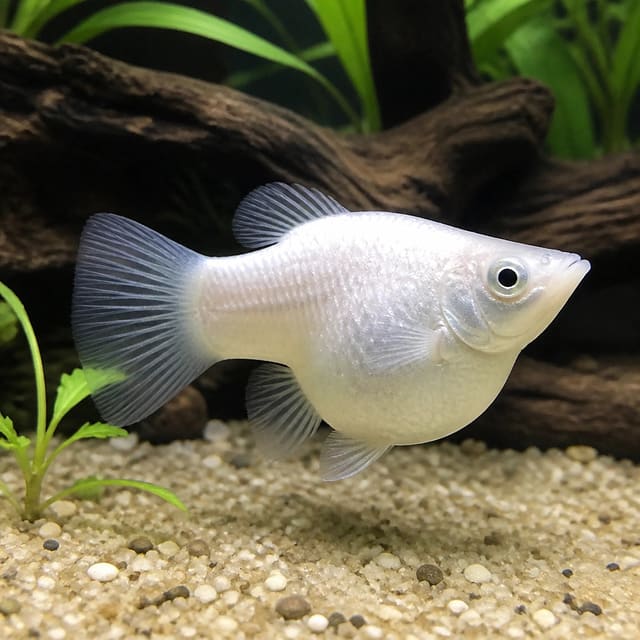
A "balloon snow" — one of the paler colour strains of the short-body morph. The colour is a line-bred look; the rounded shape underneath is the same bred spinal curvature every balloon molly carries. Product photo · our warehouse.
Balloon mollies vary a lot in how extreme — and how compromised — the body shape is, so buying carefully matters more here than for most fish:
If you want to learn molly genetics properly — including the difference between line-bred morphs and natural fish — the hobby is the place, not a shop shelf:
Balloon mollies are a little more delicate than standard mollies because of their compromised body, and like all mollies they dislike sudden hardness and pH swings — and moving into hard UK tap water [5] can be a real jump from softer holding water. Take it gently:
Visual route into the rest of our UK live-fish range.
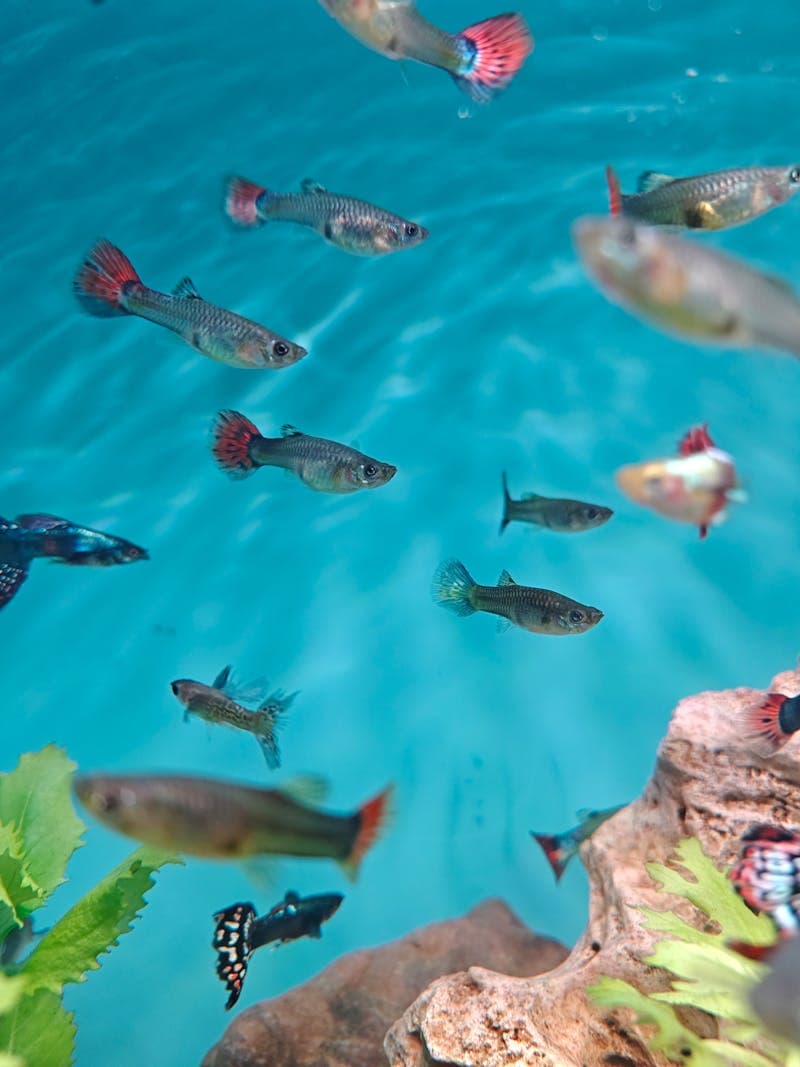
Black, gold, marble and sailfin mollies, plus balloon and lyretail forms: peaceful livebearers that prefer harder water. Price, size and sex on every listing.

Livebearer fish for sale UK — Guppies, Mollies, Platies, Swordtails, Endlers, Limias. Easy-breeding community favourites.
Material factual claims cite the sources below; store policy and cautious inference are labelled in the article. Sources are grouped by type so you can judge their weight at a glance.
Peer-reviewed GWAS documenting a 'short and dysplastic spine' in a dwarf sailfin molly line analogous to the short-body morph (DOI 10.3390/genes10060418).
Used for the molly's water parameters, hard-alkaline requirement, vegetarian diet and temperament — the base species behind the balloon morph.
Used for the latipinna molly behind many balloon lines — natural body form, size and care.
Hobbyist profile covering the balloon morph's care, size, the shortened-spine origin, swim-bladder risk and the commonly cited shorter lifespan.
Practical molly husbandry — hard water, vegetable diet, sex ratio and fry — applies directly to the balloon morph.
UK authority confirming much of southern and eastern England is hard (200–300 mg/l CaCO₃) to very hard (>300).
Fishkeeping moves fast and we want every guide spot-on. If you think something here is wrong, out of date, or could be clearer, tell us — our team reads every message and updates the page.
Suggest an editBlack, gold, marble and sailfin mollies, plus balloon and lyretail forms: peaceful livebearers that prefer harder water. Price, size and sex on every listing.
Livebearer fish for sale UK — Guppies, Mollies, Platies, Swordtails, Endlers, Limias. Easy-breeding community favourites.
Molly fish care for UK keepers: compare common and sailfin types, tank sizes, temperature, hard-water needs, groups, feeding and tank mates.
Platy fish care for UK keepers: compare platy types, tank size, temperature, water, lifespan, groups, male vs female, pregnancy and tank mates.
Evidence-checked guppy care for UK aquariums: tank size, social and sex planning, water, feeding, tank mates, health, breeding and buying.
Evidence-checked Endler guppy care for UK aquariums: tank and group planning, water, sexing, hybrids, fry, health, tank mates and buying.

Nano-Tank & Beginner Specialist · 6+ years in the hobby
Tom runs a YouTube channel on nano-aquariums (12.3k subscribers) from his one-bedroom Edinburgh flat, where he keeps eight tanks between 10 L and 60 L. He writes every beginner guide on Tropical Fish Co — on the theory that someone six years into the hobby remembers what's confusing, where a twenty-year veteran has long since forgotten.