Easy
Sailfin Molly Mix (Poecilia latipinna)
21–26°C · pH 7–8.5 · 80L
£6.99
Photo coming soon
The size, price and care details on this page are for this listing.
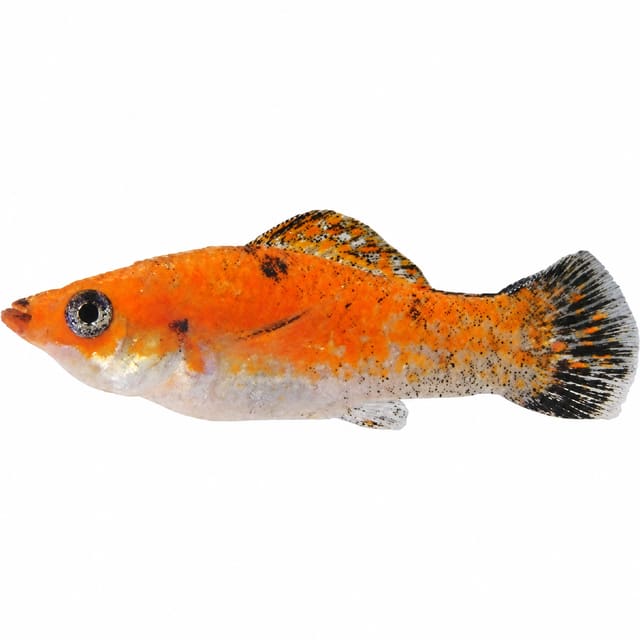
One live gold balloon molly per quantity, sex not selected. This golden, short-bodied sailfin molly (Poecilia latipinna) owes its round shape to a shortened spine, so it does best in an established aquarium of 80 litres or more with hard, alkaline water at 20-28 °C, slow flow, peaceful company and light, plant-rich meals.
Adult size is the maximum length this species reaches at full maturity (scientific sources). The livestock you receive will be younger and smaller. Product-photo provenance and any image-specific limitations are stated on the listing.
Poecilia latipinna
Shoaling fish: kept in a group they feel safer, stay calmer and show their best colour.
One live gold balloon molly per quantity, sex not selected. This golden, short-bodied sailfin molly (Poecilia latipinna) owes its round shape to a shortened spine, so it does best in an established aquarium of 80 litres or more with hard, alkaline water at 20-28 °C, slow flow, peaceful company and light, plant-rich meals.
Adult size is the maximum length this species reaches at full maturity (scientific sources). The livestock you receive will be younger and smaller. Product-photo provenance and any image-specific limitations are stated on the listing.
Maintain these water conditions for optimal health and vibrant colors
A gold balloon molly is a sailfin molly, Poecilia latipinna, from an aquarium line bred for a golden body and a stubby, rounded outline. Until now this page spelled it "ballon molly gold", which is also how a lot of people type it into a search box. Ballon, baloon and balloon all lead to the same fish.
Two things separate it from a wild molly. One is colour. The other is shape: a wild sailfin is a slim fish, while this form is short, arch-backed and round in the belly because its backbone has developed abnormally. That second point deserves a straight explanation, and you will find it in the next section, ahead of the care advice.
There is only one option on this listing. Each quantity added to your basket is one gold balloon molly. Males and females are not picked for this listing, and no dispatch size is listed. Order three and you could receive any mix of sexes. Mollies live best with more females than males, so think about that now rather than once the fish are home. Group balance is covered further down.
With no size given, set the aquarium up for an adult fish. A balloon molly will not reach a wild sailfin's 15 cm, but it still needs space for a group and water that stays stable.
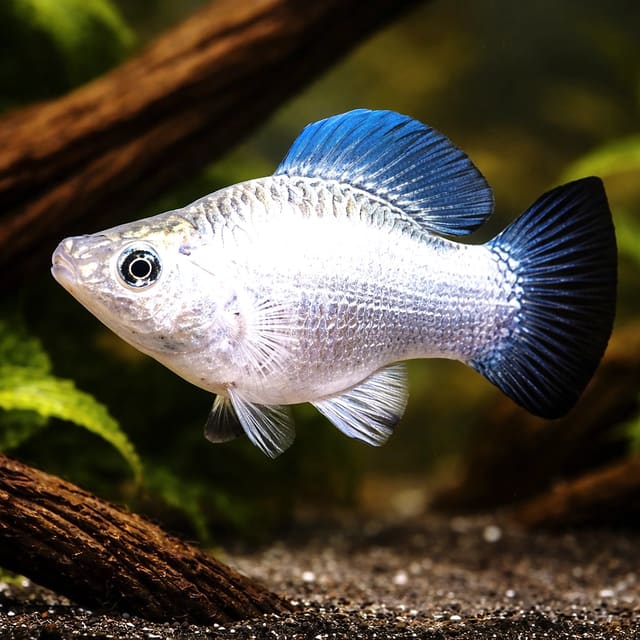
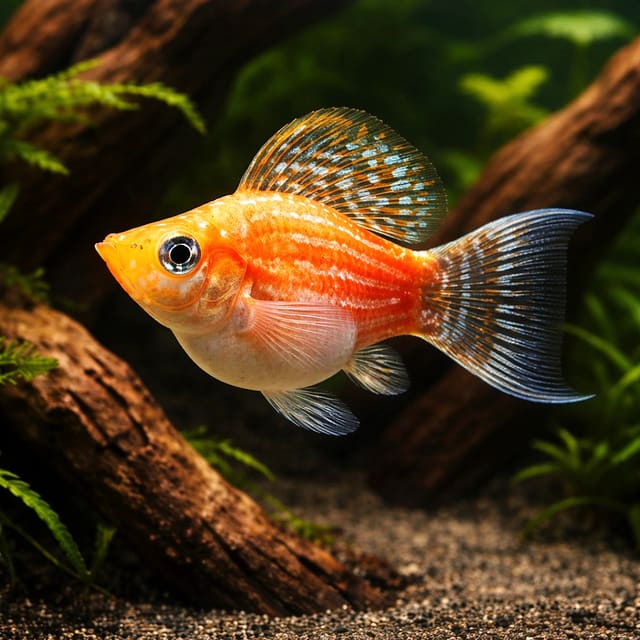
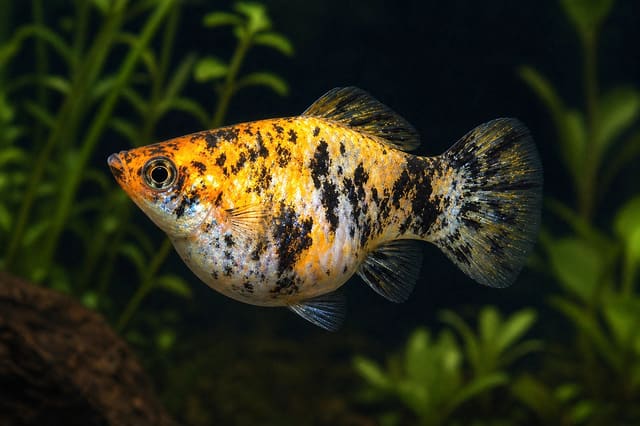
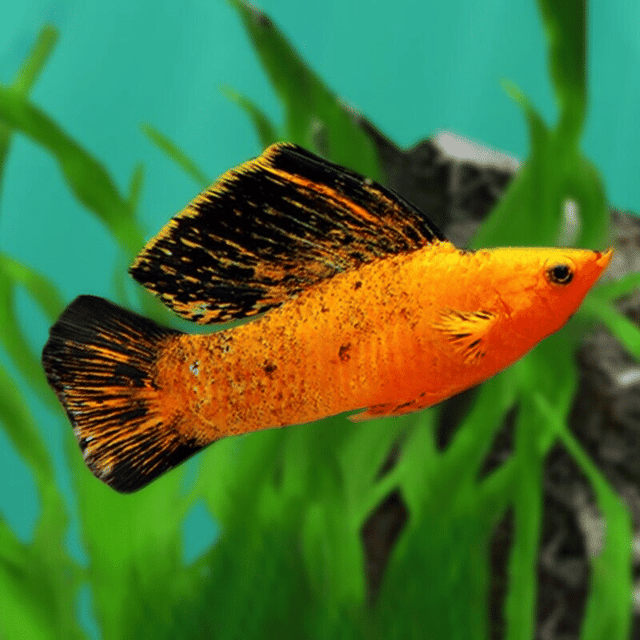
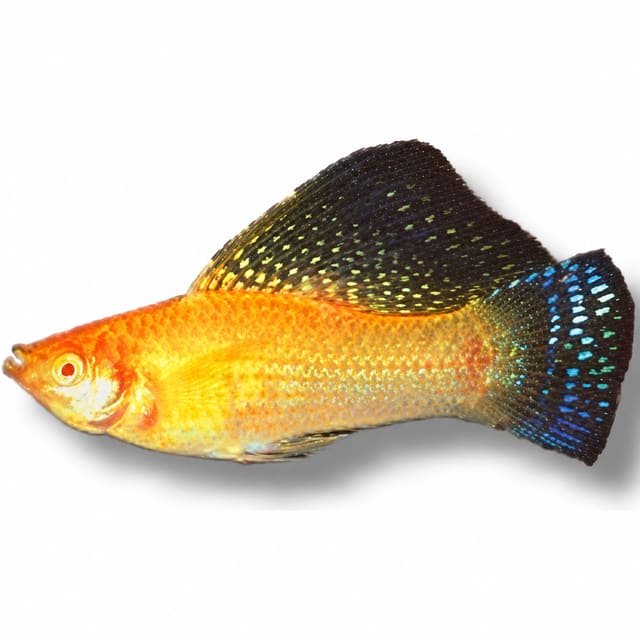
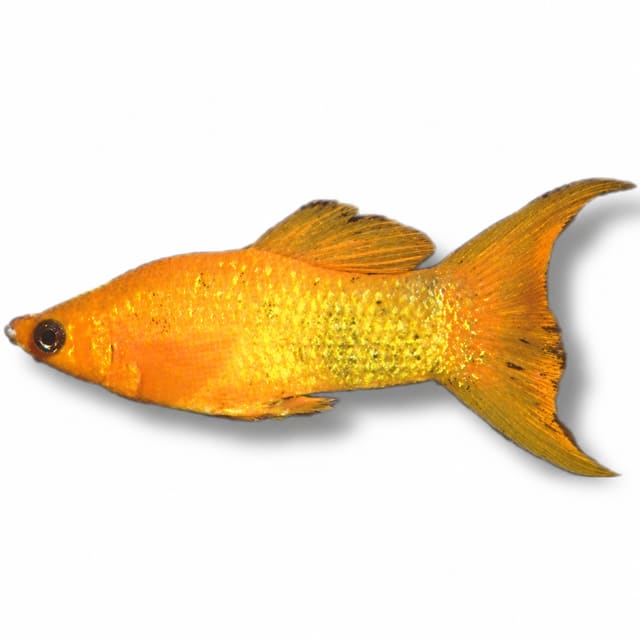
Among fancy mollies, gold is a recognised colour type rather than a loose description. Wikipedia's fancy molly article, which draws on Tropical Fish Hobbyist magazine, describes gold mollies as yellow-gold like albino mollies, but with dark eyes and occasionally scales edged in red. That is the colour this listing is named after. There are no photos on this page, so take those as features of the gold type in general, not a portrait of the individual fish you will receive.
Check the anal fin, the small fin on the underside towards the tail. In males it develops into a gonopodium, the modified fin used to fertilise the female internally; in females it stays fan-shaped. Males also grow the tall, sail-like dorsal fin that gives the species its common name, and FishBase calls that fin its most distinctive characteristic. With a balloon fish, the gonopodium is the surer guide.
Before ordering, you should know exactly what the balloon shape is. Plenty of people assume a balloon molly is just a well-fed one. It is not, and good care will neither cause the shape nor cure it.
In 2019, Shao and co-authors published a study in the journal Genes on what they called the dwarf white sailfin molly, which they say is also known as the balloon belly molly. They examined the fish's skeletons with X-rays and bone staining. Dwarf and normal fish turned out to have the same vertebra count, 27 to 29, so the short body is not the result of missing bones. The vertebrae themselves are dysplastic, meaning they have grown abnormally. The result is a short spine and a convexly arched back, where the normal fish were slender and flat. The researchers also tied the trait to two regions of the genome and three candidate genes. The shape is written into the fish's genetics.
Wikipedia sums up balloon mollies as a small variety with an extremely deformed abdominal cavity. Seriously Fish is blunter. It says the balloon variety is, in its opinion, grotesque, with a body that is malformed and rounded. It warns that the condition can cause swim bladder and digestive problems and may bring about premature death. So a gold balloon molly is a sailfin molly with a compromised body, and its care has to allow for that every day.
If what you want is the gold colour and the lively character of a molly, with a natural skeleton, look at the gold leopard sailfin molly mix. It is the same species, listed as sailfin mollies rather than a balloon form. If you have already decided on a balloon molly, commit to giving it the best conditions you can. That means a settled tank, hard water, light meals heavy on plant food, slow water movement and peaceful neighbours. The silver balloon molly is the same species and body shape in a different colour, so it needs exactly the same care and the two can be kept together.
All balloon mollies come from a wild North American fish. FishBase defines the native range as running from the Cape Fear drainage in North Carolina to Veracruz in Mexico. Wikipedia fills in the route: south to Florida, round the Gulf of Mexico through Texas, and on to the Yucatán Peninsula.
This is a fish of the coastal lowlands. FishBase lists still or slow, warm water in small creeks and drains, ponds, lakes, sloughs, and the quiet, often weedy backwaters and pools of streams. It also calls the species abundant in tidal ditches and brackish canals. Wikipedia adds estuaries, lagoons, river deltas, swamps and mangroves, and records that sailfin mollies can tolerate salinity as high as 87 parts per thousand. That number is a survival limit in the wild, and it is quoted here as such, not as advice for your aquarium. Seriously Fish describes the usual habitat as heavily vegetated coastal streams, ponds, swamps, canals and ditches. Calm water and plenty of plants come up again and again in those descriptions.
According to FishBase, the diet is mainly algae, topped up with rotifers, small crustaceans such as copepods and ostracods, and aquatic insects. Seriously Fish describes wild sailfin mollies as almost exclusively herbivorous. Wikipedia adds mosquito larvae to the list of invertebrates eaten. That plant-heavy diet is the starting point for feeding your gold balloon molly.
Aquarium mollies have a tangled family tree. Seriously Fish records that P. latipinna has been bred into many colour morphs and has also been crossed with other molly species, especially P. sphenops, the short-finned molly. Wikipedia's fancy molly article calls the origin of fancy mollies unclear and lists P. sphenops, P. gillii, P. latipinna and P. velifera as the parent species usually named. Its sailfin molly article notes that first-generation hybrids often show novel fin shapes. We sell this fish under the name Poecilia latipinna, which is how the Genes study above treats the balloon belly molly. We mention the wider picture because it explains why balloon mollies are not all built identically.
You will see two sailfin species on molly labels, ours included: Poecilia latipinna, the sailfin molly, and Poecilia velifera, the Yucatán molly. Seriously Fish notes that the two look alike and that P. latipinna can be told apart by dark, rectangular spots in its dorsal fin. With colour-bred fish and a mixed fancy-molly ancestry in the background, the name on a listing is a trade identification rather than a lab result. The care on this page follows the sailfin molly sources throughout.
FishBase records an IUCN Red List assessment of Least Concern, dated February 2019. The bigger issue is where mollies turn up outside their range. FishBase lists introductions to many countries, several of them reporting harmful ecological effects. Seriously Fish says introduced mollies often outcompete native species, and Wikipedia names established populations in New Zealand, Hawaii, California and Iraq, among others. Whatever happens, never let an aquarium fish go into the wild. Ask a local aquatic shop or club to help if you need to rehome one.
Size the aquarium for the species and the group, not for one small fish. OATA, the UK trade association for ornamental fish, puts the minimum for sailfin mollies at 80 litres. Seriously Fish suggests a base of 76 by 38 cm, about 87 litres. Since mollies should live in threes or more, those figures are a starting point. More water also dilutes waste and steadies temperature, both of which help a fish with little physical reserve.
Seriously Fish recommends dense planting combined with open swimming space. For a balloon molly, place the open water where the fish can reach it easily. Keep the middle and front clear, put plants along the back and sides, and avoid narrow gaps between rocks and wood that a rounded fish would have to squeeze through. Seriously Fish also warns that this very vegetarian fish may destroy soft-leaved plants, so choose sturdier species or expect some damage.
Algae is not the enemy here. Seriously Fish recommends common green algae as a supplementary food for sailfin mollies. Scrape the viewing pane and let a few stones or the rear glass grow a green film for the fish to graze between meals.
OATA says a filter is always essential, and the filter should be fully mature before any fish go in. What changes with a balloon molly is the flow. Seriously Fish connects the balloon body with swim bladder problems, so a fish of this shape should not have to hold its place against a strong current. Diffuse the outlet with a spray bar, aim it at the glass, or lower the pump setting until there are quiet zones at the surface and among the plants.
Fit a heater with a thermostat and a thermometer you can see without moving anything. Keep the tank away from radiators, windows and doors where sun or draughts could swing the temperature. Wikipedia lists low water temperature among the triggers for swim bladder disorder, so heater faults matter more than usual for this fish. A daily glance at the thermometer at feeding time catches most problems early.
Sailfin mollies need hard, alkaline water, and almost every source says so in numbers. Here are the targets, with sources, followed by a routine that keeps them steady.
Test kits usually report hardness in degrees (°dH or °dGH), but water company reports often give it as milligrams per litre of calcium carbonate. To convert, divide the mg/l figure by about 17.8. The 15 to 18 °dH overlap above works out at roughly 270 to 320 mg/l as calcium carbonate. A kit reading in your own tank is still the number to trust, because filters, rocks and substrate can change it.
If your tap water tests soft, sort out how you will raise and hold the hardness before buying. Ask an aquatic shop for a method suited to your water. Mollies belong in hard water, and soft water is a poor match for them.
Because wild sailfins live in brackish canals and ditches, many keepers assume aquarium mollies need salt. Seriously Fish says otherwise: salt is not necessary. The minerals behind hard water, calcium and magnesium, are what it calls crucial to the species' long-term health. A well-mineralised freshwater tank is the right home for a gold balloon molly. A brackish tank is possible, but it is a different project and would rule out most freshwater companions.
Nothing here is complicated. Its value comes from doing it every week, which is what protects a fish that has swim bladder and digestive weak points.
Two facts settle the feeding plan. Sailfin mollies are built to graze algae and plants, and Seriously Fish links the balloon body to digestive problems. That means plant food first and small amounts of it.
OATA suggests a good-quality flake or granule with a high algae content as the main food. It adds that mollies benefit from live or frozen foods such as daphnia and small bloodworm. Seriously Fish says tank-bred sailfin mollies will take varied foods but still need vegetable matter, such as blanched spinach or a vegetable-based flake. It also notes that males given too little greenstuff can develop poorer dorsal fins. Whatever the shape of your fish, the diet behind that advice is the right one.
| Food | Role |
|---|---|
| Algae-rich flake or granule | The daily staple (OATA) |
| Blanched spinach or vegetable flake | The vegetable matter Seriously Fish says tank-bred fish need |
| Live or frozen daphnia, small bloodworm | Occasional variety (OATA) |
| Green algae on rocks and glass | Grazing between meals (Seriously Fish) |
Blanching softens spinach so a molly can tear it. Dip a few washed leaves in boiling water for a moment, cool them in cold water, and squeeze out the excess. Offer a small piece clipped to the glass or weighted down, and take out whatever is left at the end of the feed so it does not foul the water. A vegetable flake does the same job with less fuss on busy days.
OATA's rule is to give only what the fish will eat within a few minutes, once a day. Hold to it. A balloon molly is round whatever you feed it, so its body is no guide to whether it has eaten enough. Watch the food instead. Anything still uneaten after a few minutes means you gave too much, so net it out and cut back next time.
Overfeeding also hits the water. Wikipedia's swim bladder disease article names overeating and constipation among the causes, and links constipation to the high nitrate that builds up from overfeeding. Light meals, a clean tank and fewer swim bladder problems all go together. For a fish whose body cavity is already compressed, keep meals small and leafy.
In a mixed aquarium, quicker fish can clear the surface before a round-bodied fish arrives. For the first week or two, stay and watch the whole of each feed. If your gold balloon molly is missing out, spread the food more widely, feed at both ends of the tank, or add a sinking vegetable tablet where it tends to feed.
Seriously Fish rates the sailfin molly as a sound choice for hard-water community tanks. It adds two warnings: mature fish may pick on much smaller fish, and males can be aggressive towards each other, particularly when spawning.
Both OATA and Seriously Fish advise two females for each male. OATA recommends keeping at least three mollies, adding more in the same ratio, to reduce stress on the females and on everything else in the tank. Wikipedia describes the males as the more aggressive sex. They show off to females by raising their enlarged dorsal and tail fins, and the females choose partners partly on those fins.
Wikipedia also notes that males suffer higher mortality than females from predators and disease. For your tank, the figure that matters is the ratio: a group of six works out at two males and four females, and nine fish at three males and six females.
Because this listing does not select sex, plan to adjust. A larger first order gives better odds of a workable balance. Over the first few weeks, watch who is chasing whom. If one female is getting no rest, you can add more females, find a new home for a male, or thicken the planting so she has somewhere to break the line of sight.
Seriously Fish suggests other livebearers and some catfish as tank mates. Whatever you choose must also want hard, alkaline water. With that settled, look for:
Leave out very small fish, which adult mollies may harass. Leave out fin-nippers and fast, rough species that would chase a rounded fish or reach every meal first. Leave out species that need soft, acidic water, because one of the two would always be compromised. A gold balloon molly already carries the risk of swim bladder trouble, and a stressful tank mate makes that harder.
Add fish gradually and test the water after each addition. A crowded tank gives quarrelling males more reasons to fight and pushes nitrate up. Keeping the open swimming area clear means no fish gets cornered.
Seriously Fish's warning about swim bladder and digestive problems means a gold balloon molly needs watching more closely than a normal-bodied sailfin. Most trouble gives early signs if you know what your fish looks like when it is well.
Wikipedia's swim bladder disease article describes affected fish floating nose-down and tail-up, floating up to the surface or sinking to the bottom, with a changed swimming pattern. The causes it gives include physical abnormalities, inbreeding, overeating, constipation, low water temperature, bacterial infections and parasites. You cannot change your fish's skeleton, but you can control food, temperature and water quality.
Get to know how your fish moves when it is healthy. The warning sign is a change from that normal: a fish that now tilts, struggles to stay level or sits on the bottom.
OATA's care sheet lists six things to watch: swimming behaviour, colour, temperament, breathing, appearance and feeding. In practice, at feeding time:
Test the water first, every time. Ammonia, nitrite, high nitrate or a cooler tank lie behind a large share of the problems keepers see, and they need a water change or a heater repair, not a medicine. For a fish that is struggling to swim, Wikipedia lists the usual measures: keep the tank very clean, raise the temperature slightly to help digestion, feed nutritious food, offer green peas, and separate the affected fish from the others. Peas suit a plant-eating molly well. For the separate tank, Wikipedia's advice is to keep it bare, without gravel, stones or ornaments, which also makes it easy to keep spotless and to see whether the fish is eating. If there is no improvement, ask an aquatic specialist or a vet who treats fish before using any medication.
According to OATA, guppies and mollies can live several years in a well-matured aquarium with good water. Seriously Fish's warning about premature death in the balloon variety means you should not count on a balloon molly matching that. Careful keeping gives it the best odds.
If you already keep fish, a separate quarantine tank lets you watch new arrivals for a few weeks before they join everyone else. It also lets you see how a gold balloon molly eats and swims without competition.
Sailfin mollies are livebearers. Fertilisation happens inside the female, by way of the male's gonopodium, and the young are born live. Wikipedia notes that females store sperm and can give birth several times a year, so a female that has mated before may drop fry later even if she never meets one of your males.
| Source | Gestation | Young per brood |
|---|---|---|
| FishBase | 28 days | 10-100 |
| Wikipedia | about 3-4 weeks, depending on temperature | 10-140, depending on the female's maturity and size |
| OATA (guppies and mollies) | 24-30 days | 20-80 |
| Seriously Fish | around 2 months | up to 50 |
Most of these sources agree on about four weeks. Seriously Fish's longer figure is the exception. Wikipedia ties brood size to a female's maturity and size, so a small balloon female is unlikely to reach the largest broods quoted for wild fish.
FishBase puts first maturity in wild sailfins at around 6.7 cm, within a range of 5 to 9.5 cm. That length belongs to full-bodied wild fish and does not map neatly onto a short balloon molly. Once your fish look grown, assume the females could be pregnant.
Seriously Fish calls sailfin molly fry relatively large and says they can eat brine shrimp nauplii, microworm or powdered flake straight away. It recommends a heavily planted breeding tank. Thick planting in the main aquarium, or a separate planted nursery, is the easiest way to bring a brood on.
Our view is to think hard before setting out to. The balloon shape is inherited, and Seriously Fish ties it to swim bladder and digestive problems. If fry arrive anyway, plan homes for them early. Shops and clubs sometimes take healthy young fish, but none has to.
Before ordering, please read our delivery and live-arrival page. These are the points that matter most for a gold balloon molly.
The aquarium needs to be ready before the box is: filter running, water tested, temperature matched to the targets above. Someone has to be at the delivery address to take in the parcel, because it contains live animals. The confirmed delivery date and tracking come to you by email. In transit, your fish travels in an oxygen-filled bag in insulated packaging, with heat packs added when conditions call for them, carried by a tracked courier licensed to carry live animals.
Begin a continuous video while the parcel is still sealed and keep recording, in the same take, as you open it, showing the fish inside the bag before the bag is opened. If any fish is dead, dying or clearly compromised on arrival, send that video with your order number to hello@tropicalfishco.co.uk on the day of delivery. Photographs on their own do not meet the policy. The fix is either a replacement with your next order or a refund for the affected fish, subject to the guarantee terms.
Over the first week, check breathing, appetite and behaviour every day, and feed sparingly. With a balloon molly, swimming is the extra thing to watch. Steady swimming and an interest in food mean it is settling. Struggling to stay level, or refusing food, means test the water at once and look more closely.
These are the sources behind the facts on this page.
No reviews for this item yet. Bought one? Honest reviews only, good or bad.
What customers say about ordering from us
Easy website plenty of info on fish your buying great to pick a time slot
TRACEY DURRANT · 7 Oct 2026
Got some lovely fish thank you
Kevin Mackie · 7 Oct 2026
Reviews of our shop, collected by Judge.me, an independent third-party review collector. Newest first.