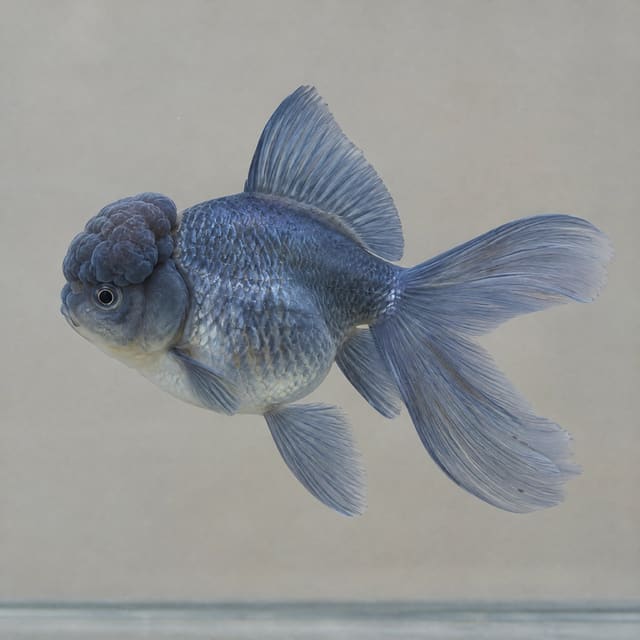
The red cap oranda is a white fancy goldfish with a bright red hood on its head, a round body and a long double tail. Choose a 5 cm youngster or an 8-10 cm fish. It needs an indoor coldwater aquarium of at least 100 litres for one adult, gentle flow and goldfish food. Sold individually.
Care at a Glance
Scientific Name
Carassius auratus
Max Adult Size
20–31 cm
Care Level
Moderate
pH Range
6.5–8.5
Diet
Omnivore: goldfish sticks or pellets, daphnia, brine shrimp, peas, blanched lettuce
Adult size is the maximum length this species reaches at full maturity (scientific sources). The livestock you receive will be younger and smaller — pick a size above for the actual shipping size. Product-photo provenance and any image-specific limitations are stated on the listing.
Too much to read? Just ask Aqua.
Aqua, our 24/7 AI assistant, can answer questions about Red Cap Oranda Goldfish (Carassius auratus). Talk or type.
Water Parameters
pH Level
6.5–8.5
6.5Guidance range8.5
Carassius auratus
Red Cap Oranda Goldfish (Carassius auratus)
Moderate Care
£20.89Sold Out
Shoal Pricing
— from £14.63 eachQuantity discounts are pricing offers, not a group-size recommendation. Check the full care guidance and your existing animals before choosing a quantity.
Your shoal
£167.20You save £41.70
Get a product-specific stock alert
Confirm your email, then we’ll send an availability message for this exact item if it returns within 180 days.
This request is only for this product—no newsletter or other promotions. A mail-provider retry may very rarely duplicate the same availability message. Unconfirmed addresses are removed after 48 hours. See our privacy policy.
- Live arrival guaranteed. Email photos the same day if anything is wrong. An unboxing video is optional; we recommend one when practical to help us review problems faster. How it works
- £19.95 delivery, half price from £100, free from £200, or free on the whole order with free delivery fish packs.
- Check our reviews (opens Google Business Profile in a new tab) on Google.
The red cap oranda is a white fancy goldfish with a bright red hood on its head, a round body and a long double tail. Choose a 5 cm youngster or an 8-10 cm fish. It needs an indoor coldwater aquarium of at least 100 litres for one adult, gentle flow and goldfish food. Sold individually.
Care at a Glance
Scientific Name
Carassius auratus
Max Adult Size
20–31 cm
Care Level
Moderate
pH Range
6.5–8.5
Diet
Omnivore: goldfish sticks or pellets, daphnia, brine shrimp, peas, blanched lettuce
Adult size is the maximum length this species reaches at full maturity (scientific sources). The livestock you receive will be younger and smaller — pick a size above for the actual shipping size. Product-photo provenance and any image-specific limitations are stated on the listing.
Too much to read? Just ask Aqua.
Aqua, our 24/7 AI assistant, can answer questions about Red Cap Oranda Goldfish (Carassius auratus). Talk or type.
Similar choices available now
Moderate
Advanced
Moderate

Water Parameters
Read the full care guidance when planning conditions for your aquarium.
pH Level
6.5–8.5
6.5Guidance range8.5
Bring home a red cap oranda, the white goldfish with a red crown
The red cap oranda is one of the most recognisable fancy goldfish: a snow-white body and fins topped by a bright red hood, as if the fish were wearing a cap. Wikipedia's summary of the oranda describes the red-cap as having a silverish white body with a prominent red head growth on the forehead. Underneath the colour it is a true oranda, with a round, deep body, a tall single dorsal fin and a long, divided double tail that drifts behind it as it swims. In a planted coldwater aquarium the contrast between the white body and the red crown stands out from across the room.
The red cap oranda is a domestic goldfish, Carassius auratus, of the carp family, Cyprinidae. Orandas are named after the Japanese Oranda-shishi-gashira, "Dutch lionhead", although the breed came from China. The red cap is one colour form among many: the same Wikipedia summary lists orange, red, red-and-white, red-and-black, black, blue, chocolate, bronze, white or silver orandas, plus panda, tri-colour and calico patterns. See the range in our oranda and fancy goldfish category.
Spot the difference from other red-and-white goldfish
| Fish | Where the red is | Hood |
|---|---|---|
| Red cap oranda (this fish) | On the hood only; body and fins white | Yes |
| Red and white oranda | Patches over the body, fins and head | Yes |
| Red Oranda | All over | Yes |
| Red and White Ryukin | Patches; deep, humped body | No |
Pick the size that suits you
This red cap oranda comes in two sizes. Each purchase is one live fish, sex not chosen, priced per fish at the size you select. The photographs show the colour form, prepared from a reference image; the size of the cap, the shape of the hood and the exact shade of red vary from fish to fish.
| Option | What you receive | Best for |
|---|---|---|
| 5 cm | A young fish with the white body and red on the head, its hood still to grow | Keepers who enjoy growing a fish on, and a lower starting price |
| 8-10 cm | An older fish with more of its hood and red cap showing | Keepers who want more of the adult look straight away |
Whichever size you choose, plan the aquarium for a 20 cm adult. Our delivery page explains dispatch days and the Live Arrival Guarantee; make sure the filter is mature before your fish arrives.
Watch the hood develop
The red cap sits on the oranda's hood, or wen. Li and colleagues (2025) studied how it forms: the skin of the head thickens with collagen-rich layers and multiplying skin cells, and small bony outgrowths appear on the skull beneath it. Practical Fishkeeping says the head growth of young orandas takes one to two years to develop, so a 5 cm fish will look very different a year after it arrives.
Follow a young red cap through its first two years
| Stage | What you should see | What helps |
|---|---|---|
| Arrival | White body, red on the top of the head, little hood | A calm, mature tank and small meals |
| First months | Steady growth in length and depth; the first bumps of hood | Clean water and a varied diet |
| End of year one | A clear hood with the red cap more defined | Regular water changes as the fish's waste increases |
| Year two | The hood filling out, as Practical Fishkeeping describes | Room to grow: at least 100 litres per adult |
Accept that the cap may change
Writing about ranchu, Practical Fishkeeping notes that a goldfish's colour can change almost completely as it matures and that many goldfish become whiter with age. On a red cap oranda, the red can spread, shrink, or appear in small patches on the body. Good water and a colour-rich food such as Tropical Goldfish Color help the red look its best, but no food can override the fish's genes.
Plan the aquarium for the adult fish
OATA says fancy goldfish are unlikely to grow past about 20 cm, but Practical Fishkeeping and Wikipedia give 20-31 cm for orandas, so a 5 cm red cap may become four to six times longer. OATA's rule is 100 litres for one adult fancy goldfish plus 50 litres for each additional adult. FishBase suggests groups of five or more in a tank at least 100 cm long, and Practical Fishkeeping suggests a tank length of at least six times the adult fish.
Work out your stocking
| Plan | Adult fish | Minimum volume (OATA) |
|---|---|---|
| One red cap oranda | 1 | 100 litres |
| A red cap with a Blue Oranda | 2 | 150 litres |
| Red cap, Red Oranda and Red and Black Oranda | 3 | 200 litres |
| A group of five fancy goldfish | 5 | 300 litres, on a base at least 100 cm long (FishBase) |
Check the real volume of your tank with our tank volume tool and the adult stocking in the stocking calculator.
Furnish it smooth and simple
OATA recommends smooth gravel or sand and warns against décor with sharp edges that can damage long fins and eyes. The hood needs the same care: Wikipedia notes that the wen is easily injured by rough objects and is prone to bacterial infection. Choose rounded pebbles, smooth wood and sturdy plants, and leave a wide open swimming area along the front of the tank.
Set out the tank like this
| Element | Choice | Why |
|---|---|---|
| Substrate | Smooth gravel or sand | Goldfish sift the bottom for food |
| Décor | Rounded stones and smooth wood | No sharp edges to cut fins or hood |
| Plants | Hardy, tough-leaved species | Goldfish nibble soft plants |
| Lighting | Overhead light on a timer (OATA) | A regular day and night |
| Position | Indoors, away from radiators, draughts and sun | Steady temperature |
Keep the water cool, clean and steady
| Value | Target | Source and notes |
|---|---|---|
| Temperature | 15-23°C ideal; tolerates 4-25°C | OATA. Wikipedia gives orandas 17-28°C and calls them sensitive to cold |
| pH | 6.5-8.5 | OATA |
| General hardness | 8-18°dH | OATA |
| Carbonate hardness | 5-15°dKH | OATA |
| Ammonia and nitrite | 0 mg/l | OATA |
| Nitrate | No more than 20 mg/l above tap water | OATA |
Find the overlap
Because the sources disagree on temperature, aim for 17-23°C, inside both OATA's ideal and the range Wikipedia gives for orandas. Most UK homes hold that without a heater, but an oranda should never be kept in a cold conservatory or a garden pond; OATA says fancy goldfish should be kept indoors. Compare your tap water with these values in our water matcher, and see our water chemistry guide for what each value means.
Filter well without strong current
Practical Fishkeeping calls good filtration essential for fancy goldfish because of their high waste output and oxygen demand, but asks for moderate flow because they are poor swimmers. OATA suggests a spray bar to spread the return. Pick a filter rated well above the tank volume and point the outlet along the surface. Our guide to aquarium filtration explains the choices, and a new tank must complete the nitrogen cycle before any fish go in.
Follow a weekly checklist
- Test ammonia, nitrite and nitrate.
- Change at least 25% of the water, as OATA recommends, with conditioned water at the same temperature.
- Siphon waste from the gravel, especially around the plants.
- Look closely at the hood for debris, white patches or redness.
- Once a month, rinse the filter media in removed tank water, never tap water.
Feed little and often enough
FishBase gives the wild diet of the species as plankton, bottom-living invertebrates, plant material and detritus. OATA recommends a goldfish-specific staple, because goldfish need more carbohydrate than many fish, fed once a day in an amount they finish within a few minutes, with daphnia, bloodworm, brine shrimp, blanched lettuce or shelled peas as extras.
- Staple: Super Goldfish Mini Sticks, small enough for a 5 cm fish.
- Colour support: Tropical Goldfish Color two or three times a week.
- Frozen: Daphnia and Spirulina Frozen for fibre and variety.
- Treat: freeze-dried brine shrimp, pre-soaked.
If the fish floats or tilts after eating, OATA suggests a slow-sinking food. Our article on a fish swimming sideways covers other possible causes.
Quarantine, then acclimatise slowly
OATA warns that fish can carry disease without showing it. Ito and Maeno (2014) found that goldfish herpesvirus caused disease most readily at 20-25°C and that fish infected in cooler water could survive and still carry the virus, a good reason to keep a new red cap in a separate tank for a few weeks before it joins other goldfish.
When it goes in, follow OATA's floating-bag method: lights off, float the sealed bag for about 10 minutes, add small amounts of tank water over up to 20 minutes, then net the fish across and discard the bag water. Our acclimatisation guide covers each step, and the first week is best spent watching appetite, swimming and the hood.
Choose companions that move at its speed
OATA recommends keeping fancy goldfish alone or with other fancy goldfish, not with common goldfish, which are faster, take the food and sometimes nip fins. Wikipedia adds that an oranda whose hood restricts its vision is best kept with other poor-sighted goldfish so it is not out-competed at feeding time.
| Suits | Avoid |
|---|---|
| Orandas of a similar size, such as our Red and Black Oranda | Comets, shubunkins and common goldfish (see our comet goldfish page) |
| Fantails such as the White Fantail Goldfish | Tropical fish that need a heater |
| Ryukins and other twin-tailed fancies | Fin-nippers and fish much larger than the oranda |
A young 5 cm red cap is best kept with fish of a similar size until it has grown. Check your plan in our tank mates checker, and browse goldfish and coldwater fish or our goldfish category for companions.
Keep an eye on hood and fin health
OATA lists the warning signs: hanging at the surface or sitting on the bottom, darkening or paling, more hiding, unusual breathing, white spots, fluffy growths, lost fins or scales, weight change and poor appetite. On a red cap, look at the hood every day; its folds can trap debris, and Wikipedia notes that a hood that grows too large can cover the eyes.
| Sign | First step |
|---|---|
| White spots like salt grains | Follow our white spot treatment guide |
| Ragged or split fins | Test the water and read our fin rot treatment guide |
| White, cotton-like patches in the hood | Improve water quality and get fish-health advice early |
| Hood growing over the eyes | Make sure the fish still finds its food; keep only slow tank mates |
Know the goldfish behind the red cap
FishBase gives East Asia as the native range of the species, and every fancy variety descends from fish domesticated there. Kon and colleagues (2020) sequenced 27 goldfish strains and linked regions of the genome to traits such as dorsal fin loss, long tails and telescope eyes. The red cap oranda's hood, double tail and white body with a red crown are the result of the same long history of selection.
Answer red cap oranda questions
What is a red cap oranda?
A fancy goldfish, Carassius auratus, with a white body and fins and a red hood on top of the head. Wikipedia describes it as having a silverish white body with a prominent red head growth on the forehead. It has the oranda shape: a round body, a tall dorsal fin and a long double tail.
Should I choose the 5 cm or the 8-10 cm red cap oranda?
The 5 cm fish is a youngster at a lower price, with its hood only just starting. The 8-10 cm fish is older, with more of its hood and red cap already showing, so you can see more of the adult look. Both need the same adult-sized aquarium in the end.
Will a 5 cm red cap oranda already have a red hood?
It will show the white body and some red on the head, but the hood itself takes time. Practical Fishkeeping says the head growth of young orandas takes one to two years to develop.
Can the red cap change colour or spread?
It can. Practical Fishkeeping notes that goldfish colours can change almost completely as they mature and that many goldfish become whiter with age. A cap may grow, shrink or gain red patches elsewhere on the body.
How big does a red cap oranda grow?
OATA says fancy goldfish are unlikely to grow past about 20 cm; Practical Fishkeeping and Wikipedia give 20-31 cm for orandas. Plan for a fish of at least 20 cm.
How many litres does a red cap oranda need?
OATA advises 100 litres for the first adult fancy goldfish and 50 litres for each extra adult. Two adult orandas need at least 150 litres.
Is a red cap oranda a good first fancy goldfish?
Yes, if you are prepared for its needs: a large indoor tank, a good filter with gentle flow, weekly water changes and only slow fancy goldfish as company. The hood needs clean water and smooth décor to stay healthy.
Why is my red cap oranda floating after meals?
Fancy goldfish can swallow air when they eat at the surface. OATA suggests switching to a slow-sinking food. If the problem continues, check the water and read our guide to fish swimming sideways.
Check the sources behind this guide
- OATA: How to look after fancy goldfish - UK trade guidance on water values, tank size, décor, filtration, feeding, tank mates, acclimatisation and health signs.
- FishBase: Carassius auratus - species record: native range, water ranges, wild diet and aquarium group size.
- Practical Fishkeeping: How to get fancy with goldfish - oranda size, hood development, tank-size rule, filtration, flow and water changes for fancy goldfish.
- Practical Fishkeeping: Ranchu, king of goldfish - colour change as goldfish mature, including fish becoming whiter with age.
- Wikipedia: Oranda - summary of the oranda: the name, colour forms including red-cap, temperature tolerance and hood (wen) problems.
- Li et al. 2025, Research 8: 0786 - study of how the goldfish hood forms from thickened, collagen-rich skin.
- Kon et al. 2020, Current Biology 30: 2260-2274 - genome study of 27 goldfish strains linking DNA regions to fancy traits.
- Ito & Maeno 2014, Diseases of Aquatic Organisms 110: 193-200 - goldfish herpesvirus (CyHV-2) at different water temperatures.
Customer Reviews
No reviews for this item yet. Bought one? Honest reviews only, good or bad.
What customers say about ordering from us
4.7 on Google Maps, rated 4.7 out of 5 (opens in a new tab)4.4 · 123 shop reviews read them, rated 4.4 out of 5
- 5 out of 5Verified buyer
Easy website plenty of info on fish your buying great to pick a time slot
TRACEY DURRANT · 7 Oct 2026
- 4 out of 5Verified buyer
Got some lovely fish thank you
Kevin Mackie · 7 Oct 2026
Reviews of our shop, collected by Judge.me, an independent third-party review collector. Newest first.
Licensed Courier
Moved by UK carriers licensed to handle live animals
Trained Packing
Hand-packed with oxygen bags, poly box, heat pack
Live Arrival Guarantee
Email photos the same day; an optional unboxing video helps us review problems faster — claim terms apply
Pay Later Available
Klarna & PayPal Pay in 3 at checkout