Moderate
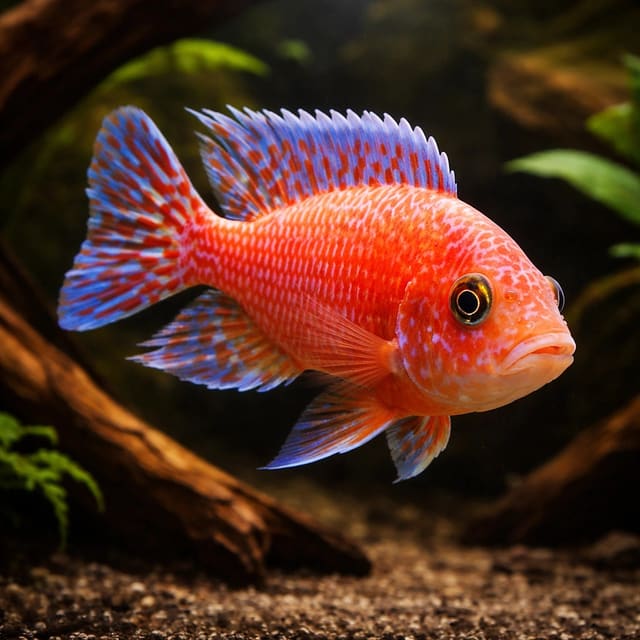
Acei Cichlid (Pseudotropheus sp. “acei”)
24–26°C · pH 7.5–8.5 · 300L
£7.99

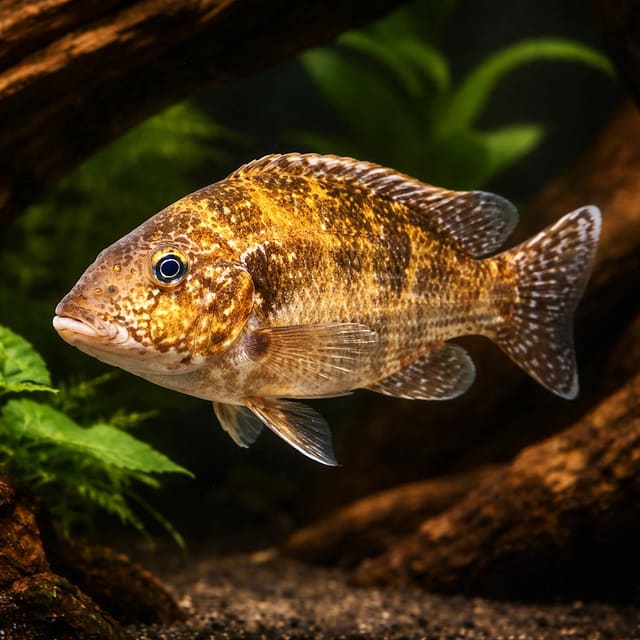
The Livingston's Hap (Nimbochromis livingstonii) is a predatory cichlid from Lake Malawi, the upper Shire River and Lake Malombe that reaches 25 cm. It suits keepers who can provide about 205 litres or more on a 120 × 45 cm base, keep it as a solitary specimen, and maintain the FishBase, Seriously Fish and OATA overlap of 25–27°C, pH 8.0 and 12–18 dGH. Sold individually in 4–5 cm, 6–7 cm, 7–9 cm and XL sizes.
Adult size is the maximum length this species reaches at full maturity (scientific sources). The livestock you receive will be younger and smaller — pick a size above for the actual shipping size. Product-photo provenance and any image-specific limitations are stated on the listing.
Nimbochromis livingstonii
Save when buying multiple fish. Each quantity is one fish; sex and pair formation are not guaranteed unless the selected variant explicitly states them.
The Livingston's Hap (Nimbochromis livingstonii) is a predatory cichlid from Lake Malawi, the upper Shire River and Lake Malombe that reaches 25 cm. It suits keepers who can provide about 205 litres or more on a 120 × 45 cm base, keep it as a solitary specimen, and maintain the FishBase, Seriously Fish and OATA overlap of 25–27°C, pH 8.0 and 12–18 dGH. Sold individually in 4–5 cm, 6–7 cm, 7–9 cm and XL sizes.
Adult size is the maximum length this species reaches at full maturity (scientific sources). The livestock you receive will be younger and smaller — pick a size above for the actual shipping size. Product-photo provenance and any image-specific limitations are stated on the listing.
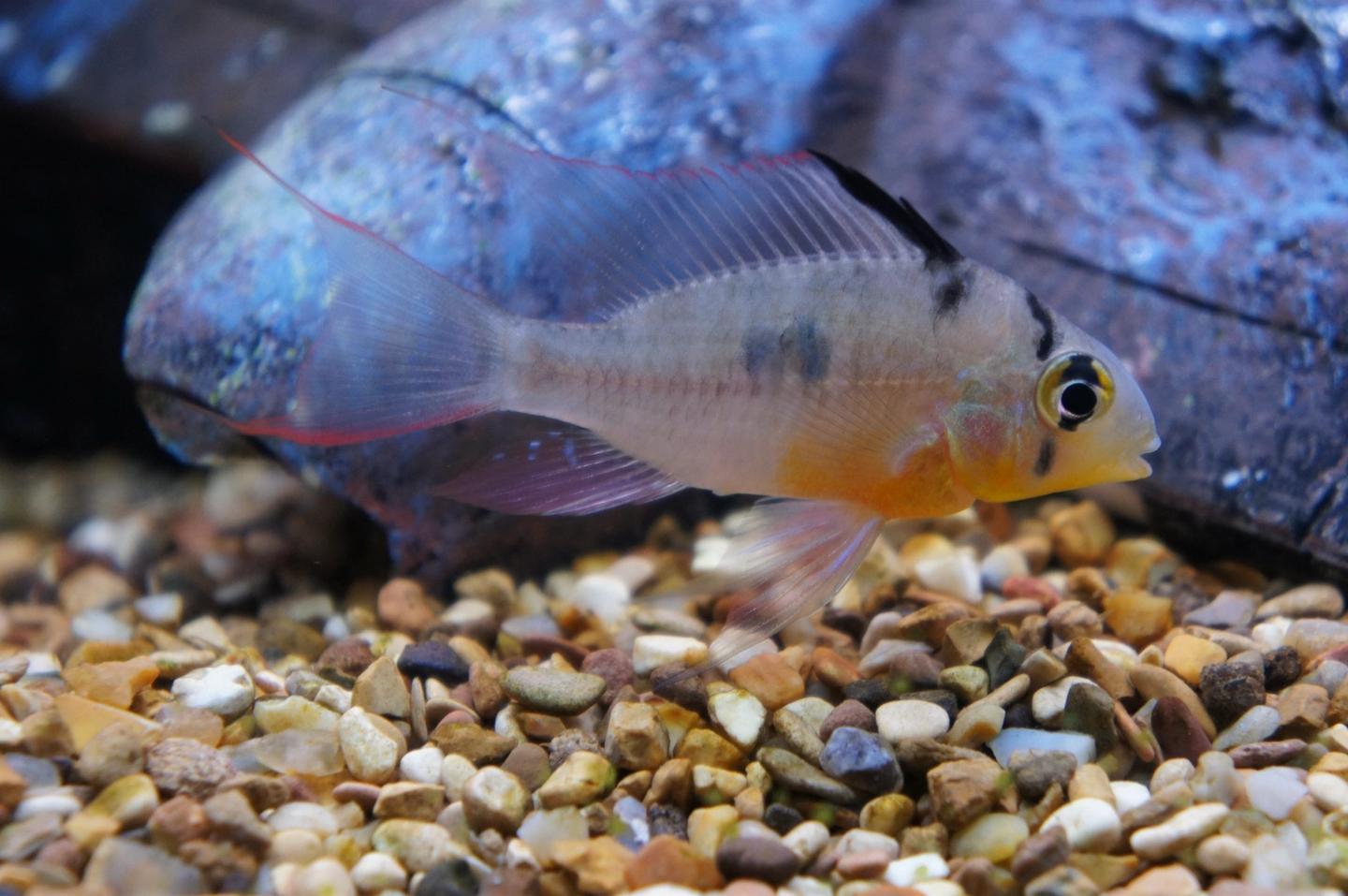
Cichlids are a family of roughly 1,800 accepted species, not one care type. Before buying, identify the exact species and source, then compare adult measurement, usable tank dimensions, social system, territory, tested water, diet and an exit plan. No family-wide minimum tank, water range or tank-mate list is safe.
Maintain these water conditions for optimal health and vibrant colors
The Livingston's Hap (Nimbochromis livingstonii) is a large freshwater cichlid from Lake Malawi, the upper Shire River and Lake Malombe in Africa. FishBase places it in the cichlid family and lists a maximum length of 25 cm total length. It is a predatory, usually solitary and territorial fish for a keeper prepared to provide a large, hard-water aquarium and screen every companion by adult size.
Seriously Fish notes that it is not a fish for the general Malawi cichlid community. The decisive questions are whether the aquarium has the required footprint, whether its water can remain hard and alkaline, and whether every other fish will remain too large to be treated as prey.
| Suits | Not suited to |
|---|---|
| Aquariums of about 205 litres or more with a base of at least 120 × 45 cm | Small aquariums planned around the fish's dispatch size |
| Hard, alkaline water maintained at 25–27°C, pH 8.0 and 12–18 dGH | Soft or acidic community conditions |
| Solitary keeping or a carefully planned breeding harem | Casual small groups that create territorial conflict |
| Large Rift Lake companions that cannot be swallowed | Smaller mbuna, young fish or other prey-sized fish |
You can compare the broader African cichlid collection before deciding whether this specialised predator matches the aquarium you are planning.
Plan for a 25 cm adult from the beginning. FishBase gives 25 cm total length, while Seriously Fish gives 25 cm standard length in its aquarium planning figures.
Use an aquarium with a base of at least 120 × 45 cm and a volume of about 205 litres or more. The footprint matters because this robust cichlid needs room for caves, open water and territorial separation. A tall aquarium with a narrow floor does not offer the same layout choices as a tank with the stated base dimensions.
One purchase supplies one Livingston's Hap in the size selected. The live size selector uses the labels 4–5 cm, 6–7 cm, 7–9 cm and XL. The size you select is the size supplied, not the adult size. Use the selector to choose a dispatch size that fits your stocking plan, while preparing the aquarium for a fish that reaches 25 cm.
A larger dispatch grade does not change the species' adult requirements. It also does not determine sex, temperament or origin. Match the selected fish against the present sizes of its intended companions as well as their eventual sizes: a companion that will be large later can still be vulnerable while young.
Sex is guaranteed only when the selected option explicitly states male or female. This Livingston's Hap listing has no sex-guaranteed option.
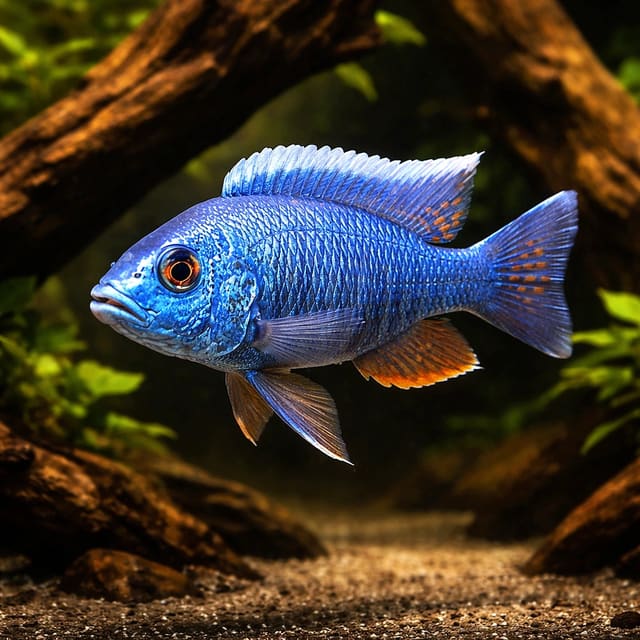
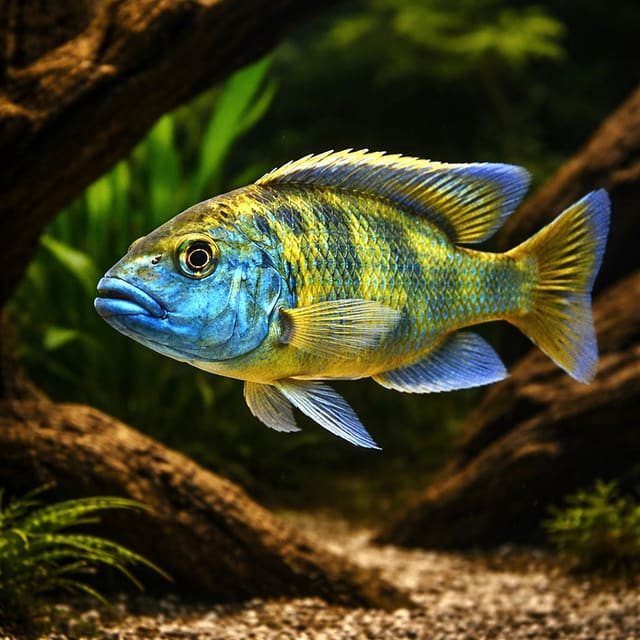
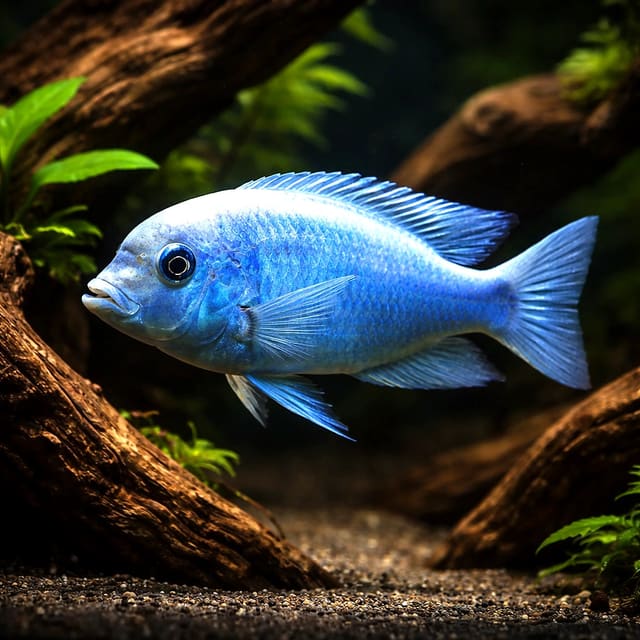
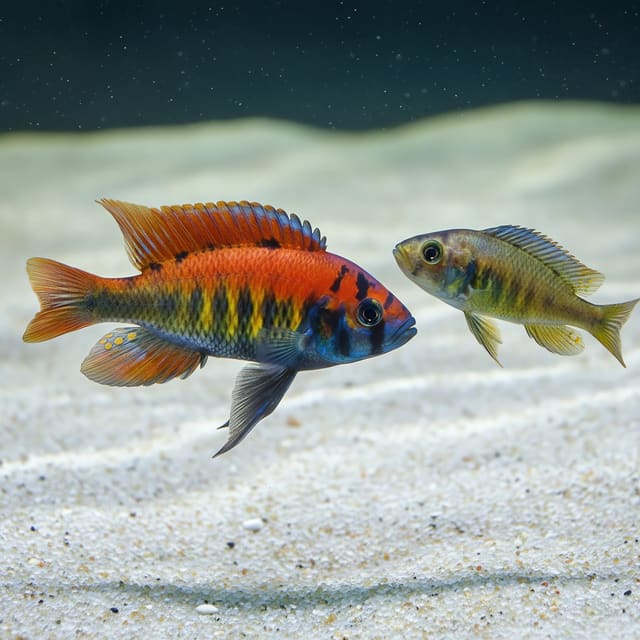
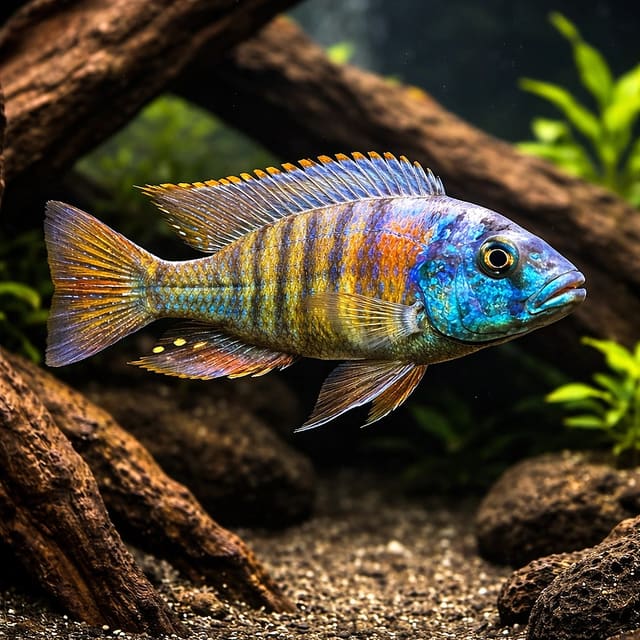
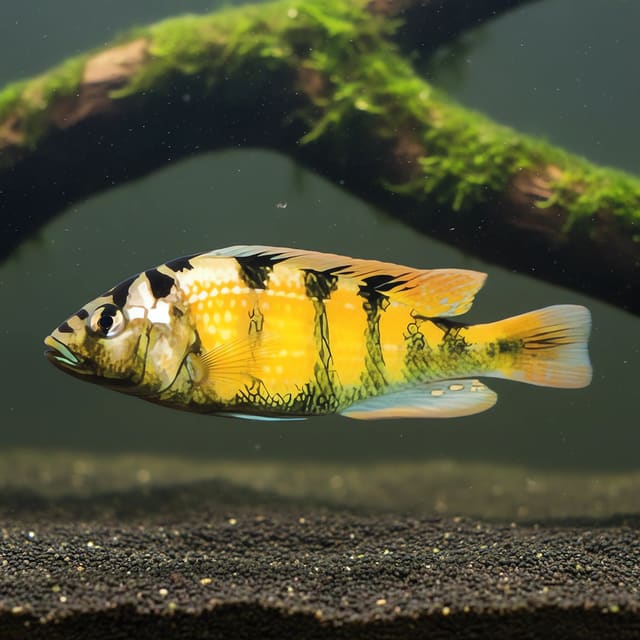
The gallery images are representative, based on reference photographs of this species, so colours can look slightly different from the live animal.
Its mottled appearance supports an unusual hunting method. In the wild, the fish may lie motionless and appear dead until a small fish approaches, then seize the prey. FishBase records it in all kinds of habitats, most commonly vegetated areas of sheltered bays; it prefers soft, muddy bottoms but is also seen in purely rocky environments. This combination explains why an aquarium should provide cover without sacrificing open swimming room.
Arrange piles of rock to form caves, leave substantial open water for swimming and use a sandy substrate. Seriously Fish recommends this combination for Nimbochromis livingstonii, with dense patches of Vallisneria as an optional way to echo the vegetated parts of its natural habitat. The aquarium should not have a strong current.
Begin with the tank footprint rather than filling the aquarium with rock and judging the remaining space afterwards. On a 120 × 45 cm base, place stable rock structures so the fish can pass around them without being forced through one narrow route. Retain a clear open zone instead of turning the entire floor into caves.
| Feature | Purpose |
|---|---|
| Rock caves | Provide structure, cover and boundaries between usable areas |
| Open water | Preserves swimming room for a fish reaching 25 cm |
| Sand | Matches the recommended substrate and allows a natural floor layout |
| Vallisneria patches | Add dense planted cover without occupying every open area |
| Moderate flow | Supports filtration without creating a strong current |
Make rock piles stable before the fish enters the aquarium. OATA's group guidance notes that Malawi cichlids will often dig and rearrange the substrate, which will uproot any plants present. Do not rely on loose sand to hold heavy structures upright. Keep caves large enough to remain usable as the fish grows, and leave access around equipment for maintenance.
When companions are included, create more than one visually distinct area. A single dominant cave can become the focus of territorial pressure. Several separated structures give fish routes around one another, but décor cannot make prey-sized tank mates safe. The final stocking decision must still be based on adult size and predatory behaviour.
Keep the aquarium at 25–27°C, pH 8.0 and 12–18 dGH. These values are the overlap of FishBase's environmental figures, the Seriously Fish aquarium range and OATA's Malawi cichlid group guidance. OATA also gives hard carbonate hardness of 10–15 dKH for the group.
Use the same test methods consistently and act on trends rather than waiting for a visibly distressed fish. The water chemistry guide explains the roles of the main measurements, while the water matcher helps compare measured values with the target range.
The nitrate instruction is relative to the incoming water. If conditioned tap water measures 10 mg/l nitrate, the OATA ceiling is 30 mg/l in the aquarium. If the tap-water result changes, recalculate from the new baseline instead of treating 30 mg/l as a permanent target.
Test replacement water as well as the aquarium when results move unexpectedly. That comparison distinguishes a change entering with the tap water from one developing inside the tank. Make adjustments through measured preparation and routine maintenance; repeated large swings in temperature, pH or hardness work against the stable conditions this cichlid needs.
Run a mature biological filter before adding the fish. The RSPCA explains that fish release toxic ammonia and that an established biological filter supports bacteria that convert ammonia to nitrite and then to the safer nitrate. A new aquarium should therefore be prepared and matured before livestock arrives; our first tropical aquarium guide covers that preparation.
Seriously Fish recommends filtration turnover of four to five times the aquarium volume each hour. For its approximately 205-litre example, that means a filter rated around 820–1,025 litres per hour. Apply the same calculation to the actual aquarium: a 300-litre tank needs a nominal four-to-five-times range of about 1,200–1,500 litres per hour.
Rated flow is a planning figure. Media, pipework and the installed layout affect how water moves, so confirm that the aquarium has circulation without creating the strong current this species should avoid. OATA recommends an oversized filter and vigorous aeration for crowded Malawi communities because both waste processing and dissolved oxygen demand rise with stocking.
For an aquarium of about 205 litres in a room around 20°C, Seriously Fish estimates roughly 125–175 W of heating divided across two heaters. Recalculate for a different aquarium volume or room temperature rather than copying that wattage unchanged. Place and operate heating so the measured aquarium temperature remains within 25–27°C.
Base the diet on suitable meaty aquatic foods such as prawns, lancefish and whitebait. FishBase identifies the wild diet as fish, while Seriously Fish describes the species as an exclusive piscivore in nature and recommends those dead foods for aquarium feeding. Live feeder fish are unnecessary because Livingston's Hap accepts dead food readily.
Do not feed animal meat of any kind. Use the named aquatic foods and vary them within that meaty diet rather than depending on one item at every meal. Choose pieces the fish can take promptly; large leftovers increase waste without improving nutrition.
Feed only what the fish can consume within a few minutes, twice a day. This timing and portion rule comes from OATA's Malawi cichlid guidance. Watch the food disappear rather than estimating the ration once and repeating it regardless of appetite, fish growth or water temperature.
Reduced appetite is an observation cue, not a reason to add extra food. Test water quality when feeding behaviour changes, because ammonia, nitrite or deteriorating conditions may accompany a loss of interest. Also compare body condition over time: both weight loss and increasing condition can indicate that the portion needs attention.
Predatory behaviour does not require live prey in the aquarium. Avoid introducing small fish as food; doing so is unnecessary for acceptance of dead foods and would make feeding quantity harder to control. A measured meal also allows uneaten material to be removed before it contributes to nitrate and filter load.
Change 25% of the water at least once every week. OATA strongly recommends this frequency and percentage for Malawi cichlids, together with testing for ammonia and nitrite at least once a week. Treat all replacement tap water with a conditioner that removes chlorine or chloramine before adding it to the aquarium.
Use the water change to remove solid waste from the substrate and accessible spaces around rocks. A siphon helps lift debris from sand or gravel without requiring the whole layout to be dismantled. Check behind structures where food and waste can collect, while preserving stable caves and boundaries.
When filter media needs cleaning, rinse it lightly in aquarium water removed during the water change, never under the tap, because any chlorine or chloramine present may kill the beneficial bacterial population.
Weekly results should guide the next action. Any ammonia or nitrite reading requires immediate attention to water quality and biological filtration. If nitrate approaches 20 mg/l above the tap-water baseline before the next scheduled change, review feeding, waste removal, stocking and the water-change routine.
A large fish and its companions can produce a substantial waste load even when the water looks clear. Visual clarity is therefore not a substitute for testing. The combination of measured chemistry, partial water changes, controlled feeding and maintained filtration keeps the aquarium within the planned conditions.
Arrange for someone to receive the live-fish parcel so it is not left unattended. The fish is hand-bagged in pure oxygen, placed in an insulated box and packed with a heat pack when weather conditions call for one. Tracking and the confirmed delivery date are sent by email.
If anything has gone wrong, contact us the same day your fish arrive with your order number and the unboxing video; the complete claim conditions appear in the delivery and Live Arrival Guarantee policy.
Prepare the aquarium before the parcel arrives. Have the water holding 25–27°C, pH 8.0 and 12–18 dGH before the fish arrives. OATA advises checking that ammonia and nitrite are both zero mg/l before adding fish. Rockwork must be secure and the intended introduction plan settled before the parcel is opened.
After release, observe the individual rather than judging it against one fixed pose. OATA notes that healthy fish normally show clear, bright eyes, undamaged fins, intact scales and appropriate swimming. Compare breathing, posture and movement over time, because transport and a new territory create a transition that must be watched carefully.
Add no further livestock until the biological filter and existing fish have remained stable under the changed waste load. OATA advises increasing fish numbers slowly because beneficial bacteria need time to respond when feeding and waste production rise.
Know the fish's normal swimming, colour, breathing, appetite and territorial routine. A change from that individual baseline is often more useful than comparing it with another Livingston's Hap, especially because colour and behaviour vary between fish and situations.
OATA highlights several changes that merit attention: hanging at the surface, sitting on the bottom, erratic swimming, becoming darker or paler, hiding more than usual, altered aggression, faster or slower gill movement, white spots, fluffy growths, damaged fins or scales, bumps, weight change and reduced feeding.
Correct a measurable husbandry problem through the established maintenance routine. Condition replacement water, preserve biological filter media and avoid making several uncontrolled chemistry changes at once. If ammonia or nitrite appears after a new addition, treat the increased waste load as a central concern rather than assuming the filter has already adjusted.
Territorial behaviour requires a separate assessment from feeding behaviour. Remaining motionless can be part of this species' ambush strategy, but bottom-sitting that is new for this fish, or that comes with breathing, colour or appetite changes, warrants a water and health check. Likewise, predatory stalking of a smaller fish is a compatibility problem, not enrichment.
Contact us for further guidance if concerning changes continue after checking water quality, filtration and aggression. Give the measured values and describe the change from the fish's normal behaviour so the next step can be based on concrete observations.
Keep Livingston's Hap only with fish too large to be considered food and able to share its hard, alkaline conditions. Seriously Fish describes it as predatory but generally peaceful with species that are too large to eat. It will eat smaller mbuna and young fish, so avoid both.
Named examples from Seriously Fish include Frontosa, Dimidiochromis compressiceps, larger mbuna and other large Rift Lake species. These are categories for assessment, not automatic matches. Compare each proposed fish's adult size, present size, water requirements and territorial behaviour before mixing it with a 25 cm predator.
| Candidate | Decision |
|---|---|
| Smaller mbuna or young fish | Avoid because they may be eaten |
| Frontosa | Consider only after checking size, water and space |
| Dimidiochromis compressiceps | Consider only in a suitably planned large Rift Lake aquarium |
| Larger mbuna | Assess present size, adult size and territorial behaviour |
| Other large Rift Lake species | Screen individually rather than treating the category as universally compatible |
| Some Synodontis catfish | OATA permits some species with Malawi cichlids; assess the particular species and adult size |
Do not use future growth to justify a risky introduction. If a juvenile companion can fit into the predator's mouth now, its eventual adult dimensions do not protect it. The same principle applies when adding a smaller Livingston's Hap to an aquarium of established large cichlids: evaluate whether it can avoid aggression and reach food at its present dispatch size.
Water compatibility is necessary but not sufficient. Two fish can both suit hard alkaline water yet differ sharply in predation risk, territory use or current preference. Ask us for stocking advice, giving the aquarium dimensions, measured water, décor and the present and adult sizes of every proposed fish.
A larger aquarium creates more room to separate sight lines and place territories, but litres alone do not make a combination safe. A poor mix of fish can still produce predation or territorial pressure in a spacious tank. Start with adult dimensions and behaviour, then decide how much usable floor area remains after rocks and equipment are fitted.
Keep one Livingston's Hap as the normal aquarium arrangement. FishBase describes the wild fish as usually solitary and territorial, and Seriously Fish recommends a solitary specimen unless a breeding harem is being attempted.
A breeding harem is a deliberate exception, not a casual small group. Seriously Fish recommends one male with three to six females, kept alone as a breeding group, and describes reproduction as not easy. The breeding aquarium should be at least 48 inches long and follow the species layout, with large flat rocks as potential spawning sites and Vallisneria planting.
Do not build a harem by guessing sex from dispatch size, gallery colour or a brief view of a juvenile. Seriously Fish notes that adults can be hard to find, so a breeding group may have to start as 6–8 juveniles grown on together, in an aquarium with space for several large fish. The ordinary purchase unit remains one fish, so calculate the full adult biomass and territory plan for every individual involved.
Rearranging rockwork may reduce aggression by making fish establish territories again, but it does not remove the predator's feeding biology. Separate any fish that is being treated as prey, persistently trapped or prevented from feeding.
OATA's recommendation for communities of at least 15 Malawi cichlids is broad community guidance and should not replace this species' solitary recommendation. A heavily stocked community also demands an aquarium, filter and aeration system designed for the resulting adult fish and waste load.
Livingston's Hap reaches 25 cm. FishBase gives 25 cm total length, so plan every part of the aquarium around a large adult rather than the selected dispatch size.
Use an aquarium of about 205 litres or more with a base of at least 120 × 45 cm, leaving room for rock caves, open water and a sandy substrate.
Keep one solitary specimen for routine care. A deliberate breeding harem is one male with three to six females, kept alone in a suitably planned breeding aquarium.
It demands careful adult-size, predation, territory and hard-water planning, so it is better suited to a keeper prepared to manage a 25 cm predatory Malawi cichlid.
Feed suitable meaty aquatic foods such as prawns, lancefish and whitebait. Give only what it can finish within a few minutes, twice daily, and do not feed animal meat.
Keep it at 25–27°C and pH 8.0, with general hardness of 12–18 dGH. These values are the overlap of FishBase, Seriously Fish and OATA guidance.
It is usually solitary and territorial and will eat smaller fish, but Seriously Fish describes it as generally peaceful with species too big to be considered food.
Potential companions include Frontosa, Dimidiochromis compressiceps, larger mbuna and other large Rift Lake fish that are too big to eat; assess each proposed combination individually.
It is hand-bagged in pure oxygen, insulated and carried by a licensed live-animal courier. Be present to receive it, start filming while the parcel is still sealed, open it continuously with the fish still in the bag, then float the bag for 20–30 minutes before release.
No reviews for this item yet. Bought one? Honest reviews only, good or bad.
What customers say about ordering from us
I have a small group of long finned mountain minnows. So was delighted to be able to order ten of this variety to increase the genetics in my tank . The ones I recieved are healthy but it’s to early to give a verdict on wether they are of a long finned type since they are small currently.
Gordon Walker · 23 Sept 2026
100% success travel and "installation". Pleased with quality of purchase. The Siamese fighter a bit "shy" so have not yet seen him at his best yet but looking good. Happy customer. GG
George E Garratt · 21 Sept 2026
Reviews of our shop, collected by Judge.me, an independent third-party review collector. Newest first.