−13%
Moderate
Crowntail Male Betta (Betta splendens)
26–28°C · pH 6–8 · 20L
£12.17£13.99

The Big Ear Plakat Male Betta Mix (Betta splendens) is an ornamental labyrinth fish from an Asian species of the Mekong basin that reaches 6.5 cm. It suits a careful keeper with at least 20 litres for one male; Tropical Fish Co uses 26–28°C as its routine target, while OATA’s broad Betta guidance gives pH 6.0–8.0 and 4–12 dGH. Sold individually as one male fish.
Adult size is the maximum length this species reaches at full maturity (scientific sources). The livestock you receive will be younger and smaller. Product-photo provenance and any image-specific limitations are stated on the listing.
Betta splendens
The Big Ear Plakat Male Betta Mix (Betta splendens) is an ornamental labyrinth fish from an Asian species of the Mekong basin that reaches 6.5 cm. It suits a careful keeper with at least 20 litres for one male; Tropical Fish Co uses 26–28°C as its routine target, while OATA’s broad Betta guidance gives pH 6.0–8.0 and 4–12 dGH. Sold individually as one male fish.
Adult size is the maximum length this species reaches at full maturity (scientific sources). The livestock you receive will be younger and smaller. Product-photo provenance and any image-specific limitations are stated on the listing.
For one typical domestic Betta splendens, start with at least 20 litres, a mature filter, thermostatic heater, separate thermometer, gentle flow, a secure lid with surface access, and plants or refuges. Keep one male per aquarium.
Maintain these water conditions for optimal health and vibrant colors
The Big Ear Plakat Male Betta Mix is an ornamental Betta splendens, a labyrinth fish in the family Osphronemidae. The wild species occurs in Asia’s Mekong basin, and FishBase records a maximum length of 6.5 cm. This male suits a careful keeper who can prepare a mature, heated and gently filtered aquarium, test the water and provide a dedicated territory.
“Big ear” refers to the form’s enlarged pectoral fins, while “plakat” is the trade term for a short-finned form. Domestic Bettas vary widely in colour and finnage, so use those words to understand the intended form rather than expecting one fixed pattern.
This is a territorial fish with a specialised organ that lets it take atmospheric air at the surface. That ability never replaces filtration, heating or clean water. It means the aquarium must combine a secure cover with clear surface access and a small air space beneath the lid.
FishBase places Betta splendens in the family Osphronemidae, while NCBI Taxonomy also lists the accepted scientific name. FishBase records the wild species in standing waters, floodplains, canals, rice paddies and rivers. Its wild diet includes zooplankton, mosquitoes and other insect larvae. These details explain the value of calm flow, cover and small animal-based foods, while the domestic aquarium routine below uses dedicated husbandry guidance.
Our care assessment is intermediate. A careful first-time keeper can succeed, but only after preparing a mature aquarium, learning to test water and accepting that a male normally needs his own territory. For the complete background to those decisions, read our Betta Fish Care Guide.
One purchase supplies one animal. Plan the aquarium around the adult measurements.
Sex is guaranteed only when the exact product or selected option explicitly states male or female. This Big Ear Plakat Male Betta Mix listing is sold as male.
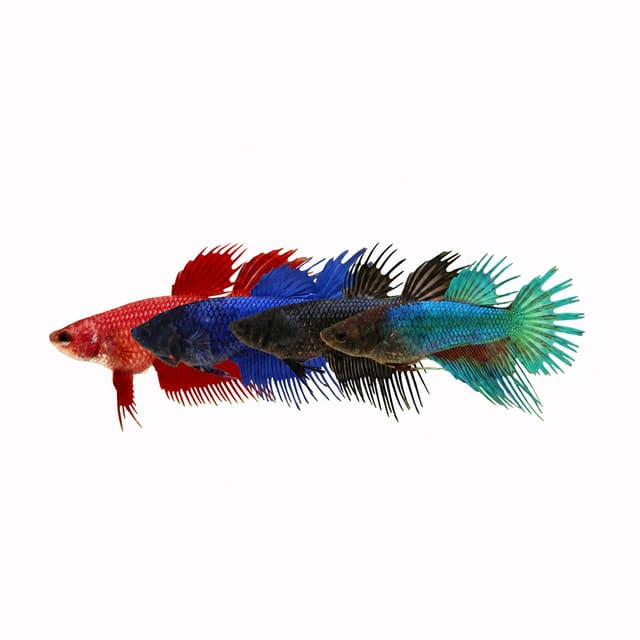
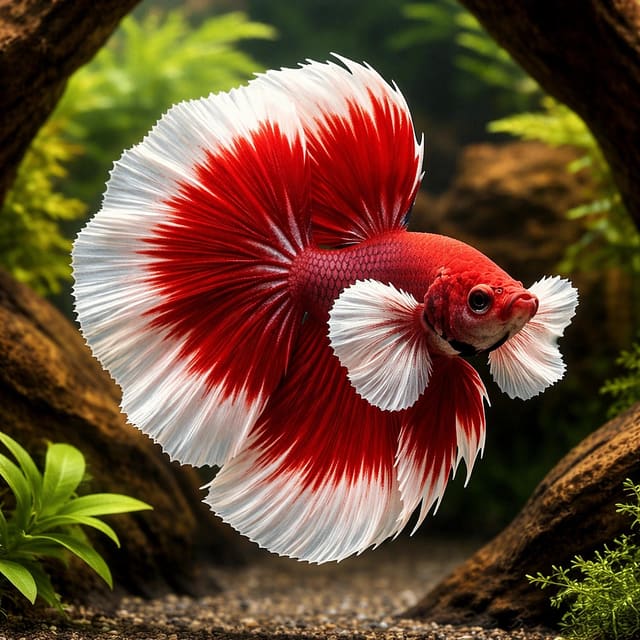
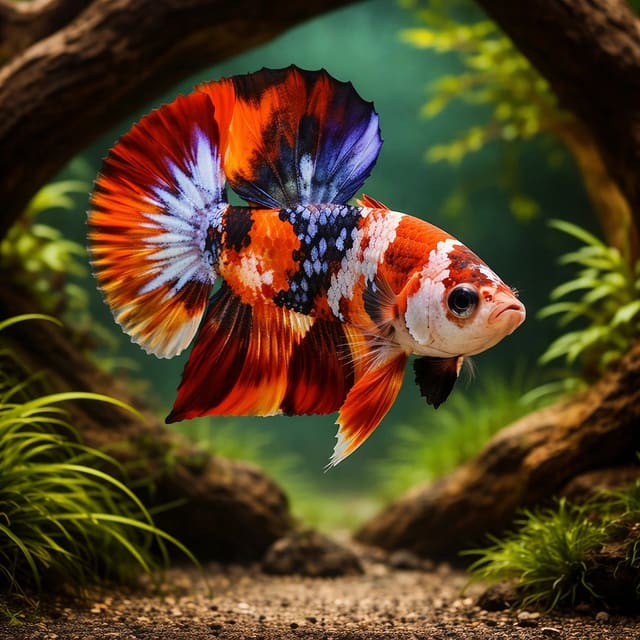
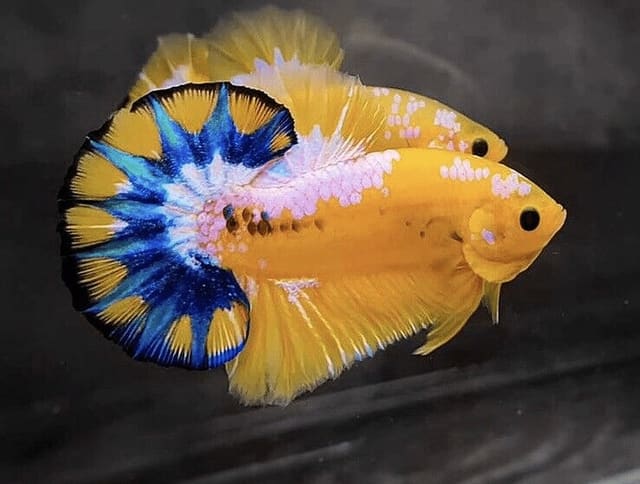
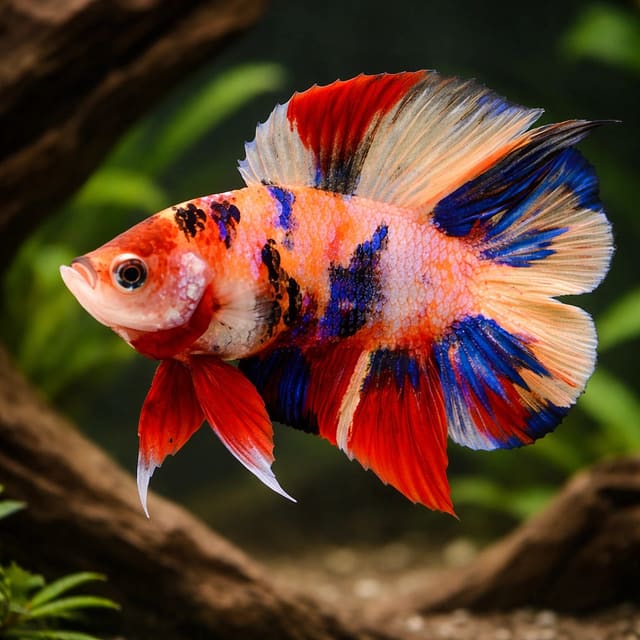
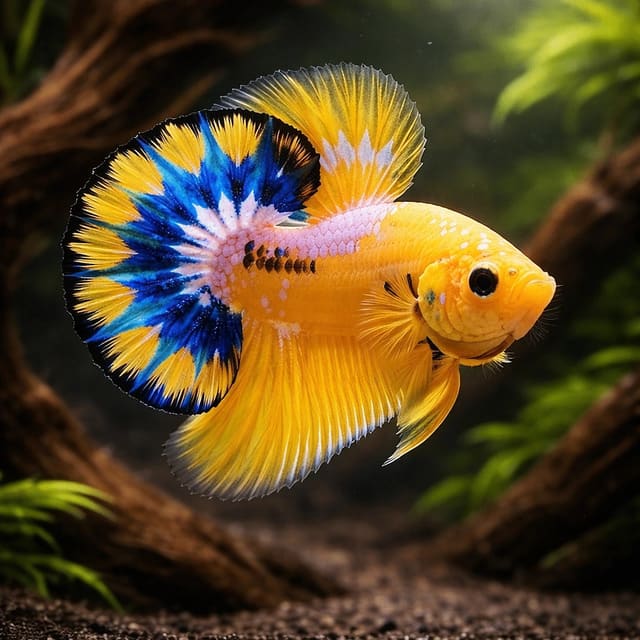
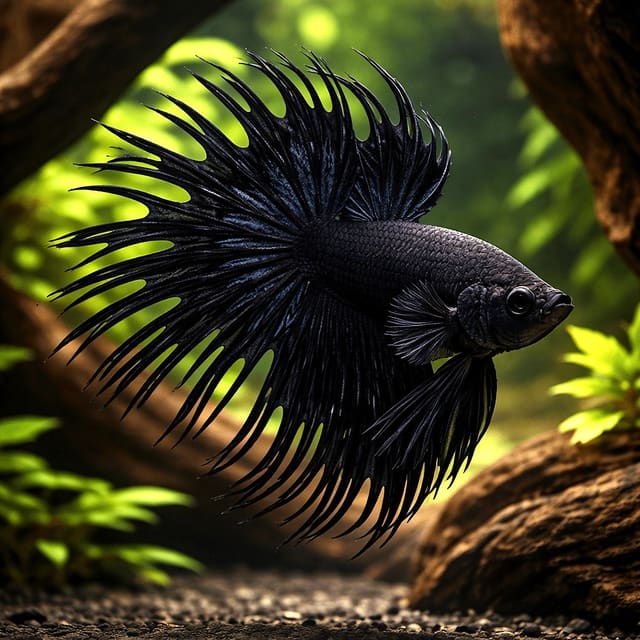
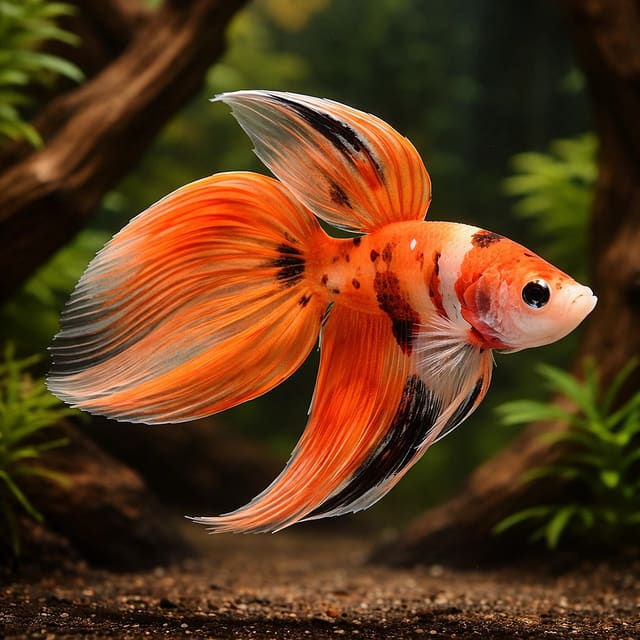
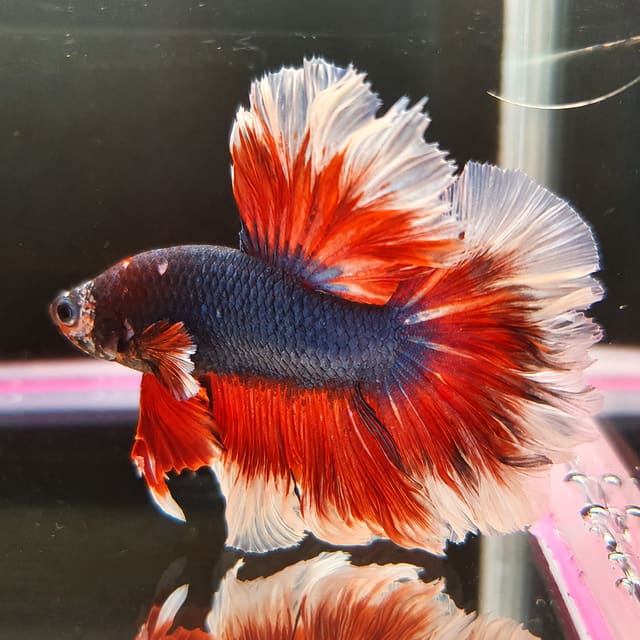
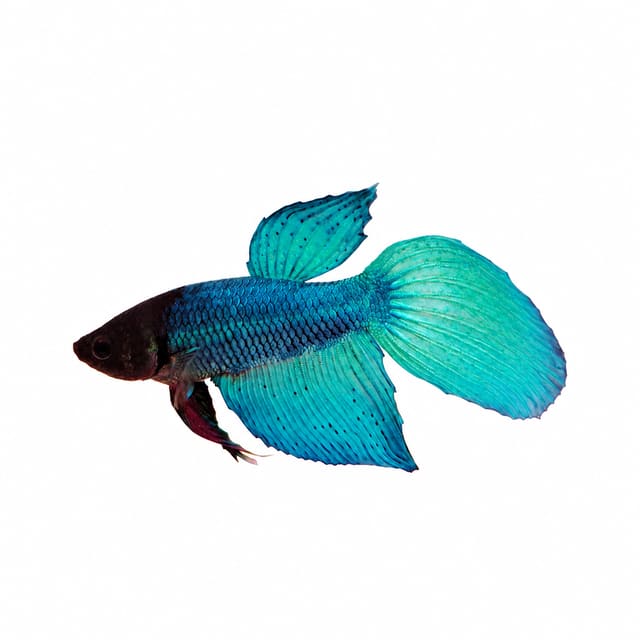
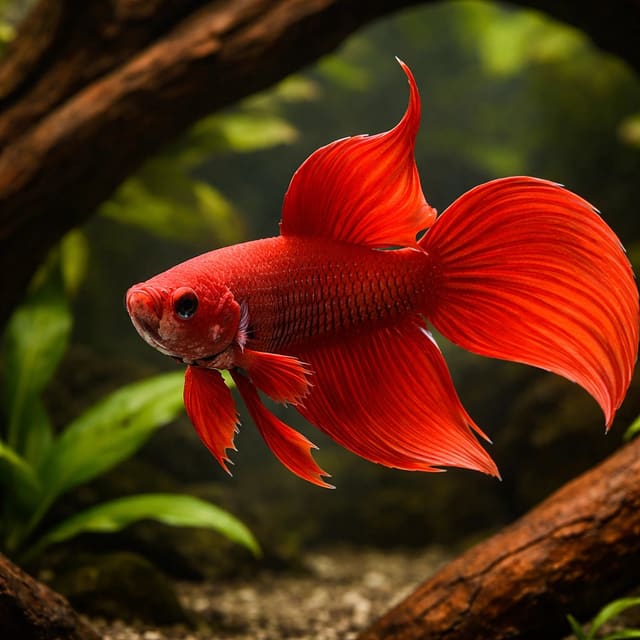
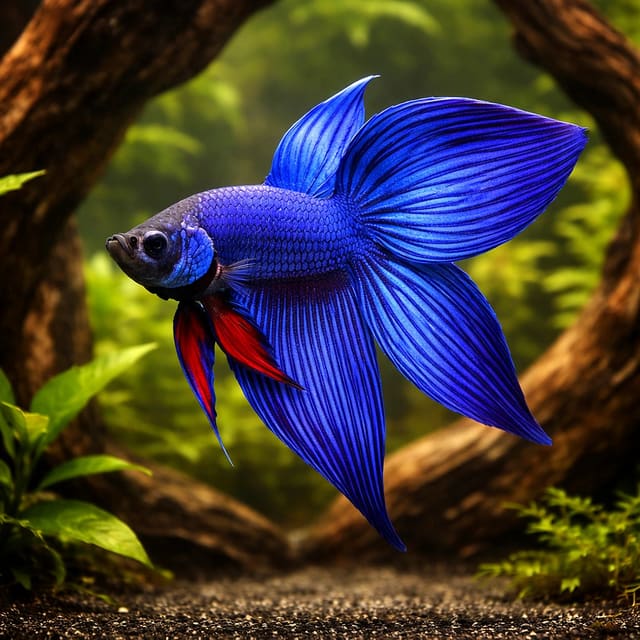
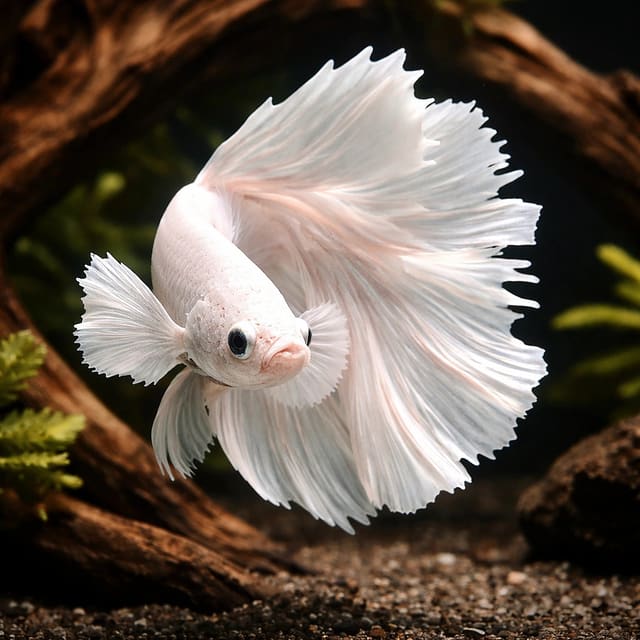
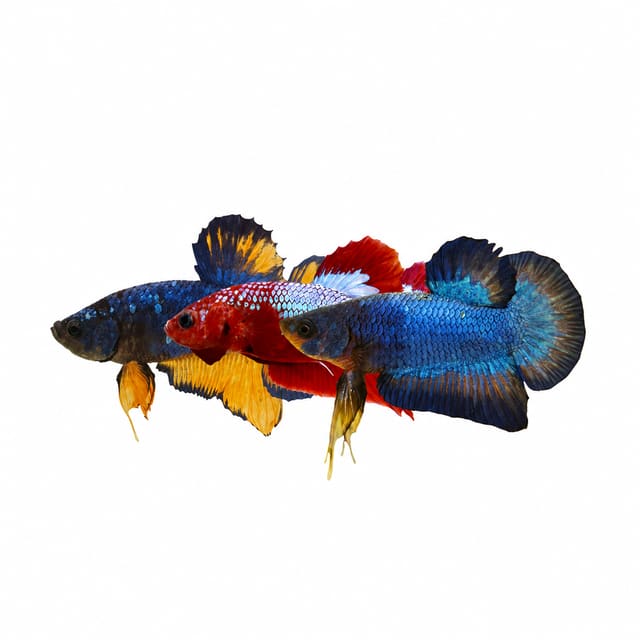
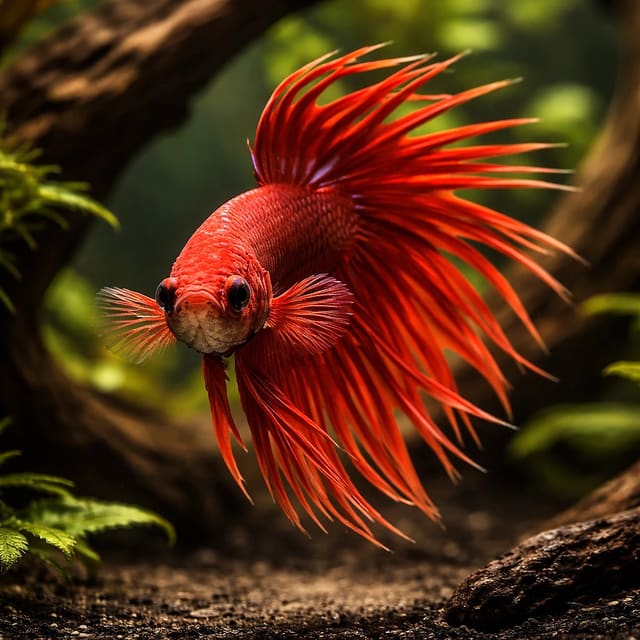
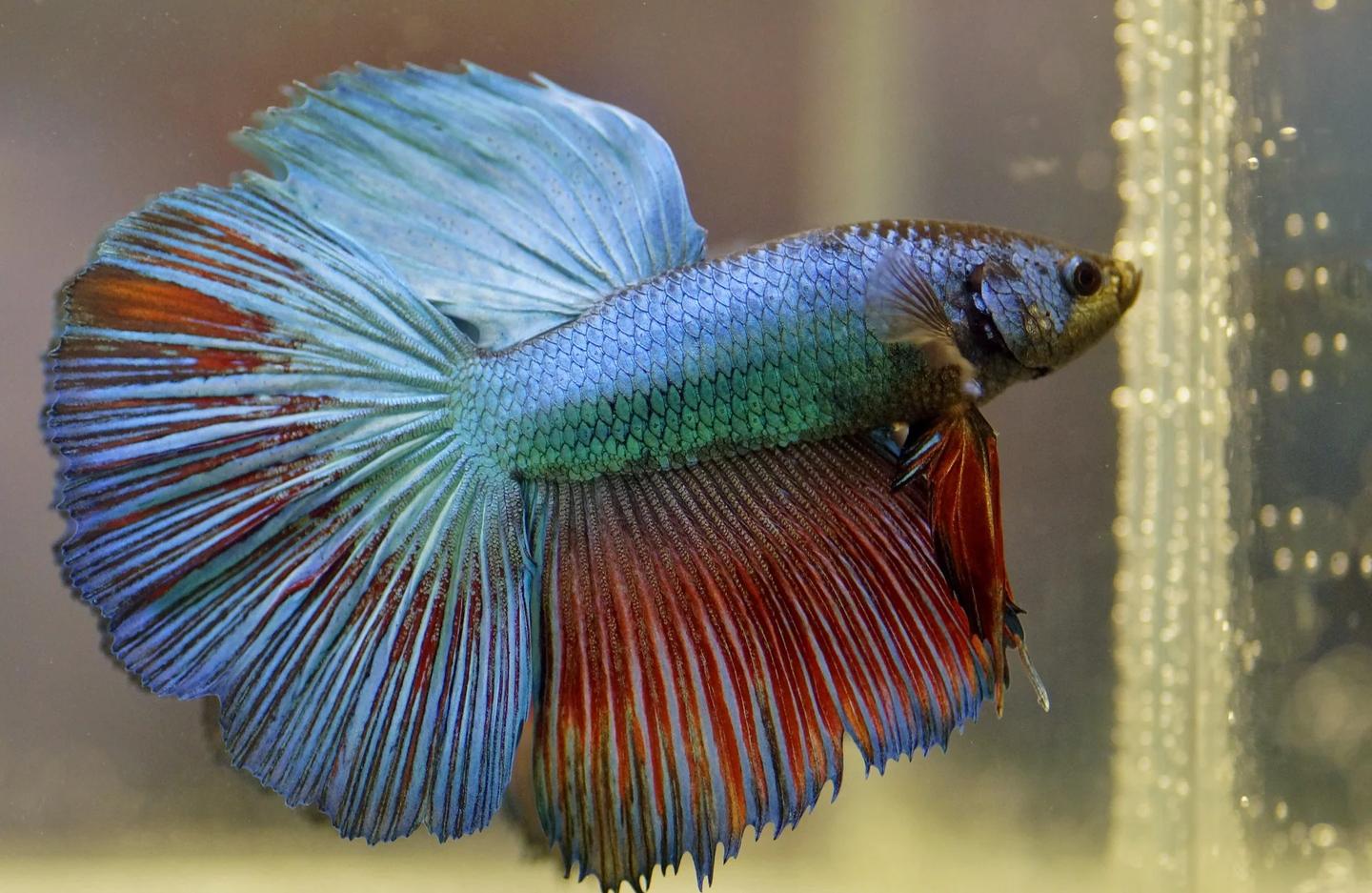
The gallery images are representative illustrations of this type of animal, not photographs of the animal supplied, so pattern and colours can differ from the live animal.
The illustrations show red and purple Bettas with enlarged pale pectoral fins, but they also show long, flowing red-and-white fins. Because the intended form is plakat, do not use the illustrated fin length as a guarantee of the live animal’s outline. Domestic colour, fin and body traits are highly diverse; research into domestic Betta diversity also shows why appearance should not be used to infer origin, age, temperament or welfare.
If you are comparing ornamental forms rather than preparing the aquarium, browse our Betta collection. Keep the husbandry decision separate from the colour decision: every candidate still needs a heated, filtered, covered and furnished aquarium.
Seriously Fish gives Betta splendens a length reference of 70 mm standard length and an aquarium base of 45 × 30 cm, equivalent to about 41 litres, for a single male or pair. FishBase records a maximum of 6.5 cm total length, which is the adult figure used throughout this listing. Plan the aquarium around 6.5 cm rather than the fish’s size at dispatch.
Our starting minimum is at least 20 litres for one male, following the store’s Betta policy and OATA’s UK recommendation. When choosing a new aquarium, the 45 × 30 cm, roughly 41-litre species reference gives more room for planting, refuges and a gentle filter. Check internal dimensions and real filled volume because substrate, wood and an air gap reduce usable water.
OATA’s broad guidance covers Bettas as a group: it gives 20–28°C, pH 6.0–8.0 and 4–12 dGH for tank-reared fish. Seriously Fish gives the species 22–30°C, pH 6.0–8.0 and 1–15 dGH. Tropical Fish Co uses a stable 26–28°C routine target for a typical domestic Betta splendens, keeping that target inside both published temperature ranges.
| Suits | Not suited to |
|---|---|
| A careful keeper prepared to maintain an intermediate-care aquarium | An unheated or unfiltered bowl or jar |
| A mature aquarium of at least 20 litres for one male | Housing two male Bettas together |
| A planted or furnished layout with shade, refuges and surface access | Strong water movement or blocked surface access |
| Stable 26–28°C routine care | A standard community plan without compatibility screening and separation space |
| Decision | Planning value |
|---|---|
| Adult size | 6.5 cm |
| Starting volume | At least 20 litres for one male |
| Stronger footprint reference | 45 × 30 cm, about 41 litres |
| Routine temperature | Stable 26–28°C |
| pH | 6.0–8.0 |
| General hardness | 4–12 dGH |
| Social plan | One male per aquarium |
Start with an aquarium of at least 20 litres, then choose more space where practical. A rectangular footprint makes it easier to arrange cover, open swimming room and surface access than a narrow container with the same nominal volume. If you are buying a new setup, compare it with the 45 × 30 cm and roughly 41-litre reference rather than treating 20 litres as an ideal ceiling.
A new tank can look clear while lacking enough beneficial bacteria to process ammonia. Follow our first tropical aquarium preparation guide before adding livestock. Record the test results rather than judging maturity from water clarity or elapsed time alone.
Run the heater, filter and thermometer together before choosing the fish. Check the temperature in the morning and evening, then compare the readings. A steady result shows that the heater, aquarium volume and room conditions are working together; a changing result means the cause should be found before livestock enters the tank.
Test the lid around every cable and airline. The cover should sit securely without closing the route to atmospheric air. Move floating plants aside if they block the whole surface, and confirm that the filter outlet does not force the plants into one solid mat.
Place one refuge in a calm area and leave an open route between it, the feeding area and the surface. Watch a small piece of floating food or plant debris to see how the current travels. If it races around the aquarium or becomes trapped against the glass, redirect or diffuse the outlet while keeping the filter running.
Finish by checking maintenance access. You should be able to reach the heater, filter, substrate and water-change areas without dismantling every refuge. A layout that can be maintained gently is safer than an elaborate arrangement that requires a major disturbance each week.
Set a typical domestic Betta splendens aquarium to a stable 26–28°C. Measure it with a separate thermometer at a consistent time of day and check again after cold nights, warm weather, maintenance or equipment changes. Do not make rapid adjustments simply to reach the middle of a range.
Keep pH between 6.0 and 8.0 and general hardness between 4 and 12 dGH. These working values sit inside the wider species parameters. Test the water that actually enters the aquarium because UK tap supplies differ, and domestic softeners or treatment devices can alter the result.
| Reading | Action |
|---|---|
| 26–28°C and stable | Continue the routine and record changes |
| Outside the planned temperature | Check heater operation, thermometer accuracy and room conditions before adjusting gradually |
| Ammonia above 0 mg/L | Investigate waste, feeding, filter function and recent changes immediately |
| Nitrite above 0 mg/L | Treat it as a biological-filtration warning and reduce further loading |
| Changing pH or hardness | Check the source water and maintenance routine before adding corrective products |
Use conditioner on replacement tap water to deal with chlorine or chloramine. Match replacement water carefully enough to avoid abrupt temperature or chemistry changes. Our water chemistry guide explains what each reading means, while the water matcher helps compare your measured aquarium values with these working ranges.
Suppose the aquarium remains at 27°C for several days and then reads 25°C after a cold night. Check the room temperature, heater indicator, thermometer position and water circulation before changing the thermostat. The goal is to identify why the reading moved, then restore the planned range gradually without creating a second swing.
If pH changes after a water change, compare the aquarium with the conditioned replacement water. A mismatch points to the water source or preparation method; a continuing change inside the aquarium calls for a review of decor, accumulated waste and maintenance. Avoid repeatedly adding products before understanding which part of the routine changed.
Use a written log during the first month. Record temperature, ammonia, nitrite, nitrate and pH on the same days and note water changes, filter work and feeding changes beside the results. Patterns become easier to recognise when a number can be linked to an action.
A stable reading near one end of the range is preferable to repeatedly changing the aquarium in pursuit of a fashionable decimal. The fish, filter and plants all benefit from predictable conditions.
RSPCA aquarium guidance explains that biological filtration converts toxic ammonia to nitrite and then to safer nitrate. The filter therefore remains essential even though a Betta can breathe atmospheric air. Turning it off or repeatedly sterilising the media removes the system that processes the fish’s waste.
If the filter needs cleaning, rinse the media lightly in aquarium water removed during the water change. Do not run it under the tap because any chlorine or chloramine present may kill the beneficial bacterial population established in the media. Clean only as much as required to restore flow; sparkling media is not the goal.
Use nitrate as a trend as well as a single number. OATA advises keeping it no more than 20 mg/L above the normal tap-water level. A rising trend can point to excessive feeding, accumulated waste, insufficient water changes or more biological load than the routine can manage.
A normal weekly water change should be predictable and limited. Remove the planned amount of water, siphon accessible debris, treat the replacement water and confirm that the equipment restarts. Avoid combining a large water change, complete filter clean and full rearrangement unless a specific problem makes that necessary.
If flow falls, inspect the easiest causes first: a blocked intake, trapped plant material, a kinked airline or debris around the outlet. Restore circulation with the smallest intervention that works. Opening every chamber and replacing all media at once can remove useful bacteria without addressing the original blockage.
| Checkpoint | Decision |
|---|---|
| Water remains clear but ammonia appears | Trust the test and investigate the biological filter |
| Flow falls after plant trimming | Check the intake and outlet for loose leaves |
| Nitrate rises faster each week | Review portions, trapped debris and water-change effectiveness |
| Filter media looks brown but flow is normal | Leave established media in service |
| Power has been interrupted | Confirm heating, flow and water readings when equipment restarts |
If ammonia or nitrite appears, pause any plan to add animals. Check for uneaten food, decaying matter, interrupted power, clogged media or a recent deep clean. Correct the cause while protecting the remaining bacterial colony.
A well-planted, shaded aquarium gives this fish places to explore and rest. Seriously Fish recommends tall stems, floating plants, tropical lilies, Cryptocoryne, driftwood and plants such as Microsorum or Taxiphyllum. These are options rather than a compulsory shopping list; choose aquarium-safe plants that suit your lighting and water.
Leave open routes between refuges and a clear path to the surface. Floating cover can create shade, but it must not seal the whole surface. Fit the lid securely above a small air space so the fish can breathe atmospheric air without creating an escape route.
| What you see | What to do |
|---|---|
| The fish is repeatedly displaced | Diffuse or redirect the outlet while keeping filtration running |
| Resting areas move strongly | Add sheltered zones away from the outlet |
| The surface is completely still | Check filter flow and maintain gentle circulation without creating a jet |
| Access is blocked by plants | Thin or reposition the surface growth |
| Fins touch rough decor | Remove or replace the hazardous object |
Seriously Fish suggests an 80–125 litres-per-hour filter for its roughly 41-litre setup. Treat that as equipment guidance for that aquarium scale, not a fixed rate for every tank. Layout, outlet design and the individual fish determine how forceful a stated turnover feels.
Create a sheltered resting zone away from the strongest current, an open route for swimming and feeding, and an unobstructed surface area. These zones can overlap, but each must remain usable after plants grow. Check them from the fish’s level rather than only from above.
For example, tall stems can screen the filter side, wood can hold attached plants lower in the aquarium, and floating growth can shade part of the surface. Leave a clear channel between the resting area and open air. If the only path passes directly through the filter jet, redirect the outlet or move the refuge.
Inspect every opening before installation. The fish should not need to squeeze through a tight hole, brush against a rough edge or enter a cavity that cannot be checked. Smooth plant pots or suitable pipe sections can provide shelter, but position them so waste can be removed and the fish cannot become trapped.
Dried leaf litter may add cover and support microbe colonies as it decomposes, but monitor it as part of the aquarium’s waste load. Remove material that is fouling the water or obstructing flow. Recheck the layout during each water change because plants, leaves and floating cover move over time.
Use a suitably sized complete Betta pellet or quality aquarium flake as the nutritional base. OATA recommends feeding only what the fish can eat within a few minutes, once a day. Observe the food as it is eaten and remove leftovers before they decompose.
Offer small live or frozen foods such as daphnia or bloodworm as variety. Seriously Fish also lists Artemia, chironomid larvae, small crickets and fruit flies, while warning that Bettas can be prone to obesity. Variety supports condition, but a treat should not replace the balanced staple.
A fixed pellet count is unreliable because pellet dimensions and energy density differ between brands. The size of the fish’s eye is also not a dependable portion formula. Use prompt consumption, body condition and water-quality trends together.
If a new pellet is larger than the previous food, do not copy the old piece count. Begin with the manufacturer’s directions, watch how quickly each piece is swallowed and stop when the measured meal has been consumed. Record the product and portion so another carer can repeat the same routine.
When frozen food is used as variety, separate a suitably small amount and avoid allowing thawing liquid or unused food to accumulate in the aquarium. Return to the complete staple at the next routine feed rather than letting a preferred treat become the whole diet.
| What happens | Next decision |
|---|---|
| Food remains after a few minutes | Remove it and reduce the next measured portion |
| Pieces are repeatedly rejected | Check piece size and whether the food is recognised |
| The fish begs after eating | Use body condition and the measured plan, not begging alone |
| Nitrate or debris rises quickly | Review portions before adding more food types |
| More than one person feeds | Prepare labelled portions to prevent duplication |
If appetite falls, check temperature, ammonia, nitrite, recent maintenance and the fish’s breathing or posture before offering richer food. A sudden feeding change can be an early system warning. Remove uneaten food and continue observing rather than adding repeated meals to test the appetite.
Have the aquarium heated, filtered and tested before the delivery window. Arrange for someone to receive live fish so the parcel is not left unattended. Read the current delivery and Live Arrival Guarantee policy before the delivery date because it contains the claim steps and timing that apply to the order.
| When | Check |
|---|---|
| First hour | Surface access, balance, breathing and whether flow pushes the fish |
| First day | Temperature, ammonia, nitrite and use of cover |
| Each feed | Interest in food and whether every piece is eaten promptly |
| Daily | Fins, colour, posture, swimming and equipment operation |
| End of week | Recorded water trend and whether the maintenance plan is keeping pace |
Look at the fish at similar times each day and record only clear changes. Note whether it reaches the surface freely, holds a steady position away from the outlet, uses cover and responds at the planned feeding time. Consistent observations make a developing change easier to distinguish from a single unfamiliar movement.
Check the equipment before assuming the fish is the only variable. Confirm the heater indicator, actual thermometer reading, filter flow and lid position. Test ammonia and nitrite whenever behaviour changes rather than waiting for the next scheduled maintenance day.
Do not introduce another animal during this settling period. A stable, lightly disturbed first week makes changes easier to recognise and avoids increasing the filter’s load while the new fish establishes its routine.
Learn the individual fish’s normal appetite, breathing, posture, colour, swimming pattern and resting places. A change from that baseline is more useful than comparing one movement with a generic symptom list. OATA highlights hanging at the surface, sitting on the bottom, erratic swimming, altered colour, hiding, changed aggression, unusual gill movement, damaged fins, white spots, fluffy growths and reduced feeding as signs that deserve investigation.
The MSD Veterinary Manual’s aquarium-fish guidance supports investigating aquarium history and water quality as part of diagnosis. A white mark, torn fin, swollen abdomen or unusual swimming pattern can have several causes, so one visible sign should not decide the medicine.
Write down when the change began, the current water readings and anything that changed beforehand. Include filter cleaning, a missed water change, new food, moved decor, a power cut or unusual room temperature. This sequence helps distinguish a continuing system problem from a brief response to maintenance.
Correct dangerous water conditions promptly but gradually enough to avoid creating another abrupt change. Keep notes on readings, behaviour and actions. When signs are severe, persistent or unexplained, use OATA’s fish-vet directory to locate qualified help.
Occasional surface breathing is normal for a labyrinth fish. Repeated distress at the surface alongside rapid gill movement, poor balance or abnormal water tests requires immediate investigation of the whole aquarium.
Keep one male Betta splendens per aquarium. FishBase states that males fight each other, while Seriously Fish says ornamental strains are generally best kept alone and that only a single individual can be maintained per tank in most cases. More space or extra planting does not turn direct male cohabitation into a safe plan.
Avoid another male Betta and avoid fish with a similar body shape or trailing finnage that may be treated as rivals. Seriously Fish directly warns against those forms. OATA also warns that male Bettas can suffer intense fin-nipping from other fish, so avoid fin-nipping fish.
Avoid housing male and female Bettas together as routine companions. FishBase advises keeping the sexes separately except for mating, and breeding is a managed project rather than a community arrangement. This offer is for one male, not a pair or group.
If two male Bettas occupy different aquariums, arrange the tanks so they do not have constant direct visual contact. Persistent displays at a visible neighbour are not a substitute for enrichment. Add opaque screening or reposition the tanks rather than relying on the fish to stop reacting.
Check the separation from several angles. A divider that blocks the front view may still leave a clear line of sight through the side panels or reflections. Observe both tanks after room lighting changes because reflections can become stronger when the aquarium is brighter than its surroundings.
The RSPCA’s guidance on keeping fish together also recognises that male Bettas may fight their own kind. Make the dedicated single-male aquarium the starting plan, then any proposed community becomes a cautious exception requiring its own assessment and separation option.
No companion species is automatically safe with this male. Seriously Fish describes community tolerance as the exception rather than the expected outcome, although some individuals may tolerate carefully chosen fish. The honest plan is therefore to assess both species and still prepare a separate home.
| Question | Required decision |
|---|---|
| Do adult water needs overlap? | Reject the combination if one animal would be kept outside its range |
| Is the aquarium large enough for every adult? | Do not base a community on the Betta’s 20-litre single-fish minimum |
| Does the candidate nip fins? | Avoid it |
| Does it have trailing fins or a rival-like outline? | Avoid it |
| Is it boisterous or highly competitive at food? | Choose a calmer plan |
| Do both animals use the same limited refuge? | Redesign the layout or reject the combination |
| Can either animal be separated immediately? | Prepare a mature alternative aquarium before mixing |
Shrimp, snails and fish fry should be treated as uncertain rather than as guaranteed companions. A Betta may investigate or hunt smaller animals, while larger or defensive invertebrates can introduce injury risk. Do not add an animal as a cleaning tool or live-food experiment.
The alternative aquarium must be heated, filtered and mature before the animals meet. An empty container, uncycled spare tank or temporary divider is not an adequate response to active pursuit or injury. Decide which animal will move and make sure it can be transferred without dismantling the main aquarium.
Observe feeding from start to finish. A candidate may avoid direct aggression yet still prevent the Betta from eating, occupy the only calm refuge or keep it away from the surface. Assess the welfare of both animals rather than judging success only by the absence of visible fighting.
Watch both animals during feeding and at quiet times. Separate them if you see repeated pursuit, blocked surface access, persistent hiding, fin damage, missed meals or displacement from a refuge. A combination that appears calm briefly may still fail after territorial behaviour develops.
FishBase records a maximum adult length of 6.5 cm for Betta splendens, so plan the aquarium and furnishings around that size.
Use at least 20 litres with a mature filter, heater, thermometer, secure lid, gentle flow and clear surface access; Seriously Fish gives 45 × 30 cm and about 41 litres as a stronger species reference.
Keep one male per aquarium. Avoid housing two males together, and keep males and females separately outside a managed breeding project.
Our care assessment is intermediate. A careful beginner can keep this fish after preparing a mature, heated and filtered aquarium, learning to test the water and planning one male per aquarium.
Feed a suitably sized complete Betta pellet or quality flake once daily in an amount eaten within a few minutes, with small live or frozen foods such as daphnia or bloodworm as variety.
Use Tropical Fish Co’s stable 26–28°C routine target; OATA’s broad Betta guidance gives pH 6.0–8.0 and 4–12 dGH, with ammonia and nitrite at 0 mg/L.
Males fight each other, so keep one male per aquarium. OATA warns that male Bettas can suffer intense fin-nipping from other fish, so avoid fin nippers and fish with trailing finnage or a rival-like shape.
Solitary housing is safest. Seriously Fish says some small cyprinids and loaches may be suitable after careful screening, while shrimp, snails and fish fry remain uncertain; assess adult water needs, space, feeding and temperament and prepare a mature separation aquarium.
Start filming every delivery continuously from the sealed parcel before floating the bag, recording it being opened with the fish still inside the sealed bag. Someone must be present to receive it; float the bag for 20–30 minutes before release and never pour the bag water into the aquarium.
No reviews for this item yet. Bought one? Honest reviews only, good or bad.
What customers say about ordering from us
I have a small group of long finned mountain minnows. So was delighted to be able to order ten of this variety to increase the genetics in my tank . The ones I recieved are healthy but it’s to early to give a verdict on wether they are of a long finned type since they are small currently.
Gordon Walker · 23 Sept 2026
100% success travel and "installation". Pleased with quality of purchase. The Siamese fighter a bit "shy" so have not yet seen him at his best yet but looking good. Happy customer. GG
George E Garratt · 21 Sept 2026
Reviews of our shop, collected by Judge.me, an independent third-party review collector. Newest first.