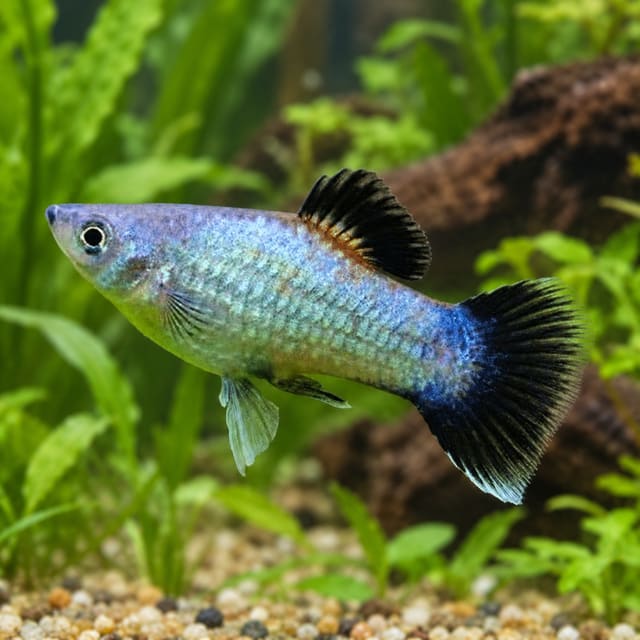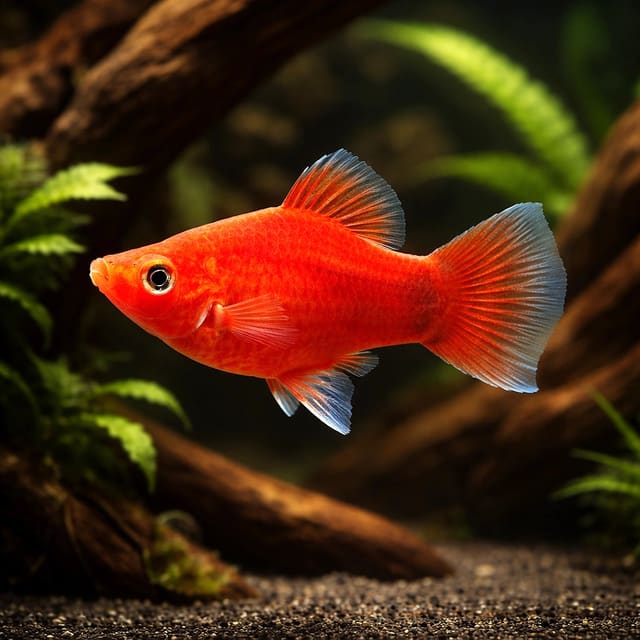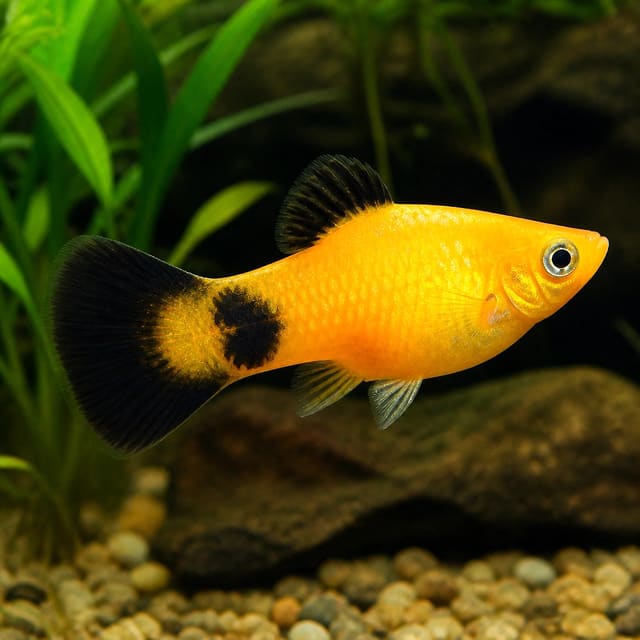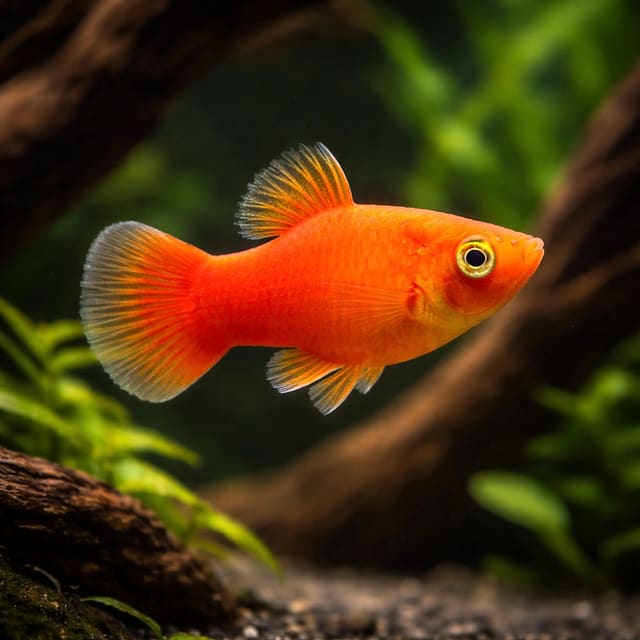
Easy
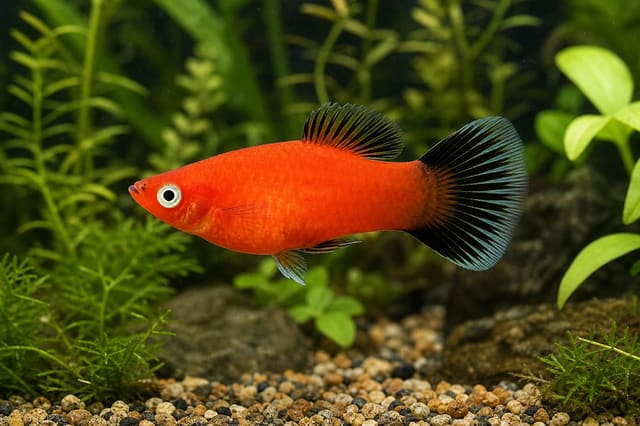
Xiphophorus maculatus red tiger
20–25°C · pH 7–8 · 54L
£3.99
Photo coming soon
The size, price and care details on this page are for this listing.
A Hi-Fin Mixed Platy is a peaceful Xiphophorus maculatus livebearer for a mature freshwater aquarium. Provide planted cover, swimming room and moderately hard water. Each cart unit buys one fish, with a two-fish order minimum; sex is not guaranteed.
Adult size is the maximum length this species reaches at full maturity (scientific sources). The livestock you receive will be younger and smaller. Product-photo provenance and any image-specific limitations are stated on the listing.
Xiphophorus maculatus
Shoaling fish: kept in a group they feel safer, stay calmer and show their best colour.
Minimum of 2 per order.
A Hi-Fin Mixed Platy is a peaceful Xiphophorus maculatus livebearer for a mature freshwater aquarium. Provide planted cover, swimming room and moderately hard water. Each cart unit buys one fish, with a two-fish order minimum; sex is not guaranteed.
Adult size is the maximum length this species reaches at full maturity (scientific sources). The livestock you receive will be younger and smaller. Product-photo provenance and any image-specific limitations are stated on the listing.
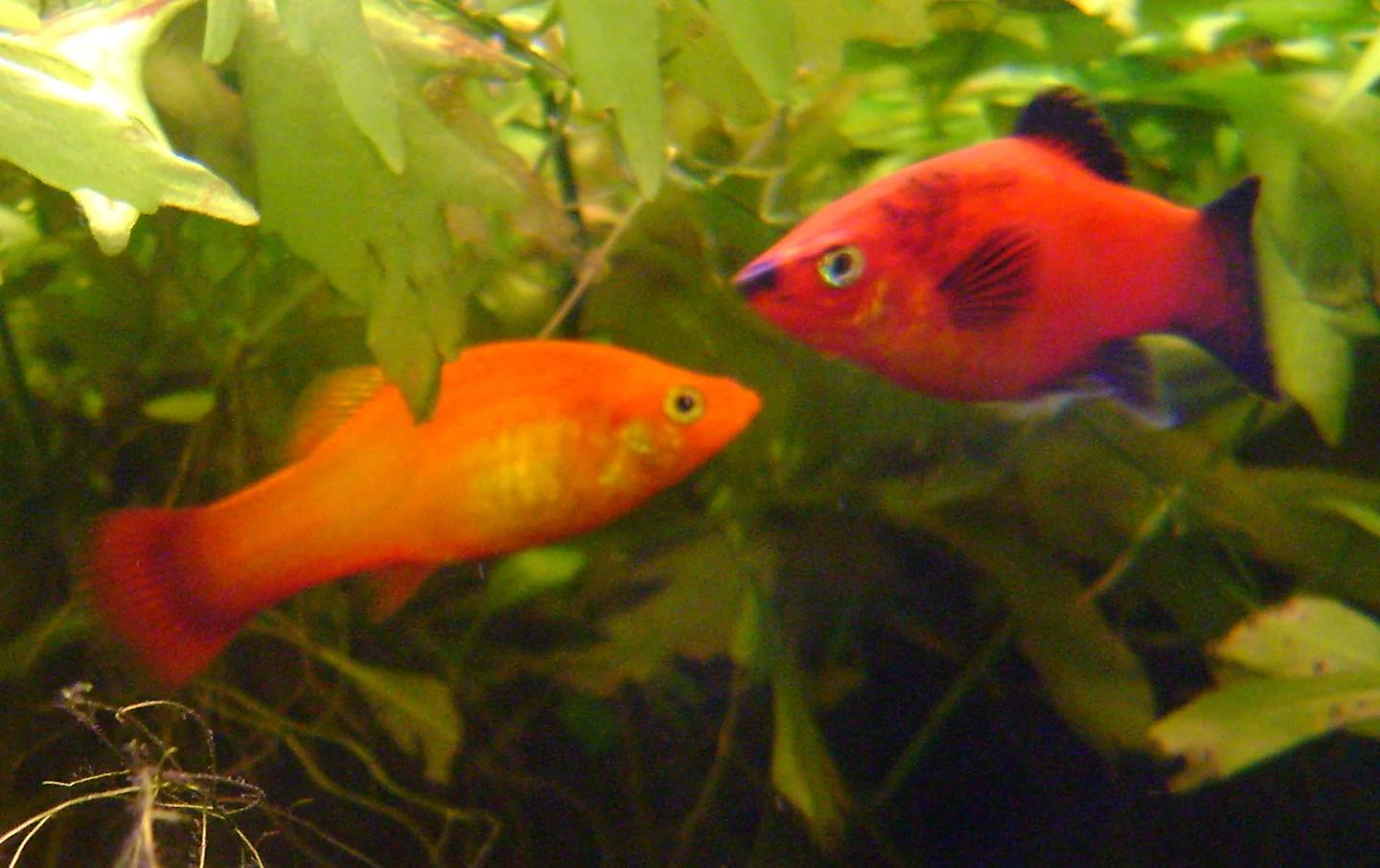
Platy is a trade name used for Xiphophorus maculatus, X. variatus and domestic forms. Start with at least three in a mature aquarium of at least 45 litres, verify the exact fish and measured water, and plan extra capacity before mixing sexes.
Maintain these water conditions for optimal health and vibrant colors
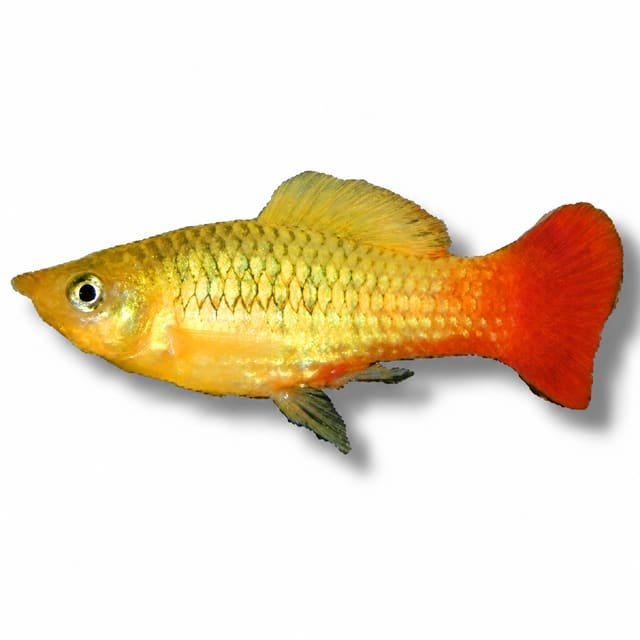
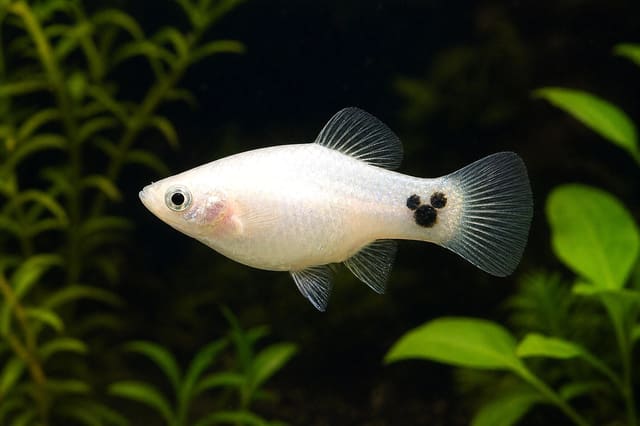
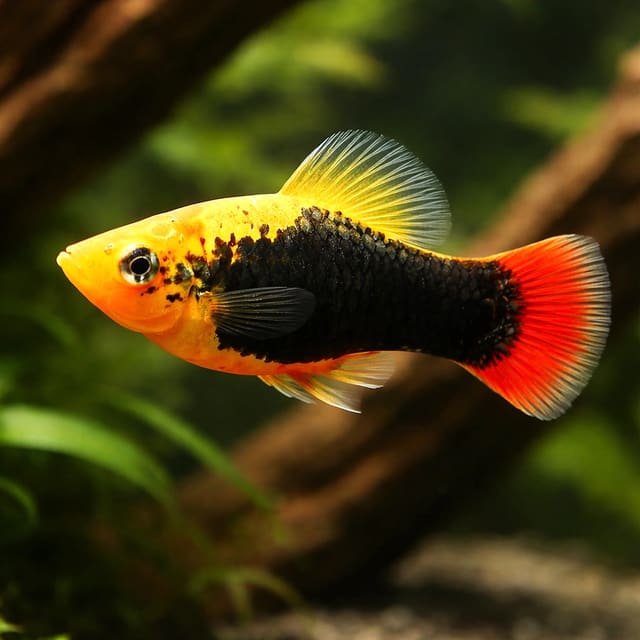
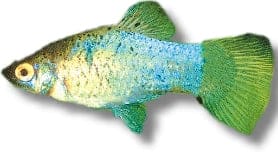
The Hi-Fin Mixed Platy is sold here as a form of Xiphophorus maculatus, the freshwater platy in the Poeciliidae family. The words hi-fin mix describe this form; they do not describe a scientifically separate species or promise that every individual will have the same fin outline, pattern or colour. That variation can be part of the pleasure of keeping a group. It also means this is a poor purchase if you need an identical set of fish for a display. Start with the species' water and social needs, then decide whether its livebearer activity suits the community you want.
One cart unit purchases one live Hi-Fin Mixed Platy. The order minimum is two fish, but this is not a pack containing two fish for each unit entered. A quantity of two buys two individual animals, and a larger quantity buys that number of individual animals. Plan the quantity against the fish already in the tank and the group you eventually intend to keep. Sex is guaranteed only when the selected option explicitly states male or female. This Hi-Fin Mixed Platy listing has no sex-guaranteed option. Do not rely on an order to produce a chosen male-to-female ratio.
A small platy can appear to need very little space, yet it uses the horizontal swimming room of a proper aquarium and lives best with companions. Seriously Fish gives X. maculatus a tank base of 60 × 30 cm and an approximate 54-litre example. The OATA group sheet discusses a 45-litre aquarium for a small group of platies. These are examples with different scopes, not interchangeable warranties that a particular tank will accommodate any combination of fish. Consider the floor space, mature filter, decor, group size and existing occupants together.
Begin with the water you can maintain reliably. The species aquarium profile suggests 20–26 °C, pH 7.0–8.2 and hardness 10–30 dGH. It is especially clear that X. maculatus should not be kept in soft, acidic water. The colour and fin form on the trade label do not cancel this biological need. If your established aquarium is a soft-water setup, choosing a different animal is usually a more responsible decision than making rapid changes to suit this listing. Stability in a suitable range matters more than chasing a precise point.
Natural history adds context without replacing aquarium care. FishBase places the species from the Veracruz area of Mexico to northern Belize and describes adults in slow waters with silt and weedy margins, as well as creeks and swamps. That helps explain the value of planted cover and a layout with quieter areas. It does not mean an aquarium should be dirty, poorly filtered or copied from a wild ditch. The mature biological filter and clean, oxygenated water are essential parts of the home habitat.
FishBase records 4 cm total length for male or unsexed fish. A specialist aquarium profile lists 5 cm standard length, which measures the fish differently. Those figures should not be treated as two interchangeable upper limits or as a dispatch-size promise. Plan for a full adult platy with swimming room and compatible companions. If a narrow size match matters to an existing group, ask the shop for a current measurement before ordering.
| Likely to suit | Check first |
|---|---|
| A mature, planted community with moderately hard water and room for several platies | Measured water values, free swimming base, established filtration and a plan for possible fry |
Think of the aquarium as the space used by an entire group, rather than a container for the two-fish order minimum. A 60 × 30 cm base from the species profile offers a useful point of reference because swimming length matters to an active livebearer. The profile's approximate 54 litres describes one example aquarium, not a fixed quota per fish. A tank may have the same litres but a very different footprint. Existing fish, decor and the route around plants all change how much usable room remains.
The broad UK platy and swordtail care sheet advises an aquarium large enough for at least a small group and mentions 45 litres for platies. It also notes that more groups require more volume and that larger aquaria make temperature and water quality easier to keep stable. Use that as group-level advice, not a species-specific claim that every 45-litre tank is adequate. If your planned group shares the aquarium with other fish, calculate room for the whole population at adult size. Keep a margin rather than stocking to an exact minimum.
Lay out plants and ornaments to create sight breaks. FishBase's account of weedy margins and the specialist profile's preference for a planted aquarium both support cover. A platy should still be able to travel through open water without weaving around a solid wall of hardscape. Set taller cover toward edges or in islands and leave more than one route around it. If fish can retreat from a persistent follower, they have more choices than in a bare tank. Cover is particularly useful if a mixed-sex group develops.
Gravel or sand can both work for this group according to OATA's general aquarium advice. Choose a substrate and decor you can clean and maintain, and avoid sharp pieces that could catch a fin. The hi-fin name is not evidence that these fish need a special substrate or that a particular fin shape is guaranteed. If using live plants, select species that suit your water and lighting; if using artificial plants, ensure they offer shelter without rough edges. Leave the filter intake, heater and routine cleaning points accessible.
An effective filter is essential even when the water looks clear. The RSPCA explains that biological filtration supports bacteria which convert toxic ammonia and nitrite into less harmful nitrate. The filter's capacity should match the eventual stock and feeding, not only the first delivery. Position the outlet so it moves water and maintains oxygenation while leaving calmer areas. A species profile discusses a turnover example for a particular 54-litre setup; that is a context-specific example, not an instruction to buy one exact pump for every aquarium.
Before ordering, watch the aquarium as if the new group were already present. Is there a continuous swimming path? Can fish move past one another without being trapped at a filter or ornament? Are quieter residents able to reach food? Is there still space for a platy group after accounting for adult occupants? These questions make a more useful capacity check than counting empty centimetres beside the glass. They also help you spot a layout problem before the new fish must live with it.
For routine aquarium planning, the specialist X. maculatus profile gives 20–26 °C, pH 7.0–8.2 and hardness 10–30 dGH. This is more directly applicable to an aquarium than a wild environmental listing. FishBase gives 18–25 °C, pH 7.0–8.0 and 9–19 dGH in its species summary, but those figures describe reported environment, not an instruction to run a home tank at the cool or soft edge. The OATA platy and swordtail sheet gives broader group guidance. The ranges have distinct purposes.
Hardness is worth measuring before buying this form. The profile states that X. maculatus needs moderately hard or harder water and will not thrive in soft, acidic conditions. A pH reading alone does not tell you the general hardness. Record both pH and GH, along with the tank's usual temperature. If the terms are unfamiliar, the shop's water chemistry guide explains what they measure. A test made once after a large water change may also fail to show how stable the aquarium remains through an ordinary week.
Use the water you can reproduce consistently. If tap water is suitable, condition it before changes and bring replacement water close to the aquarium's usual temperature. If you prepare a different water mix, test that mix too. Abruptly correcting one reading can create a rapid shift in several others. A fish transported into a stable aquarium with slightly different but suitable values is better served by a controlled introduction than by a sudden, dramatic alteration to meet a textbook midpoint.
The water matcher can help compare your measured tank readings with stated guidance. Enter actual numbers and read the result alongside what you know about your fish, filter and maintenance. A tool cannot determine whether a territorial neighbour will chase a platy or whether an aquarium has enough swimming area. If the water is outside the species' normal requirements, solve that planning question before placing an order, rather than hoping the fish will adjust while you experiment.
Temperature is easier to manage when it is monitored, not assumed from a heater setting. Use a thermometer to check what the fish experiences during the day and overnight. Room warmth, aquarium size, light and equipment can all affect the measured value. Keep the tank within a suitable stable range instead of shifting between the outer numbers of a care table. If the room becomes unusually warm or cool, respond to the measured change and the needs of every species in the aquarium, not only the newly ordered platies.
Freshwater fish continually add waste to the water through feeding and metabolism. OATA's group care advice says ammonia and nitrite should be zero and recommends regular testing and partial water changes. It gives a weekly 25% change as a practical baseline; the exact routine may need adjustment to actual stocking and nitrate results. Remove visible waste as you maintain the substrate. Prepare replacement tap water with conditioner to remove chlorine or chloramine before adding it. Keep a simple record of tests and changes so that a slow trend is visible.
Clean a blocked filter without destroying the bacteria you rely on. OATA advises gently rinsing media in water removed during a partial change, not under chlorinated tap water. Check the equipment while it is running as well as during cleaning: a stopped or severely reduced filter can change water quality quickly. Add livestock gradually so the bacterial population can respond to increasing waste. A sudden jump from an empty tank to a full community can outpace a newly matured filter even when the first test looked safe.
Observing the fish is part of water care, but observation and testing belong together. Persistent surface hanging, fast gill movement, unusual swimming, clamped or damaged fins, changes in colour or lost appetite are signals to check conditions. These signs are not a diagnosis of one disease or proof that a hi-fin form is delicate. Measure ammonia, nitrite and temperature first, consider recent maintenance and additions, then seek knowledgeable help if the problem continues. Do not add treatments simply because a fish behaves differently for an hour.
The wild diet reported by FishBase includes worms, small crustaceans, insects and plant material. In an aquarium, the species profile describes X. maculatus as an unfussy feeder that accepts dried, frozen and live foods. That does not mean every possible food is equally useful as a daily staple. OATA's platy and swordtail advice recommends a good quality flake or granule with algae content, with small live or frozen items offered for variety. Choose a food size that the fish can take readily.
A group can make feeding look competitive. Offer a modest amount across the water rather than dropping everything where the boldest fish waits. Watch whether quieter fish have an opportunity to eat. OATA's broad rule is to offer what can be eaten within a few minutes once daily, avoiding leftovers that decay and add waste. Use the condition of the fish and the water tests to judge whether the ration is right. Constant extra food is not a substitute for a good social layout.
Small frozen or live foods can enrich the diet, but they should not be treated as a cure for poor water quality or a way to force a reluctant fish to feed. Handle them according to the food supplier's directions and offer portions that can be eaten promptly. If a newly arrived platy pauses before feeding, let it settle and check the tank conditions before cycling through several rich foods. If one fish consistently misses meals because it is chased away, address that social problem as well.
A community may include fish that feed in other parts of the tank. Plan for their actual diets separately rather than assuming a platy flake feeds every resident. Equally, do not add an animal solely to collect leftovers; uneaten food is a maintenance issue. The hi-fin mix trade name does not imply a special colour-enhancing diet; individual fish can vary in colour. Good staple food, measured portions and stable clean water are the defensible everyday priorities.
Overfeeding can hide behind good intentions, especially when several people feed the aquarium. Agree a simple routine for the household and note unusual feeds or treats. Look for food that remains after the fish lose interest, and remove it where practical. If nitrate or other readings trend upward, review stocking, feeding and maintenance together. Feeding is one of the easiest parts of care to change gently without stressing the fish through a large sudden water adjustment.
Use a suitable staple, add small varied foods occasionally, and let the water tests tell you whether the aquarium is coping with its ration.
The OATA sheet suggests that platies and swordtails have company and discusses at least three together as broad group guidance. A two-fish order minimum therefore should not be read as a claim that a pair is always the ideal permanent group. If you already have platies in a suitable tank, two additions may join a social group. If you are starting from none, plan the eventual number, filtration and space before buying. The fish should be able to interact and to retreat, rather than be isolated or crowded.
The sex mix requires care because this particular listing has no sex guarantee. The species profile says males can tolerate each other but can persistently pursue females when both sexes are kept together. It recommends more females in a known mixed group to spread that attention. Those husbandry statements cannot turn an unsexed purchase into a promise of any ratio. If an existing group depends on adding a particular sex, ask what can actually be confirmed before ordering; do not infer sex from a trade photo, colour or size.
Plants and other visual breaks can make a mixed group easier to live in. Watch whether one fish can rest without another following it continuously. A quick movement at feeding time is different from repeated chasing that drives a fish away from food or shelter. When behaviour changes, look at the full picture: water quality, stocking density, new introductions and places to withdraw. Avoid assuming that a fish must be a different species because its fin looks different from another member of the mixed form.
These are livebearers. FishBase notes that colour varieties of X. maculatus reproduce readily in aquaria, and the species profile expects fry when males and females are together. A fish can also have a history before it reaches your tank. Plan for the possibility of young fish even if breeding is not your goal. Additional platies need space, food and filtration as they grow, so think about what you would do if the population increases. A small starting group is not necessarily a fixed population.
If you do not want fry or cannot house more fish, make that part of the choice before purchase. A sex-guaranteed offer, where genuinely available, may allow a different plan, but this mixed listing does not provide that guarantee. Do not rely on identifying a young platy by colour or a static image. For an established mixed community, leave enough capacity for realistic changes and seek advice based on the actual fish, not a generic breeding formula copied from another aquarium.
Plan the arrival before the courier is due. The aquarium or prepared quarantine tank should be mature, at a suitable stable temperature, and tested for ammonia and nitrite. Make sure there is cover and that existing residents will not immediately crowd the release area. Tropical Fish Co's current delivery and Live Arrival Guarantee policy explains packing, tracked licensed live-animal carriage and the steps required if an animal arrives in poor condition. Arrange to receive the parcel yourself; live fish should not be left unattended.
Inspect the box promptly. If something appears wrong, the policy asks for a continuous unboxing video beginning with the sealed parcel, showing it opened and the fish still inside the bag, along with the order number and contact on the day of arrival. That video is claim evidence; it is not an instruction to delay necessary care or expose fish unnecessarily. Read the policy in full for current terms. Static product copy cannot replace the conditions that apply to a particular delivery.
For routine introduction, the policy describes floating the sealed bag for about 20–30 minutes so the temperature moves closer to the aquarium's. Follow the store's practical transfer guidance and do not pour the transport water into the tank. Test the receiving water beforehand rather than trying to correct a poor match with the fish waiting in its bag. If using quarantine, the same care standards apply there: an uncycled bare container is not made safe simply by calling it quarantine.
After release, allow quiet observation and a place to withdraw. Watch swimming, breathing and interaction with residents, then check water if a fish appears distressed. Offer a small feed once the new fish have settled rather than pouring in food to provoke activity. Avoid a large second livestock addition at the same time. It is easier to tell whether the filter and group are coping when change is gradual. Continue the usual maintenance schedule, adjusting from measured evidence rather than one unusual movement immediately after travel.
Seriously Fish calls X. maculatus a very peaceful fish and describes it as suitable with many community species. OATA similarly treats platies as generally peaceful. These broad descriptions are useful, but no source can guarantee that every individual, every tank size or every species combination will work. Begin with water: the planned companions should be comfortable at the same ordinary temperature and in the moderately hard conditions chosen for platies. A fish that only shares a short tolerated overlap at the edge of its range is a weaker match.
Next compare adult size and feeding style. A small platy should not be housed with a predator that can swallow it. A much more forceful feeder may take the ration before platies can reach it; conversely, active platies can disturb particularly timid residents even without attacking them. Include the aquarium's actual swimming and resting space in the decision. A species list is only the beginning of an assessment that also depends on the animals already present and the way the tank is arranged.
Within a platy group, the main concern described by the specialist profile is persistent male attention to females in a mixed-sex tank, not routine attack on unrelated community fish. The profile says males can tolerate one another. There is no evidence that the hi-fin mix form has a separate aggressive temperament or that the form is inherently a fin nipper. Still, watch for torn fins, chasing or excluded fish after introductions. Observed harm should be investigated rather than dismissed because a care sheet calls the species peaceful.
OATA notes that larger swordtails may be boisterous and chase timid tankmates, even though platies and swordtails are generally compatible with other species. It is a good example of why a broad family label is insufficient. If you consider another livebearer, look at its adult size, water needs and behaviour rather than assuming it must fit because both names occur on the same care sheet. A similar colour form is an alternative purchase, not evidence that a full collection of forms belongs together in one aquarium.
Do not use a platy to solve an unrelated aquarium problem. It is not an algae-control tool, a guarantee of movement for a quiet tank or a substitute for resolving poor filtration. Add it when its own group and water requirements are met. Observe the community at feeding time and when the lights are at their normal level, paying attention to fish that remain hidden or unable to rest. Good compatibility is something maintained through stocking and observation, not established once at checkout.
If your tank is already mature but its water sits naturally on the soft acidic side, look for livestock suited to those conditions rather than making every resident endure a compromise. If an aquarium is mostly planned but not yet filled, choose the intended community before setting it up so that its water, footprint and planted cover suit the group. The first tropical tank guide can help structure those early decisions. A patient plan avoids stressful last-minute adjustments.
FishBase records 4 cm total length for male or unsexed Xiphophorus maculatus, while a specialist profile gives 5 cm standard length. These are different measurements. Provide adult swimming space instead of planning only for arrival size.
Seriously Fish uses a 60 × 30 cm base and an approximate 54-litre example for Xiphophorus maculatus. A UK group care sheet discusses at least 45 litres for a small platy group. Footprint, filter maturity and other fish matter too.
Platies benefit from company. OATA suggests at least three as broad group guidance; the two-fish purchase minimum is separate from the eventual social group.
It can suit a beginner who has a mature, filtered tank, stable moderately hard water and room for a small group. Establish the aquarium and test ammonia and nitrite before adding fish.
Use a good quality flake or granule with plant content as a staple. Xiphophorus maculatus also accepts appropriately sized live or frozen foods; offer modest portions and avoid leftovers.
A species aquarium profile gives 20–26 °C, pH 7.0–8.2 and 10–30 dGH. Keep values steady and avoid soft acidic water.
Xiphophorus maculatus is generally peaceful and is not described as a routine fin nipper in the cited care sources. Mixed-sex groups can show persistent chasing, so observe real fish and provide cover.
Consider peaceful community fish whose ordinary water needs match the platy's moderately hard-water setting. Check adult size, feeding and available space; no species is a guaranteed tank mate in every aquarium.
Tropical Fish Co's delivery policy describes hand packing and a tracked licensed live-animal courier. Be present for delivery and follow its arrival and continuous unboxing-video instructions if something is wrong.
The accepted scientific identity, native range and recorded 4 cm total length for male or unsexed fish are reported in FishBase's Xiphophorus maculatus account. For aquarium water, tank footprint, diet and behaviour, see the Seriously Fish species profile. The broader UK group guidance on social keeping, maintenance and feeding is in OATA's platy and swordtail sheet. The RSPCA fish environment advice explains biological filtration.
These sources describe species or group care. They cannot verify the colour, sex or measured arrival length of an individual fish from this order. Use the live buy box for current purchase quantity and ask the shop if a particular fish attribute is essential to your existing group.
No reviews for this item yet. Bought one? Honest reviews only, good or bad.
What customers say about ordering from us
Easy website plenty of info on fish your buying great to pick a time slot
TRACEY DURRANT · 7 Oct 2026
Got some lovely fish thank you
Kevin Mackie · 7 Oct 2026
Reviews of our shop, collected by Judge.me, an independent third-party review collector. Newest first.