Easy
Xiphophorus maculatus red tiger
20–25°C · pH 7–8 · 54L
£3.99
Photo coming soon
The size, price and care details on this page are for this listing.
The Mickey Mouse Platy is a peaceful Xiphophorus maculatus colour form sold as one live fish per purchase, with three genuine size choices. Keep it in a mature planted aquarium with moderately hard, neutral-to-alkaline water, open swimming space and compatible community fish. Sex is not guaranteed.
Xiphophorus maculatus
Shoaling fish: kept in a group they feel safer, stay calmer and show their best colour.
Minimum of 2 per order.
The Mickey Mouse Platy is a peaceful Xiphophorus maculatus colour form sold as one live fish per purchase, with three genuine size choices. Keep it in a mature planted aquarium with moderately hard, neutral-to-alkaline water, open swimming space and compatible community fish. Sex is not guaranteed.
Platy is a trade name used for Xiphophorus maculatus, X. variatus and domestic forms. Start with at least three in a mature aquarium of at least 45 litres, verify the exact fish and measured water, and plan extra capacity before mixing sexes.
Maintain these water conditions for optimal health and vibrant colors
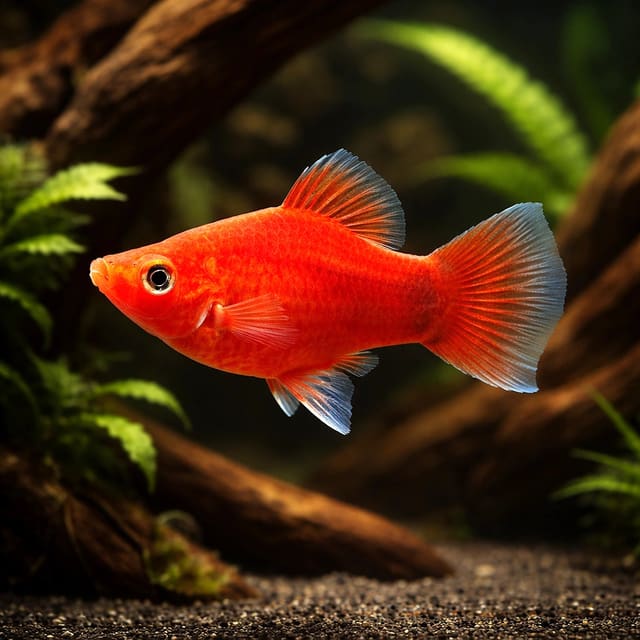
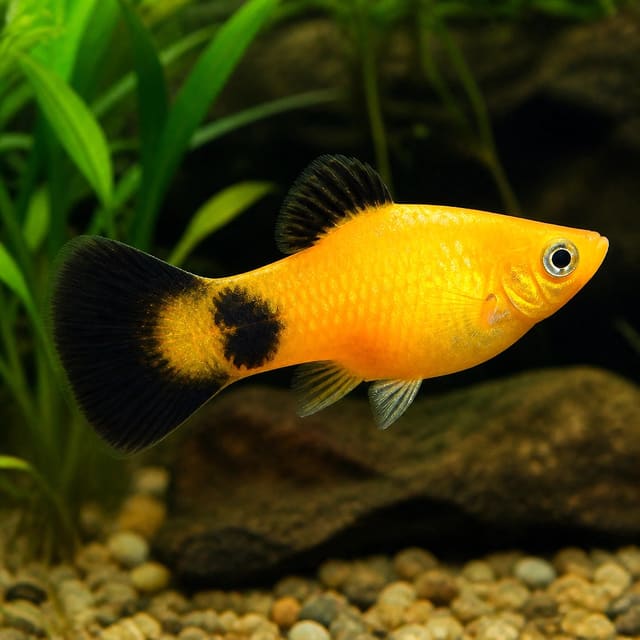
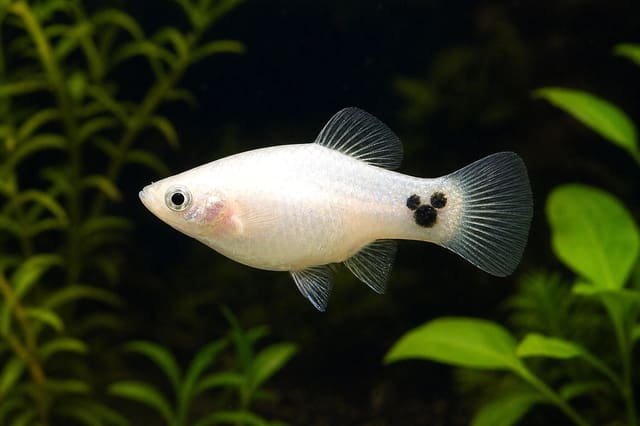
The Mickey Mouse Platy is a selectively bred colour form of Xiphophorus maculatus. Its trade name refers to the dark rounded markings near the base of the tail, often arranged like the silhouette that inspired the name. The colour form does not change the accepted species identity, so the scientific field remains the clean binomial Xiphophorus maculatus.
One purchase supplies one live fish in the chosen size. This product has three genuine size choices: 2–2.5 cm, 3–4 cm and XL. XL is a real named choice but it has no reviewed numeric centimetre range, so it remains labelled XL. The size you select is the size supplied, not the adult size.
Sex is guaranteed only when the selected option explicitly states male or female. This Mickey Mouse Platy listing has no sex-guaranteed option. Plan a social group without assuming that a purchase quantity will create a particular female-to-male ratio.
FishBase places the species in the Poeciliidae family and records its native range from Veracruz in Mexico to northern Belize. Wild records include warm springs, canals, ditches, creeks and swamps, commonly with slow water, silt and weedy banks. Those observations help explain why planted cover and calmer areas are useful, but routine aquarium values should come from aquarium husbandry guidance rather than the extremes of a distribution record.
FishBase records 4 cm total length for a male/unsexed record. Total length includes the tail. The aquarium profile gives 5 cm standard length, which excludes the tail and serves as its planning figure. OATA’s broader platy-and-swordtail sheet says platies as a group generally reach 6–8 cm, without stating a measurement method. These figures are not interchangeable, so this page keeps each one labelled instead of turning them into a single promised maximum.
For the aquarium, the species profile uses a 60 × 30 cm base and an example volume of approximately 54 litres. Footprint is important because it gives the fish open swimming space as well as room to avoid persistent attention. A larger aquarium is appropriate when the group or wider community grows.
| Good fit | A mature planted community with moderately hard, neutral-to-alkaline water and peaceful companions. |
|---|---|
| Needs more planning | A very soft or acidic aquarium, an immature filter, or a community with large predators and relentless feeders. |
The current care-level field says easy. That is a retailer suitability assessment, and it is reasonable only with conditions attached. Seriously Fish calls the species one of the better beginner fish while the pH remains above neutral, and OATA describes platies and swordtails broadly as undemanding. Easy does not mean suitable for an uncycled aquarium or for unknown water.
Browse the current platy collection if you want to compare colour forms. Product alternatives are presented separately and should not be treated as automatic tank-mate recommendations.
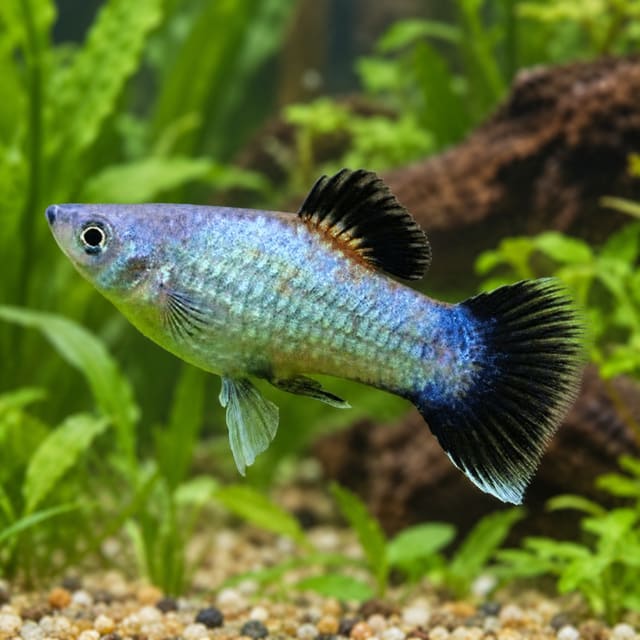
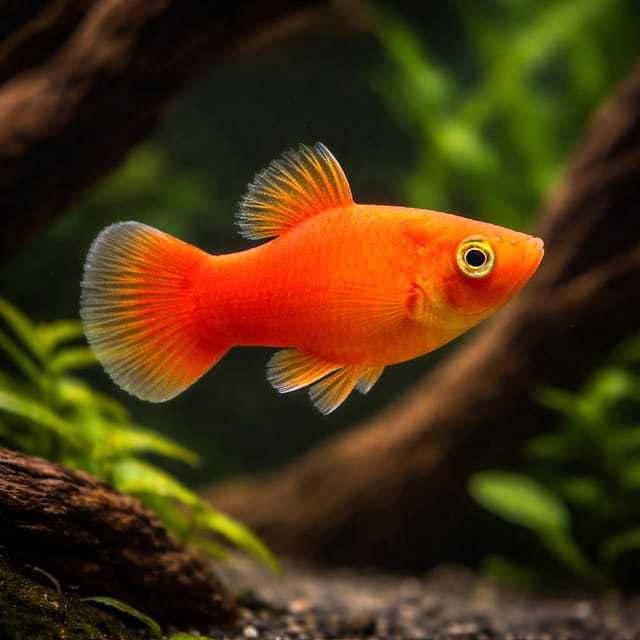
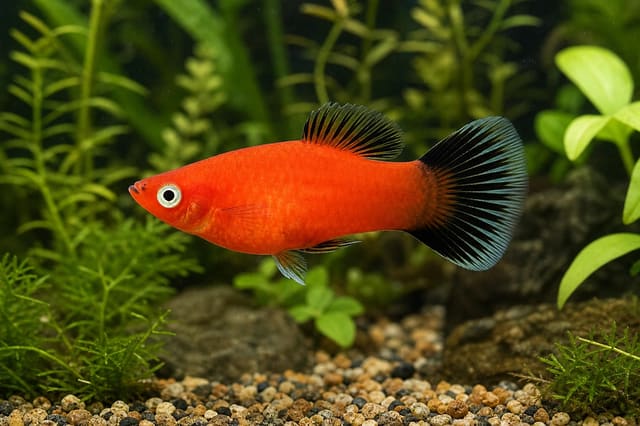
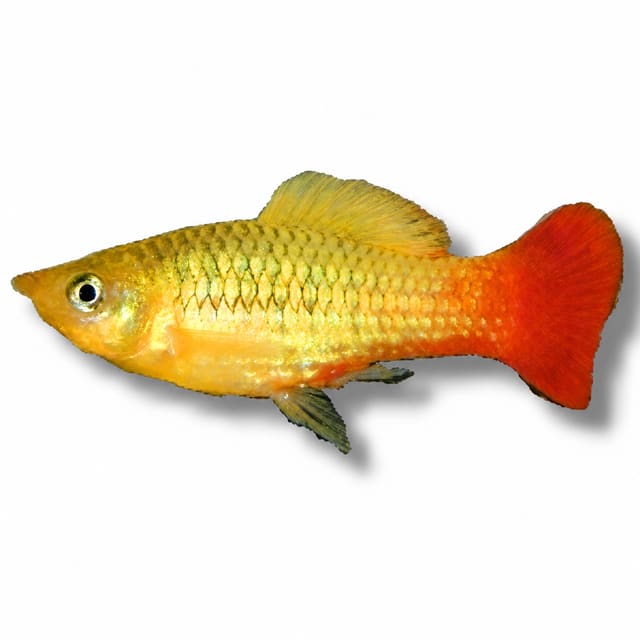
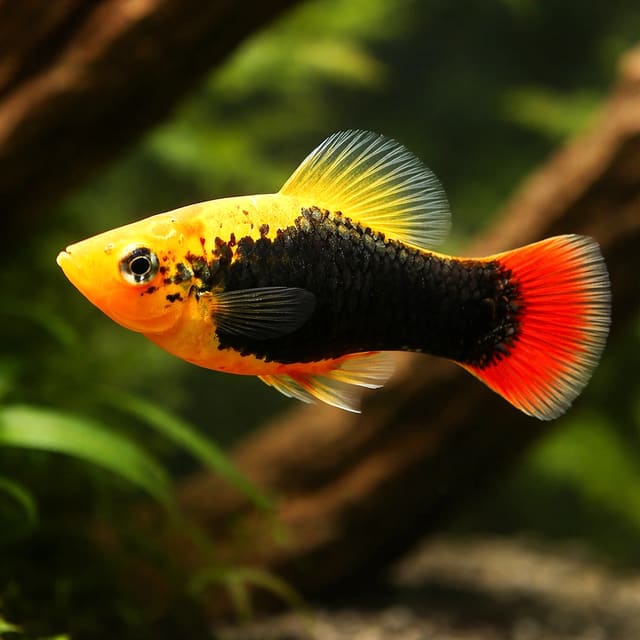
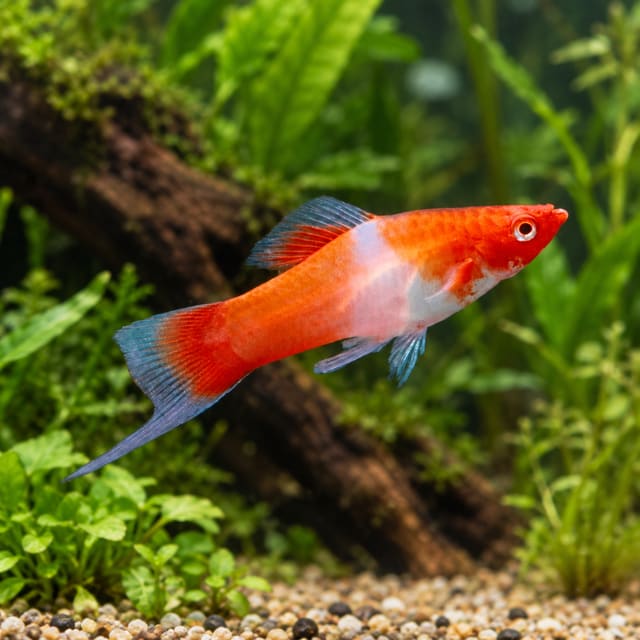
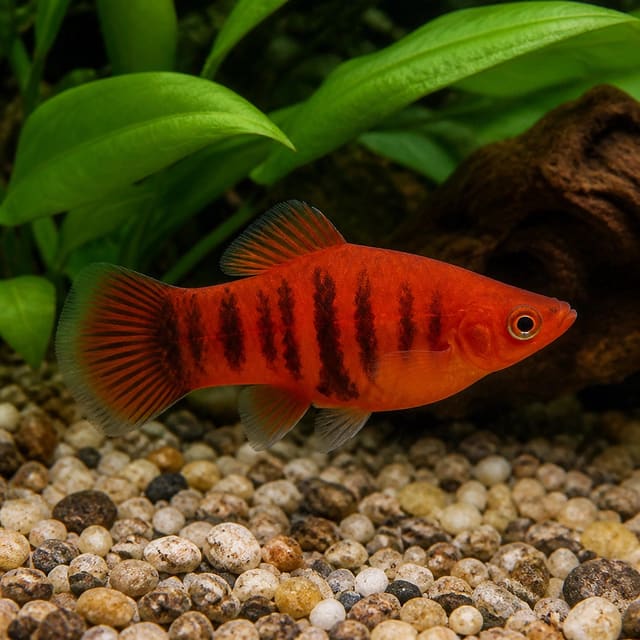
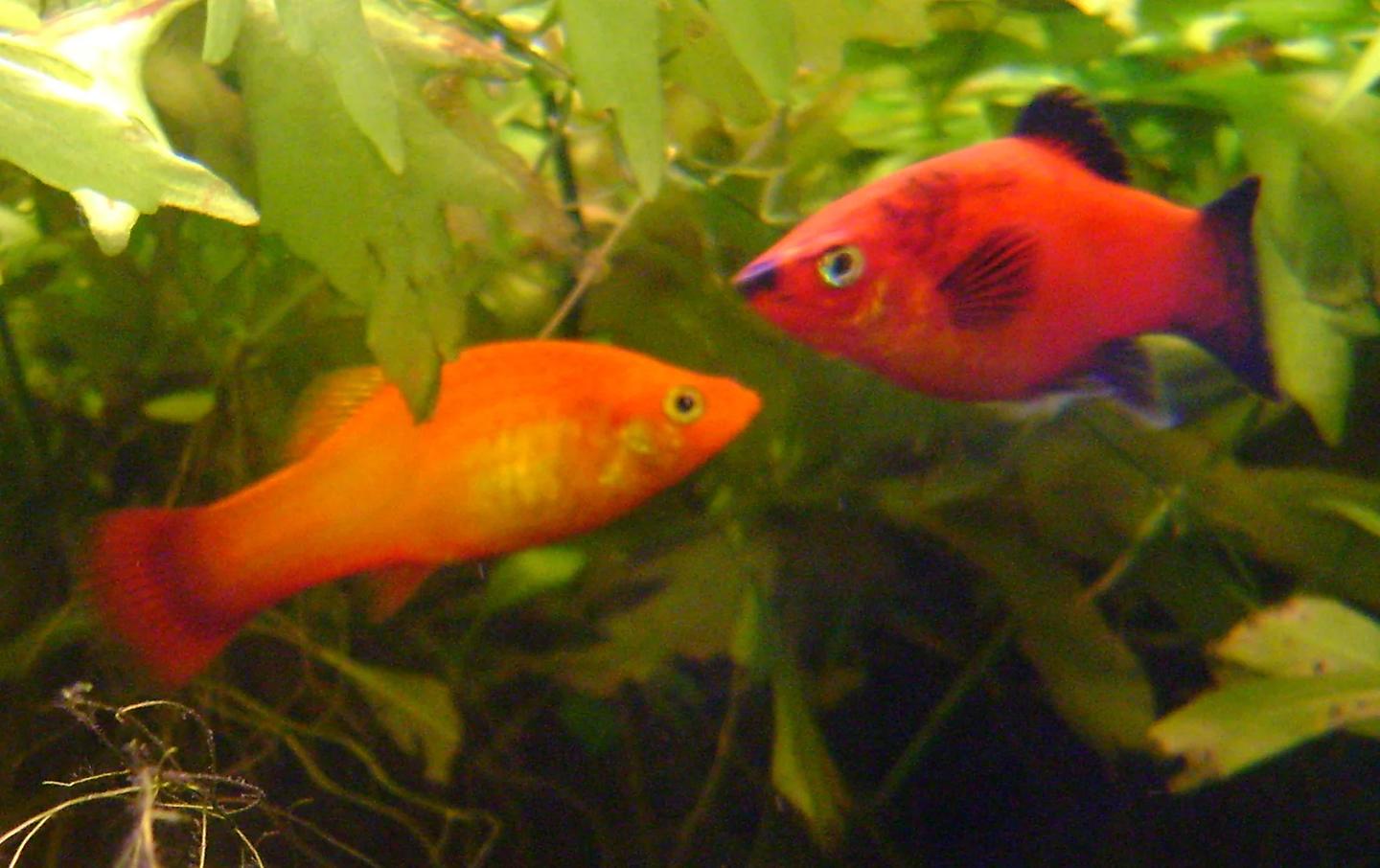
The first image shows one orange-gold fish with dark paired markings at the tail base, swimming among blurred plants and wood. The second shows two orange-gold fish in a planted aquarium. The third is a single side profile against a pale blue background, and the fourth shows one fish above a green plant and pale substrate. Gallery images have been digitally enhanced to improve image quality. Natural colour, pattern, size and maturity can vary between live animals.
| Accepted species | Xiphophorus maculatus |
|---|---|
| Sold unit | One live fish in the chosen size |
| Adult-length records | 4 cm TL male/unsexed record; 5 cm SL species-profile figure |
| Routine aquarium temperature | 20–26 °C |
| Routine aquarium pH | 7.0–8.2 |
| Routine hardness | 10–30 dGH |
| Planning footprint | 60 × 30 cm; example approximately 54 litres |
| Diet | Omnivorous; quality dried food with algae-rich and suitable live or frozen variety |
| Social planning | OATA’s broad group guidance suggests at least three and more females than males |
The routine aquarium values, footprint and 5 cm SL figure are species-level guidance from Seriously Fish. The 4 cm TL figure comes from FishBase. The group number is OATA guidance for platies and swordtails together rather than a species-specific optimum.
A filter needs time to develop the bacteria that convert toxic ammonia to nitrite and then nitrate. Do not judge readiness by clear-looking water. Prove the cycle with tests, confirm ammonia and nitrite at zero, and establish a repeatable maintenance routine before the platy arrives. The first tropical tank guide sets out the preparation steps for a new aquarium.
The 60 × 30 cm footprint and roughly 54-litre example are useful starting points for this species. They are not a universal stocking formula. The real capacity depends on the complete group, adult sizes, filtration, feeding and maintenance. Give the fish both open swimming room and planted edges where an individual can leave another fish’s view.
Plants suit this species well and echo the weedy margins described in wild habitat records. Live plants can also take up some dissolved nutrients, but they do not replace water changes. If artificial plants are used, choose soft forms without edges that can damage fins. Keep an open area through the front or middle and make sure wood or stones cannot shift.
Aim for 20–26 °C, pH 7.0–8.2 and 10–30 dGH for routine aquarium care. Seriously Fish says X. maculatus must be kept in moderately hard or harder water and will not thrive in soft, acidic conditions. Keep the values stable rather than moving repeatedly between endpoints.
FishBase records wild environmental values of 18–25 °C, pH 7.0–8.0 and 9–19 dH. OATA’s broader platy-and-swordtail sheet gives 17–27 °C for platies, pH 7.0–8.0 and 4–12 dGH. The differences reflect different purposes and scopes. For a home aquarium, follow the species-level husbandry range while recognising that the OATA numbers describe a broader group sheet, not a tailored optimum for this colour form.
Measure the aquarium itself. The water chemistry guide explains pH, general hardness, carbonate hardness and nitrogen compounds. Once you have real readings, the water parameter matcher can help compare them with the care range.
If the tap water is very soft, decide before purchase whether it can be remineralised accurately at every water change. Mineral additions must be measured and verified. A stable reading near one end of the range is preferable to large corrections made by guesswork. Ordinary aquarium salt is not a replacement for the calcium and magnesium represented by general hardness.
Provide effective biological filtration and steady surface movement. The species profile’s worked example for approximately 54 litres uses turnover around four to five times the aquarium volume per hour, about 215–270 litres per hour. That is a sizing illustration rather than a guarantee: media capacity, real flow after loading, stocking and cleaning all affect performance.
Create movement without forcing the fish to swim against a powerful outlet constantly. Plants, wood and the tank walls can produce quieter pockets. Check the intake is guarded, the surface is moving and debris is not collecting in dead areas. At warmer temperatures, gas exchange matters more because warm water holds less oxygen.
FishBase records worms, crustaceans, insects and plant matter in the wild diet. Seriously Fish describes the species as unfussy and accepting live, frozen or dried foods. OATA’s group sheet recommends a good-quality flake or granule with a high algae content, plus small live or frozen items such as daphnia, small bloodworm or tubifex.
Use a good dried staple, rotate suitable variety and keep portions small. OATA advises feeding what the fish can finish within a few minutes once a day. Watch that every individual eats; a shy fish can lose condition even when food disappears quickly. Remove leftovers because decomposing food increases the load on the filter.
Do not use extra food as a substitute for observing body condition. A rounded livebearer may be well fed, gravid or unwell, and this unsexed offer does not allow assumptions. Look at the fish from above or head-on as well as from the side, and respond to sustained change with water testing and careful assessment.
OATA strongly recommends a weekly partial water change of about 25% and at least weekly checks for ammonia and nitrite. Adjust the schedule to measured nitrate, stocking and feeding. Treat replacement tap water for chlorine or chloramine and bring it close enough in temperature and mineral content to avoid a sudden swing.
If the filter needs cleaning, do not run it under the tap; rinse it lightly in aquarium water removed during a water change. Avoid replacing all mature biological media at once. Clean an obstructed intake, inspect the heater and thermometer, and remove trapped waste from open substrate without tearing the whole aquarium apart.
Keep a written log of test results, water changes, filter work and unusual behaviour. It makes slow drift visible and helps everyone in the household follow one routine. Add new livestock gradually, because an established biological filter is adapted to its existing waste load and needs time to respond to a meaningful increase.
Arrange for someone to receive the parcel. Inspect the fish while the bag is sealed, float the sealed bag for 20–30 minutes as stated in the store policy and do not pour transport water into the aquarium. Give the fish quiet time after transfer and feed lightly only after it has settled.
A Live Arrival Guarantee claim requires a continuous unboxing video beginning with the parcel sealed, showing the outer box and opening, and showing the fish still inside the sealed bag. Contact the store on the day of arrival with the order number. These steps preserve claim evidence; they are separate from everyday biological care. Read the current delivery and Live Arrival Guarantee policy before delivery.
Seriously Fish describes Xiphophorus maculatus as very peaceful and notes that even males tolerate one another better than some swordtails and mollies. OATA likewise describes platies and swordtails broadly as peaceful and compatible with other species. This makes the Mickey Mouse form a useful community candidate, but only after water, adult size and feeding style are matched.
Choose companions that tolerate neutral-to-alkaline, moderately hard water and are not large enough to treat a platy as prey. Avoid building a community by common name alone. Compare the exact species for temperature overlap, adult mouth and body size, activity, fin behaviour and feeding speed. A quiet fish that repeatedly misses food is not a successful match even when there is no visible fighting.
OATA’s broad guidance suggests at least three platies or swordtails, with two females for each male. Seriously Fish also recommends several females per male because males may pursue females relentlessly. Sex cannot be chosen on this product, so the recommended ratio is a management goal rather than a purchase guarantee.
Use plants and visual barriers to give fish a route away from attention. Observe whether one fish is chased repeatedly, hides through feeding, breathes faster or loses condition. Separate or reorganise the group if persistent pressure develops. Simply adding more fish to dilute aggression can worsen crowding and filtration load.
Platies give birth to live young. Seriously Fish reports that this species breeds readily in community aquaria and recommends dense planting when fry are expected. This offer is not sexed, and adults supplied now may have been housed with the opposite sex previously. Do not buy a mixed group without a plan for fry, extra capacity and responsible rehoming.
The sources discuss sexing by the anal fin and note that males are smaller, but the store does not use appearance to promise the sex of the fish supplied. Treat any observation after arrival as husbandry information, not a retrospective guarantee.
Colour-form alternatives can be helpful when choosing the look of a display, but sharing the same species does not automatically solve space, sex-ratio or breeding questions. Count every fish in the final stocking plan and allow room for growth.
Spend a minute watching the fish before feeding. Healthy behaviour should be assessed against its usual pattern: swimming level, balance, response to nearby fish, appetite, breathing and fin position. OATA recommends watching for changes such as hanging at the surface, sitting on the bottom, erratic swimming, darker or paler colour, hiding, altered breathing, damaged fins, white spots, fluffy growths and loss of body condition.
A changed behaviour is a reason to investigate, not a diagnosis. Test temperature, ammonia, nitrite, nitrate, pH and hardness, compare the results with your log and correct any confirmed husbandry fault safely. Seek suitable professional or retailer guidance when the cause is unclear. Do not mix treatments or change several major variables at once, because that makes both the fish’s response and the original cause harder to understand.
Feed at a consistent time, make measured water changes and clean only what needs cleaning. Sudden deep cleaning can remove biofilm and bacteria, while neglected maintenance lets waste accumulate. The useful middle ground is regular partial work: siphon accessible debris, rinse blocked media in removed aquarium water, trim plants and confirm equipment operation.
Check that the group has enough refuge without losing all open water. As plants grow, they can close swimming lanes; after trimming, they may expose a fish that relied on a dense corner. Make small layout changes and then observe the social effect. Keep décor stable and free from sharp edges.
Growth changes the aquarium’s demand. A fish selected at 2–2.5 cm does not stay at dispatch size, and more food means more waste. Review stocking and filtration as juveniles develop. The XL choice likewise describes the supplied option, not a separate adult species or a promise that growth is complete.
Good care is mostly repeatable detail: suitable mineral water, a mature filter, modest food, enough footprint, realistic community choices and attention to change. None is difficult in isolation, but skipping one can undo the others. A simple written routine makes the ‘easy’ care assessment meaningful rather than casual.
The smaller numeric choice can look tiny in a mature display, yet it still needs an aquarium planned for the adult fish and its social group. Do not use juvenile body length to justify a temporary bowl or an overcrowded nursery. A stable 60 × 30 cm footprint gives a young fish room to grow without another disruptive move as soon as it settles.
The 3–4 cm choice is also a dispatch measurement, not evidence that the fish is mature or sexed. XL is a supplier size label without a reviewed centimetre equivalent. In every case, judge the aquarium by the species, group and community rather than the wording of one size choice.
Platies appreciate planted cover, but the layout should not become a wall of stems. Keep a clear route across the front or middle, then use denser planting at the sides and rear to break lines of sight. This gives a pursued fish somewhere to withdraw without preventing the group from feeding and swimming normally.
Inspect the layout at each water change. Remove loose plant bands, sharp plastic seams and unstable stones. Guard the filter intake and make sure no gap can trap a fish. If floating plants cover the surface, leave open areas for gas exchange and feeding. A secure lid also prevents accidental escapes during startled movement or maintenance.
Juvenile sex may not be obvious at purchase, and sex is not guaranteed here. As the fish develop, observe the anal fin, body shape and behaviour without treating a visual guess as a store promise. If males begin pursuing females continuously, increase visual separation and correct the group ratio where practical rather than waiting for the quieter fish to lose condition.
Mixed-sex livebearers can increase the aquarium population quickly. Dense plants may help fry survive, which is useful only when there is space to raise them. Decide who can house offspring before they appear. Never release aquarium fish into local waterways; introduced populations can harm native ecosystems, and FishBase notes adverse ecological impact reports for this species in at least one country.
When a reading is outside the care range, confirm the test and identify the cause before making a large correction. Check source water, recent additions, decaying food, filter flow and maintenance history. Adjust gradually unless an acute ammonia or nitrite emergency requires immediate safe dilution. Several simultaneous chemical changes make the outcome harder to predict.
Use the same approach when social behaviour changes. First confirm which fish is pursuing, hiding or missing meals, then alter one practical factor such as a sight line, feeding position or group arrangement. Observe the result. This measured approach protects the aquarium from constant disruption and helps distinguish a real improvement from a brief pause.
Write down the feeding amount, usual temperature, water-change method and emergency contact before a holiday. Pre-measure food portions so a helper does not overfeed. Ask them to observe the fish and equipment rather than clean the filter or alter water chemistry. A short, precise routine is safer than leaving a long list of optional tasks.
FishBase records 4 cm total length for a male/unsexed Xiphophorus maculatus, while the aquarium profile uses 5 cm standard length. Total length includes the tail and standard length excludes it. OATA’s 6–8 cm figure covers platies as a broad group, so the three records should stay labelled rather than become one promised maximum.
For Xiphophorus maculatus, the species profile uses a 60 × 30 cm base and an example volume of about 54 litres. The footprint provides swimming room and space to move away from persistent attention. Increase the aquarium size for a larger group or community, and use a mature biological filter rather than relying on volume alone.
For Xiphophorus maculatus, OATA’s broader guidance for platies and swordtails suggests at least three, with two females per male. Seriously Fish also recommends several females per male. Sex cannot be chosen here, so a purchase quantity cannot guarantee that ratio; observe the developing group and be ready to manage persistent pursuit.
It can be. Seriously Fish calls Xiphophorus maculatus one of the better beginner species while pH stays above neutral, and OATA describes platies broadly as easy to keep. The aquarium still needs a mature filter, tested water and stable moderately hard, neutral-to-alkaline conditions.
Use a quality flake or small granule as the staple, including an algae-rich food. Suitable small live or frozen foods such as daphnia or small bloodworm can add variety. Offer only what the fish finish within a few minutes, watch that every individual eats and remove leftovers before they affect water quality.
For routine aquarium keeping, aim for 20–26 °C and pH 7.0–8.2, with hardness around 10–30 dGH. These are species-level husbandry values from Seriously Fish. Keep them stable and avoid soft, acidic water rather than chasing the broader endpoints in wild or group-level records.
The species profile describes it as very peaceful and says even males tolerate one another. The more common social issue is persistent male attention toward females. Provide more females than males when sex is known, break sight lines with plants and investigate repeated chasing, hiding or missed meals.
They can live with peaceful community species that share moderately hard, neutral-to-alkaline water and are not large enough to eat them. Check every exact species for adult size, temperature, feeding speed and temperament. Avoid choosing a tank mate solely because both labels say community fish.
Tropical Fish Co hand-packs livestock in oxygenated bags inside an insulated box, adding a heat pack when conditions call for one, and uses a tracked licensed live-animal courier. Someone must receive the parcel. A same-day claim requires the order number and a continuous unboxing video starting with the sealed parcel and showing the fish still sealed in the bag.
Wild environmental records, group guidance and species-level aquarium advice have different scopes. Keeping those scopes distinct gives a clearer plan than combining all endpoints into one broad range.
No reviews for this item yet. Bought one? Honest reviews only, good or bad.
What customers say about ordering from us
Easy website plenty of info on fish your buying great to pick a time slot
TRACEY DURRANT · 7 Oct 2026
Got some lovely fish thank you
Kevin Mackie · 7 Oct 2026
Reviews of our shop, collected by Judge.me, an independent third-party review collector. Newest first.