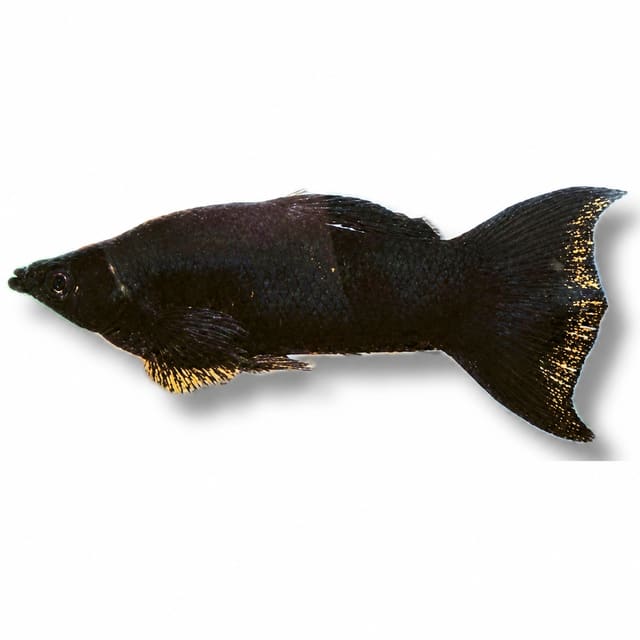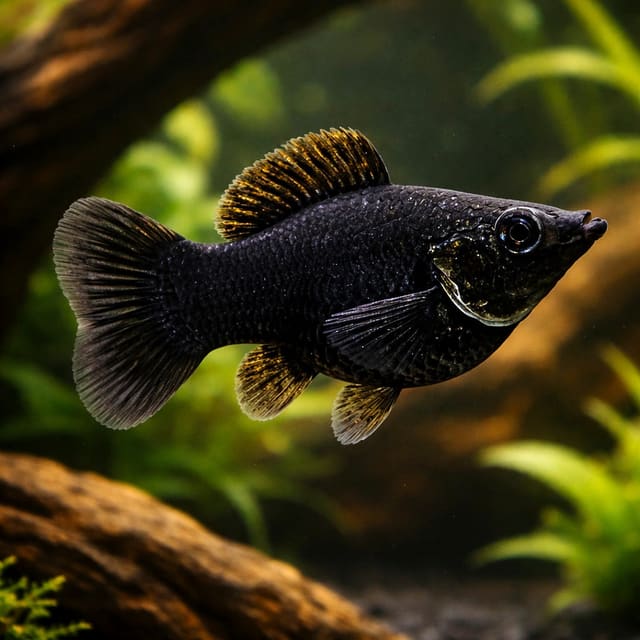
Sail-Fin Molly assorted (Poecilia velifera)
22–28°C · pH 7–8.5
£14.99

One live, unsexed Red Molly (Poecilia sphenops) supplied at approximately 4 cm. A vivid hard-water livebearer for a mature 90L+ aquarium with a suitably planned social group.
Poecilia sphenops
Save when buying multiple fish. Each quantity is one fish; sex and pair formation are not guaranteed unless the selected variant explicitly states them.
Confirm your email, then we’ll send an availability message for this exact item if it returns within 180 days.
This request is only for this product—no newsletter or other promotions. A mail-provider retry may very rarely duplicate the same availability message. Unconfirmed addresses are removed after 48 hours. See our privacy policy.
One live, unsexed Red Molly (Poecilia sphenops) supplied at approximately 4 cm. A vivid hard-water livebearer for a mature 90L+ aquarium with a suitably planned social group.
Maintain these water conditions for optimal health and vibrant colors
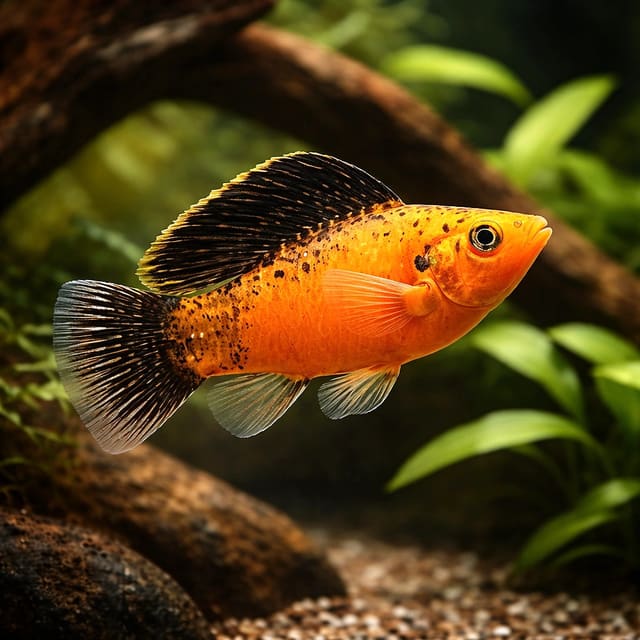
Red Molly (Poecilia sphenops) is a vivid domestic colour form of the short-fin molly. It combines a warm red to orange-red appearance with the active grazing and social behaviour expected from this hard-water livebearer. The colour attracts attention, but the important buying questions are less decorative: is the aquarium genuinely mineral-rich, is there enough room for a group, and can male courtship be managed without crowding?
This listing is for one live, unsexed fish supplied at approximately 4 cm. The source does not say whether that figure is standard, body or total length, so allow normal measurement variation. One quantity is not a trio, breeding set or wholesale carton. Plan for the adult fish rather than its arrival size, and do not assume the individual dispatched will have one exact shade or fin outline.
The single gallery image is a representative aquarium illustration of the Red Molly colour form, not a photograph of the individual that will be dispatched. Live fish vary in red intensity, orange tone, scale sheen, body depth, fin shape, sex and exact supplied length. Lighting, background, age, diet and stress also change how colour appears. Use the image to understand the general colour direction, not as a promise that every scale or fin will match.
| What you receive | One live, unsexed fish |
|---|---|
| Scientific name | Poecilia sphenops |
| Trade name | Red Molly |
| Supplied size | Approximately 4 cm; measurement convention is not specified |
| Adult planning size | Allow for up to about 10 cm total length in domestic stock |
| Practical aquarium baseline | About 90 litres and 75-80 cm long for a small social group; larger for a mixed community |
| Published temperature range | 18-28 C; a stable 23-27 C is a practical domestic target |
| Published pH | 7.5-8.2 |
| Published general hardness | 11-30 dGH |
| Temperament | Peaceful and active, although males can pursue females persistently |
| Diet | Omnivore needing plant matter, algae and varied prepared foods |
| Care level | Easy to moderate when hardness, space and group structure are suitable |
A Red Molly is a strong choice when the aquarium already has hard alkaline water, open swimming room and companions comfortable with an active livebearer. It is a poor choice when the only available tank is very small, the water is naturally soft and acidic, or delicate fish already struggle to reach food. Deciding from the tap-water chemistry first saves more problems than trying to alter an established community after purchase.
| Question | Good sign | Reason to pause |
|---|---|---|
| Is the aquarium cycled? | Ammonia and nitrite remain at zero under the current stocking load | The tank is new, readings are unstable or a filter has recently been replaced |
| Is the water suitable? | pH and GH are measured inside the hard alkaline range | Only pH is known, or the water is soft and acidic |
| Is there group capacity? | The tank can house a social group at adult size | There is room for one juvenile but not several adults |
| Are companions compatible? | They share the same chemistry and are peaceful but not easily outcompeted | They need soft water, nip fins or may swallow a 4 cm fish |
| Can fry be managed? | There is a plan for separation, rehoming or natural population control | Mixed sexes would create unwanted fish with nowhere to go |
Out-of-stock periods are useful preparation time. Measure the aquarium, test source and tank water, inspect filter capacity and decide how sex ratio will be managed. Availability can change, but the adult needs do not. Never reserve space by assuming every young molly will remain the same size or sex.
The scientific identity is Poecilia sphenops. "Red" is the domestic colour-form name, not a third word in the scientific name and not a separate species. Commercial mollies have been selected for colour, finnage and body shape over many generations. A responsible listing can identify the supplied form without claiming a pure wild locality, fixed genetic line or guaranteed breeding outcome.
Red expression can range from orange-red through deep warm red. Some fish show paler areas around the abdomen or fins; others appear more even. Young fish may intensify as they mature, while transport stress can temporarily mute colour. A darker aquarium background often makes warm pigment appear stronger. None of those changes alter the underlying sale unit or species.
The product URL contains "X Mix" because it belonged to an older mixed-molly listing. The URL remains unchanged to protect Google indexing and links. It does not mean that three mixed-colour fish are included. The current title, size statement and live selector define the current Red Molly product.
Choose this form when a predominantly red molly suits the display, but make water compatibility the first filter. A perfect red shade cannot compensate for soft acidic water or an overcrowded tank. If exact pattern matters more than a colour family, a live fish selected in person is more predictable than any online representative photograph.
Red pigmentation is not a health score by itself. A well-kept fish may be orange-red rather than dark crimson, and two siblings can mature differently. Aquarium lamps with a strong warm spectrum can make a fish look deeper red, while cool white lighting can make the same animal appear paler. Dark substrate and plants increase visual contrast; a bright bare tank often washes colour out in photographs.
Good nutrition supports normal pigment expression, but food cannot rewrite the inherited colour form. Products marketed for colour enhancement should remain part of a balanced diet, not replace plant matter, fibre and varied protein. Avoid comparing a newly transported fish under subdued lighting with a highly edited catalogue image. Give the animal time to settle, then judge colour alongside appetite, posture, respiration and social behaviour.
Stress-related fading should improve as conditions stabilise. A persistent colour change combined with clamped fins, hiding, weight loss or breathing difficulty requires investigation. Test the environment before reaching for supplements. The goal is a healthy fish expressing its natural domestic red range, not an artificial shade produced at the expense of digestion or water quality.
The source lists this fish at 4 cm. Treat that as an approximate commercial size band rather than a precise fin-to-fin guarantee. Small differences occur because live fish grow between stock assessment and dispatch, individuals are measured differently, and the tail may or may not be included. The fish is unsexed unless the selector explicitly says otherwise.
FishBase gives 7.5 cm as a maximum standard length for Poecilia sphenops. Standard length stops at the base of the tail, so total length is greater. Domestic line variation also exists. Allowing for up to about 10 cm gives a safer aquarium plan than assuming a 4 cm arrival will remain small.
| Measurement | Use | What it does not promise |
|---|---|---|
| Approximately 4 cm supplied size | Helps assess intake safety, food size and immediate tank-mate risk | One exact length, adult size or sex |
| 7.5 cm published standard length | Scientific body-length reference | Total length including the tail |
| Up to about 10 cm planning allowance | Conservative domestic aquarium planning | That every fish reaches exactly 10 cm |
Red Mollies are best treated as hard-water fish, not generic tropical fish that will adapt indefinitely to any tap supply. FishBase records Poecilia sphenops at pH 7.5-8.2 and 11-30 dH. Those values describe alkaline, mineral-rich conditions. They are especially useful because pH alone cannot tell you whether the water contains enough calcium and magnesium.
Use a liquid or reliable digital test regime for the aquarium and source water. GH measures calcium and magnesium hardness. KH indicates carbonate buffering and helps explain how resistant pH is to sudden movement. A tank can read pH 7.8 yet have weak GH, or can begin with good tap-water hardness and drift as water-change practice changes. Record the numbers rather than judging from clear water or healthy plants alone.
If the tap supply is soft, do not chase a target with random alkaline powders. Test tap and tank water, choose a reproducible remineralising method and change chemistry gradually. Replacement water should be prepared consistently so every water change does not become a new acclimation event. The water parameter matcher can help compare your readings with the species range.
No. The species can tolerate brackish conditions, but tolerance is different from necessity. Stable hard fresh water can support a Red Molly without routine aquarium salt. Salt does not provide the same mineral profile as GH, does not detoxify an uncycled aquarium, and may be wrong for plants or companions. Use it only for a defined purpose after checking every inhabitant.
FishBase gives a 60 cm minimum aquarium length, but that should be read as a species floor, not a complete social stocking recommendation. A mature aquarium around 90 litres or larger and approximately 75-80 cm long is a more useful starting point for a small group. Increase both footprint and filtration when other livebearers, several males or growing fry are involved.
Open swimming space matters because mollies cruise continuously. Place plants, wood or rock around the edges and rear to break sight lines, then retain a broad route through the middle. Established surfaces offer algae and biofilm for grazing. Hardy plants chosen for alkaline water provide cover without requiring the aquarium to become a dense thicket.
A cover limits jumping risk. Filter flow should move oxygenated water without sweeping a 4 cm fish across the tank. Fit a sponge guard where an intake could trap small fish or fry. Use reliable heating, but protect livestock from direct contact with a hot heater surface. Avoid sharp plastic plants and narrow gaps that can damage fins.
Set water-change frequency from measured waste and stocking rather than a fixed slogan. In many established community aquariums, a regular weekly partial change creates a dependable rhythm. Match replacement water for temperature and mineral content, condition it correctly, and avoid waiting for nitrate or debris to force a very large emergency change.
Rinse mechanical filter media in removed aquarium water when flow falls. Do not replace all mature biological media at once. Siphon accumulated waste while leaving useful biofilm on selected surfaces. Evaporation top-ups restore water volume but remove no nitrate; in hard water they can also concentrate dissolved minerals, so they do not replace partial water changes.
| Observation | Useful check | Common mistake to avoid |
|---|---|---|
| pH drifts between changes | Compare KH in tap and aquarium water | Adding a fast pH chemical without finding the cause |
| Fish rock or clamp fins | Test GH, pH, ammonia, nitrite and temperature | Assuming one symptom proves one disease |
| Flow weakens | Inspect intake and mechanical media | Replacing every filter component together |
| Nitrate climbs quickly | Review feeding, stocking and change volume | Treating top-up water as a water change |
A Red Molly is an active social fish. A group of four or more is preferable where the aquarium has enough adult capacity. In a mixed-sex group, aim for one male to two or three females. Males court frequently, and a lone female may receive persistent attention. Extra females distribute that pressure, while plants and hardscape provide visual separation.
This product is unsexed. Adult males develop a narrow modified anal fin called a gonopodium; females retain a broader fan-shaped anal fin and often develop a fuller body. A 4 cm juvenile may not be reliably sexable, and colour intensity is not a dependable sex test. Contact the team before dispatch if the existing group makes sex balance especially important, but recognise that a guarantee may not be possible.
Normal activity includes cruising, surface feeding, grazing and brief display chases. Persistent pinning into a corner, damaged fins, hiding, rapid breathing, rocking, loss of appetite or weight loss require attention. Observe individuals, not only the busiest fish. A confident male at the front can make the whole tank appear healthy while a quieter fish is excluded behind decor.
Unsexed juveniles may mature into more males than expected. Keep a cycled separation option and a realistic plan to rebalance the group. Do not add more fish automatically if the tank is already near capacity. More females help only when there is sufficient water volume, filtration and long-term space for them.
Suitable companions share hard alkaline water, have a peaceful but resilient feeding style and will not swallow a 4 cm fish. Platies, selected swordtails, other short-fin mollies and robust hard-water community fish may work. Adult size, sex ratio and the available swimming length matter more than the word "community" on a label.
| Often suitable | Use caution | Avoid |
|---|---|---|
| Platies in compatible hard water | Other mollies if male pressure is already high | Species requiring soft acidic water |
| Swordtails in a larger aquarium | Guppies where courtship or feeding competition becomes intense | Persistent fin nippers |
| Peaceful hard-water livebearers | Bottom fish only after matching temperature and GH | Aggressive or predatory cichlids |
| Robust peaceful fish too large to swallow | Shrimp, particularly juveniles and freshly moulted animals | Slow delicate feeders likely to miss food |
Many tetras, dwarf cichlids and wild-type catfish prefer softer water. Keeping every species at the edge of its tolerance is not balanced compatibility. Check the complete molly care guide, then compare the actual temperature, pH and GH overlap with every existing inhabitant.
Poecilia sphenops is omnivorous. FishBase records worms, crustaceans, insects and plant matter, while aquarium mollies readily graze algae and accept prepared foods. Build the diet around quality omnivore food with a meaningful vegetable component. Colour should come from good condition and a balanced diet, not from excessive colour food or one rich protein source.
| Food group | Examples | Purpose |
|---|---|---|
| Prepared staple | Spirulina flake, quality omnivore granule, algae-based flake | Consistent broad nutrition |
| Plant and grazing foods | Algae wafer pieces, natural biofilm, suitable blanched courgette or spinach | Plant matter, fibre and grazing behaviour |
| Live or frozen rotation | Daphnia, brine shrimp, mosquito larvae and occasional bloodworm | Variety and animal protein in moderation |
At approximately 4 cm, use flakes or small granules that can be swallowed easily. Feed modest portions once or twice daily and watch that each fish eats. Remove leftovers before they decay. A fish rushing to the glass is displaying learned feeding behaviour, not proving that it needs another meal.
Track body condition over several weeks. A healthy fish should look alert and well filled without remaining continuously bloated. Females naturally become fuller during pregnancy, so combine body shape with appetite, scales, swimming, faeces and behaviour. A simple rotation of two good prepared foods plus small live or frozen feeds is more reliable than buying many supplements and using them inconsistently.
Red Mollies are livebearers. Fertilisation is internal, and females produce free-swimming young rather than attaching eggs to plants. FishBase reports broods from around 20 to 150 after roughly 28 days, but timing and brood size vary with female age, size, condition, temperature and previous mating. Females can store sperm and may produce later broods after males are removed.
A rounded abdomen does not reveal an exact due date. On a red body, a gravid spot may be difficult to interpret. Repeatedly moving a female into a cramped trap can cause more stress than providing dense planted cover. If some natural fry survival is acceptable, fine-leaved plants and floating roots offer shelter. Deliberate rearing needs a separate mature grow-out setup, protected filtration, frequent small feeds and disciplined maintenance.
If fry are not wanted, consider a reliably sexed single-sex group and still allow for sperm storage in females. Before saving a brood, calculate grow-out space and future homes. Never release aquarium fish into rivers, ponds or drains connected to natural water.
Mollies can turn one carefully planned group into a crowded aquarium within months. The first brood may seem manageable because fry are tiny, but juveniles grow, begin reproducing and add waste before they look adult. Include future offspring in the stocking calculation from the beginning. A larger filter does not create unlimited swimming space or remove the need for regular maintenance.
Keep simple records of additions, births, deaths and sex balance. This makes it easier to see whether the group is expanding faster than expected and whether one male is responsible for most pressure. Arrange responsible homes before raising large numbers. Local fishkeepers or retailers may have requirements around size, health and notice; never assume they can accept every brood.
If natural fry survival is not wanted, do not add dense nursery cover specifically for babies. Even then, some may survive. A single-sex group reduces future breeding only when sexing is reliable, and a female may still carry stored sperm. Separating sexes after the first birth does not guarantee that no later brood will appear.
Long-term care also means reassessing the aquarium as the fish age. A group that worked as 4 cm juveniles may need more floor area, stronger biological capacity or a revised ratio when adults mature. Review water tests and behaviour after each significant change rather than waiting for visible conflict.
| Sign | First checks | Why the order matters |
|---|---|---|
| Shimmying or rocking | GH, pH, ammonia, nitrite and temperature stability | Environmental stress can resemble disease |
| Clamped fins or rapid breathing | Oxygen, toxins, heat and gill irritation | Medication will not repair poor water |
| Weight loss or hollow belly | Food access, faeces, bullying and quarantine assessment | Competition and internal disease need different responses |
| White spots, rubbing or excess mucus | Isolate where possible and identify the pattern | Different parasites and irritants require different treatment |
| Torn fins | Male pressure, fin nippers, sharp decor and water quality | Healing fails when the original cause continues |
| Colour fades after arrival | Lighting, stress, temperature and social pressure | Temporary fading alone does not prove illness |
Do not add salt, medication or mineral products simply because mollies have a reputation for needing them. Test the environment, document symptoms and isolate where practical. Treatments can damage biological filtration or invertebrates. Seek qualified aquatic-veterinary guidance for severe, unusual or persistent cases.
A separate cycled quarantine aquarium lets a new fish feed without competition and makes faeces, breathing and fin condition easier to inspect. Match suitable hard water rather than quarantining in chemically inappropriate water. Use dedicated equipment where possible and keep written notes of test results, dates and any treatment.
| Listing | Visual emphasis | Useful choice question |
|---|---|---|
| Red Molly | Predominantly warm red to orange-red short-fin form | Do you want a red focal colour while keeping standard molly proportions? |
| Gold Molly | Predominantly yellow-gold short-fin form | Would a brighter yellow-gold fish suit the display better? |
| Gold Black Molly | Gold with a stronger dark component | Do you prefer a two-tone domestic pattern? |
| Assorted Molly | Colour or pattern selected from mixed available stock | Are you comfortable with the exact colour being chosen by availability? |
Browse the Molly Fish collection and the hard-water Molly buying guide before combining forms. Different colour names do not create different water chemistry, and too many males remain a problem even when every fish has a different pattern.
The UK livestock delivery and Live Arrival Guarantee page explains eligible destinations, packing, dispatch conditions and the arrival claim process. New customers can use WELCOME10 for 10% off a first order, subject to the current offer terms.
One product quantity includes one live fish. This is not the old trio listing and not a wholesale carton.
The source size is approximately 4 cm. The source does not define whether this is standard, body or total length, so allow natural variation.
No. The accepted species name is Poecilia sphenops. Red Molly is the domestic colour-form or trade name.
No. The single image is representative rather than a photograph of the individual dispatched. Shade, sheen, body depth, fin shape, sex and exact length vary.
The current title and description define one Red Molly.
Published species parameters are 18-28 C, pH 7.5-8.2 and 11-30 dGH. A stable 23-27 C is a practical domestic temperature target.
No. Suitable hard fresh water is sufficient. Salt tolerance does not make routine salt essential and does not replace GH or good water quality.
A social group is preferred. In a suitable 90L-or-larger aquarium, keep four or more where capacity allows and aim for one male to two or three females in mixed-sex groups.
The fish is unsexed unless the selector explicitly says otherwise. A juvenile around 4 cm may not be reliably sexable.
Plan for up to about 10 cm total length in domestic stock. The supplied 4 cm size is not an adult maximum.
Often that creates a poor compromise. Choose companions that genuinely share hard alkaline water rather than keeping either group at the edge of its range.
Yes. Female mollies can store sperm from earlier mating, so later broods are possible after separation.
The source record establishes the Red Molly name and approximate 4 cm size but supplies no care parameters or photograph. Species identity, published water range, adult reference, feeding and reproductive biology were therefore checked against taxonomic, fisheries and institutional sources. Practical aquarium recommendations are deliberately more conservative than a survival minimum.
No reviews for this item yet. Bought one? Honest reviews only, good or bad.
What customers say about ordering from us
I have a small group of long finned mountain minnows. So was delighted to be able to order ten of this variety to increase the genetics in my tank . The ones I recieved are healthy but it’s to early to give a verdict on wether they are of a long finned type since they are small currently.
Gordon Walker · 23 Sept 2026
100% success travel and "installation". Pleased with quality of purchase. The Siamese fighter a bit "shy" so have not yet seen him at his best yet but looking good. Happy customer. GG
George E Garratt · 21 Sept 2026
Reviews of our shop, collected by Judge.me, an independent third-party review collector. Newest first.