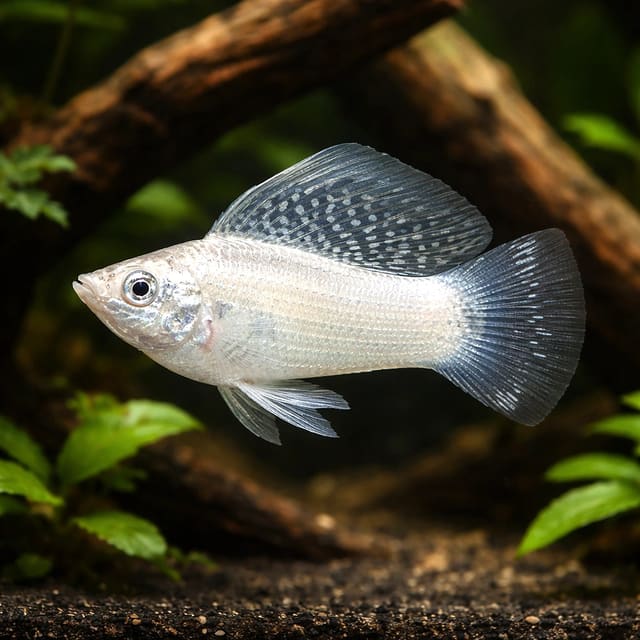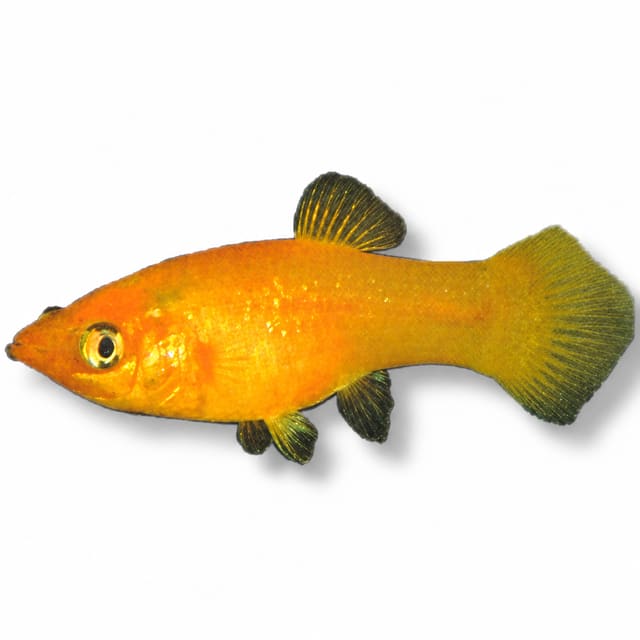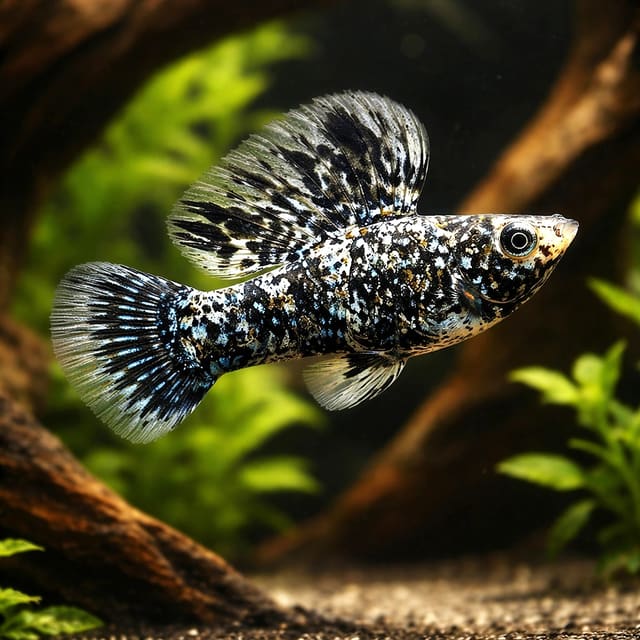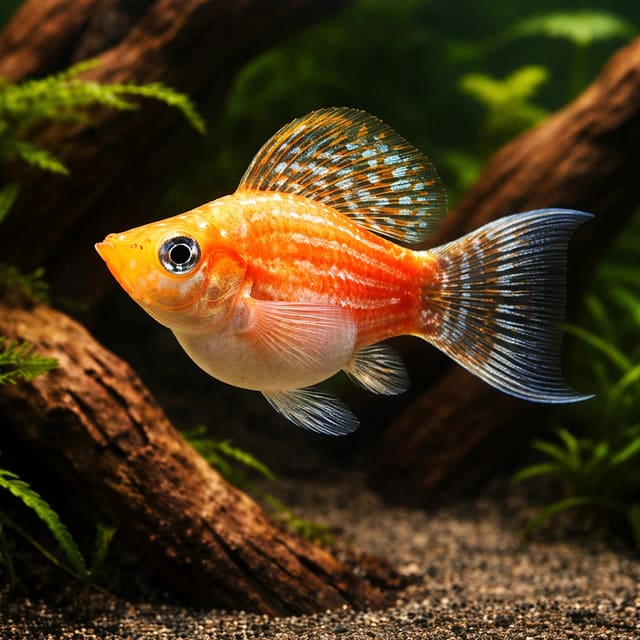
Assorted Balloon Molly (Poecilia cf. latipinna)
20–28°C · pH 7–8
£6.99

Pale domestic Platinum Sailfin Molly at approximately 4-5 cm, for mature hard-water aquariums with proper group, sex-ratio and adult-space planning.
Poecilia latipinna
Save when buying multiple fish. Each quantity is one fish; sex and pair formation are not guaranteed unless the selected variant explicitly states them.
Confirm your email, then we’ll send an availability message for this exact item if it returns within 180 days.
This request is only for this product—no newsletter or other promotions. A mail-provider retry may very rarely duplicate the same availability message. Unconfirmed addresses are removed after 48 hours. See our privacy policy.
Pale domestic Platinum Sailfin Molly at approximately 4-5 cm, for mature hard-water aquariums with proper group, sex-ratio and adult-space planning.
Maintain these water conditions for optimal health and vibrant colors
Platinum Sailfin Molly (Poecilia latipinna) is a pale silver-white domestic colour form of the Sailfin Molly. A settled fish can look luminous against green plants and a darker background, while a mature male may raise the broad dorsal fin that gives the species its common name. Young fish and females do not show the same full sail, so body shape, fin development and colour naturally vary.
This is a substantial livebearer rather than a tiny beginner fish. It does best in a mature, well-filtered aquarium with hard alkaline water, open swimming room, planted shelter and companions chosen for the same mineral-rich conditions. Good molly care is built around stable water quality and appropriate space, not around treating salt as a substitute for maintenance.
Each selected quantity supplies one live, unsexed Platinum Sailfin Molly at approximately 4-5 cm. This is one fish, not a pair and not a wholesale trade pack. Dispatch size is approximate and does not guarantee exact length, age, sex, mature fin shape or colour intensity.
If you are building a group, select the total number of individual fish required. OATA recommends at least three mollies and, where sex can be chosen reliably, a practical ratio of one male to two females. Sex is not guaranteed on this listing, so plan enough room to observe and manage the group as the fish mature.
| Common name | Platinum Sailfin Molly |
|---|---|
| Scientific name | Poecilia latipinna (Lesueur, 1821) |
| Family | Poeciliidae |
| Colour form | Domestic platinum trade morph; live shade and markings vary |
| Sale unit | One live, unsexed fish per selected quantity |
| Approximate dispatch size | 4-5 cm |
| Adult size | Plan for a large molly; FishBase records up to 15 cm total length for male/unsexed fish and 10 cm for females |
| Care level | Moderate; easiest in mature hard-water aquariums |
| Temperament | Generally peaceful, active and socially assertive |
| Group | At least three; use one male to two females when sex is known |
| Starting aquarium | 80 litres minimum for a small sailfin group; 100 litres or more and about 80 cm frontage recommended for adults |
| Practical temperature target | 22-27°C, stable and acclimated |
| Practical pH target | 7.2-8.2, stable |
| General hardness | Hard water, approximately 12-20 dGH as a practical target |
| Diet | Omnivore with an important algae and plant component |
| Breeding | Livebearer; mixed-sex groups can produce frequent fry |
The accepted species name is Poecilia latipinna. "Platinum" is a domestic aquarium-trade description for the pale colour form; it is not a scientific third name, a subspecies or proof that a fish comes from a particular wild locality. Keeping those two ideas separate makes the listing more useful: the species name anchors care and taxonomy, while the morph name describes what the breeder or trade selected for appearance.
Wild Sailfin Mollies occur naturally along Atlantic and Gulf coastal drainages from the south-eastern United States towards Veracruz, Mexico. USGS records them in shallow, slow-moving and often vegetated marshes, ponds, streams, ditches, swamps and estuaries. Domestic platinum fish are aquarium strains, however, and may carry a history of selective breeding or hybrid influence that cannot be reconstructed from colour alone.
The mature male sail is the species' most recognisable feature. FishBase describes the large sail-like dorsal as a male characteristic, and OATA also notes that only male sailfin mollies develop the larger dorsal fin. A 4-5 cm unsexed fish may be juvenile, female or a male whose fin is not yet fully developed. The word "Sailfin" identifies the species; it does not promise that every dispatched individual already displays an adult male sail.
| Feature | What may be seen | What is not guaranteed |
|---|---|---|
| Platinum colour | Silver-white, cream or pale reflective body, sometimes with subtle darker areas | An identical shade under every light or on every individual |
| Dorsal fin | Modest in juveniles and females; potentially much larger in mature males | A fully raised male sail at dispatch |
| Body shape | Normal Sailfin Molly body, with females often fuller and males usually slimmer | Exact sex, maturity or reproductive condition |
| Length | Approximately 4-5 cm at dispatch | Millimetre-exact measurement or final adult size |
| Markings | Natural variation in eyes, fins, sheen and any small pigment patches | A photographic duplicate of the gallery reference |
The current gallery contains one protected existing aquarium reference.
Use the written identity, approximate 4-5 cm dispatch size and live condition at arrival as the dependable buying information. The image can help visualise a pale molly in a planted aquarium, but it cannot prove sex, mature sail development, exact platinum shade, body proportions or individual markings.
OATA recommends at least an 80-litre aquarium for Sailfin Mollies. Treat that as a minimum starting point for a small group, not a universal capacity for any mixture of fish. For mature adults, a mixed-sex group or a community, 100 litres or more with about 80 cm of frontage gives a more responsible margin for swimming, courtship, feeding and water stability.
Footprint matters. Sailfin Mollies are active through the middle and upper water and can be assertive at feeding time. A taller aquarium with a short front panel may hold the same litres but provide less useful horizontal movement. More water volume also slows changes in temperature and chemistry, which is particularly valuable when keeping mineral-rich conditions stable.
| Plan | Responsible starting point | What to watch |
|---|---|---|
| One fish joining an established molly group | Use the group's existing adult-size requirement, never the dispatch size alone | Sex balance, chasing, feeding access and shared water chemistry |
| Small group of three | At least 80 litres; 100 litres or more preferred for long-term margin | Known or emerging sex ratio and space to leave a pursuit |
| Mixed-sex adult group | 100 litres or more with about 80 cm frontage | One male to two females where identifiable, plus a fry plan |
| Community aquarium | Increase beyond the molly minimum for every other adult resident | Hard-water compatibility, activity, adult size and total biological load |
| Breeding or fry grow-out | Separate mature filtered space planned before fry arrive | Overpopulation, feeding, filtration safety and future homes |
Do not use a simple litres-per-fish equation. Adult size, sex, behaviour, filter capacity, aquarium length, plant cover and the waste produced by every resident all influence capacity. A lightly stocked longer aquarium is usually easier to manage than a crowded display chosen around a theoretical volume limit.
Mollies are often described as adaptable because the species can tolerate a wide environmental range. In a home aquarium, that does not mean a fish benefits from repeated swings between extremes. Domestic Sailfin Mollies are most dependable in mature, mineral-rich water with stable pH and enough carbonate hardness to resist sudden acidification.
OATA's UK molly guidance lists 20-28°C, pH 7.0-8.0, general hardness 8-18 dGH and carbonate hardness 5-15 dKH. For this listing, a stable practical target is 22-27°C, pH 7.2-8.2 and approximately 12-20 dGH. This slightly narrower working target communicates the hard-water preference while leaving room to acclimate a live fish to the actual source and destination water.
| Measure | Working target | Action point |
|---|---|---|
| Temperature | 22-27°C practical target; OATA group range 20-28°C | Avoid fast changes and match replacement water sensibly |
| pH | 7.2-8.2 practical target | Investigate instability rather than chasing a reading with repeated chemicals |
| General hardness | Approximately 12-20 dGH | Very soft water needs a planned mineral strategy, not guesswork |
| Carbonate hardness | At least medium, with 5-15 dKH covered by OATA guidance | Low KH can allow pH to fall between maintenance visits |
| Ammonia | 0 mg/L | Any detectable result requires immediate investigation |
| Nitrite | 0 mg/L | Any detectable result is unsafe |
| Nitrate | Controlled and stable | OATA advises no more than 20 mg/L above the tap-water baseline |
Test both tap water and aquarium water. A postcode or utility report cannot show what is happening after water has passed through household treatment, substrate, rocks, biological activity and maintenance routines. Our Water Parameter Matcher can help compare broad species requirements, but a reliable aquarium test kit and recorded results are still essential.
If your water is naturally soft, do not rely on occasional handfuls of unknown rock or random doses of buffer. Use a consistent remineralisation method designed for freshwater aquariums, measure the result and make changes gradually. If the existing community requires soft acidic water, a Sailfin Molly is usually the wrong addition even if both listings use the word "peaceful".
No routine salt dose is required simply because the fish is a molly. Poecilia latipinna is euryhaline and wild populations occur in fresh, brackish and saline habitats, but a freshwater aquarium can work when hardness, alkalinity, filtration and maintenance are appropriate. Salt should not be used to hide an immature filter, detectable ammonia, soft unstable water or chronic overstocking.
| Situation | Best response | Why |
|---|---|---|
| Healthy fish in hard, alkaline freshwater | Keep the system stable; do not add salt automatically | Good freshwater husbandry already meets the core need |
| Soft or falling-pH water | Correct mineral and carbonate support with a measured plan | Sodium chloride alone does not create balanced hard water |
| Ammonia or nitrite detected | Address the biological and stocking problem immediately | Salt is not a substitute for a functioning nitrogen cycle |
| Deliberate brackish aquarium | Use marine salt mix, a refractometer and species-wide planning | Every fish, plant, invertebrate and filter routine must suit the salinity |
| Suspected illness | Test water, identify the likely problem and obtain informed advice | Blind salt or medication can delay the correct response |
A deliberate brackish setup is a separate husbandry choice, not an emergency scoop of tonic salt. Salinity must be measured, changed gradually and matched by suitable tank mates and plants. Never add salt directly onto livestock or use a kitchen spoon as the only control for a long-term system.
Use a fully matured filter with enough biological capacity for adult mollies and any fry that remain in the aquarium. A calendar cannot prove that a tank is cycled. Confirm that ammonia and nitrite remain at zero under the actual feeding and stocking load, and continue testing after adding fish because each addition changes demand on the filter.
Sailfin Mollies benefit from good oxygenation and surface movement. They may naturally browse near the surface, but repeated gasping, laboured breathing or crowding around the outlet deserves immediate investigation. Check temperature, oxygen, ammonia, nitrite, filter flow and recent chemical exposure rather than assuming the fish is simply behaving like a molly.
Carry out regular partial water changes with dechlorinated replacement water reasonably matched for temperature and mineral content. OATA strongly recommends a weekly 25% change as a general baseline. Adjust frequency to measured nitrate, stocking and feeding rather than allowing visible dirt to become the first signal. Siphon trapped waste and remove uneaten food before it breaks down.
Rinse filter media gently in removed aquarium water when cleaning is needed. Do not wash established biological media under untreated tap water, replace every cartridge at once or deep-clean the entire aquarium on the same day. Stability comes from preserving useful bacteria while removing accumulated waste.
Build the aquarium around two needs: shelter and open movement. Dense planting along the back and sides gives females and lower-ranking fish a route out of view, while a clear central lane lets the group swim and feed without constant collision. Hardy plants attached to wood or rock can work well where digging or browsing makes delicate stems difficult.
A darker substrate often gives useful contrast to a platinum fish, but it should be smooth and compatible with the water chemistry. Calcareous substrate or mineral-bearing rock can support hardness in a planned hard-water setup, though it must be tested rather than assumed. Avoid sharp decorations that could damage fins when fish chase or turn quickly.
Floating plants can soften bright light and give fry cover, provided they do not close the entire surface. Maintain open areas for gas exchange and feeding. A lid is strongly recommended because active livebearers can jump when startled, pursued or competing for food. Secure cable and filter gaps without blocking ventilation.
Sailfin Mollies are generally peaceful with suitable companions, but "peaceful" does not mean inactive or free from social pressure. Males display, raise the dorsal fin, follow females and challenge rivals. In a short bare aquarium, one fish may be unable to leave a persistent pursuit. Length, plant breaks and group structure are welfare features, not decoration.
When mature fish can be sexed, one male to two females is a practical starting ratio because it distributes courtship pressure. A male has a modified pointed anal fin called a gonopodium; a female has a broader fan-shaped anal fin and often a fuller abdomen. Juveniles can be difficult to identify, and this product is sold unsexed, so do not buy an exact quantity expecting a guaranteed ratio.
If the emerging ratio is unsuitable, respond with space and a real rehoming or separation plan rather than repeatedly adding more fish to a marginal aquarium. Two males may coexist in a spacious structured group, but individual behaviour varies. Persistent chasing, damaged fins, hiding, weight loss or blocked feeding requires action even if no dramatic fight is seen.
Sailfin Mollies are omnivores with a strong natural use of algae and plant material. FishBase records algae as a main food alongside rotifers, small crustaceans and aquatic insects. In the aquarium, use a good-quality complete flake or granule with spirulina or other plant content as the staple, then add modest frozen or live variety.
| Food | Role | Practical use |
|---|---|---|
| Algae-rich complete flake | Everyday balanced staple | Offer a small amount that the group can finish without a residue |
| Small complete granules | Measured alternative staple | Choose a size every fish can swallow and watch slower individuals |
| Spirulina-based food | Supports the plant-rich part of the diet | Rotate with a complete formula rather than feeding one ingredient alone |
| Daphnia, brine shrimp or similar frozen/live foods | Variety and conditioning | Use small portions from a dependable source |
| Blanched vegetable or specialist grazing food | Optional enrichment | Remove uneaten material before it decays |
| Large, rich protein meals | Occasional at most | Heavy feeding can worsen waste and displace the plant component |
Feed once or twice daily in modest portions, adjusting for temperature, age, body condition and the rest of the community. Watch the fish eat. A dominant molly taking every first bite does not prove the group is adequately fed, while food reaching the substrate does not prove the portion was needed.
Mollies browse surfaces, but they are not a replacement for cleaning or algae management. They will not solve excess light, nutrient imbalance or neglected maintenance. Keep the diet varied and remove old vegetable matter before it affects water quality.
Choose companions around hard alkaline water, adult size and activity. A small soft-water tetra may be peaceful but still be a poor match for the chemistry that keeps mollies robust. Very timid fish can also be unsettled by the size and confident feeding behaviour of adult Sailfin Mollies.
| Candidate | Assessment | Planning note |
|---|---|---|
| More Sailfin Mollies of compatible size | Often suitable | Plan total group, sex ratio, adult volume and fry capacity |
| Silver Sailfin Molly | Close species comparison | Compare live size and variant details; colour forms are separate products |
| Albino Balloon Sailfin Molly | Use care | Balloon body shape is a separate welfare and swimming consideration |
| Assorted Balloon Molly | Use care | Do not assume the same body form, size or competitive ability |
| Gold Leopard Giant Sailfin Molly | Comparison, not the same species | Poecilia velifera grows larger and needs its own space assessment |
| Hard-water platies and swordtails | Often possible in larger aquariums | Check adult size, sex ratios, activity and combined livebearer fry load |
| Selected rainbowfish or hard-water bottom fish | Species-dependent | Compare exact temperature, hardness, adult size and tank footprint |
| Very soft-water fish or delicate timid species | Avoid | Chemistry and activity mismatch can cause chronic stress |
| Fin nippers, predators or fish able to swallow them | Avoid | Risk of injury, stress or predation |
Browse the wider Molly fish collection to compare body forms, colours and live sizes, but read every product as a separate animal. "Molly" can cover several species, hybrids, fin types and balloon forms. Never build a community from names or pictures alone.
Sailfin Mollies are livebearers: the young are born free-swimming rather than hatching from externally laid eggs. A mature female can store sperm and produce later broods even when a male is no longer present. Buying females only is therefore not a guarantee that no fry will appear.
OATA notes that molly pregnancy may last around 24-30 days and a female can produce 20-80 fry, though real brood size varies with species, age, size, condition and environment. Dense plants may allow some young to avoid adults and tank mates. This can be rewarding when planned, but frequent broods can quickly exceed filtration and housing capacity.
Prepare a separate mature grow-out aquarium, guarded sponge filtration and appropriate first foods before deliberately breeding. A small plastic trap is not a long-term home for an adult female or a growing brood. Monitor the female's behaviour and condition; do not repeatedly move or confine her because her abdomen looks full.
Fry can take fine prepared food, newly hatched brine shrimp and other suitably small foods as they grow. Feed small portions more frequently without allowing waste to build up. Before encouraging a brood, identify responsible long-term homes and understand that local retailers may not be able to take surplus fish.
A healthy settled molly is alert, balanced, responsive to food and able to hold its fins open. Its breathing should be steady and its body should not look pinched, abnormally swollen or damaged. Transport may temporarily reduce colour, but continuing deterioration needs investigation.
| Observation | Check first | Do not assume |
|---|---|---|
| Shimmying or rocking in place | Temperature, pH, GH/KH, ammonia, nitrite and recent acclimation | That one generic medication will solve the cause |
| Gasping or surface crowding | Oxygen, temperature, toxins, filter flow and chemical exposure | That surface use is harmless molly behaviour |
| Clamped fins or hiding | Water quality, chasing, tank mates and physical injury | That a peaceful species cannot be socially stressed |
| White spots, growths or damaged skin | Clear photographs, water tests and informed diagnosis | That every pale mark is the same disease |
| Loss of weight or appetite | Feeding access, waste, internal health and competition | That adding more food is always the answer |
| Very full female | Behaviour, scales, breathing and reproductive context | That every swollen abdomen is pregnancy |
"Shimmies" describes a rocking or trembling motion rather than one diagnosis. Mollies may show it when cold, stressed by unsuitable mineral conditions, exposed to poor water or affected by illness. Test first and correct verified environmental problems gradually. Avoid mixing multiple treatments or adding salt blindly, especially in a community with plants, invertebrates or salt-sensitive fish.
Quarantine new fish where practical using a mature, appropriately mineralised system. Nets and equipment should not move between aquariums without cleaning. If professional treatment advice is needed, provide the species, tank volume, tested readings, recent additions, symptoms and clear images rather than relying on a short label.
Do not judge the final platinum shade in the transport bag. Stress, darkness, temperature and background can alter colour temporarily. Give the fish quiet cover and stable conditions. For a genuine arrival concern, preserve the evidence required by the current guarantee and contact us within the stated window before taking action that could hide the original condition.
Eligible livestock orders are covered by the current Live Arrival Guarantee under its terms. Active code WELCOME10 currently provides 10% off where checkout eligibility and the current promotion terms allow. Read live availability and the current price from the product controls rather than from a copied care paragraph.
This fish is a strong choice when you have hard alkaline water, a mature filter, enough horizontal room and a plan for social dynamics. The pale body can give excellent contrast in a planted hard-water display, and mature males may become impressive feature fish without the aggression of many similarly sized species.
Choose another species if your aquarium is deliberately soft and acidic, too small for adult Sailfin Mollies, newly set up, already crowded or stocked with timid fish that cannot compete at feeding time. Do not buy an unsexed fish when your plan depends on receiving a guaranteed male, female or pair. Do not choose a platinum morph when only an exact photographed shade will be acceptable.
For close comparisons, view the Silver Sailfin Molly or compare other current fish in the Molly collection. The Gold Leopard Giant Sailfin Molly is a different species and should be evaluated around its larger adult needs, while balloon forms have a separate body shape that must not be treated as visually interchangeable with this normal-bodied fish.
This page reconciles the live product identity with recognised taxonomic, ecological and UK ornamental-fish guidance. FishBase supports the accepted name, family, adult-size record, male sail, habitat and diet. OATA supplies UK-focused water, group, tank, maintenance, feeding and breeding guidance. USGS adds native-range, habitat and non-release context. Practical Fishkeeping explains why hard alkaline freshwater husbandry should come before routine salt use.
Care ranges are planning guidance, not permission to mix any animals sharing one number. Observe the fish in front of you and respond to tested water, behaviour and body condition.
One selected quantity supplies one live, unsexed Platinum Sailfin Molly at approximately 4-5 cm. It is not a pair or pack. Select the total number of individual fish needed for your group.
No. The accepted species name is Poecilia latipinna. Platinum is a domestic aquarium-trade colour description, not a subspecies or locality name.
Not necessarily. The enlarged sail is a mature male trait. Juveniles and females have a smaller dorsal fin, and sex or maturity is not guaranteed at the approximate 4-5 cm dispatch size.
Plan for a large molly. FishBase records a maximum published total length of 15 cm for male or unsexed fish and 10 cm for females. Domestic individuals vary, but the dispatch size should never be used as the adult capacity figure.
OATA recommends at least 80 litres for Sailfin Mollies. For mature adults, a mixed-sex group or a community, 100 litres or more with about 80 cm frontage is a better practical target.
A single fish can join an appropriate established group, but mollies benefit from companionship. OATA recommends at least three, with two females per male where sex is known. This listing does not guarantee sex.
Use a stable practical target of 22-27°C. OATA's broader molly range is 20-28°C. Avoid sudden changes and match new water sensibly during maintenance and acclimation.
Aim for stable hard alkaline water around pH 7.2-8.2 and approximately 12-20 dGH. OATA's general molly guidance covers pH 7.0-8.0, 8-18 dGH and 5-15 dKH.
No routine salt dose is required in suitable hard alkaline freshwater. A deliberate brackish system must be planned and measured for every resident; salt should never replace cycling, minerals, filtration or water changes.
Use a complete algae-rich flake or small granule as the staple, with spirulina and modest frozen or live foods such as daphnia or brine shrimp for variety. Avoid heavy feeding and remove leftovers.
They are generally peaceful but active and socially assertive. Males display and pursue females, and adults can outcompete timid fish. Provide swimming length, visual breaks and an appropriate sex ratio where identifiable.
Choose robust peaceful species that share hard alkaline water, suitable temperature and enough space. Other mollies, selected platies, swordtails and some hard-water species may work after exact checks. Avoid soft-water specialists, timid fish, predators and fin nippers.
A mature male has a pointed modified anal fin called a gonopodium and may develop the large dorsal sail. A female has a broader fan-shaped anal fin and is often fuller-bodied. Juveniles can be difficult to sex reliably.
They can. Females may store sperm and produce later broods after separation from a male. Plan for fry and possible population growth even when no current male is visible.
OATA gives a general range of about 20-80 fry after a pregnancy of roughly 24-30 days, but brood size and timing vary with species, age, size, condition and environment.
Shimmying is a symptom, not one disease. Test temperature, pH, hardness, ammonia and nitrite, then review acclimation, oxygen and social stress. Do not add salt or medication blindly.
Very soft or unstable acidic water is a poor long-term choice. If your source water is soft, use a consistent measured remineralisation plan or choose a species suited to the aquarium rather than making abrupt corrections around the fish.
No. The current gallery item is a protected existing aquarium reference, not the exact fish dispatched or a verified product-specific source photo. Live colour, sex, fin development and markings vary.
Only after planning for the larger adult needs of Poecilia velifera, the Giant Sailfin Molly. It is a different species, and shared common names do not make aquarium size, adult size or group dynamics identical.
No. Never release aquarium fish, fry, eggs, plants or water into natural waterways. Arrange responsible rehoming through an aquatic retailer, rescue or experienced keeper.
No reviews for this item yet. Bought one? Honest reviews only, good or bad.
What customers say about ordering from us
I have a small group of long finned mountain minnows. So was delighted to be able to order ten of this variety to increase the genetics in my tank . The ones I recieved are healthy but it’s to early to give a verdict on wether they are of a long finned type since they are small currently.
Gordon Walker · 23 Sept 2026
100% success travel and "installation". Pleased with quality of purchase. The Siamese fighter a bit "shy" so have not yet seen him at his best yet but looking good. Happy customer. GG
George E Garratt · 21 Sept 2026
Reviews of our shop, collected by Judge.me, an independent third-party review collector. Newest first.