Moderate
Somalia Nothobranch (Nothobranchius patrizii)
23–26°C · pH 6–7
£7.99

Tiny Brazilian annual killifish supplied at 2.5-5 cm. Best for experienced keepers in a covered, quiet species setup at 20-22 C with soft acidic water and peat or coco-coir spawning media.
Adult size is the maximum length this species reaches at full maturity (scientific sources). The livestock you receive will be younger and smaller. Product-photo provenance and any image-specific limitations are stated on the listing.
Notholebias minimus
Save when buying multiple fish. Each quantity is one fish; sex and pair formation are not guaranteed unless the selected variant explicitly states them.
Confirm your email, then we’ll send an availability message for this exact item if it returns within 180 days.
This request is only for this product—no newsletter or other promotions. A mail-provider retry may very rarely duplicate the same availability message. Unconfirmed addresses are removed after 48 hours. See our privacy policy.
Tiny Brazilian annual killifish supplied at 2.5-5 cm. Best for experienced keepers in a covered, quiet species setup at 20-22 C with soft acidic water and peat or coco-coir spawning media.
Adult size is the maximum length this species reaches at full maturity (scientific sources). The livestock you receive will be younger and smaller. Product-photo provenance and any image-specific limitations are stated on the listing.
Maintain these water conditions for optimal health and vibrant colors
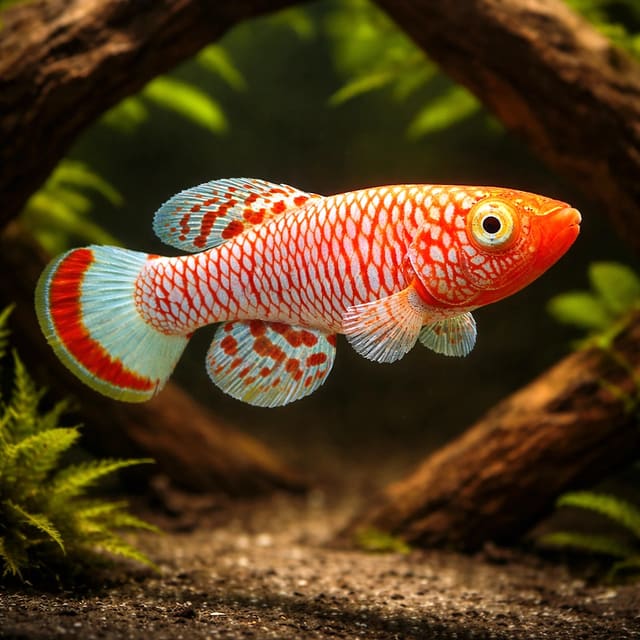
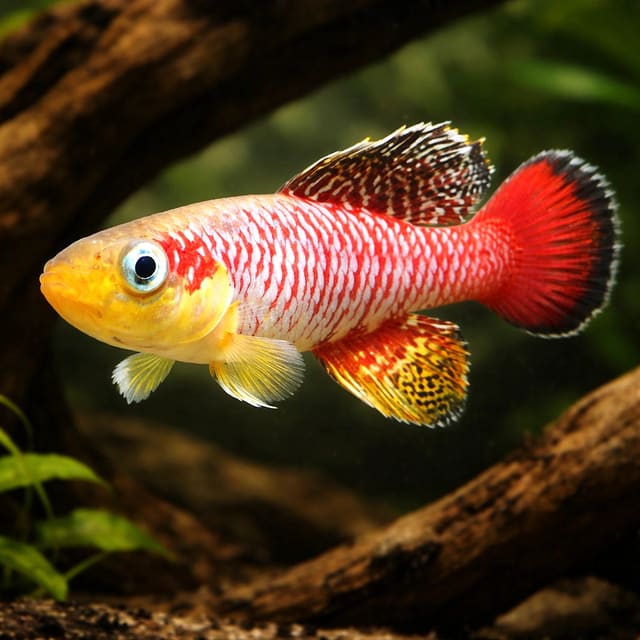
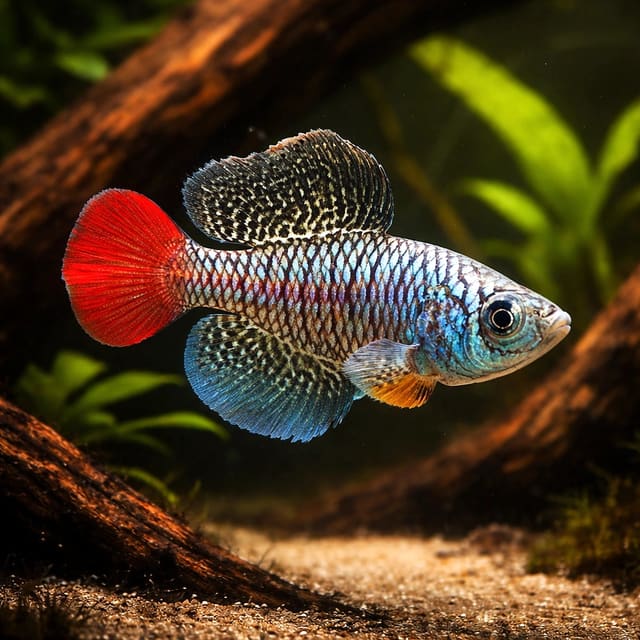
Ladiges' Gaucho, also sold under the older supplier name Cynolebias ladigesi, is best treated today as Notholebias minimus: the Barredtail Pearlfish, Least Pearlfish or Minute Pearlfish. It is a tiny South American annual killifish for experienced keepers who enjoy specialist species aquariums, soft acidic water and peat-style breeding projects. This listing keeps the trade name because it is how the fish arrives as supplied, but the care and taxonomy have been checked against current source material before publishing.
The fish supplied on this SKU are listed at 2.5-5 cm. FishBase gives the accepted species a maximum around 4 cm total length, so plan for a very small fish even when a supplier size band includes larger individuals. The appeal is not size; it is the combination of barred tail patterning, subtle red-brown body colour, pearly highlights and the remarkable annual life cycle. It is not a generic warm community fish, and it should not be bought as one.
FishBase lists Cynolebias ladigesi as a junior synonym of Notholebias minimus, and ITIS also treats the old name as invalid. GBIF-linked World Register data shows the same synonym group, including Cynolebias ladigesi, Cynopoecilus ladigesi and Leptolebias minimus. That is why this page uses the trade name naturally while making the accepted name clear.
The previous geography also needed tightening. Source literature places Notholebias minimus in Atlantic coastal river basins and temporary wetlands of Rio de Janeiro State, Brazil, rather than a broad Uruguay and southern Brazil story. Recent field work describes shallow temporary wetlands in the Atlantic Forest biome, including shaded and unshaded swamp habitats. That matters for aquarium care: this is a soft-water, seasonal-pool annual killifish, not a hard-water or busy display-tank species.
Males are the reason this fish has such a loyal specialist following. Expect a compact body with warm brown to reddish tones, fine pale spotting and a strongly marked tail area. Females are usually plainer and rounder, which is normal for many annual killifish.
Use subdued lighting, floating cover and a darker base if you want the fish to show well. Bright, exposed aquariums can make small annual killifish look nervous and washed out. A settled pair in a quiet tank often shows more colour, better posture and more natural feeding behaviour than fish kept with fast tank mates.
A 40 litre aquarium is a sensible minimum for a pair or small breeding group, with a secure lid, gentle filtration and no strong current. For serious breeding, many keepers use a simple specialist setup with leaf litter, dark sides, floating plants and a removable container of peat fibre or coco coir. For a more display-style aquarium, keep the layout calm and still include spawning media so the fish can behave naturally.
Good choices include Java moss, floating plants, fine sand, leaf litter and a peat or coir spawning box. Avoid sharp gravel and avoid high-flow filters. The water should be clean but not blasted around the tank. South American annual killifish are not endurance swimmers; they do best when food, cover and spawning substrate are easy to reach.
Feed small live and frozen foods. Daphnia, cyclops, baby brine shrimp, mosquito larvae, grindal worm and finely chopped bloodworm are all more useful than relying on dry food alone. The fish are small, and weaker individuals can miss out if food is too large or too quickly taken by other species.
Offer small portions and remove leftovers. Specialist annual killifish need regular feeding, but dirty water damages them quickly. A rhythm of small meals, calm water movement and frequent light maintenance is better than large feeds in a tank with waste collecting in the corners.
Ladiges' Gaucho is peaceful in the sense that it is small and not a predator of other fish, but breeding males can defend a chosen spawning area and the species is easily outcompeted. The best recommendation is a species aquarium. If you are not breeding and want tank mates, choose only very calm, tiny fish with the same cool, soft-water requirements and make sure feeding is controlled.
Avoid boisterous community fish, fin-nippers, larger killifish, hot hard-water setups and ornamental shrimp you would be upset to lose. The old FAQ said this fish can live in a community tank if tank mates are robust; that is the wrong emphasis. A robust community usually means this fish loses at feeding time.
This is an annual bottom-spawning killifish. In nature, seasonal pools fill, fish grow quickly, adults spawn into soft substrate, and eggs survive the dry phase before the next wet season. FishBase notes bottom spawning and a long incubation period for the accepted species, while recent South American annual-killifish literature explains the role of diapause and the need for damp egg incubation.
For aquarium breeding, condition a pair or small group with live and frozen foods. Provide a container of peat fibre or coco coir deep enough for diving or pushing into the medium. Remove and store the medium damp, not wet, then inspect and incubate eggs according to breeder practice. This is not a beginner breeding project, but it is exactly the kind of life cycle that makes annual killifish so rewarding for careful keepers.
When this fish is in stock, it is packed for livestock transport and sent with our licensed live-animal courier process. The page keeps the delivery promise natural and accurate: careful packing, temperature-aware dispatch planning and our Live Arrival Guarantee. We do not change the fish's price, stock status or variant data during a content refresh.
Care and identity notes were checked against FishBase for Notholebias minimus, FishBase synonym data for Cynolebias ladigesi, ITIS, GBIF-linked taxonomy, Killifische.info genus notes, recent Neotropical Ichthyology habitat research for Notholebias minimus and our stock records.
No reviews for this item yet. Bought one? Honest reviews only, good or bad.
What customers say about ordering from us
I have a small group of long finned mountain minnows. So was delighted to be able to order ten of this variety to increase the genetics in my tank . The ones I recieved are healthy but it’s to early to give a verdict on wether they are of a long finned type since they are small currently.
Gordon Walker · 23 Sept 2026
100% success travel and "installation". Pleased with quality of purchase. The Siamese fighter a bit "shy" so have not yet seen him at his best yet but looking good. Happy customer. GG
George E Garratt · 21 Sept 2026
Reviews of our shop, collected by Judge.me, an independent third-party review collector. Newest first.