Moderate
Amiet's Killie (Fundulopanchax amieti)
23–26°C · pH 6–7 · 30L
£11.99

A rare Inkisi-drainage killifish supplied around 3-4 cm, best in a covered, cooler, quiet planted aquarium with small live or frozen foods.
Adult size is the maximum length this species reaches at full maturity (scientific sources). The livestock you receive will be younger and smaller. Product-photo provenance and any image-specific limitations are stated on the listing.
Aphyosemion labarrei
Save when buying multiple fish. Each quantity is one fish; sex and pair formation are not guaranteed unless the selected variant explicitly states them.
Confirm your email, then we’ll send an availability message for this exact item if it returns within 180 days.
This request is only for this product—no newsletter or other promotions. A mail-provider retry may very rarely duplicate the same availability message. Unconfirmed addresses are removed after 48 hours. See our privacy policy.
A rare Inkisi-drainage killifish supplied around 3-4 cm, best in a covered, cooler, quiet planted aquarium with small live or frozen foods.
Adult size is the maximum length this species reaches at full maturity (scientific sources). The livestock you receive will be younger and smaller. Product-photo provenance and any image-specific limitations are stated on the listing.
Maintain these water conditions for optimal health and vibrant colors
Labarre's Aphyosemion (Aphyosemion labarrei) is a rare Central African killifish from the Inkisi drainage of the Democratic Republic of the Congo.
This listing is for young fish supplied at approximately 3-4 cm. Plan for an adult fish around 5 cm total length, not the old hidden 3.5 cm adult figure. It is still a small fish, but not a throwaway nano species: it needs stable water, careful feeding, a secure lid and a calm planted aquarium.
FishBase records Aphyosemion labarrei from Africa, specifically the middle and lower Inkisi River in the Democratic Republic of the Congo. The AKA/WAK reference gives the type locality as an area near Madimba, close to Kiavo in western Zaire, and describes the species from the middle to lower Inkisi River drainage, including a small tributary of the Ngufu River. FishBase point data also clusters around Kisantu and related Inkisi/Bas-Congo localities.
The habitat is not a generic open community aquarium. FishBase describes small rainforest brooks and small streams, while WAK describes swampy areas of small rainforest brooks and streams. In practical aquarium terms, aim for a mature tank with gentle flow, cover, shaded areas, fine plants, roots, leaf litter if used safely and very clean water.
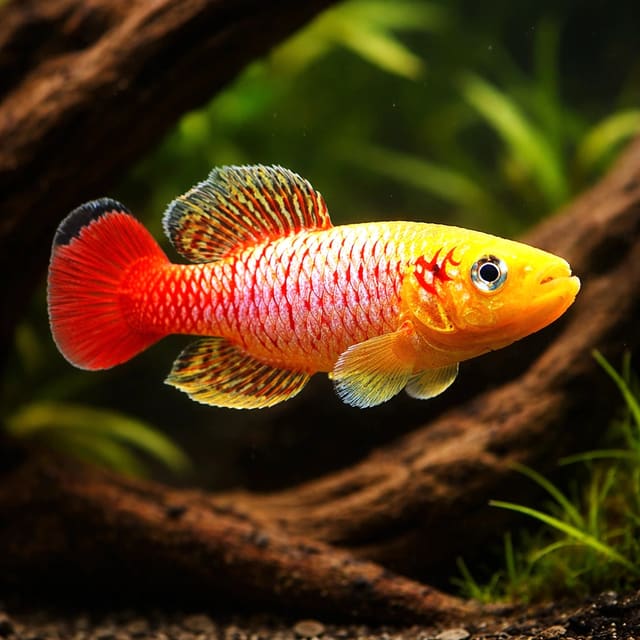
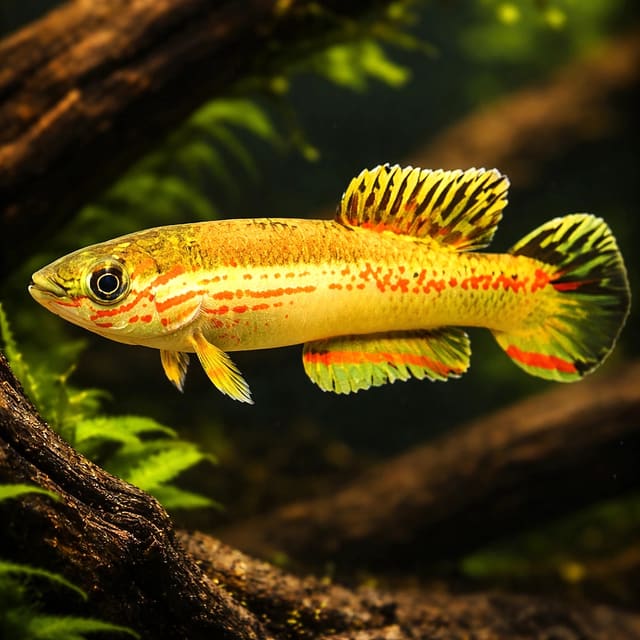
BKA describes males with grey-white flanks, brown tones toward the head, blue toward the caudal peduncle and many bright red spots. The caudal and dorsal fin colour can be especially attractive, with blue and deep red edging. WAK also notes broad red outer margins in the caudal fin and a strong blue metallic shine on the sides.
Females are not plain filler fish. BKA notes light reddish-brown females with red spotting and subtle fin markings, which is one reason this species feels more refined than many small fish. Young stock may arrive less dramatic than adult reference photos, so colour is best judged after settling, good feeding and low stress.
Use a covered, mature planted aquarium rather than a bare bright tank. A pair or small group can be kept in a compact setup by experienced killifish keepers, but a display aquarium of around 45 litres or more gives better stability and space for cover. The lid must be tight because killifish jump well.
Botanicals such as Indian almond leaves or alder cones can help create a calmer rainforest-brook feel if you already understand how they affect your water. They are not a shortcut for clean water, regular maintenance or careful feeding.
Our stock records list 22-24 C, pH 5.8-7.2 and 5-15 dGH. FishBase also lists 22-24 C. The BKA pamphlet is more cautious, saying temperature should be no higher than 72 F, and later notes place 68 F as an ideal breeding temperature. In other words, do not treat this as a warm community fish.
Acclimate slowly after delivery, especially if your tap water is harder, warmer or more alkaline than the holding water. FishBase marks the species as difficult to maintain in the aquarium, so it is better suited to keepers who already have stable small-fish husbandry.
Aphyosemion labarrei is a small carnivorous killifish. Offer small live and frozen foods such as daphnia, cyclops, baby brine shrimp, mosquito larvae, grindal worm, fruit flies and small bloodworm where appropriate. Fine prepared foods may be accepted, but do not rely on dry food alone for condition.
Feed small amounts and watch each fish. These fish are not built for a busy tank where fast danios, barbs or larger community fish take all the food first. Uneaten rich foods should be removed quickly to protect water quality.
This is a peaceful killifish in the right setting, but it is not a careless mixed-community choice. BKA notes that large males may bully or eat much smaller fish, and WAK notes males can be aggressive with a recommendation for two or three females where possible. A species-focused pair, trio or small group is the safest route.
If you add tank mates, choose only very calm, similarly sized fish that share cooler, soft-water conditions and will not dominate feeding. Avoid fin nippers, boisterous community fish, aggressive dwarf cichlids, large fish and tiny fry or shrimplets that may be eaten. For the best colour and behaviour, keep the display quiet.
WAK and BKA describe mop, sunken peat or bottom-spawning methods with water incubation; they do not support drying eggs as the default advice for ordinary keepers.
For a breeding attempt, condition adults with small live foods and provide floating or sunken mops, moss or peat fibre. WAK reports large eggs taking about 12-14 days of water incubation, with other reports hatching between 9 and 21 days. BKA also notes that higher temperature can reduce egg yield and that clean egg water matters. Fry may need tiny first foods before taking baby brine shrimp.
Labarre's Aphyosemion suits keepers who like rare killifish, small live foods and quiet planted aquariums. It is a good choice if you can keep cooler stable water, cover the tank properly and feed thoughtfully. It is less suitable for a first aquarium, a warm mixed community, uncovered aquariums or anyone wanting a fish that thrives on dry food and bright open space.
The original reference photo is included in the gallery so you can judge the fish honestly, while the existing aquarium visuals remain for planted-tank context. Your fish may arrive as young stock around 3-4 cm and should continue to colour and fill out with maturity, good food and low-stress surroundings.
Eligible livestock orders are packed carefully and supported by the Tropical Fish Co Live Arrival Guarantee. Please be ready to receive the parcel, acclimate slowly and move the fish into a mature, covered aquarium with suitable water conditions. WELCOME10 is the current first-order discount code in the site discount registry; use it at checkout if the published terms apply.
Care and identity notes were checked against FishBase for range, maximum size, temperature and non-seasonal status; AKA/WAK reference notes for type locality, Inkisi drainage, habitat, history and breeding; British Killifish Association notes for appearance, temperature, temperament and spawning; FishBase point data for Kisantu/Inkisi locality evidence; our stock records for supplied size, pH, hardness and stock photo.
No reviews for this item yet. Bought one? Honest reviews only, good or bad.
What customers say about ordering from us
I have a small group of long finned mountain minnows. So was delighted to be able to order ten of this variety to increase the genetics in my tank . The ones I recieved are healthy but it’s to early to give a verdict on wether they are of a long finned type since they are small currently.
Gordon Walker · 23 Sept 2026
100% success travel and "installation". Pleased with quality of purchase. The Siamese fighter a bit "shy" so have not yet seen him at his best yet but looking good. Happy customer. GG
George E Garratt · 21 Sept 2026
Reviews of our shop, collected by Judge.me, an independent third-party review collector. Newest first.