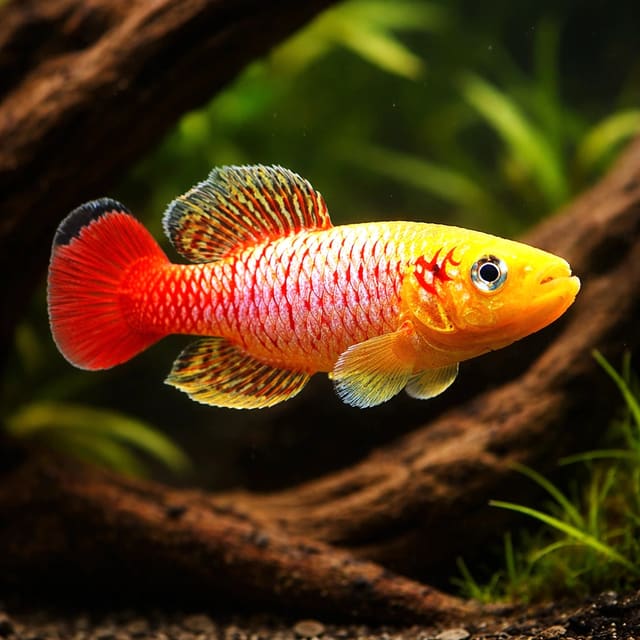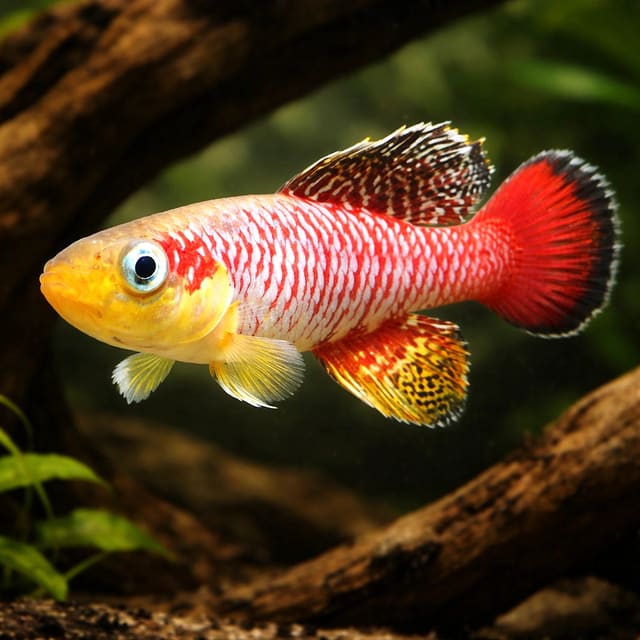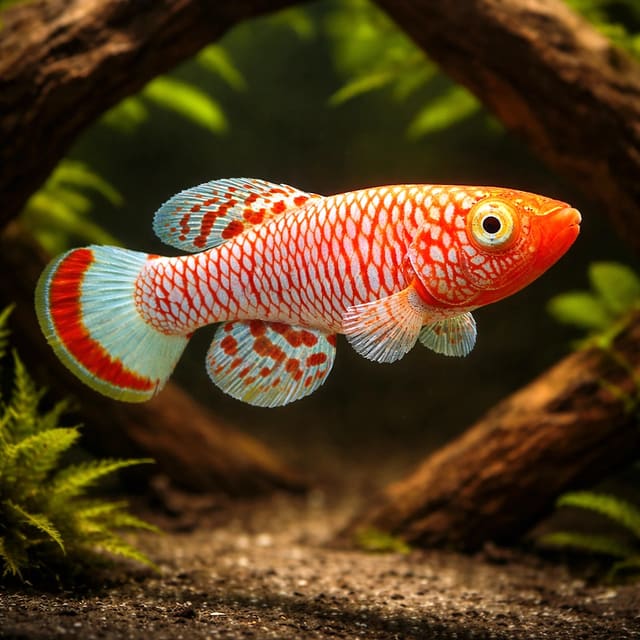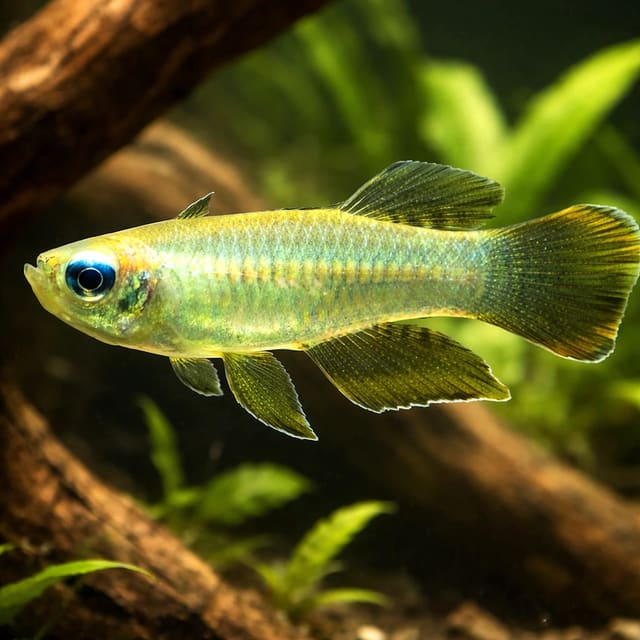
Lampeye (Aplocheilichthys normani)
22–26°C · pH 6.5–7.2
£3.99

A small Tanganyika lampeye supplied around 3-5 cm, best kept in a covered planted group with calm water, floating cover and peaceful similar-sized tank mates.
Adult size is the maximum length this species reaches at full maturity (scientific sources). The livestock you receive will be younger and smaller. Product-photo provenance and any image-specific limitations are stated on the listing.
Lacustricola pumilus
Shoaling fish: kept in a group they feel safer, stay calmer and show their best colour.
Confirm your email, then we’ll send an availability message for this exact item if it returns within 180 days.
This request is only for this product—no newsletter or other promotions. A mail-provider retry may very rarely duplicate the same availability message. Unconfirmed addresses are removed after 48 hours. See our privacy policy.
A small Tanganyika lampeye supplied around 3-5 cm, best kept in a covered planted group with calm water, floating cover and peaceful similar-sized tank mates.
Adult size is the maximum length this species reaches at full maturity (scientific sources). The livestock you receive will be younger and smaller. Product-photo provenance and any image-specific limitations are stated on the listing.
Maintain these water conditions for optimal health and vibrant colors
Lake Pampeye Pumilus is the trade name on this stock, and the fish is best treated as the Tanganyika lampeye, Lacustricola pumilus. Older aquarium and supplier material may still use Aplocheilichthys pumilus or Micropanchax pumilus, so those names are kept here as synonym context rather than forced keywords. This is a small, peaceful African lampeye supplied at around 3-5 cm, with a slender body, reflective eye shine and constant surface activity in a calm planted aquarium.
Although the trade name uses Lake Pampeye, source-backed references place this species around Lake Tanganyika and associated drainages rather than treating it as a Lake Pampeye endemic. The practical care point is simple: keep it as a social, surface-oriented lampeye in a covered aquarium with floating plants, gentle flow, small foods and stable warm water.
FishBase currently treats this fish as Lacustricola pumilus, commonly Tanganyika lampeye, while trade lists often still show Aplocheilichthys pumilus. That matters for care because this is not a peat-spawning annual killifish and it should not be managed like one. It is a procatopodid lampeye from shallow vegetated margins, river mouths, deltas, coastal swamps and quieter associated waters around Lake Tanganyika.
In nature it is reported in small groups close to banks and calm edges, where surface cover, insects, tiny crustaceans and fine suspended foods are available. Recreate that calm edge habitat in the aquarium: plant cover below, floating cover above, open surface lanes for movement, and filtration that keeps the water clean without blasting the top of the tank.
This is a subtle fish rather than a loud one. The body is slim and lightly metallic, with a dark side stripe, green-gold reflections and the bright lampeye shine that makes the group so attractive under softer aquarium lighting. Males can show more colour in the unpaired fins, sometimes with warm orange or yellow tones, while females are usually plainer and rounder.
Lake Pampeye Pumilus is most interesting when kept as a group. Individuals spend much of their time in the top third of the aquarium, holding position under floating plants, making short feeding darts and displaying lightly to one another. Males may bicker, but serious damage is unlikely when the group has space, cover and more than one line of sight.
Use a covered, mature aquarium of at least 60 litres for a small group. A 60 cm tank gives them more useful surface length than a very tall nano cube, so it is the better shape for this species. Keep the lid tight because lampeyes are capable jumpers, especially when startled or kept under bright open light.
A dark substrate, fine-leaved plants, Java moss, Microsorum, Cryptocoryne, trailing roots and floating plants all help this fish settle. Leave some open surface water so the group can move naturally. Gentle filtration is important: enough movement to keep oxygen and water quality stable, but not so much surface turbulence that food and fish are pushed around.
A steady 24-26 C is the best core target. Some aquarium sources list a slightly wider tolerance, but stability is more useful than chasing the edges of a range. Keep pH around 6.5-7.5 and hardness roughly 3-12 dGH. This is not a fish for sudden swings, dirty water or immature aquariums.
Because these fish are small and feed near the surface, water quality can look fine until waste builds up in planted corners. Use regular partial water changes, rinse mechanical media in old tank water when needed, and keep ammonia and nitrite at zero. Nitrate should be kept low through planting, stocking restraint and routine maintenance.
Feed small foods that reach the upper water without sinking too fast. Fine floating granules, crushed quality flake and micro-pellets can be used as a base, but the fish looks and behaves better with variety. Offer daphnia, baby brine shrimp, cyclops, mosquito larvae, grindal worm and other suitably small frozen or live foods when available.
Small portions work better than one heavy feed. This lampeye is not a pushy feeder, so avoid housing it with very fast surface fish that grab everything first. A mixed diet supports condition, colour and breeding behaviour without overloading the water.
For a peaceful planted community, choose calm tank mates that use different levels of the aquarium and do not bully surface fish. Small rasboras, gentle tetras, peaceful bottom-dwellers and quiet dwarf species can work when water needs match. Snails are suitable. Adult shrimp may be possible in a planted tank, but very small shrimplets should be considered at risk.
Avoid large fish, fin-nippers, predatory cichlids, boisterous livebearers, hard-feeding barbs and high-flow Rift Lake cichlid communities. Although this fish comes from the Tanganyika region, it is not a robust rock-cichlid companion. It belongs in a calm planted setup, not a bright high-current cichlid tank.
This is not a seasonal annual killifish. In aquarium conditions it can spawn among fine plants or spawning mops, and FishBase records captive egg development at roughly two weeks. For best results, condition the adults with small live foods, provide fine spawning media and move eggs or mops to a separate container if you want to raise fry.
The fry are tiny and need very small first foods before they can manage newly hatched brine shrimp. A mature planted aquarium with microorganisms can help, but a planned fry setup is far more reliable than hoping the community tank will raise them.
Choose Lake Pampeye Pumilus if you like small, unusual African lampeyes and you can give them a covered planted tank with quiet surface water. They are a lovely choice for keepers who enjoy behaviour and subtle detail rather than only bright colour. They suit careful community keepers, small-species specialists and aquarists who can feed fine foods consistently.
Each livestock shipment is packed for a UK live-animal courier service and covered by our Live Arrival Guarantee. The exact source photo is retained on this listing so you can compare the real stock image with the aquarium-view images rather than relying on generic artwork alone.
Care guidance for this listing was checked against FishBase, Aqualog and specialist hobby notes for Aplocheilichthys pumilus / Lacustricola pumilus. The key corrections are the accepted Tanganyika lampeye identity, the Lake Tanganyika-associated habitat, the 5-5.5 cm adult-size planning, the non-seasonal breeding style, the group-based social behaviour and the calm covered aquarium setup.
No reviews for this item yet. Bought one? Honest reviews only, good or bad.
What customers say about ordering from us
I have a small group of long finned mountain minnows. So was delighted to be able to order ten of this variety to increase the genetics in my tank . The ones I recieved are healthy but it’s to early to give a verdict on wether they are of a long finned type since they are small currently.
Gordon Walker · 23 Sept 2026
100% success travel and "installation". Pleased with quality of purchase. The Siamese fighter a bit "shy" so have not yet seen him at his best yet but looking good. Happy customer. GG
George E Garratt · 21 Sept 2026
Reviews of our shop, collected by Judge.me, an independent third-party review collector. Newest first.