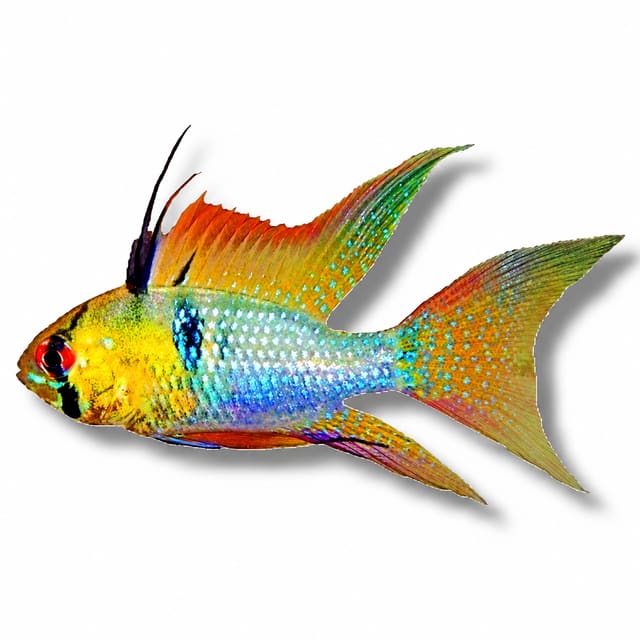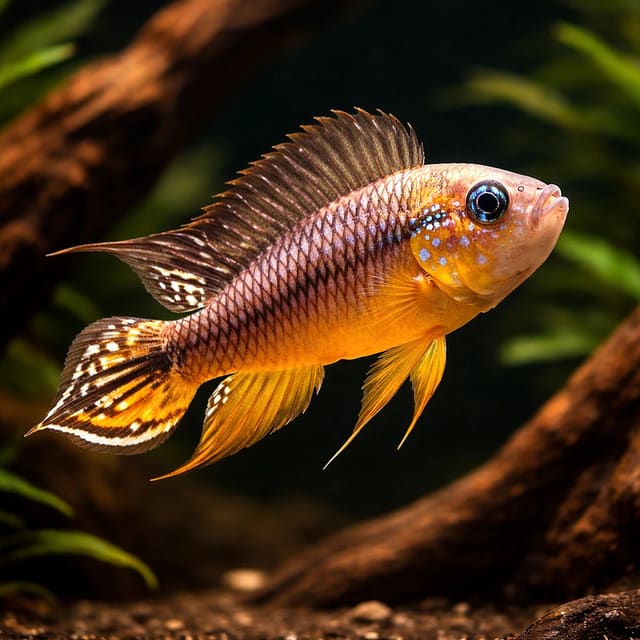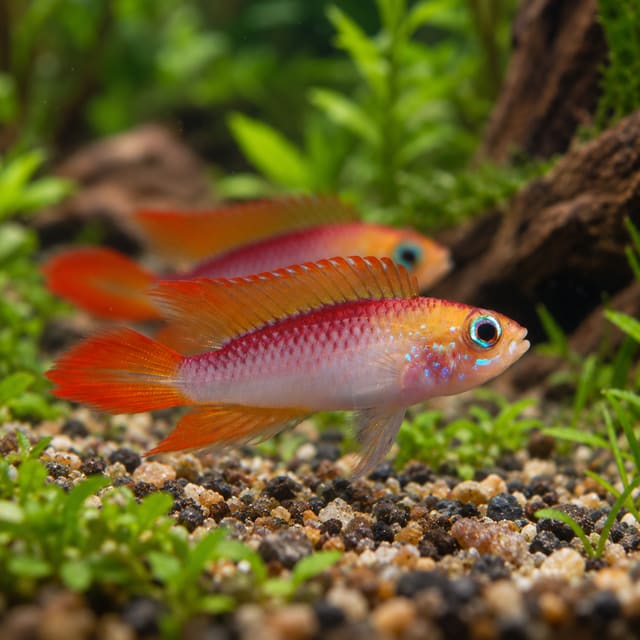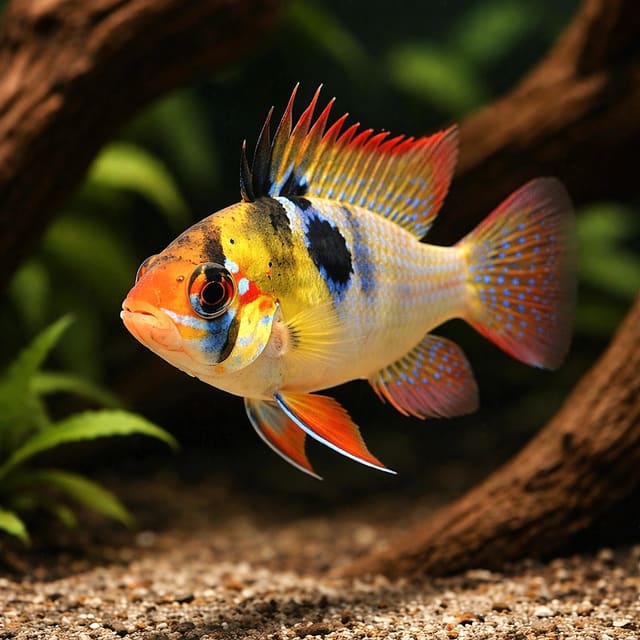
Asia Form Ram Cichlid (Mikrogeophagus ramirezi)
27–30°C · pH 4–7 · 54L
£5.99

The Gold Agassiz’s Dwarf Cichlid (Apistogramma agassizii) is a freshwater cichlid from the Amazon basin that reaches 4.4 cm standard length. It suits intermediate keepers planning a pair in a 60 × 30 cm base; keep it at 26–27°C and 4–10 dGH, the overlap of FishBase, Seriously Fish and OATA, with pH 6.0–7.0 from the FishBase–OATA overlap. Sold individually in 3–4 cm and XL dispatch sizes.
Adult size is the maximum length this species reaches at full maturity (scientific sources). The livestock you receive will be younger and smaller. Product-photo provenance and any image-specific limitations are stated on the listing.
Apistogramma agassizii
Save when buying multiple fish. Each quantity is one fish; sex and pair formation are not guaranteed unless the selected variant explicitly states them.
Confirm your email, then we’ll send an availability message for this exact item if it returns within 180 days.
This request is only for this product—no newsletter or other promotions. A mail-provider retry may very rarely duplicate the same availability message. Unconfirmed addresses are removed after 48 hours. See our privacy policy.
The Gold Agassiz’s Dwarf Cichlid (Apistogramma agassizii) is a freshwater cichlid from the Amazon basin that reaches 4.4 cm standard length. It suits intermediate keepers planning a pair in a 60 × 30 cm base; keep it at 26–27°C and 4–10 dGH, the overlap of FishBase, Seriously Fish and OATA, with pH 6.0–7.0 from the FishBase–OATA overlap. Sold individually in 3–4 cm and XL dispatch sizes.
Adult size is the maximum length this species reaches at full maturity (scientific sources). The livestock you receive will be younger and smaller. Product-photo provenance and any image-specific limitations are stated on the listing.
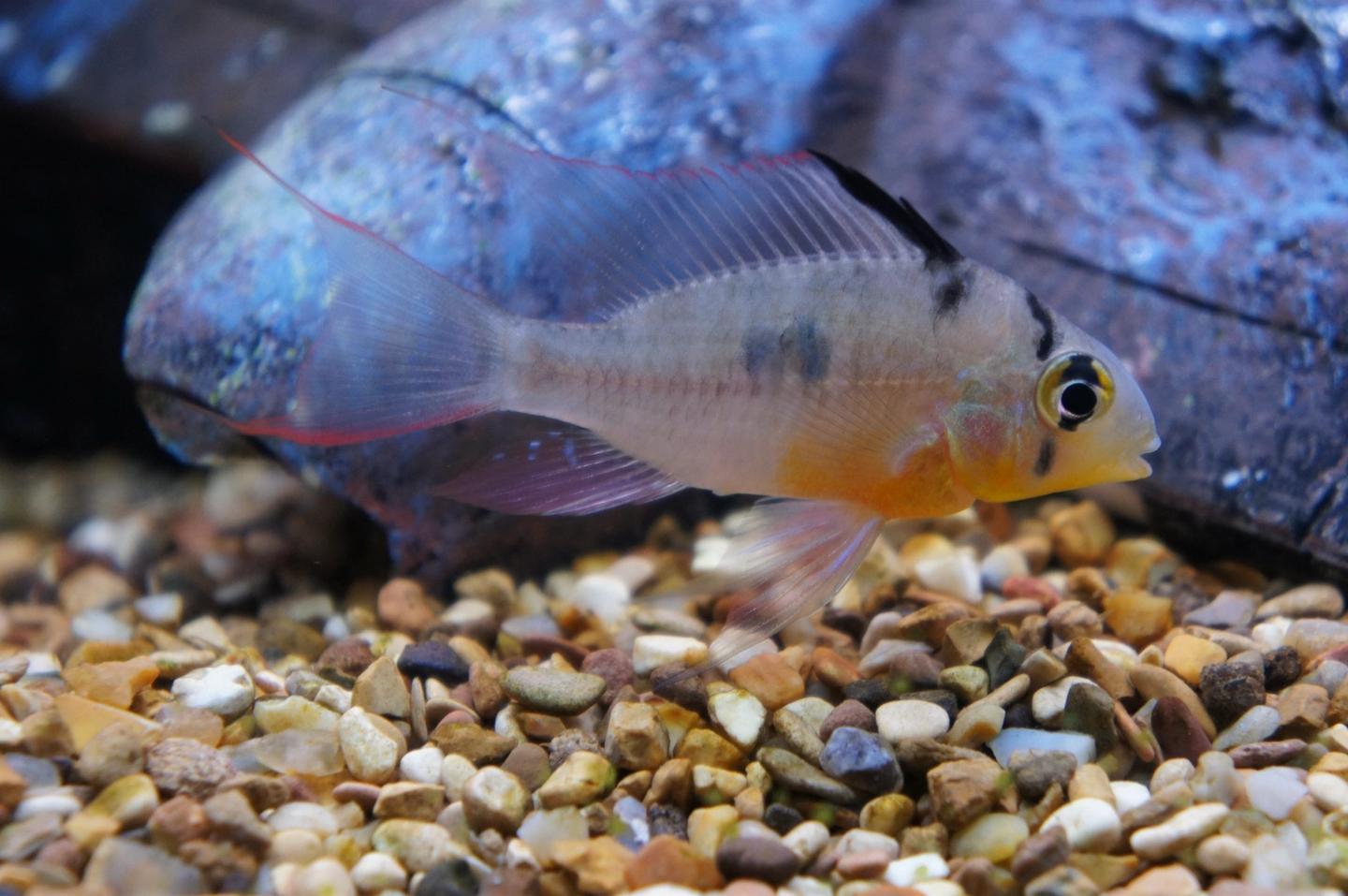
Cichlids are a family of roughly 1,800 accepted species, not one care type. Before buying, identify the exact species and source, then compare adult measurement, usable tank dimensions, social system, territory, tested water, diet and an exit plan. No family-wide minimum tank, water range or tank-mate list is safe.
Maintain these water conditions for optimal health and vibrant colors
The Gold Agassiz’s Dwarf Cichlid (Apistogramma agassizii) is a freshwater member of the cichlid family from South America’s Amazon basin. FishBase records its range along the Amazon–Solimões River from Peru through Brazil to the Capim River basin and gives a maximum of 4.4 cm standard length. This is an intermediate choice for a keeper prepared to maintain warm, soft water, provide several caves and manage territorial behaviour rather than treating it as an automatic addition to any community.
Keep it at 26–27°C and 4–10 dGH. Those routine figures are the overlap of FishBase, the Seriously Fish species profile and OATA’s dwarf-cichlid guidance. Keep routine pH at 6.0–7.0, the overlap of FishBase and OATA. OATA’s figures are group guidance, not a species-specific optimum. Measure the aquarium rather than judging its suitability from appearance: a pair needs a base of at least 60 × 30 cm, while groups require larger quarters.
Adults inhabit clear, black and white waters in nature. In the aquarium, the useful lesson is to create sheltered floor space with a soft sandy substrate, roots, branches, shady areas and caves. Seriously Fish records it as primarily carnivorous, apparently feeding mostly on benthic invertebrates in nature, so both the layout and feeding routine should let small foods reach its territory.
Confirm that the measured base can hold several separated shelters while retaining routes through the lower aquarium. A pair plan must meet both the 60 × 30 cm footprint and OATA’s recommendation of at least 60 litres; a mixed aquarium needs at least 80 litres. Check that the established water remains within the routine range through the weekly maintenance cycle, not only immediately after a water change. Finally, screen every intended companion for activity and territorial pressure before treating the aquarium as ready.
| Suits | Not suited to |
|---|---|
| Intermediate keepers maintaining stable warm, soft water | Newly established or unfiltered aquariums |
| A 60 × 30 cm or larger base with caves and cover | Small, open layouts without territorial shelter |
| Carefully screened communities with calm dither fish | Very active or boisterous tank mates |
| Keepers prepared for territorial behaviour during breeding | Mixing with other Apistogramma |
Each purchase covers one Gold Agassiz’s Dwarf Cichlid in the option selected on the live size selector. The selector uses the 3–4 cm size label. The size you select is the size supplied, not the adult size. Use the dispatch label to plan the fish’s arrival and use the recorded adult length, aquarium footprint and territorial requirements to plan its permanent home.
Sex is guaranteed only when the selected option explicitly states male or female. This Gold Agassiz’s Dwarf Cichlid listing has no sex-guaranteed option. Plan stocking so the aquarium remains workable without relying on receipt of a particular sex, then reassess social structure as the fish settles and its behaviour becomes clear.
The gallery images are representative of this type of animal rather than photographs of the exact animal supplied, so colours can look slightly different from the live animal. The Gold name identifies the colour form, while the care plan remains anchored to Apistogramma agassizii. Colour intensity is not a substitute for checking body condition, breathing, appetite and territorial interactions.
Before selecting a size, confirm that the aquarium is mature, filtered and already holding the required water values. A larger dispatch label does not remove the need for acclimatisation, shelter or gradual stocking. A smaller label does not make a reduced permanent aquarium suitable. If this fish is one possibility among several South American species, browse the South American cichlid collection and compare each animal’s adult space, water and social requirements before deciding.
Plan around an adult length of 4.4 cm standard length. FishBase records that maximum for male or unsexed Apistogramma agassizii. Seriously Fish separately lists males at 7.5 cm and females at 5 cm standard length. Base the permanent setup on the published aquarium footprint, not on the 3–4 cm dispatch size.
For a single pair, Seriously Fish accepts a base of at least 60 × 30 cm and describes that footprint as approximately 54 litres. A group needs larger quarters. OATA’s UK dwarf-cichlid sheet recommends at least 60 litres for a pair and says an aquarium of at least 80 litres will be needed to mix dwarf cichlids with other fish. A practical setup should therefore meet both the 60 × 30 cm footprint and the appropriate litre requirement for the intended stocking plan.
Floor space matters because the useful décor—caves, roots, leaf litter and plants—occupies the lower part of the aquarium. Leave enough room to separate shelters rather than clustering every cave in one exposed area. Each fish needs a route into cover without crossing the full open base.
Judge the final setup by usable territory, not litres alone. A tall aquarium can hold the nominal volume while offering less base area than the stated 60 × 30 cm minimum. Conversely, meeting the footprint does not permit crowding; group and community plans still require the larger volumes and careful screening described above.
Keep the aquarium at 26–27°C, pH 6.0–7.0 and 4–10 dGH. Temperature and general hardness are the overlap of FishBase’s recorded range, Seriously Fish’s aquarium guidance and OATA’s dwarf-cichlid range. The pH target is the overlap of FishBase’s 5.0–7.0 range and OATA’s 6.0–8.0 guidance. Seriously Fish says commercially produced fish are relatively unfussy, but some wild populations may require a pH as low as 3.0–4.0 in order to breed; keep the routine pH at 6.0–7.0.
Keep ammonia at zero mg/l and nitrite at zero mg/l. OATA also says nitrate should not exceed 20 mg/l above the normal level in the tap water. These waste readings matter because dwarf cichlids can be stressed by even small amounts of ammonia and nitrite. Test the source water as well as the aquarium so the nitrate comparison has a real baseline.
| Reading | Routine instruction |
|---|---|
| Temperature | Hold 26–27°C |
| pH | Hold 6.0–7.0 |
| General hardness | Hold 4–10 dGH |
| Ammonia | Maintain zero mg/l |
| Nitrite | Maintain zero mg/l |
| Nitrate | Do not exceed 20 mg/l above the tap-water level |
Use the same test method consistently and log results before and after maintenance. Our aquarium water chemistry guide explains what each reading represents, while the water matcher can compare measured values with this routine range.
If a reading sits outside the range, correct the underlying water or maintenance issue before adding fish. Avoid repeated rapid adjustments made only to hit a single number. The goal is a stable aquarium that remains within the stated temperature, pH, hardness and waste limits through the normal weekly cycle.
For a natural-looking layout, use a soft sandy substrate with roots and branches arranged to form shady areas and several caves. Seriously Fish also accepts ceramic flowerpots, lengths of plastic pipe and other artificial shelters when adequate cover and structure are present. The essential decision is not whether the layout looks natural to the keeper; it is whether the fish can leave another fish’s line of sight and reach a separate shelter.
Place caves in different parts of the base, with entrances facing in different directions. This reduces direct visual contact around breeding sites and gives a chased fish more than one route into cover. OATA notes that even well-settled pairs often chase each other, which is why plants, wood, leaf litter, suitable ornaments and model caves are functional parts of the setup rather than decoration alone.
Beech, oak and Ketapang almond leaves are listed by Seriously Fish as suitable leaf litter. They may be left to break down fully or removed and replaced every few weeks. The developing microbe colonies can provide a secondary food source for fry, while tannins and other compounds are released as the leaves decay.
Provide gentle movement rather than turning the aquarium into a high-flow display. Seriously Fish suggests a filter rated at 110–160 litres per hour for its approximately 54-litre example. Treat that figure as a setup reference for that aquarium size, then check the actual circulation around caves and leaves. Water should move through the filtered system without stripping every sheltered zone from the lower aquarium.
Run a well-set-up, maintained filter in every aquarium holding this fish. The RSPCA explains that fish release toxic ammonia and that a working biological filter supports bacteria which convert ammonia to nitrite and then nitrate. This process protects livestock only when the bacterial population is established and the filter remains operational.
Prepare and mature the aquarium before the fish arrives. The first tropical aquarium guide sets out the practical preparation sequence. Confirm zero ammonia and zero nitrite with tests rather than relying on clear-looking water. Clear water can still contain dissolved waste, while a mature biological filter is defined by its ability to process the waste entering the system.
Increase the number of fish slowly. OATA warns that the beneficial bacterial population must increase when more fish are added and feeding rises. Adding too many animals too quickly can cause new tank syndrome, in which the filter cannot process the increased waste and ammonia or nitrite reaches harmful levels.
Look at the complete system when a result changes. A blocked filter, increased feeding, added livestock or accumulated waste can all coincide with a reduced margin for biological filtration. Correct the husbandry issue and return ammonia and nitrite to zero before making another stocking change.
At least once every week, change 25% of the aquarium water. OATA strongly recommends this schedule for dwarf cichlids and says a siphon is useful to remove solid waste from the gravel.
Treat replacement tap water with an aquarium conditioner before adding it, removing harmful chlorine or chloramine. Check that its temperature and chemistry will not push the aquarium outside the 26–27°C, pH 6.0–7.0 and 4–10 dGH routine range. A test log helps reveal whether the aquarium drifts between changes or reacts sharply after maintenance.
If the filter needs cleaning, do not run it under the tap. Rinse it lightly in aquarium water removed during the partial water change. This reduces the loss of the beneficial bacteria established in the media.
Test at least weekly even when the fish looks well. Ammonia and nitrite must remain at zero mg/l, and nitrate must not exceed 20 mg/l above the normal tap-water level. If a test changes after heavier feeding or a stocking increase, pause further additions and restore stable water quality through the established maintenance routine.
Base the diet on small foods appropriate for a primarily carnivorous fish that apparently feeds mostly on benthic invertebrates in nature. Seriously Fish recommends regular live and frozen foods such as Artemia, Daphnia and chironomid larvae, commonly sold as bloodworm. Most specimens will also learn to accept dried alternatives, with pelleted products generally preferred to flake.
Feed once a day and offer only what the fish can eat within a few minutes, as OATA’s dwarf-cichlid sheet advises. Watch food reach the lower territory rather than assuming it has been eaten because it disappeared from the surface. Remove or reduce food when it repeatedly remains uneaten.
Use appetite as an observation point, not a reason to keep adding food. Uneaten material breaks down and contributes toxic waste, while overfeeding places more demand on the biological filter. If food remains after the normal feeding window, reduce the next portion and test ammonia and nitrite rather than offering a second meal.
Maintain variety within the foods named above. The animal’s recorded diet makes invertebrate-based live, frozen and appropriate dried foods the foundation. Feeding should support steady condition while preserving water quality, so portion control and weekly maintenance are part of the same decision.
Arrange for someone to receive the parcel in person because live fish cannot be left unattended. The fish is hand-bagged in oxygen and packed in an insulated box, with a heat pack when the weather calls for it. Read the current delivery and Live Arrival Guarantee policy before the delivery date.
The continuous recording should run from the sealed parcel through opening and inspection of the fish in its sealed bag. Keep the order number with the recording. If anything has gone wrong, contact us the same day with the order number and the short unboxing video so the Live Arrival Guarantee process can be handled under the policy.
Prepare the aquarium before the parcel arrives; OATA advises checking that ammonia and nitrite are zero before adding any fish. Its temperature, pH, hardness, ammonia and nitrite should already meet the routine values, and the filter should be mature and running. Those aquarium checks belong before the arrival event because acclimatisation cannot correct an unsuitable or unstable permanent environment.
After release, use the established caves, roots and shaded areas as the settling space. Continue the normal observation routine for breathing, swimming, colour, appetite and interactions rather than changing several parts of the aquarium at the same time.
Check the fish every day for changes in swimming, colour, breathing, temperament, appearance, body condition and feeding. OATA lists warning signs including hanging at the surface, sitting on the bottom, erratic swimming, becoming darker or paler, changes in aggression, increased hiding, altered gill movement, white spots, fluffy growths, loss of fins or scales, changes in body weight and reduced interest in food.
Use the result to guide the next action. A water-quality problem calls for correction of maintenance, filtration or stocking pressure. Increased hiding or aggression also calls for a review of caves, sight breaks and tank-mate activity. Avoid changing water chemistry, décor, food and stocking simultaneously unless an immediate welfare issue requires intervention, because a repeatable routine makes the cause easier to identify.
If the change persists, test the water and contact us for guidance. Describe the measured values and the specific change rather than using a general statement that the fish looks unwell.
Plan the layout for cave-spawning behaviour even when breeding is not the aim. FishBase says eggs are deposited on cave ceilings and tended by the female. Seriously Fish describes the fish as a substrate spawner that normally uses crevices or cavities among the décor, with the female responsible for the eggs and fry after spawning.
Provide several caves and plenty of cover so one site does not become the only defensible shelter. In smaller aquariums, the male may need to be removed because the female may become hyper-aggressive after spawning. This is another reason to avoid building a tightly stocked community around the assumption that the fish will remain equally tolerant at all times.
Seriously Fish records males as larger, more colourful and more extended in the fins than females, but appearance does not create a sex guarantee for this offer. Build the aquarium around the social plan that can actually be supported, and do not buy a single fish expecting it to complete a pair of a particular sex.
Keep breeding-related water advice in context. Some wild populations may require pH as low as 3.0–4.0 to breed, while the routine aquarium target here remains pH 6.0–7.0. Stable husbandry, cover and sufficient territory remain necessary whether or not spawning occurs.
Treat compatibility as an aquarium-level decision, not a universal list of good tank mates. Dwarf cichlids can be territorial, especially while breeding, and OATA says Apistogramma can be quite shy and will not do well in aquariums with very active or boisterous tank mates. Every proposed companion must therefore be screened for activity, space use, the room left around caves and its likely effect on spawning territories.
OATA says dwarf cichlids are best kept with shoals of dither fish, which give them a sense of security and are quick enough to swim away if the cichlids become territorial. Seriously Fish specifically names small Nannostomus species for wild examples. Use that named example within a carefully assessed plan rather than treating every small schooling fish as equivalent.
Captive-raised fish are the choice recommended by Seriously Fish for a general community, while wild examples are best maintained alone or with small dither fish such as Nannostomus. Use the stricter arrangement when planning: calm companions, generous cover, no other Apistogramma, and room for territorial behaviour.
Begin with the aquarium’s measured base, not a proposed list of fish. A pair needs at least 60 × 30 cm, and a group requires larger quarters. For a mixed aquarium, OATA says at least 80 litres will be needed. Those are starting constraints; caves, wood and plants must still fit while leaving separate routes through the lower aquarium.
Observe the response after each addition. OATA identifies increased aggression, unusual hiding, altered swimming, colour change, breathing change and reduced feeding as signs that warrant attention. If one fish repeatedly loses access to shelter or feeding space, revise the layout and stocking plan rather than assuming the behaviour will resolve as more animals are added.
A pair and a community are different decisions. The 60 × 30 cm species footprint applies to a single pair; OATA says a mixed aquarium needs at least 80 litres, and social structure may demand more. Several females for one male is the FishBase aquarium arrangement, but that group also needs larger quarters and cannot be planned from this offer as though a particular sex were assured.
Ask us for a stocking and compatibility assessment before combining this fish with an existing community. Include the aquarium dimensions, volume, measured water values, current animals, décor and filter maturity so the assessment reflects the complete system.
The Gold Agassiz’s Dwarf Cichlid reaches 4.4 cm standard length according to FishBase. Plan its permanent aquarium around that adult figure rather than the 3–4 cm or XL dispatch label.
Seriously Fish sets a base of at least 60 × 30 cm, approximately 54 litres, for a single pair and says groups require larger quarters. OATA’s dwarf-cichlid guidance recommends at least 60 litres for a pair and says at least 80 litres will be needed to mix dwarf cichlids with other fish.
FishBase advises several females for one male, while Seriously Fish accepts a single pair in a 60 × 30 cm base and requires larger quarters for a group. This offer does not guarantee a particular sex, so do not build a fixed social plan around the dispatch size or colour.
We rate it intermediate because it needs stable warm, soft water, zero ammonia and nitrite, a mature filter, several caves and active management of territorial behaviour. A prepared keeper who can test water and assess compatibility can meet those needs.
The Gold Agassiz’s Dwarf Cichlid is primarily carnivorous and apparently feeds mostly on benthic invertebrates in nature. Offer Artemia, Daphnia and chironomid larvae regularly, with an accepted quality pellet as a dried alternative, once daily in an amount eaten within a few minutes.
Keep Apistogramma agassizii at 26–27°C and 4–10 dGH, the overlap of FishBase, Seriously Fish and OATA, with pH 6.0–7.0 from the FishBase–OATA overlap. Maintain ammonia and nitrite at zero mg/l.
Territorial behaviour is documented, especially during breeding; whether an individual will nip fins is uncertain. Provide several caves and plenty of cover, avoid very active or boisterous companions, and revise the stocking plan if chasing prevents another fish from feeding or reaching shelter.
The Gold Agassiz’s Dwarf Cichlid can be considered with calm shoals of dither fish after the complete aquarium is screened; Seriously Fish names small Nannostomus species for wild examples. Avoid other Apistogramma, and when breeding is intended avoid tank mates that may disturb spawning sites or predate fry.
Start filming the sealed parcel before opening it or floating the bag. The Tropical Fish Co policy says the fish is bagged in oxygen and placed in an insulated box, with a heat pack when the weather calls for it; receive it in person, record the continuous opening and fish in the sealed bag, then float the bag for 20–30 minutes before release.
No reviews for this item yet. Bought one? Honest reviews only, good or bad.
What customers say about ordering from us
I have a small group of long finned mountain minnows. So was delighted to be able to order ten of this variety to increase the genetics in my tank . The ones I recieved are healthy but it’s to early to give a verdict on wether they are of a long finned type since they are small currently.
Gordon Walker · 23 Sept 2026
100% success travel and "installation". Pleased with quality of purchase. The Siamese fighter a bit "shy" so have not yet seen him at his best yet but looking good. Happy customer. GG
George E Garratt · 21 Sept 2026
Reviews of our shop, collected by Judge.me, an independent third-party review collector. Newest first.