Tropical 3-Algae Granulat - fish food UK
£5.09

One sealed Tropical Red Parrot Granulat tub in the selected 250 ml/100 g or 1000 ml/400 g size. This floating colour-support granulate is made for parrot cichlids and other suitable Cichlidae, with 48% crude protein and 100 mg/kg astaxanthin. Feed several small portions daily, limited to what the fish consume within 2-3 minutes. Packaging and formulation can change, so the delivered tub label is the final batch-specific authority.
One sealed Tropical Red Parrot Granulat tub in the selected 250 ml/100 g or 1000 ml/400 g size. This floating colour-support granulate is made for parrot cichlids and other suitable Cichlidae, with 48% crude protein and 100 mg/kg astaxanthin. Feed several small portions daily, limited to what the fish consume within 2-3 minutes. Packaging and formulation can change, so the delivered tub label is the final batch-specific authority.
Tropical Red Parrot Granulat is a floating colour-support food made by Tropical for parrot cichlids and other cichlids with a high dietary carotenoid requirement. It contains 48% crude protein and 100 mg/kg astaxanthin. The granules are designed to retain their structure and expand only slightly after feeding, giving surface- and mid-water feeders time to take a measured portion.
This listing supplies one sealed tub in the selected size. Choose either 250 ml/100 g or 1000 ml/400 g. Each option has its own price and stock. A quantity of one means one tub, not one granule, one daily portion or both pack sizes.
The food is intended principally for blood parrot cichlids and related ornamental Cichlidae whose mouth size and feeding behaviour suit the granule. It is not a universal food for every tropical fish, a medicine, a water treatment or a guaranteed way to change a fish's colour. Genetics, health, stress, water quality, lighting and the rest of the diet still influence appearance.
Manufacturer formulations and packaging can change. The composition and analysis below reproduce the Tropical product information reviewed for this listing; the label on the selected tub remains the final batch-specific authority, particularly where an ingredient must be avoided.
| Brand | Tropical |
|---|---|
| Food type | Floating colour-support granulate for ornamental aquarium fish |
| Intended fish | Parrot cichlids and other suitable Cichlidae with a high carotenoid requirement |
| Current pack choices | 250 ml/100 g or 1000 ml/400 g |
| Protein | 48% crude protein |
| Astaxanthin | 100 mg/kg |
| Feeding direction | Several small portions daily, only as much as the fish consume within 2-3 minutes |
| Retail unit | One sealed tub in the selected size |
| Image | One preserved front-of-pack image; packaging and the visible tub size may differ from the selected current pack |
| Delivery | UK delivery subject to current stock, checkout, destination and delivery terms |
Use the size selector before adding the food to the basket. The 250 ml tub contains 100 g; the 1000 ml tub contains 400 g. The larger pack contains four times the stated food weight, but it is not automatically the better choice for every aquarium. Choose a size that can be kept fresh and dry within the label's best-before period.
| Selected option | Net weight | Practical fit | Check before purchase |
|---|---|---|---|
| 250 ml tub | 100 g | Smaller household or a first trial where the fish and granule fit still need to be observed | Selected price, current stock, label and best-before date on arrival |
| 1000 ml tub | 400 g | Larger or multi-cichlid household that can use the food while it remains fresh | Dry storage space, realistic consumption rate, selected price and current stock |
Pack volume and food weight are both shown because granules do not weigh one gram per millilitre. Do not compare this product with another food by tub volume alone. Compare net weight, formula, intended fish, granule behaviour and the amount your aquarium can use without waste.
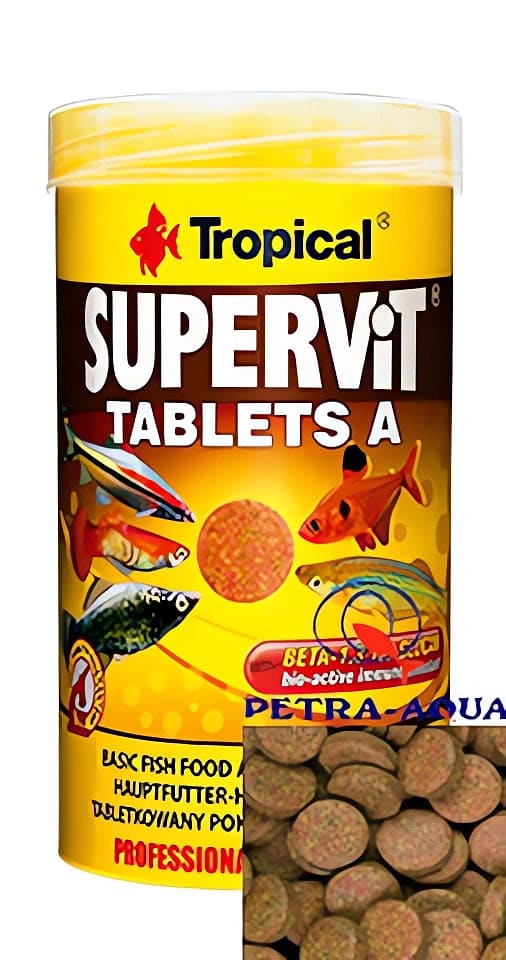
The existing product photograph shows the Tropical Red Parrot Granulat front label and a granule inset. It is a preserved reference image, not a complete photograph of every side of the selected tub. A revised label, lid, language panel or tub proportion does not necessarily mean a different formula, but the delivered label should always be checked before feeding.
Tropical describes this as a floating, colour-enhancing granulate for parrot cichlids and other Cichlidae with a high demand for carotenoids. In ordinary aquarium language, that makes it a focused cichlid food rather than an indiscriminate community flake. The formula and granule must still suit the particular fish in front of you.
Blood parrot cichlids are the clearest intended use. Their individual mouth shape can vary, so confirm that each fish can take and swallow the granule comfortably. A food may be nutritionally relevant yet mechanically unsuitable if a fish repeatedly mouths it, spits it out or cannot compete at the feeding point.
Other medium or larger cichlids may use this food where their natural feeding ecology, current diet, mouth size and condition fit. The phrase "other Cichlidae" is not permission to feed every cichlid identically. Herbivorous, highly specialised, juvenile, fry, recovering or unusually small fish may need a different format or a more specific diet.
Marine parrotfish, pet birds called parrots, pond fish and coldwater fish are not the target of this listing. The name refers to freshwater parrot cichlids. For the broader aquarium range, compare the fish food collection and the tropical dry-food category by species and feeding level rather than by product colour.
The manufacturer identifies Red Parrot Granulat as a floating granulate with high water stability and only slight expansion. It is therefore appropriate to present this product to fish that take food at the surface or through the upper and middle water. It should not be sold as a bottom-feeder tablet or wafer.
Floating does not mean every granule remains fixed at the surface indefinitely. Current, filter returns, surface tension, trapped air, soaking time and repeated mouthing can move a softened granule lower in the water. Feed a small amount and watch what happens in the actual aquarium instead of assuming where the food went.
High water stability helps the granules retain their structure long enough to be eaten, but it does not make uneaten food harmless. Any food left in the aquarium adds organic load. Remove visible leftovers and revise the next portion if granules remain after the manufacturer's 2-3 minute feeding window.
Routine pre-soaking is not required by the manufacturer's direction. If an individual fish struggles with the format, first check granule size, mouth shape, dental or health concerns, aggression at the feeding point and whether another food is more appropriate. Do not leave granules soaking in a cup for long periods and then pour stale food and soak water into the tank.
The reviewed manufacturer composition lists fish and fish derivatives, cereals, vegetable protein extracts, molluscs and crustaceans, derivatives of vegetable origin, algae, yeasts, oils and fats, and mineral feed materials including 1% zeolite. This is a mixed animal- and plant-derived formula; it is not vegetarian, grain-free, fish-free, crustacean-free or mollusc-free.
| Group | Declared information |
|---|---|
| Ingredients | Fish and fish derivatives; cereals; vegetable protein extracts; molluscs and crustaceans; derivatives of vegetable origin; algae; yeasts; oils and fats; mineral feed materials |
| Named mineral material | Zeolite 1% |
| Vitamins per kg | Vitamin A 35,400 IU; vitamin D3 1,650 IU; vitamin E 140 mg; vitamin C 540 mg |
| Trace elements per kg | Iron 39 mg; zinc 10.1 mg; manganese 8.2 mg; copper 1.8 mg; iodine 0.24 mg; selenium 0.24 mg; molybdenum 0.05 mg |
| Other declared additives | Lecithin, astaxanthin 100 mg and antioxidants |
Ingredient categories do not identify every species, cereal or processing source. Anyone managing a known sensitivity or strict ingredient exclusion should inspect the physical tub before use and contact the manufacturer if the batch label is not sufficiently specific. The web description cannot replace the legally supplied label.
The presence of vitamins, trace elements, fatty ingredients and lecithin describes the formula; it does not turn the food into a treatment for disease. A sick, injured, bloated or persistently non-feeding fish needs the cause investigated. Changing to a bright-coloured granule is not a substitute for water testing, diagnosis or appropriate veterinary advice.
| Constituent | Declared amount | What the figure does and does not tell you |
|---|---|---|
| Crude protein | 48% | A laboratory category used to compare labelled feeds; it does not by itself show digestibility or make the food appropriate for every species |
| Crude oils and fats | 7.5% | Part of the energy and fatty-acid profile; portion control still matters |
| Crude fibre | 2% | A declared analytical fraction, not a complete description of every carbohydrate or plant ingredient |
| Moisture | 8% | Explains why dry storage and protection from humidity are important |
Do not compare foods on protein percentage alone. Two feeds with a similar number can use different ingredients, granule sizes, feeding levels and intended species. The useful question is whether the complete formula, format and portion fit the fish and the rest of its diet.
Tropical also refers to omega-3 and omega-6 fatty acids in the product description. These are part of the manufacturer's formulation context. Their presence does not justify a promise of faster growth, immunity, fertility or a particular health outcome for an individual aquarium fish.
Astaxanthin is a carotenoid pigment included here at a declared 100 mg/kg. Fish obtain carotenoids through diet and can deposit or transform them in tissues according to species and physiology. That is why carotenoid-containing feeds are commonly described as colour-support foods.
The ingredient does not paint the fish from the outside, and a stronger dose is not a shortcut to an exact shade. A blood parrot's visible colour also reflects genetics, age, baseline pigmentation, health, social stress, background, water clarity and lighting. Photography and display settings can make the same fish look different from one screen to another.
Use the product as labelled and judge long-term condition in normal aquarium light. Do not overfeed in pursuit of a faster or redder result. Excess food is more likely to increase waste and body fat than to improve appearance. No colour food can guarantee that a pale fish will become the colour shown on a package.
If colour changes suddenly, test water and observe appetite, breathing, faeces, social behaviour and skin condition. A loss of colour can accompany stress or illness. It should not automatically be treated as a dietary-pigment shortage.
The manufacturer's direction is to feed several small portions daily, giving only as much as the fish consume within 2-3 minutes. That is an observation-based limit, not a fixed number of granules for every fish. Body size, number of fish, temperature, competition and the rest of the daily diet all alter the correct portion.
A fish that grabs every granule can still be overfed. Cichlids often show strong feeding responses, and the fastest fish can consume food intended for slower companions. Separate feeding points, smaller drops and direct observation provide more information than one large handful.
Use dry hands or a clean dry spoon. Moisture introduced into the tub can soften granules and encourage spoilage. Never return aquarium-wet food, a used feeding spoon or spilled granules to the container.
Introduce any new food gradually when the fish already eats a stable diet. Offer a small amount alongside a familiar suitable feed and confirm acceptance. A fish may need time to recognise a new shape or scent, but repeated refusal should prompt a review of fit rather than an ever-larger portion.
If the fish takes a granule and repeatedly spits it out, check whether the particle is too large or firm for that individual. Spitting can be normal processing in some cichlids, but food should ultimately be swallowed. Persistent difficulty, weight loss, abnormal faeces or mouth damage needs closer assessment.
If food vanishes instantly, watch where it goes. A dominant tank mate may be taking it, granules may be entering the filter flow, or they may be hidden behind decor. Do not increase the ration until you know the intended fish has eaten.
If leftovers remain, remove them and reduce the next feed. Do not compensate by skipping water maintenance. Food input and filter capacity must remain balanced, even when the granules retain their shape well.
Tropical presents Red Parrot Granulat as a food suitable for regular use, but a complete feeding plan still considers species biology and the other feeds offered. Variety can change nutrient sources and feeding enrichment without turning every meal into an unplanned mixture.
For a compatible cichlid, rotation options can include another correctly sized complete granulate, a suitable flake, or carefully selected foods with a different ingredient emphasis. The Insect Menu Granules provide a format to compare, while Spirulina Granulat offers a plant-rich comparison. Read each product's own suitability and do not combine full portions from several foods.
The Vitality & Color Flakes show how a colour-support feed can use a different physical format. Flakes spread across a wider surface and may suit mixed feeding behaviour, whereas this product gives a more defined floating granule. Neither format is universally better.
Discus Gran is a specialist granulate comparison, not an automatic substitute for every parrot cichlid. Supervit Tablets use another feeding presentation again. Product names do not replace a species-appropriate diet decision.
| Situation | Fit | Reason |
|---|---|---|
| Adult or growing blood parrot cichlid able to take the granule | Designed use | Parrot cichlids are the named target and the formula supplies declared carotenoids |
| Another suitable medium or larger cichlid | Possible after checking | Mouth size, natural diet, condition and the complete feeding plan must fit |
| Very small juvenile or fry | Usually choose another format | The granule may be too large and fry have stage-specific feeding needs |
| Bottom feeder that waits for food on the substrate | Poor default fit | This is a floating granulate, not a purpose-made bottom-feeder tablet |
| Strict herbivore or specialised grazer | Not a default choice | The formula contains fish, molluscs and crustaceans and may not match the species' needs |
| Marine parrotfish, bird or pond animal | Not intended | This listing is freshwater ornamental cichlid food |
| Fish with a known ingredient restriction | Check the physical label first | The formula includes multiple broad ingredient categories and can change by batch |
For husbandry context on the intended fish, see the Blood Parrot Cichlid listing. That page describes the animal; this page describes the food. Buying the feed does not remove the need to plan the fish's adult aquarium, social environment, filtration and long-term care.
A commercial food cannot cycle an aquarium, neutralise ammonia, correct unsuitable pH, increase oxygen or replace partial water changes. The manufacturer's reference to water stability means the granule is designed to hold together, not that uneaten portions have no effect on water quality.
It cannot diagnose or cure disease. Appetite can change because of stress, bullying, temperature, water chemistry, internal disease, mouth injury, recent transport or reproductive behaviour. If a fish stops eating, test the environment and assess the whole animal instead of repeatedly changing foods.
It cannot guarantee growth rate, body shape, breeding, immunity or lifespan. Nutrition contributes to condition, but outcomes depend on genetics, life stage, total intake and husbandry. Claims about one ingredient should never be separated from the complete aquarium.
It also cannot guarantee a particular red shade. The most responsible colour-support plan is measured feeding, stable care and realistic expectations, not adding more granules whenever a fish looks different under another light.
Keep the tub tightly closed in a cool, dry place away from direct sunlight, radiators, aquarium condensation and food steam. Use the original container so the label, batch and best-before information remain attached to the product. Do not decant it into an unlabelled jar.
Open the lid only long enough to take a portion, then close it firmly. Use clean dry hands or a dedicated dry spoon. A large tub is poor value if repeated moisture exposure spoils it before the household can use the food.
Follow the best-before and storage instructions printed on the delivered tub. No universal number of months after opening is invented here because packaging and manufacturer directions can change. Record the opening date yourself if that helps manage rotation.
Discard food that becomes damp, mouldy, unusually clumped, contaminated by pests or noticeably abnormal in odour. Do not try to dry spoiled granules or feed them in smaller amounts. Keep aquarium feed away from children and from pets for whom it was not formulated; it is not for human consumption.
The existing gallery image remains on the listing and shows a Tropical Red Parrot Granulat tub with a front label and granule inset. It is useful for product recognition, but it is a single low-resolution supplier photograph with a visible supplier-origin mark. It does not show the complete ingredient panel, best-before date, batch code or every current pack variant.
The photograph may show a different tub size or older package treatment from the option selected at checkout. The written selector, order confirmation and delivered label are the relevant pack-size evidence.
Because packaging can be revised, judge product identity from the brand, product name, selected weight and delivered label together. Contact us before opening the tub if the delivered item appears inconsistent with the selected order.
Confirm the selected 100 g or 400 g option, live price and stock before checkout. One quantity adds one tub of that option. Inventory can differ between sizes and can change after this page was indexed by a search engine.
Food is a dry-goods item. Current dispatch, destination, cost, returns and reporting terms are explained on the delivery information page and at checkout. A search-result snippet is not a delivery contract.
If the first-order WELCOME10 promotion is displayed as active, enter it at checkout on a qualifying order and review the current conditions there. Do not rely on an old cached search snippet: promotion availability, exclusions and minimums can change.
Yes. It is a floating granulate. Tropical also describes it as water-stable and only slightly expanding. Current and soaking time can move individual granules lower, but it is not sold as a bottom-feeder tablet.
The current options are 250 ml/100 g and 1000 ml/400 g. Select the size before adding the product to the basket because each option has its own price and stock.
No. One quantity supplies one sealed tub in the selected size. Choose 100 g or 400 g in the variant selector.
Yes. Parrot cichlids are the manufacturer's named target. Confirm that the individual fish can take the granule and that the complete formula suits its diet.
Tropical also identifies other Cichlidae with high carotenoid demand, but that is not every cichlid. Check species diet, mouth size, life stage and condition before use.
No. This is a focused floating cichlid granulate. Very small fish, fry, bottom feeders and species with specialised diets may need another product or format.
The reviewed manufacturer analysis declares 48% crude protein. That figure alone does not show digestibility or suitability for a particular fish.
The declared amount is 100 mg/kg. Astaxanthin is a dietary carotenoid used for colour support, not a guarantee of a particular shade.
It can contribute dietary carotenoids, but no exact colour result is guaranteed. Genetics, age, baseline pigment, health, stress, water, lighting and the whole diet also influence appearance.
The manufacturer advises several small portions daily, limited to what the fish consume within 2-3 minutes. Adjust to the fish and total daily diet rather than using a universal granule count.
There is no safe fixed count for every aquarium. Begin with a small portion, observe each fish and stop when feeding slows or the 2-3 minute window ends.
Routine pre-soaking is not part of the reviewed manufacturer direction. If a fish cannot manage the granule, reassess particle size, mouth condition and food choice.
Remove visible leftovers and reduce the next portion. Water stability does not make uneaten granules harmless.
Yes. Fish and fish derivatives are listed among the ingredients.
Yes. The reviewed composition lists molluscs and crustaceans. Check the delivered tub if an ingredient must be avoided.
Yes. Cereals are a declared ingredient category, so this is not a grain-free food.
No. The formula contains fish, molluscs and crustaceans as well as plant-derived ingredients, algae and yeast.
Tropical presents it for regular feeding, but the complete diet should still reflect the species, life stage and other foods offered. Do not combine multiple full portions simply to create variety.
No. It is aquarium fish feed and does not diagnose, prevent or cure disease. Investigate appetite loss, colour loss or abnormal behaviour rather than treating with extra food.
No. The granules are described as water-stable, but leftovers still add organic waste. Filtration, portion control and maintenance remain necessary.
Keep it tightly closed, cool and dry, away from sunlight, heat and aquarium moisture. Use clean dry hands or a dry spoon and follow the delivered label's best-before guidance.
Packaging can change and the one preserved image may show another pack size. Use the selected option, order confirmation and delivered label to confirm the current product.
This is a dry aquarium product. Use the current delivery and returns terms for non-living goods, together with the selected option and checkout information.
See the official Tropical Red Parrot Granulat product page. The label on the delivered tub remains the final batch-specific source.
Identity, format, intended fish, pack sizes, ingredients, analytical constituents, additives and feeding direction were checked against Tropical's official product information. Current variants, stock, price and media were checked against the owned Shopify record. Search wording was selected from UK Keyword Planner and live mobile search-result evidence, then written naturally rather than inserted as repeated phrases.
Last evidence review: 13 July 2026. Product formulation, packaging, stock, pricing, promotions and delivery terms can change. Always check the selected option, checkout and physical label before use.
No reviews for this item yet. Bought one? Honest reviews only, good or bad.
What customers say about ordering from us
I have a small group of long finned mountain minnows. So was delighted to be able to order ten of this variety to increase the genetics in my tank . The ones I recieved are healthy but it’s to early to give a verdict on wether they are of a long finned type since they are small currently.
Gordon Walker · 23 Sept 2026
100% success travel and "installation". Pleased with quality of purchase. The Siamese fighter a bit "shy" so have not yet seen him at his best yet but looking good. Happy customer. GG
George E Garratt · 21 Sept 2026
Reviews of our shop, collected by Judge.me, an independent third-party review collector. Newest first.