Tropical Malawi Chips - Mbuna Cichlid Food
£10.99

Tropical Tanganyika Chips are slowly sinking, 52% protein food for larger Lake Tanganyika cichlids whose diets are mainly animal material. Choose 250ml/130g or 1000ml/520g.
Tropical Tanganyika Chips are slowly sinking, 52% protein food for larger Lake Tanganyika cichlids whose diets are mainly animal material. Choose 250ml/130g or 1000ml/520g.
Tropical Tanganyika Chips are a multi-ingredient, slowly sinking food for larger Lake Tanganyika cichlids whose diets consist mainly of animal material. Tropical names Altolamprologus, Lamprologus, Neolamprologus and Lepidiolamprologus, as well as young Cyphotilapia frontosa, among the fish for which the food is intended. This is therefore a specialist cichlid food rather than a universal food for every tropical community or every African cichlid.
This product page offers two selectable tubs of the same recipe: 250ml / 130g and 1000ml / 520g. Choose the required size beside the current price and availability. The published formula contains 70% ingredients of marine origin, including whole shrimp meal, krill meal and squid meal, and the declared analysis is 52% crude protein.
| Detail | Published Information |
|---|---|
| Brand | Tropical |
| Food format | Multi-ingredient, slowly sinking chips |
| Manufacturer's intended fish | Larger Lake Tanganyika cichlids that feed mainly on animal organisms |
| Named examples | Altolamprologus, Lamprologus, Neolamprologus, Lepidiolamprologus and young Cyphotilapia frontosa |
| Marine-origin ingredients | 70% of the published formula |
| Declared protein | 52% crude protein |
| Choices on this page | 250ml / 130g or 1000ml / 520g |
| Manufacturer's feeding direction | Several small portions during the day, each eaten within 2-3 minutes |
The word chips describes the food's flat pieces. These are prepared food for ornamental fish, not a single-ingredient treat and not human snack food. Tropical describes the pieces as slowly sinking, so they move down through part of the water column instead of remaining only at the surface. That gives the keeper time to watch where the food travels, which fish take it and whether pieces remain uneaten.
The product belongs to Tropical's Premium line. The manufacturer positions that range as prepared foods with added ingredients, while this particular recipe is targeted at cichlids with a strong animal-food component in their natural diet. The product name should not be read as meaning that every fish from Lake Tanganyika needs the same food. The lake contains cichlids with very different feeding specialisations, and a fish's exact identity remains more important than the lake name on a tub.
Nor should "cichlid food" be treated as one universal category. Cichlids occur across several continents and range from plant-grazing specialists to predators. Tropical's current product information is narrower: larger Lake Tanganyika cichlids and other fish whose diets consist mainly of animal organisms. That narrower description is the safer basis for choosing the food.
Tropical specifically lists fish in the genera Altolamprologus, Lamprologus, Neolamprologus and Lepidiolamprologus. These names cover a variety of Lake Tanganyika cichlids, including species that differ in adult size, behaviour and normal prey. The manufacturer also names young Cyphotilapia frontosa. This does not guarantee that one chip size or one ration will suit every individual in those groups, so confirm the species, life stage and mouth size before feeding.
The manufacturer extends suitability to other fish whose diets are based mainly on animal organisms. That is a dietary description, not permission to feed the product indiscriminately to any fish that will swallow it. A fish may accept a food without that food being an appropriate long-term choice. Check the species' normal diet first, especially in mixed tanks where similarly sized fish can have very different nutritional requirements.
| Situation | How Tanganyika Chips Fit | What To Check |
|---|---|---|
| Named larger Tanganyika cichlid genera | Matches the manufacturer's stated audience | Exact species, life stage, mouth size and feeding response |
| Young Cyphotilapia frontosa | Specifically named by the manufacturer | Individual size and ability to take the chips comfortably |
| Another animal-food-oriented fish | May fit the manufacturer's broader dietary description | Species-specific nutritional guidance and food size |
| Plant-grazing or herbivore-leaning cichlid | Do not assume suitability from the cichlid name alone | Use a formula matched to that species' plant and fibre requirements |
| Small community fish, fry or invertebrate-only aquarium | Not the product's stated purpose | Choose an appropriate recipe and particle size for those animals |
For broader background on why cichlid diets vary so widely, read our cichlid care guide. If you keep plant-oriented mbuna rather than the animal-food-oriented Tanganyika fish described here, compare the recipe with Tropical Malawi Chips, which the manufacturer positions for mbuna and other herbivorous cichlids. Product names are only a starting point; the species and its diet decide which formula is appropriate.
One purchase adds one selected tub to the basket. The two choices on this listing are different quantities of the same named Tanganyika Chips recipe, not different strengths, flavours or feeding formulas. The smaller option contains 250ml by volume and 130g by weight. The larger option contains 1000ml by volume and 520g by weight.
| Selectable Option | Volume | Weight | Practical Choice |
|---|---|---|---|
| Smaller tub | 250ml | 130g | Useful for trying the food or feeding a smaller number of suitable fish |
| Larger tub | 1000ml | 520g | Useful where the same suitable food is used regularly and can be stored correctly |
The physical tub and its printed label remain the final reference for batch-specific information, best-before details and any manufacturer formulation update. Do not select a larger tub solely because the price per gram may appear lower. A size is only good value if it can be used while the food is stored dry, sealed and within the printed date guidance.
The following table transcribes the composition published by Tropical. A stated minimum is a label declaration for that ingredient. An ingredient group without a percentage should not be assumed to be present at any particular level. The 70% marine-origin statement is the manufacturer's total for the formula; it should not be reconstructed by adding only the individually declared minimums.
| Ingredient Group | Published Detail | Minimum Where Declared |
|---|---|---|
| Molluscs and crustaceans | Whole shrimp meal | 30% |
| Molluscs and crustaceans | Krill meal | 6% |
| Molluscs and crustaceans | Squid meal | 6% |
| Fish and fish products | Declared ingredient group | Not individually stated |
| Algae | Ascophyllum nodosum (kelp) | 1.7% |
| Vegetable by-products | Garlic | 2.5% |
| Other declared groups | Vegetable protein extracts, cereals, yeast, oils and fats | Not individually stated |
| Mineral feed material | Zeolite | 1% |
Tropical states that 70% of the recipe comes from marine-origin ingredients and highlights shrimp, krill and squid as protein sources. That makes the formula materially different from an algae-led or vegetable-led cichlid food. It also means the food is not vegetarian or vegan. The published composition includes fish, molluscs and crustaceans.
Ingredient percentages do not, on their own, establish whether a food is suitable for a particular fish. Suitability depends on the complete formula, the fish's biology, the amount fed and the rest of the feeding plan. The most important first question is still whether the species normally consumes a diet based mainly on animal material.
Analytical constituents are broad measurements of the finished food. They help buyers compare labels, but they do not reveal every ingredient's digestibility and they do not guarantee a particular growth, colour, breeding or health result. Tropical publishes the following analysis for Tanganyika Chips:
| Declared Analysis | Amount | How To Interpret It |
|---|---|---|
| Crude protein | 52.0% | Total crude protein measurement for the finished food |
| Crude oils and fats | 9.6% | Declared lipid fraction |
| Crude fibre | 3.0% | Labelled crude fibre measurement, not a complete measure of all plant material |
| Moisture | 10.0% | Declared moisture in the finished dry food |
The 52% crude-protein figure is useful when identifying this as a protein-rich prepared food, but "more protein" does not automatically mean "better" for every cichlid. The right comparison is between products intended for the same dietary group and life stage. A food designed for a plant-grazing fish should not be rejected merely because its protein percentage is lower, and this Tanganyika formula should not be selected for a herbivore simply because its protein figure is high.
Tropical also publishes additives per kilogram of food. These figures describe the amount declared in one kilogram, not a recommended dose for the aquarium. Do not add separate vitamin or trace-element products simply by trying to reproduce these numbers; aquarium supplements and prepared-food additives are different products with different instructions.
| Additive | Declared Per Kilogram |
|---|---|
| Vitamin A | 39,300 IU |
| Vitamin D3 | 2,360 IU |
| Vitamin E | 150mg |
| Vitamin C | 525mg |
| Beta-carotene | 150mg |
| Iron (Fe) | 40.5mg |
| Zinc (Zn) | 11.1mg |
| Manganese (Mn) | 8.4mg |
| Copper (Cu) | 2.0mg |
| Iodine (I) | 0.24mg |
| Selenium (Se) | 0.24mg |
| Molybdenum (Mo) | 0.06mg |
| Astaxanthin | 100mg |
| Other declared additive category | Antioxidants; individual amounts are not published on the product page |
The manufacturer connects the formula with condition, colour, development and natural immune support. Those are manufacturer formulation claims, not a promise that this food will prevent disease or produce a guaranteed visual change. Fish health still depends on correct species selection, water quality, stocking, social conditions and a feeding plan that avoids both deficiencies and excess.
Tropical's published direction is to feed several times during the day in small portions, with each portion eaten within 2-3 minutes. The manufacturer does not publish one universal chip count per fish. A fixed count would be unreliable because cichlid size, group size, life stage, body condition, temperature and the presence of other foods all change the appropriate ration.
Cichlids may continue begging after they have eaten an adequate ration. Feeding response is useful evidence, but it is not a precise measure of need. The aim is not to keep food present for the whole 2-3 minutes regardless of quantity. The aim is to offer a small, observed meal that the fish clear within that maximum window.
In a group with uneven access, distribute the same small total ration across more than one position rather than automatically increasing the amount. Water flow and rockwork can carry sinking food into crevices, so watch the first feeds from above and from the side. If the food repeatedly disappears where fish cannot reach it, change the feeding position or reduce the portion.
Slow sinking describes movement, not a guaranteed destination. Some chips may be taken near the surface, some while descending and some lower in the aquarium. Filter outlets, circulation pumps, chip hydration and fish activity all affect the path. The useful feature is that the food remains available through more than one feeding level while it descends.
This can be helpful when the intended cichlids prefer to take food below the surface, but it does not automatically prevent competition or waste. A slowly sinking food can still be overfed. It can also settle behind rocks if the aquarium's flow carries it away from the fish. Portion control and observation matter more than the marketing name of the format.
| Format | Typical Movement | Useful Question Before Choosing |
|---|---|---|
| Slowly sinking chip | Moves gradually through part of the water column | Can the intended fish take the chip size and reach it as it descends? |
| Flake | Usually remains at the surface initially, then softens and disperses | Are the fish comfortable feeding near the surface and taking thinner pieces? |
| Fast-sinking pellet or tablet | Reaches lower levels more quickly | Does the target fish normally feed at that level, and is the piece appropriately sized? |
No format is universally superior. Recipe, particle size and intended species matter alongside movement. Tanganyika Chips make sense where the formula and the slowly sinking delivery both match the fish.
The 250ml / 130g tub is the cautious choice when you are introducing the food, confirming acceptance or feeding only a small number of suitable fish. It reduces the time an opened tub may need to remain in storage. The 1000ml / 520g tub may suit a larger compatible group or a fish room that uses this exact recipe regularly.
Do not estimate how long a tub will last from another keeper's aquarium. Feeding rates vary too much for a reliable universal answer. Instead, note how much your fish actually clear per day during the first week. That observed use rate gives a more meaningful guide for the next purchase, while the printed best-before and storage instructions set the outer limit.
The larger tub is four times the labelled volume and four times the labelled weight of the smaller option. It is not a concentrated version. Changing pack size should not change the ration offered to the fish.
Keep the tub tightly closed, dry and away from direct sunlight or strong heat. Use dry hands or a clean, dry utensil. Moisture introduced into a dry-food container can cause clumping and deterioration, while repeated exposure to warm, humid air can reduce storage quality.
We do not publish an invented opened-tub shelf life because the manufacturer provides batch-specific date information on the pack. If the food becomes damp, develops an unusual odour, shows visible contamination or has been stored contrary to the label, stop using it and obtain product-specific advice.
No prepared food "maintains water quality" by itself. Water quality depends on stocking, filtration, maintenance and how much organic material enters the aquarium. The previous short description made a broad water-quality claim; the more accurate point is that any uneaten food can break down and add waste.
Test ammonia and nitrite whenever fish behaviour or water clarity changes, and monitor nitrate according to the aquarium's normal maintenance plan. If food remains after feeding, reduce the next portion rather than relying on filtration to process the excess. In rock-filled Tanganyika aquariums, inspect gaps and sheltered areas where slowly sinking pieces can collect out of sight.
A sudden refusal to eat is not automatically a problem with the food. Stress, social pressure, water quality, illness, recent transport and an unsuitable particle size can all affect feeding. Check the aquarium and the fish rather than repeatedly adding more food to provoke a response.
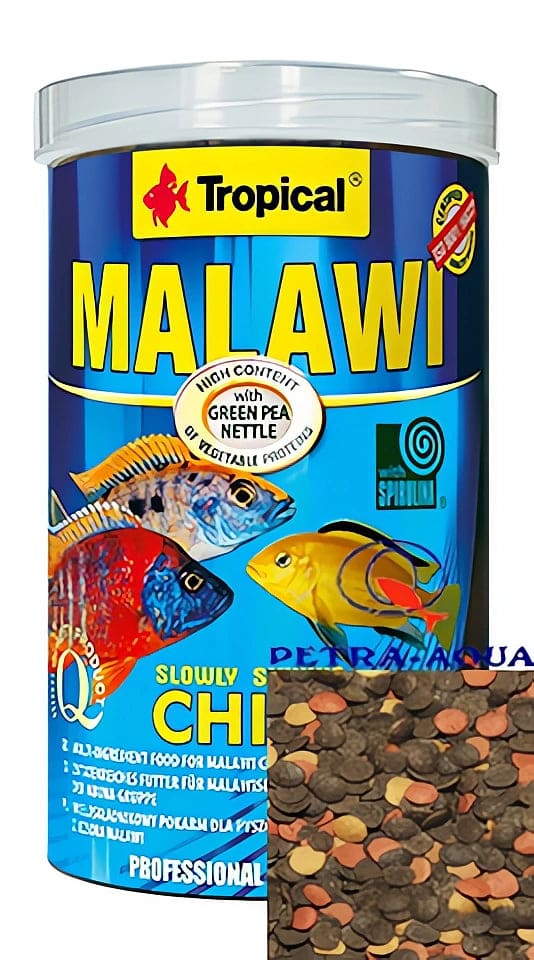
Tanganyika Chips and Malawi Chips are both slowly sinking foods made by Tropical, but their intended dietary groups and published recipes differ. Tanganyika Chips are positioned for larger Lake Tanganyika cichlids and other fish whose diets consist mainly of animal organisms. Malawi Chips are positioned for mbuna and other herbivorous cichlids and publish a more plant-led ingredient profile.
| Comparison | Tropical Tanganyika Chips | Tropical Malawi Chips |
|---|---|---|
| Manufacturer's intended group | Larger Tanganyika cichlids feeding mainly on animal organisms | Mbuna and other herbivorous cichlids |
| Format | Slowly sinking chips | Small, slowly sinking chips |
| Prominent published ingredients | Shrimp, krill, squid and fish ingredients | Pea, oat, nettle, spirulina, wheat germ, spinach, kelp and krill meal |
| Declared crude protein | 52% | 43% |
| Selection rule | Choose from the species' dietary requirements, not from lake name, colour or protein percentage alone | |
This comparison is not a feeding instruction for a mixed cichlid aquarium. If a tank contains species from different dietary groups, one food may not be an appropriate sole diet for all of them. Separate feeding, a carefully planned rotation or different housing may be needed depending on the fish.
Tropical states that the marine ingredients provide protein rich in essential amino acids and describes the recipe as readily accepted. It also associates spirulina, kelp, garlic and stabilised vitamin C with natural immune support, and links regular use with development and colour. These statements explain the manufacturer's formulation intent.
They should not be converted into medical promises. This food is not presented here as a treatment, a disease preventative, a guaranteed colour enhancer or a guaranteed growth result. Individual outcomes depend on species, genetics, age, health, environment, ration and the rest of the diet. If fish show persistent weight loss, swelling, abnormal faeces, breathing changes or loss of appetite, check water quality promptly and seek appropriate aquatic-veterinary or experienced specialist advice.
Likewise, the presence of garlic, algae, vitamins or astaxanthin does not make extra supplementation automatically necessary. Avoid stacking products with overlapping additives unless a reliable species-specific plan supports it.
If those answers are clear, choose the tub size beside the current product options. For other prepared, frozen and live feeds, browse the fish food collection. Delivery charges, dispatch information and any current promotion should be checked on the site's live policy and checkout surfaces rather than relying on permanent product copy.
Fish-food labels combine several kinds of information, and they answer different questions. The product name and intended-animal statement tell you who the manufacturer designed the food for. The composition names ingredient groups and may give minimum percentages for selected ingredients. The analytical constituents report broad measurements in the finished food. Additives are declared separately per kilogram. None of those sections should be substituted for another.
For example, the formula's 30% whole shrimp meal is an ingredient minimum. The 52% crude protein figure is an analytical measurement of the complete food, not the percentage of shrimp, fish or any single protein source. The 70% marine-origin statement covers the manufacturer's full grouping of marine-origin ingredients; it is not contradicted merely because the individually printed shrimp, krill and squid minimums add to less than 70%.
Volume and weight also describe different properties. A 250ml tub has a labelled net weight of 130g, while the 1000ml tub has a labelled net weight of 520g. The millilitre value describes container volume and the gram value describes food mass. Do not compare millilitres from one product with grams from another as though they were the same unit, because foods of different shapes and densities can fill a container differently.
"Crude" in crude protein, crude oils and fats, and crude fibre is standard analytical terminology. It does not mean low quality. At the same time, a high analytical number is not proof that a formula is ideal for every fish. Ingredient source, digestibility, the animal's needs and the amount fed all matter.
A minimum declaration does not reveal the exact current amount above that minimum, and an ingredient without a stated percentage cannot be assigned one by inference. This page keeps those distinctions visible so that search summaries do not turn a partial label into a more precise recipe than Tropical has actually published.
When offering any new prepared food, begin while you have time to observe the aquarium. Check that the fish are behaving normally and that routine water conditions are stable. Offer a small test portion rather than replacing the whole feeding plan on the first meal. Watch whether the intended fish recognise the chips, whether they can take them comfortably and where uneaten pieces settle.
Initial hesitation does not prove that the food is unsuitable, but repeated refusal should not be answered by adding larger quantities. First confirm species suitability, chip size, water quality and whether dominant fish are blocking access. If the fish are already fed several foods, change one variable at a time so that you can tell which product they are accepting and which one is leaving waste.
Keep a short observation record for the first few feeds. It need not be technical. Note the portion offered, approximate time until it was cleared, any persistent leftovers and whether every intended fish fed. That record is more useful than a universal online ration because it reflects the actual group, aquarium and food.
| Observation | What It May Mean | Sensible Next Check |
|---|---|---|
| Food remains after 2-3 minutes | The ration may be too large, poorly placed or not readily accepted | Remove leftovers, reduce the next portion and recheck suitability |
| One fish takes nearly every chip | Access is uneven even if the total portion is small | Distribute the same total ration across more than one position |
| Fish mouth and repeatedly release pieces | Chip size, texture, unfamiliarity or species suitability may be involved | Do not assume; check the fish, food size and intended diet |
| Chips disappear behind rockwork | Flow or feeding position is carrying food out of reach | Move the feeding point and inspect sheltered areas for waste |
| Normally eager fish suddenly refuse all foods | The issue may be environmental or health-related rather than product preference | Check water quality, behaviour and other signs promptly |
Acceptance is only one part of evaluating a food. Over the following weeks, look at stable body condition, normal activity, normal waste production and consistent water-test results. Do not chase rapid growth or dramatic colour change by increasing the ration. Slow, appropriate feeding is safer than using appetite as the only guide.
Correcting these mistakes makes the page more useful to a buyer and more reliable when a search engine extracts one paragraph without the rest of the listing. Each important sentence is written to remain accurate on its own: who the food is for, what is in it, how the manufacturer says to feed it and where uncertainty remains.
Formula, analysis, additives, named fish and feeding directions on this page were checked against the current Tropical manufacturer product information for Tanganyika Chips. Pack choices were also checked against the live Shopify variants for this exact listing. Manufacturer wording about condition, colour, development, acceptance and immune support is identified as a manufacturer claim and is not presented as a guaranteed outcome.
Packaging and formulations can change. Where the physical pack differs from this page, pause feeding decisions and follow the current label or contact us so the listing can be checked. Current price, stock and availability remain live commerce data beside the product options and are intentionally not hard-coded into this description.
No reviews for this item yet. Bought one? Honest reviews only, good or bad.
What customers say about ordering from us
I have a small group of long finned mountain minnows. So was delighted to be able to order ten of this variety to increase the genetics in my tank . The ones I recieved are healthy but it’s to early to give a verdict on wether they are of a long finned type since they are small currently.
Gordon Walker · 23 Sept 2026
100% success travel and "installation". Pleased with quality of purchase. The Siamese fighter a bit "shy" so have not yet seen him at his best yet but looking good. Happy customer. GG
George E Garratt · 21 Sept 2026
Reviews of our shop, collected by Judge.me, an independent third-party review collector. Newest first.