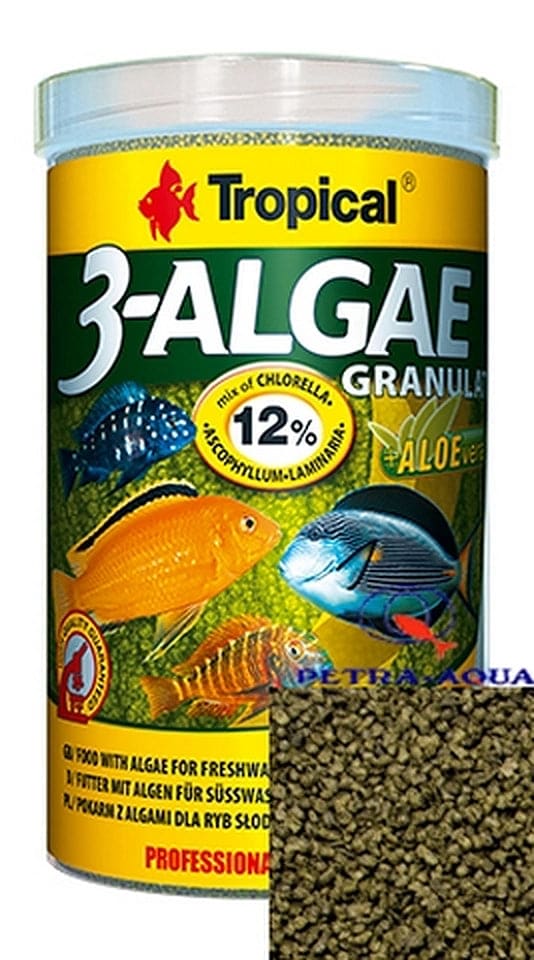
Tropical 3-Algae Granulat - fish food UK
£5.09

Tropical Insect Menu Granules S is a 1.2 mm sinking complete food with 45% black soldier fly, silkworm and mealworm ingredients for omnivorous and carnivorous aquarium fish. Available in 100 ml / 54 g and 250 ml / 135 g.
Tropical Insect Menu Granules S is a 1.2 mm sinking complete food with 45% black soldier fly, silkworm and mealworm ingredients for omnivorous and carnivorous aquarium fish. Available in 100 ml / 54 g and 250 ml / 135 g.
Tropical Insect Menu Granules S is a complete food for omnivorous and carnivorous aquarium fish. Its 1.2 mm sinking granules use three insect ingredients in equal proportions: black soldier fly larvae meal (15%), silkworm pupae meal (15%) and mealworm larvae meal (15%). That makes insects 45% of the recipe and provides a practical, protein-rich staple for fish that feed through the middle and lower parts of the aquarium.
This listing includes two manufacturer pack sizes: 100 ml / 54 g and 250 ml / 135 g. Choose the size from the product options before adding it to your basket. The food itself is the same 1.2 mm formula in both packs.
| Food type | Complete food for ornamental aquarium fish |
|---|---|
| Form | Sinking granules |
| Granule size | 1.2 mm |
| Suitable for | Omnivorous and carnivorous aquarium fish able to take a 1.2 mm granule |
| Insect content | 45% in total: black soldier fly, silkworm and mealworm ingredients |
| Pack options | 100 ml / 54 g or 250 ml / 135 g |
| Colourants and preservatives | None declared by the manufacturer |
Many omnivorous and carnivorous aquarium fish naturally take insect larvae, small crustaceans and other invertebrates. Insect Menu Granules S turns that familiar food type into a consistent dry granule that is easy to portion and store. The animal-protein ingredients come from three different insects rather than a single source, while cereals, plant protein extracts, algae, oils, fats and minerals complete the recipe.
The manufacturer uses insect protein because it is highly digestible and supplies amino acids needed by fish. Insect ingredients also provide fat, including omega-3 and omega-6 fatty acids, as an energy source. Chitin is naturally present in insect material; Tropical describes this part of the formula as supporting gut flora, digestion and nutrient use. These are formulation benefits, not a substitute for correct portions, clean water or a varied feeding plan.
The food is formulated with an appropriate phosphorus level to meet nutritional needs without adding unnecessary phosphorus to the aquarium. It can therefore be a useful part of a careful feeding routine, but no dry food prevents algae if it is overfed. Uneaten food and excessive portions still add waste, so portion control matters.
The following information is taken from Tropical's current manufacturer specification for Insect Menu Granules Size S.
Insects (black soldier fly Hermetia illucens larvae meal 15%, silkworm pupae meal 15%, mealworm larvae meal 15%), cereals, plant protein extracts, algae, oils and fats, and mineral feed materials.
| Analytical constituent | Declared amount |
|---|---|
| Crude protein | 45.0% |
| Crude fat | 9.0% |
| Crude fibre | 3.5% |
| Moisture | 8.0% |
| Vitamin | Declared amount |
|---|---|
| Vitamin A | 39,375 IU |
| Vitamin D3 | 2,360 IU |
| Vitamin E | 150 mg |
| Vitamin C | 570 mg |
The recipe also declares iron, zinc, manganese, copper and iodine trace-element additives, plus antioxidants. Always check the label on the delivered pack if an ingredient or additive is important for your fish, because the physical pack is the final specification for the batch supplied.
The 1.2 mm granule is intended for fish whose mouth size and feeding behaviour suit a small sinking particle. Tropical's own examples span community fish, dwarf cichlids, gouramis, barbs, tetras, swordtails, discus and corydoras. That does not mean every species should receive the same quantity or rely on one food alone. Match the granule to the individual fish, its adult diet and the level at which it feeds.
Typical candidates include small and medium omnivores, insect-eating community fish, dwarf cichlids and carnivorous fish that accept prepared granules. Because the food sinks, it can reach mid-water fish and many bottom-oriented feeders more reliably than a floating-only food. Watch the first feed to confirm that shy fish receive some before faster tank mates clear it.
Very small fish, fry or species with tiny mouths may need a finer product. See Tropical Insect Menu Granules XXS for a smaller alternative. Fish that strongly prefer flakes can be offered Tropical Insect Menu Flakes. For specialist herbivores, algae grazers or species with a narrow natural diet, use food designed for those needs rather than assuming an insect-rich granule is a complete match.
Feed several times during the day in small portions, following the manufacturer's guidance. Adjust the amount to the number, size and appetite of the fish. Each portion should be eaten within a few minutes. Start conservatively: adding a little more is easy, while removing excess sinking food from plants and substrate is not.
Newly introduced fish may take time to recognise a dry granule, especially if they were previously fed frozen or live foods. Offer a very small amount alongside a familiar food and increase its share gradually. Do not leave extra food in the aquarium to encourage reluctant fish; that damages water quality without teaching them to feed.
Community tanks often contain fish that feed at different speeds and depths. Add food in more than one location if dominant fish monopolise the first feeding point. A small portion near the surface can occupy quick feeders while another portion sinks towards quieter fish. Check that bottom fish actually eat the granules rather than relying on whatever happens to fall past the main shoal.
For dietary variety, rotate suitable dry foods with species-appropriate frozen or live foods. Our frozen fish food range provides options for planned variety, while the tropical dried food range makes it easier to compare granules, flakes, tablets and wafers by feeding style.
| Food form | Useful when | Check before feeding |
|---|---|---|
| Insect Menu Granules S | Fish accept a 1.2 mm sinking, insect-rich granule | Mouth size, feeding depth and portion |
| Insect Menu Granules XXS | Fish need a finer particle | Whether the smaller grade is easier to take |
| Insect Menu Flakes | Surface and upper-water feeders prefer a flake | Break flakes to the right size and avoid excess dust |
| Specialist diet | A species has predominantly herbivorous or otherwise narrow needs | Use a formula designed for that species or feeding guild |
If digestive support is your main selection criterion, compare Tropical Pro Defence Granules S. Choose by the fish's dietary needs rather than treating one formula as universally better.
Keep the tub tightly closed in a cool, dry place away from direct sunlight and aquarium splashes. Use dry fingers or a clean, dry feeding spoon so moisture does not enter the container. Do not tip food directly from the tub over an open aquarium, where condensation or an accidental spill can contaminate the contents or overload the tank.
Check the best-before date and batch information on the pack you receive. Stop using food that has become damp, mouldy, unusually clumped or rancid-smelling. The 100 ml pack is practical for fewer fish or slower use; the 250 ml pack offers more food for larger stocks, but only choose it if you can keep the contents fresh through normal use.
Select the 100 ml or 250 ml option shown on this page. Product price and stock are shown live above, so they are not repeated in this description.
No reviews for this item yet. Bought one? Honest reviews only, good or bad.
What customers say about ordering from us
I have a small group of long finned mountain minnows. So was delighted to be able to order ten of this variety to increase the genetics in my tank . The ones I recieved are healthy but it’s to early to give a verdict on wether they are of a long finned type since they are small currently.
Gordon Walker · 23 Sept 2026
100% success travel and "installation". Pleased with quality of purchase. The Siamese fighter a bit "shy" so have not yet seen him at his best yet but looking good. Happy customer. GG
George E Garratt · 21 Sept 2026
Reviews of our shop, collected by Judge.me, an independent third-party review collector. Newest first.