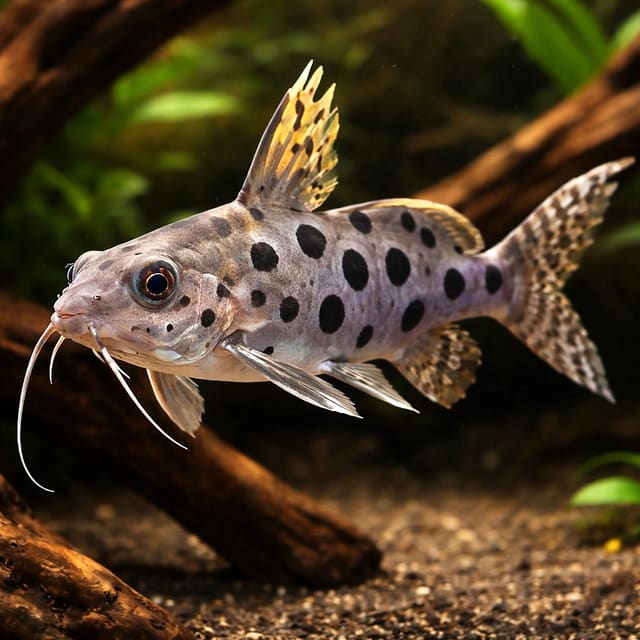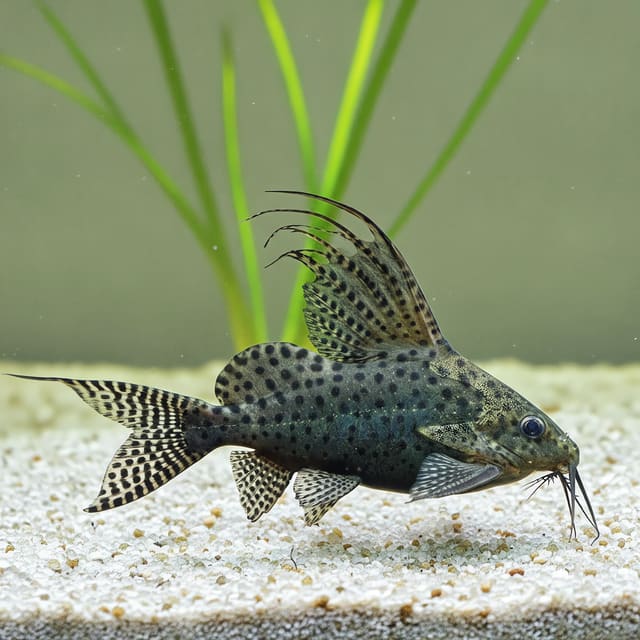
Featherfin Synodontis (Synodontis eupterus)
22–26°C · pH 6.2–7.5
£6.99

One unsexed Network Syno in the selected approximate 4-5 cm or 5-6 cm size. A Congo-basin Synodontis for a mature 80 cm+ aquarium with soft substrate, shaded cover and suitable tank mates.
Adult size is the maximum length this species reaches at full maturity (scientific sources). The livestock you receive will be younger and smaller — pick a size above for the actual shipping size. Product-photo provenance and any image-specific limitations are stated on the listing.
Synodontis aterrimus
Each quantity is one pair containing 2 fish. Discounts count pairs. Selected: 1 pair (2 fish).
Confirm your email, then we’ll send an availability message for this exact item if it returns within 180 days.
This request is only for this product—no newsletter or other promotions. A mail-provider retry may very rarely duplicate the same availability message. Unconfirmed addresses are removed after 48 hours. See our privacy policy.
One unsexed Network Syno in the selected approximate 4-5 cm or 5-6 cm size. A Congo-basin Synodontis for a mature 80 cm+ aquarium with soft substrate, shaded cover and suitable tank mates.
Adult size is the maximum length this species reaches at full maturity (scientific sources). The livestock you receive will be younger and smaller — pick a size above for the actual shipping size. Product-photo provenance and any image-specific limitations are stated on the listing.
Maintain these water conditions for optimal health and vibrant colors
The Network Syno, Synodontis aterrimus, is a compact African catfish with a reticulated pattern, sensitive barbels and the sturdy fin spines typical of many Synodontis. It is primarily documented from the middle Congo River basin and is best treated as a bottom-oriented, low-light fish for a mature freshwater aquarium. Although it is usually peaceful with suitable companions, it is not a harmless cleaner for every community: it needs its own shelter, should not be mixed with prey-sized fish, and must receive food at the bottom.
One quantity buys one live, unsexed juvenile fish in the size selected on the product page: approximately 4-5 cm or 5-6 cm at dispatch. These are approximate living-animal size bands, not guaranteed exact measurements. A quantity of two means two unsexed fish; it does not mean a male and female, an established pair or a bonded pair.
The gallery contains representative illustrations based on reference material. They help show the intended trade form, but they are not photographs of the exact fish supplied and should not be used to guarantee an individual's markings, colour, sex or proportions. One gallery scene contains two illustrated fish; the sale unit remains one fish per quantity.
| Decision point | Practical guidance |
|---|---|
| Scientific name | Synodontis aterrimus Poll & Roberts, 1968 |
| What one quantity buys | One live, unsexed juvenile fish |
| Approximate dispatch sizes | 4-5 cm or 5-6 cm, according to the selected variant |
| Published adult size | About 11.5 cm total length in FishBase; plan around an adult of roughly 11-12 cm |
| Adult aquarium plan | At least an 80 cm footprint; around 120 litres or more is our practical starting point for one, with more space for a community or multiple bottom dwellers |
| Temperature | Approximately 22-27°C; avoid sudden changes |
| pH | Approximately 6.0-7.5, with stability prioritised over a particular target |
| Hardness guidance | A broad 3-20 dGH is reported in specialist aquarium guidance |
| Diet | Omnivorous: varied sinking foods with animal and plant material |
| Temperament | Generally peaceful with suitable fish, but may defend a preferred refuge |
| Best suited to | An established aquarium with soft substrate, shaded cover and similarly sized companions |
This listing has two size options. Selecting 4-5 cm supplies one fish in that approximate dispatch band; selecting 5-6 cm supplies one fish in that approximate band. Size can vary slightly because fish are living animals and may grow between supplier measurement and dispatch. The measurement is a trade size, not a promise that every fish will be exactly the same length on arrival.
The stock is sold unsexed. Juvenile Synodontis cannot be reliably sexed from ordinary product photographs, and this listing does not offer male, female or sexed-pair selection. Colour contrast and reticulation also vary with age, individual genetics, lighting, stress and background. The fish received may therefore look lighter, darker or less strongly patterned than an illustration while settling.
Check the live variant selector for current availability. Product-page inventory is the current source for stock status; the description does not promise that either size is always available. If both variants are unavailable, the care information remains useful for planning, but an order cannot be placed until stock returns.
The accepted scientific name is Synodontis aterrimus. Eschmeyer's Catalog of Fishes treats that spelling as valid and places the species in Mochokidae, the family that includes squeakers and upside-down catfishes. Some aquarium and taxonomic sources use the historical feminine spelling Synodontis aterrima; both spellings may therefore appear during further reading, but they do not identify two different species.
"Network Syno" and "Network Catfish" are trade names referring to the fish's network-like pattern. Another specialist source uses "Blackened Syno." Common names are not controlled identifiers, so the scientific name is the safer way to compare care information or distinguish this fish from other Synodontis. Juveniles can also resemble other patterned species, making an accurate scientific label more dependable than pattern alone.
The species was described by Max Poll and Tyson Roberts in 1968 from material associated with Bokuma in the Congo River basin. It belongs to the order Siluriformes. Its recognisable catfish features include barbels around the mouth, a hardened head structure, a substantial adipose fin, a forked caudal fin and strong leading rays in the dorsal and pectoral fins.
FishBase records S. aterrimus from the middle Congo River basin in the Democratic Republic of the Congo, including the Ruki, Tshuapa, middle Congo main channel and Lomami systems. The current Catalog of Fishes also lists Gabon, while a modern Gabon checklist discusses locality uncertainty around some records. The most careful wording is therefore that the species is strongly documented from the middle Congo basin, with reported Gabon records, rather than claiming it is found only in one country.
Published databases describe it as a tropical freshwater, benthopelagic fish. "Benthopelagic" means it is associated with the bottom and water immediately above it; it does not mean the fish must remain motionless on the substrate. Detailed current speed, depth and substrate records are not available for every population. In an aquarium, the sensible aim is secure bottom cover, clean water, oxygenation and space to forage.
Wood, smooth rocks and caves can create the shaded structure expected by a crepuscular catfish without claiming to reproduce one precise collection site. Leave open substrate between shelters so the fish can search for food without scraping its belly or barbels. A dark background or floating plants may reduce glare, but neither is biologically mandatory if the fish has dependable retreats.
FishBase reports a maximum published length of 11.5 cm total length for male or unsexed material. Some specialist sources display the same number as standard length, so the measurement label is not perfectly consistent across secondary references. For practical aquarium planning, allow for an adult catfish of roughly 11-12 cm.
Its moderate adult length does not make it a nano fish. A Network Syno has a robust body, uses bottom territory, needs a secure refuge and contributes waste like any well-fed catfish. Adult footprint, shelter placement and filtration capacity remain more important than length alone.
Do not confuse dispatch size with adult size. A 4-5 cm or 5-6 cm juvenile still has considerable growth ahead. Growth rate depends on age, feeding, temperature, health and individual variation, so this listing does not promise that the fish will reach a particular length by a particular date.
A specialist reference gives a 90 x 30 x 30 cm aquarium, about 80 litres, as a minimum example. Another specialist source recommends around 120 litres and an 80 cm footprint. Because usable floor area, shelter placement and community stocking matter more than a bare litre number, Tropical Fish Co recommends around 120 litres or more with at least an 80 cm length for one adult as a practical starting point.
Choose more space for a community, multiple catfish or other bottom-oriented fish. Around 180-200 litres with a broader footprint is a more flexible plan when the aquarium will contain several similarly sized companions or when each bottom dweller needs a separate retreat. This is a planning recommendation, not a claim that 119 litres is automatically unsafe or 120 litres automatically suitable.
| Planned setup | Assessment | Why |
|---|---|---|
| Nano or short starter aquarium | Not suitable | Too little adult floor space and too few independent shelter zones |
| One adult in an established 80 cm+ aquarium | Possible from about 120 litres | Provides a practical footprint for one refuge, open feeding area and stable filtration |
| Community with similarly sized midwater fish | Use a larger footprint | Extra volume and layout reduce feeding competition and territorial pressure |
| Several Network Synos or several bottom dwellers | Specialist planning required | Every fish needs a refuge and sufficient bottom territory; compatibility is not guaranteed |
Measure the aquarium's internal footprint as well as its nominal volume. A tall tank can hold many litres while offering limited bottom area. Wood and rock also displace water and divide the floor, so arrange the hardscape before deciding how many bottom fish the aquarium can support.
Use smooth sand or fine, rounded gravel. Sharp or abrasive material can irritate a bottom-dwelling fish as it rests and searches for food. Keep the substrate clean around cave entrances and beneath removable wood, because uneaten sinking food can collect where it is not immediately visible.
Provide at least one appropriately sized refuge for each Network Syno and additional retreats when other bottom dwellers are present. Caves should be stable, have no sharp edges and allow the fish to enter and leave without trapping its dorsal or pectoral spines. Secure rockwork directly rather than balancing heavy stones on loose substrate.
Driftwood, smooth ceramic caves and rounded rock structures can all work. The fish does not require a decorative "Congo biotope" label; it requires functional shade and security. Leave some open bottom area in front of the shelters for evening feeding and observation.
Plants are optional. Hardy plants attached to wood or stone, such as Anubias or Java fern, are less likely to be disturbed than delicate carpeting plants. Floating vegetation can soften strong overhead light. Ensure plant roots, fishing line and loose mesh cannot entangle barbels or spines.
Network Synos are commonly most active in subdued light, at dusk and after the main lights go out. Daytime hiding is normal when the fish is otherwise feeding, maintaining weight and breathing steadily. A fish that has recently arrived may remain hidden for several days while it learns the aquarium's shelter and feeding routine.
Bright lighting can still be used for plants if the layout includes deep shade. Gradual dimming or a low-intensity evening period can make feeding easier to observe. Do not repeatedly remove caves to force the fish into view; predictable cover usually encourages bolder behaviour over time.
Use a secure lid and close cable gaps. This species is not promoted as a specialist jumper, but any startled fish can leave an open aquarium, and catfish can push into surprisingly narrow spaces. Check that filter intakes and overflow boxes cannot trap a juvenile.
Specialist aquarium references overlap around warm tropical, neutral-to-slightly-acidic conditions. A practical range is approximately 22-27°C and pH 6.0-7.5. Seriously Fish gives a broad hardness guide of about 3-20 dGH. These are husbandry ranges, not proof that every population experiences every value in nature.
| Parameter | Practical range | How to use it |
|---|---|---|
| Temperature | 22-27°C | Choose a stable point compatible with all tank mates; avoid rapid changes |
| pH | 6.0-7.5 | Stable, conditioned local water is preferable to repeated chemical chasing |
| General hardness | About 3-20 dGH | Use as broad aquarium guidance, not a reason for abrupt mineral adjustment |
| Ammonia and nitrite | 0 mg/L | Any detectable reading requires immediate investigation and corrective husbandry |
Match a new fish to the established aquarium gradually. The safest target is not the centre of every published range; it is a stable value that suits this fish and its companions. Large, sudden corrections to pH, hardness or temperature can be more stressful than a stable value near one edge of an accepted range.
Use a mature biological filter sized for the complete stocking level. The filter must process waste, but its intake and return should not remove all calm resting zones. Moderate circulation and visible surface movement are useful; arrange wood or rock so the fish can choose between flow and shelter.
Mechanical media should capture particles before they settle under hardscape. Rinse reusable mechanical media in removed aquarium water when flow drops, and preserve enough mature biological media to avoid destabilising the nitrogen cycle. An air stone may improve gas exchange, but bubbles do not replace biological filtration or water changes.
Test ammonia and nitrite whenever a fish is added, feeding changes, filter flow falls or behaviour becomes abnormal. Nitrate management depends on source water, planting and stocking, so use measured results rather than one universal schedule. Regular partial water changes, substrate cleaning and removal of uneaten food are the core routine.
Do not add this catfish to an uncycled aquarium. A calendar alone cannot prove that a filter is mature; use water testing and a known ammonia source to verify the cycle before livestock arrives.
Synodontis are generally omnivorous, and specialist guidance for this species supports a varied combination of dried, frozen, live and vegetable foods. Use a quality sinking pellet or wafer as the dependable base. Rotate suitable frozen invertebrate foods and offer small portions of plant material so the diet is broader than one protein-rich treat.
Feed where the fish can find food after midwater fish have slowed down. Dimming the lights before feeding often gives a shy juvenile a fairer chance. Place food near, but not inside, the refuge so you can check that it is eaten and remove leftovers.
| Food type | Role | Practical note |
|---|---|---|
| Complete sinking pellet or wafer | Staple | Choose an appropriate juvenile or adult size and confirm the fish reaches it |
| Frozen invertebrate food | Variety and conditioning | Thaw and portion sensibly; do not leave excess food beneath wood |
| Live food from a safe source | Occasional enrichment | Avoid unverified wild-collected food that may introduce contaminants |
| Vegetable material | Dietary variety | Offer a small amount and remove uneaten pieces before they decay |
This fish is not sold as an algae-control tool. It may rasp or investigate surfaces, but it still requires deliberate feeding. Small fish, fry and shrimp may be treated as food, especially after lights-out. Browse our aquarium fish foods and frozen fish foods by nutritional role rather than buying several products that duplicate the same ingredient.
Start with one measured evening meal that the fish can consume promptly. Juveniles may benefit from smaller, more frequent portions while growing, but total food should still match body condition and water quality. Increase variety before simply increasing volume.
Watch the fish from above and from the side when it emerges. A healthy juvenile should gradually develop a filled, symmetrical body without a hollow area behind the head. A persistently pinched belly, inability to compete for food or sudden loss of appetite needs investigation. A swollen abdomen is not proof of successful feeding and may require professional advice.
Remove uneaten food. Because this species feeds around the bottom, waste can disappear behind décor while still contributing to ammonia and bacterial growth. Lift only movable décor during routine cleaning and avoid dismantling the fish's secure refuge at every maintenance session.
The Network Syno is generally described as peaceful with appropriately sized fish, but "peaceful" does not mean socially passive. An adult may defend a preferred cave from another catfish or react to a fish that repeatedly enters its resting space. Shelter competition is more likely in a cramped, brightly lit or sparsely furnished tank.
Expect the fish to spend much of the bright period under wood or inside a cave. It may patrol the aquarium at dusk, inspect surfaces with its barbels and occasionally swim at unusual angles. Some Synodontis use inverted swimming, but this listing does not promise that every individual will perform that behaviour frequently.
Learn the normal routine of the individual. Hiding during the day can be normal; hiding combined with rapid breathing, declining body condition or refusal to feed is different. Changes in behaviour should prompt water tests and a review of recent stocking, maintenance and feeding.
One Network Syno can be maintained as the sole member of its species. Specialist reports also indicate that conspecifics may be possible when every fish has a refuge and the aquarium provides enough floor area. This is not evidence that the species must be kept in a shoal, nor is it a guarantee that any two individuals will coexist peacefully.
For more than one, enlarge the footprint, provide more shelters than fish and break lines of sight. Watch feeding so one dominant animal does not monopolise both food and cover. Be prepared to separate fish if there is repeated chasing, injury, weight loss or exclusion from all refuges.
Buying two unsexed juveniles does not create a breeding pair. Sex, maturity, compatibility and pair formation are all unknown at the point of sale.
Choose peaceful, similarly sized fish that use the middle or upper water and can feed without harassing the catfish. Robust tetras, rainbowfish, larger rasboras, gouramis and calm cichlids are examples of broad groups sometimes kept with this species, but compatibility depends on the exact species, size, water requirements and individual temperament.
Avoid tiny fish that could be swallowed, very aggressive cichlids, persistent fin-nippers and bottom dwellers that compete intensely for the same cave. A juvenile tank mate that is safe today may become prey-sized relative to an adult catfish, so plan from adult dimensions rather than shop size.
| Potential companion | General assessment | Condition |
|---|---|---|
| Similarly sized peaceful midwater fish | Often suitable | Match water needs and provide enough group space for the midwater species |
| Calm cichlids | Case by case | Avoid species that attack bottom fish or monopolise caves |
| Other bottom dwellers | Caution | Use a larger footprint with separate feeding areas and independent shelters |
| Tiny fish, fry or small shrimp | Not recommended | They may be eaten during nocturnal foraging |
| Aggressive Rift Lake cichlids | Generally avoid | Water chemistry overlap alone does not make the behaviour compatible |
Use the Synodontis collection to compare current species and sizes, and the wider African catfish collection to understand how different the adult requirements can be. Do not apply one generic "Synodontis catfish care" rule to every species.
Do not choose this fish for a shrimp-breeding or fry-rearing aquarium. Small shrimp and fish fry are natural-sized food items for an opportunistic bottom feeder, and dense planting does not guarantee their safety. Large adult snails may be ignored, but no invertebrate combination is guaranteed.
If preserving a shrimp colony or a valuable spawn is the priority, keep it in a separate aquarium. Feeding the catfish heavily is not a reliable way to remove predatory risk and can damage water quality.
Prepare the aquarium before ordering: confirm stable temperature, zero ammonia and nitrite, working filtration, a secure lid and a shaded refuge. Do not rearrange the entire tank after the fish arrives. Keep the lights low and reduce unnecessary movement around the aquarium.
Follow the bag-specific instructions supplied with the order and use our new-fish acclimation guide for the practical sequence. Acclimation must balance temperature and water chemistry without leaving a shipped fish in opened transport water longer than necessary. Never pour transport water into the display aquarium.
After release, allow the fish to find cover. Offer a small sinking meal after it has settled and the lights are dim; remove leftovers. It may not feed immediately after transport. Monitor breathing, posture and body condition without repeatedly lifting the cave.
Use a separate, mature observation or quarantine aquarium when possible, especially before adding imported livestock to an established collection. Quarantine duration and treatment decisions depend on the fish, source, symptoms and professional guidance. Do not medicate automatically "just in case," and do not combine treatments without checking their suitability for catfish.
The leading rays of the dorsal and pectoral fins are hardened and can catch in coarse mesh. Avoid chasing the fish around a furnished aquarium. When a move is necessary, remove loose obstacles, dim the lights and guide the fish into a smooth container where practical.
If a net must be used, choose a large, soft net and keep the fish supported. Never pull a tangled spine through mesh by force. The spines can injure the fish and the handler, so use calm, deliberate movements and keep hands away from the raised fins.
Do not lift the fish by its tail, barbels or fins. Minimise time out of water and have the destination container ready before capture begins.
Good signs include steady breathing, intact barbels and fins, a filled but not swollen body, responsive movement and regular feeding once settled. A secure fish may hide by day and still be healthy. Judge changes against the individual's established routine.
Warning signs include rapid breathing, loss of balance, persistent surface hanging, damaged barbels, white spots or patches, reddened skin, clamped fins, a hollow abdomen or prolonged refusal to eat. These signs are not a diagnosis. Test water first, isolate when appropriate and seek advice from an aquatic veterinarian or experienced fish-health professional.
Preventive husbandry is more reliable than guessing at medication: use smooth substrate, stable water, adequate oxygen, quarantine for new stock, varied nutrition and enough shelter. Some treatments are poorly tolerated by certain catfish or become unsafe at the wrong dose. Follow the exact product label and professional advice rather than using a generic reduced dose from an online comment.
Both size variants on this listing are unsexed. Adult body fullness is not a reliable retail sexing method, and examining genital papillae is a specialist procedure that should not be attempted on a newly purchased juvenile. No sex is guaranteed.
FishBase records the species as oviparous and notes distinct pairing during breeding. Seriously Fish reports that captive breeding is unrecorded in its account and describes natural breeding in seasonally flooded areas, with egg scattering and no parental care. That evidence does not support a detailed home-spawning recipe, fixed trigger temperature, hatching time or promise that a purchased group will breed.
Anyone attempting a specialist breeding project should begin with accurately identified mature fish, long-term conditioning, substantial space and a plan for separating incompatible adults. A quantity of two from this listing is not sold as a breeding pair.
The intended trade form has a patterned body, forked tail, barbels and a robust Synodontis profile. Pattern density and contrast change with age, lighting, background and stress. A newly arrived fish can look paler than a settled individual and may darken once it has secure cover.
All four gallery images are representative illustrations rather than photographs of the exact fish dispatched. Some illustrated anatomy and markings may differ from a live individual, and one scene shows two fish. The selected size and the one-fish-per-quantity statement define what is being sold.
| Your priority | Fit | Reason |
|---|---|---|
| A compact African catfish for an established medium aquarium | Good fit | Published adult size is around 11.5 cm and the fish uses structured bottom space |
| A fish for a new or uncycled starter tank | Poor fit | It needs mature filtration, stable water and deliberate feeding |
| A guaranteed algae eater or clean-up fish | Poor fit | It is an omnivore that needs a complete, varied diet |
| A shrimp-safe or fry-safe bottom fish | Poor fit | Small invertebrates and fish may be eaten |
| A visible fish for a bright, bare display | Uncertain fit | It is generally more confident when shade and secure retreats are available |
FishBase reports a maximum published length of about 11.5 cm total length. Some secondary sources label the same number differently, so a practical adult plan is roughly 11-12 cm.
Choose an approximate 4-5 cm or 5-6 cm variant. These are living-animal trade bands rather than exact guarantees, and the fish can grow between measurement and dispatch.
Yes. One quantity supplies one unsexed juvenile Network Syno in the selected size. Two quantities supply two unsexed fish, not a guaranteed pair.
No. Both variants are sold unsexed. Juveniles cannot be reliably sexed from a normal product image, and this listing does not offer sex selection.
Plan for at least an 80 cm footprint. Around 120 litres or more is our practical starting point for one adult, with a larger footprint for communities, several bottom dwellers or more than one Network Syno.
Approximately 22-27°C is a defensible specialist range. Select a stable temperature that also suits the other species in the aquarium, and avoid rapid adjustments.
Use approximately pH 6.0-7.5 and a broad specialist hardness guide of about 3-20 dGH. Stable, conditioned water is more important than repeatedly adding chemicals to chase one ideal number.
It is generally peaceful with appropriately sized companions, but may defend a preferred cave or compete with other bottom dwellers. Layout, adult size and individual behaviour still matter.
They may be kept together in a sufficiently large, structured aquarium where every fish has its own refuge. They are not sold as a compulsory shoal, and compatibility between individuals cannot be guaranteed.
Very small or slender fish may be treated as prey, especially after dark. Choose similarly sized, robust companions and reassess the risk as all fish grow.
No shrimp-safe promise should be made. Small shrimp can be eaten during nocturnal foraging, so use a separate aquarium when preserving a colony is important.
Offer a varied omnivorous diet built around complete sinking pellets or wafers, with suitable frozen or live invertebrate foods and some vegetable material. Confirm that faster fish do not take every portion.
Do not buy it as an algae eater. It may inspect and rasp surfaces, but it still needs complete sinking food and should not be expected to control an algae problem.
Daytime hiding is common for a low-light catfish, particularly after transport. Provide a secure retreat and feed at dusk. Hiding plus rapid breathing, weight loss or refusal to eat needs investigation.
It needs secure shaded cover, which can be made from stable wood, smooth rock or a suitable ceramic cave. Leave open, clean substrate for foraging and provide more than one retreat when other bottom fish are present.
Reliable captive-breeding information is limited, and a specialist account records aquarium breeding as unreported. The species is oviparous, but this listing does not provide a proven home-spawning recipe or sexed breeding stock.
No. The existing gallery images are representative illustrations based on reference material. Individual pattern, colour, body shape and exact appearance vary, and the two-fish scene does not change the one-fish sale unit.
Use a smooth container where practical. If a net is necessary, use a large soft net and avoid forcing serrated fin spines through the mesh. Prepare the destination first and minimise chasing and time out of water.
Taxonomic status and type locality are documented in Eschmeyer's Catalog of Fishes. Distribution, maximum published length and oviparity are documented in the FishBase species summary.
Aquarium ranges and practical husbandry are cross-checked against the Seriously Fish species account, the PlanetCatfish Cat-eLog and specialist catfish references. Aquarium minimums are recommendations rather than experimentally proven biological thresholds, so this page explains the footprint and stocking assumptions behind them.
Published species references do not provide a dependable aquarium-lifespan figure or a proven home-spawning method for this species. Social success also depends on footprint, refuge choice and individual behaviour, so no exact group size or pairing outcome is guaranteed.
Availability, price and dispatch options can change, so use the live variant selector and checkout rather than static text in the description. Eligible livestock orders are covered according to the current Live Arrival Guarantee and delivery terms. Review those terms and prepare the aquarium before ordering.
For a broader comparison before choosing this species, browse the current Synodontis range. The right choice is the fish whose adult size, water range, activity and shelter needs match the aquarium you already have or can responsibly prepare.
No reviews for this item yet. Bought one? Honest reviews only, good or bad.
What customers say about ordering from us
I have a small group of long finned mountain minnows. So was delighted to be able to order ten of this variety to increase the genetics in my tank . The ones I recieved are healthy but it’s to early to give a verdict on wether they are of a long finned type since they are small currently.
Gordon Walker · 23 Sept 2026
100% success travel and "installation". Pleased with quality of purchase. The Siamese fighter a bit "shy" so have not yet seen him at his best yet but looking good. Happy customer. GG
George E Garratt · 21 Sept 2026
Reviews of our shop, collected by Judge.me, an independent third-party review collector. Newest first.