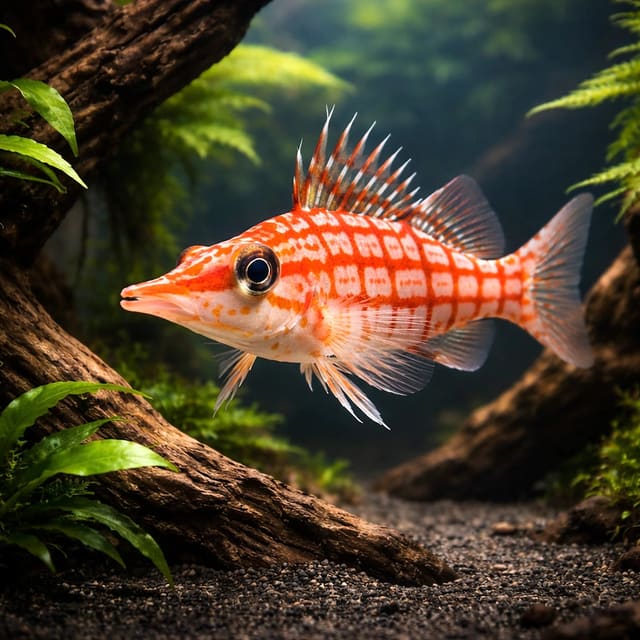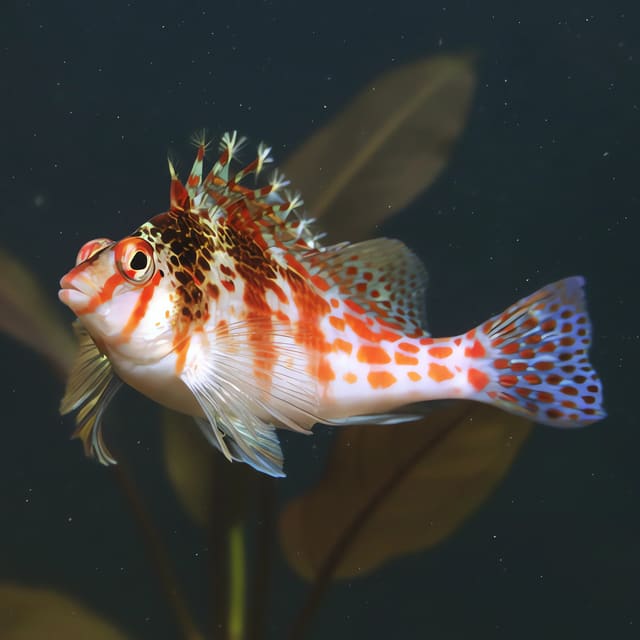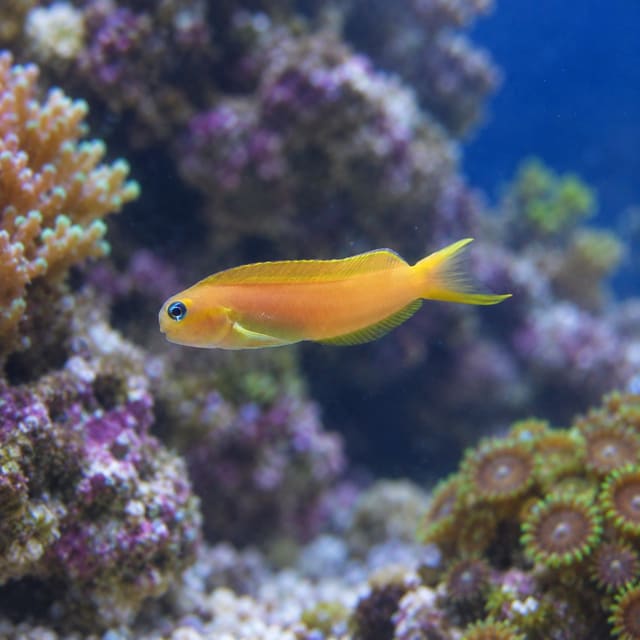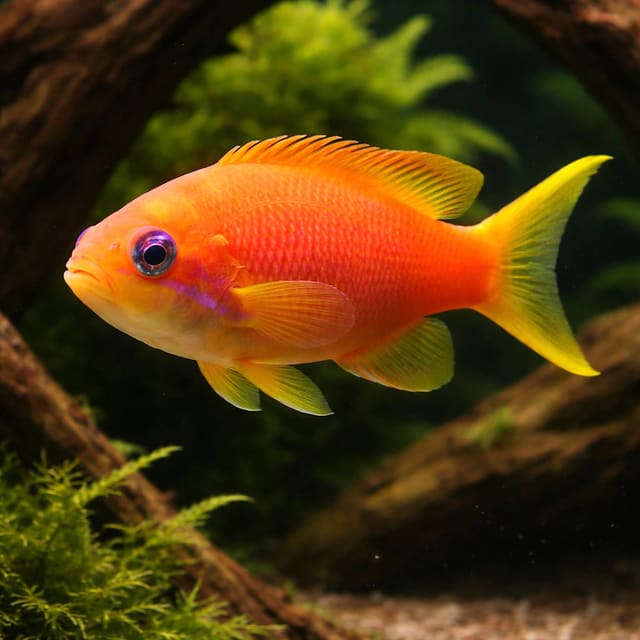
Sea goldie - female (Pseudanthias squamipinnis female)
24–27°C · pH 8–8.2
£52.99
One male sea goldie (Pseudanthias squamipinnis), the pink-to-purple harem male of the fish better known as the lyretail anthias. Males reach 15 cm TL. Plan a large, mature marine aquarium with open water and strong flow, feed small meals often, and keep only one male per tank.
Adult size is the maximum length this species reaches at full maturity (scientific sources). The livestock you receive will be younger and smaller. Product-photo provenance and any image-specific limitations are stated on the listing.
Pseudanthias squamipinnis
One male sea goldie (Pseudanthias squamipinnis), the pink-to-purple harem male of the fish better known as the lyretail anthias. Males reach 15 cm TL. Plan a large, mature marine aquarium with open water and strong flow, feed small meals often, and keep only one male per tank.
Adult size is the maximum length this species reaches at full maturity (scientific sources). The livestock you receive will be younger and smaller. Product-photo provenance and any image-specific limitations are stated on the listing.
Maintain these water conditions for optimal health and vibrant colors
This page sells one male sea goldie, Pseudanthias squamipinnis, the fish many reef keepers know as the lyretail anthias. There is a single option on the listing and it is the male, so there is no sex or size to pick: one male fish is what goes into the bag. The golden-orange females that make up the rest of a harem have their own page, the female sea goldie, and further down we explain why almost every home aquarium should hold only one male, with or without females around him.
The common names are a muddle, so it helps to sort them out before you buy. FishBase, the scientific fish database, uses "sea goldie" as its English name. Wikipedia lists a long run of alternatives, among them lyretail anthias, scalefin anthias, orange basslet, lyretail fairy basslet, scalefin fairy basslet and orange seaperch. The Fishes of Australia database, run by Museums Victoria, files it as the orange basslet. Every one of those names points at the same species. "Goldie" really describes the female. The male on this page is pink to purple, which is why the name can sound a little odd once he is swimming in your tank.
The accepted scientific name is Pseudanthias squamipinnis (Peters, 1855) in both FishBase and the World Register of Marine Species (WoRMS). Peters first described it as Serranus squamipinnis, and WoRMS records later combinations under Anthias and Franzia, so older books and import lists often say Anthias squamipinnis. The spelling catches people out as well: the species name has a double n, squamipinnis, and WoRMS keeps a small list of the misspellings that have found their way into print. Older references place the anthias inside the grouper and sea bass family, Serranidae, and the English Wikipedia article on this fish still does. FishBase and WoRMS now treat them as a family of their own, Anthiadidae.
| Point | What the sources say |
|---|---|
| Accepted name | Pseudanthias squamipinnis (Peters, 1855) |
| Family | Anthiadidae (formerly grouped within Serranidae) |
| What this listing sends | One male |
| Maximum size | Male 15 cm total length; female 7 cm total length (FishBase) |
| Wild range | Red Sea and South Africa east to Niue, north to Japan, south to Australia |
| Wild depth | 0 to 55 m, usually 5 to 35 m |
| Wild water temperature | 22 to 28°C (a range across its habitat, not a tank target) |
| Natural diet | Zooplankton |
| Social system | Harems: one territorial male with several females |
| Conservation status | Least Concern (IUCN, assessed 2015) |
One thing the listing does not state is a dispatch size, and we are not going to guess one here. If the size of the fish matters to your plans, for instance because he is joining a tank that already holds females, contact us before you order.
Male and female sea goldies look so unlike each other that a newcomer could easily take them for two different fish. The female is golden orange with a violet streak running from below the eye back to the base of the pectoral fin, and she stays small: FishBase gives her a maximum of 7 cm total length. The male reaches 15 cm total length, roughly twice her size, and carries a completely different set of colours.
The descriptions we worked from agree on the main features of a male. Wikipedia describes him as fuchsia, with an elongated third ray in the dorsal fin, a red patch on the pectoral fin and drawn-out tips to the tail. The Fishes of Australia entry describes him as purplish pink with a pink-to-orange streak from the eye to the base of the pectoral fin, a red patch on the pectoral fin and pale spots on a blue anal fin. The German Wikipedia article adds that the male's scales are yellowish with red or pale blue-grey edges, so up close he is more finely patterned than he looks from across the room.
In a tank, the long third dorsal spine is the easiest feature to spot. It rises well above the rest of the dorsal fin like a pennant. The red mark on the pectoral fin is the other easy giveaway, because none of the female descriptions we read mention it. Put those two features together with the overall pink or magenta body and you are looking at a male.
The body plan is the same in both sexes. FishBase describes it as fusiform and compressed from side to side, in other words a spindle shape flattened sideways. It gives 10 spines and 15 to 17 soft rays in the dorsal fin, and 3 spines and 6 or 7 soft rays in the anal fin. You will not need fin counts to recognise your fish, but they are handy if you ever have to separate a sea goldie from one of the many similar Pseudanthias species seen in the hobby.
Two cautions before you compare your fish with photographs. FishBase notes that colour patterns vary from one locality to another, so a male from one end of this huge range may not match a picture taken at the other. And every male started life as a female. Wikipedia describes the switch as a set of hormonal and physical changes that can take several weeks to months, so not every male is at the same point in that process. Judge your fish on the male features above, not on how closely he matches one particular picture online.
Few reef fish cover as much of the map. FishBase gives the range as the Indo-West Pacific, from the Red Sea and Natal in South Africa east to Niue, north to Japan and south to Australia. Wikipedia includes the Great Barrier Reef and south-east Australia, and notes that the species is absent from the Persian Gulf and from Hawaii. It is a reef-associated marine fish found from the surface down to 55 m, according to FishBase, usually between 5 and 35 m.
Within that range the habitat is quite specific. FishBase places adults above coral outcrops or patch reefs in clear lagoons, channels and on outer reef slopes, and Wikipedia mentions steep slopes down to 35 m. FishBase and Fishes of Australia both say they form large aggregations, and the Fishes of Australia account adds that large schools are often seen feeding on zooplankton in the water column above the reef. Picture a cloud of orange females and a few pink males hanging in clear, moving water just off the coral, each fish picking tiny drifting animals out of the current.
That picture tells you most of what the fish needs from an aquarium, and it comes down to three things:
Each of those points comes up again in the sections on the tank, the water and feeding.
FishBase gives a climate range of 22 to 28°C for the species. Treat that as the spread of temperatures across a range that runs from the Red Sea to Japan, not as a setting for your heater. The aquarium figures we suggest further down come from the UK trade association's marine guide.
The IUCN assessed the sea goldie as Least Concern on 12 March 2015, according to FishBase. FishBase lists it as a minor commercial fisheries species and a commercial aquarium species, and rates its resilience as high, with a minimum population doubling time of less than 15 months. The German Wikipedia article notes that it is caught and exported in large numbers for aquariums. None of that changes what an individual fish needs from you: a properly prepared home, which is what the rest of this guide is about.
The sea goldie lives in harems, and that single fact shapes how you should stock it. FishBase describes the males as territorial and haremic. Wikipedia's article on this species puts a male's harem at five to ten females. Its article on the anthias family as a whole describes groups made up of one dominant, colourful male, two to 12 females with a pecking order of their own, and up to two subdominant males that are less brightly coloured and not territorial. On the reef those harems sit inside the larger shoals described above.
The species is a protogynous hermaphrodite. Fish start out as females, and males are females that have changed sex. FishBase records that females are induced to change sex when males are removed from a social group. The change takes two to four weeks after a male is removed from an area, but 170 to 280 days in a group made up only of females. Fishes of Australia also gives two to four weeks. Wikipedia describes the same thing from the group's point of view: when the male dies or leaves, the largest and most dominant female undergoes hormonal and physical changes and becomes the harem's new male.
The size at which this happens varies a little between places. FishBase gives sex transition at 5.0 cm total length and notes that colour patterns and the size at transition differ slightly between localities. The German Wikipedia article gives females maturing at about 4.7 cm and changing sex at around 6 cm standard length. We mention both so that you are not thrown if you read one figure in one book and another elsewhere.
Tropical Fish Hobbyist magazine's species profile is blunt on this point: under no circumstances should two males share the same aquarium. Wild anthias groups can include subdominant males, but a reef offers far more room than any tank, and FishBase is clear that males are territorial. Plan for one male, full stop. If you already keep a male sea goldie, this listing is not for your tank.
You have two honest options. The same magazine profile says single specimens often fare better, especially in smaller systems, so a lone male in a well-run reef is a legitimate way to keep this fish. If your aquarium is big enough to give a group real room, adding females restores the natural arrangement. Remember the scale the species works at in the wild, five to ten females per male, before deciding that a tank is big enough for a harem. The females are listed on their own page as the female sea goldie (Pseudanthias squamipinnis).
Sex change has a practical upside and a downside for the buyer. A tank of females alone can, in time, produce its own male, but FishBase puts that at 170 to 280 days in an all-female group. Buying a male gives you the male colours now rather than many months down the line. On the other hand, if you lose your male, expect one of your females to start changing, which is the species doing exactly what it does on the reef.
FishBase describes the sea goldie as a pelagic spawner, meaning eggs are released into open water rather than laid on a surface, and says that successful males spawn nightly with successive females. Wikipedia notes that in the Red Sea, spawning takes place at sunset between December and February. None of the sources we used describes rearing the young in a home aquarium, so we do not offer breeding advice for this species and would not buy a male expecting fry.
The Tropical Fish Hobbyist profile calls the sea goldie an active fish that requires a large aquarium, preferably 70 gallons or better. That is a US figure, and 70 US gallons is about 265 litres. Treat it as the starting point for one male on his own; a male with females needs more room on top of that. The UK trade association OATA makes the same point in general terms in its marine set-up guide: buy an aquarium as large as possible, make sure it can hold your chosen fish once they are fully grown, and remember that larger aquariums are more stable and less prone to swings in temperature and pH than small ones. For a fish that can reach 15 cm total length, both pieces of advice push the same way.
In the wild a sea goldie hangs in the water above the coral rather than living inside it, so the layout should copy that. Build the rockwork so it leaves a clear band of open water above and in front of it, where he can patrol and feed. For any given volume, a long tank gives more swimming distance than a tall one, and swimming distance is what an active open-water fish uses. Keep the front glass clear of tall structures so you can see him feed, because watching him eat is the easiest way to judge how he is doing.
The magazine profile says this species needs a good current and high oxygenation. Wild fish live on outer reef slopes and in channels, so plan your pumps to create varied movement across the tank and enough surface movement for good gas exchange. OATA lists a protein skimmer among the extra equipment for a marine aquarium. If you also plan to keep corals, OATA describes live rock as essential and suggests roughly one kilogram of rock per ten litres of aquarium water. Arrange it as islands or a low reef wall rather than a solid bank up to the waterline, so the fish keeps his open space.
OATA notes that a fish-only marine aquarium does not need much light, while coral systems need lighting matched to the corals you choose. The sea goldie itself has no special lighting needs in our sources, so let the corals, if any, decide your lighting.
This is not a fish for a brand-new tank. OATA explains that a marine aquarium filter is mature once ammonia and nitrite have dropped to zero and stay at zero continually, and that fish numbers should only be increased slowly so the bacteria can keep up. The magazine profile says these fish need perfect water conditions. Put those together and the answer is simple: add your male to an established, stable aquarium that has been running and testing cleanly for some time, never as one of the first fish in a newly set-up system.
Sea goldies come from clear reef water, and the magazine profile we used says they need perfect water conditions. The practical targets below come from OATA's guide to setting up and maintaining a marine aquarium. OATA gives two sets of figures, one for fish-only systems and one for reef aquariums with corals and invertebrates.
| Parameter | Fish-only system | Reef aquarium |
|---|---|---|
| Specific gravity (salinity) | 1.017 to 1.023 | 1.024 to 1.026 |
| Temperature | 24 to 27°C | 24 to 27°C |
| pH | 8.0 to 8.2 | 8.0 to 8.2 |
| Ammonia | Zero | Zero |
| Nitrite | Zero | Zero |
| Nitrate | Under 20 mg/l | 5 to 10 mg/l |
| Also monitor | - | Carbonate hardness and phosphate |
The temperature range sits comfortably inside the 22 to 28°C that FishBase gives for the species across its wild range, so there is no conflict between the two. Pick a figure within 24 to 27°C and hold it steady, since a stable temperature matters more than chasing any single number.
OATA recommends reverse osmosis (RO) water for marine set-ups because it has been filtered to remove impurities, and calls it essential if you want to keep invertebrates. Mix it with a specialised aquarium salt, never table salt. Measure the specific gravity of every batch before it goes into the tank, and top up evaporation with fresh RO water rather than salt water, because the salt stays behind when water evaporates.
OATA suggests partial water changes of at least 10% every week, adjusted for the species you keep, the size of the tank and how heavily it is stocked. With a fish that needs feeding several times a day, that last point matters. More meals mean more waste, and nitrate can creep upwards in a tank where a planktivore is being fed properly. Test ammonia, nitrite, nitrate and pH regularly, and if you keep corals, keep an eye on carbonate hardness and phosphate too. If nitrate rises above the target for your type of system, increase water changes before you think about cutting back his food.
Test everything a few days before the delivery date and again on the day. You want ammonia and nitrite at zero, nitrate within range, pH between 8.0 and 8.2, a steady temperature within 24 to 27°C and specific gravity where you normally keep it. If anything is off, put it right before he goes in, not after.
FishBase lists the sea goldie's natural food as zooplankton and gives it a trophic level of 3.4, which places it among fish that eat small animals rather than plants. Fishes of Australia describes large schools feeding on zooplankton in the water column above the reef. In other words, a wild sea goldie spends much of its time picking tiny drifting animals out of the current, one at a time.
The Tropical Fish Hobbyist profile turns that into a feeding rule: this is a planktivore that needs frequent small feedings, preferably of live foods, though it can usually be trained to take frozen foods and small pellets. That is the heart of keeping this fish well. A male anthias is not a fish you feed once in the evening and forget.
The magazine profile says live foods are preferred and that most fish can be trained onto frozen foods and small pellets. If your male is slow to accept frozen food at first, live food is the bridge. Once he is feeding confidently, a mix of suitable frozen foods and small pellets makes the routine easier to keep up week after week. Thaw frozen food in a little tank water first so it disperses into the water column instead of sinking in a lump.
Frequent feeding is the real commitment with this fish. Before buying, think honestly about who will feed the tank while you are at work, and who will do it when you are away. A routine that only works at weekends is not enough for a planktivore. If you cannot keep up several small meals a day, a different marine fish will be a better choice than this one.
The more often you feed, the more carefully you need to manage waste. That is why the water-change and nitrate advice in the previous section matters so much for this species. Strong filtration, regular partial water changes and prompt removal of leftovers let you feed a sea goldie the way he needs without paying for it in water quality.
The Tropical Fish Hobbyist profile describes the sea goldie as reef safe, with one caveat: it may eat small shrimps. That fits what we know of its diet: corals are not food for a zooplankton feeder, but a fish that eats small animals can treat a small shrimp as one. Think carefully before adding a male to a tank of tiny ornamental shrimps.
The clearest compatibility rule for this species concerns its own kind. FishBase describes males as territorial, and the magazine profile says two males should never share an aquarium. So the only sea goldie that should join this male is a female, and only if the tank is large enough for a group. The female sea goldie listing covers those.
Our sources do not publish a tank-mate list for this species, and we would rather tell you that than invent one. What they do give is enough to plan sensibly. He is an active open-water fish that needs frequent small meals, so any tank mate that grabs food first or harasses him at feeding time works against him. His size also matters: a male can reach 15 cm total length, while females stay under half that, so stock with the adult size of every fish in mind. If you are unsure about a particular combination, ask us before ordering.
Our marine range also includes the black sea urchin (Mespilia globulus) and the multicolour sea urchin (Tripneustes gratilla). The sources we used for the sea goldie say nothing about urchins either way, so read each animal's own care page and plan the whole system rather than one fish at a time. As a general rule, OATA's guide reminds marine keepers that diet and feeding needs vary between species, with some feeding at the surface, some in mid-water and others sifting the bottom. A mixed tank works best when each animal's way of feeding is catered for.
OATA recommends quarantining new marine livestock in a separate aquarium, so you can make sure each animal is feeding properly and free of disease before it joins the main display. For a fish that needs frequent small meals, that is doubly useful: in a quiet quarantine tank you can see exactly what he eats and how readily he takes it, without bolder tank mates getting there first.
OATA's marine guide describes a healthy fish as having clear, bright eyes, undamaged fins, intact scales, no ulcers or bumps, appropriate swimming behaviour and steady breathing. For a male sea goldie, appropriate swimming means spending his time out in the open water above the rockwork, which is where the species lives on the reef, and coming forward when food goes in.
The same guide lists the changes to watch for in marine fish:
Because this species is fed so often, the last point is usually the first one you will notice. OATA's advice when you are worried about any animal is to test your water quality and then contact your retailer for guidance. Do it in that order: ammonia, nitrite, nitrate, pH, temperature and salinity are quick to check, and a water problem is usually the simplest thing to put right. Then get in touch with us if the cause is not clear.
OATA suggests checking that the water is at the correct temperature every day, testing water quality at least once a week for ammonia, nitrite, nitrate, pH and salinity, and checking filters for blockages and build-up of waste. The magazine profile we used stresses perfect water and high oxygenation for this species, so add a quick daily look at your pumps and surface movement to that routine. OATA also warns that adding too many fish too quickly can overwhelm the filter bacteria, the problem often called new tank syndrome, so do not add a batch of new livestock at the same time as this male.
If you keep him with females and he dies or is removed, FishBase and Wikipedia both describe what follows: the largest, most dominant female begins to change into a male. That is the species behaving normally, not a sign of illness. Wikipedia notes that the females in a group have their own hierarchy, and that hierarchy is in flux while one of them changes, so keep feeding little and often and make sure every fish is still getting a share.
Get the aquarium ready before you place the order, not on the morning the parcel turns up. The filter should be running in an established system, the water tested, and the temperature matched to the 24 to 27°C range above. Please read our delivery and live-arrival information before ordering so you know exactly how the process works.
Your sea goldie travels in an oxygen-filled bag inside insulated packaging, with heat packs added when conditions call for them, and is carried by a tracked courier licensed to carry live animals. We email the confirmed delivery date and tracking details. Someone has to be at the delivery address to receive the parcel.
Start a continuous video before you open anything, while the parcel is still sealed. Keep filming as you open it and show the fish in the still-sealed bag, all in the same take. If a fish arrives dead, dying or clearly compromised, email hello@tropicalfishco.co.uk on the day of delivery with your order number and that video. Photos on their own do not meet the policy. The resolution is a replacement with your next order or a refund for the affected fish, subject to the guarantee terms.
Keep the lights low for the rest of the first day and leave him in peace. Over the following week, watch his breathing, his appetite and how he behaves. Start offering small portions of food once he has had time to settle, and remove anything he does not take. Test the water during that week as well, since a new arrival adds to the load on the filter.
Judge progress over the week rather than the first afternoon. What you want to see is steady breathing, growing interest in food and more time spent out in open water. If he is still refusing food after several days, or you notice anything from the warning list in the health section, test the water and contact us for advice.
These are the sources behind this guide. Each one is worth reading in full if you want more detail than we have room for here.
Photo adapted (new background, slight change of angle) from a photo by Francois Libert, CC BY-SA 2.0, via Wikimedia Commons; the adapted photo is shared under the same licence.
No reviews for this item yet. Bought one? Honest reviews only, good or bad.
What customers say about ordering from us
Easy website plenty of info on fish your buying great to pick a time slot
TRACEY DURRANT · 7 Oct 2026
Got some lovely fish thank you
Kevin Mackie · 7 Oct 2026
Reviews of our shop, collected by Judge.me, an independent third-party review collector. Newest first.