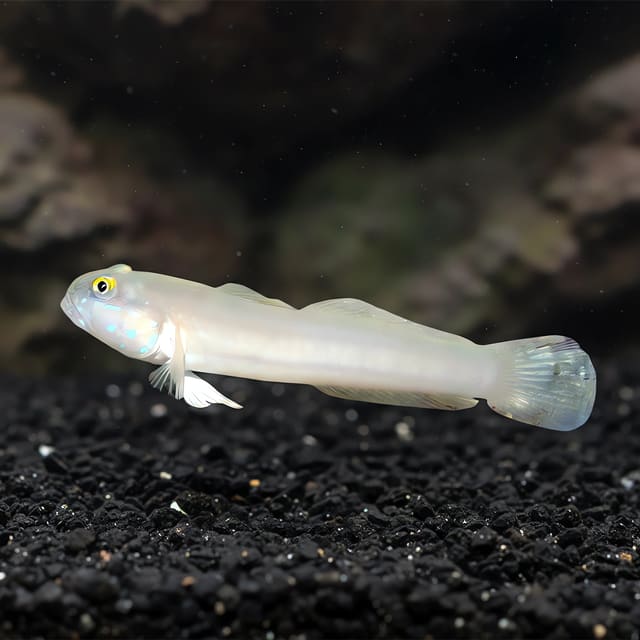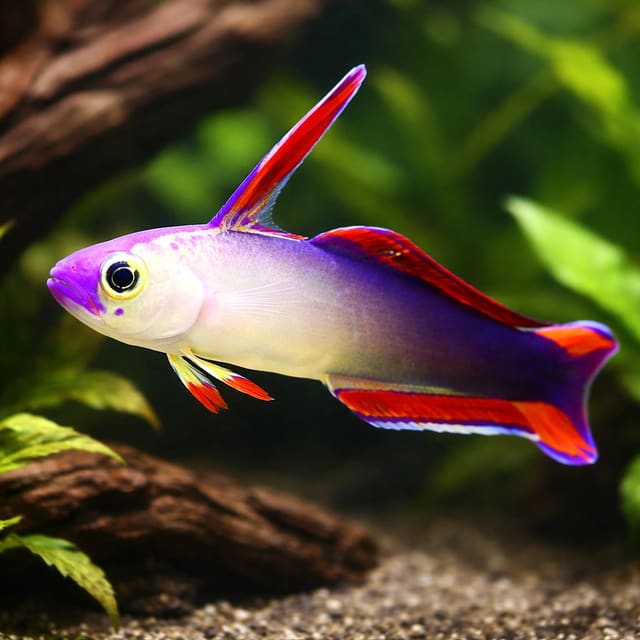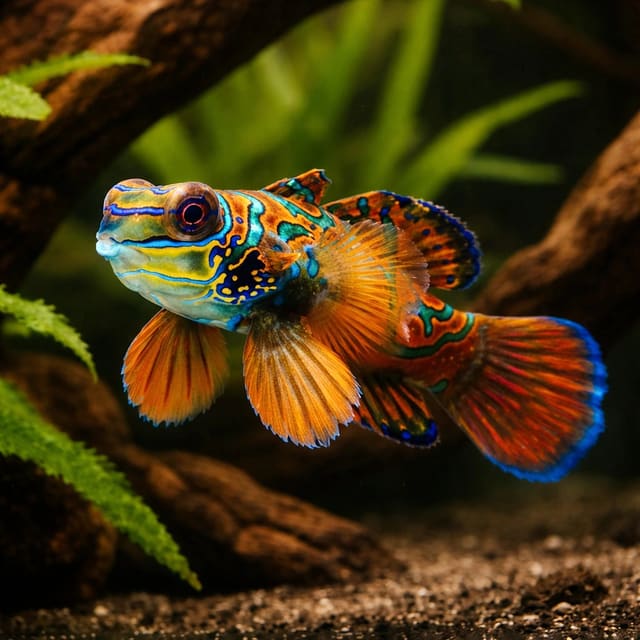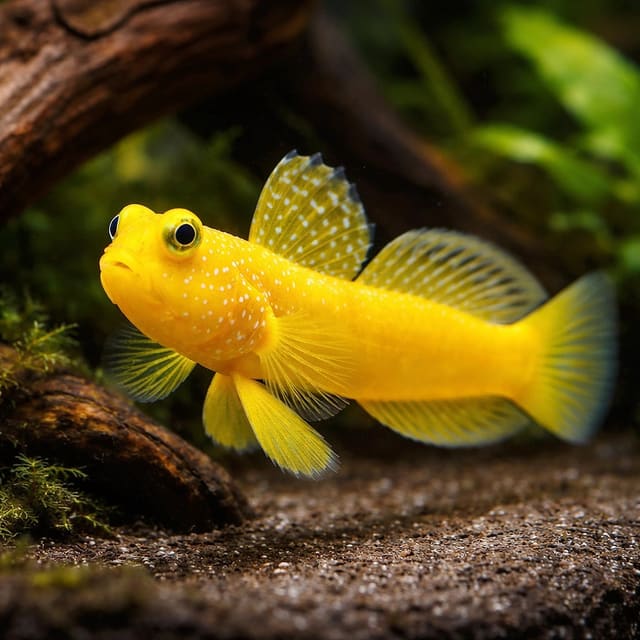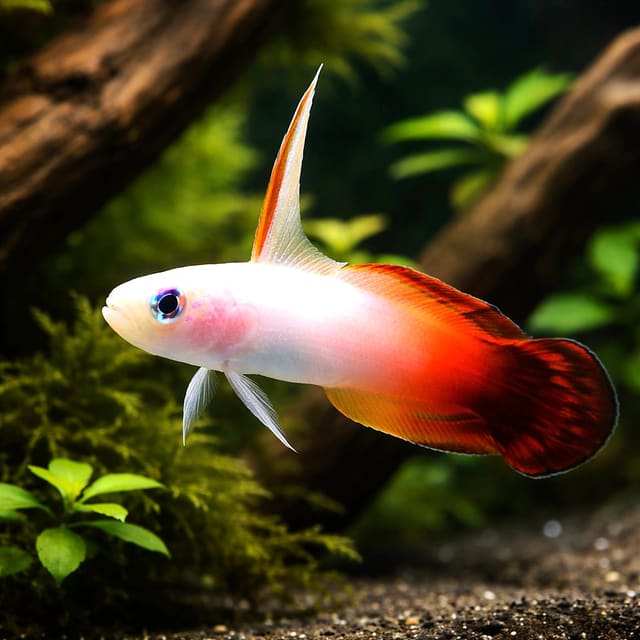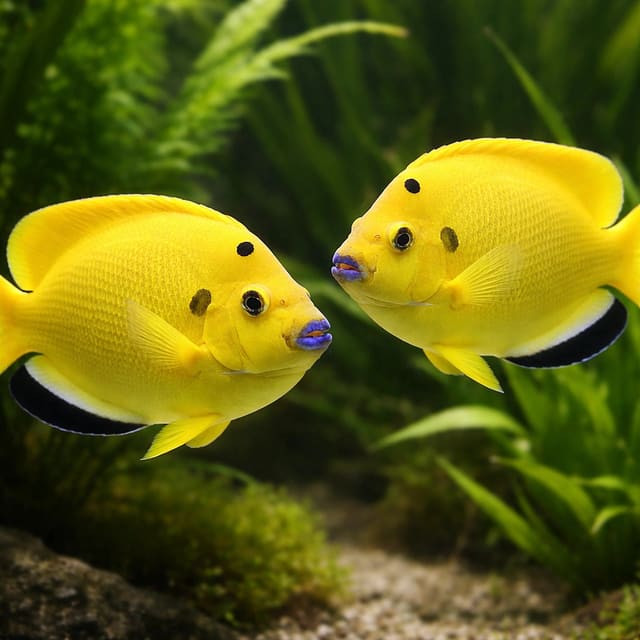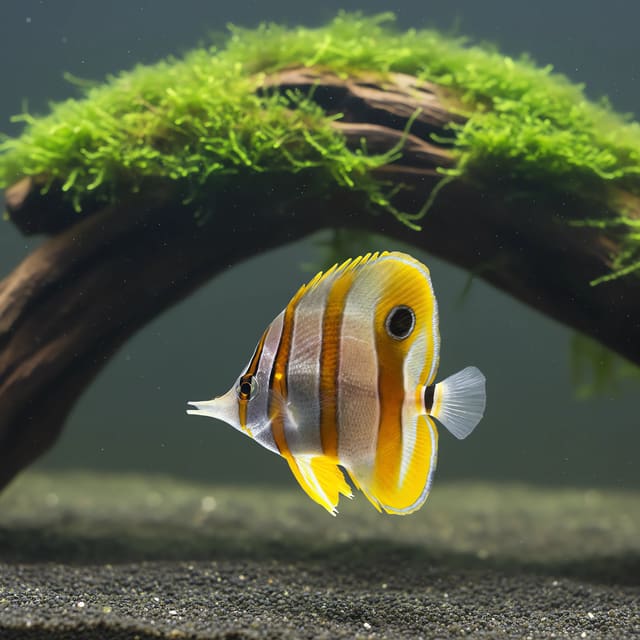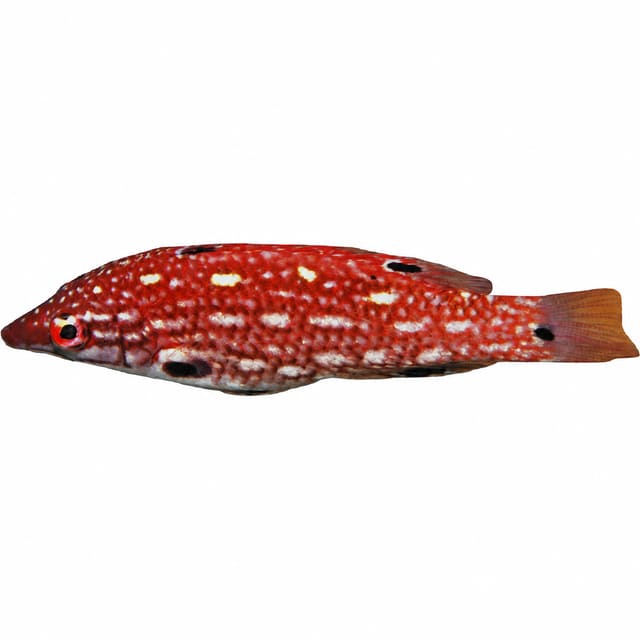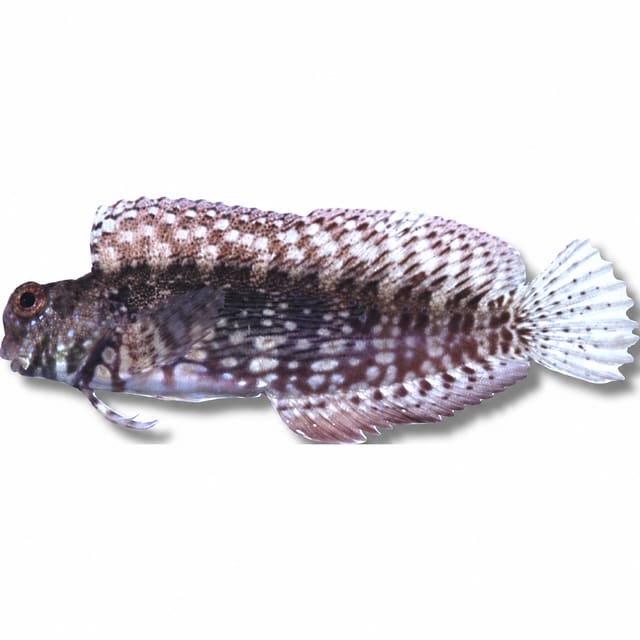
Jewelled Blenny (Salarias fasciatus)
24–26°C · pH 7.9–8.3
£52.99
One Persian blenny (Ecsenius midas), also known as the Midas blenny. A lyre-tailed Indo-Pacific reef blenny reaching about 13 cm, it feeds on plankton in open water and copies the colours of anthias. It needs a mature marine aquarium of at least 80 litres with rockwork, swimming room and a tight lid.
Adult size is the maximum length this species reaches at full maturity (scientific sources). The livestock you receive will be younger and smaller. Product-photo provenance and any image-specific limitations are stated on the listing.
Ecsenius midas
One Persian blenny (Ecsenius midas), also known as the Midas blenny. A lyre-tailed Indo-Pacific reef blenny reaching about 13 cm, it feeds on plankton in open water and copies the colours of anthias. It needs a mature marine aquarium of at least 80 litres with rockwork, swimming room and a tight lid.
Adult size is the maximum length this species reaches at full maturity (scientific sources). The livestock you receive will be younger and smaller. Product-photo provenance and any image-specific limitations are stated on the listing.
Maintain these water conditions for optimal health and vibrant colors
This listing is for one Persian blenny, Ecsenius midas. It is just as often called the Midas blenny, the name Wikipedia files it under, and FishBase adds golden blenny and Midas coralblenny to the list of English names. Every one of those names points to the same animal: a combtooth blenny of the family Blenniidae, subfamily Salariinae, described by W. A. Starck in 1969 and still the accepted name on the World Register of Marine Species. Each order is for a single fish.
The species name is a nod to King Midas, the Phrygian king of Greek legend who turned everything he touched to gold. Starck recorded the living fish as golden yellow, hence the name, although we now know it comes in a much wider range of colours than that. He judged it different enough from its relatives to give it a subgenus of its own, Anthiiblennius, and the holotype he described was a male of 74 mm standard length from D'Arros Island in the Amirante Islands of the Seychelles.
Victor Springer's 1988 revision of the genus for the Smithsonian recognised 46 species of Ecsenius. The Midas blenny stands apart from nearly all of them. It is the largest species in the genus, the most widely distributed by a long way, and the one that spends most time up in open water instead of on the reef. It also has more fin rays and vertebrae than its relatives and much bigger front teeth. If you have kept one of the smaller Ecsenius species, which stay closer to the coral, expect a rather different fish.
It is worth clearing up one worry straight away. The word blenny makes some people think of the fangblennies of the genus Meiacanthus, many of which have a venomous bite, a risk the Ornamental Aquatic Trade Association (OATA) flags in its blenny care sheet. The Persian blenny belongs to a different genus, and FishBase lists it as harmless to people.
| Feature | What the sources say |
|---|---|
| Accepted name | Ecsenius midas Starck, 1969 |
| Adult size | Up to 13 cm total length (FishBase) |
| Wild range | Gulf of Aqaba and south-east Africa east to the Marquesas Islands |
| Wild depth | 2 to 40 metres on coral reefs |
| Natural food | Zooplankton taken in open water |
| Aquarium temperature | 24 to 26°C (OATA blenny guidance) |
| Minimum aquarium | 80 litres for the larger blennies (OATA) |
| What you receive | One fish |
The fish suits someone who already runs a stable marine aquarium, or who is building one properly and is prepared to let it mature first. OATA describes blennies as fairly undemanding about décor and usually undemanding about water chemistry, but that is no licence to cut corners: this one still needs sea water held within tight limits, a lid, open swimming space and steady feeding with small foods. The sections below take each of those in turn.
The most reliable mark is also the easiest to miss: a black spot just in front of the vent on the underside of the body. Springer, who examined preserved fish from right across the range, called it the most consistent and conspicuous marking the species has, and FishBase lists the black spot around the anus among its identifying features. Among blennies and their close relatives, only the four species of the small group to which E. midas belongs carry that spot.
The tail is the next giveaway. The caudal fin is lyre-shaped, with long upper and lower lobes, and Springer noted that the shape comes partly from the central rays being short. In other Ecsenius species, any long lobes come purely from the outer rays growing longer. The dorsal fin is distinctive too. It runs as one unbroken fin with no notch between the spiny front portion and the soft-rayed rear, and it starts unusually far forward, ahead of a line dropped from the front edge of the gill cover. Only one other species in the genus shares that forward start.
FishBase gives 13 to 14 dorsal spines, 19 to 21 soft dorsal rays, two anal spines and 20 to 23 soft anal rays. Springer's own counts ran from 12 to 14 dorsal spines (usually 13) and 18 to 21 soft rays (usually 19 or 20), so the two sources overlap rather than agree exactly. He also found that fish from the Gulf of Aqaba and the western Pacific appeared to have fewer soft fin rays and tail vertebrae than fish from the Indian Ocean and the Marquesas.
Combtooth blennies take their family name from their rows of fine teeth. The Midas blenny has far fewer teeth in each jaw than any other Ecsenius, and the canines at the front of the lower jaw are greatly enlarged and obvious. There is also a small fleshy tab, or cirrus, on the rear rim of the front nostril, though you will only spot it from very close.
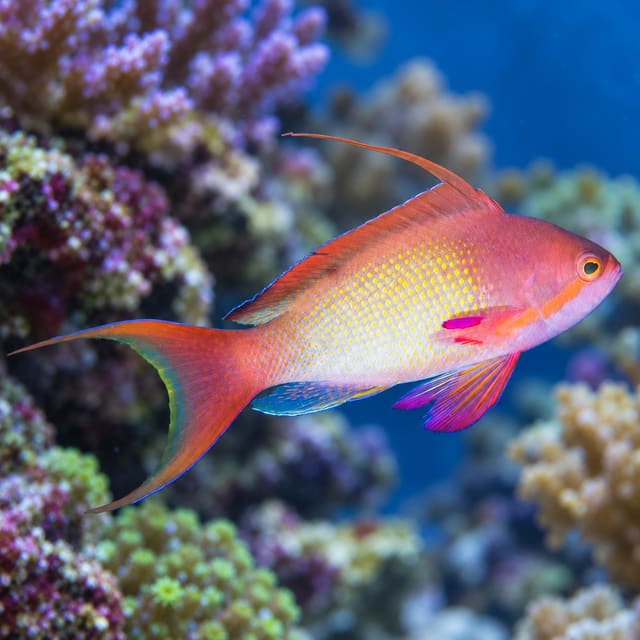
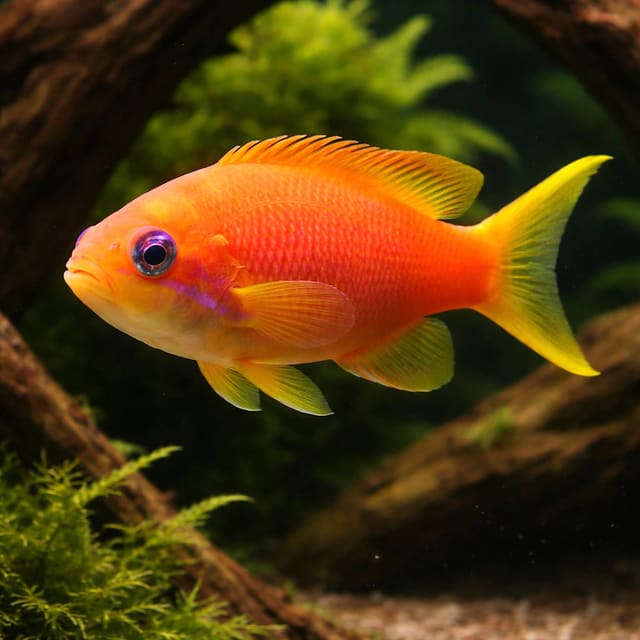
Colour is the part to be careful with. FishBase describes the species as golden orange with a narrow dark margin on the front part of the dorsal fin, and adds that Indonesian fish can be grey or greenish through to golden yellow. Springer went further and described the live colour as extremely variable. A freshly dead fish from the Gulf of Aqaba had a dusky orange head with a pale yellow-green stripe from the eye to the gill cover, a white throat, pale dusky purple over orange on the flanks, a chartreuse belly and orange-yellow fins. Fish photographed at Christmas Island in the Indian Ocean were bright yellow along the back and greyish white on the sides with yellow upper and lower tail lobes, while others there were brownish at the front with brownish or yellowish-brown bands across the body. One fish from Mauritius showed brilliant yellow spots on the head, fine black lines over the muscle blocks, a thin black stripe running back along the lateral line to the tail base and a pearly white underside.
On top of all that, FishBase records that individuals can change colour quickly as they move from the bottom into open water, to match the fish they are mixing with. So please buy this fish for what it is and not for one particular shade. The colour it shows on arrival is not a fixed feature, and the same fish can look quite different in different company. We cannot promise a colour, and nobody honestly can.
FishBase gives a maximum of 13 cm total length, and Wikipedia repeats that figure. Springer describes the species as the largest Ecsenius, reaching almost 100 mm standard length. Standard length stops at the base of the tail, and on a lyre-tailed fish the tail adds a fair amount, which is how the two figures sit together. Read 13 cm as the size of a fully grown fish, not a size every individual will reach, and plan the aquarium around it.
Few reef fish cover as much ground. FishBase gives the range as the Indo-Pacific, from the Gulf of Aqaba and the south-east coast of Africa east to the Marquesas Islands, and Wikipedia notes that the Red Sea is included. Springer found it was the most widely distributed member of its genus by some margin: its spread across longitude covers and goes beyond that of every other Ecsenius species put together.
The specimens Springer examined show just how wide that is. They came from the Gulf of Aqaba and Port Sudan in the Red Sea, the Amirante Islands, Grand Comore, the Chagos Islands, Mauritius and Zululand in South Africa, then east through the Nicobar and Cocos-Keeling Islands, Palawan in the Philippines, Indonesia, Papua New Guinea and the Great Barrier Reef, and out into the Pacific at the Solomon Islands, the New Hebrides (now Vanuatu), the Loyalty Islands, Fiji, the Marquesas and Christmas Island in the Line Islands, a different island from the Indian Ocean one mentioned above. One notable gap is Hawaii, where Springer found the genus apparently does not live.
FishBase places adults on coral reefs between 2 and 40 metres deep, from clear coastal reefs out to the outer reef walls, usually where currents are moderate. Springer notes that Ecsenius blennies as a group live almost entirely below the low-tide line on reefs with living coral, unlike several other blenny genera that crowd the shallows, the intertidal zone and mangrove swamps. Within that group the Persian blenny is the open-water specialist. FishBase describes adults swimming two to three metres above the bottom while feeding on plankton, and Springer calls it the most pelagic species in the genus, rising well above the coral heads.
The behaviour that made this fish famous is its link with anthias. In its orange-yellow phase it schools with the lyretail anthias, Pseudanthias squamipinnis, which it closely resembles in colour, and Wikipedia notes that it is often seen in that company. FishBase adds that it copies the swimming style of two other fish, Pseudanthias huchtii and Lepidozygus tapeinosoma, and that it can change colour quickly to match whichever fish it is with. Springer's monograph includes an observer's report from the Gulf of Aqaba of live fish looking very like female lyretail anthias, the species they were swimming among, and a photograph from Sudan of a Midas blenny in a lyretail shoal.
The mimicry is not the whole story, though. Springer pointed out that the lyretail anthias does not range as far east into the Pacific as the Midas blenny does, and that the colours recorded at Mauritius and Christmas Island look nothing like an anthias. Copying that one species cannot, then, be essential to the blenny's way of life. It reads better as a flexible habit: a plankton-feeding blenny that blends into whichever shoal it happens to be feeding beside.
This is not a blenny that spends its day on one rock. In the wild it feeds up in the water column over living coral, in moderate current. OATA's general advice is that blennies need rockwork with crevices, overhangs and outcrops, plus swimming space for the more active species, and the Persian blenny, the most open-water member of its genus, needs both halves of that advice.
On conservation, FishBase reports an IUCN Red List assessment of Least Concern, dated 2009, rates the species' resilience as high, with a minimum population doubling time of under 15 months, and gives it a low vulnerability score. FishBase also notes that it is used in the commercial aquarium trade, and Wikipedia describes it as turning up there occasionally.
OATA's starting rule for blennies is to buy as large an aquarium as you reasonably can. Its minimums are at least 40 litres for one fish of a smaller species and at least 80 litres for the larger ones, with more needed if the blenny is to live alongside other fish. At up to 13 cm, the Persian blenny sits firmly among the larger blennies; OATA puts most species at around 10 cm. So 80 litres is the floor. Because this fish swims in open water and does not simply perch, we would not plan for it at the bare minimum, especially in a mixed community. A larger volume also keeps temperature and water quality steadier, which OATA counts as a benefit in its own right.
OATA describes rockwork, live or artificial, as essential for blennies, built up to give crevices, overhangs and outcrops so the fish can behave naturally. It also asks for open swimming space for the more active species. For this blenny, give the second point as much weight as the first: a rock structure with plenty of holes and ledges, arranged so that a good stretch of clear water runs above and in front of it. A tall wall of rock reaching the surface leaves a mid-water fish with nowhere to go, while a low, open structure with caves gives it both a refuge and a place to cruise.
On the floor, OATA suggests a thin layer of coral sand, about 2 cm deep, which helps blennies feel secure and helps hold carbonate hardness. Flow should be moderate: enough to give good surface movement and stop detritus settling. That fits well with the moderate currents FishBase describes on the reefs where this species lives. Overhead lighting keeps a proper day and night rhythm. It does not need to be bright for a blenny kept alone, but any corals will set their own lighting needs.
The lid is not optional. OATA states plainly that a lid or cover is essential because blennies can jump, especially when startled. For a fish that spends its time swimming in mid-water, check the small gaps as well as the main cover: cut-outs for cables and pipework and the area around any overflow.
A heater is needed to hold the temperature all year. Filtration is essential, and on a marine system OATA lists live rock with enough water movement, an internal or external filter, or a sump-based filter as the options; a protein skimmer helps by removing dissolved organic waste before it breaks down into something more harmful. Site the aquarium away from draughts, heat sources and direct sunlight, and away from loud noise, vibration and sudden movement.
| Set-up point | Guidance |
|---|---|
| Volume | At least 80 litres for one fish; larger with tank mates |
| Rockwork | Crevices, overhangs and outcrops, with open water above |
| Substrate | Coral sand about 2 cm deep |
| Flow | Moderate, with good surface movement |
| Cover | Tight-fitting lid, gaps closed |
| Equipment | Heater, filtration, protein skimmer recommended, test kits |
OATA notes that blennies can live for many years in a well-matured set-up with good water quality, and it warns that stocking too fast risks new tank syndrome, when there are not yet enough nitrifying bacteria to cope with the extra waste and ammonia and nitrite climb. Add the Persian blenny to an aquarium that has been running and stable for some time, and build up the rest of the community gradually around it.
FishBase lists the Persian blenny as a tropical, reef-associated marine fish but gives no temperature range for the species, so for the numbers we follow OATA's water requirements for marine blennies. Treat them as targets to hold steady, not a band to drift around in.
| Parameter | Target |
|---|---|
| Specific gravity | 1.020 to 1.025 |
| Temperature | 24 to 26°C |
| pH | 7.9 to 8.3 |
| Ammonia | Zero |
| Nitrite | Zero |
| Nitrate | No more than 50 mg per litre |
| Carbonate hardness | 8 to 12 dKH |
| Calcium | 380 to 450 ppm |
| Magnesium | 1,250 to 1,350 ppm |
OATA warns that blennies can be stressed by even very small amounts of ammonia and nitrite, and that the stress can lead on to disease. Both should read zero every time you test. If you are setting up specially for this fish, wait until the system has matured and those two readings have stayed at zero before you order.
Water evaporates from a marine aquarium but the salt stays behind, so the specific gravity creeps up unless you replace the lost water. OATA's advice is to monitor salinity regularly and top up evaporation losses with reverse osmosis water, not with more salt water. A refractometer or hydrometer used the same way each time will show you any drift early.
The calcium and magnesium figures matter most if you keep corals alongside the blenny; OATA lists reef test kits for calcium, alkalinity, magnesium and phosphate as necessary for anyone keeping corals. Carbonate hardness, the buffer that holds pH steady, matters in every marine tank, and the thin bed of coral sand OATA recommends helps support it.
OATA strongly recommends a 25% partial water change at least once a week, using a siphon to lift waste from the sand as you go. Test ammonia, nitrite, nitrate, pH and carbonate hardness weekly, and more often while the tank is new or after adding fish. When the filter needs cleaning, rinse the media lightly in the water you have just taken out, never under the tap, because chlorine or chloramine in tap water kills the bacteria living in it. Clean the protein skimmer regularly so it keeps working properly.
One habit makes those water changes far gentler on the fish: mix the new salt water in advance, bring it to the same temperature as the aquarium and check its specific gravity before it goes in. A water change should freshen conditions, not jolt them.
In the wild the Persian blenny is a planktivore. FishBase lists its food as zooplankton and other planktonic organisms, taken while it swims two to three metres above the reef, and Wikipedia describes it the same way. That sets it apart from the herbivorous blennies in OATA's care sheet, which need foods high in algae and graze the rockwork. This fish is built to pick small animals out of moving water.
For omnivorous blennies, OATA recommends algae-based foods alongside small frozen meaty items such as mysis shrimp, enriched brine shrimp and copepods. For a plankton feeder those small frozen foods are the natural staple, so build the diet around them and add an algae-containing food to keep it broad. Rotating between the frozen foods gives more variety than relying on one.
OATA's guidance is to feed twice a day, giving only as much as the fish will clear within a few minutes. Overfeeding leaves uneaten food to break down and release waste into the water, and for a fish that reacts badly to traces of ammonia that is a real cost, not a cosmetic one.
Because this blenny takes its food from open water, how you feed matters as much as what you feed. Thaw frozen food first and release it into the flow so it drifts through the aquarium, instead of dropping it in one place where it sinks straight to the sand. For the first few weeks, watch every feed to make sure the blenny is actually getting its share. In a busy community, quick fish can take most of what goes in before a newcomer has learned the routine, and a fish that keeps losing out will gradually lose condition.
Keeping it well fed also protects everything else. OATA notes that some blennies will nibble corals or clams, especially when underfed. The Persian blenny's wild diet is plankton, not coral, but that warning covers blennies in general, and steady, generous feeding is the simplest insurance. If you keep clams or soft-bodied invertebrates, keep an eye on them for the first weeks as well.
OATA's view is that most blennies mix well with other fish, and the Persian blenny's own wild habits, swimming among shoals of anthias, point the same way. The cautions come from its own family. OATA advises keeping no more than one blenny species in an aquarium unless it is large and broken up with plenty of visual barriers, because blennies can turn territorial towards one another. It also notes that blennies may become territorial towards similar-looking fish that live near the bottom, naming firefish and shrimp gobies as examples.
For most set-ups that means one Persian blenny as the only blenny, with peaceful tank mates that will not compete with it for the same crevices. If you already keep a firefish or a burrowing goby, watch the first days closely and make sure the rockwork gives each fish a refuge of its own, out of the other's line of sight.
This listing is for a single fish, and that suits the species. OATA notes that most blennies are hard to sex unless they are in breeding condition, so buying two in the hope of a pair is a gamble, and two blennies in a normal-sized aquarium can fall out over space. One Persian blenny per aquarium is the sensible default.
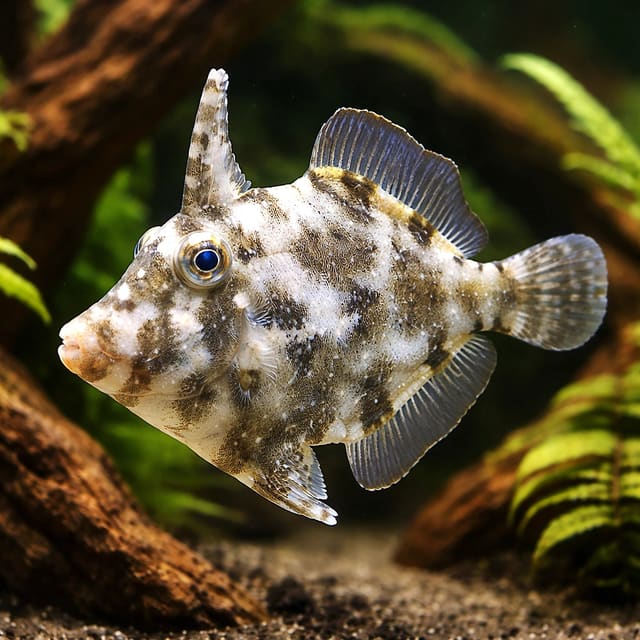
If you are weighing up blennies, our Jewelled Blenny (Salarias fasciatus) is another species worth comparing, and OATA's care sheet discusses it under the name algae blenny. Think of it as an alternative, not an addition. OATA notes that it can become quite territorial as it grows older and should not be mixed with shy species, and OATA's one-blenny-species rule applies to the pair of them.
The wild picture of a golden blenny swimming among lyretail anthias makes people want to recreate it. That pairing is a field observation, not evidence that the two will behave that way in a home aquarium, so choose any anthias on its own requirements and your aquarium's size, and do not expect the blenny to act as a shoal member just because it does on the reef.
Its natural habit is to feed in open water, so expect a settled Persian blenny to spend time swimming clear of the rock, not only sitting on it. It will still use the rockwork, which is why OATA's crevices and overhangs matter. A fish that hides constantly after the first week, or one that is chased into the rock by tank mates, is telling you something about the community that needs fixing.
OATA's description of a healthy fish is a good checklist for this one: clear bright eyes, undamaged fins, intact scales, no ulcers or lumps, normal swimming and steady breathing. It also lists warning signs: clamped fins, flicking against rock or sand, and shimmying, a shaking motion on the spot. OATA points out that diseases can be carried by fish that show no signs at all, which is the strongest argument for quarantine.
Where you can manage it, OATA recommends quarantining new livestock in a separate aquarium for at least a week before it joins the main display. For a mid-water plankton feeder there is a second benefit: a quiet quarantine tank lets you check that the fish is eating well before it has to compete with established residents for food in the flow.
Once the blenny is settled, OATA's watch list makes a good daily habit. Look for changes in:
Colour takes some judgement here. FishBase records that the Persian blenny changes colour quickly to match the fish around it, so a shift in shade on its own can be perfectly normal. What should concern you is colour change that comes with other signs on that list: faster breathing, a refused meal, or a fish that hides all day. Learn what your own blenny looks like in your own aquarium during its first weeks, and use that as your baseline.
OATA's advice when you are worried about a fish is to test the water quality first and then ask for guidance. With blennies sensitive to small traces of ammonia and nitrite, that order makes sense: rule out the water before anything else. Be careful with treatments in any display that holds invertebrates. OATA notes that copper is toxic to invertebrates, so a copper-based remedy has no place in a reef aquarium; use the quarantine tank instead.
FishBase records the Persian blenny as an egg-layer that forms distinct pairs. Its eggs are demersal and adhesive, meaning they sink and stick, and they are attached to the surface they are laid on by a filamentous adhesive pad or pedestal.
OATA's care sheet describes the general pattern among blennies that dedicated hobbyists have bred. The female lays hundreds of eggs on a hard surface and the male tends them until they hatch, after about a week. In the wild the larvae then drift in ocean currents while they develop. In a home aquarium, OATA warns, they are too delicate to survive, getting drawn into filters and pumps or eaten by the other inhabitants.
Specific information on Ecsenius is thin. Springer wrote in 1988 that little was known about the reproductive habits and early life of the genus. The aquarium account he cites is Wickler's 1965 description of breeding a related species, E. bicolor, whose newly hatched larvae were 3.5 mm long and toothless, swam straight up to the surface and did not feed. Springer also noted that the smallest wild-collected Ecsenius, at roughly 12 to 15 mm standard length, already look much like adults in colour and shape.
Put together, the picture is clear. You cannot reliably sex this blenny outside breeding condition, raising blenny larvae is a specialist undertaking well beyond a display aquarium, and this listing is for one fish. Buy a Persian blenny to enjoy as a single specimen, not as a breeding project.
Have everything ready before delivery day: the aquarium running with its filter established, the water tested and the temperature matched to what the blenny needs. Someone must be at the delivery address to receive live animals, and we ask every customer to read our delivery and live-arrival information before ordering. Your confirmed delivery date and tracking details are sent by email.
The blenny travels in an oxygen-filled bag inside insulated packaging, with heat packs when conditions call for them, and is carried by a tracked courier licensed to transport live animals.
Before you open anything, start recording a video and keep it running as one continuous take. Film the parcel while it is still sealed, open it in the same take and show the fish in its sealed bag. If a fish arrives dead, dying or clearly compromised, email hello@tropicalfishco.co.uk on the day of delivery with your order number and that video. Photos alone do not meet the policy. The resolution is a replacement with your next order or a refund for the affected fish, subject to the guarantee terms.
Dim the aquarium lights and float the sealed bag in the tank for 20 to 30 minutes so the water inside reaches the same temperature. Floating matches temperature only. It does nothing for pH, hardness or salinity, so if you know your water differs a lot from typical marine conditions, ask us for advice before you start. Then net the blenny across into the aquarium. Discard the bag water and never pour it into your tank.
Keep the lighting low for the first week and watch three things: breathing, appetite and behaviour. A new fish needs a few days before you know what normal looks like for it, so judge the trend. Steady breathing, growing interest in food and more confident swimming out in the open are the signs that it is settling. Make sure the lid is in place from the moment the fish goes in, since OATA warns that blennies can jump, especially when startled.
Everything in this guide about the fish itself comes from the sources below. They are worth reading in full if you want to go further.
Photo adapted (new background, slight change of angle) from a photo by Tappinen, CC BY-SA 3.0, via Wikimedia Commons; the adapted photo is shared under the same licence.
No reviews for this item yet. Bought one? Honest reviews only, good or bad.
What customers say about ordering from us
Easy website plenty of info on fish your buying great to pick a time slot
TRACEY DURRANT · 7 Oct 2026
Got some lovely fish thank you
Kevin Mackie · 7 Oct 2026
Reviews of our shop, collected by Judge.me, an independent third-party review collector. Newest first.