Fire goby (Nemateleotris magnifica) - Marine Aquarium Livestock UK
24–26°C · pH 7.9–8.3
£46.99
The Elegant Firefish (Nemateleotris decora) is a slender dartfish from the tropical Indo-West Pacific that reaches 9 cm. It suits a calm marine aquarium with rock crevices and a secure lid, kept to OATA's dartfish guidance of 24–26°C, pH 7.9–8.3 and salinity 1.020–1.025. Sold as one live fish per purchase.
Adult size is the maximum length this species reaches at full maturity (scientific sources). The livestock you receive will be younger and smaller. Product-photo provenance and any image-specific limitations are stated on the listing.
Nemateleotris decora
The Elegant Firefish (Nemateleotris decora) is a slender dartfish from the tropical Indo-West Pacific that reaches 9 cm. It suits a calm marine aquarium with rock crevices and a secure lid, kept to OATA's dartfish guidance of 24–26°C, pH 7.9–8.3 and salinity 1.020–1.025. Sold as one live fish per purchase.
Adult size is the maximum length this species reaches at full maturity (scientific sources). The livestock you receive will be younger and smaller. Product-photo provenance and any image-specific limitations are stated on the listing.
Maintain these water conditions for optimal health and vibrant colors
The Elegant Firefish (Nemateleotris decora), also called the purple firefish, is a slender marine dartfish from the tropical Indo-West Pacific. FishBase records it from Mauritius east to Samoa, north to the Ryukyu Islands and south to New Caledonia, usually at 25–70 m, and gives a maximum length of 9.0 cm total length. It spends its day hovering just above the rock, picking tiny food from the water, and dives into a hole the moment it is alarmed.
It suits a keeper with a mature marine aquarium, plenty of rock crevices, a secure lid and peaceful fish that leave it room to feed. It is a poor fit for a busy community of boisterous fish, an open-topped aquarium or a system that already holds another dartfish species.
| Suits | Not suited to |
|---|---|
| A mature marine aquarium of at least 60 litres for one dartfish, as OATA recommends | Open-topped aquariums; OATA says dartfish will jump, especially if startled |
| Rockwork built with crevices, overhangs and outcrops | Bare aquariums without bolt-holes |
| Calm companions such as cardinalfish or small gobies | Boisterous tank mates that stop it coming out to feed |
| Fish-only marine systems and reef aquariums alike | Aquariums already housing a different dartfish species |
OATA names the purple firefish as one of the two most popular dartfish in the trade, alongside the red firefish, and Wikipedia notes that it is popular in reef aquariums and that firefish are commonly kept in nano reefs. The appeal is its colour and its behaviour: a fish that hangs in the current near its hole, picking food from the water, then vanishes in an instant. That same behaviour is the reason to think twice if you want a fish that owns the front glass of a busy community aquarium. Around boisterous fish, a firefish spends its time hidden and can miss its food, so it rewards a calm, well-planned aquarium far more than a lively one.
| Fact | Detail |
|---|---|
| Maximum length | 9.0 cm total length (FishBase) |
| Aquarium | At least 60 litres for one dartfish (OATA) |
| Water | 24–26°C, pH 7.9–8.3, salinity 1.020–1.025 (OATA dartfish guidance) |
| Diet | Zooplankton in the wild; pellets, flake and small frozen foods in the aquarium |
| Temperament | Relatively docile, easily intimidated by boisterous fish |
| Sold as | One live fish per purchase |
Each purchase supplies one live Elegant Firefish. Sex is guaranteed only when the selected option explicitly states male or female. This Elegant firefish listing has no sex-guaranteed option. OATA notes that sexing dartfish is difficult unless they are in breeding condition, so two firefish bought together should be planned as two individuals rather than a known male and female. The section on pairs and groups in the compatibility tab explains what that means for stocking.
Elegant firefish and purple firefish are both names for Nemateleotris decora, which Wikipedia credits to Randall and Allen, 1973. FishBase places the species in the family Microdesmidae, while OATA's care sheet groups the firefish with the dartfish in the family Ptereleotridae; both refer to the same fish. Some researchers treat the western Indian Ocean populations as a separate species, Nemateleotris exquisita, though that split still needs more taxonomic work. FishBase lists the species as Least Concern on the IUCN Red List.
Do not confuse it with the fire goby, a trade name for the red firefish, Nemateleotris magnifica. That is a different dartfish species, and OATA advises that different dartfish species should not be mixed, so treat the two as alternatives rather than companions.
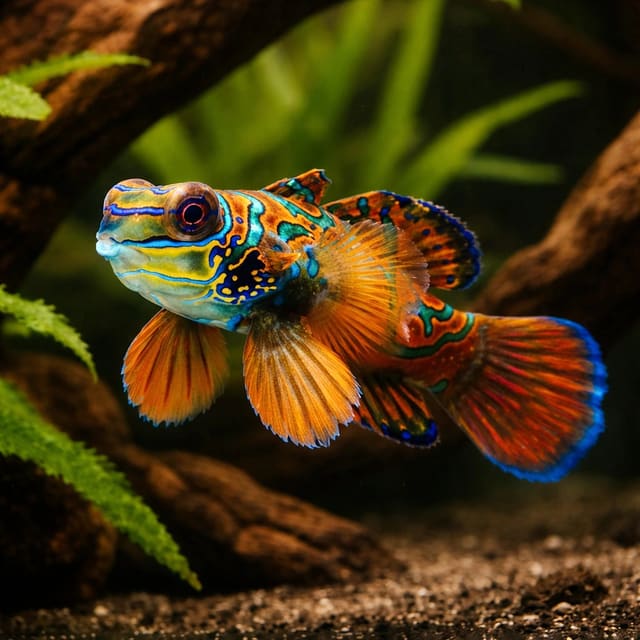
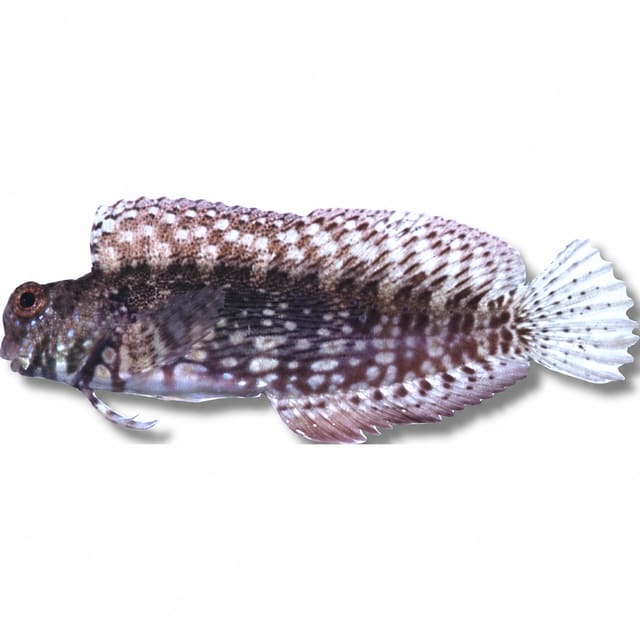
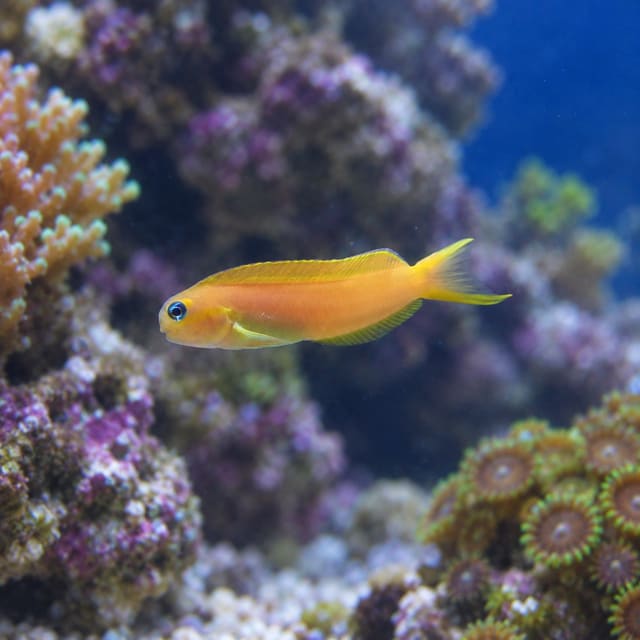
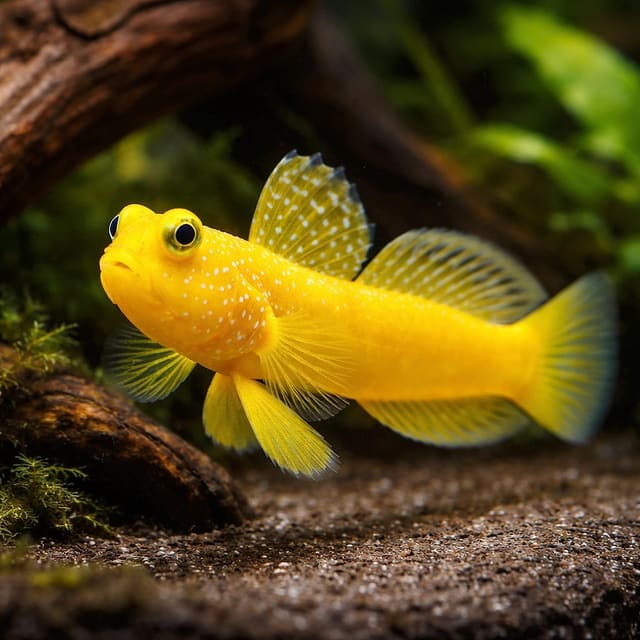
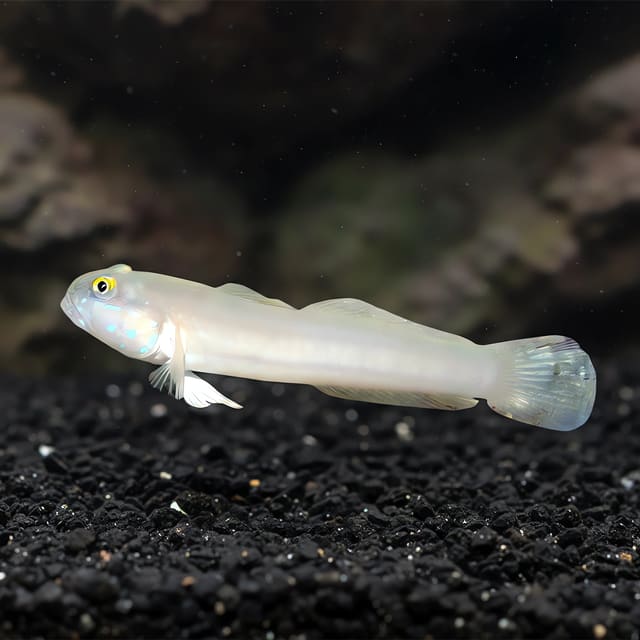
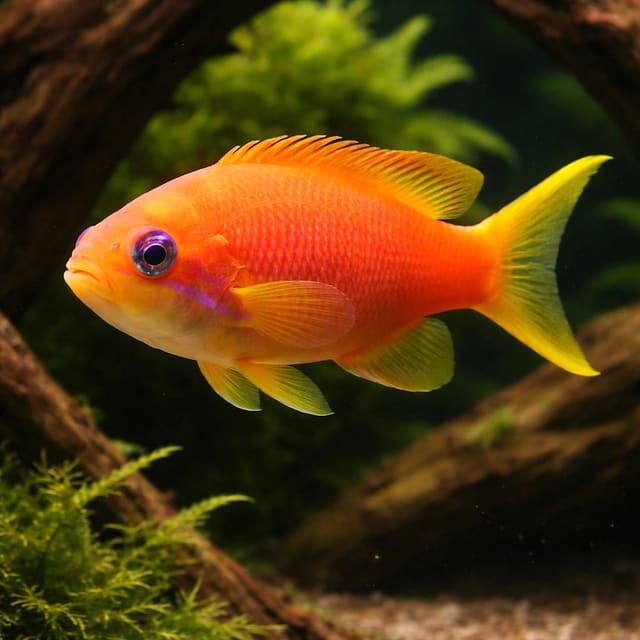
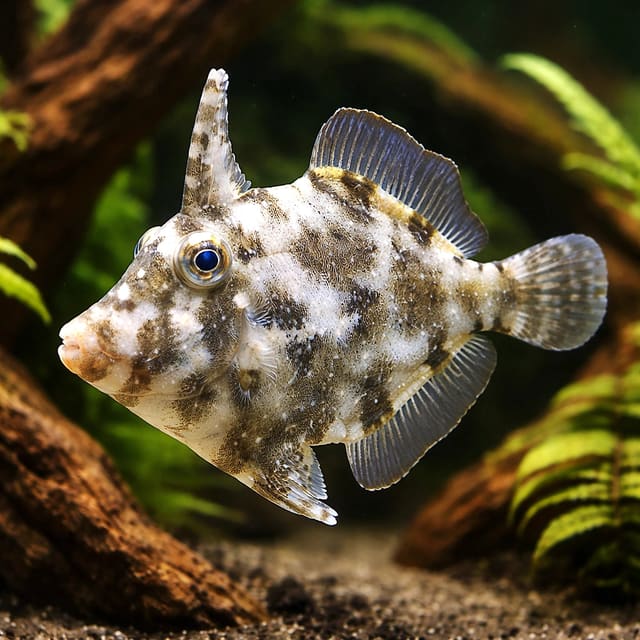
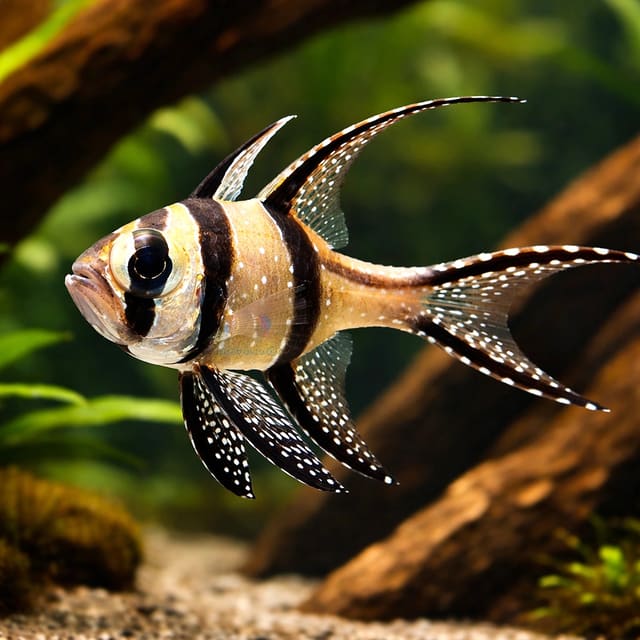
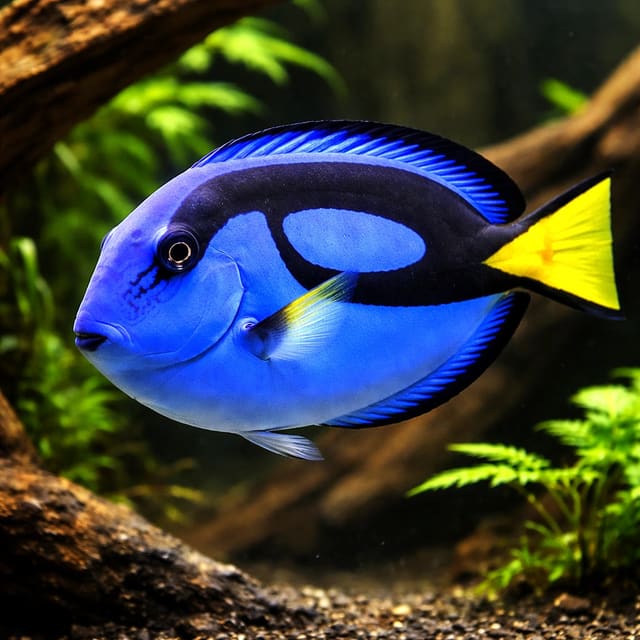
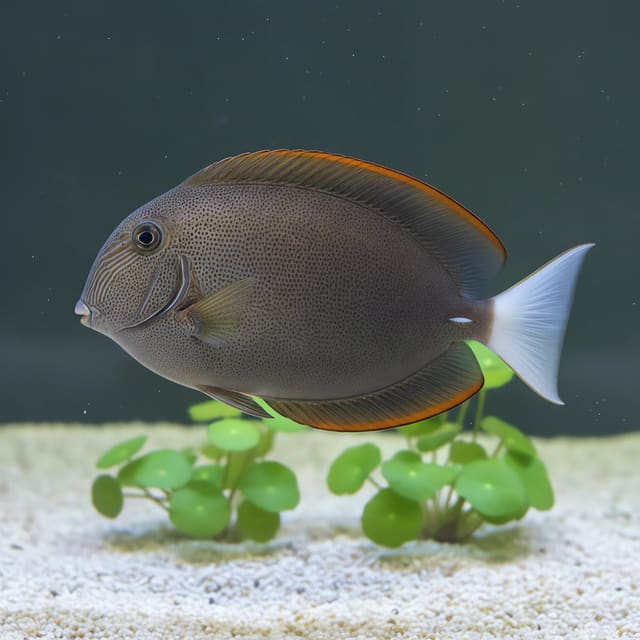
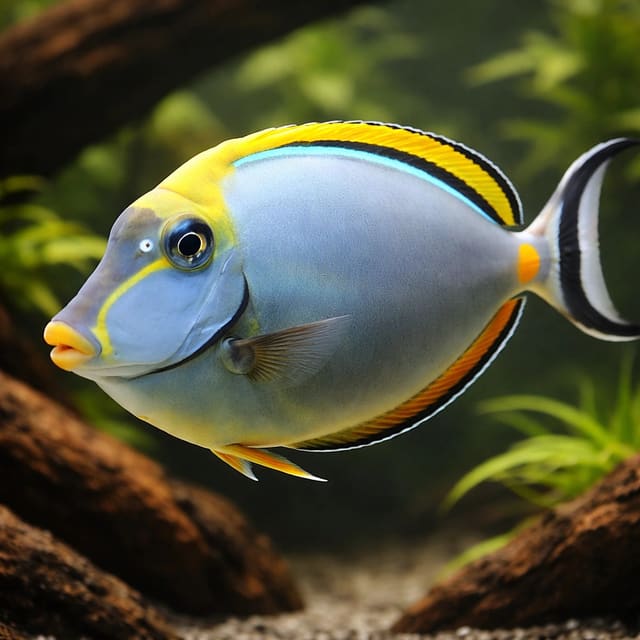
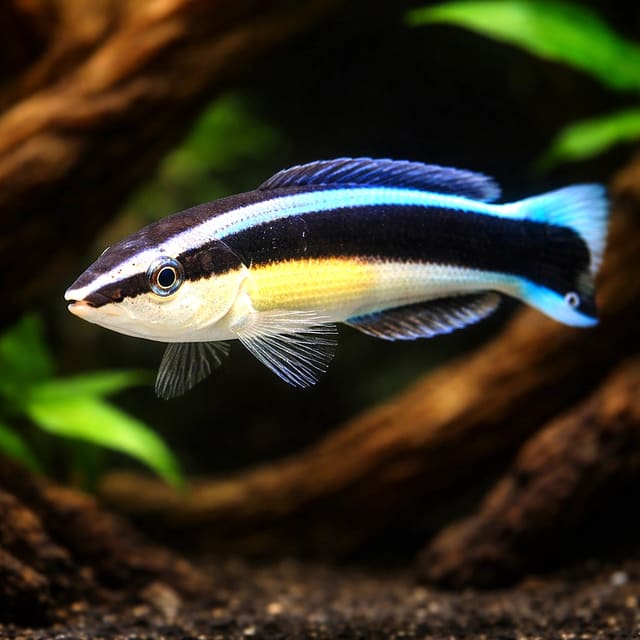
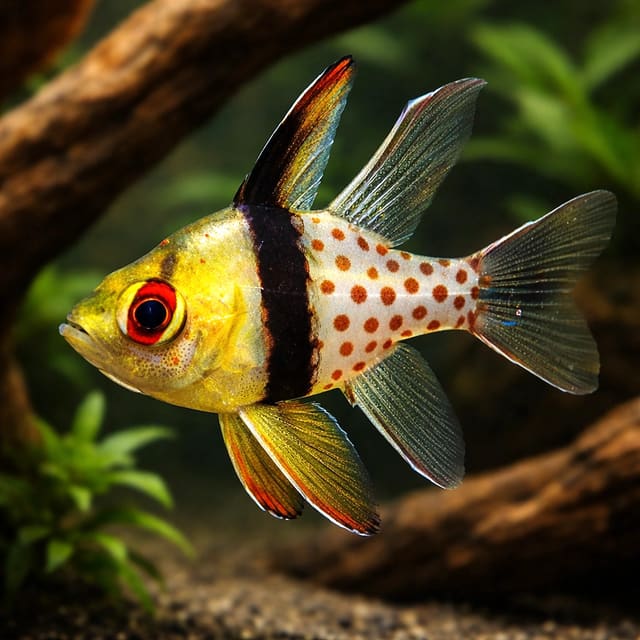
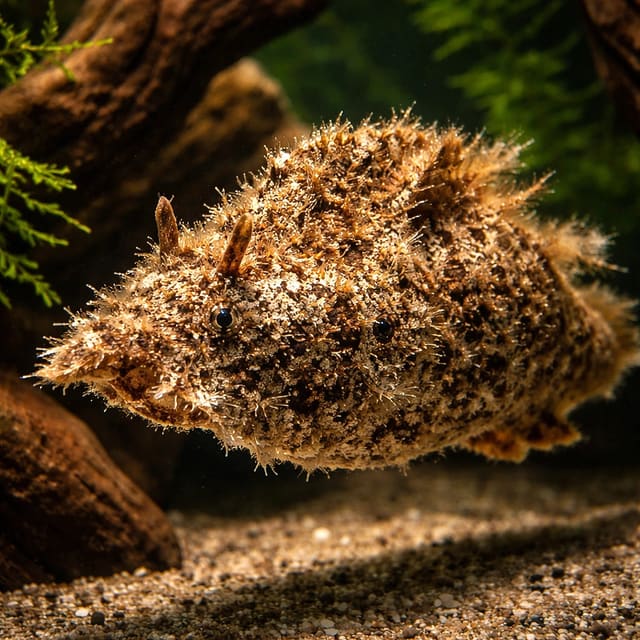
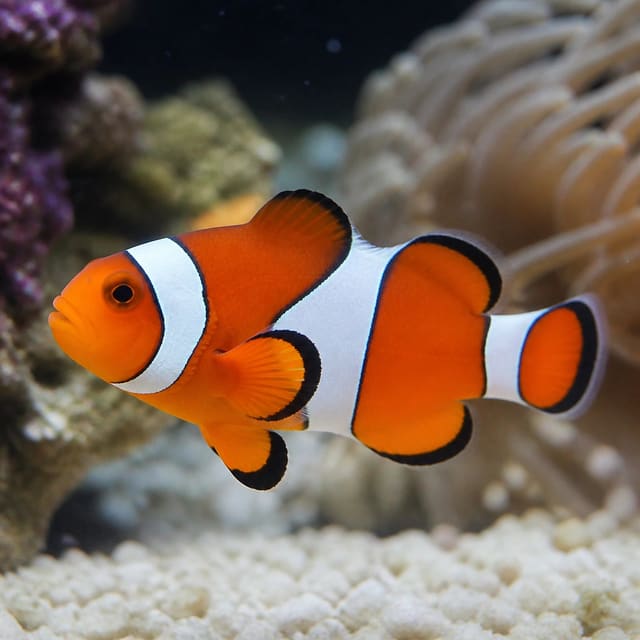
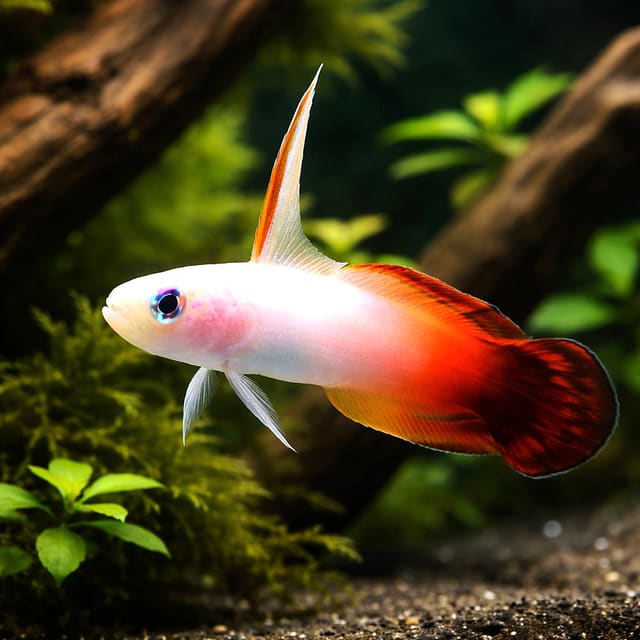
Wikipedia describes a purple head and a whitish or yellowish body that darkens towards the tail, with fins carrying long bands of purple, red, black and orange. The photographs show that pattern: a violet snout, a pale body shading to purple, a tall red-edged first dorsal fin and red-trimmed rear fins. Gallery images have been digitally enhanced to improve image quality. Natural colour, pattern, size and maturity can vary between live animals. Several gallery scenes show plants and driftwood; the fish itself needs a marine aquarium built around rockwork, as the care tab sets out. Browse the marine fish we keep when planning the rest of the aquarium, checking each candidate against the compatibility tab.
FishBase describes adults on deep outer coastal reefs and outer reef drop-offs swept by moderate to strong currents. They are found over hard, open bottoms at the bases of reefs and over patches of sand and rubble, across a depth range of 25–100 m and usually 25–70 m. The species is often seen in pairs and is monogamous. It feeds on zooplankton, especially copepods and crustacean larvae, and darts into a hole when alarmed.
| Wild record | FishBase detail |
|---|---|
| Range | Indo-Pacific: Mauritius to Samoa, Ryukyu Islands to New Caledonia |
| Latitude and longitude | 30°N–23°S, 30°E–172°W |
| Depth | 25–100 m, usually 25–70 m |
| Habitat | Reef-associated, non-migratory, over hard bottoms, sand and rubble |
| Conservation | IUCN Least Concern |
OATA's jawfish and dartfish care sheet fills in the behaviour an aquarist sees: dartfish live in caves or crevices and spend their time in the water column waiting for planktonic food to drift by. When frightened, they dart into their burrow, which is where the group gets its name.
OATA recommends an aquarium of at least 60 litres for an individual dartfish, and says it will need to be larger if you keep more than one or mix dartfish with other species. Bigger is better within reason: a larger volume keeps temperature and water quality more stable.
A filter is essential whatever the size. For a marine set-up, OATA lists live rock with sufficient water flow, an internal or external filter, or a sump. A protein skimmer is a useful addition because it removes dissolved organic waste before it breaks down into more harmful substances.
Live or artificial rockwork is essential for dartfish. Build it to give crevices, overhangs and outcrops so the firefish can find cover whenever it needs to, and place several bolt-holes near the open water where it will hover. OATA adds that dartfish may appreciate a slightly thicker sand bed than usual, about 4 cm, so they can make a home under rocks if they choose.
OATA calls an aquarium lid or cover essential because dartfish will jump, especially if startled, and Wikipedia describes firefish as prolific leapers. Close every gap around pipework, cables and feeding hatches before the fish arrives, and keep the cover in place during maintenance whenever you can.
In a 60 litre aquarium, build one main rock structure with two or three bolt-holes opening towards the open water where the firefish will hover. Keep about 4 cm of sand along the rock edges so it can settle under the rock if it chooses. Set the flow so the surface moves well and food drifts along the face of the rock rather than straight into the sand, and leave a clear strip of open water in front of the structure. In a larger aquarium, repeat the pattern with more bolt-holes spread along the rockwork, so the fish always has cover within a short dash of wherever it feeds.
OATA's care sheet ends with a checklist worth working through before a firefish is ordered. Make sure you have the right equipment and position for the aquarium, have researched every species you are considering and confirmed they are all compatible, know how to transport and release the fish, understand the daily, weekly and monthly maintenance involved, and are prepared to look after the fish properly for the rest of its life.
| Item | Why it matters for a firefish |
|---|---|
| Suitably sized aquarium with a secure lid | Room to hover and protection from jumping |
| Filter and protein skimmer | Zero ammonia and nitrite, and less dissolved waste |
| Heater | Holds 24–26°C all year round |
| Marine salt, refractometer or hydrometer, and RO water | Accurate, stable salinity |
| Wavemaker or powerhead | Moderate flow and good surface movement |
| Rockwork and aquarium sand | Bolt-holes, cover and a place to settle under rock |
| Marine test kits | Ammonia, nitrite, nitrate, pH and hardness checks |
| Lighting | A day-night cycle; reef lighting only if you keep coral |
| Siphon and bucket | Weekly water changes and waste removal |
OATA lists an ultraviolet steriliser as optional but recommended, and reef test kits for calcium, alkalinity, magnesium and phosphate as necessary only if you keep corals.
Keep it away from draughts, heat sources and direct sunlight to limit temperature swings, and away from loud noise, vibration and sudden movement. Overhead lighting gives the fish a proper day-night cycle; it does not need to be bright for dartfish alone, though corals may need more.
OATA's final checks are simple: the aquarium is a suitable size for the fish when fully grown, the water values match the guidance in the next section, and the aquarium is cycled and ready.
Keep the Elegant Firefish at 24–26°C, pH 7.9–8.3 and a salinity of 1.020–1.025, with ammonia and nitrite at zero. These are OATA's broad guidance figures for dartfish and jawfish as a group rather than a species-specific optimum, and OATA describes dartfish as usually undemanding of water chemistry. The temperature range sits inside the 23–27°C that FishBase records for the species' wild environment.
| Measure | OATA dartfish guidance |
|---|---|
| Salinity | 1.020–1.025 |
| Temperature | 24–26°C |
| pH | 7.9–8.3 |
| Ammonia | Zero mg per litre |
| Nitrite | Zero mg per litre |
| Nitrate | Not to exceed 50 mg per litre |
| Carbonate hardness | 8–12 dKH |
| Calcium | 380–450 ppm |
| Magnesium | 1250–1350 ppm |
OATA notes that if you keep dartfish in a reef aquarium, some of these values will need to change to suit more sensitive species. Run a reef to the needs of its most sensitive corals and invertebrates, and keep testing so every change is gradual rather than sudden.
The RSPCA's aquarium guidance explains the chain: fish release ammonia, which is toxic; a working biological filter grows bacteria that turn it into nitrite, also toxic, and then into nitrate, which is safer. OATA warns that dartfish can be stressed by even the smallest amounts of ammonia and nitrite, which may then cause them to develop various diseases.
Test ammonia, nitrite, nitrate, pH and carbonate hardness every week, and more closely during the first weeks of a new set-up and after adding fish. Check salinity regularly too, and replace water lost to evaporation with reverse osmosis (RO) water rather than salt water, because the salt stays behind when water evaporates.
| Result | What to do |
|---|---|
| Ammonia or nitrite above zero | Hold back extra food, check the filter and add no new fish until both read zero |
| Nitrate approaching 50 mg per litre | Review your water changes and how much you feed |
| Salinity creeping upwards | Top up evaporation with RO water, not salt water |
| Everything inside the guidance | Keep the routine steady and keep testing weekly |
OATA strongly recommends a partial water change of 25% at least once every week, using a siphon to lift solid waste from the substrate as you go. The table turns that into real volumes.
| Aquarium volume | Weekly 25% change |
|---|---|
| 60 litres | 15 litres |
| 100 litres | 25 litres |
| 200 litres | 50 litres |
OATA explains that the bacteria in a matured filter must increase every time fish are added and feeding increases. Stocking too many fish, or stocking too quickly, can cause new tank syndrome: there are not enough nitrifying bacteria to cope with the extra waste, ammonia and nitrite rise, and fish may become ill or die. Before the firefish goes in, confirm ammonia and nitrite read zero, and then add further fish slowly.
In a 100 litre aquarium, a sensible week might look like this: daily checks that the firefish is hovering and feeding, one 25 litre water change with the siphon run over the sand, a weekly test of ammonia, nitrite, nitrate, pH and carbonate hardness, salinity checks with RO top-ups in between, and filter or skimmer cleaning when needed, using the water you removed. If a test shows ammonia or nitrite above zero, deal with that before feeding more or adding fish.
In the wild the Elegant Firefish feeds on zooplankton, especially copepods and crustacean larvae. OATA's dartfish advice translates that into aquarium food: dartfish will usually take prepared pellets or flake, and they also appreciate smaller frozen items such as frozen copepods, enriched brine shrimp and finely chopped mysis or krill.
| Food | Its place in the diet |
|---|---|
| Prepared pellets or flake | A convenient everyday food that dartfish usually take |
| Frozen copepods | The closest match to the copepods it eats in the wild |
| Enriched brine shrimp | A small frozen food for variety |
| Finely chopped mysis or krill | Meaty food, chopped fine as OATA specifies |
Feed only what the fish can eat within a few minutes, twice a day. Overfeeding leads to a build-up of uneaten food, which breaks down and releases toxic waste into the water, so err on the side of less and watch the leftovers.
OATA warns that dartfish are easily intimidated by boisterous tank mates and should be kept with fish that allow them to come out to feed. A firefish that is bullied at feeding time retreats to its hole while faster fish take the food. Practical ways to help:
A well-fed firefish hovers in the open, takes food as it drifts past and keeps a steady body condition. OATA lists reduced intake, lack of interest in food and changes in body weight among the signs to watch, so note appetite at every feed during the first weeks.
Your firefish is hand-packed by our team, bagged in pure oxygen in an insulated poly box, with a heat pack when the weather calls for it, and travels with a licensed live-animal courier. We email the tracking number and your confirmed delivery date, and someone needs to be home to receive the parcel because live fish cannot be left unattended. Our delivery and Live Arrival Guarantee page has the full terms.
Make sure the lid is back on before you walk away: a newly released firefish is at its most easily startled. OATA explains why bag water stays out, especially in a reef: some retailers run copper in their systems, and copper is toxic to invertebrates.
OATA suggests switching off the aquarium lights and taking the bag out of its outer wrappings carefully, avoiding exposure to bright light, because fish are easily stressed by bright lights, extreme temperatures, noise and movement. Monitor the new fish carefully for the first week, paying particular attention to water quality. If you can, OATA recommends quarantining new livestock in a separate aquarium for at least a week before it enters the main display, which reduces the risk of spreading disease.
Expect the firefish to spend time in its bolt-hole at first. Look for it hovering near cover and taking food, rather than expecting it in open water on day one.
OATA describes a healthy fish as having clear, bright eyes, undamaged fins, intact scales, no ulcers or bumps, normal swimming and steady breathing. Signs of disease can include clamped fins, flicking against rock or décor and shimmying. Because disease can be carried by fish that show no signs, good water quality and careful observation are your main protection.
| If you notice | First step |
|---|---|
| Hanging at the surface, sitting on the bottom or erratic swimming | Test ammonia, nitrite and nitrate straight away |
| Colour turning darker or paler than normal | Check water values and watch for bullying at feeding time |
| Hiding far more than usual | Watch the tank mates; boisterous fish may be keeping it in |
| Gill covers moving faster or slower than normal | Test the water and check temperature |
| White spots, fluffy growths, or loss of fins or scales | Test the water and seek advice promptly |
| Weight loss, reduced intake or no interest in food | Check that food is reaching it past faster fish |
All fish vary slightly in behaviour and appearance, so learn what normal looks like for your firefish in its first fortnight. Its usual hovering height, favourite bolt-hole and feeding response make the best baseline. If you are concerned, test the water first, then contact us with your readings and a description of what you have seen.
FishBase notes that the Elegant Firefish is often found in pairs and is monogamous, and Wikipedia records that this and other firefish species are occasionally spawned in captivity. OATA sets realistic expectations for dartfish in general:
Buy an Elegant Firefish for its looks and behaviour rather than as a breeding project. If a pair does form and you see eggs tended in a cave, treat it as a bonus and keep water quality stable; do not rearrange the rockwork around them.
Keep the Elegant Firefish with calm fish that let it come out to feed, and do not mix it with other dartfish species. Those two rules, both from OATA, decide most stocking plans.
OATA names cardinalfish and small gobies as examples of fish that allow dartfish to come out and feed. Wikipedia describes the firefish itself as relatively docile, noting that it will not attack tank mates in a suitably sized aquarium.
Wikipedia notes that the Elegant Firefish is popular in reef aquariums and that firefish are commonly kept in nano reefs. In a reef, run the water to the corals' needs, as OATA advises for more sensitive species, and remember that corals may need brighter lighting than the firefish alone. Rockwork for corals doubles as cover for the fish, provided you leave bolt-holes open.
OATA's standing advice is to consult your retailer before buying any dartfish, to make sure it will mix with your current fish, and its checklist asks you to research every species you are considering and confirm your final choices are all compatible. Add new fish slowly so the filter keeps pace, and watch the first few feeds after each addition to check that the firefish still comes out to eat.
Most keepers will do best with a single Elegant Firefish. These are the points that make more than one a considered decision rather than a default.
Suppose you have a 60 litre marine aquarium. That meets OATA's recommendation for one dartfish, so plan for a single firefish with calm companions. Now suppose you run a much larger reef with long runs of rockwork and several separate bolt-holes, and you would like two. Because two fish bought together are not a guaranteed male and female, and firefish may squabble in confined quarters, give each fish its own cover well apart and be ready to separate them if one keeps the other from open water or food.
FishBase records a maximum length of 9.0 cm total length for this species, and Wikipedia gives the same 9 cm. Plan the aquarium around that adult length rather than the size of a newly arrived fish.
OATA recommends at least 60 litres for one dartfish, with a larger aquarium if you keep more than one or add other species. It also needs rockwork with crevices and overhangs, moderate flow and a secure lid, because dartfish will jump, especially if startled.
Most keepers should plan for one. Wild fish are often found in pairs, but dartfish are difficult to sex outside breeding condition and firefish may squabble in confined quarters, so keep two only in a larger aquarium with separate bolt-holes.
OATA describes dartfish as usually undemanding of water chemistry, which helps. The fish still needs a matured marine filter with zero ammonia and nitrite, a lid, plenty of cover and calm tank mates, so it suits a keeper who can provide all four.
In the wild it eats zooplankton, especially copepods and crustacean larvae. In the aquarium, OATA's dartfish advice is prepared pellets or flake plus small frozen foods such as copepods, enriched brine shrimp and finely chopped mysis, fed twice a day in amounts eaten within a few minutes.
Keep it at 24–26°C, pH 7.9–8.3 and salinity 1.020–1.025, with ammonia and nitrite at zero and nitrate below 50 mg per litre. These are OATA's broad guidance for dartfish and jawfish, not a species-specific optimum.
Wikipedia describes it as relatively docile and says it will not attack tank mates in a suitably sized aquarium, though firefish kept in confined quarters may squabble over territory. It is more likely to be bullied than to bully.
OATA suggests calm fish that let dartfish come out to feed, such as cardinalfish or small gobies. Avoid boisterous tank mates and other dartfish species, including the red firefish sold as the fire goby.
Film a continuous unboxing video from the moment the parcel is still sealed, open and inspect it the same day, then float the bag for 20–30 minutes before releasing; the Live Arrival Guarantee needs that video. It travels hand-bagged in pure oxygen in an insulated poly box, carried by a licensed live-animal courier.
No reviews for this item yet. Bought one? Honest reviews only, good or bad.
What customers say about ordering from us
Easy website plenty of info on fish your buying great to pick a time slot
TRACEY DURRANT · 7 Oct 2026
Got some lovely fish thank you
Kevin Mackie · 7 Oct 2026
Reviews of our shop, collected by Judge.me, an independent third-party review collector. Newest first.