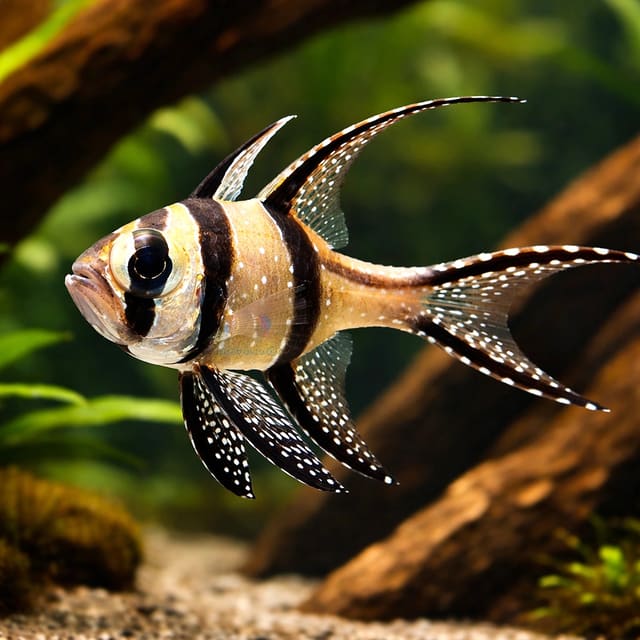
Banggai Cardinalfish (Pterapogon kauderni)
24–26°C · pH 8–8.2
£52.99
Pajama Cardinalfish (Sphaeramia nematoptera) is a red-eyed marine cardinalfish that reaches 8.5 cm and gathers among branching corals in sheltered Indo-Pacific lagoons. It needs a mature, stable saltwater aquarium with rockwork cover and calm, non-territorial companions, and in the wild it feeds after dark. One purchase supplies one live fish.
Adult size is the maximum length this species reaches at full maturity (scientific sources). The livestock you receive will be younger and smaller. Product-photo provenance and any image-specific limitations are stated on the listing.
Sphaeramia nematoptera
Pajama Cardinalfish (Sphaeramia nematoptera) is a red-eyed marine cardinalfish that reaches 8.5 cm and gathers among branching corals in sheltered Indo-Pacific lagoons. It needs a mature, stable saltwater aquarium with rockwork cover and calm, non-territorial companions, and in the wild it feeds after dark. One purchase supplies one live fish.
Adult size is the maximum length this species reaches at full maturity (scientific sources). The livestock you receive will be younger and smaller. Product-photo provenance and any image-specific limitations are stated on the listing.
Maintain these water conditions for optimal health and vibrant colors
The Pajama Cardinalfish (Sphaeramia nematoptera) is a small marine cardinalfish from the western Pacific, easy to recognise by its red eyes, a broad dark band around the middle of the body and a scatter of red spots across the pale rear half. It is also known as the spotted, coral or polkadot cardinalfish. Each purchase is one live fish, and the most important thing to know before buying is that it needs a mature, stable saltwater aquarium with cover and calm company, not a new or crowded system.
In the wild this fish gathers in groups among the branches of finger-like Porites corals in sheltered bays and lagoons, then spreads out after dark to feed close to the bottom. That one habit explains most of its appeal and most of its needs: structure to stay beside, a peaceful day, and food that reaches it when it is ready to eat.
| Suits | Keepers with a mature fish-only or reef aquarium and calm, non-territorial fish |
|---|---|
| Less suited to | Brand-new systems, crowded tanks and aggressive or territorial companions |
| Maximum recorded length | 8.5 cm total length |
| Family | Apogonidae, the cardinalfishes |
| Natural range | Indo-Pacific, from Java to Fiji and from the Ryukyu Islands to the Great Barrier Reef |
| Water | Full marine conditions; OATA's ranges are set out in the care section |
| Daily pattern | Stays near cover by day; wild fish feed after dark |
| Supplied | One live fish per purchase |
One purchase supplies one live Pajama Cardinalfish. The 8.5 cm figure is the largest length recorded for the species, measured from snout to tail tip. It describes a fully grown fish rather than the size of the fish on arrival, so allow room for growth when you plan the aquarium and its companions.
At that adult length it is a modest marine fish: big enough to hold its own visually in a community display, yet small enough that any tank mate able to swallow it, or determined to bully it, rules itself out. Keep that size in mind when you read the compatibility advice.
Sex is guaranteed only when the selected option explicitly states male or female. This Pajama cardinalfish listing has no sex-guaranteed option.
The species has a remarkable breeding habit: the male carries the eggs in his mouth until they hatch. The care section explains what that means for keepers.
Shops and books use several common names for this one species: pajama or pyjama cardinalfish, spotted cardinalfish, coral cardinalfish and polkadot cardinalfish. The scientific name Sphaeramia nematoptera is the reliable anchor, and it places the fish in the cardinalfish family, Apogonidae. The pyjama name suits the pattern well: a plain yellowish head, a dark 'waistband' and a spotted rear, rather like a plain top worn with polka-dot trousers.
If you are still deciding on the rest of the community, our marine fish range lets you compare saltwater species side by side before you commit.
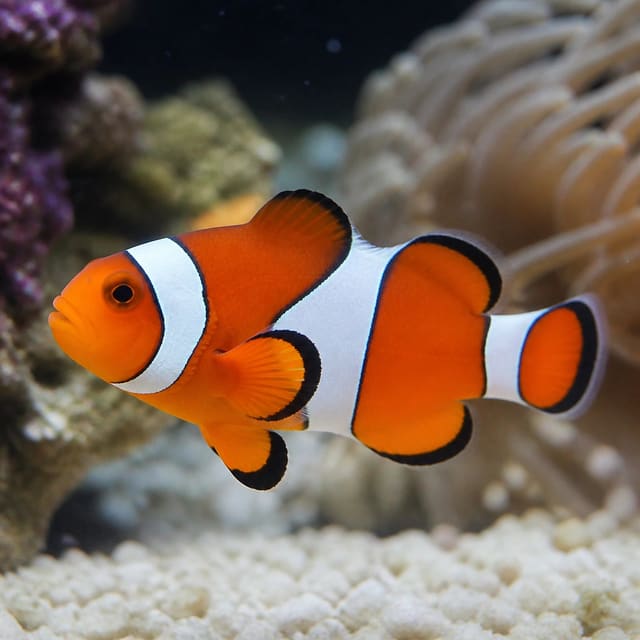
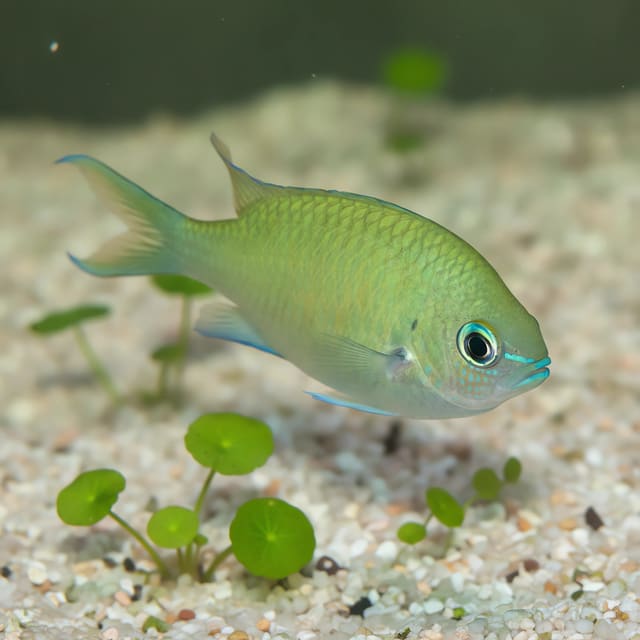
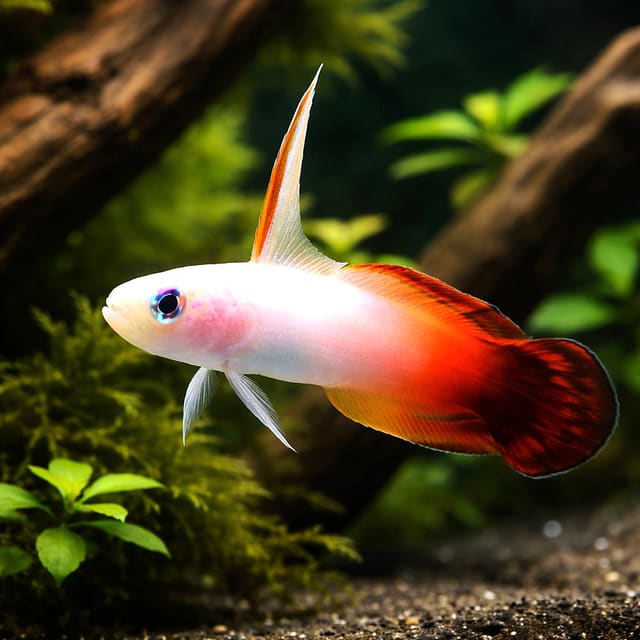
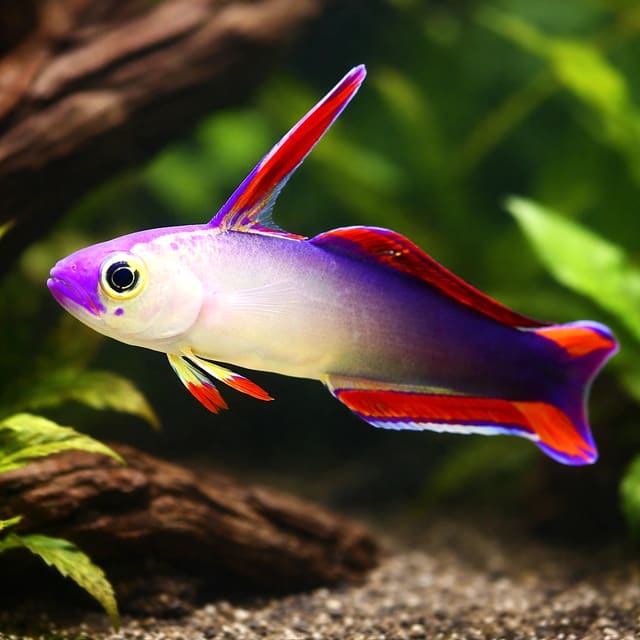
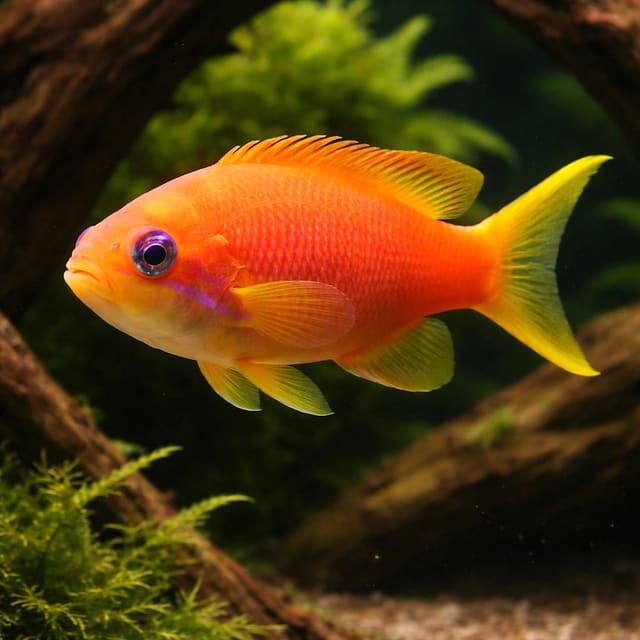
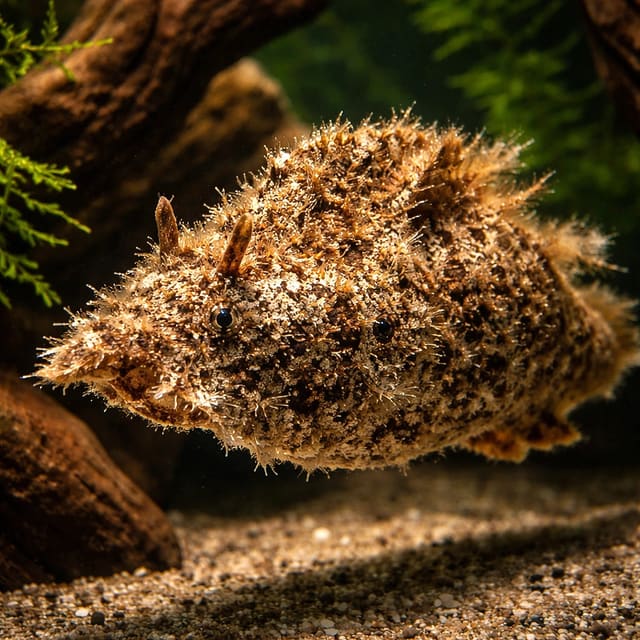
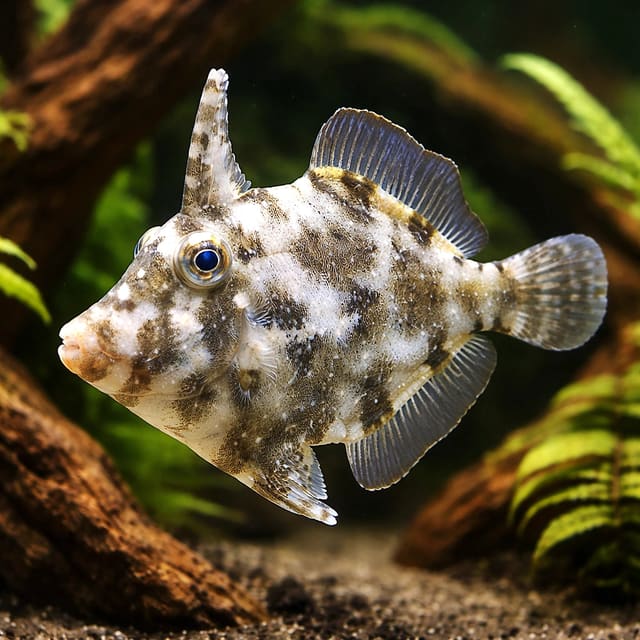
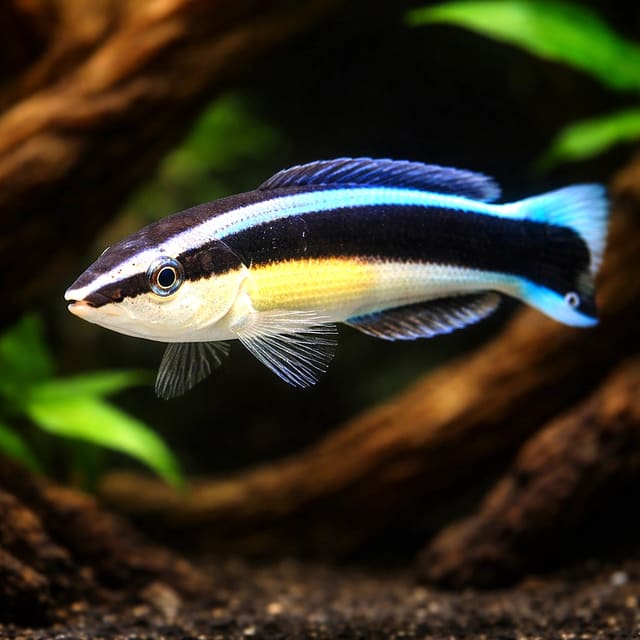
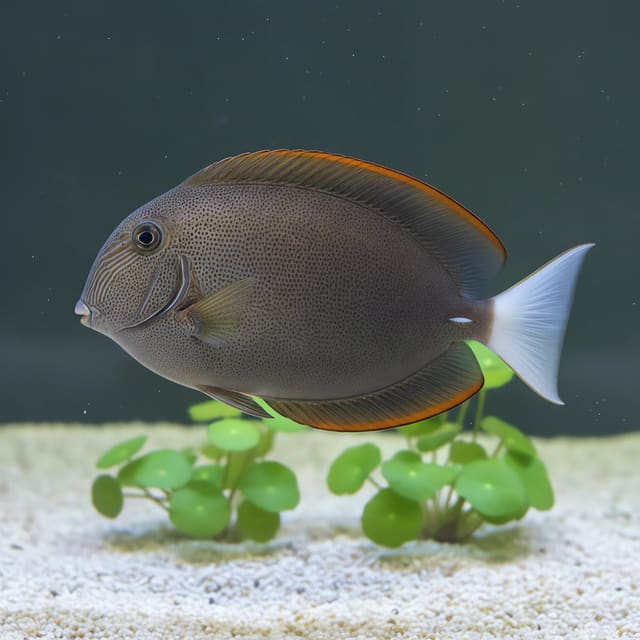
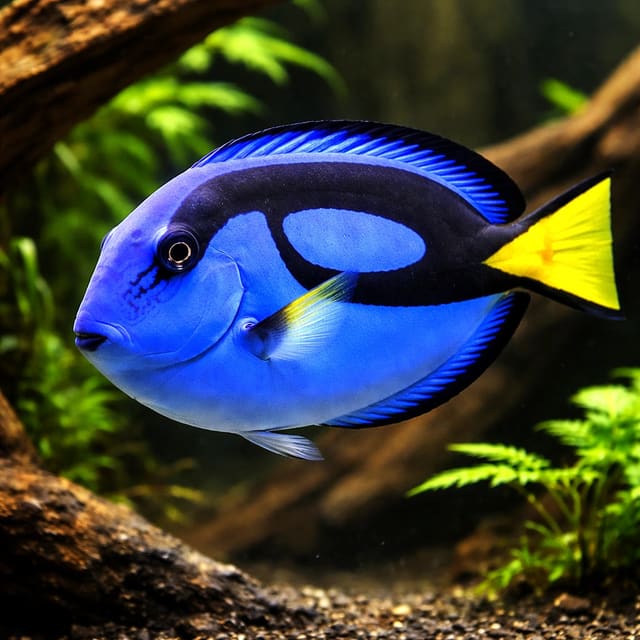
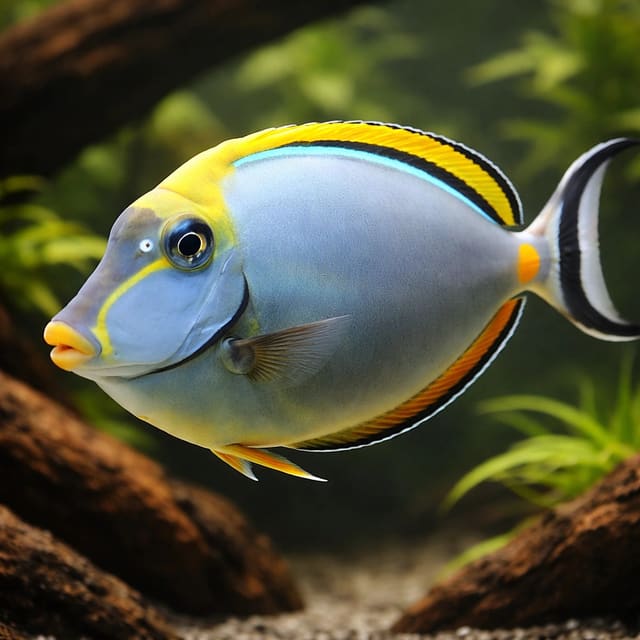
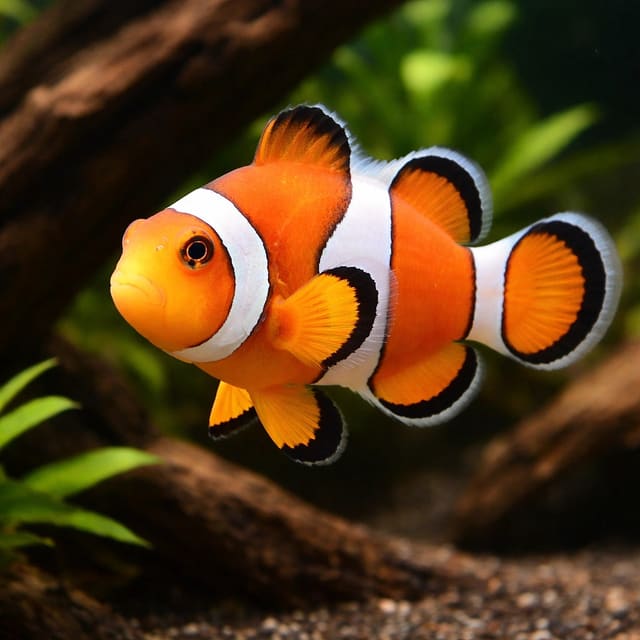
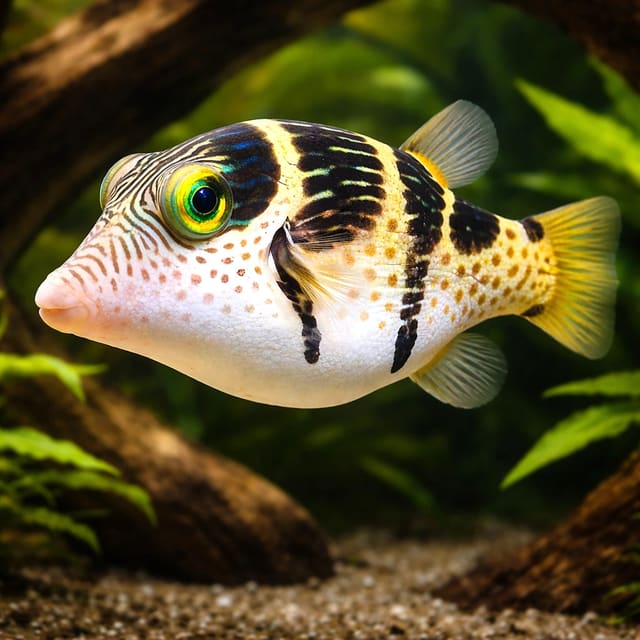
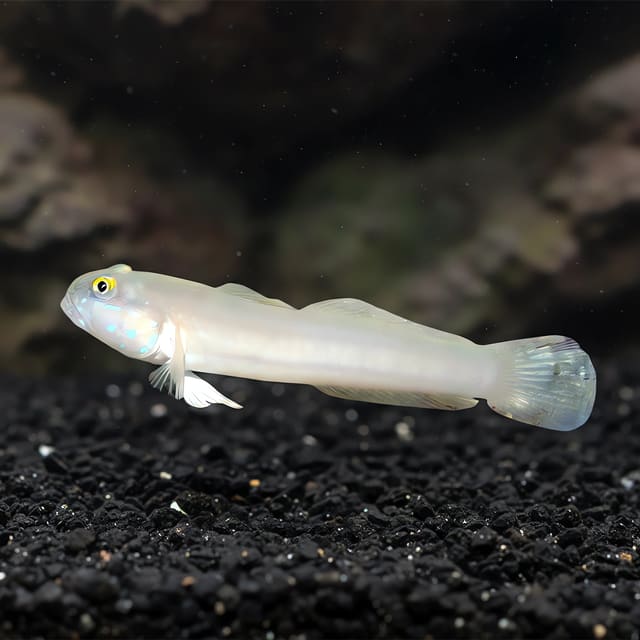
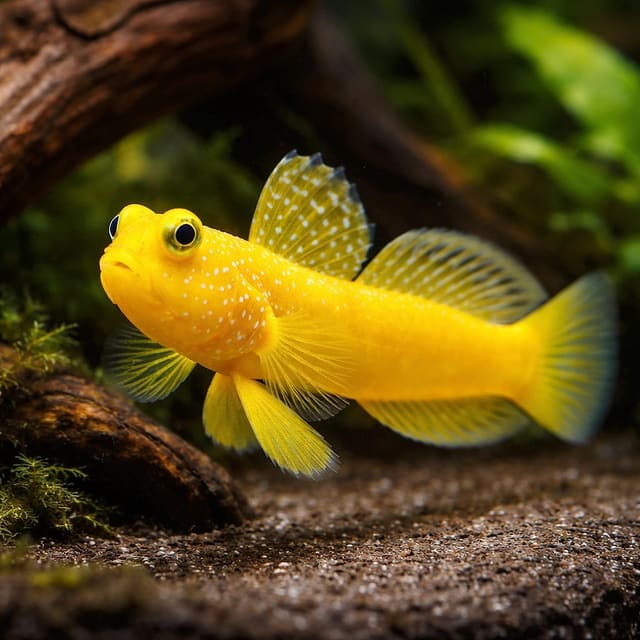
The gallery shows the species' typical markings: the red eye, the dark bar and the red-spotted rear body. Some scenes use plant and driftwood backdrops, which are not a guide to furnishing a marine aquarium. Gallery images have been digitally enhanced to improve image quality. Natural colour, pattern, size and maturity can vary between live animals.
FishBase describes Sphaeramia nematoptera as a reef-associated marine fish found from Java east to Fiji, north to the Ryukyu Islands and south to the Great Barrier Reef, with a more recent record from Tonga. Wild fish have been recorded between 1 and 14 m deep. That depth range describes where the species lives in nature; it is habitat context, not a figure to reproduce in a home aquarium.
The species summary on Wikipedia places it across much of the western Pacific and describes it as of low vulnerability, and FishBase lists it as Least Concern on the IUCN Red List. Both sources also note that it is a popular aquarium fish.
The detail that matters most for keepers is where the fish spends its day. Wild aggregations shelter among the branches of Porites nigrescens and Porites cylindrica, two branching corals, in sheltered bays and lagoons. These are calm-water places with plenty of structure rather than exposed, wave-washed reef edges.
You can echo that setting without copying it exactly. Rockwork with overhangs and upright structure gives the fish somewhere to stay close to cover, while open water in front lets you enjoy it. In a reef aquarium, branching corals offer the same kind of shelter; in a fish-only system, rock arranged with gaps and ledges does the job.
Wild fish disperse at night to feed close to the bottom. In practice a Pajama Cardinalfish may look quiet during the brightest part of the day and become more purposeful towards evening. Plan feeding around that rhythm, as the feeding section below explains, and take a look at the aquarium later in the day: that is often when this fish is at its most interesting.
Wikipedia describes the distinctive red eyes and a broad, dark, vertical waistband with scattered red spots towards the tail. In the aquarium those spots and the dark bar make it easy to pick out even among other small cardinalfish.
The OATA marine aquarium care sheet advises buying an aquarium as large as possible within reason, ideally one that can hold your chosen fish once they are fully grown; otherwise you must be ready to move them to a bigger set-up later. It also explains why size helps: larger aquariums hold more water, so temperature, pH and other values change more slowly than in small tanks. For a fish that reaches 8.5 cm and is often kept with others, that stability counts for more than any single headline number.
When you size the tank, count the finished community rather than the first fish. OATA points out that it is not possible to say exactly how many fish an aquarium can hold, because body size, requirements and compatibility vary so much, and because many marine fish are territorial. Build in spare capacity and add fish slowly.
OATA describes two main marine set-ups: fish-only tanks, and reef tanks that also contain invertebrates such as corals. It suggests a fish-only tank or a soft coral reef as a good starting point for someone new to marine aquariums, and notes that a fish-only tank can later become a reef if the species are compatible and you add the extra equipment. A Pajama Cardinalfish can be planned into either style, but a reef calls for the tighter water values shown in the next section.
Live plants are generally not kept in marine aquaria, apart from specialist set-ups such as refugiums or mangroves. Furnish this fish's home with rock, coral sand and, in a reef, corals.
OATA recommends reverse osmosis (RO) water for marine aquaria and describes it as essential if you want to keep invertebrates such as corals. RO water can be bought ready salted to the correct level, or as fresh RO water to mix at home. If you mix your own, dissolve a specialised aquarium salt, never table salt, following the manufacturer's instructions.
On first set-up the salt can be dissolved inside the aquarium, helped along by a powerhead's flow and the heater's warmth. Water for later changes, however, should be mixed and heated in a separate vessel. Once the salt is in, OATA suggests washing the coral sand or gravel in RO water before adding it.
A hydrometer or refractometer is one of the most important pieces of equipment, because it lets you monitor salinity. You also need test kits to measure water quality regularly. The figures below only help if you know where your own aquarium sits, so treat testing as part of the routine rather than a response to trouble.
The ranges below come from OATA's general marine care sheet and apply to marine aquaria as a whole. They give a sound framework rather than a species-specific optimum for Sphaeramia nematoptera.
| Value | Fish-only aquarium |
|---|---|
| Salinity | 1.017–1.023 SG (23–30 ppt) |
| Temperature | 24–27 °C |
| pH | 8.0–8.2 |
| Ammonia and nitrite | Zero |
| Nitrate | No more than 20 mg per litre |
| Value | Reef aquarium with invertebrates |
|---|---|
| Salinity | 1.024–1.026 SG (32–35 ppt) |
| Temperature | 24–26 °C |
| pH | 8.0–8.2 |
| Ammonia and nitrite | Zero |
| Nitrate | 5–10 mg per litre, depending on species |
| Carbonate hardness | 8–12 dKH |
| Phosphate | 0.04–0.1 mg per litre, depending on species |
If you keep hard corals, OATA adds that calcium and magnesium should be monitored too. For a cardinalfish sharing a reef, run the aquarium to the reef column; in a fish-only system, the first table applies.
Whichever column you follow, aim for steadiness. Stable conditions matter more than chasing an exact number, so bring a drifting value back gradually rather than all at once.
The RSPCA's aquarium environment advice is clear that no fish should be kept in a tank without a well set up and maintained filter. Fish release ammonia, which is toxic. A working biological filter lets beneficial bacteria grow, and those bacteria convert ammonia to nitrite, which is also toxic, and then to nitrate, which is safer.
That chain is the reason a mature aquarium matters so much. A cardinalfish added before the bacteria have caught up is exposed to exactly the ammonia and nitrite that both OATA tables set at zero.
A Pajama Cardinalfish is better suited to joining an aquarium that has already proved itself than to being the first fish in a brand-new tank. Let the system settle, then add it.
Because wild Pajama Cardinalfish spread out to feed near the bottom at night, the most useful habit for a keeper is to watch when your own fish is keen to eat. Offer food at your usual feeding time and see how it responds. If it hangs back while livelier fish feed, add a small portion later in the evening, towards the end of the lighting period, when the busier fish have settled and the cardinalfish is naturally more active.
We suggest small, meaty marine foods such as frozen mysis and brine shrimp, finely chopped seafood, and a quality marine pellet or flake made for carnivorous or omnivorous saltwater fish. Choose pieces small enough to swallow easily, and rotate between several foods so the diet does not depend on a single item.
A fish that feeds well in the evening and holds its body condition is doing fine, even if it seems shy at midday meals. Judge it over several days rather than by a single feed.
Evaporation removes water but leaves the salt behind, so salinity slowly rises between changes. Replace evaporated water with fresh RO water rather than salt water, then check the reading again. When you change water, match the new water's salinity and temperature to the aquarium before it goes in, so the fish never meet a sudden shift.
Keep the filter well maintained, as the RSPCA stresses, and look after the bacteria it holds: they are what keeps ammonia and nitrite at the zero readings a marine fish needs.
Get the aquarium ready in advance. OATA advises checking that new fish are compatible with those you already keep and that the water is suitable, with ammonia and nitrite at zero, before any fish goes in.
Someone needs to be at the delivery address to receive the parcel, because live fish cannot be left unattended. Our delivery and Live Arrival Guarantee page explains how each order is hand-packed, bagged in pure oxygen and sent in an insulated poly box, with a heat pack when the weather calls for it, then carried by a licensed live-animal courier. Open and inspect the parcel the same day it arrives.
OATA also advises taking the bag out of its outer wrappings carefully and avoiding exposure to bright light, since fish are easily stressed by bright lights, extreme temperatures, noise and movement.
If anything has gone wrong, contact us the same day your fish arrive with your order number and the unboxing video; WhatsApp is the fastest route. We will then arrange a replacement or refund under the Live Arrival Guarantee.
Expect the fish to stay close to cover at first. Keep the room calm, offer small feeds, and watch that tank mates leave it alone while it learns its surroundings. Once it has a favourite spot beside the rockwork and takes food, it has settled.
A settled Pajama Cardinalfish usually keeps close to rockwork or coral branches during the day, much as wild fish shelter among coral. That quiet daytime habit is part of its nature, not a sign of illness. Look instead for a fish that holds its position calmly, keeps its fins open and feeds when it is ready, especially later in the day.
Water quality is the first thing to check. Test ammonia, nitrite, nitrate, salinity, temperature and pH against the tables in the water section before changing anything else, and think back over recent events such as a new fish, a missed water change or equipment that has failed.
Each of these points to a cause you can act on: the water, the companions or the way food reaches the fish. Deal with that cause first rather than reaching for a treatment without knowing what is wrong.
This species has a fascinating breeding habit: the male incubates the eggs in his mouth until they hatch. FishBase also notes that the Pajama Cardinalfish has been reared in captivity. Spawning in a home aquarium is not something to plan a purchase around, but it is one more reason to enjoy watching a settled group.
This listing sells one fish of unknown sex, so a breeding pair cannot be chosen by order.
Choose calm, non-territorial marine fish that will neither bully a slow cardinalfish nor beat it to every meal. OATA makes the underlying point for marine aquaria in general: some fish need to be kept with their own kind, while others are territorial or aggressive and will not live together peacefully. Many marine fish are territorial, which also reduces how many fish a tank can hold.
A calm, settled community gives this cardinalfish the easiest start. Before it arrives, make sure there is a sheltered spot beside rock or coral that no resident fish guards, because a newcomer that is pushed away from cover spends its energy hiding rather than feeding. At its first few feeds, offer food to the resident fish in their usual place and then a small portion near the newcomer, so it can eat without competing.
Watch closely for the first days. Occasional investigation by other fish is normal; repeated chasing, or a cardinalfish that never gets to the food, means the mix needs rethinking.
Check every prospective tank mate against its own care needs and adult size before you buy. A fish that appears elsewhere in our range is not automatically a safe companion, and a peaceful label on its own says little about feeding speed or eventual size.
Wild Pajama Cardinalfish form aggregations among coral branches, so the species naturally lives near others of its kind. One fish can live in a peaceful community, although it will not show that grouping behaviour. Whether you keep one or several is mainly a question of space, cover and how much your filter can handle.
Each purchase supplies one fish, so order the number you have planned for rather than relying on a set group.
In the wild this cardinalfish shelters among branching Porites corals, so a reef aquarium is a natural setting for it. If you choose that route, OATA's reef parameters apply: salinity of 1.024–1.026 SG, 24–26 °C, nitrate at 5–10 mg per litre depending on species and carbonate hardness of 8–12 dKH, with calcium and magnesium monitored if you keep hard corals.
RO water becomes essential rather than simply recommended once invertebrates such as corals are part of the plan. OATA's suggestion of a fish-only aquarium or a soft coral reef as a first marine system still applies if you are new to reef keeping.
Treat small ornamental shrimps, crabs and other mobile invertebrates as a separate decision for each species. Check the size and needs of every animal, and watch the first introductions closely.
FishBase records a maximum length of 8.5 cm, measured as total length from snout to tail tip. That is the size of a fully grown fish, so plan tank space and companions around it rather than around the size of the fish on arrival.
Choose the largest aquarium you reasonably can, ideally one that will still suit this cardinalfish and its companions when all of them are fully grown. OATA notes that larger marine aquariums stay more stable, and the fish also needs rockwork for cover with open water in front of it.
Wild Pajama Cardinalfish gather in groups among branching corals, but one fish can live in a peaceful community. For a group, allow more space and more cover, and add fish gradually so the filter bacteria keep pace with the extra waste.
It is a calm fish, but it needs a mature, stable marine aquarium with zero ammonia and nitrite, correct salinity and regular testing. OATA suggests a fish-only aquarium or a soft coral reef as a good starting point for newcomers to marine fishkeeping.
Wild fish spread out at night to feed close to the bottom. In the aquarium, offer small meaty marine foods such as frozen mysis and brine shrimp, plus a quality marine pellet or flake, in portions it can finish, and add a small evening feed if it hangs back at daytime meals.
OATA's broad guidance for marine fish-only aquariums is 24–27 °C and pH 8.0–8.2, with salinity of 1.017–1.023 SG. Reef aquariums with invertebrates run at 24–26 °C, pH 8.0–8.2 and 1.024–1.026 SG. These are general marine ranges, so aim to keep your chosen values steady.
It is a slow, calm fish that shelters near cover, so it is far more likely to be bothered by pushy tank mates than to cause trouble itself. Choose companions that are peaceful and not territorial.
It suits calm, non-territorial marine fish and, in a reef aquarium kept to reef water values, corals: wild fish shelter among the branches of Porites corals. Avoid territorial or aggressive fish and any fish big enough to swallow it.
It is hand-packed in a bag of pure oxygen inside an insulated box, with a heat pack when the weather calls for it, and carried by a licensed live-animal courier. Someone must be in to receive it. Film a continuous unboxing video from the sealed parcel to the fish in its bag, then float the bag for 20–30 minutes before releasing the fish.
The water ranges on this page are general marine guidance for aquaria as a whole. The species facts come from the FishBase and Wikipedia entries above.
No reviews for this item yet. Bought one? Honest reviews only, good or bad.
What customers say about ordering from us
Easy website plenty of info on fish your buying great to pick a time slot
TRACEY DURRANT · 7 Oct 2026
Got some lovely fish thank you
Kevin Mackie · 7 Oct 2026
Reviews of our shop, collected by Judge.me, an independent third-party review collector. Newest first.