Clown anemonefish (Amphiprion ocellaris)
24–26°C · pH 7.9–8.3
£29.99
One young Misbar Ocellaris Clownfish (Amphiprion ocellaris), dispatched at about 3–5 cm. On a misbar one or more white bars, usually the middle one, is broken or incomplete, so every fish looks a little different. Hardy for a marine fish, it needs a mature, stable saltwater aquarium; an anemone is optional.
Adult size is the maximum length this species reaches at full maturity (scientific sources). The livestock you receive will be younger and smaller. Product-photo provenance and any image-specific limitations are stated on the listing.
Amphiprion ocellaris
Save when buying multiple fish. Each quantity is one fish; sex and pair formation are not guaranteed unless the selected variant explicitly states them.
One young Misbar Ocellaris Clownfish (Amphiprion ocellaris), dispatched at about 3–5 cm. On a misbar one or more white bars, usually the middle one, is broken or incomplete, so every fish looks a little different. Hardy for a marine fish, it needs a mature, stable saltwater aquarium; an anemone is optional.
Adult size is the maximum length this species reaches at full maturity (scientific sources). The livestock you receive will be younger and smaller. Product-photo provenance and any image-specific limitations are stated on the listing.
Maintain these water conditions for optimal health and vibrant colors
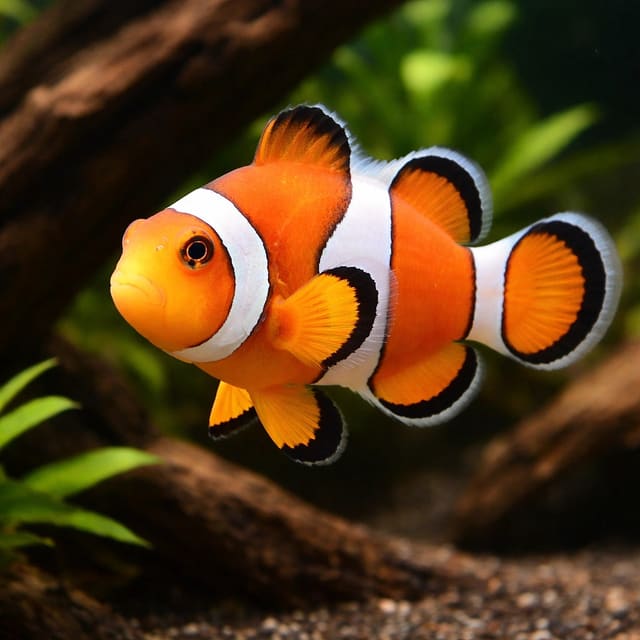
The Misbar Ocellaris Clownfish is Amphiprion ocellaris, the clown anemonefish described by Cuvier in 1830, in a pattern form where the white bars do not run cleanly from back to belly. It is exactly the same species as the familiar orange-and-white clownfish, a member of the damselfish family Pomacentridae, and the word "misbar" tells you about its markings rather than about a different animal. Around the hobby you will hear the species called the ocellaris, the common clownfish or the false clownfish, and FishBase lists it in English as the clown anemonefish.
A normally marked ocellaris is bright orange with three vertical white bars: one just behind the eye, one across the middle of the body and one at the base of the tail, each outlined with a fine black line. On a misbar at least one of those bars is incomplete. A 2021 scientific review of anemonefish colour forms describes the misbar look as a reduction in the cells that make the white, often with weaker black edging, and says it usually affects just one bar, most often the body bar. On most misbars that means the middle bar is incomplete or irregular while the head and tail bars look entirely ordinary, although on some fish more than one bar is affected. Some show only a slight break; others are far more irregular.
That variety is the whole appeal, and it also means we cannot promise a particular shape of bar. Your fish will carry its own markings, which may be subtler or bolder than another misbar you have seen, including any you see in photographs. If you would rather have the species in its usual pattern, our clown anemonefish, the standard ocellaris, is the same fish with the classic bars.
Each order on this page is for one young fish, dispatched at about 3–5 cm. That is a juvenile. FishBase records a maximum length of 11 cm total length for the species, and OATA, the UK's ornamental fish trade association, notes that common clownfish are unlikely to grow beyond 10 cm. No sex is sold or promised, and at this size it would mean little anyway: clownfish change sex as they mature, with the dominant fish of a pair becoming the female. If you want a pair, the usual advice is to buy two young fish and let them sort it out between themselves, which is covered further down.
The ocellaris is regularly confused with its close cousin the percula clownfish, Amphiprion percula. Wikipedia's species account gives three differences: the ocellaris usually has 11 spines in its dorsal fin against 10 in the percula, its spiny dorsal fin stands taller, and its black outlines are thinner. FishBase gives a dorsal spine count of 10–11 for the ocellaris, so treat the spine count as a pointer rather than a guarantee. On a misbar the black edging can be thinner still where a bar breaks up, so identify the fish by species, not by how tidy its pattern is.
The white on a clownfish comes from reflective cells rather than a coloured pigment. In 2018 Salis and colleagues, working at the Banyuls-sur-Mer marine laboratory in France, showed in the journal BMC Biology that clownfish white bars are made by iridophores, cells that reflect light, and that blocking those cells with a drug during development made young fish lose bars in proportion to the dose. They also timed the arrival of the bars in laboratory-reared ocellaris. At 8 days after hatching the larvae had no bars at all. The head and body bars appeared together at 10 to 11 days, and the tail bar followed at 14 days. In other words, the pattern is laid down from front to back in a short window while the fish is still a larva.
A misbar is what you see when that process falls short in one place. The review by Marleen Klann and colleagues, published in EvoDevo in 2021, links the misbar look both to environmental factors and to mutations. The studies it cites found that diet and the density at which young fish are kept can affect white bar formation in ocellaris and percula, producing misbar fish. In other cases the cause is genetic, and aquaculture companies have used such fish to establish lines; the review's list of retail strains includes an "Extreme Misbar" ocellaris. Misbarring is not purely a fish-farm creation either. The same review describes it as a rather common phenotype in the wild, and illustrates misbarred ocellaris from the Philippines.
Selective breeding has given clownfish keepers a whole catalogue of patterns. OATA's care sheet names snowflake, Picasso and gladiator among the strains developed in tank-bred clownfish, and states that most clownfish in the trade are tank-bred, which helps make them adaptable and good beginner fish. FishBase notes that the ocellaris is bred artificially for the aquarium trade, and the Klann review reports that it is among the five most imported ornamental fish species in the United States. For a fishkeeper that popularity is useful: the species is very well understood, and good information about its care is easy to find.
In the wild the ocellaris lives in the Indo-West Pacific. FishBase gives its range as the eastern Indian Ocean through Indonesia and the Philippines, extending north to Taiwan and the Ryukyu Islands of southern Japan. It is a reef-associated marine fish found from 1 to 15 metres deep, usually between 3 and 15 metres, and FishBase describes adults living among the tentacles of sea anemones in shallow lagoons on coral reefs. Wikipedia's account adds reef slopes as well as lagoons. These are shallow tropical reefs, and warm, stable seawater is the thing you are really recreating in the aquarium, whatever equipment you use to do it.
FishBase names three host anemones for the species: the magnificent sea anemone Heteractis magnifica and two carpet anemones, Stichodactyla gigantea and Stichodactyla mertensii. The anemone is the centre of a wild clownfish's life: it lives among the tentacles and its eggs are laid nearby. Wild ocellaris feed on plankton and algae, and Wikipedia mentions copepods and other zooplankton in the diet.
The social set-up on a wild anemone is worth understanding before you buy, because it explains how clownfish behave in your tank. A 2021 laboratory guide to rearing the species, by Roux and colleagues, describes each group as a breeding pair plus sexually immature juveniles ranked by size. The female is the largest and dominant fish, the male is next, and the smaller fish wait their turn. The breeding pair is established through aggressive behaviour, and the dominant pair holds back the sexual maturation of the smaller fish. If the female dies or is removed, the male changes sex to replace her and the largest juvenile becomes the new breeding male. Clownfish are protandrous hermaphrodites: they mature as males first and only the dominant fish becomes female.
The species is assessed as Least Concern by the IUCN (FishBase cites an assessment dated 3 February 2021), and FishBase rates its resilience as high, with a minimum population doubling time of less than 15 months.
No. Both OATA and the Roux laboratory guide say the same thing: although clownfish live with anemones in the wild, anemones are not required to keep them successfully in aquariums. OATA adds that clownfish may try to host other species of coral in captivity, and that live or artificial rockwork gives them a site to host where they will spend most of their time. If you do want to keep an anemone with your misbar, treat that as a separate project. Research the needs of that particular anemone, make sure your lighting and set-up suit it, and choose a species your clownfish will actually live with. We are always happy to talk it through before you order.
Clownfish are forgiving by marine standards, but they are still full-time saltwater fish, so the aquarium has to be cycled and steady before one arrives. OATA's guidance is to buy, within reason, as large an aquarium as possible. Its minimum for a single pair of the smaller species, such as common or percula clownfish, is 60 litres, and it says the aquarium needs to be larger again if you want to keep clownfish with other species. A bigger volume also holds temperature and water quality more steadily. Our care summary uses 90 litres as its starting figure, which leaves room for a pair plus a few small companions.
A filter is essential. On a marine set-up OATA lists three ways of providing it: live rock with sufficient water flow, an internal or external filter, or a sump-based filter. A protein skimmer is recommended too, because it removes dissolved organic waste before it breaks down into more harmful substances. A heater is needed all year round, and the tank should sit away from draughts, radiators, direct sunlight, loud noises and vibration.
Clownfish are not fussy about décor, but layout still shapes how a misbar behaves. OATA recommends live or artificial rockwork as a site for the fish to host, noting that they will likely spend most of their time there, together with open space to swim and extra areas of rock if other species are to be kept. A thin layer of coral sand, about 2 cm, helps the fish feel secure and helps maintain carbonate hardness. Flow should be moderate: enough to give good surface movement and to stop detritus settling, but not a constant blast through the spot your fish has chosen as home.
Overhead lighting keeps a proper day and night cycle. For clownfish on their own it does not need to be particularly bright, but OATA points out that corals need brighter, reef-grade lighting, so decide early whether this will be a fish-only tank or a reef.
A misbar is equally at home in either, and the decision mostly changes your shopping list. A fish-only set-up needs the basic marine test kits for ammonia, nitrite, nitrate, pH and hardness. A reef with corals adds reef lighting and, in OATA's list, reef test kits for calcium, alkalinity, magnesium and phosphate. OATA also lists an ultraviolet steriliser and a wavemaker or powerhead as optional extras. Whichever you choose, OATA's pre-purchase checks are the same: the aquarium should be big enough for the fish once fully grown, the water should match the parameters below, and the tank must be cycled and ready to receive fish.
OATA's care sheet reminds owners that the Animal Welfare Act 2006 gives everyone who keeps a pet a legal duty of care, covering a suitable environment, a suitable diet, the chance to behave normally, appropriate company and protection from pain, injury and disease. For a clownfish that translates into a correctly sized and heated marine tank, a varied diet, rockwork to claim and the right companions. OATA also stresses that aquarium animals must never be released into the wild, which is illegal.
| Item | Why it matters for a clownfish |
|---|---|
| Aquarium of 60 litres or more (90 litres in our care summary) | OATA's minimum for one pair of common clownfish; more volume gives more stability |
| Filtration: live rock with flow, internal/external filter or sump | Essential for removing waste |
| Protein skimmer | Recommended; removes dissolved organic waste early |
| Heater and thermometer | Keeps the tank in the tropical range all year |
| Refractometer or hydrometer | Measures salinity, which must stay steady |
| Reverse osmosis water | OATA advises it for topping up evaporation |
| Marine test kits (ammonia, nitrite, nitrate, pH, hardness) | Weekly testing catches problems early |
| Rockwork and about 2 cm of coral sand | A home base for the fish and help with carbonate hardness |
| Secure lid | Recommended by OATA |
Clownfish are, in OATA's words, usually undemanding of water chemistry, but "undemanding" assumes stability. The figures below come from two different kinds of source. OATA's sheet gives general guidance for keeping clownfish, and notes that a reef aquarium may need some parameters adjusted for more sensitive inhabitants. The Roux laboratory guide gives the conditions used to get breeding pairs spawning reliably. Our own care summary sits within the span the two cover.
| Parameter | OATA clownfish guide | Breeding pairs (Roux et al. 2021) | Our care summary |
|---|---|---|---|
| Temperature | 24–26 °C | 26–28 °C (their lab runs at 26 °C) | 24–27 °C |
| Salinity | Specific gravity 1.020–1.025 | 30–35 g/L (their lab runs at 34 g/L) | Specific gravity 1.023–1.026 |
| pH | 7.9–8.3 | 8.0–8.5 | 8.1–8.4 |
| Ammonia and nitrite | Zero | 0–0.5 mg/L ammonium and 0–0.2 mg/L nitrite | Zero |
| Nitrate | No more than 50 mg per litre | 0–5 mg per litre for breeding | Below 50 mg per litre |
| Carbonate hardness | 8–12 °dKH | Not stated | 8–12 °dKH |
| Calcium and magnesium | 380–450 ppm and 1,250–1,350 ppm | Not stated | Follow OATA |
The figure that both temperature sources share is 26 °C, which is a comfortable everyday target. For salinity, pick one value in the range and hold it there rather than letting it wander. Evaporation removes only fresh water, so a tank topped up with salt water creeps steadily saltier. OATA recommends reverse osmosis water for top-ups and regular salinity checks for exactly this reason.
OATA also notes that clownfish can be stressed by even small amounts of ammonia and nitrite, which can then lead to disease. That is why the readings before delivery matter more than anything else on your shopping list: zero ammonia and zero nitrite, a steady temperature and a stable salinity reading for several days running.
In the wild an ocellaris eats plankton and algae. In the aquarium OATA describes clownfish as omnivores that need a wide range of foods to be at their best. A good quality marine flake or pellet covers most of their nutritional needs, and OATA recommends supplementing it with frozen foods such as mysis shrimp, enriched brine shrimp or red plankton. Clownfish will also graze algae growing in the aquarium or offered to herbivorous tank mates.
OATA's rule is to feed only what the fish can eat within a few minutes, twice a day. Overfeeding leaves uneaten food to break down and release toxic waste, and in a marine tank that shows up quickly in your test results. A 3–5 cm juvenile has a small mouth, so choose small pellets or crumbled flake and frozen foods with small pieces; thaw frozen food first and offer a little at a time so it is eaten in mid-water rather than settling in the rockwork.
For perspective on what a well-fed clownfish eats, the Banyuls laboratory guide describes the diet used for its breeding pairs: a homemade frozen mix of shrimp, squid, egg yolk, pellets and nori seaweed, high in unsaturated fatty acids, given once a day. Their young fish move from live foods to fine artificial pellets of 80 and 200 micrometres from about 30 days after hatching. You do not need to make anything that elaborate for a single juvenile, but it shows the principle: a varied diet with marine protein and some plant matter.
| Food | Role in the diet |
|---|---|
| Small marine pellets or flake | Daily staple that covers most nutritional needs |
| Frozen mysis shrimp | Regular protein supplement |
| Enriched brine shrimp | Frozen supplement recommended by OATA |
| Red plankton | Another frozen option on OATA's list |
| Algae in the tank or nori | Plant matter the fish will graze |
Once settled, a healthy clownfish should show interest at feeding time. If a fish that was eating well stops, test the water before anything else; reduced appetite is one of the early signs OATA lists for problems.
The ocellaris and the percula are, OATA says, generally less aggressive than the larger clownfish species. That does not make them meek. All clownfish are territorial over a particular part of the aquarium and will defend it from other fish, especially once they breed. The practical rules are to give them enough room to establish their patch and not to mix them with species that are shy or easily intimidated.
OATA recommends keeping clownfish in pairs and warns against groups, so if your tank has room, plan for two. A single fish will still claim a spot in the rockwork as its home, but a pair is the natural unit for this species, and clownfish biology makes one easy to form. Because they are protandrous hermaphrodites, all clownfish mature first as males, and the dominant fish of a pair becomes female. FishBase cites a length at sex change of 4.4 cm total length, which is within the size range of the fish we send. OATA's advice is to buy two juveniles and let them pair up naturally, one becoming the male and the other the female. Raising two young fish together lets them work out that order between themselves.
A misbar is still Amphiprion ocellaris, so the pairing advice for the species applies to it, including pairing it with a normally barred ocellaris if you like the contrast. It is dominance that decides the roles: OATA explains that the more dominant fish grows larger and becomes the female. Expect some squabbling while the pair settles its order. OATA notes that the female is normally the dominant fish and will often bully the male; that is normal, but watch closely to make sure the male is not injured. Keeping clownfish in larger groups invites trouble, because some individuals may be bullied, so a single pair is the arrangement OATA recommends.
Before adding anything, OATA's checklist is worth following: research every species you are considering and make sure your final choices are all compatible, and add fish gradually so the filter keeps pace.
Ocellaris clownfish are among the hardier marine fish, but they are not immune to stress. OATA notes that fish are easily stressed by bright light, extreme temperatures, noise and movement, and that even small amounts of ammonia or nitrite can stress clownfish enough to bring on disease. OATA describes a healthy fish as having clear bright eyes, undamaged fins, intact scales, no ulcers or bumps, normal swimming and steady breathing. Those are the things to check in the first days after arrival.
OATA lists the changes worth noticing before they turn into real health problems:
OATA adds clamped fins, flicking against rocks or sand, and shimmying (a shaking movement) as signs of disease. If you see any of these, OATA's advice is to test your water quality and then get advice. You are welcome to contact us with your test results and a description of what you see.
Fish can carry disease without showing signs. OATA suggests quarantining new livestock in a separate aquarium for at least a week before it joins the main tank, which is good practice for any marine collection with existing fish or invertebrates. It also warns that copper, which some retailers run in their fish systems, is toxic to invertebrates, which is another reason never to tip transport water into a reef aquarium.
Clownfish are a long-term commitment. OATA says they can live for many years in a well-matured set-up with good water quality, and FishBase notes that the species has reached an age of 12 years in captivity. That is a recorded age, not a promise, but it shows what good care can achieve.
OATA calls clownfish one of the easiest marine species to spawn in the home aquarium, which is part of their charm for anyone who keeps a pair. Don't expect it quickly, though. The Roux laboratory guide says that a newly formed pair can take between six months and two years to reproduce for the first time, and that temperature, salinity, pH and a stable day length all need to be closely monitored for reliable spawning.
The pair cleans a site, the female lays her eggs there and the male fertilises them. FishBase describes the eggs as demersal, meaning they are attached to a hard surface rather than drifting, and notes that the male guards and aerates them. OATA adds that both parents fan the eggs to keep water flowing over them and eat any that are not viable. In the Banyuls laboratory the pairs lay on the underside of a terracotta pot placed in their tank, laying 100–500 eggs every 12–15 days, an average of 24 clutches a year per pair, with a pause of one or two months over December and January.
Hatching time depends on temperature. OATA gives about 7 or 8 days, Wikipedia six to eight days, and the laboratory papers report hatching 9 to 10 days after laying at 26 °C. In the Banyuls laboratory the larvae hatched in the dark, about an hour after the lights went off.
OATA is clear that the larvae are too delicate to survive in a normal home aquarium: they get pulled into filters and pumps or eaten by other fish, and they need live foods. The laboratory method uses rotifers from hatching to 8 days, newly hatched brine shrimp nauplii from day 3 to day 30, and green microalgae for the first eight days, before weaning on to fine pellets. Larval development takes about 15 days at 26 °C. It is a real project with its own equipment, and it is also the stage when the white bars form, around 10 to 14 days after hatching. As mentioned earlier, research links misbarring partly to how young fish are fed and stocked, so whether a misbar pair's young are misbarred is never certain.
A marine fish travels best into an aquarium that has been ready for days, not hours. Before you order, make sure the filter is running and matured, ammonia and nitrite read zero, the heater is holding a steady temperature and your salinity has been stable for several days. Please read our delivery and live-arrival information before ordering, and make sure someone will be at the delivery address to receive the parcel.
Your clownfish travels in an oxygen-filled bag inside insulated packaging, with heat packs when conditions call for them, carried by a tracked courier licensed to carry live animals. We email you the confirmed delivery date and tracking.
Keep the lights low for the rest of the first day and then watch breathing, appetite and behaviour through the week. Offer a small feed of fine frozen food or small pellets once the fish is moving about normally, and keep portions modest while it settles. Steady breathing, interest in food and a fish that starts claiming a spot in the rock are all good signs. Test the water during this week too: OATA advises paying particular attention to water quality while new fish settle.
If you are adding a second fish later to form a pair, add it into the same conditions and watch both closely for the first few days while they work out who is in charge.
The facts on this page come from these sources, all of which are worth reading in full if you want to know more about the species and its colour forms:
No reviews for this item yet. Bought one? Honest reviews only, good or bad.
What customers say about ordering from us
Easy website plenty of info on fish your buying great to pick a time slot
TRACEY DURRANT · 7 Oct 2026
Got some lovely fish thank you
Kevin Mackie · 7 Oct 2026
Reviews of our shop, collected by Judge.me, an independent third-party review collector. Newest first.