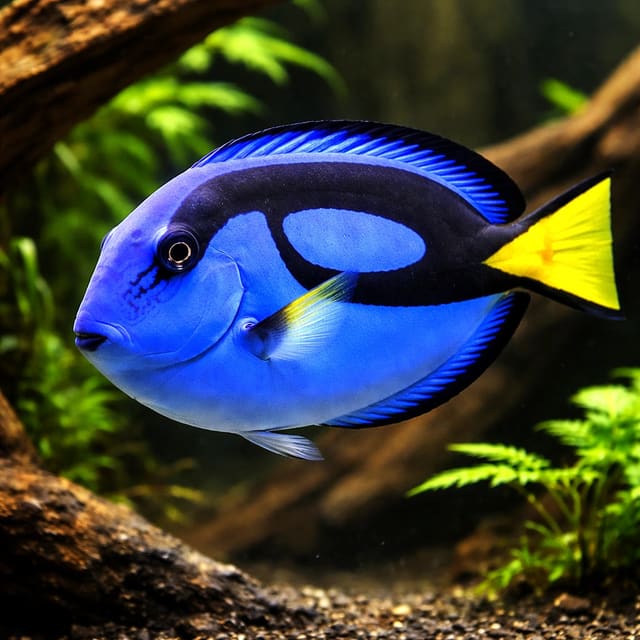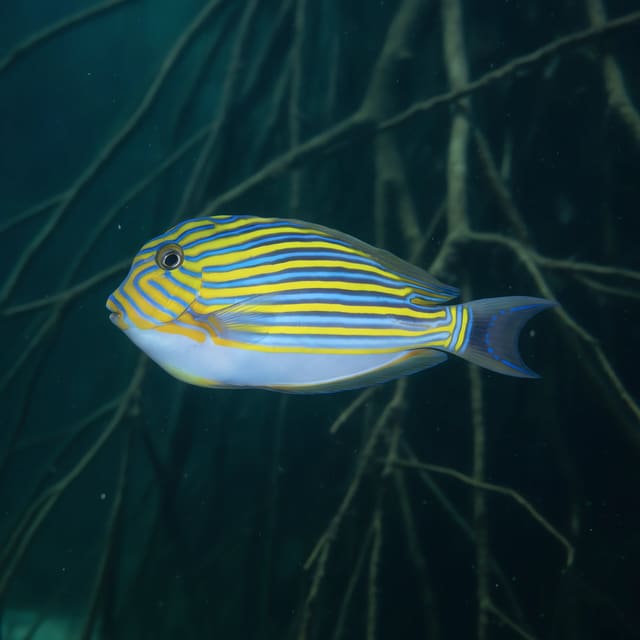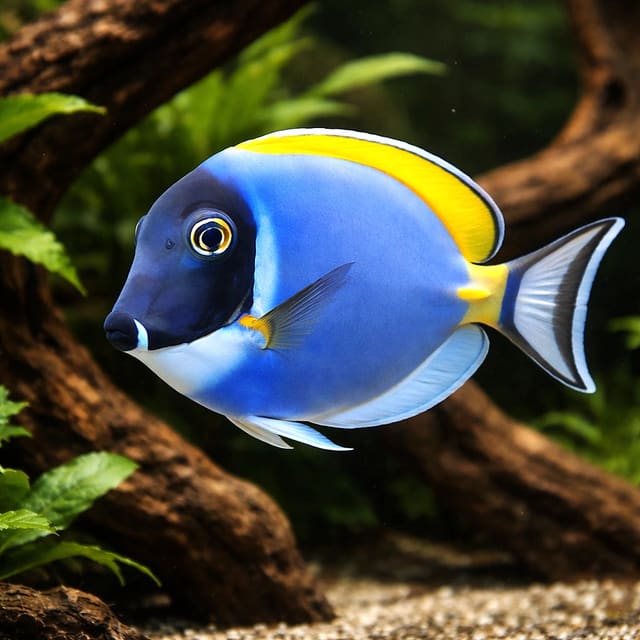
Powder Blue Surgeonfish (Acanthurus leucosternon)
24–26°C · pH 7.9–8.3
£92.99
One Whitecheek Surgeonfish (Acanthurus nigricans), sent at around 20 cm. An algae-grazing, territorial tang that can reach 36 cm fork length: it needs a mature marine aquarium of 500 litres or more, specific gravity 1.020-1.026, 24-27°C, and care with other tangs.
Adult size is the maximum length this species reaches at full maturity (scientific sources). The livestock you receive will be younger and smaller. Product-photo provenance and any image-specific limitations are stated on the listing.
Acanthurus nigricans
One Whitecheek Surgeonfish (Acanthurus nigricans), sent at around 20 cm. An algae-grazing, territorial tang that can reach 36 cm fork length: it needs a mature marine aquarium of 500 litres or more, specific gravity 1.020-1.026, 24-27°C, and care with other tangs.
Adult size is the maximum length this species reaches at full maturity (scientific sources). The livestock you receive will be younger and smaller. Product-photo provenance and any image-specific limitations are stated on the listing.
Maintain these water conditions for optimal health and vibrant colors
This listing is for a single Whitecheek Surgeonfish, Acanthurus nigricans. Our stock records describe it as a medium specimen of around 20 cm, so this is already a substantial fish when it arrives, not a small juvenile. Please plan for a large, fast-swimming marine fish from day one.
The whitecheek is a surgeonfish, the family Acanthuridae, which UK reef keepers usually call tangs. WoRMS, the World Register of Marine Species, lists Acanthurus nigricans (Linnaeus, 1758) as the accepted name. Linnaeus first described it as Chaetodon nigricans, and two later names, Acanthurus glaucopareius and Acanthurus aliala, are now treated as synonyms, so you may still see them in older books. Wikipedia notes that the type locality was given as the Red Sea but is actually thought to be Indonesia.
The fish goes by several English names. FishBase gives whitecheek surgeonfish, velvet surgeonfish and goldrim surgeonfish; Wikipedia adds yellow-banded and yellowrimmed surgeonfish. Aquarium shops often call it the whitecheek tang or goldrim tang. One caution: Wikipedia lists ‘gold rim tang’ and ‘powder brown tang’ as names for a different fish, Acanthurus japonicus, so the scientific name is the only reliable label. What we send is Acanthurus nigricans.
This is a fish for an experienced marine keeper with a large, mature system. It needs a big volume of stable saltwater, room to swim at speed, a diet built on algae and some thought about which other tangs, if any, share the tank. The sections below take each of those in turn, using FishBase, Wikipedia, WoRMS and the UK trade association OATA as the evidence, so you can judge honestly whether your aquarium is the right home before you order.
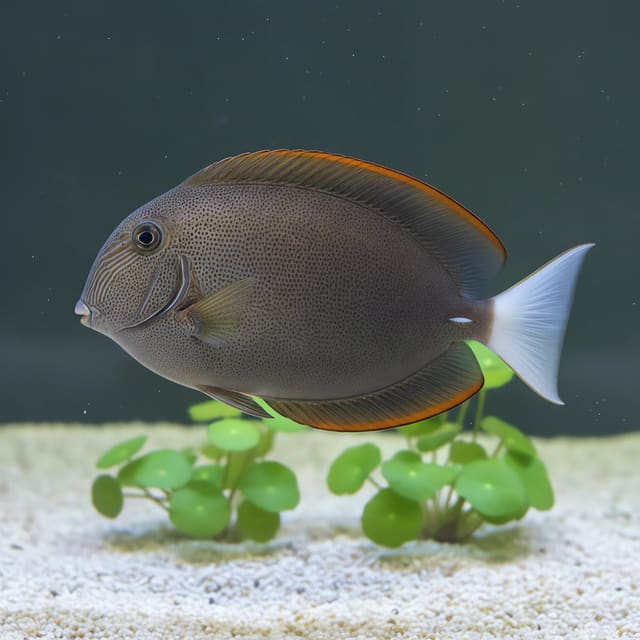
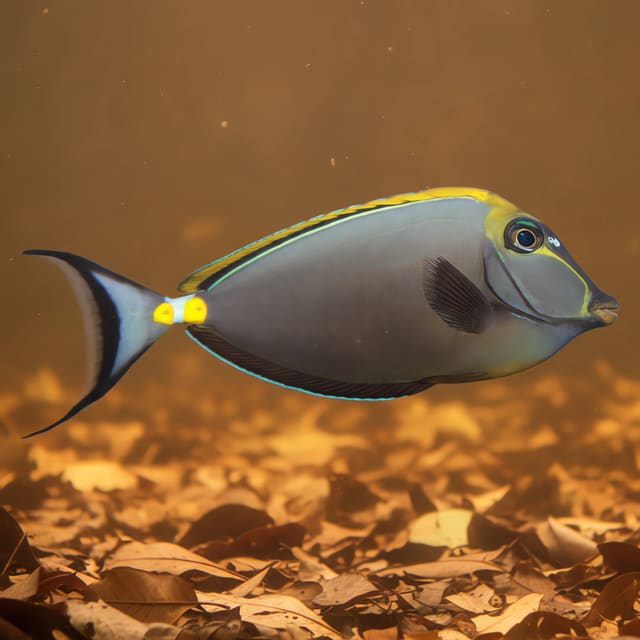
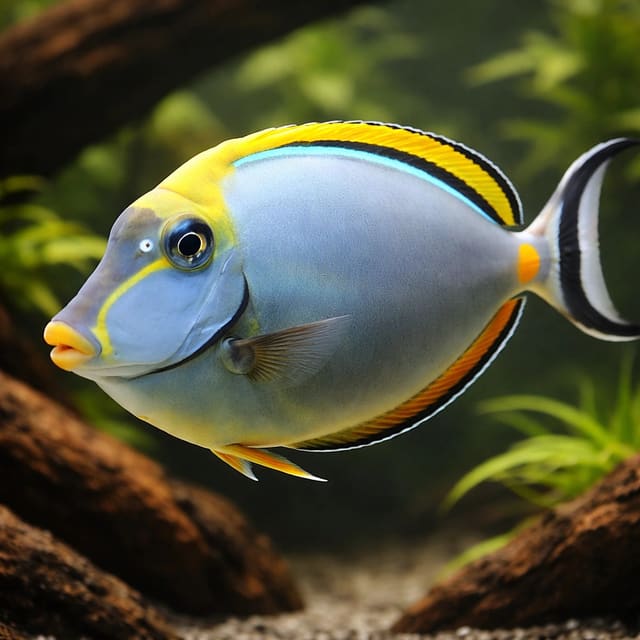
Wikipedia describes the body as bluish-black, with a large patch of white below the eye. FishBase is more precise about that mark, calling it a horizontally elongate white blotch below the eye, and it is the feature that gives the fish its name. Yellow bands run along the base of both the dorsal fin on top and the anal fin underneath, growing stronger towards the tail. The tail fin itself is white with a slender yellow band set just inside its edge.
The gallery photo shows those features clearly: the dark body, the white cheek patch and a small white mark at the mouth, the gold lines along the fin bases, a short yellow bar on the tail stem and the pale tail with its yellow band and blue edge. FishBase notes that the caudal peduncle, the narrow stem in front of the tail, is black except for a yellow edge.
All surgeonfish carry what OATA describes as sharp modified scales near the tail that resemble a scalpel. It is how the family got its name. FishBase lists this species as harmless to people, but the blade is genuinely sharp, so treat the tail end with respect when netting the fish or working in the tank with your hands.
For anyone checking identification against a key, FishBase gives nine dorsal spines with 28–31 soft rays, and three anal spines with 26–28 soft rays.
The whitecheek belongs to a small group of closely related tangs. Wikipedia reports that it frequently hybridises with Acanthurus achilles, A. japonicus and A. leucosternon where their ranges overlap, and that together they form a species complex. A study of reef-fish hybrids at Christmas Island and the Cocos (Keeling) Islands by Hobbs and Allen, published in the Raffles Bulletin of Zoology in 2014, illustrates a wild A. leucosternon × A. nigricans cross. That relationship matters in the aquarium as well as in the sea, because similar-looking relatives are also the fish most likely to clash with it, as the temperament section explains.
FishBase describes the whitecheek as a reef-associated marine fish. Adults live over hard substrate in clear lagoons and on seaward reefs, from the lower surge zone down to at least 67 metres. That surge zone detail is worth noticing: this is a fish that is at home where waves break over the reef and the water is well mixed and full of oxygen. FishBase also notes that small juveniles stay shy among large corals, and Wikipedia agrees that the young live among large corals.
Its range is wide. FishBase records it in the eastern Indian Ocean at the Cocos (Keeling) Islands and Christmas Island, and across the Pacific from the Ryukyu Islands and the Great Barrier Reef to the Hawaiian Islands and French Polynesia. It has also crossed the Eastern Pacific Barrier, the wide stretch of open ocean between the central and eastern Pacific, to reach the Revillagigedo Islands, Cocos Island, the Galápagos and the Mexican coast. Across that range FishBase gives a water temperature of 21–29°C.
FishBase records the species feeding on filamentous algae, the fine, hair-like algae that grow over rock. It may be solitary or found in groups, it is listed as monogamous, and it is described as territorial. That combination of a grazer and a territory-holder is the key to understanding the whitecheek in captivity. A territorial grazer is, in effect, guarding its food, and in an aquarium the fish most likely to be treated as competitors are other algae grazers of similar shape. That is the thinking behind OATA's advice to keep similar-looking tangs apart, covered in the temperament section below.
FishBase also lists the whitecheek as Least Concern on the IUCN Red List and notes that it is both a commercial aquarium species and taken in subsistence fisheries.
Put those facts together and the aquarium brief writes itself: clean, well-oxygenated water; mature rockwork with a film of algae to graze between meals; open water for a fish that is used to swimming along a reef face; and careful choice of companions so it is not competing for the same food and space as a near relative.
FishBase gives the maximum recorded size of Acanthurus nigricans as 36 cm fork length, with a maximum recorded weight of 620 g, and Wikipedia gives the same 36 cm fork length. Fork length is measured from the snout to the fork in the tail, so it leaves out the tail tips. That is the largest fish on record, not a target, and many aquarium specimens will stay below it. Still, a fish that arrives at around 20 cm and belongs to a species capable of 36 cm needs to be planned for as a big animal.
OATA's care sheet for tangs and rabbitfish gives 300 litres as a minimum for single individuals under 20 cm, and says that larger, more active species need bigger aquariums. This fish is already at that 20 cm line on arrival and comes from a species that can grow well past it, so the 300 litre figure is the wrong starting point. We treat 500 litres as the minimum for one whitecheek, and a larger system is better.
A large, active surgeonfish is served far better by a long tank than a tall or cube-shaped one of the same volume. A long footprint gives the fish a real swimming run and lets other fish keep their distance. When you build the rockwork, keep open water along the front and through the middle, and use the rock to create grazing faces, caves and places where the fish can pass out of sight of a tank mate for a moment. Avoid stacking rock into one wall with a single narrow channel; a tang that has to squeeze through the same gap as every other fish is a tang that will start arguments.
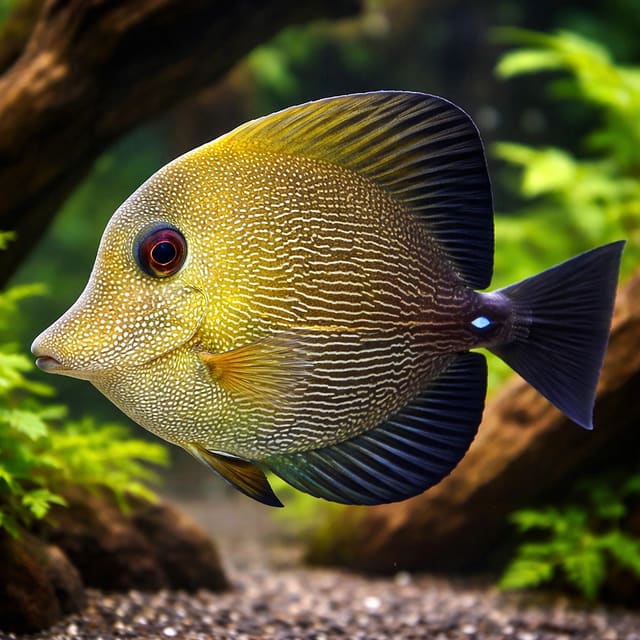
If your system is smaller than this, the whitecheek is not the right fish for it yet. Our Tomini Surgeonfish (Ctenochaetus tominiensis) listing is worth reading for comparison, and each of our surgeonfish listings sets out its own space needs so you can match fish to tank honestly.
OATA publishes three marine care sheets that bear on this fish: a general guide to setting up and looking after a marine aquarium, a guide to marine water quality, and a care sheet for tangs and rabbitfish. Their figures differ slightly, because a fish-only system and a reef with corals and invertebrates are run differently. The table sets them side by side.
| Parameter | OATA fish-only system | OATA reef system | OATA tangs and rabbitfish |
|---|---|---|---|
| Specific gravity | 1.017–1.023 (23–30 ppt) | 1.024–1.026 (32–35 ppt) | 1.020–1.025 |
| Temperature | 24–27°C | 24–26°C | 24–26°C |
| pH | 8.0–8.2 | 8.0–8.2 | 7.9–8.3 |
| Carbonate hardness | not given | 8–12 dKH | 8–12 dKH |
| Ammonia and nitrite | zero | zero | zero |
| Nitrate | no more than 20 mg/l | 5–10 mg/l, species dependent | no more than 50 mg/l |
| Phosphate | not given | 0.04–0.1 mg/l, species dependent | not given |
| Calcium | not given | not given | 380–450 ppm |
| Magnesium | not given | not given | 1,250–1,350 ppm |
In practice that gives two sensible targets. In a reef aquarium, hold specific gravity at 1.024–1.026 with the reef figures for nitrate, phosphate and carbonate hardness, because the corals and invertebrates set the limits. In a fish-only system with live rock, the tang sheet's 1.020–1.025 is fine, but keep nitrate low: OATA's fish-only limit is 20 mg/l, which is stricter than the 50 mg/l ceiling on the tang sheet. We work to 24–27°C and pH 8.0–8.3 for this fish, which sits within OATA's figures; the wild range FishBase gives is 21–29°C, but steady is what counts in a tank.
Mix new saltwater from reverse osmosis water and a proper marine aquarium salt, never table salt; OATA notes that a powerhead and heater speed up dissolving. Evaporation removes water but leaves the salt behind, so the specific gravity creeps up between water changes. OATA's advice is to mark the full water line and top up with fresh reverse osmosis water, adding it in an area of high flow so it mixes quickly. Measure specific gravity regularly, and if it has drifted, bring it back slowly. OATA stresses that changes should always be made gradually rather than chasing an ideal number in one go.
Test ammonia, nitrite, nitrate, pH and hardness at least once a week, more often in a newly set-up tank or if a fish behaves oddly. OATA's marine set-up guide asks for at least 10% of the water to be changed every week, and its tang sheet asks for at least 25% weekly. With a large, heavy-feeding grazer in the system, the larger figure is the safer habit.
Prepare new saltwater in a clean container set aside for the job, using reverse osmosis water and marine salt. Run a small powerhead and a heater in it, as OATA suggests, until the salt has fully dissolved and the water has reached tank temperature. Before any of it goes into the aquarium, check its specific gravity against the tank's own reading, so the change does not shift salinity. Matching temperature and salinity in the new water is the simplest way to follow OATA's rule that changes are made gradually.
In a reef, OATA's tang sheet also gives calcium at 380–450 ppm and magnesium at 1,250–1,350 ppm. Those two matter mainly for corals and other calcifying life rather than for the tang itself, but if the whitecheek is going into a reef they are part of the routine you will already be testing.
OATA describes a new marine tank's filter as mature once ammonia and nitrite have risen, fallen and then stayed at zero continually. A whitecheek should go into a well-established system that has been stable for a good while after that point, not one that has only just finished cycling, and OATA's stocking advice is to add territorial fish later rather than first.
FishBase records the whitecheek feeding on filamentous algae in the wild, and OATA describes tangs as primarily herbivorous. That sets the shape of the diet: algae first, every day, with meaty foods as a supporting extra rather than the main course.
OATA's guidance for tangs is to feed what they can eat within a few minutes, twice a day. For a large grazer it often helps to split the algae ration: one clip at each end of the tank spreads the fish out and stops one dominant animal guarding the only food. Keep an eye on the whole tank at feeding time, because a fast, confident surgeonfish can take more than its share from slower fish.
Here is one way to put OATA's guidance into a routine for a settled fish. It is a starting point to adjust to your tank, not a fixed rule:
Watch the fish rather than the clock. If the algae is gone in seconds and the tang is still searching, the portion may be too small; if pieces are still drifting about after several minutes, cut back.
A whitecheek in good condition has a rounded, well-filled body. OATA lists weight loss and reduced interest in food among the warning signs to watch in tangs, so a fish that looks pinched behind the head or along the back, or that has stopped grazing, needs attention: check the water, check whether it is being chased off the food, and make sure algae makes up the bulk of what it is actually eating.
Uneaten food breaks down into nitrate and phosphate, the two numbers a reef keeper is trying to hold low, so feed little and often rather than leaving food to settle in the rockwork.
FishBase describes the whitecheek as territorial, and OATA's tang care sheet points the same way, advising that similar-looking species are not kept together. The two things most within your control are the size of the tank and the choice of companions, and both are worth settling before the fish is ordered.
The Powder Blue Surgeonfish (Acanthurus leucosternon) is a relative many marine keepers will recognise. It is one of the species the whitecheek hybridises with in the wild, and the two look broadly alike in shape and pattern. Under OATA's advice to keep similar-looking species apart, we would not plan to house a powder blue and a whitecheek together in a typical home aquarium.
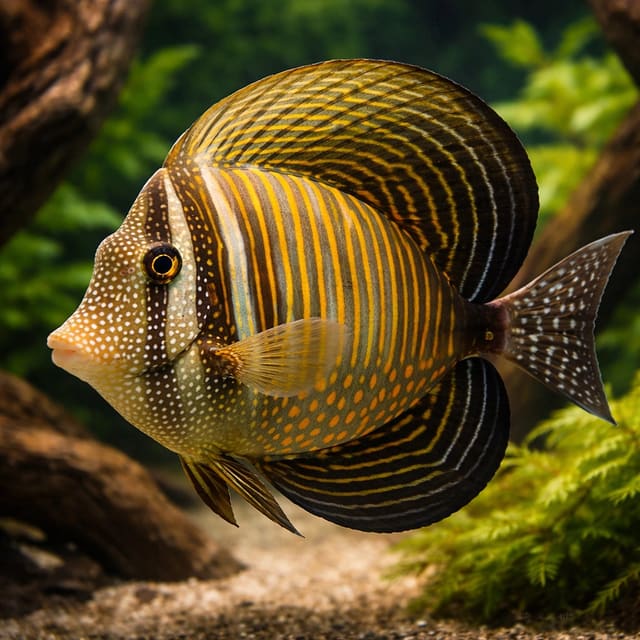
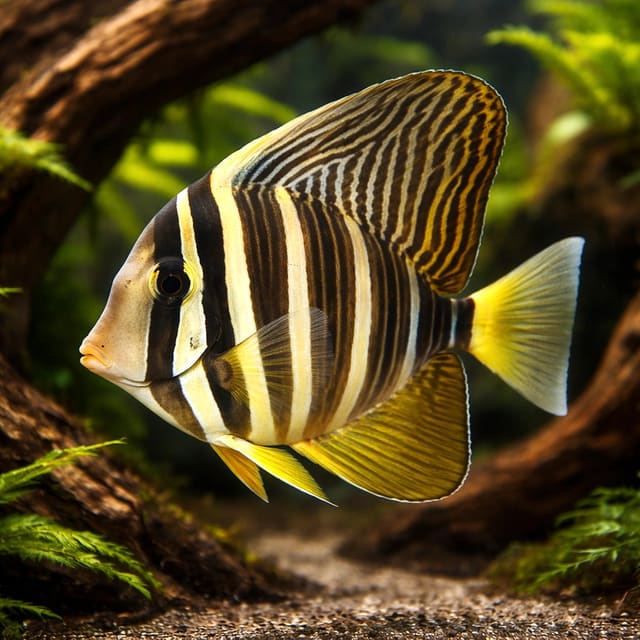
Some keepers with very large systems do keep surgeonfish of clearly different shapes and genera together. That is a judgement call that depends on volume, layout and introduction order, and there is no guarantee it will work. If you are weighing up your options, our Indian sail-fin surgeonfish (Zebrasoma desjardini) and Palette surgeonfish (Paracanthurus hepatus) listings set out each fish's own needs. Read them as comparisons, not as a promise that any two tangs will live peacefully together.
OATA lists marine angelfish, damselfish and some butterflyfish as compatible with tangs, and advises avoiding shy species. Clownfish belong to the damselfish family. The safest companions are confident fish that do not graze algae the way the whitecheek does and do not share its body shape. Very timid, slow-feeding fish are a poor match, because a hungry surgeonfish can dominate the food and the open water.
Chasing between tangs is easy to see: one fish repeatedly driving another along the glass, tail turned towards it, or blocking it from the food clip. The fish on the receiving end tends to show the warning signs on OATA's list, such as colour changes, faster breathing, damaged fins and a loss of interest in food. If it does not ease within a short time of introduction, act early. More rockwork and visual barriers sometimes help; if not, the only real fix is to separate the fish.
The short answer is that nothing in its recorded natural diet points at corals. FishBase lists filamentous algae as its food, not coral polyps, and that is the main reason the whitecheek is kept in reef aquaria. A well-fed tang that spends the day grazing rock is generally a reasonable reef fish.
The longer answer is that reef suitability is about more than diet. A reef tank for this fish has to meet the needs of both the corals and a large, fast surgeonfish at the same time. That means:
Invertebrates such as cleaner shrimps and snails are not part of the whitecheek's recorded diet either. The bigger risk to a mixed reef is more likely to come from the tang's size and energy than from what it eats: small, shy fish can find a large surgeonfish hard to live with in a crowded tank.
In a fish-only system with live rock, the reef-specific limits on phosphate and nitrate are less critical, but the space, stable salinity and algae-first diet are exactly the same.
Ordering a large marine fish is easier to get right on paper than to put right afterwards. Run through this list honestly before you buy. If any row is a no, it is worth waiting until it is a yes.
| Question | What a whitecheek needs | Where the figure comes from |
|---|---|---|
| Is the tank big enough? | 500 litres or more, with a long footprint | Our minimum, set above OATA's 300 litres for tangs under 20 cm because this fish is already around 20 cm and the species reaches 36 cm fork length |
| Is the system mature? | Ammonia and nitrite at zero continually, and stable for some time after that | OATA marine set-up guide |
| Is salinity steady? | Specific gravity 1.024–1.026 in a reef, 1.020–1.025 in a fish-only system | OATA reef and tang figures |
| Is the temperature right? | 24–27°C, held steady | OATA fish-only figure; reef and tang sheets give 24–26°C |
| Are pH and alkalinity stable? | pH 8.0–8.3, carbonate hardness 8–12 dKH | OATA tang and reef figures |
| Is nitrate under control? | No more than 20 mg/l fish-only; 5–10 mg/l in a reef | OATA marine set-up guide |
| Are there similar tangs already? | Ideally none, and certainly not its close relatives | OATA tang sheet; Wikipedia on the species complex |
| Can you feed algae every day? | Twice a day, what is eaten within a few minutes | OATA tang sheet |
| Can you quarantine it? | A separate tank for at least a week where possible | OATA tang sheet |
OATA's marine set-up guide recommends adding fish slowly, with hardier and more timid species first and the more territorial species later. In most tanks the whitecheek belongs near the end of that list. Adding it late means the quieter fish have already settled and claimed their places before a large, confident tang arrives, and it gives your filtration time to grow with the fish load rather than being hit by a big fish all at once.
A fish that arrives at around 20 cm and can reach 36 cm fork length will be the largest fish in most home aquaria. Before you order, think about whether the tank you have today is the tank you will be running in the years ahead, and whether you are happy for the rest of your stocking to be planned around this one fish. If the answer is yes, a whitecheek is a striking, active centrepiece for a big marine system.
OATA's tang care sheet lists the warning signs: erratic swimming, changes in colour, a change in breathing rate, white spots, fluffy growths, fin or scale loss, weight changes and reduced interest in food. A healthy whitecheek swims steadily and purposefully, holds its colour, breathes evenly and grazes or feeds with interest. If you see any of OATA's signs, test the water first, then look at whether another fish is bullying it.
OATA recommends quarantining new marine fish for at least one week where possible. A separate tank lets you check feeding, body condition and skin for a while before the fish has to compete in your display. For a fish this size, the quarantine tank needs to be a decent volume, with stable salinity and temperature matched to the main system.
Please read the delivery and live-arrival information on our delivery page before ordering. Your aquarium must be ready before the parcel arrives: filter running, water tested, and temperature and salinity where they should be. Someone must be at the delivery address to receive live animals, and we email the confirmed delivery date and tracking details. The fish travels in an oxygen-filled bag inside insulated packaging, with heat packs when conditions call for them, carried by a tracked courier licensed to carry live animals.
Start a continuous unboxing video while the parcel is still sealed, then open it in the same take and show the fish in its still-sealed bag. If the fish arrives dead, dying or clearly compromised, email hello@tropicalfishco.co.uk on the day of delivery with your order number and that video. Photos alone do not meet the policy. Where a claim is accepted, the resolution is a replacement with your next order or a refund for the affected fish, subject to the guarantee terms.
Over the first week, watch breathing, appetite and behaviour. Put algae on a clip from the first day so there is food the fish recognises, and feed the established fish at the same time so they are busy while the newcomer finds its way around.
These are the sources behind this guide, and they are worth reading before you decide:
No reviews for this item yet. Bought one? Honest reviews only, good or bad.
What customers say about ordering from us
Easy website plenty of info on fish your buying great to pick a time slot
TRACEY DURRANT · 7 Oct 2026
Got some lovely fish thank you
Kevin Mackie · 7 Oct 2026
Reviews of our shop, collected by Judge.me, an independent third-party review collector. Newest first.