Sea Urchin Black (Mespilia globulus) - Marine Aquarium Livestock UK
24–26°C · pH 7.9–8.3
£59.99
Multicolour Sea Urchin (Tripneustes gratilla) is an Indo-Pacific grazing urchin that can reach 10–15 cm and needs an established marine aquarium with plenty of rock to graze. Each purchase is one live urchin.
Adult size is the maximum length this species reaches at full maturity (scientific sources). The livestock you receive will be younger and smaller. Product-photo provenance and any image-specific limitations are stated on the listing.
Tripneustes gratilla
Multicolour Sea Urchin (Tripneustes gratilla) is an Indo-Pacific grazing urchin that can reach 10–15 cm and needs an established marine aquarium with plenty of rock to graze. Each purchase is one live urchin.
Adult size is the maximum length this species reaches at full maturity (scientific sources). The livestock you receive will be younger and smaller. Product-photo provenance and any image-specific limitations are stated on the listing.
Maintain these water conditions for optimal health and vibrant colors
The Multicolour Sea Urchin is Tripneustes gratilla, a grazing sea urchin better known as the collector urchin and sometimes called the halloween urchin. The trade name is also spelt Multicolor. The World Register of Marine Species lists it as an accepted species in the family Toxopneustidae. Like starfish and sea cucumbers it is an echinoderm, a spiny-skinned animal built on a radial plan rather than a head-to-tail body.
This is a fully marine animal. It needs salt water at full reef strength, living or artificial rock to graze and shelter against, and an aquarium that has had time to mature before it goes in. It is not suitable for freshwater, brackish or newly set-up tanks.
In the wild, collector urchins are found at depths of about 2 to 30 metres across the Indo-Pacific, including Hawaii and the Red Sea, and adults can reach 10 to 15 cm, according to the species summary on Wikipedia. That adult size is the fact to plan around. A 10–15 cm urchin is a substantial grazer: it needs room to travel over rock, a steady supply of algae or a supplement, and rockwork solid enough that a heavy animal pushing past cannot bring it down.
Each purchase supplies one live Multicolour Sea Urchin. The listing has a single offer rather than graded sizes, and the 10–15 cm figure describes what the species can reach, not the size of the animal in the bag. An urchin that arrives smaller than that simply has growing still to do.
Sex is guaranteed only when the selected option explicitly states male or female. This Multicolor Sea Urchin listing has no sex-guaranteed option. Nothing in the care below depends on the sex of the animal.
| Suits | Keepers with an established, stable marine aquarium, plenty of rock and room for a large grazer |
|---|---|
| Not suited to | Freshwater tanks, newly set-up marine tanks and tanks that hold triggerfish |
| Diet | Herbivorous grazer; add nori algae sheets when the tank runs short of algae |
| Adult size | 10–15 cm |
| Water | Marine; OATA's broad group guidance is 24–26°C, pH 7.9–8.3 and salinity 1.023–1.026 |
This urchin appeals for two reasons: the warm orange-red colouring with darker bands and pale spine tips, and its appetite for algae. The Ornamental Aquatic Trade Association (OATA) notes in its care sheet for starfish, sea urchins and sea cucumbers that urchins are herbivorous and are often used to control algae. That makes it a working animal as well as a display piece, but the arrangement only works when there is enough to eat and the rest of the aquarium is set up with it in mind.
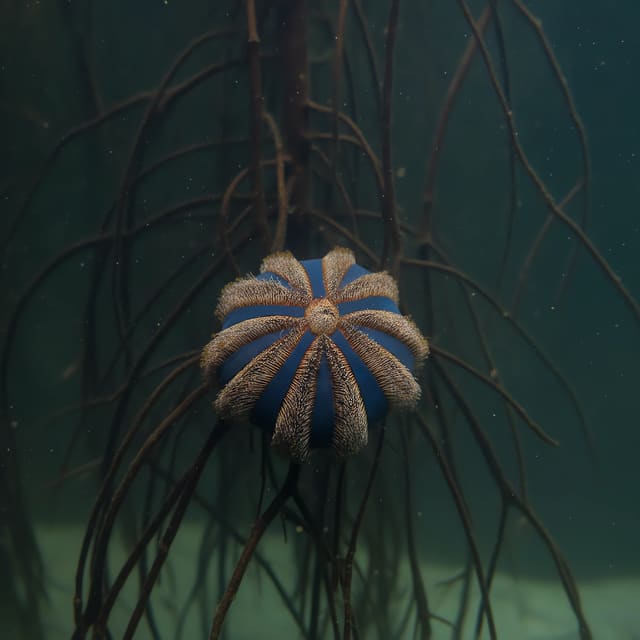
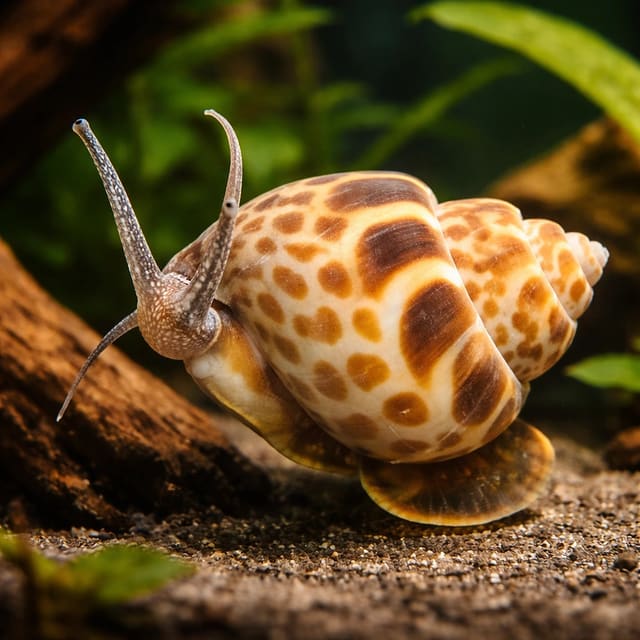
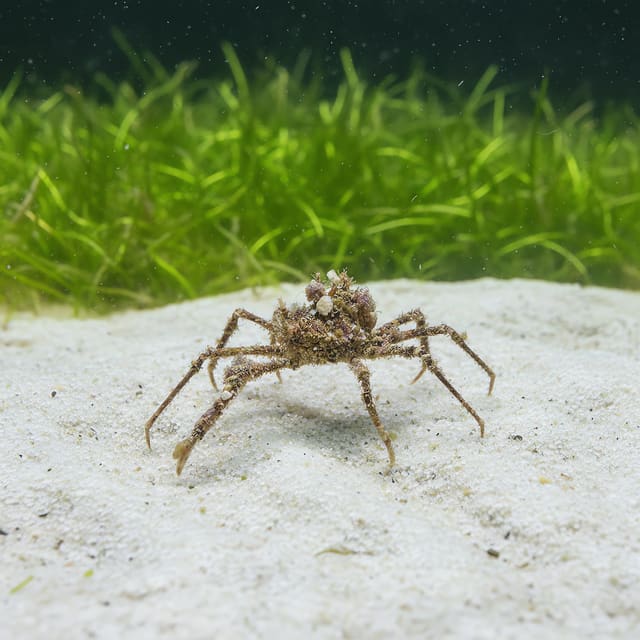
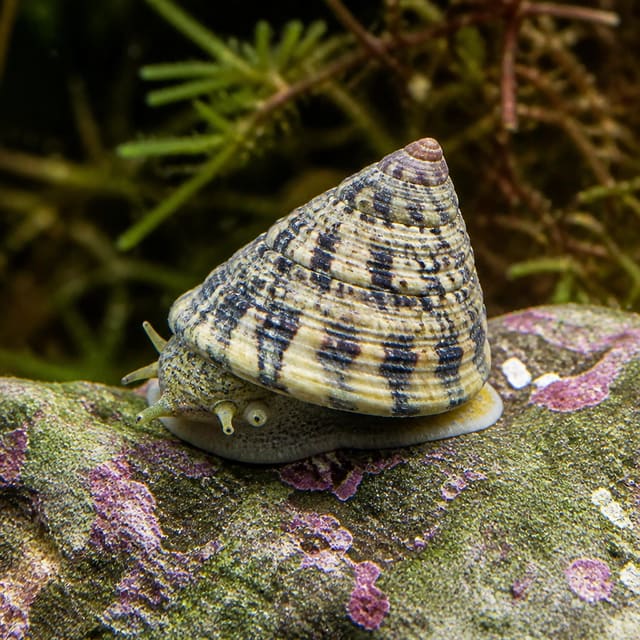
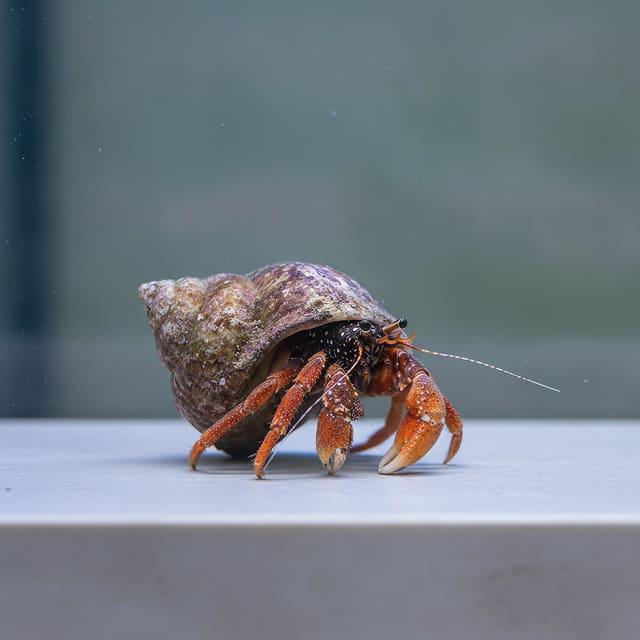
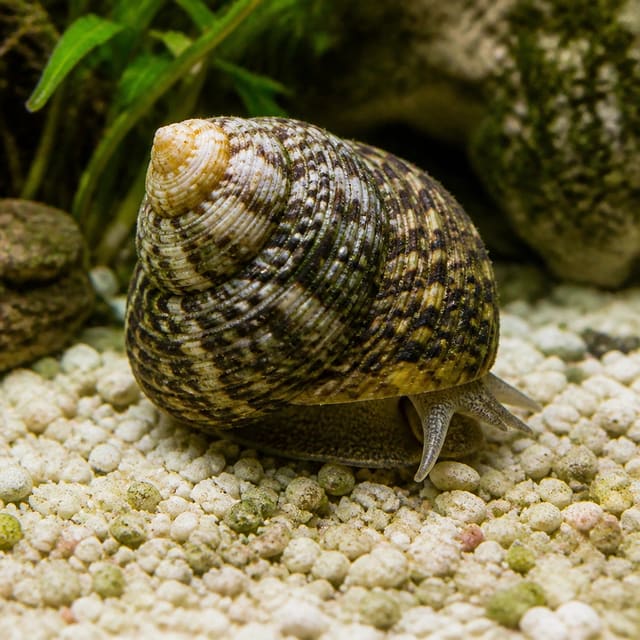
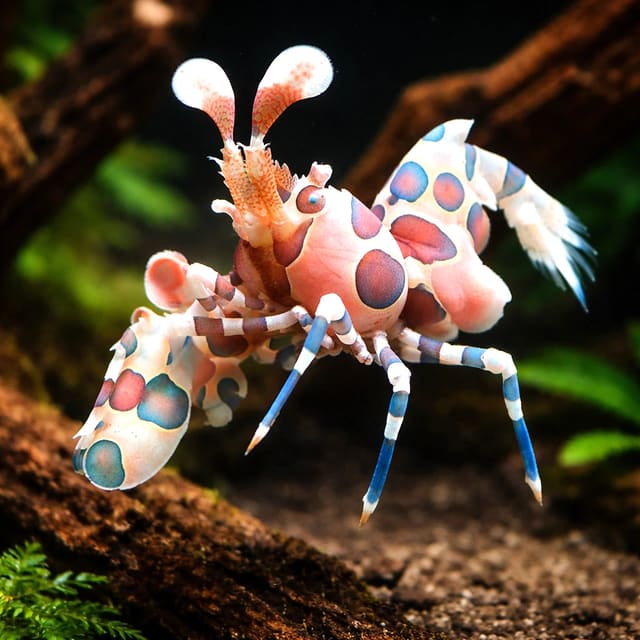
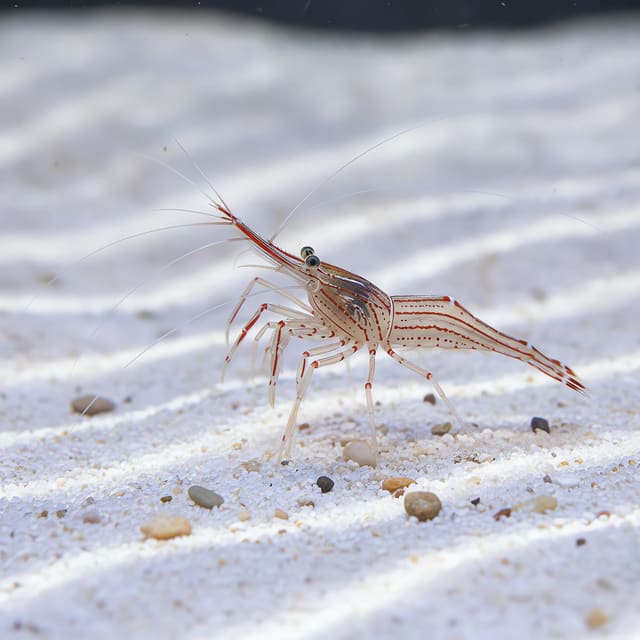
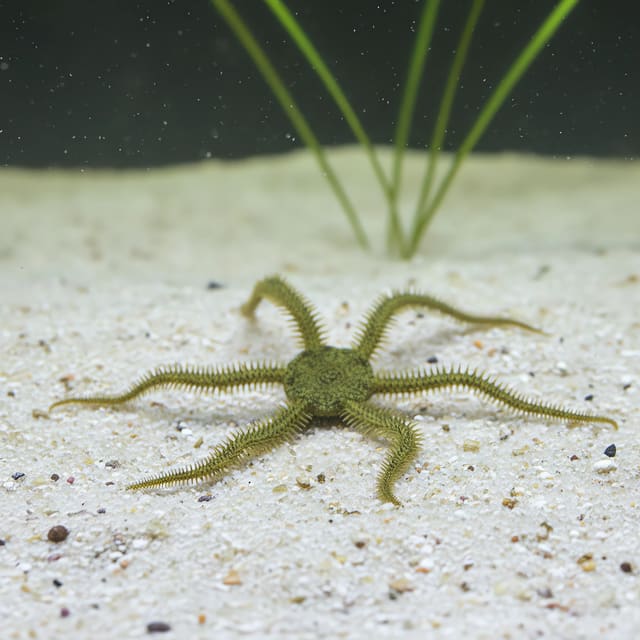
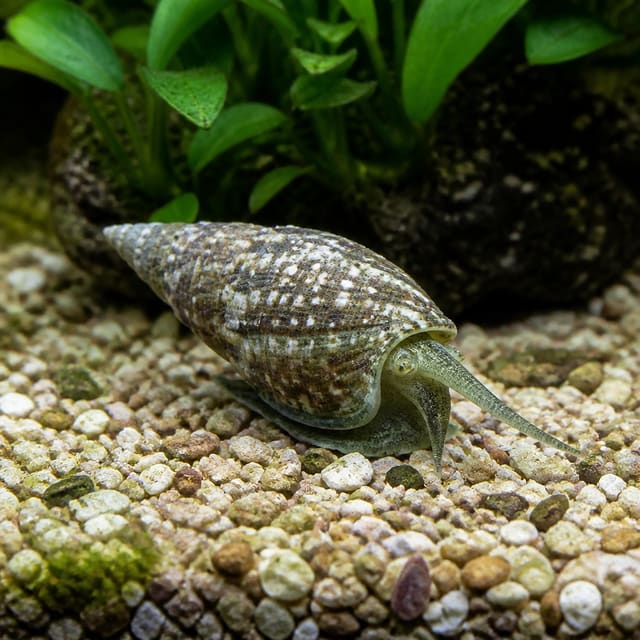
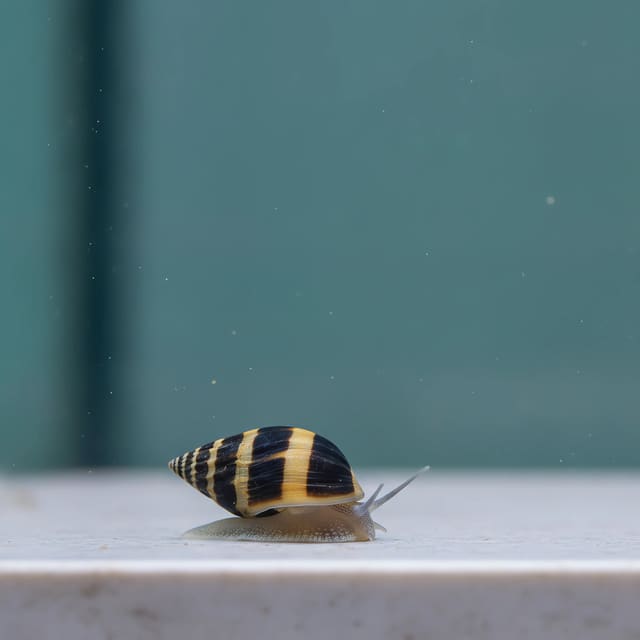
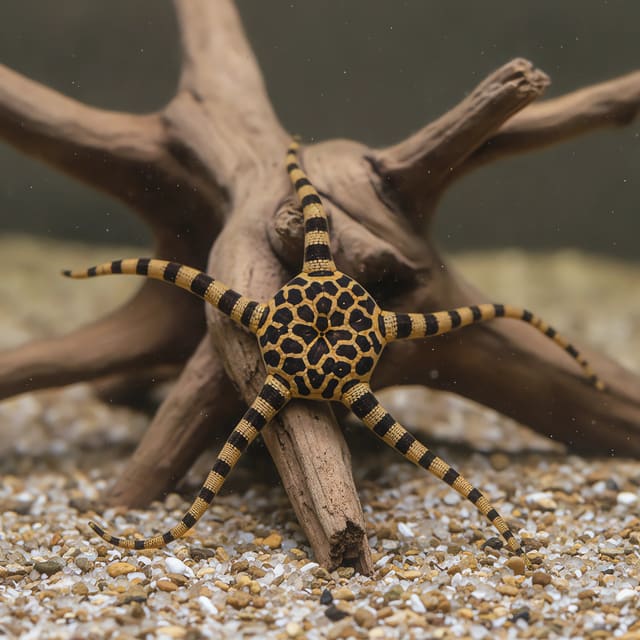
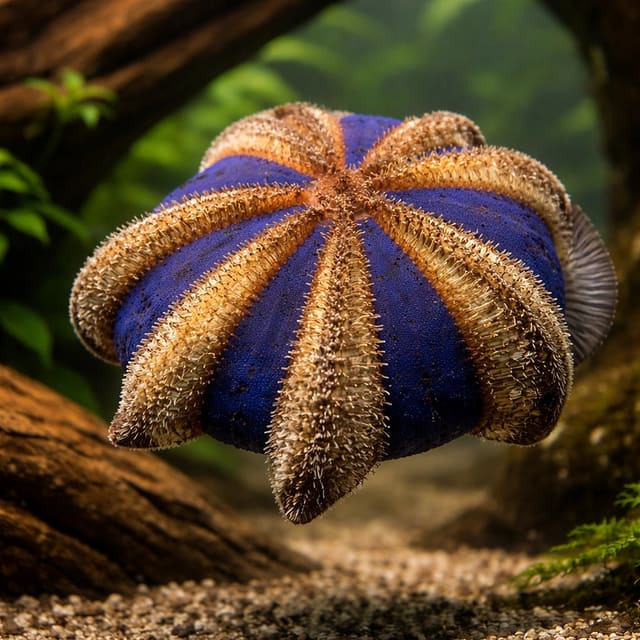
The gallery shows orange-red urchins with dark red bands and pale-tipped spines. Several shots are styled against wood and leafy plants; treat those backdrops as display only, because this urchin belongs in a marine aquarium built around rock. Gallery images have been digitally enhanced to improve image quality. Natural colour, pattern, size and maturity can vary between live animals.
If you are planning a wider clean-up crew around it, browse our marine invertebrates and check each one against the compatibility notes below.
Before ordering, run through four questions. Is the aquarium fully marine and matured, with ammonia and nitrite reading zero? Is there enough rock for a large grazer to travel over, and is it built solidly? Is the tank free of triggerfish and any other fish known to eat echinoderms? And will you keep nori on hand for the weeks when grazing runs short? If the answer to all four is yes, you have covered most of what this animal needs.
It also helps to compare it with the other urchins keepers usually consider. OATA lists the tuxedo urchin, the long spine urchin and the pin cushion urchin among popular aquarium urchins, and notes that the long spine urchin can grow spines up to 25 cm long. The collector urchin sits at the other end of that range: its spines are short and dense and its bulk is in the body, so rock stability and food supply matter more with this species than clearance around long spines.
OATA advises buying an aquarium as large as possible within reason. It recommends at least 60 litres for smaller species and says larger starfish, urchins and sea cucumbers need a larger aquarium, with the size varying by species. For scale, the same sheet gives the yellow sea cucumber as unlikely to grow over 7 cm. An urchin that reaches 10 to 15 cm is clearly in the larger group, so treat 60 litres as a figure for small species and plan a considerably bigger tank.
For a grazer, floor area and rock surface matter as much as the headline volume. The urchin feeds by travelling across surfaces, so a long tank with a broad spread of rock gives it more to graze and more room to move without shouldering past every structure. If you would like a second opinion on a particular tank, send us its dimensions and the livestock already in it.
OATA describes these echinoderms as undemanding of décor, but says live or artificial rock is essential because it provides opportunities for grazing and cover. For this species the rock is the menu as much as the furniture: films of algae on rock and glass are what it works through between supplementary feeds.
Build rockwork that is stable on its own. A large urchin moving along a ledge can shift loosely placed pieces, unsecured coral frags and small ornaments. Seat the base rock firmly on the tank floor, avoid tall, top-heavy stacks and fix frags so they cannot be pushed off their perches.
It may also pick up small shells, rubble or scraps of algae and carry them on its spines, the habit behind the name collector urchin. Keep sharp or fragile loose items out of the display so that nothing it gathers can damage it or be carried away.
Whatever the size of the tank, a filter is essential. OATA lists three routes for marine set-ups: live rock with sufficient water flow, an internal or external filter, or a sump-based filter. A protein skimmer is also beneficial because it removes dissolved organic waste before it breaks down into more harmful substances.
The RSPCA's aquarium environment guidance explains why the filter matters: animals release ammonia, which is toxic, and a working biological filter holds the bacteria that convert it to nitrite, also toxic, and then to the safer nitrate. The same process protects an urchin as much as any fish.
Urchins climb glass as readily as they cross rock. Fit a secure lid or make sure the top edge of the tank offers no easy route out, and look at overflows and pump intakes from the urchin's point of view: a climbing animal can wedge itself against an intake or wander into an overflow box. Guards over intakes are a simple precaution.
OATA describes starfish, sea urchins and sea cucumbers as usually undemanding of water chemistry and gives the suggested values below as a general guide for the whole group. It adds that some parameters need altering in a reef aquarium to accommodate more sensitive species, so a mixed reef tank may run to different figures.
| Parameter | OATA group guidance |
|---|---|
| Salinity | 1.023–1.026 |
| Temperature | 24–26°C |
| pH | 7.9–8.3 |
| Ammonia | Zero mg per litre |
| Nitrite | Zero mg per litre |
| Nitrate | Not above 50 mg per litre |
| Carbonate hardness | 8–12 dKH |
| Calcium | 380–450 ppm |
| Magnesium | 1250–1350 ppm |
These are group values for echinoderms in general rather than a measured optimum for Tripneustes gratilla. Use them as the frame for a stable marine tank: hold salinity and temperature steady inside the ranges rather than drifting from one edge to the other, and correct any change gradually.
OATA warns that starfish, sea urchins and sea cucumbers can be stressed by even the smallest amounts of ammonia and nitrite, which may then cause them to develop various diseases. That is why zero is the only acceptable reading for both. A tank that shows any ammonia or nitrite is not ready for the urchin, and a tank that starts showing it later needs attention before anything else.
Water evaporates from a marine tank but the salt stays behind, so salinity creeps upwards between water changes. Top up evaporation with fresh water prepared for marine use rather than with salt water, and check the reading with a refractometer or hydrometer afterwards. Holding the water level steady is one of the simplest ways to keep salinity inside the 1.023–1.026 range.
Add this urchin only to an aquarium whose filter has fully matured. OATA's introduction advice is to check that ammonia and nitrite are both zero before any invertebrate goes in, and to increase the number of animals slowly. The beneficial bacteria in a filter grow to match the waste they receive, so each new animal, and each increase in feeding, needs time for the bacterial population to catch up.
Stocking too much too quickly leads to what OATA calls new tank syndrome: there are not enough nitrifying bacteria to cope with the extra waste, ammonia and nitrite rise, and invertebrates can become ill or die. Because echinoderms react to even small amounts of ammonia and nitrite, that is a strong reason to add the urchin to a settled tank rather than a new one.
There is a second reason to wait. A grazer arriving in a fresh, spotless aquarium finds little to eat. OATA makes the same point about starfish that graze algae and biofilm, saying they belong in mature aquariums where those foods have had time to grow, and the logic carries straight over to an algae-grazing urchin.
Collector urchins are grazers. OATA states that urchins are herbivorous and are often used to control algae, and that they should be supplemented with nori algae sheets if there is insufficient algae in the aquarium. In a mature tank the urchin works over the film algae and biofilm that grow on rock and glass, moving slowly and steadily as it feeds.
The cleaner the aquarium, the more the urchin relies on you. Watch the surfaces it has been over: if rock and glass look bare and it keeps travelling without settling to graze, the tank is not producing enough on its own. That is the point to begin supplementing.
An urchin grazes surfaces rather than choosing only the algae you dislike. Expect it to work over coralline and other encrusting growth as well as nuisance films. Keeping it well supplied with nori is the practical way to reduce the pressure on anything you would rather it left alone.
An urchin removes algae; it does not remove the reasons algae grows. If algae keeps returning faster than the urchin can graze it, look at the nutrient side as well: nitrate creeping towards OATA's 50 mg per litre ceiling, heavy feeding of the fish or a skimmer that needs cleaning. The urchin works best as a grazer alongside good maintenance. Bought only to clear an outbreak, it tends to end up hungry once the outbreak has gone while the cause is still in place.
Any food that is not eaten becomes waste. OATA's maintenance advice includes siphoning solid waste during water changes, and the same habit keeps uneaten nori from spoiling water quality for an animal that reacts to even small amounts of ammonia.
OATA strongly recommends a partial water change of 25% at least once every week, using a siphon to remove solid waste from the substrate as you go. Prepare the replacement salt water in advance and match it to the tank's salinity and temperature before it goes in, so the change itself does not become a shock.
Filters should be checked and cleaned regularly to prevent blockages. When the media needs cleaning, do not run it under the tap: chlorine or chloramine in tap water may kill the beneficial bacteria that have established in it. Rinse it lightly in the tank water you have just removed during the water change, which keeps far more of those bacteria alive.
Clean the protein skimmer regularly so that it keeps performing, and keep testing ammonia, nitrite and nitrate. OATA's point that echinoderms can be stressed by the smallest amounts of ammonia and nitrite makes routine testing part of the care, not an optional extra.
Keep copper-based treatments out of any aquarium that holds the urchin, and use only medicines labelled as safe for invertebrates. If a fish in the same tank ever needs treating with something that is not invertebrate-safe, move the fish to a separate treatment tank rather than dosing the display.
Every order is hand-packed by our team. Animals are hand-bagged in pure oxygen and packed in an insulated poly box, with a heat pack when the weather calls for it, then carried by a licensed live-animal courier. We email the tracking number and your confirmed delivery date so you know when to be in.
The full terms are on our delivery and Live Arrival Guarantee page. Before the parcel arrives, check that the aquarium's temperature and salinity sit within the ranges in the water table above, so the urchin moves from a stable bag into a stable tank.
Once it is in the aquarium, let the urchin find its own way over the rock. It may sit still for a while before it starts to move, and moving it back and forth to a spot you prefer only adds disturbance. Check that it can grip the rock or glass, keep an eye on pump intakes and overflows, and leave the lid closed.
A new animal adds waste that the filter bacteria have to catch up with, which is exactly why OATA advises adding livestock slowly. Test ammonia and nitrite more often than usual for the first few days and keep both at zero. Note where the urchin grazes and whether those surfaces are left bare. If they are, start offering small pieces of nori rather than waiting for it to go hungry.
By now the routine should be settling: the weekly partial water change, regular testing and nori when grazing runs short. Walk the length of the rockwork every few days and check anything the urchin has pushed against, including frags and loose pieces. Look again at its colour, spines and tube feet against the warning signs below, so that you know what normal looks like for this individual before anything changes.
A settled urchin moves slowly over rock and glass, gripping with its tube feet, and grazes as it goes. It holds on to surfaces, rights itself if it is turned over and responds when water movement or light changes around it. Give it time to explore a new aquarium.
OATA points out that every echinoderm varies a little in behaviour and appearance, and advises watching for changes such as these:
If you are worried, test the water before anything else, as OATA advises. Check ammonia, nitrite, nitrate, salinity and temperature, and look back at your written readings for a recent change. OATA links disease in these animals to stress from poor water quality, so correcting the water is the most useful first step. If the readings look right and the urchin still seems unwell, get in touch and tell us what you have seen.
OATA says starfish, sea urchins and sea cucumbers mix with fish considered reef-safe, and advises checking compatibility with your retailer before any of them go into an aquarium. Treat that as a starting point rather than a blanket pass: check each fish you plan to keep by name, because a fish that leaves corals alone can still harass slow invertebrates.
OATA names triggerfish as fish that may predate on these animals, so do not keep this urchin with them. Apply the same rule to any fish known to eat urchins or other echinoderms. A slow-moving grazer has no way to escape a determined predator in a closed tank.
Check every invertebrate as carefully as the fish. If you also keep starfish, note OATA's warning that harlequin shrimp prey exclusively on starfish; they are a hazard to those starfish rather than to the urchin, but they matter in a mixed echinoderm tank. Snails and other grazers share the same algae supply, so a busy clean-up crew means the urchin will need nori sooner.
In a reef aquarium the main risk from this urchin is mechanical. A large animal moving across rock can dislodge unsecured frags and small colonies, and it will graze coralline and other encrusting growth along the way. Fix frags firmly, keep delicate pieces out of its usual routes and keep it well fed. Remember too that OATA expects some reef aquaria to run different water values for more sensitive species; a stable, mature reef tank can suit it well.
OATA's advice to add livestock slowly applies to the whole tank, not just to the urchin. Add it once the aquarium is mature and algae has had time to establish, then leave a gap before the next addition so the filter can adjust to each increase in waste. Planning the full stocking list in advance also lets you check every future fish against the urchin before it arrives, rather than discovering a problem afterwards.
Two or more large grazing urchins in one aquarium, whether two collector urchins or a mix such as this species with a tuxedo urchin, divide the same algae between them. Only combine them in a tank with plenty of rock and a reliable nori routine, and watch closely for bare surfaces.
| Tank mate | Guidance |
|---|---|
| Reef-safe fish | Suitable once each species has been checked by name |
| Triggerfish | Avoid: they may prey on sea urchins |
| Other large grazing urchins | Only with plenty of rock and regular nori |
| Starfish and sea cucumbers | Check each species before mixing |
| Loose coral frags | Fix them securely before the urchin goes in |
The rule is simple: a mature marine aquarium, reef-safe fish checked one by one, no triggerfish and enough grazing or nori for every herbivore in the tank.
Adult collector urchins can reach 10 to 15 cm. The urchin you receive may be smaller and still growing, so plan the aquarium, the rockwork and the food supply around that adult size.
OATA recommends at least 60 litres for smaller echinoderms and a larger aquarium for larger species. At 10 to 15 cm this urchin belongs in the larger group, so plan a roomy, mature marine tank with a broad spread of rock well above that 60-litre figure.
Start with one. Each large grazing urchin needs its own share of algae, and extra urchins mean more supplementary feeding and more pressure on the rock. Add a second only in a large tank with plenty of rock and a reliable nori routine.
It suits a keeper with an established marine aquarium more than someone setting up their first tank. OATA warns that echinoderms can be stressed by even the smallest amounts of ammonia and nitrite, so the filter must be fully matured and water testing must already be routine.
It is a herbivorous grazer that feeds on algae and biofilm on rock and glass. OATA advises supplementing urchins with nori algae sheets when there is insufficient algae, and removing leftovers keeps the water clean.
OATA's broad guidance for starfish, sea urchins and sea cucumbers is 24–26°C, pH 7.9–8.3, salinity 1.023–1.026 and carbonate hardness 8–12 dKH, with ammonia and nitrite at zero. Keep the values steady rather than letting them drift.
No. It is a slow-moving herbivorous grazer and does not chase or bite fish. Its effect on a tank is physical: it can push loose rock and unsecured frags aside and it grazes encrusting growth.
OATA says urchins mix with fish considered reef-safe, while triggerfish may prey on them and should be avoided. Check every fish and invertebrate by name before it joins the tank.
It is hand-bagged in pure oxygen in an insulated poly box, with a heat pack when needed, and carried by a licensed live-animal courier. Be at home, start a continuous unboxing video before opening, then float the sealed bag for 20–30 minutes before releasing.
No reviews for this item yet. Bought one? Honest reviews only, good or bad.
What customers say about ordering from us
Easy website plenty of info on fish your buying great to pick a time slot
TRACEY DURRANT · 7 Oct 2026
Got some lovely fish thank you
Kevin Mackie · 7 Oct 2026
Reviews of our shop, collected by Judge.me, an independent third-party review collector. Newest first.