Sea Urchin Black (Mespilia globulus) - Marine Aquarium Livestock UK
24–26°C · pH 7.9–8.3
£59.99
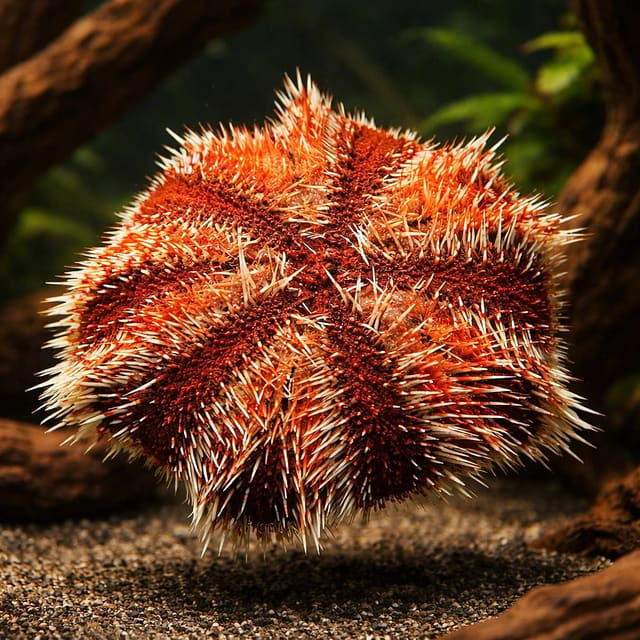
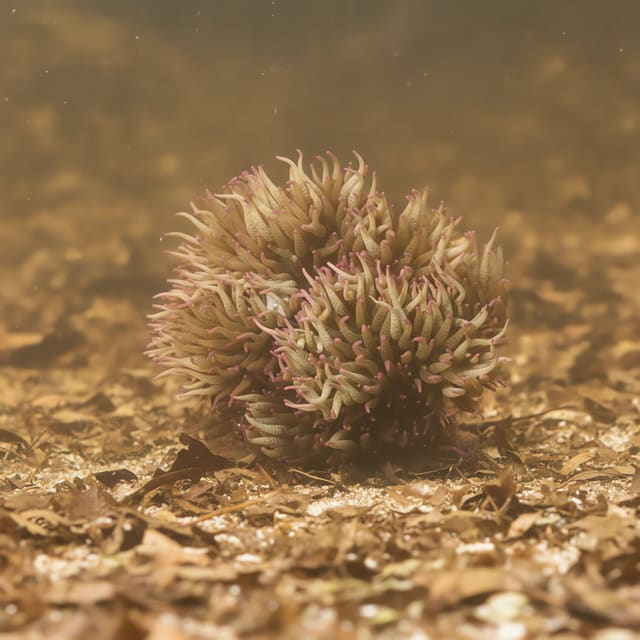
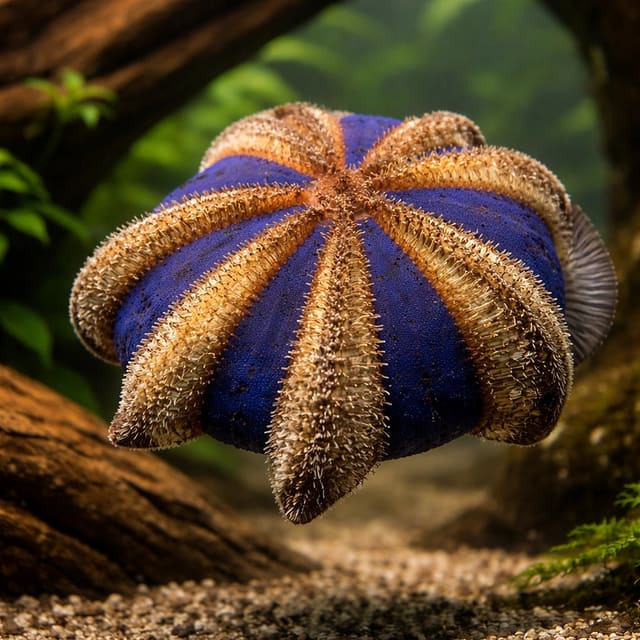
The Red Tuxedo Urchin (Mespilia globulus) is a small grazing sea urchin from shallow tropical reefs, up to 5 cm across, with red-toned spines between bare blue bands. Each purchase is one live urchin for a mature, copper-free marine aquarium with plenty of rock to graze.
Mespilia globulus
The Red Tuxedo Urchin (Mespilia globulus) is a small grazing sea urchin from shallow tropical reefs, up to 5 cm across, with red-toned spines between bare blue bands. Each purchase is one live urchin for a mature, copper-free marine aquarium with plenty of rock to graze.
Maintain these water conditions for optimal health and vibrant colors
The Red Tuxedo Urchin (Mespilia globulus) is a small, grazing sea urchin from shallow tropical reefs, rubble and seagrass beds. It grows to a diameter of up to 5 cm, and its short spines grow in bands separated by bare, velvety zones of blue or green. Each purchase is one live urchin. It needs a mature marine aquarium with live or artificial rock to graze, steady water quality and no copper.
| Suits | Keepers with an established, stable marine aquarium and plenty of grazing surface |
|---|---|
| Family | Temnopleuridae |
| Wild home | Shallow tropical reefs, coral rubble and seagrass in the Indo-Pacific |
| Size | Up to 5 cm across the body, spines up to 2 cm |
| Diet | A grazer of algae and organic film on rock and glass |
| What you receive | One live urchin |
Mespilia globulus is popular with marine aquarists for its colours and unusual shape, and it is generally described as low-maintenance and harmless to the other animals in the tank. It is small enough for modest reef aquariums, and it adds slow, steady movement that is easy to follow once you know where it shelters.
Expect a quiet routine. By day it usually wedges itself into the rockwork, and after the lights go out it travels over rock and glass, grazing as it goes. You will often find it somewhere new each morning, sometimes wearing a fresh collection of shell fragments or rubble. That night-time grazing is the heart of its care: the more mature rock surface it can work over, the easier it is to keep well fed.
One purchase supplies one live Red Tuxedo Urchin. There is a single version of this listing, sold as the red colour form of Mespilia globulus. The spines of this species are usually brown, red or dark, and the red form is the same species as darker tuxedo urchins, with the same care.
Sex is guaranteed only when the selected option explicitly states male or female. This Mespilia globulus red listing has no sex-guaranteed option. Tuxedo urchins have separate sexes, like all sea urchins, but no male or female is selected for this listing.
Gallery images have been digitally enhanced to improve image quality. Natural colour, pattern, size and maturity can vary between live animals.
Like all echinoderms, sea urchins show radial symmetry. The rounded shell of Mespilia globulus, called the test, carries ten vertical zones without spines, and these bare zones are the velvety blue or green stripes behind its tuxedo trade name. Between them run bands of short spines, reaching up to 2 cm, usually brown, red or dark. Tube feet let the urchin grip rock and glass and move along; loss of attachment or loss of tube feet are both on OATA's list of warning signs.
The species was named by Linnaeus in 1758, originally as Echinus globulus. The World Register of Marine Species lists Mespilia globulus as an accepted species in the family Temnopleuridae, order Camarodonta. The specific name refers to a small ball or spherule, a fair description of its rounded test, and Mespilia globulus is the only species in its genus.
Besides tuxedo urchin, which is a trade name, it is known as the globular sea urchin and the sphere sea urchin. Red and black refer to the spine colour of individual animals rather than to separate species.
Mespilia globulus lives mainly on shallow reefs, among coral rubble and in seagrass beds. Its range covers the shallow tropical waters of the Indo-Pacific and Indian Ocean, including the western Pacific and Japan. Wikipedia's article on Mespilia globulus gathers the published descriptions of its habitat, behaviour and breeding.
In the wild, animals gather near the coast in the breeding season and move slightly offshore for the rest of the year. That seasonal shift is a note about wild populations, not something your aquarium needs to reproduce.
Sea urchins in these habitats graze, eating organic material that has settled or is growing on rock, coral structure and the sea floor. Tuxedo urchins forage mainly at night and stay hidden in coral or rock during the day. In the aquarium, that means an urchin tucked into the rockwork by day is behaving normally, and the rockwork itself is both its larder and its shelter.
A study published in 2019 raised young Acropora millepora corals alongside tuxedo urchins and found that the urchins' grazing improved the corals' early survival. The same line of research found that crowding urchins together slows their growth, because each one has less food. Both findings point the same way: a tuxedo urchin does best where there is plenty of grazing and not too much competition for it.
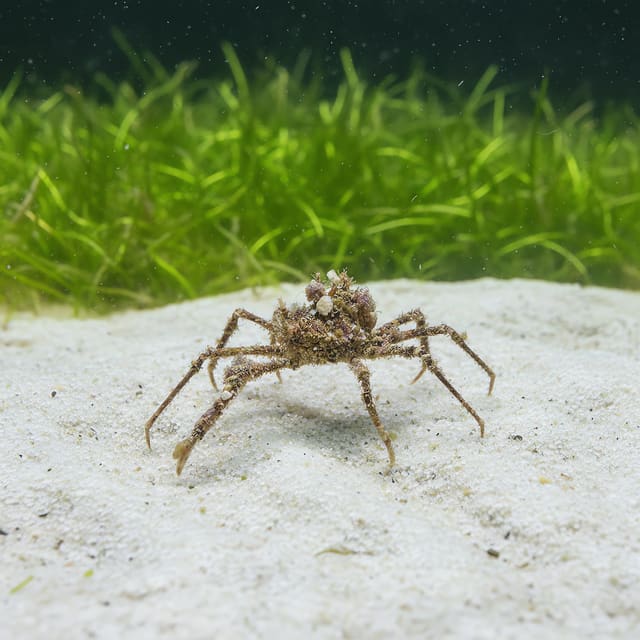
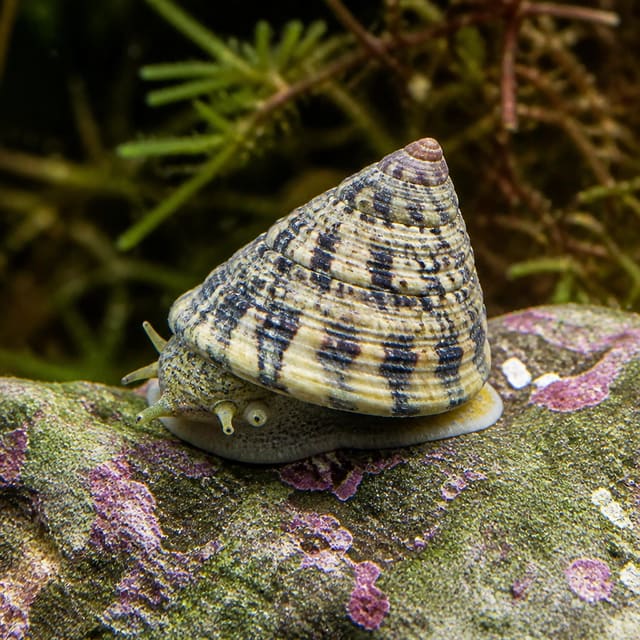
This species gathers debris from its surroundings onto its test, apparently as camouflage or protection. In the aquarium you may see it wearing fragments of shell, rubble, algae or other loose material. It has also been observed living alongside other invertebrates such as crabs, and some sea snails are known to parasitise it.
Like all sea urchins, Mespilia globulus has separate male and female sexes. In the Pacific and Indian Oceans the breeding season typically runs from July to September. Eggs and sperm are released into the water, where fertilisation takes place, and brooding of eggs on the body is also common. Successful breeding in aquariums has been reported only a few times, so the aquarium trade relies largely on animals collected from the wild.
OATA's care sheet for starfish, sea urchins and sea cucumbers gives the general rule: within reason, buy an aquarium as large as possible. It recommends an aquarium of at least 60 litres for smaller species, and larger for bigger echinoderms. At up to 5 cm across, the tuxedo urchin is one of the smaller urchins, but the real limit is food: a larger, mature aquarium has more rock surface for it to graze, which matters more than the urchin's own size.
Larger volumes also change more slowly. Invertebrates struggle with changes in water chemistry more than fish do, so the extra stability of a bigger system is a genuine benefit for this animal.
A filter is essential whatever the size of the aquarium. OATA lists live rock with sufficient water flow, an internal or external filter, or a sump-based filter as suitable marine options. A protein skimmer can also help, because it removes dissolved organic waste before it breaks down into more harmful substances.
The RSPCA's guidance on aquarium filtration explains why this matters. Animals release ammonia, which is toxic, and a working biological filter grows the beneficial bacteria that convert it to nitrite, also toxic, and then to nitrate, which is safer. Aim for moderate water flow that gives good surface movement and stops detritus settling in dead spots.
Build the rock as one stable structure with overhangs and crevices where the urchin can wedge itself by day, and open faces where algae and film can grow under the lights. Leave a gap between the rock and the glass so it can travel between them. Keep some rock surface free of corals to act as grazing ground; a reef packed wall to wall with coral leaves little for a grazer to eat. Position pumps to give good surface movement without blasting the crevices where it shelters, and check that nothing loose sits where a climbing urchin could topple it.
A grazer needs something to graze. OATA advises that starfish which feed on algae and biofilm should only go into mature aquariums where those foods have had time to grow, and the same logic applies to a grazing urchin. Add the tuxedo urchin once the aquarium has run long enough for algae and film to establish on the rock, not in the first weeks of a new set-up.
OATA publishes suggested water values for starfish, sea urchins and sea cucumbers as a group. They are a general guide for these invertebrates, not a species-specific optimum for Mespilia globulus, and OATA notes that some values need adjusting in a reef aquarium to suit more sensitive species such as corals.
| Measure | OATA group guidance |
|---|---|
| Salinity (specific gravity) | 1.023–1.026 |
| Temperature | 24–26°C |
| pH | 7.9–8.3 |
| Ammonia | Zero mg per litre |
| Nitrite | Zero mg per litre |
| Nitrate | Not to exceed 50 mg per litre |
| Carbonate hardness | 8–12 dKH |
| Calcium | 380–450 ppm |
| Magnesium | 1250–1350 ppm |
Whatever values your system runs at, keep them steady. OATA stresses that echinoderms can be stressed by even the smallest amounts of ammonia and nitrite, which may then lead to disease, so zero readings are the target rather than a low reading.
Evaporation removes water but leaves the salt behind, so an open marine aquarium slowly becomes saltier between water changes. Replace evaporated water with fresh water that has been treated to remove chlorine, not with more saltwater, and check salinity regularly with a hydrometer or refractometer. Small, frequent top-ups keep specific gravity far steadier than one large correction, which is what an animal sensitive to changes in water chemistry needs.
These three values sit in the same OATA group guidance as salinity and pH. In an urchin-only or fish-only system they are worth checking whenever other readings drift. In a reef aquarium with corals, test them routinely, because OATA points out that some parameters may need adjusting to suit more sensitive species.
Copper is toxic to sea urchins, as it is to other invertebrates. Never use copper-based treatments in an aquarium that holds a tuxedo urchin, check the ingredients of anything you add to the water, and take care when introducing fish from systems that use copper. A separate treatment aquarium keeps fish medication away from your invertebrates.
OATA describes sea urchins as herbivorous and notes that they are often used to control algae in the aquarium. In the wild, tuxedo urchins graze organic material that has settled or is growing on rock and the sea floor. In a mature aquarium, much of its food comes from the algae and film on your rockwork and glass.
If there is not enough algae in the aquarium, OATA advises supplementing an urchin's diet with nori algae sheets. It is most likely to be needed in a clean, well-skimmed system or in a tank where several grazers share the same rock.
A well-fed urchin moves across the rock, stays attached firmly and keeps its spines and tube feet intact. Reduced feeding and lower activity are among the changes OATA lists as early warnings, so if the rock looks grazed clean and the urchin slows down, add nori and test the water. Remember that density matters: the more grazers share the aquarium, the sooner the natural food runs out.
Tuxedo urchins climb glass as well as rock, and a grazing urchin can leave clean tracks through a film of algae. Those trails are a useful sign that it is moving and feeding. If the glass and rock stay spotless for long periods, the natural food supply may be running low, which is the moment to start supplementing with nori.
Urchins are generally good at grazing algae, and a tuxedo urchin will work steadily over the rock it can reach. Treat it as one part of good husbandry alongside water changes, sensible feeding of the other livestock and appropriate lighting, and plan its diet as carefully as you would for any other animal in the tank.
Everything is hand-packed by our team. Your urchin is hand-bagged in pure oxygen and packed in an insulated poly box, with a heat pack when the weather calls for it. We email you the tracking number and your confirmed Thursday or Friday delivery date, and a licensed live-animal courier carries the parcel. Our delivery and Live Arrival Guarantee page sets out the full terms.
Urchins have sharp spines, so OATA advises handling them carefully. Move the urchin gently, place it on rock rather than dropping it, and keep your hands clear of the spines. OATA also suggests a sign on the front or lid of any aquarium holding animals with hazards, so that everyone in the household knows what is inside.
Monitor the new urchin carefully for the first week, paying particular attention to water quality. Expect it to head for cover by day, and look for grazing trails or a changed position the next morning as signs that it is moving and feeding. OATA notes that quarantining new livestock in a separate aquarium for at least a week can reduce the risk of disease reaching the main tank, if you have the space to do so.
Increase the number of animals in the aquarium only slowly afterwards. Each addition increases waste and feeding, and the filter's bacteria need time to catch up.
All echinoderms vary a little in behaviour and appearance. OATA lists the changes worth noticing early:
Tuxedo urchins normally carry bits of debris on their tests. In the aquarium trade it is often said that an urchin carrying nothing is stressed or unwell. Treat a sudden change in this habit as a prompt to test the water and look for the other signs above, rather than as a diagnosis on its own.
Note where the urchin shelters each morning, when you last saw fresh grazing trails, and your weekly water readings. A few lines in a notebook make it much easier to spot a slow change in activity or appetite, and they give you something concrete to work from if you need advice.
Test the water quality first: ammonia, nitrite, nitrate, salinity, temperature and pH. OATA links stress and disease in echinoderms to even small amounts of ammonia and nitrite, so the fix often starts there. Then get in touch with our team for further guidance, with your readings to hand.
A tuxedo urchin can live in either, as long as the system is mature and copper-free. In a reef aquarium, its grazing complements the corals, but the corals set the lighting and may need water values adjusted from the urchin group guidance. In a fish-only aquarium, choose fish that are reef-safe and that do not prey on echinoderms, and keep copper-based fish treatments out of the system for as long as the urchin lives there.
Tuxedo urchins vary in spine colour from red to brown and dark shades. The colour forms are the same species with the same care, so the choice is purely a matter of taste. Keeping different colour forms together follows the same rule as any group: enough food for every urchin.
Generally, sea urchins are not social animals and can be kept singly, so one tuxedo urchin is a complete purchase in its own right. If you want more, add them gradually and make sure the rock surface and supplementary feeding can support every animal.
Our marine invertebrates collection covers other animals often kept with urchins in reef aquariums. Check each one's own diet and compatibility, and always confirm that a new fish or invertebrate is suitable for the animals you already keep before buying. A generally peaceful urchin still needs companions that leave it alone and enough food to go round.
Mespilia globulus reaches a body diameter of up to 5 cm, and its short spines grow to about 2 cm. It is one of the smaller urchins kept in marine aquariums.
Choose as large a mature marine aquarium as you reasonably can, with plenty of live or artificial rock to graze. OATA recommends at least 60 litres for smaller echinoderms such as this one, but more rock surface means more natural food.
One is fine on its own, because sea urchins are generally not social. They are not territorial either, so a group works if there is enough algae and supplementary food for every animal.
It is a popular, low-maintenance urchin that generally does not harm other animals, but it needs an established marine aquarium with stable water and no copper. It is not an animal for a newly set-up tank.
It is a herbivorous grazer that feeds on algae and organic film on rock and glass, mostly at night. If there is not enough algae, supplement its diet with small pieces of nori algae sheet.
OATA group guidance for sea urchins is 24–26°C, pH 7.9–8.3 and salinity 1.023–1.026, with ammonia and nitrite at zero. These are general values for the group, so keep your own readings steady within them.
No. Urchins are not territorial and generally do not harm other animals, and it has no fins to nip or be nipped. Its spines are sharp, though, so handle it carefully.
It mixes with fish considered reef-safe and with corals in a mature reef once fragments are fixed in place. Keep it away from triggerfish and other fish that prey on echinoderms, and never add copper to its aquarium.
It is hand-bagged in pure oxygen, packed in an insulated box with a heat pack when the weather calls for it, and delivered on a confirmed Thursday or Friday by a licensed live-animal courier. Someone must be at the address to receive it. Start a continuous unboxing video before opening the parcel, inspect the urchin the same day, then float the sealed bag for 20–30 minutes before releasing it. Under our Live Arrival Guarantee, contact us the same day with your order number and the video if anything has gone wrong.
No reviews for this item yet. Bought one? Honest reviews only, good or bad.
What customers say about ordering from us
Easy website plenty of info on fish your buying great to pick a time slot
TRACEY DURRANT · 7 Oct 2026
Got some lovely fish thank you
Kevin Mackie · 7 Oct 2026
Reviews of our shop, collected by Judge.me, an independent third-party review collector. Newest first.