Easy
Black Fire Endler Guppy (Poecilia wingei)
24–28°C · pH 7–8 · 41L
£16.99

One live, unsexed Sunset Comet Platy (Xiphophorus maculatus) at approximately 3-4 cm. Keep at least five in a mature 75L+ hard-water aquarium; the gallery image is a representative illustration.
Xiphophorus maculatus
Shoaling fish: kept in a group they feel safer, stay calmer and show their best colour.
Confirm your email, then we’ll send an availability message for this exact item if it returns within 180 days.
This request is only for this product—no newsletter or other promotions. A mail-provider retry may very rarely duplicate the same availability message. Unconfirmed addresses are removed after 48 hours. See our privacy policy.
One live, unsexed Sunset Comet Platy (Xiphophorus maculatus) at approximately 3-4 cm. Keep at least five in a mature 75L+ hard-water aquarium; the gallery image is a representative illustration.
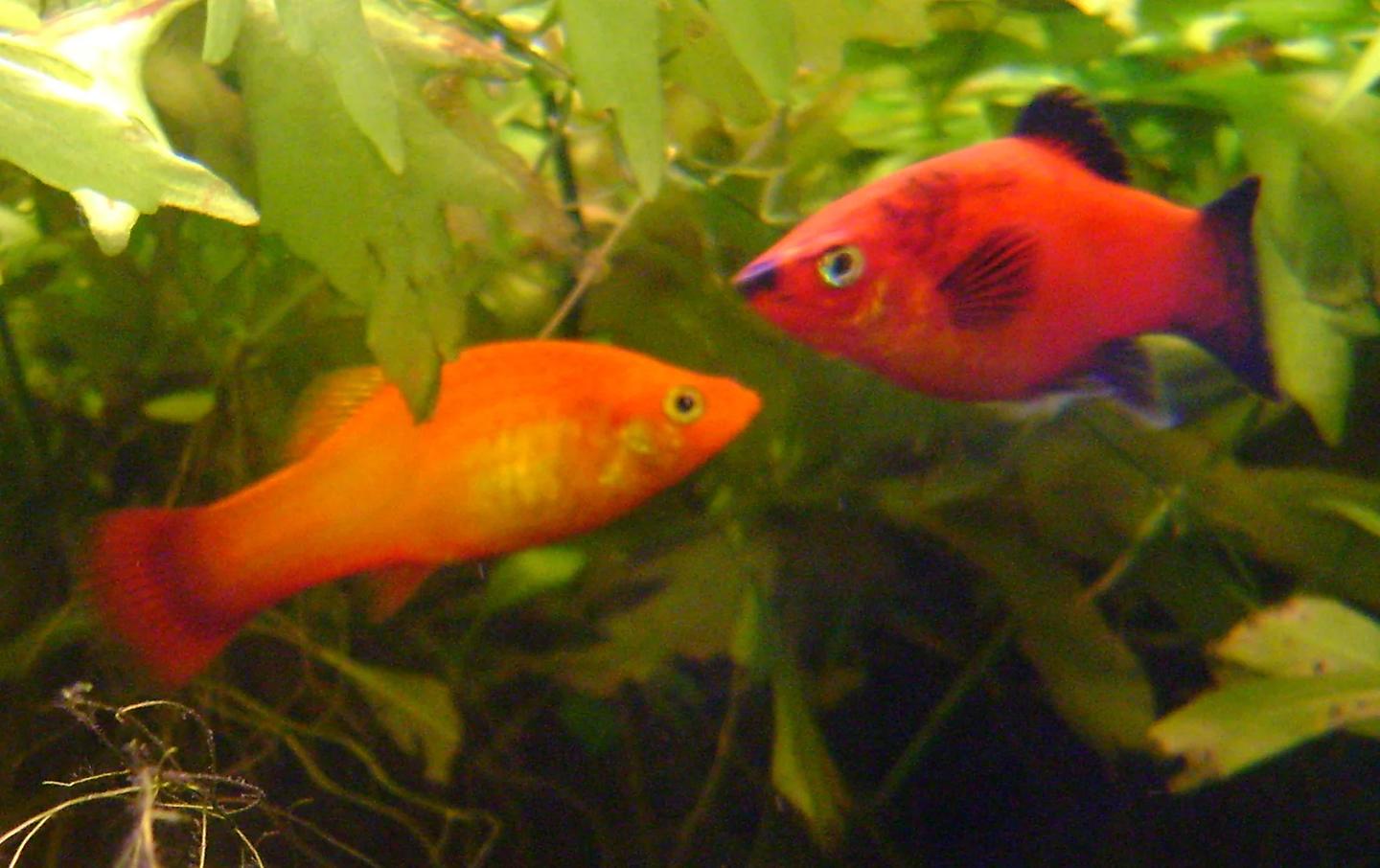
Platy is a trade name used for Xiphophorus maculatus, X. variatus and domestic forms. Start with at least three in a mature aquarium of at least 45 litres, verify the exact fish and measured water, and plan extra capacity before mixing sexes.
Maintain these water conditions for optimal health and vibrant colors
Sunset Comet Platy (Xiphophorus maculatus) is a bright, active livebearer for a mature freshwater community aquarium. The Sunset Comet name identifies a commercial colour variety of the Southern platyfish; it is not a separate species or a wild locality. Expect individual variation in orange, red, dark and pale markings rather than one mechanically identical pattern.
This product is one live, unsexed fish at approximately 3-4 cm when available. Quantity one is not a pair, and the listing does not promise a male, female or pregnant fish. Plan the complete social group and aquarium before choosing the basket quantity.
One selection adds one live Sunset Comet Platy to the basket. The current supplied length is approximately 3-4 cm, with ordinary biological variation around that guide. The protected Shopify product has one default option and our stock records do not specify sex, pregnancy, a pair or a trio.
| Listing detail | Current meaning | Not promised |
|---|---|---|
| Quantity 1 | One live fish | Not a pair, trio or group |
| Supplied size | Approximately 3-4 cm | Not an exact measured length |
| Sex | Unsexed | No male or female guarantee |
| Reproductive status | Not specified | No pregnancy or fry promise |
| Colour | Sunset Comet trade variety | No identical pattern guarantee |
| Gallery | One representative illustration | Not an exact-stock photograph |
The historic URL contains pregnancy wording, but a URL is not a selectable product option. Neither the current source row nor Shopify identifies this fish as female or pregnant. The handle remains unchanged for continuity because Google has already crawled it, while every customer-facing statement follows the current unsexed sale contract.
Platies are social livebearers, although they do not form a tightly coordinated school. Plan at least five platies and enough space for the full adult group. Because sex cannot be selected on this SKU, do not assume that ordering several creates a particular male-to-female ratio. Dense planting, visual breaks and careful observation are still required.
The species is Xiphophorus maculatus, known in scientific references as the Southern platyfish. NCBI Taxonomy records the accepted identity in family Poeciliidae and order Cyprinodontiformes. The older name Platypoecilus maculatus may appear in historic literature but does not describe a different product here.
Sunset Comet is a commercial aquarium-variety name. It helps distinguish this line in trade, but it does not define a formal subspecies, a collection site or a universal pattern standard. Colour can change with age, lighting, diet, background, stress and individual genetics. Use the name to choose the general variety, not to demand an exact duplicate of an illustration.
| Name | Role | What it tells you |
|---|---|---|
| Sunset Comet Platy | Trade-variety name | General commercial colour identity |
| Xiphophorus maculatus | Accepted species name | Biological identity and care evidence |
| Southern platyfish | English species name | Common name used in references |
| Poeciliidae | Family | Livebearer family relationship |
| Blue Wagtail Platy | Different colour variety | Not the product offered on this page |
Wild X. maculatus occurs in northern Central America, with FishBase recording a range from Veracruz in Mexico to northern Belize. Domestic colour varieties have been selected in aquaria and may have mixed breeding histories. This listing does not claim that the supplied fish is wild-caught, from a named river, or representative of wild colour.
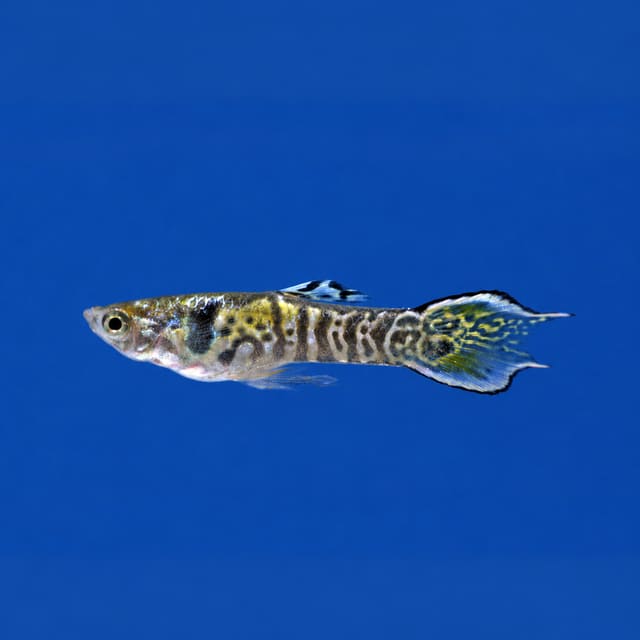
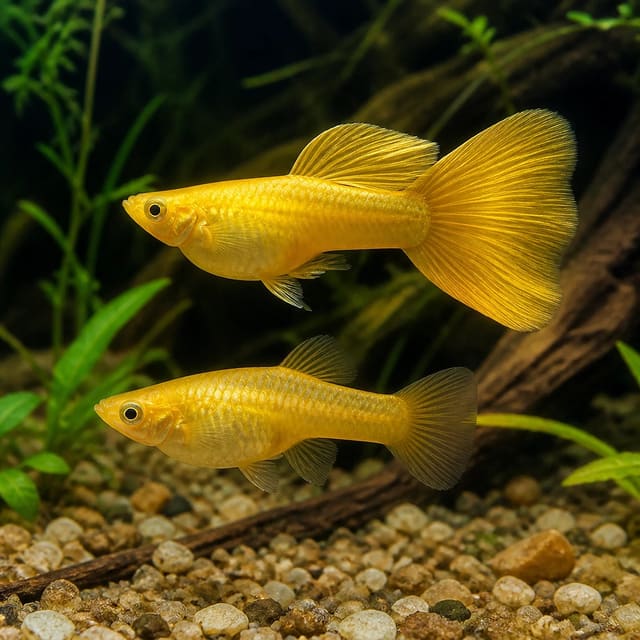
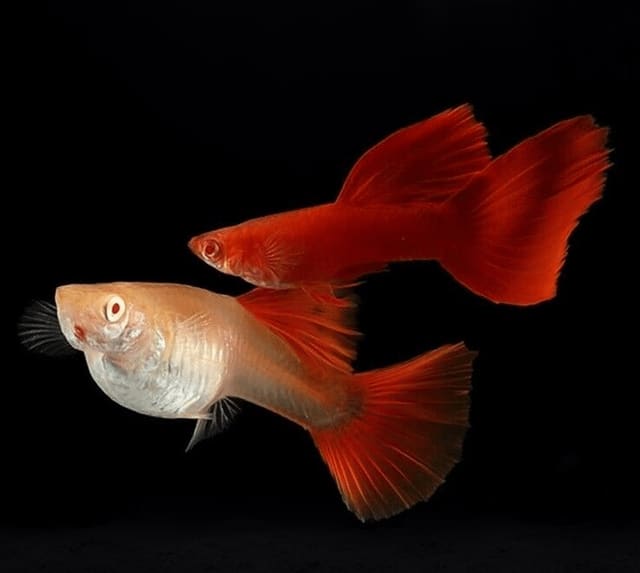
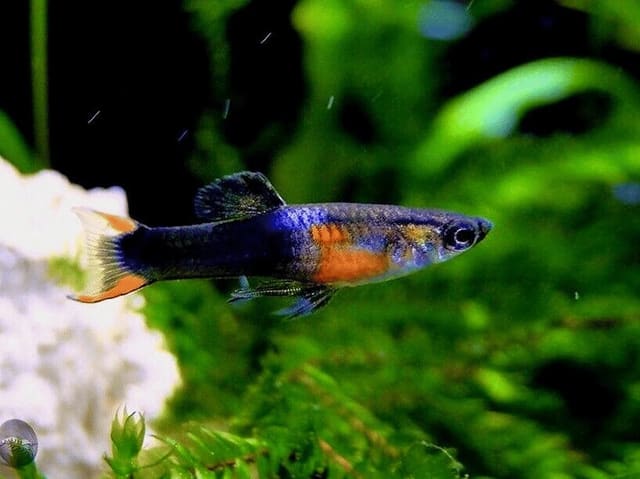
The gallery contains one generated aquarium illustration because our stock records have no reference photograph. It is retained as a visual guide, not proof of the exact fish in stock. The dispatched animal may differ in hue, markings, fin outline, body depth, maturity and sex.
Do not use the illustration to sex the fish, diagnose pregnancy, identify a strain standard or infer adult anatomy. In particular, platies do not carry the extended lower tail sword associated with male swordtails. Product identity comes from the current source record and accepted species name, not from interpreting a generated fin shape.
A newly arrived fish may appear paler while settling. Colour normally becomes easier to judge under stable conditions, appropriate food and calm social behaviour. Aquarium lighting and camera processing also alter how orange and red tones appear, so an online image should never be treated as a calibrated colour sample.
| Care point | Practical recommendation |
|---|---|
| Scientific name | Xiphophorus maculatus |
| Family | Poeciliidae |
| Supplied size | Approximately 3-4 cm |
| Adult planning size | Up to about 6 cm total length |
| Social plan | At least five platies |
| Practical minimum | 75L+, at least 60 cm long for five |
| Preferred temperature | 20-25°C |
| pH | 7.0-8.0 |
| Hardness | 9-19 dGH |
| Diet | Omnivore; complete staple plus plant and invertebrate foods |
| Tank region | Mainly middle to upper water |
| Temperament | Generally peaceful, active and socially persistent |
| Care level | Moderate |
FishBase records 18-25°C, pH 7.0-8.0, 9-19 dH and a 60 cm minimum aquarium length. This page uses 20-25°C as a stable domestic target and 75 litres for five adults to create practical headroom for group movement, planting and filtration. The larger retail recommendation is deliberately conservative.
Test the aquarium with reliable equipment. A town described as having hard water can still have household treatment, seasonal variation or a different supply zone. Temperature, pH and hardness labels are useful only when ammonia is zero, nitrite is zero, nitrate is controlled and changes remain gradual.
The Sunset Comet Platy can suit a keeper with a cycled, mineral-rich freshwater aquarium, room for a social group, peaceful companions and time to monitor reproduction and pursuit. Its visible activity and appetite make it engaging, while the colour variety can add warm tones without requiring a species-only display.
Choose another species for persistently soft acidic water, a tiny container, an uncycled aquarium, a community of slow delicate long-finned fish, or a setup where unexpected fry cannot be managed responsibly. This SKU is also unsuitable when a guaranteed sex, exact pattern or named breeder line is essential.
| Existing setup | Fit | Reason |
|---|---|---|
| Mature 75L+ planted community | Potentially suitable | Confirm hardness, group and adult stocking |
| Hard-water livebearer aquarium | Potentially suitable | Check social pressure and reproduction plan |
| Soft acidic blackwater aquarium | Poor fit | Mineral chemistry does not match |
| 30L nano aquarium | Unsuitable | Too little room for the complete group |
| Uncycled new aquarium | Unsuitable | Ammonia and nitrite must remain zero |
| Exact-colour breeding project | Not supported | No breeder line or pattern guarantee is documented |
Platies are often marketed as effortless beginner fish, but a strong listing should describe the complete responsibility. They need stable hard water, a suitable group, measured feeding, adult-sized space and a plan for persistent courtship or fry. Those tasks are manageable, but they should not be hidden behind an easy-care slogan.
Use at least 75 litres and 60 cm aquarium length for five adult platies. The 60 cm length follows the published aquarium guidance; the volume recommendation adds working room for plants, open swimming, filtration and dilution. Increase both length and volume for more platies or substantial tank mates.
Active livebearers use horizontal space for feeding, avoidance and courtship. A tall narrow aquarium may hold the same litres while offering less useful distance. Arrange plants and wood so a pursued fish can leave view without removing all open swimming space.
| Planning case | Direction | Important note |
|---|---|---|
| Five adults, species-led group | 75L+, 60 cm length | Provide cover and multiple feeding positions |
| Larger platy group | Increase footprint | Allow for adult biomass and possible fry |
| Platies with tank mates | Increase again | Fit every species at full adult group size |
| Temporary juvenile housing | Short, planned use only | Do not postpone the adult aquarium indefinitely |
| Breeding management | Separate planned capacity | Never rely on an overcrowded display tank |
Filter capacity does not cancel social or swimming-space limits. Count the final adult sizes of every fish, the floor and surface area used by other species, feeding competition and the possibility of offspring. A heavily planted 75-litre aquarium can still be overstocked if every available niche is already occupied.
Add live fish only after the filter can process waste reliably. Ammonia and nitrite must remain at zero. A calendar alone does not prove a cycle; test results and stable processing after a known ammonia source are more meaningful than saying that a tank has simply been running for a number of weeks.
Keep nitrate controlled through sensible stocking, measured feeding, plant growth where appropriate and regular partial water changes. The appropriate change volume depends on the measured trend, source-water chemistry and stocking load. Match replacement water temperature and avoid a sudden mineral swing.
Use sufficient surface movement for gas exchange without turning the aquarium into a high-current channel. Warm water holds less oxygen, and a crowded livebearer tank can deteriorate quickly during a power or filter failure. Observe breathing rate and surface behaviour as well as test results.
| Parameter | Target | Avoid |
|---|---|---|
| Temperature | 20-25°C | Rapid shifts or chronic overheating |
| pH | 7.0-8.0 | Persistently acidic conditions |
| General hardness | 9-19 dGH | Very soft, mineral-poor water |
| Ammonia | 0 | Any detectable reading |
| Nitrite | 0 | Any detectable reading |
| Nitrate | Low and controlled | A steadily rising neglected trend |
A pH of 7.4 that remains steady is generally more useful than repeatedly dosing the aquarium to chase a decimal. If source water is outside the suitable mineral range, understand alkalinity and hardness before choosing a correction method. Sudden pH movement is dangerous even when the final number falls inside a published range.
Do not add salt by routine. The species is a freshwater fish, and suitable hardness should be achieved through known freshwater mineral chemistry rather than an unexplained scoop of sodium chloride. Salt can affect plants, invertebrates and tank mates, and any therapeutic use should be based on a diagnosis and compatible occupants.
Use the water parameter matcher to compare measured conditions with the intended care range. Record temperature, pH, general hardness, ammonia, nitrite and nitrate. This prevents an attractive colour variety from being placed into fundamentally incompatible water.
Plant the rear and sides densely enough to break sight lines, then retain an open central or front area for swimming and feeding. Fine-leaved or floating cover can help shy fish and any unexpected fry, but the surface should not become sealed against gas exchange.
Sand or smooth gravel can both work when maintained appropriately. Wood and smooth stone create boundaries and make the aquarium easier to read socially. Avoid sharp openings that can trap an active fish and unstable piles that may shift during maintenance.
| Feature | Purpose | Good practice |
|---|---|---|
| Dense side planting | Visual refuge | Leave access for cleaning and observation |
| Open swimming lane | Group movement and feeding | Do not fill every centimetre with decor |
| Floating cover | Diffuse light and surface shelter | Keep open gas-exchange areas |
| Wood or smooth stone | Territory breaks | Secure every piece |
| Secure lid | Reduces escape risk | Close cable and filter gaps |
Choose lighting for plant health and a regular day-night rhythm rather than maximum brightness. Very intense light over a bare tank can increase exposure and stress. A consistent timer, shaded areas and gradual room lighting around switch-on and switch-off create a calmer routine.
Platies tolerate useful circulation but should not have to sprint continuously against one concentrated outlet. Aim for even turnover, clear surface movement and quiet refuge. Redirect a strong jet against glass or hardscape if every fish is being held at one end.
A sponge pre-filter helps prevent small fish, plant fragments and possible fry from entering an intake. Rinse filter media in removed aquarium water when flow drops, preserving the bacterial community. Never replace all mature media at the same time without a planned seeded alternative.
During an outage, oxygen and filter bacteria become the priorities. Avoid feeding heavily, keep media wet, restore surface movement when possible and test ammonia and nitrite after a prolonged interruption. Do not assume the aquarium is unchanged simply because the water still looks clear.
Sunset Comet Platies are generally suitable community fish, but they are active and socially persistent. Males may pursue females, and individuals of either sex can compete around food. Watch the whole group rather than using the absence of torn fins as the only welfare measure.
| Observation | Possible meaning | Response |
|---|---|---|
| Brief display or chase | Normal social interaction | Check that every fish can disengage |
| One fish hidden continuously | Pressure, illness or mismatch | Inspect group, cover and water quality |
| Repeated cornering | Persistent harassment | Add barriers and revise stocking |
| All fish at the surface | Possible oxygen or water problem | Test immediately and restore aeration |
| Normal feeding and exploration | Useful positive sign | Continue observation, not complacency |
A group of at least five spreads attention better than a singleton or pair. In a deliberately sexed group, keepers often use more females than males to reduce concentrated courtship. This SKU cannot be selected by sex, so it cannot promise that ratio. Be ready to change the social arrangement if persistent pursuit develops.
Platies commonly use the middle and upper levels but will investigate the entire aquarium, especially at feeding time. Leave surface access, avoid aggressive surface feeders that exclude them, and make sure lower-water companions still receive food before it is intercepted.
Mature males develop a modified anal fin called a gonopodium; mature females retain a broader fan-shaped anal fin and often grow larger. Juveniles or stressed fish can be difficult to assess reliably. An image, body shape or dark abdominal mark alone is not a guarantee.
The current product is sold as unsexed. Even when a fish proves female, abdominal fullness may reflect feeding, body shape, maturation or disease rather than pregnancy. This listing does not diagnose reproductive status and does not promise a particular delivery date or brood.
Research on X. maculatus shows that previously inseminated females can produce further broods after separation from males. A female acquired from a mixed group may therefore give birth later, but this is a possibility rather than a product feature. Have a humane plan for fry and future stocking before keeping mixed livebearers.
Do not breed fish merely because fry appear. Consider space, genetic quality, health, destinations and the risk of crossing poorly documented commercial varieties. Never release unwanted fish, fry, plants or aquarium water outdoors; introduced platies can affect habitats beyond their native range.
Use a reputable small flake, granule or micro-pellet formulated as a complete omnivore food. The particle size should be easy to take without repeated spitting. A staple supplies consistent vitamins and minerals; supplementary foods add variety but should not displace nutritional balance.
| Food type | Role | How to use it |
|---|---|---|
| Complete small flake or granule | Daily nutritional base | Offer a measured portion |
| Spirulina or plant-rich food | Plant and algal component | Rotate within the balanced diet |
| Daphnia, cyclops or brine shrimp | Small invertebrate variety | Use modest live or frozen portions |
| Blanched vegetable | Occasional enrichment | Remove uneaten material promptly |
| Rich worm foods | Occasional supplement | Do not make them the entire diet |
Feed only what the group can consume promptly, adjusting for temperature, fish size and competition. Persistent leftover food is a maintenance warning, not evidence that fish need more time. Remove waste and reduce the next portion before water quality declines.
Spread food across more than one point so dominant fish cannot intercept everything. Watch for an individual that approaches food but cannot swallow, repeatedly spits, or loses condition. Feeding response is useful evidence, but one enthusiastic meal does not rule out illness.
A peaceful reputation is not enough. Tank mates must also accept 20-25°C, neutral-to-alkaline hard water, similar feeding activity and the final adult stocking level. Use the platy fish hub to compare colour varieties and the broader livebearer hub to understand related options without assuming every livebearer has identical care.
| Companion type | Guidance | Main check |
|---|---|---|
| Other platies | Often suitable | Group space, sex pressure and fry plan |
| Calm hard-water community fish | Potentially suitable | Temperature, adult size and feeding speed |
| Peaceful bottom dwellers | Potentially suitable | Footprint, hardness and food access |
| Long-finned slow fish | Use caution | Activity and feeding competition |
| Dwarf shrimp or tiny fry | Use caution | Small animals may be eaten |
| Large predators or fin-nippers | Avoid | Injury and chronic stress risk |
| Soft-water specialists | Avoid | Conflicting mineral requirements |
No table can guarantee behaviour. Aquarium length, cover, exact group composition, feeding access and individual history all influence outcomes. Have a safe alternative arrangement available before adding any fish to an established community.
Commercial platies and swordtails have complex aquarium histories and can hybridise. Keep accurate purchase records and avoid presenting undocumented offspring as a pure named line. This product makes no genetic-purity or breeder-line claim.
Confirm the aquarium is cycled, heated, covered and within range before the delivery date. Keep test kits and suitable food ready. Do not order first and plan the aquarium after arrival, because a newly transported fish should not be moved into an improvised uncycled container.
| Stage | Action | Avoid |
|---|---|---|
| Before arrival | Test the destination aquarium | Last-minute chemical chasing |
| At delivery | Inspect promptly and follow current instructions | Leaving the parcel unopened |
| Temperature step | Follow the supplied method | Prolonged floating by habit |
| Water transfer | Move the fish as directed | Pouring transport water into the aquarium |
| First hours | Keep lighting calm and observe breathing | Immediate heavy feeding |
Transport chemistry changes after a bag is opened, so do not apply one universal acclimation routine from memory. Follow the instructions supplied with the livestock and use the acclimation timer only where that method matches those instructions.
Eligible livestock orders are covered under the current Live Arrival Guarantee when its reporting and evidence conditions are followed. Read the delivery and guarantee information before selecting a date so someone can receive and inspect the parcel promptly.
Keep disturbance low and verify normal breathing, balance and ability to shelter. A fish may initially be pale or cautious after transit. Do not keep netting it for a closer look unless intervention is necessary; calm observation usually provides better information.
Offer small familiar foods and confirm that the fish can reach them. Test ammonia and nitrite, especially after adding several fish. Check whether established tank mates exclude the newcomer or whether the newcomer directs persistent attention at one resident.
Look for a stable feeding response, normal swimming, intact fins and improving colour. Continue testing rather than assuming the biofilter absorbed the new load. Record any concern with clear photographs, water results and dates so support or aquatic veterinary advice has useful evidence.
Observe every fish before cleaning: breathing, posture, body condition, fins, skin, faeces, social position and appetite. A baseline makes subtle change easier to recognise. Count fish and inspect behind equipment rather than assuming a missing individual is hidden in plants.
Base frequency and volume on measured nitrate, stocking and feeding. Use dechlorinator where required and bring replacement water reasonably close to aquarium temperature and chemistry. Large emergency corrections may be necessary for toxins, but routine instability should not become the maintenance method.
Clean mechanical waste without sterilising the biological filter. Siphon accessible debris while leaving useful planted areas intact. If flow slows, inspect the intake and media rather than increasing pump power to push through a blockage.
A healthy platy should hold balance, move without laboured effort, respond to its surroundings, compete reasonably for food and show intact skin and fins. Normal colour varies, so behaviour and body condition are more useful than comparing the fish with one edited image.
| Sign | Immediate check | Next step |
|---|---|---|
| Rapid breathing | Oxygen, ammonia, nitrite, temperature | Correct environment and seek advice |
| Clamped fins or isolation | Water quality and social pressure | Document changes and investigate |
| White spots or excess mucus | Whole group and recent additions | Obtain a diagnosis before treatment |
| Weight loss despite feeding | Intake, faeces and competition | Seek specialist assessment |
| Abdominal swelling | Scale position, feeding and behaviour | Do not assume pregnancy |
| Frayed fins | Tank mates, decor and water | Remove the cause and assess infection |
Similar visible signs can have environmental, infectious, nutritional or social causes. Test water first and gather a clear history. Avoid combining treatments, changing pH and adding salt at the same time, because overlapping interventions can harm fish and erase diagnostic clues.
Seek an aquatic veterinarian or experienced fish-health professional for persistent breathing difficulty, loss of balance, severe injury, progressive swelling, unexplained deaths or a problem affecting several fish. Product copy cannot diagnose an individual animal.
Age at purchase, genetics, temperature, water quality, reproduction, nutrition and disease exposure all affect longevity. The current source does not provide age or a guaranteed lifespan, so this listing does not turn a commonly searched phrase into a precise promise. Plan for several years of responsible care rather than treating the fish as temporary colour.
A 3-4 cm fish may still grow and change socially. Do not delay the adult aquarium because the supplied fish looks small. Older fish may feed more slowly or need easier access to resting areas, but a sudden decline should still be investigated rather than dismissed as age.
Keeping fish at the hot edge of a range can increase metabolism and reduce oxygen availability. Stay within the preferred 20-25°C range, avoid chronic overheating and respond to measured seasonal room changes. Temperature stability matters more than chasing the exact midpoint every hour.
| Variety term | Typical trade emphasis | Does this listing promise it? |
|---|---|---|
| Sunset Comet | Warm sunset-like colour and variable markings | Yes, as the trade identity; exact pattern varies |
| Blue Wagtail | Blue body with dark fins | No |
| Red Wagtail | Red body with dark fins | No |
| Mickey Mouse | Dark caudal-peduncle marking | No |
| Balloon | Shortened, deep body form | No |
| High-fin | Enlarged dorsal-fin form | No |
Compare varieties by their current source name and actual selectable options. Do not infer Blue Wagtail, high-fin, balloon or a particular tail mark because an old description or generated image resembles one. The exact Xiphophorus maculatus category shows related products while keeping each listing's own contract separate.
Colour varieties of compatible platies can usually share care conditions, but social pressure, mixed breeding and offspring identification remain concerns. A display group may be visually mixed; a breeding project needs stronger source records and deliberate separation.
FishBase describes adults from warm springs, canals, ditches, creeks and swamps, often with slow water and vegetated margins. Reported foods include worms, crustaceans, insects and plant matter. These records support a structured aquarium, moderate flow and a varied omnivore diet; they do not require recreating one exact wild biotope for a domestic colour variety.
The US Fish and Wildlife Service evidence review documents populations introduced outside the native range and discusses ecological effects. Never release a platy or dispose of aquarium contents into a pond, stream or drain that reaches natural water.
Species-level biology does not prove the sex, age, breeder, health history or exact colour of one retail fish. The source record, Shopify option and gallery status define what is actually sold. Where evidence is absent, this page says so instead of filling gaps with confident marketing language.
Count the number of platies, their expected adult biomass and every existing tank mate. Confirm that all fish share a compatible temperature and mineral range. Do not use a low current stock number as a reason to keep an undersized permanent group.
New customers can use WELCOME10 for 10% off a first eligible order, subject to the current promotion terms. A discount should never decide whether an aquarium is ready; complete cycling, water compatibility and group capacity first.
The live product controls show current availability and price. This description does not hardcode either because inventory and commercial conditions can change. An item is not reserved until checkout is completed successfully.
One live fish is included for each quantity selected. The supplied size is approximately 3-4 cm. It is not a pair, trio or pre-balanced group.
Sex is not selectable and is not guaranteed. Our stock records and Shopify option are unsexed.
No pregnancy claim is made. The old URL wording does not override the current unsexed sale contract, and abdominal shape alone is not a reliable diagnosis.
Plan for up to about 6 cm total length, allowing for the larger documented female maximum. The supplied 3-4 cm size is not necessarily the final adult size.
For five adults, use at least 75 litres and 60 cm length. Increase the footprint for more platies, tank mates or persistent social pressure.
A permanent singleton is not recommended. Plan at least five platies and provide enough planted refuge and open swimming space for the complete group.
Target 20-25°C for normal long-term care, with gradual changes and adequate oxygenation.
Target pH 7.0-8.0 and 9-19 dGH. Ammonia and nitrite must remain zero, and very soft acidic water is a poor match.
Use a complete small omnivore staple with plant-rich foods and modest small frozen or live invertebrate variety. Feed measured portions and remove leftovers.
Potentially, but only when temperature, hardness, adult stocking, feeding speed and social behaviour all match. Shared family labels do not guarantee compatibility.
No. It is a representative generated illustration. Exact colour, markings, fin shape, maturity, body proportions and sex vary.
No. Age, genetics, water quality, temperature, nutrition, reproduction and disease exposure all influence longevity. Plan for long-term care without relying on a fixed promise.
Receive the parcel promptly, follow the current livestock instructions, keep lighting calm and document any immediate concern according to the guarantee process. Check breathing and balance before offering a small meal later, once the fish has settled.
Maintain stable hard freshwater, a varied measured diet, useful plant cover and enough horizontal room for social movement. Keep records, respond early to change and treat the Sunset Comet name as a variable living colour form rather than a promise of one fixed photograph.
No reviews for this item yet. Bought one? Honest reviews only, good or bad.
What customers say about ordering from us
I have a small group of long finned mountain minnows. So was delighted to be able to order ten of this variety to increase the genetics in my tank . The ones I recieved are healthy but it’s to early to give a verdict on wether they are of a long finned type since they are small currently.
Gordon Walker · 23 Sept 2026
100% success travel and "installation". Pleased with quality of purchase. The Siamese fighter a bit "shy" so have not yet seen him at his best yet but looking good. Happy customer. GG
George E Garratt · 21 Sept 2026
Reviews of our shop, collected by Judge.me, an independent third-party review collector. Newest first.