Easy
Blue Moscow Male Guppy (Poecilia reticulata)
22–28°C · pH 7–8 · 45L
£6.49
The Poecilia ret. male red turquoise (Poecilia reticulata) is a male guppy in the family Poeciliidae from Venezuela, Barbados, Trinidad, northern Brazil and the Guyanas that reaches 5 cm standard length. It suits a prepared beginner; use Tropical Fish Co’s 60 cm aquarium and group-of-five-or-more policy, 22–28°C, and OATA’s guppy-and-molly guidance of pH 7.0–8.0 and 8–18 dGH. Sold individually at a 3–4 cm dispatch size.
Adult size is the maximum length this species reaches at full maturity (scientific sources). The livestock you receive will be younger and smaller. Product-photo provenance and any image-specific limitations are stated on the listing.
Poecilia reticulata
Shoaling fish: kept in a group they feel safer, stay calmer and show their best colour.
Minimum of 2 per order.
The Poecilia ret. male red turquoise (Poecilia reticulata) is a male guppy in the family Poeciliidae from Venezuela, Barbados, Trinidad, northern Brazil and the Guyanas that reaches 5 cm standard length. It suits a prepared beginner; use Tropical Fish Co’s 60 cm aquarium and group-of-five-or-more policy, 22–28°C, and OATA’s guppy-and-molly guidance of pH 7.0–8.0 and 8–18 dGH. Sold individually at a 3–4 cm dispatch size.
Adult size is the maximum length this species reaches at full maturity (scientific sources). The livestock you receive will be younger and smaller. Product-photo provenance and any image-specific limitations are stated on the listing.

Guppies are social livebearers suited to a prepared beginner, not a fish-per-litre formula. Use a mature filtered aquarium, tested neutral-to-alkaline mineral-bearing water, deliberate sex and population planning, open swimming room, cover and a separation option.
Maintain these water conditions for optimal health and vibrant colors
Poecilia ret. male red turquoise is a selected male colour form of the guppy, Poecilia reticulata, in the family Poeciliidae. FishBase records the species from Venezuela, Barbados, Trinidad, northern Brazil and the Guyanas, and gives a maximum of 5 cm standard length for male or unsexed fish. It can suit a prepared beginner who can provide a mature filtered aquarium, stable mineral-bearing water, a planned social group and measured routine care.
“Poecilia ret.” is the familiar shortened trade wording for the scientific name, while “red turquoise” describes the colour form rather than a separate species. Eschmeyer’s Catalog of Fishes recognises Poecilia reticulata as the accepted name.
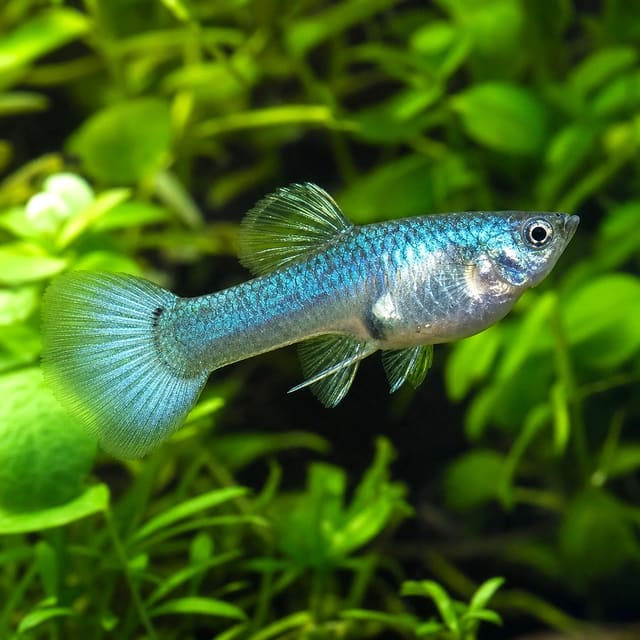
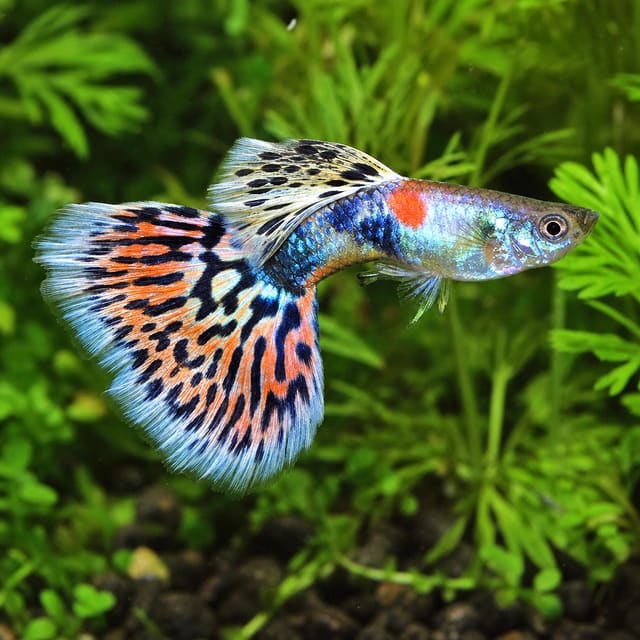
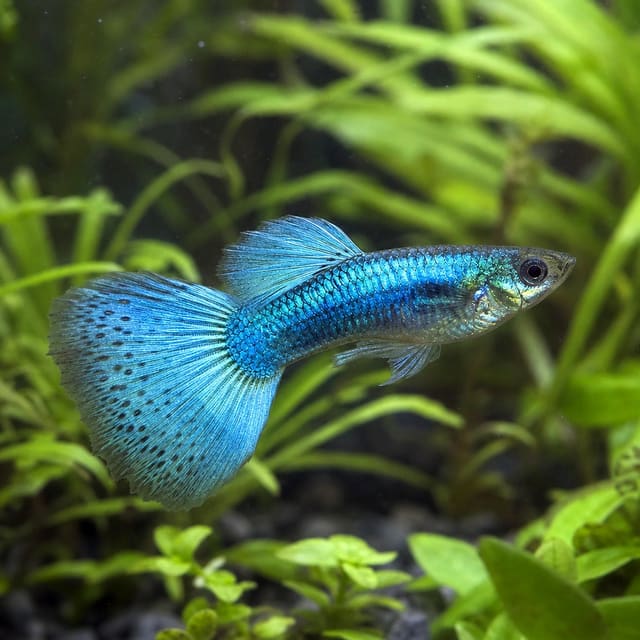
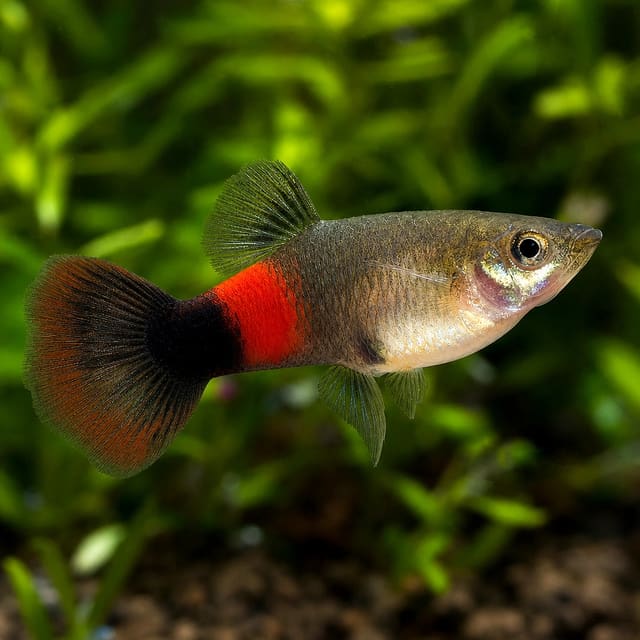
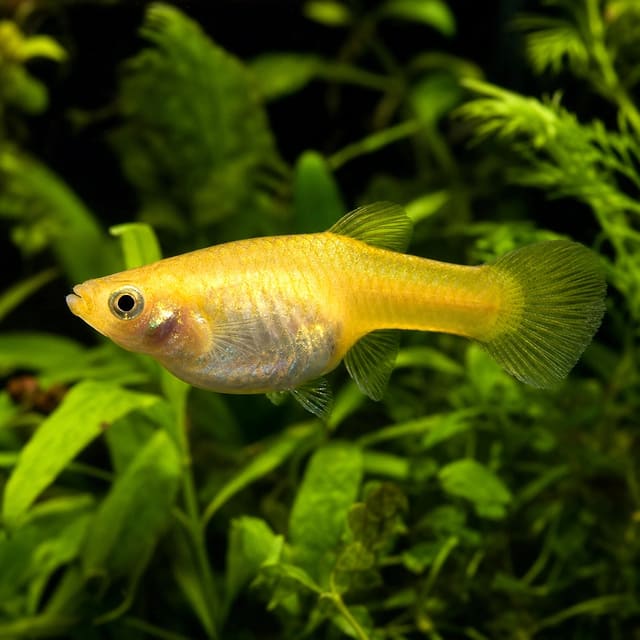
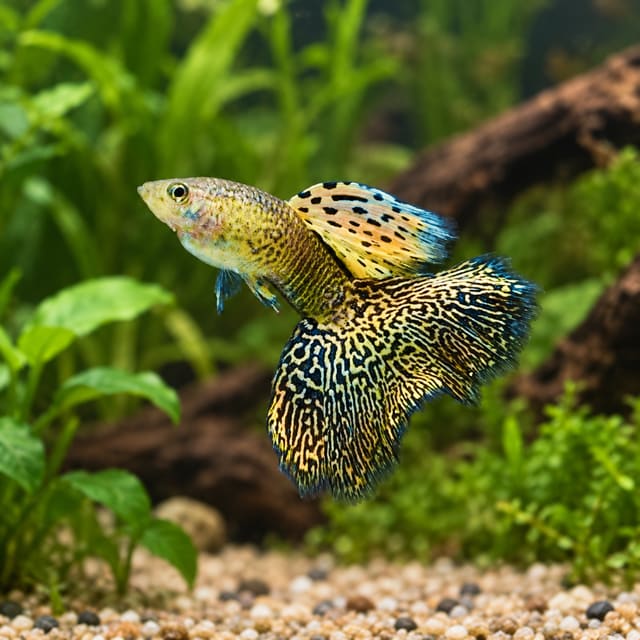
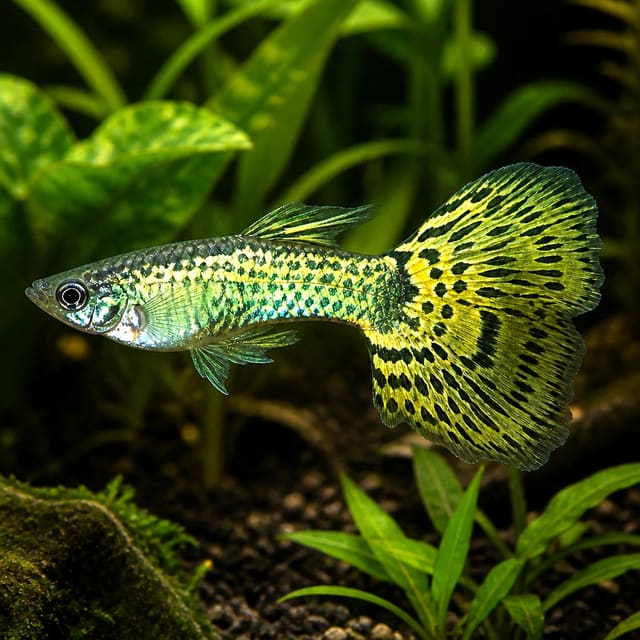
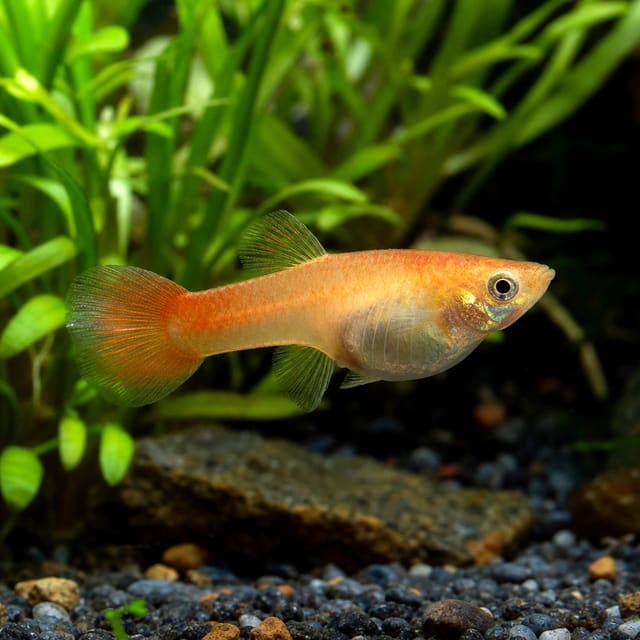
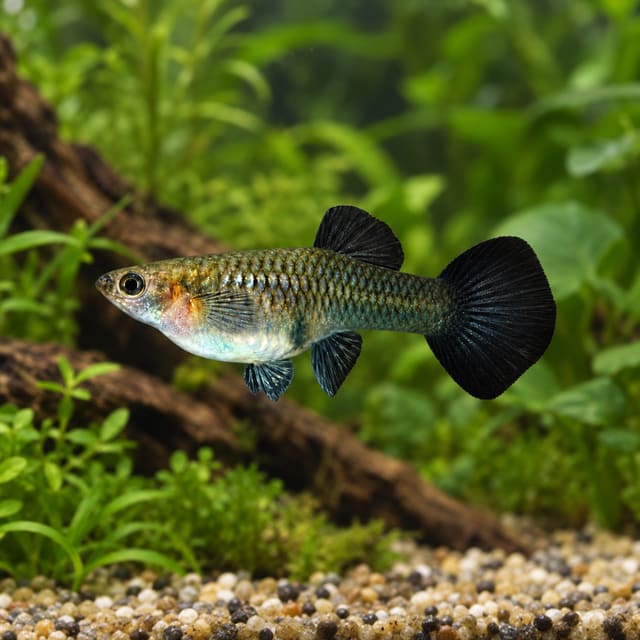
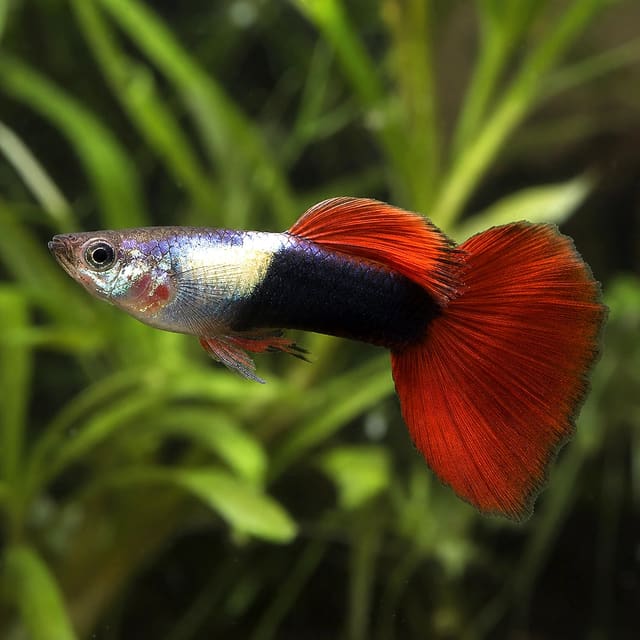
The representative animal has a silver body overlaid by turquoise-blue and red markings, with broad red dorsal and tail fins. Selective guppy varieties can differ in the precise balance and placement of colour, so choose this form for its overall red-and-turquoise character rather than expecting an identical arrangement on every fish.
Wild guppies occur in freshwater and brackish environments, including vegetated streams, springs, canals, ponds and ditches. Those distribution details describe the species in nature; they do not identify the breeding or geographical origin of this individual colour form.
In nature, guppies feed on zooplankton, small insects and detritus. That flexible feeding biology helps explain why aquarium guppies accept an omnivorous routine, but captive feeding should use clean, nutritionally complete aquarium foods rather than collected wild material.
| Suits | Not suited to |
|---|---|
| A prepared beginner with a mature, filtered aquarium | An uncycled bowl or unfiltered container |
| A planned social guppy group | Being kept as a solitary fish |
| Stable neutral-to-alkaline, mineral-bearing water | Long-term soft or acidic conditions |
| A quiet community screened for compatible behaviour | Fin-nipping species such as tiger barbs and serpae tetras |
One purchase supplies one animal. The dispatch grade is 3–4 cm. Dispatch size describes the fish at the point it is sent; it is not an adult-size promise and does not identify age or life stage.
Sex is guaranteed only when the exact product or selected option explicitly states male or female. This Poecilia ret. male red turquoise listing is sold as male.
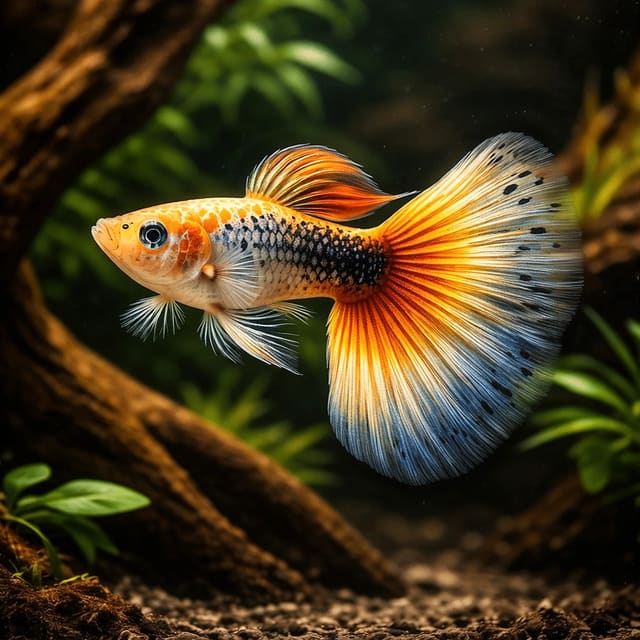
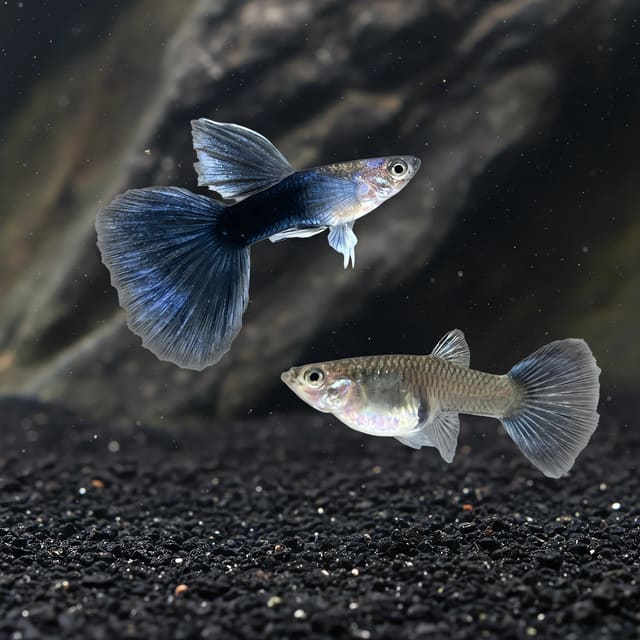
The gallery images are representative of this type of animal rather than photographs of the exact animal supplied, so colours can look slightly different from the live animal.
FishBase records a maximum of 5 cm standard length for male or unsexed Poecilia reticulata. Standard length excludes the tail fin, and selected domestic guppies can carry substantial finnage, so leave usable swimming room around the body-length figure instead of treating 5 cm as the complete space occupied by the fish.
Our complete guppy care guide uses a conservative house plan: a mature, filtered aquarium at least 60 cm long and a social group of five or more where the sex plan, filtration, test results and other livestock allow. OATA’s guppy-and-molly guidance gives pH 7.0–8.0, 8–18 dGH, at least three fish and 45 litres for a small group as broad group targets, not a species-specific optimum. Our routine aquarium temperature range is 22–28°C.
| Decision | Starting point |
|---|---|
| Adult body length | Plan around up to 5 cm standard length for this male offer |
| Aquarium length | At least 60 cm under our conservative guppy policy |
| Social plan | Five or more where capacity and sex planning allow |
| Routine temperature | 22–28°C |
| Water chemistry | pH 7.0–8.0 and 8–18 dGH |
| Nitrogen waste | Zero ammonia and zero nitrite |
This fish can suit a prepared beginner who already understands cycling, testing and measured feeding. The “easy” care label is our retail suitability assessment, not permission to use an uncycled bowl or skip maintenance. If you are comparing colour forms, use the guppy collection while keeping the same adult-space, social and water checks in view.
Choose a mature, biologically filtered aquarium at least 60 cm long for one small guppy group under our conservative house policy. Aquarium length matters because active fish need horizontal swimming room, while litres help describe dilution and stability. A tall container can hold a respectable nominal volume without offering the same usable swimming length.
Seriously Fish gives a 45 × 30 cm base and approximately 41 litres for Poecilia reticulata. OATA recommends at least 45 litres for a small group of the smaller livebearers. We use the longer 60 cm screen because it leaves more room for social movement, cover and intervention when several guppies share the aquarium.
A larger aquarium generally gives more water stability, but extra litres do not create an automatic entitlement to add more fish. Existing livestock, adult sizes, biological filtration, sex mix and observed behaviour still set the safe stocking plan.
Cycle the filter and confirm the result with water tests rather than counting elapsed days. The aquarium is ready only when it can maintain zero ammonia and zero nitrite under the intended biological load. If this is your first setup, follow our guide to preparing and maturing a first tropical aquarium before arranging the fish’s arrival.
Plan a separate, cycled holding option as well. It gives you somewhere safe to move a fish if persistent pursuit, injury or illness makes separation necessary. A small unfiltered container is not an adequate substitute because waste can accumulate rapidly.
Run this aquarium at 22–28°C under our routine guppy range. Keep pH between 7.0 and 8.0 and general hardness between 8 and 18 dGH. Aim for stable values within those ranges rather than repeatedly adjusting the water towards a single imagined ideal.
Test the aquarium itself and the tap water used for changes. UK water chemistry differs between regions and can change when water companies blend supplies, so a general postcode description is less useful than measurements from the water entering this aquarium. Our water chemistry guide explains what pH, hardness and nitrogen-cycle tests measure, while the water matcher helps compare measured results with the care range.
| Observation | Action |
|---|---|
| Temperature varies through the day | Use a thermostatically controlled aquarium heater where needed and confirm the water with an independent thermometer. |
| pH sits outside 7.0–8.0 | Test source water and hardness before changing anything; make any necessary transition gradually. |
| Hardness is below 8 dGH | Assess the measured source water and every aquarium inhabitant before choosing a mineral adjustment. |
| Ammonia or nitrite appears | Pause further additions, test again and address biological filtration and waste immediately. |
| Nitrate rises quickly | Review feeding, stocking, waste removal and the frequency of partial water changes. |
OATA advises keeping nitrate no more than 20 mg/L above the normal tap-water level. Record both results so that the aquarium figure is interpreted against the source water rather than in isolation.
Always treat replacement tap water with a suitable conditioner before it enters the aquarium, removing harmful chlorine or chloramine according to the product directions. Match temperature and chemistry gradually during maintenance. Sudden correction can be more disruptive than a stable reading near one end of the suitable range.
Wild guppies can occur in brackish habitats, but that does not make routine salt addition necessary. Add salt or minerals only for a measured purpose after checking the needs of every fish, invertebrate and plant in the aquarium.
A working filter is essential because fish waste releases toxic ammonia. RSPCA aquarium guidance explains that biological filtration supports bacteria which convert ammonia to nitrite and then to the safer nitrate. The filter must therefore remain established, oxygenated and matched to the aquarium’s actual biological load.
When filter media needs cleaning, rinse it lightly in aquarium water removed during the partial change. Do not run it under the tap because chlorine or chloramine may kill the beneficial bacterial population established in the media. Avoid replacing all mature media at the same time unless the filter manufacturer’s safety directions require it.
| If you find | Check next |
|---|---|
| Reduced filter flow | Intake obstruction, clogged mechanical media and safe impeller operation |
| Uneaten food | Portion size, feeding competition and whether every fish is eating |
| Rising nitrate | Stocking, feeding, waste removal and water-change frequency |
| Any ammonia or nitrite | Recent additions, filter disruption, excess food and decaying material |
Increase livestock slowly. Each added animal and each increase in feeding raises the waste load, and the filter bacteria need time and suitable conditions to respond. Adding a full social group to a newly cycled system without monitoring can still overwhelm a small biological filter.
Plants can use some nutrients and provide cover, but they do not replace filtration, testing or water changes. Treat clear-looking water as an appearance, not a measurement: ammonia and nitrite can be dangerous without making the aquarium visibly dirty.
Use an appropriately sized, nutritionally complete omnivore flake or granule as the staple food. OATA’s guppy-and-molly routine advises feeding once a day and giving only what the fish can consume within a few minutes. Start with a small portion, watch every fish, and stop before food is left drifting into plants or settling on the substrate.
Choose a staple with an algal component and add safe, compatible variety rather than relying on one treat. Small items of live or frozen food such as daphnia, small bloodworm or tubifex can be offered as part of that varied routine. Make sure each item is appropriately sized for the guppy’s mouth and obtained as biosecure aquarium food.
| What you see | What to do |
|---|---|
| Food remains after a few minutes | Reduce the next portion and remove accessible leftovers before they decay. |
| One fish takes most of the food | Spread a smaller portion across more than one feeding point and observe whether the quieter fish can eat. |
| Food is too large to swallow | Use a smaller particle size rather than expecting the fish to break it apart. |
| Interest in food suddenly falls | Test water and assess breathing, swimming, social pressure and appearance before offering more. |
| Waste increases after feeding | Review both portion size and the filter’s ability to handle the group’s load. |
Wild guppies consume small insects, zooplankton and detrital material, but an aquarium diet should not attempt to reproduce a wild site literally. A complete manufactured staple provides controlled nutrition, while suitable variety reflects the species’ flexible feeding biology.
Overfeeding is a water-quality problem as well as a nutrition problem. Uneaten food breaks down and increases the burden on the biological filter. A portion that disappears quickly can still be excessive if one fish is repeatedly overfed while another is excluded, so watch body condition and access across the whole group.
If fry appear, they need food particles sized for their mouths and especially close monitoring of water quality. Do not increase food automatically without testing and confirming that the nursery filtration can process the added waste.
Prepare and test the aquarium before the delivery date. Confirm zero ammonia and zero nitrite, stable temperature, suitable pH and hardness, normal filter operation and a secure separation option. Do not use the arriving fish to test whether an immature aquarium has completed its cycle.
Read the current delivery and Live Arrival Guarantee policy before ordering and make sure someone is present to receive the parcel because live fish cannot be left unattended.
A settled guppy should show steady swimming, regular breathing, open fins, a normal body profile and consistent feeding. Hiding, clamped fins, surface gasping, erratic swimming, loss of balance, wounds, spots, fluffy growths or a sudden appetite change are warning signs rather than diagnoses.
RSPCA fish-health guidance supports water-quality checks and veterinary escalation when behaviour or appearance changes. If the fish remains distressed, contact us promptly and use OATA’s UK fish-vet directory for qualified diagnosis. Do not select salt, heat or medication from one symptom alone.
Use a separate biosecure quarantine aquarium for new fish where practical. It should have biologically supported filtration, suitable heat, tested water, cover and dedicated equipment. A quarantine container without mature filtration simply exchanges disease-control risk for unstable water quality.
The MSD Veterinary Manual recommends at least 30 days of isolation for aquarium fish, with longer periods where indicated. That veterinary reference supports quarantine duration and water-quality-led assessment; any diagnosis or treatment in the UK should follow lawful product labelling and veterinary direction.
| Checkpoint | Decision |
|---|---|
| First day | Confirm stable swimming, breathing, balance and freedom from immediate pursuit. |
| First week | Compare appetite, fins, colour, body profile and water-test trends from day to day. |
| Through quarantine | Keep equipment separate and investigate any spots, wounds, abnormal waste or behavioural change. |
| Before transfer | Confirm stable health, suitable chemistry in both systems and enough capacity for the receiving group. |
| First month | Review whether every fish can feed, rest and use open water without persistent chasing. |
Do not add several later purchases directly to the display aquarium simply because the first fish settled well. Every addition changes disease exposure, social behaviour and biological load. Repeat the same preparation and observation process each time.
Continue weekly testing and partial water changes after the first month. An easy care classification describes suitability for a prepared keeper; it does not reduce the need for filtration, measured feeding or observation.
Never release guppies, fry, plants, snails, aquarium water or damp substrate into a pond, natural waterway or surface-water drain. Guppies have become established beyond their native range, and responsible rehoming is the correct response when the aquarium can no longer support its population.
Guppies are social fish. Our conservative house policy is a group of five or more where aquarium capacity, filtration, water tests and the sex plan allow. FishBase also gives aquarium keeping in groups of five or more. Treat that as a starting group rather than a fixed stocking allowance: usable space and observed behaviour still decide whether the aquarium can support every animal.
| Group plan | Decision to prepare for |
|---|---|
| Male-only | Prevents new mixed-sex mating inside the group, but display and chasing can still become persistent. |
| Mixed sex | OATA suggests two females per male to reduce pressure, while fry and continued courtship require capacity and monitoring. |
| Adding one male | Check the existing group, swimming space and behaviour rather than assuming one more fish will be absorbed safely. |
This offer can be used within a planned male group, but “peaceful” does not mean socially inactive. Watch for repeated pursuit, cornering, hiding, missed feeding, clamped fins or fin damage. If one fish cannot move away or eat normally, intervene with safe separation and review the group instead of adding another animal to distract the aggressor.
Guppies are livebearers, so a mixed-sex group can produce fry. Plan space, filtration, feeding and responsible rehoming before combining sexes. Dense planting can improve fry survival, which may increase rather than solve the future population challenge.
Endler’s livebearer is the separately described species Poecilia wingei. The formal description of Poecilia wingei supports that distinction, and Eschmeyer’s Catalog of Fishes lists it as a valid species.
Laboratory research summarised in our guppy care guide demonstrates that P. reticulata and P. wingei can hybridise. House documented lines separately if preserving their identity matters. That possibility does not classify an unexamined aquarium fish or establish the ancestry of this red turquoise form.
Seriously Fish describes the guppy as very peaceful and suitable for a quiet community, but it specifically advises against fin-nipping species such as tiger barbs and serpae tetras. OATA likewise advises avoiding species that might nip guppy fins. Broad dorsal and tail fins make that risk especially important for selected male forms.
| Compatibility category | How to use it |
|---|---|
| Avoid | Fin-nipping species such as tiger barbs and serpae tetras. |
| High caution | Any fish large enough to swallow or injure a guppy, or any combination with incompatible water needs. |
| Conditional candidates | Quiet community fish whose exact adult size, social needs, water range and feeding behaviour pass every check. |
| Reassess immediately | Persistent pursuit, hiding, missed feeding, torn fins, surface crowding or blocked access to refuge. |
Other livebearers, rasboras, corydoras, small loricariids and tetras can include candidates for a quiet community, but those category names are not universal approval. Exact species differ in adult size, water chemistry, social needs and behaviour. Screen the named species rather than relying on its family or shop category.
Introduce livestock gradually so the filter and social group can adjust. Observe feeding and movement closely after each addition. Ask us for a stocking and compatibility assessment when you can provide the aquarium dimensions, measured water values, filtration and a complete livestock list.
FishBase records up to 5 cm standard length for male or unsexed Poecilia reticulata; standard length excludes the tail fin.
Use a mature, filtered aquarium at least 60 cm long under Tropical Fish Co’s conservative guppy policy; Seriously Fish gives a species-level minimum footprint of 45 × 30 cm and approximately 41 litres.
Plan five or more guppies where aquarium capacity, filtration, water tests and the sex plan allow, following Tropical Fish Co’s conservative policy and FishBase’s group-of-five-or-more aquarium note.
It can suit a prepared beginner who uses a mature filtered aquarium, maintains zero ammonia and nitrite, tests the water and plans the social group before adding fish.
Feed an appropriately sized, nutritionally complete omnivore flake or granule as the staple; OATA’s guppy-and-molly guidance advises one daily portion that the fish consume within a few minutes, with safe compatible variety.
Keep it at Tropical Fish Co’s routine 22–28°C range; OATA’s guppy-and-molly guidance gives pH 7.0–8.0 and 8–18 dGH for the group, with zero ammonia and zero nitrite.
Seriously Fish describes the guppy as very peaceful, although guppies may chase one another; avoid fin-nipping species such as tiger barbs and serpae tetras.
Other livebearers, rasboras, corydoras, small loricariids and tetras can be candidates for a quiet community when their exact adult size, water range, social needs and feeding behaviour pass the full compatibility screen.
Start filming every delivery continuously from the sealed parcel before opening it, then show the animal still inside the sealed bag. Have someone present to receive the parcel, float the bag for 20–30 minutes, and never pour the bag water into the aquarium.
No reviews for this item yet. Bought one? Honest reviews only, good or bad.
What customers say about ordering from us
Easy website plenty of info on fish your buying great to pick a time slot
TRACEY DURRANT · 7 Oct 2026
Got some lovely fish thank you
Kevin Mackie · 7 Oct 2026
Reviews of our shop, collected by Judge.me, an independent third-party review collector. Newest first.