
Easy
Orange Gold Variatus Platy (Xiphophorus variatus)
20–25°C · pH 7–8 · 54L
£4.99

One unsexed Orange Gold Simpson Variatus Platy per quantity at approximately 3-4 cm. A social Xiphophorus variatus for mature, hard-water aquariums.
Adult size is the maximum length this species reaches at full maturity (scientific sources). The livestock you receive will be younger and smaller — pick a size variant above for the actual shipping size. Product-photo provenance and any image-specific limitations are stated on the listing.
Xiphophorus variatus
Save when buying multiple fish. Each quantity is one fish; sex and pair formation are not guaranteed unless the selected variant explicitly states them.
Confirm your email, then we’ll send an availability message for this exact item if it returns within 180 days.
This request is only for this product—no newsletter or other promotions. A mail-provider retry may very rarely duplicate the same availability message. Unconfirmed addresses are removed after 48 hours. See our privacy policy.
One unsexed Orange Gold Simpson Variatus Platy per quantity at approximately 3-4 cm. A social Xiphophorus variatus for mature, hard-water aquariums.
Adult size is the maximum length this species reaches at full maturity (scientific sources). The livestock you receive will be younger and smaller — pick a size variant above for the actual shipping size. Product-photo provenance and any image-specific limitations are stated on the listing.
20–25°C · pH 7–8 · 54L
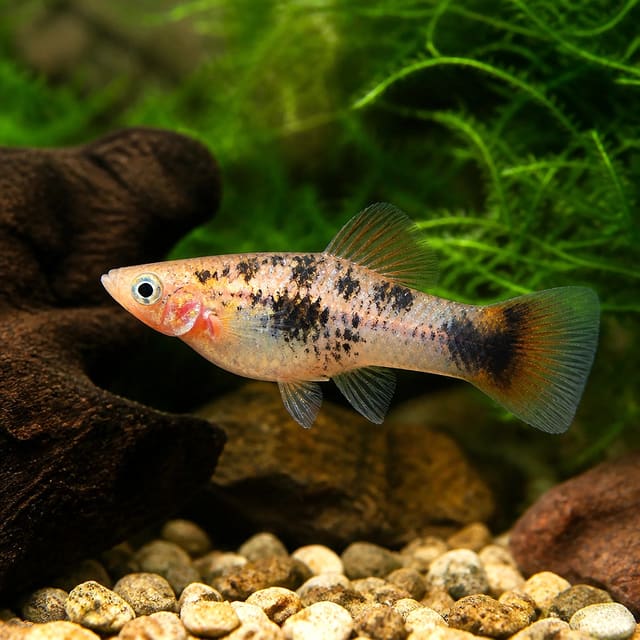
20–26°C · pH 7–8.2 · 54L

20–26°C · pH 7–8.2 · 54L
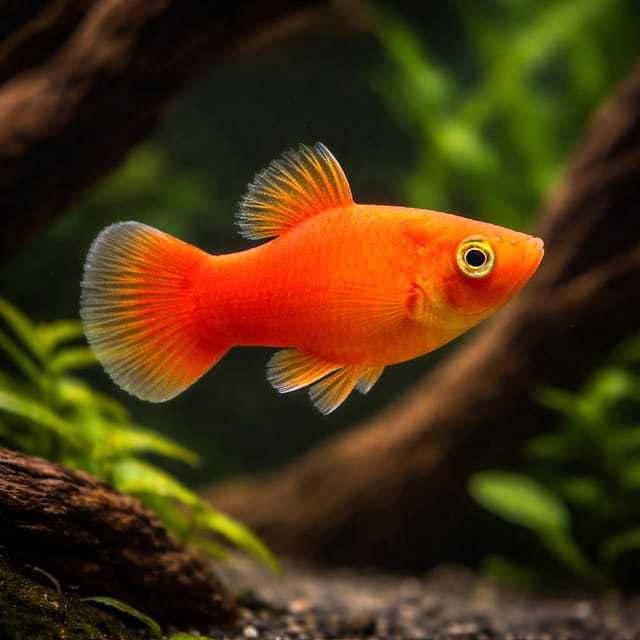
20–25°C · pH 7–8 · 54L
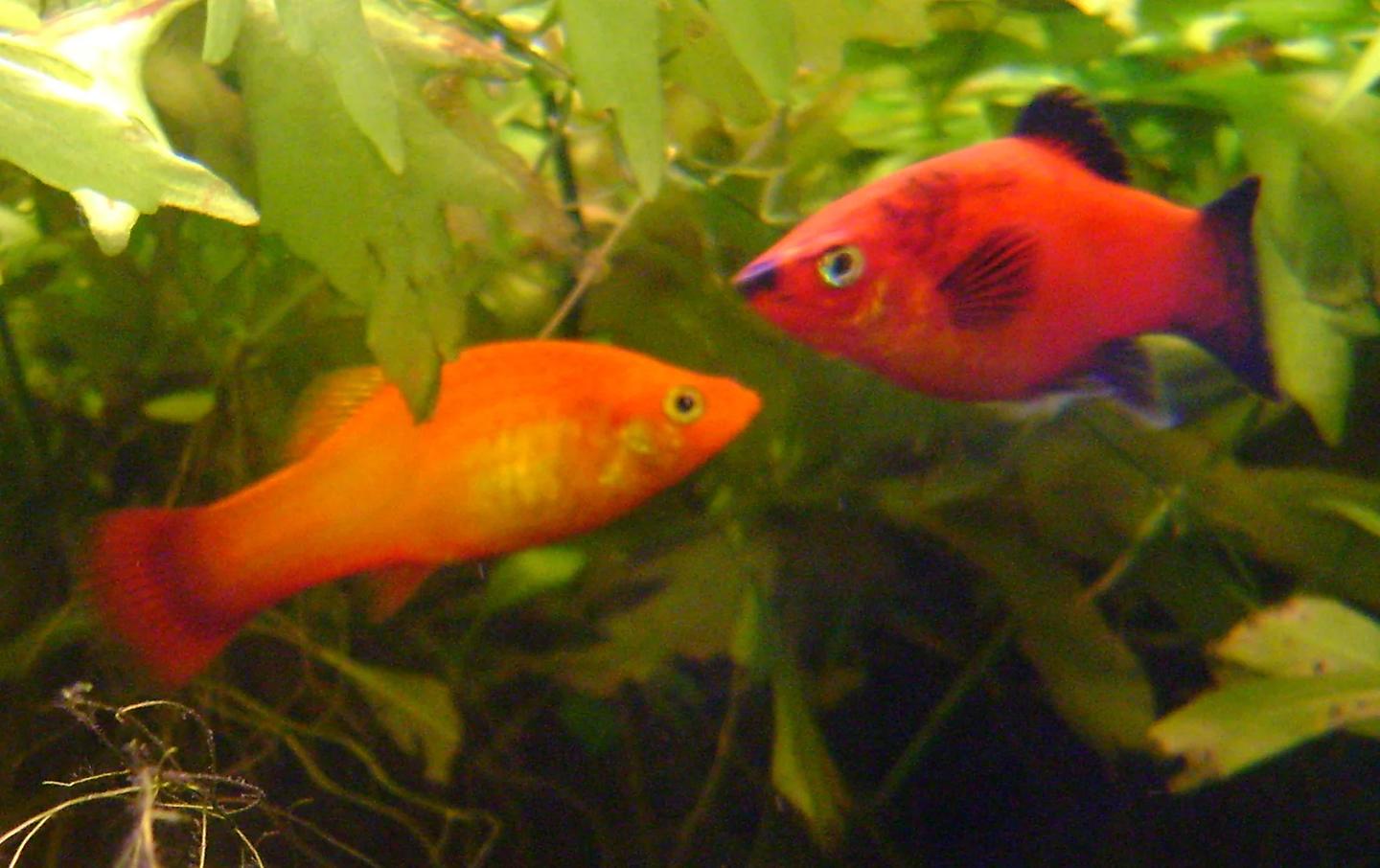
Platy is a trade name used for Xiphophorus maculatus, X. variatus and domestic forms. Start with at least three in a mature aquarium of at least 45 litres, verify the exact fish and measured water, and plan extra capacity before mixing sexes.
Maintain these water conditions for optimal health and vibrant colors
Orange Gold Simpson Variatus Platy is a domestic colour-and-fin form of Xiphophorus variatus, the Variable Platy. The name combines an orange-gold colour selection with the aquarium-trade term Simpson, commonly used for an extended or high dorsal fin. Each quantity is one fish supplied at approximately 3-4 cm. Sex, exact colour balance and the degree of dorsal-fin extension are not selected or guaranteed unless a live option says otherwise.
This active livebearer is best planned as part of a social group in a mature, filtered aquarium. It suits keepers who can provide stable hard-to-moderately-hard water, planted cover, open swimming room and a realistic plan for breeding if males and females are mixed. For broader shopping across colour forms, start with the Platy Fish collection; this page stays focused on the Orange Gold Simpson form.
| Accepted species | Xiphophorus variatus (Variable Platy) |
|---|---|
| Trade form | Orange Gold Simpson Variatus Platy |
| Sale unit | One fish per quantity; sex is not specified |
| Approximate supplied size | 3-4 cm |
| Adult size guide | Usually about 5-7 cm, with individual and sex variation |
| Care level | Easy to moderate once the aquarium is mature and water chemistry is suitable |
| Temperament | Social, active and generally peaceful; courtship and status chasing can occur |
| Practical group plan | At least five Variatus Platies, with a deliberate sex-ratio and fry plan |
| Practical aquarium minimum | About 60 litres with roughly 60 cm of swimming length for a small group |
| Temperature | 20-25 C |
| pH | 7.0-8.0 |
| Hardness | A practical core of about 9-19 dGH; the trade source gives a wider 5-30 dGH range |
| Tank region | Mainly middle and upper water, with frequent use of open swimming areas |
| Diet | Omnivorous, with both animal and plant material |
| Breeding | Livebearer; mixed-sex groups can produce fry repeatedly |
The figures above are planning guides, not permission to crowd fish into the smallest possible aquarium. More room is valuable when the group is larger, the community contains other species, males are persistent, or fry are likely. Our Platy care guide covers the broader group, while the ranges on this page prioritise evidence specific to X. variatus and this trade listing.
Xiphophorus variatus is a recognised freshwater species in the livebearer family Poeciliidae. It is commonly called the Variable Platy or Variatus Platy. The wild species occurs in Mexico, but an aquarium fish sold under a colour name should be understood as a domestic ornamental form rather than a wild-type specimen or a fish collected from a named locality.
Variatus Platies are related to the Southern Platy, Xiphophorus maculatus, and to swordtails. Domestic lines have been crossed within the genus over many generations, so a commercial colour form should not be presented as a genetically pure wild population unless a breeder provides that evidence. This listing makes no locality, pedigree or genetic-purity claim.
Orange Gold is a trade description for the warm orange, amber or gold appearance expected from the line. It is not a measured colour standard. Living fish can differ in body shade, metallic sheen, fin colour, markings and how strongly the colour develops after transport. Age, sex, lighting, food, background and stress can all change how a fish looks from one day to the next.
A buyer should expect the named colour family, not a perfectly identical copy of another fish. Natural variation is normal and is one reason a healthy group often looks more interesting than a row of identical ornaments.
In livebearer terminology, Simpson is commonly associated with an extended or high dorsal fin. The term has historical roots in high-fin Xiphophorus breeding and is used for both platy and swordtail forms. It does not mean that every fish will have the same dorsal-fin height, length or angle, and it is not a separate species.
No exact product-specific photograph is currently available for this listing. That means the presence and strength of the expected high-fin expression cannot be assessed from a gallery image before purchase. The trade name is useful identification evidence, but it is not a visual guarantee for the individual dispatched.
For a small group, use a practical starting point of about 60 litres with roughly 60 cm of horizontal swimming length. OATA gives 45 litres as a welfare floor for a small platy group, while FishBase records a 60 cm aquarium context for X. variatus. Choosing the roomier interpretation gives active fish more usable space and makes temperature and water chemistry easier to keep stable.
A tall narrow aquarium can hold the same litres as a longer tank but provide less room for social spacing. Prioritise a wide footprint, open middle water and several routes around plants or wood. Increase volume for a mixed community, a larger group, persistent males or any plan likely to produce fry.
Each quantity represents one fish. Variatus Platies are social and should not be planned as permanent solitary livestock simply because a product is sold individually. A group of at least five is a useful starting point, provided the aquarium is large enough and every fish can feed without repeated harassment.
Groups do not behave like a tight schooling tetra shoal. They spread through the available space, graze, investigate and regroup. That makes cover and broken sightlines useful even in a peaceful aquarium. A fish that is always hiding, pinned into a corner or excluded from food needs intervention rather than an assumption that chasing is harmless.
The product does not promise male or female. If a mixed-sex group develops, males can repeatedly court females. A common management starting point is at least two females for each male, with more room and cover as the group grows. The ratio reduces pressure but cannot remove it completely.
If you do not want fry, do not rely on visual sexing at a small supplied size as a perfect safeguard. Females may arrive already inseminated and can store sperm. A single-sex group selected by an experienced keeper may reduce breeding, but sexing errors remain possible, especially in juveniles.
| Parameter | Working target | Why it matters |
|---|---|---|
| Temperature | 20-25 C | Matches the trade source and sits within the upper part of the species range recorded by FishBase |
| pH | 7.0-8.0 | Neutral-to-alkaline water supports the mineral-rich conditions preferred by this livebearer |
| General hardness | About 9-19 dGH as a practical core | FishBase supports this firmer range; do not chase the extremes of a broad tolerance band |
| Ammonia | 0 mg/l | Detectable ammonia is an urgent water-quality problem |
| Nitrite | 0 mg/l | Detectable nitrite can impair oxygen transport and requires immediate action |
| Nitrate | Keep low and stable | Use the normal tap-water baseline and aquarium trend; rising nitrate usually signals excess waste or insufficient maintenance |
The specific trade range is 20-25 C. FishBase records a broader 15-25 C species context, but the lower figure describes biological range rather than a promise that every domestic line will thrive in a fluctuating unheated room. For a home aquarium, choose a stable point within 20-25 C that also suits every tank mate.
Do not market this fish as automatically suitable for every cold-water setup. A room that falls sharply overnight or through winter can push an unheated aquarium below the intended range. Check the aquarium itself with a reliable thermometer across the day and season, not just the room thermostat.
A pH of 7.0-8.0 and mineral-rich water are the useful planning targets. FishBase gives 9-19 dH, while the trade record spans 5-30 dGH. The wide trade figure is a tolerance range, not a reason to move a fish rapidly between extremes. Aim for a stable middle that matches the water in which the rest of the community is genuinely comfortable.
Many UK tap-water areas are naturally suitable for hard-water livebearers. Very soft water may need careful remineralisation, but do not add random salts or pH chemicals without testing. Rapid correction can be more dangerous than a stable reading near the edge of the suitable range. The water chemistry guide explains pH, GH, KH and safe adjustment in more detail.
Ammonia and nitrite should remain at zero in a cycled aquarium. Test weekly during setup and after adding fish, and retest whenever behaviour, breathing or appetite changes. Track nitrate relative to the tap-water baseline and use regular conditioned, temperature-matched partial water changes to stop waste accumulating.
There is no universal water-change percentage that replaces testing. Stocking, feeding, plants, source-water nitrate and filter maturity all matter. A modest weekly routine is easier on fish than infrequent emergency changes, provided new water is dechlorinated and closely temperature matched.
Use live or soft artificial plants around the sides and rear, leaving a clear central route for swimming. Fine-leaved and floating plants provide visual cover, help females move away from persistent attention and give fry somewhere to shelter. Darker backgrounds can make orange-gold colour easier to see without forcing the fish under harsh lighting.
Smooth wood, rounded stones and varied planting heights create several paths through the aquarium. Avoid sharp decor that can damage an extended dorsal fin. Leave enough open surface and mid-water space that the group can feed and move without queuing through a single gap.
Choose a filter sized for the real adult group and expected community biomass, not only the aquarium's empty volume. The outlet should create oxygenating surface movement without turning the entire tank into a strong current. Sponge pre-filters are useful where fry may be present and reduce the chance of small fish being drawn into an intake.
Keep a secure lid with service gaps covered. Platies are not famous specialist jumpers, but active livebearers can leave an aquarium when startled or chased. A lid also reduces evaporation, which otherwise concentrates minerals and changes water chemistry between water changes.
If this is a new setup, follow the first tropical aquarium guide and prove the filter is cycled before adding livestock. Clear water is not evidence that ammonia and nitrite are safe.
Xiphophorus variatus is omnivorous. FishBase records worms, crustaceans, insects and plant matter in the diet, so a good aquarium plan should not be animal-protein-only. Use a complete quality flake or small granule as the staple, ideally with algae, spirulina or other plant ingredients.
Select food small enough for the supplied fish to take easily. Crush large flakes and watch the least assertive fish, not only the quickest feeder. A food can be nutritionally complete on the label yet still fail the group if one fish never reaches it.
Offer small frozen or live foods such as daphnia, Artemia or appropriately sized mosquito larvae as measured variety. Blanched vegetable matter or a quality herbivore-rich prepared food can support the plant side of the diet. Avoid relying on one rich treat or feeding large bloodworm portions as a daily staple.
Orange and gold colour is influenced by genetics, maturity, health, lighting and diet. Carotenoid-containing food can support normal pigmentation, but no food can turn every fish into a fixed shade or replace suitable water and low stress.
Offer a small portion the group finishes promptly and spread it across more than one point. This reduces competition and allows shy or lower-ranking fish to feed. Remove obvious leftovers before they decay. Overfeeding is not kindness: it increases waste, destabilises water quality and can leave fish overweight while still missing dietary variety.
Variatus Platies usually spend much of their time in the middle and upper parts of the aquarium, moving between open water, plants and feeding points. They also graze surfaces and investigate lower areas. Their activity makes them visible community fish, but it should not be confused with frantic glass surfing or continuous escape behaviour.
Healthy individuals should show a flexible pattern: swimming, grazing, resting, feeding and interacting. Persistent surface gasping, clamped fins, isolation, repeated flashing, loss of balance or staying motionless in an exposed area warrants water testing and closer assessment.
The species is generally peaceful, yet social behaviour can include display, courtship, short chases and competition around food. A 2023 peer-reviewed study using Variatus Platies found that social composition after transport changed several behaviours. That is a useful reminder to observe introductions rather than assuming familiar-looking tank mates remove stress automatically.
Break sightlines, provide more than one feeding area and avoid overcrowding. If one fish is persistently targeted, separate it safely and review sex ratio, group size, tank layout and health. Adding more fish to dilute aggression is only appropriate when the aquarium has the space and filtration to support them.
| Fit | Examples | Checks before mixing |
|---|---|---|
| Often suitable | Other healthy Variatus Platies; peaceful hard-water livebearers; robust peaceful community fish of compatible size | Adult size, group needs, sex ratio, water overlap and total biomass |
| Conditional | Guppies, mollies, swordtails, some Corydoras, some rasboras and some tetras | Exact species water needs, fin-nipping risk, tank footprint, breeding and feeding competition |
| Usually unsuitable | Aggressive cichlids, persistent fin nippers, large predators and soft acidic-water specialists | Predation, harassment, incompatible chemistry or temperature |
Common names are not enough for compatibility. Some Corydoras and tetras prefer much softer water than a Variatus Platy. Some barbs are peaceful in the right large shoal but become fin-nipping risks in the wrong setup. Compare the exact species, not a broad family label.
Other Xiphophorus can interbreed. If preserving a distinct line matters, do not mix breeding-capable Variatus Platies with Southern Platies or swordtails. Hybrid fry can be healthy, but they should not later be represented as pure species or a named line without evidence.
| Listing | Species label | Useful difference | Important limit |
|---|---|---|---|
| This Orange Gold Simpson form | X. variatus | Orange-gold colour label plus expected Simpson high-fin influence | No exact photo or measured fin standard |
| Orange Gold Variatus Platy | X. variatus | Orange-gold form without Simpson in the listing name | Do not infer identical genetics or colour from similar wording |
| Sunset Simpson Variatus Platy | X. variatus | Sunset colour wording with Simpson in the trade name | Sunset and Orange Gold are not interchangeable guarantees |
| Assorted Variatus Platy | X. variatus | Selected from assorted colour forms rather than one named colour | Exact colour is intentionally variable |
| Assorted Platy | X. maculatus | Southern Platy species label and assorted appearance | Different accepted species, despite overlapping care |
The comparison is about listing identity, not a claim that one form is healthier, rarer or better. Choose by verified water compatibility, group plan and the type of variation you are comfortable receiving.
Mature males develop a gonopodium, a narrow modified anal fin, while females retain a fan-shaped anal fin and are often fuller-bodied. At 3-4 cm, many fish can be sexed, but maturity and individual development vary. This product does not promise a selected sex.
Variatus Platies are livebearers. Fertilised females give birth to free-swimming fry rather than laying an external clutch of eggs. FishBase records a gestation context of about 24 days and up to 100 young, but brood size varies substantially with female size, age, condition and environment.
Dense fine-leaved or floating plants increase fry survival. That can be welcome in a breeding aquarium and a population problem in a community tank. Decide before purchase whether fry will be raised, left within the community, separated or rehomed. Never release aquarium fish or fry into the wild or outdoor waterways.
A breeding box is not a substitute for space, stable water or observation. Prolonged confinement can stress a female. If deliberate breeding is the goal, a mature planted nursery or a carefully managed separate aquarium offers more control.
Confirm ammonia and nitrite are zero, temperature is stable, the filter is mature and tank mates are healthy before ordering. Do not schedule a major rescape, filter replacement or large chemistry adjustment for the arrival day. New fish need predictable conditions more than a freshly rearranged display.
Follow the current acclimation instructions supplied with the order. Keep lighting low during introduction and avoid feeding heavily immediately. Observe breathing, balance, fin position, skin, waste and social behaviour through the first hours and days.
A properly cycled quarantine or observation aquarium can reduce disease-transfer risk and make feeding and waste easier to monitor. It must have stable heat, filtration and cover; an empty uncycled container is not safer simply because it is separate.
Do not medicate healthy fish automatically or mix treatments without a diagnosis. If signs appear, test water first, document symptoms and seek qualified aquatic-veterinary or experienced specialist advice. Many apparent disease signs begin with transport stress or unsuitable water.
One quantity is one Orange Gold Simpson Variatus Platy supplied at approximately 3-4 cm. It is not a pair, trio, sexed group or broodstock guarantee. Exact measurement method is not stated, so allow normal variation around the supplied-size band.
Live price, availability and quantity are shown by the product controls and can change with stock. This care text deliberately avoids a fixed price or stock promise. When the form is unavailable, compare the related Variatus Platies above rather than assuming a different orange fish is identical.
The expected identity is an orange-gold Variatus Platy sold under the Simpson high-fin trade term. Without a current product-specific photograph, exact shade, markings, sex and dorsal-fin expression cannot be previewed or guaranteed. That limitation is stated plainly instead of using a generated or borrowed fish image.
Eligible livestock orders use specialist UK live-animal delivery and are covered by the current Live Arrival Guarantee when its delivery, evidence and contact-time conditions are followed. Read the full delivery and guarantee information before checkout, especially if your postcode is remote or you cannot receive a midweek parcel.
Eligible first orders can use the current 10% code WELCOME10, subject to the active promotion and checkout terms. The checkout remains the final source for discount eligibility, delivery charge, live price and availability.
This listing separates accepted species facts from domestic trade-form expectations. The following sources were checked for identity, husbandry context and welfare evidence:
These sources do not certify the genetics or exact appearance of an individual shop fish. Where species references and the trade listing differ, this page labels the difference instead of blending them into one unsupported promise.
For another named X. variatus form, compare the Orange Gold Variatus Platy or Sunset Simpson Variatus Platy. If exact colour is less important, the Assorted Variatus Platy is the closer species-level alternative.
For Southern Platy forms, compare the Assorted Platy, Red Tuxedo Platy and Red Wagtail Platy. Similar care does not make these listings the same species or colour guarantee.
It is a domestic Xiphophorus variatus sold under an orange-gold colour name and the Simpson high-fin trade term. The labels describe an expected ornamental form, not a separate species or certified pedigree.
They are closely related but not the same accepted species. Variatus Platy usually refers to X. variatus; common or Southern Platy usually refers to X. maculatus. Domestic aquarium lines can contain mixed ancestry.
That is the usual aquarium-trade meaning. Expression varies, and this listing has no exact product photograph or measured fin standard, so the degree of extension cannot be guaranteed.
No. Expect the named colour family, with natural variation in shade, markings, sheen and fin colour. Transport stress, age, sex, diet and lighting can change visible colour.
Sex is not specified. Each quantity is one fish, and no male, female, pair or ratio is guaranteed.
The trade size is approximately 3-4 cm. Normal variation is expected, and the measurement method is not specified.
The trade source gives about 6 cm, while FishBase records a maximum of 7 cm total length. Sex and individual development affect adult size.
Plan at least five where aquarium space and filtration allow. One fish is the sale unit, not a recommendation for permanent solitary care.
Use about 60 litres and roughly 60 cm of swimming length as a practical minimum for a small group. Increase this for a mixed community, persistent males or fry.
Use a stable 20-25 C for this domestic form. Check the aquarium across day and season rather than assuming an unheated room always stays suitable.
Aim for pH 7.0-8.0 and about 9-19 dGH as a practical core. Avoid rapid swings and very soft acidic conditions.
Use a complete quality flake or small granule with plant content, plus measured small frozen or live foods. Feed modestly and make sure every fish reaches food.
Often, but only when adult size, water chemistry, group needs, breeding and total biomass all fit. Do not treat all livebearers as automatically interchangeable.
Some species can, while many prefer softer water. Check the exact tetra or Corydoras species rather than relying on the broad group name.
Very likely. They are livebearers, females can store sperm, and repeated broods are possible. Plan space and fry management before mixing sexes.
Only if the water remains stable within the intended 20-25 C range through the full day and season. Do not assume every unheated UK aquarium is warm enough.
No product-specific source photograph is available. A generated or borrowed Platy image would be more misleading, so exact colour and fin expression are stated as variable instead.
It applies to eligible livestock orders when the current delivery, arrival-check, evidence and contact-time conditions are followed. Read the delivery page before ordering.
Eligible first orders can use the current 10% code WELCOME10, subject to the active promotion and checkout terms.
Max adult size is the length this species reaches at full maturity (from scientific sources). The livestock you receive will be younger and smaller — pick a size variant on the buy box for the actual shipping size. Product-photo provenance and any image-specific limitations are stated on the listing.
Variatus Platies are social but not tight-schooling fish. Each quantity is one unsexed fish, not a solitary-care recommendation. Plan at least five, use planted cover and broken sightlines, and manage courtship pressure and repeated fry if males and females are mixed.
Always research specific species before adding them to your tank. Consider:
No reviews for this item yet. Bought one? Honest reviews only, good or bad.
What customers say about ordering from us
I have a small group of long finned mountain minnows. So was delighted to be able to order ten of this variety to increase the genetics in my tank . The ones I recieved are healthy but it’s to early to give a verdict on wether they are of a long finned type since they are small currently.
Gordon Walker · 23 Sept 2026
100% success travel and "installation". Pleased with quality of purchase. The Siamese fighter a bit "shy" so have not yet seen him at his best yet but looking good. Happy customer. GG
George E Garratt · 21 Sept 2026
Reviews of our shop, collected by Judge.me, an independent third-party review collector. Newest first.
