−10%
CH44 Thick-Skin Hap (Haplochromis sp. CH44)
23–27°C · pH 8–8.6
£10.79£11.99
Pundamilia nyererei is a Lake Victoria cichlid sold in the trade as Haplochromis nyerei, supplied as one fish per purchase at 3–4 cm, 4–5 cm or XL. Plan a large, well-filtered, hard and alkaline aquarium for a group of its own kind, keep it apart from Malawi cichlids and small community fish, and feed a varied cichlid diet in small amounts.
Pundamilia nyererei
Save when buying multiple fish. Each quantity is one fish; sex and pair formation are not guaranteed unless the selected variant explicitly states them.
Pundamilia nyererei is a Lake Victoria cichlid sold in the trade as Haplochromis nyerei, supplied as one fish per purchase at 3–4 cm, 4–5 cm or XL. Plan a large, well-filtered, hard and alkaline aquarium for a group of its own kind, keep it apart from Malawi cichlids and small community fish, and feed a varied cichlid diet in small amounts.

Cichlids are a family of roughly 1,800 accepted species, not one care type. Before buying, identify the exact species and source, then compare adult measurement, usable tank dimensions, social system, territory, tested water, diet and an exit plan. No family-wide minimum tank, water range or tank-mate list is safe.
Maintain these water conditions for optimal health and vibrant colors
Pundamilia nyererei is a cichlid from Lake Victoria in eastern Africa, sold in the trade as Haplochromis nyerei. Each purchase is one live fish, and you can choose it at 3–4 cm, 4–5 cm or XL. Before ordering, the key point is that this lake cichlid is planned as a group in its own aquarium: it needs a large, well-filtered tank with stable, hard and alkaline water, and it is not a fish for a peaceful community set-up.
The size you select is the size supplied, not the adult size. Every size grows on into an adult that needs the same aquarium, so plan the tank for grown fish rather than for the youngsters that arrive.
| Suits | Keepers ready to run a large, hard-water aquarium for a group of one cichlid species |
|---|---|
| Sold as | One live fish per purchase, at 3–4 cm, 4–5 cm or XL |
| Scientific name | Pundamilia nyererei, family Cichlidae |
| Trade name | Haplochromis nyerei |
| Wild distribution | Lake Victoria, eastern Africa |
| Water planning range | 23–27 °C, pH 8.0–8.6, 12–18 °dH (OATA group guidance) |
| Group living | A group rather than a pair, with more females than males |
| Company | Best in its own aquarium, away from Malawi cichlids and community fish |
The record in Eschmeyer’s Catalog of Fishes explains the naming. The species was described in 1985 by Witte-Maas and Witte as Haplochromis nyererei, “a new cichlid fish from Lake Victoria”, from the Mwanza Gulf in Tanzania. It is now treated as valid under the name Pundamilia nyererei, in the cichlid family Cichlidae, and its distribution is recorded as Lake Victoria in eastern Africa. The trade label Haplochromis nyerei is a shortened spelling of that original name, so both labels point to the same fish.
The three grades let you decide how far along you want your fish to be. The 3–4 cm and 4–5 cm grades are young fish with most of their growing still to do. XL is the largest grade we offer and is not tied to a fixed measurement. Whichever you choose, the aquarium, the water and the group you plan for are the same.
Sex is guaranteed only when the selected option explicitly states male or female. This Haplochromis nyerei listing has no sex-guaranteed option. In this group of cichlids, differences between the sexes usually only appear once fish mature, and colour is typically the main difference, so young fish cannot be reliably sexed by eye.
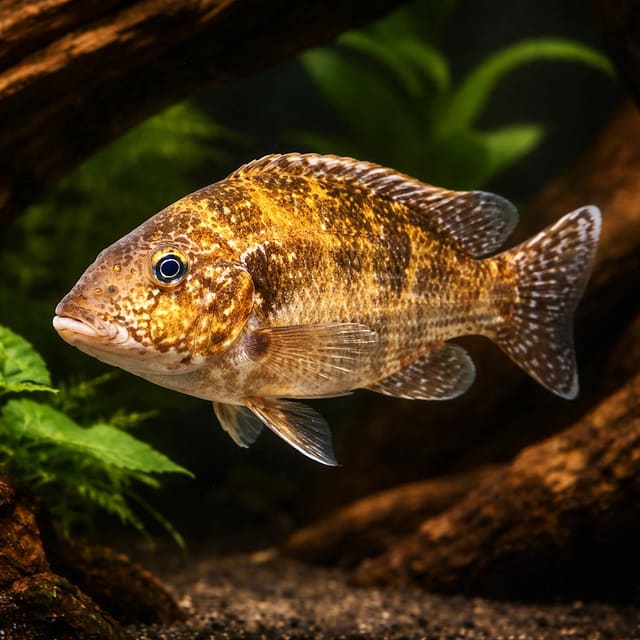
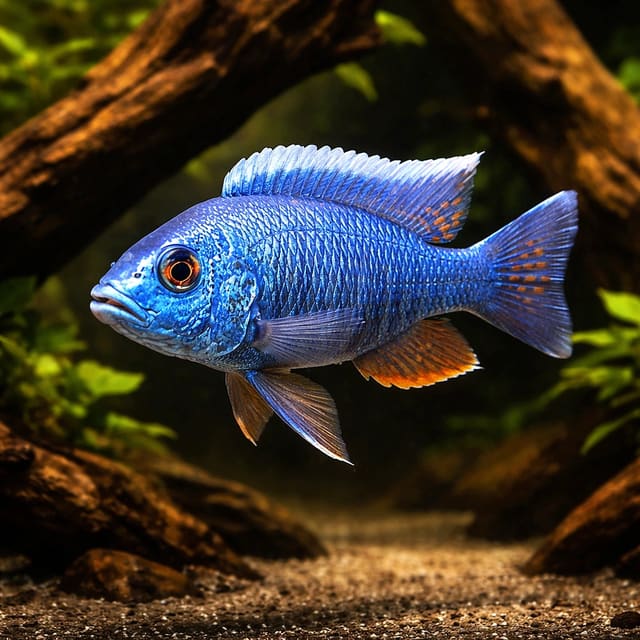
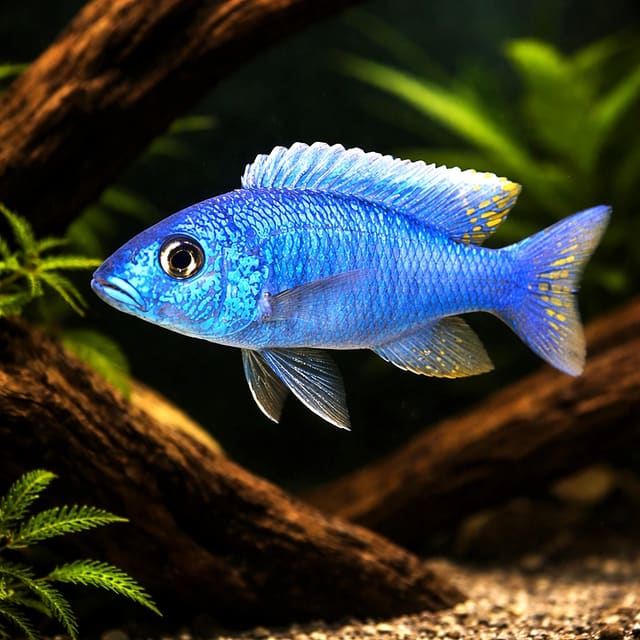
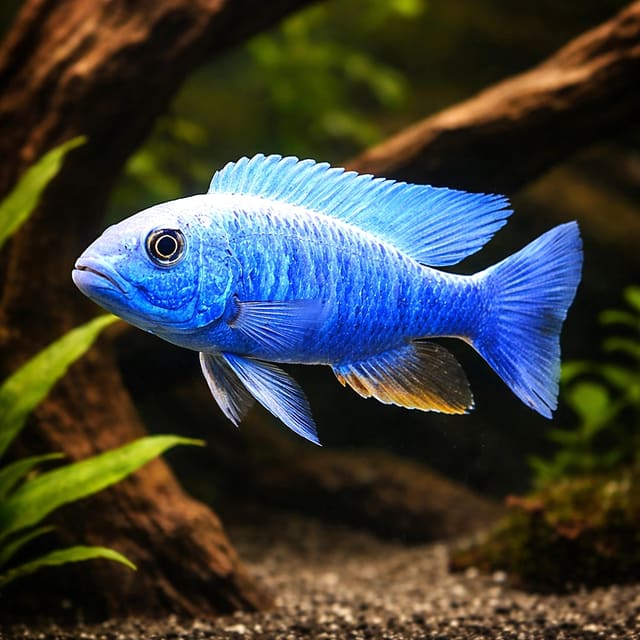
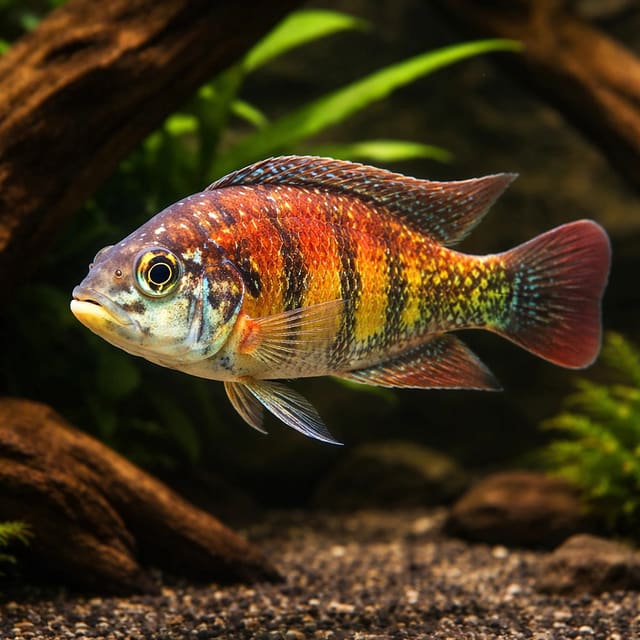
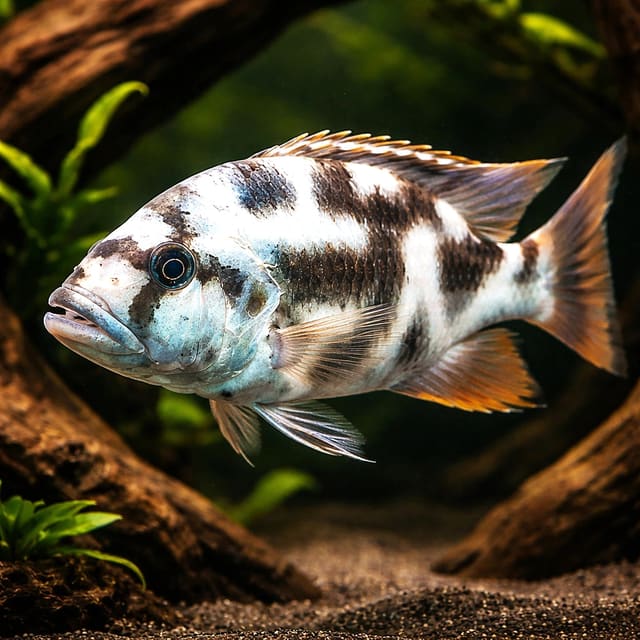
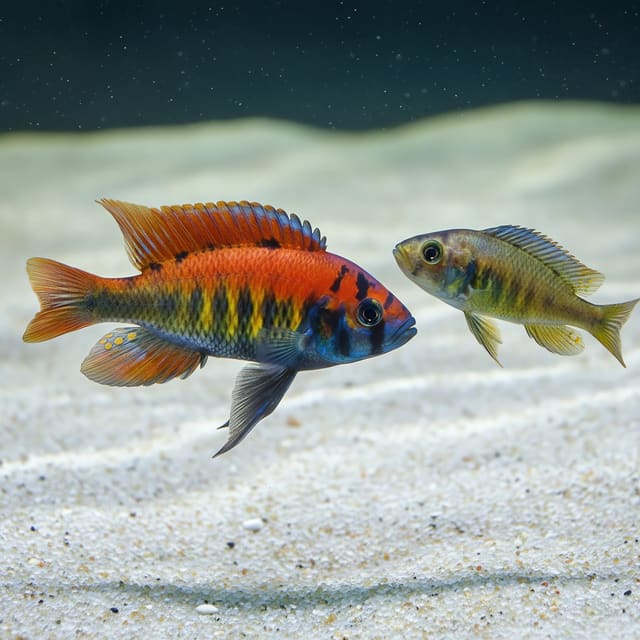
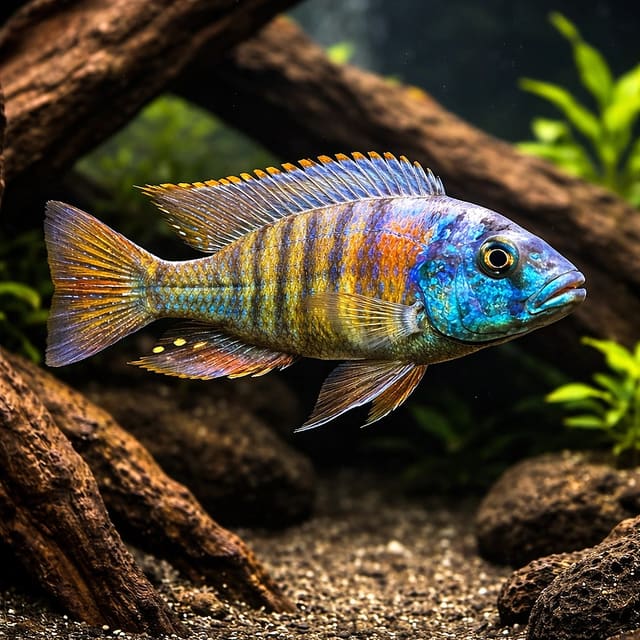
Gallery images have been digitally enhanced to improve image quality. Natural colour, pattern, size and maturity can vary between live animals. The image shows a fish with an olive-gold body, rows of small dark spots along the flank, a dark mark behind the gill cover and a blue-green sheen on the cheek, swimming over pebbles and sand beside rock and fine-leaved plants.
Run through this list first. If every point is already in place, or will be before delivery, you are ready for a group of these fish:
This cichlid rewards keepers who enjoy planning a whole aquarium around one species and watching a group settle into it. It is a poor fit for a mixed community of small fish, for soft or acidic water, or for anyone hoping to keep a single fish in a small tank. If you are comparing it with other species, our African cichlid collection brings the range together in one place.
The water and stocking figures in this guide come from OATA’s care sheet for Malawi cichlids, the UK trade body’s guidance for hard-water cichlids from Lake Malawi. Pundamilia nyererei comes from Lake Victoria instead, so treat those figures as a planning framework for a hard-water lake cichlid rather than proven values for this exact species.
OATA recommends an aquarium of at least 200 litres for a reasonable-sized community of Malawi cichlids, while noting that some specialist species manage in less. For a group of Pundamilia nyererei, start from that figure and go larger if you can. As OATA puts it, you should buy an aquarium as large as possible within reason: a bigger volume holds its temperature and water quality more steadily, and it gives a group more room to spread out.
A filter is always essential, and OATA recommends an oversized one for Malawi cichlid communities, which are kept slightly crowded, and a group of this fish produces waste in the same way. The reason is the nitrogen cycle. RSPCA guidance on aquarium environments explains that fish release ammonia, which is toxic, and a working biological filter lets beneficial bacteria turn it into nitrite, which is also toxic, and then into nitrate, which is safer. Those bacteria need time to build up, so the aquarium must be fully matured before any fish arrive. Our step-by-step guide to setting up a tropical tank walks through maturing an aquarium safely.
OATA also recommends vigorous aeration, so that a well-stocked group always has enough dissolved oxygen. Plan for good surface movement from the filter outlet or an air pump, and keep it running at night.
OATA advises coral sand or a similar substrate to help buffer the water towards the hard, alkaline side. OATA notes that Malawi cichlids will often dig and rearrange the substrate, which will uproot any plants present. Plan for the same behaviour here, so only the hardiest plants are worth trying.
Rockwork gives the group structure. Build it into stable piles with gaps and caves, set directly on the base glass or a firm layer rather than on top of loose sand, so that digging cannot undermine it. A layout with several distinct areas helps individual fish find a space of their own. OATA notes that rearranging the décor can help to reduce aggression, because the fish have to establish new territories.
Most of the work with this fish happens before you order. A group of lake cichlids needs a large, heavy aquarium that has been running long enough for its filter to mature, so give yourself time.
A large aquarium filled with rock and water is extremely heavy. Stand it on a cabinet built for aquariums of that size, on a level, solid floor, and within reach of sockets so that cables do not trail. Keep it away from direct sunlight, radiators and draughty doors, because all three make a steady temperature harder to hold.
The planning range of 23–27 °C sits above normal room temperature in most British homes for much of the year, so a reliable heater with a thermostat is essential. Choose one rated for the volume of your aquarium, position it where water flows past it, and check the thermometer every day rather than trusting the heater’s dial.
These are OATA’s parameters for Malawi cichlids, which the trade body describes as a general guide for that group. They describe hard, alkaline water, but they are not a measured optimum for Pundamilia nyererei, so use them as a range to hold steadily rather than a single target.
| Temperature | 23–27 °C |
|---|---|
| pH | 8.0–8.6 |
| General hardness | Hard, 12–18 °dH |
| Carbonate hardness | Hard, 10–15 °dKH |
| Ammonia | Zero mg per litre |
| Nitrite | Zero mg per litre |
| Nitrate | No more than 20 mg per litre above your tap water level |
Start by finding out what comes out of your tap. Many areas already supply hard water, and a coral sand substrate helps hold the pH and hardness up. Our water parameter matcher compares your own readings with a stated range, which makes it easy to see whether your supply sits close to the figures above or will need adjusting before fish arrive.
Our guide to aquarium water parameters and what to test explains what each reading means and why it matters. The two that matter most day to day are ammonia and nitrite, which should both read zero. OATA warns that these cichlids can be stressed by even the smallest amounts of ammonia, so treat any reading above zero as a problem to fix, not a number to watch.
OATA’s nitrate figure is set against your own supply: the aquarium should stay no more than 20 mg per litre above whatever your tap water already contains. So test the tap first and note the result. After that, regular partial water changes are the main way to keep nitrate down, and overfeeding or adding too many fish at once are the usual reasons it climbs.
Steady water does more good than chasing an exact figure. Make changes gradually, match the temperature of new water to the aquarium, and avoid large swings in pH or hardness between water changes. A well-sized aquarium, a matured filter and a regular maintenance routine keep the water steady almost by themselves.
OATA strongly recommends a partial water change of 25% at least once every week. A siphon makes light work of it and lifts solid waste from the substrate at the same time. Test the water regularly, at least once a week, so that ammonia and nitrite never have a chance to build up.
If the filter needs cleaning, never rinse it under the tap: chlorine or chloramine in tap water can kill the beneficial bacteria living in the media. Instead, rinse it lightly in some of the aquarium water you have just removed during a water change, which keeps most of that bacterial population intact.
A group of lively, well-fed cichlids produces a lot of waste, and the slight overcrowding used to spread aggression adds to it. Regular changes and testing are what keep that system healthy. Skipping them is how problems start, because by the time fish look unwell, water quality has usually been slipping for some time.
OATA points out that the dietary needs of Malawi cichlids vary. Among those species, the smaller rock-dwelling mbuna are more herbivorous and do well on high-algae foods and fresh vegetables, while some larger open-water species are more predatory and need pellets with more animal content, plus frozen foods such as brine shrimp. For Pundamilia nyererei, a mixed diet covers both sides:
OATA advises feeding only what the fish can eat within a few minutes, twice a day. Take care not to overfeed. Uneaten food breaks down and releases toxic waste into the water, which in a busy cichlid aquarium quickly shows up as rising ammonia or nitrite.
Young fish from the 3–4 cm and 4–5 cm grades need small food they can take easily, so choose a pellet or granule size to match and move up as they grow. Spread food across the aquarium so that the boldest fish cannot guard it all.
Feeding time is the best daily health check you have. A healthy group comes forward readily; a fish that hangs back, spits food out or ignores it altogether is worth watching more closely over the next day or two.
The 3–4 cm and 4–5 cm grades are young fish with most of their growth ahead of them, and the XL grade is further along. Whichever you choose, the months after arrival are when a group takes shape.
Young cichlids need small food they can take in one bite, so start with a fine pellet or granule and move up in size as they grow. Keep to OATA’s approach of feeding only what they eat within a few minutes, twice a day. Growth depends as much on clean water as on food, and the weekly water change matters more, not less, while fish are growing quickly.
In this group of cichlids the sexes usually only become distinguishable as fish mature, with colour typically the main difference, so a group of young fish will change gradually over the months ahead. As fish grow, they begin to establish territories, and the balance of the group becomes clearer. That is the point to review numbers: if males outnumber females, plan to rehome some so that the group stays calmer.
If you want to add to the group, add several fish together rather than one at a time, and increase numbers slowly so that the filter’s bacteria can keep pace. OATA notes that rearranging the décor at the same time can help, because every fish then has to establish a new territory and established fish lose some of their advantage.
All fish vary a little in behaviour and appearance, but OATA’s care sheet lists the changes worth noticing before they become a real health issue:
OATA describes healthy fish as having clear, bright eyes, undamaged fins and intact scales, with no ulcers or bumps and normal swimming. In a group of cichlids, keep an eye on fins in particular, because torn fins can show that one fish is being picked on.
If you are worried about a fish, test the water first. Water problems such as ammonia or nitrite above zero, or a sudden change in pH, are the first thing to rule out and the easiest to put right with a water change. If the water is fine and the problem continues, contact us with details of what you are seeing and your latest test results.
Your fish are hand-bagged in pure oxygen by our team and packed in an insulated poly box, with a heat pack when the weather calls for it. A licensed live-animal courier carries the parcel, and we email you the tracking number and your confirmed delivery date so you know when to be in. The full policy is on our delivery and Live Arrival Guarantee page.
The Live Arrival Guarantee needs someone at the delivery address to receive the parcel, the parcel opened and inspected the same day it arrives, and a continuous unboxing video that begins with the parcel still sealed.
If anything is wrong, contact us the same day your fish arrive, with your order number and the unboxing video. WhatsApp is the fastest way to reach us, and we will arrange a replacement or refund.
OATA’s advice on introductions is straightforward. Check that ammonia and nitrite are both at zero before any fish go in, and increase the number of fish slowly. The bacteria in a matured filter have to catch up each time more fish are added and feeding increases. Stocking too many too quickly can cause “new tank syndrome”, where there are not enough nitrifying bacteria to cope, ammonia and nitrite rise, and fish can become ill or die.
It is also best to add these cichlids as a group rather than one at a time, so that no single newcomer takes all the attention while the group settles.
Test ammonia and nitrite more often than usual after new fish go in, because the filter’s bacteria are still catching up with the extra waste. Increase feeding gradually for the same reason. Keep an eye on each fish using the health signs above: swimming, colour, breathing, appetite and fins. A group that is feeding well and spreading out across the rockwork is settling in.
OATA advises that Malawi cichlids should only be kept with other Malawi cichlids, or with some species of Synodontis catfish that also live in Lake Malawi. Pundamilia nyererei is a Lake Victoria cichlid, so Malawi cichlids are not suitable companions for it. The simplest, most reliable plan is an aquarium built around a group of this one species.
OATA describes Malawi cichlids as fish that are not social yet can be highly aggressive, and its answer is numbers: keep them in groups of at least 15, slightly overcrowded to limit aggression, because those kept in small groups will often fight. It also recommends more females than males of each species, so that a male cannot focus his harassment on a single female.
Applying the same principles to Pundamilia nyererei means buying a group rather than a single fish or a pair. Because young fish are sold unsexed and the sexes usually only become clear as they mature, a practical approach is to start with a larger group of young fish and be ready to rehome some males later if the balance turns out uneven.
Small, peaceful community fish are a poor match for any of these aggressive lake cichlids, and soft-water species will not share the hard, alkaline water this fish is kept in. Malawi cichlids belong with their own kind. If you are tempted to add anything other than more Pundamilia nyererei, treat it as a separate decision and plan it with care.
It can suit a committed beginner who plans properly, but it is not a first community fish. OATA’s care sheet for Malawi cichlids, which guides the care of this fish, describes them as usually undemanding once their water needs are met, yet aggressive and best mixed with caution. The real work is setting up a large, hard-water aquarium for a group before the fish arrive.
It grows well beyond the size supplied, so plan for adult fish from the start. OATA notes that most Malawi cichlids reach around 10 cm and some grow to 25 cm; treat that as a planning range for the group rather than a measurement of this species.
OATA recommends an aquarium of at least 200 litres for a reasonable-sized community of Malawi cichlids, and a group of this fish deserves the same planning. Bigger is better: a larger volume keeps temperature and water quality more stable.
Keep a group rather than a single fish or a pair. OATA’s guidance for Malawi cichlids is groups of at least 15, kept slightly overcrowded to spread aggression, with more females than males, because fish kept in small groups will often fight.
Offer a varied diet built on a quality cichlid pellet, with frozen foods such as brine shrimp and some vegetable matter for variety. Feed only what the fish eat within a few minutes, twice a day, and remove leftovers so they do not foul the water.
Use OATA’s broad group guidance for Malawi cichlids as the planning range: 23–27 °C, pH 8.0–8.6 and general hardness of 12–18 °dH, with zero ammonia and nitrite. These are group figures rather than a proven optimum for this species, so keep the water steady within them.
Plan for aggression. OATA’s Malawi cichlid care sheet describes that group as aggressive and best mixed with caution, and notes that fish kept in small groups will often fight; we plan this fish the same way. A properly sized group, plenty of rockwork and adding fish in groups all help to spread it out.
Plan an aquarium for its own species first. OATA advises that Malawi cichlids should only be kept with other Malawi cichlids or some Synodontis catfish from Lake Malawi, so they are not companions for this Lake Victoria fish, and small, peaceful community fish are a poor match for any of these aggressive cichlids.
Each fish is hand-bagged in pure oxygen, packed in an insulated poly box with a heat pack when the weather calls for it, and carried by a licensed live-animal courier. Start a continuous unboxing video before you open the parcel, float the sealed bag for 20–30 minutes, then release the fish without pouring the bag water into your aquarium.
No reviews for this item yet. Bought one? Honest reviews only, good or bad.
What customers say about ordering from us
Easy website plenty of info on fish your buying great to pick a time slot
TRACEY DURRANT · 7 Oct 2026
Got some lovely fish thank you
Kevin Mackie · 7 Oct 2026
Reviews of our shop, collected by Judge.me, an independent third-party review collector. Newest first.