Moderate
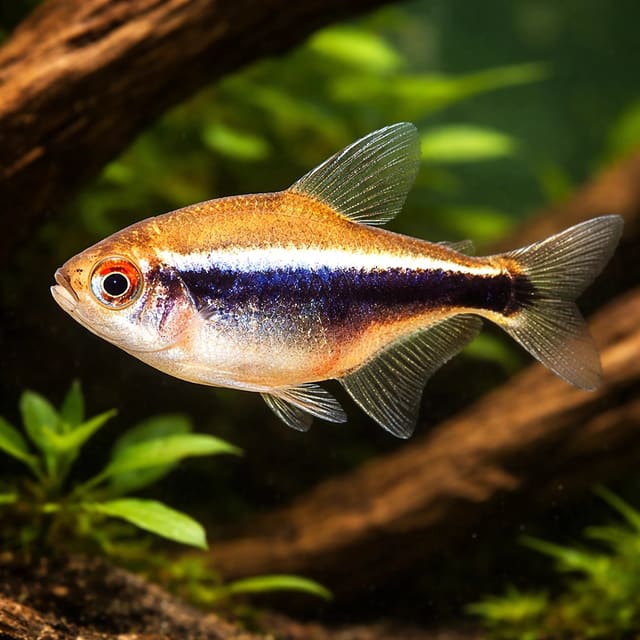
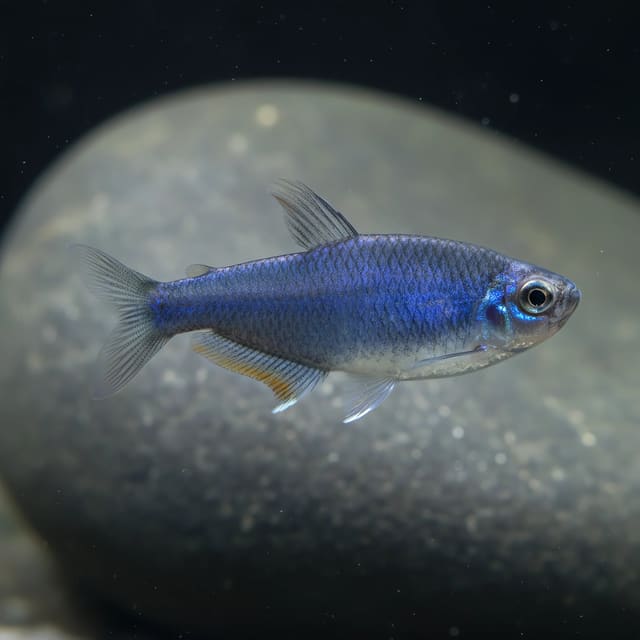
Neon Tetra (Paracheirodon innesi)
21–25°C · pH 5–7
£2.99

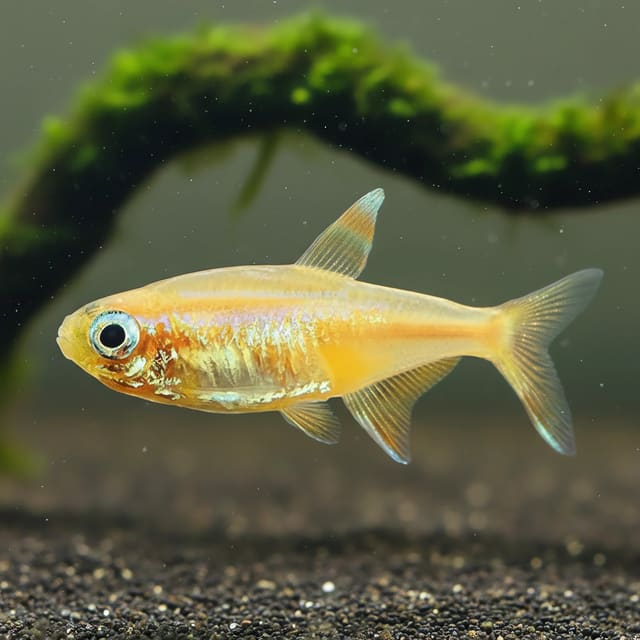
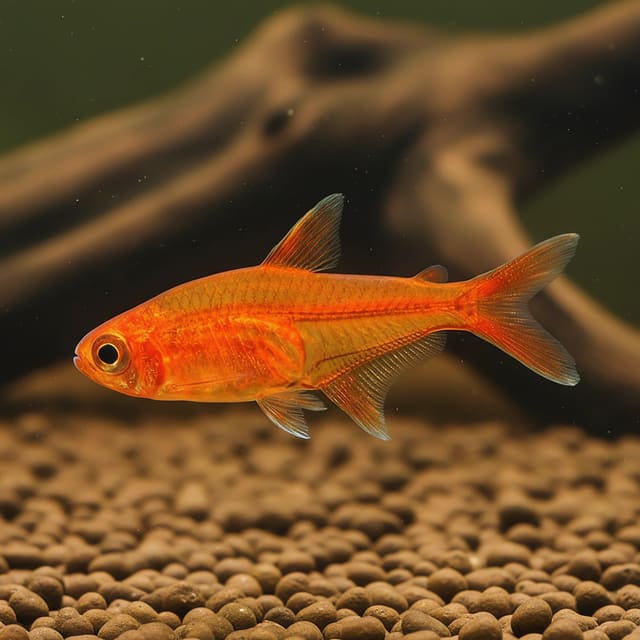
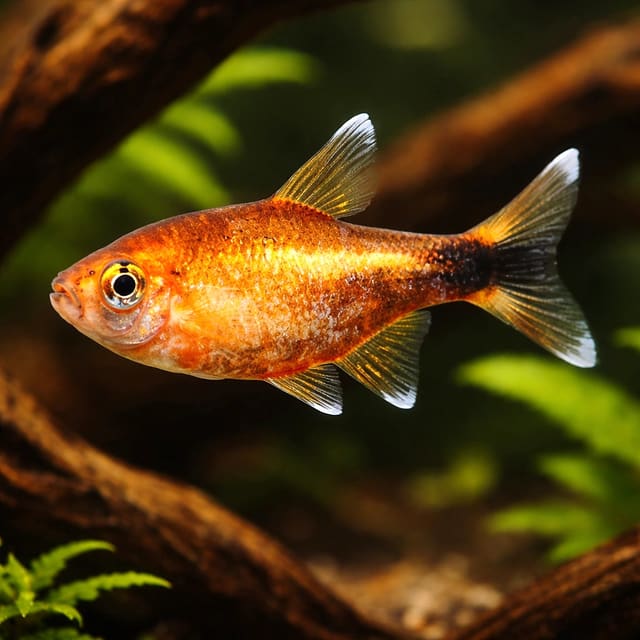
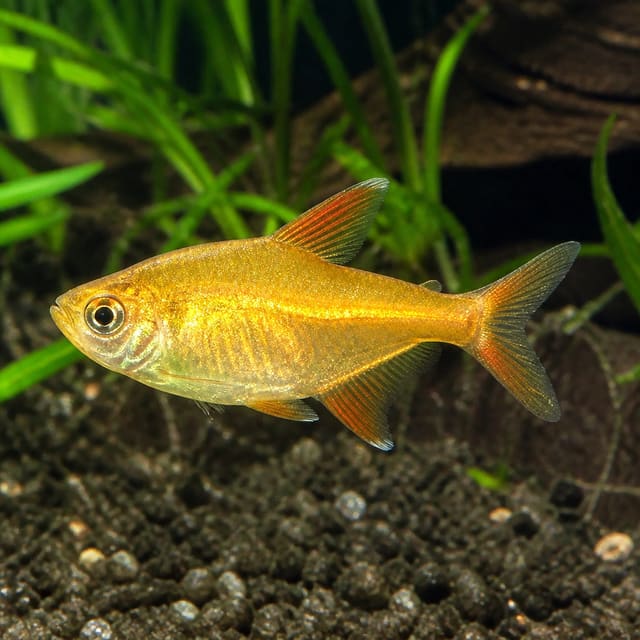
Gold Cardinal Tetra is the gold ornamental form of Paracheirodon axelrodi, a small South American shoaling fish for mature planted aquariums. Keep 8–10 or more in a 60 × 30 cm base of roughly 54 litres or larger, at 23–29 °C, pH 3.5–7.5 and 1–12 dGH. One fish is supplied per purchase, with three dispatch sizes from 2–5 cm.
Adult size is the maximum length this species reaches at full maturity (scientific sources). The livestock you receive will be younger and smaller — pick a size above for the actual shipping size. Product-photo provenance and any image-specific limitations are stated on the listing.
Paracheirodon axelrodi
Shoaling fish: kept in a group they feel safer, stay calmer and show their best colour.
Gold Cardinal Tetra is the gold ornamental form of Paracheirodon axelrodi, a small South American shoaling fish for mature planted aquariums. Keep 8–10 or more in a 60 × 30 cm base of roughly 54 litres or larger, at 23–29 °C, pH 3.5–7.5 and 1–12 dGH. One fish is supplied per purchase, with three dispatch sizes from 2–5 cm.
Adult size is the maximum length this species reaches at full maturity (scientific sources). The livestock you receive will be younger and smaller — pick a size above for the actual shipping size. Product-photo provenance and any image-specific limitations are stated on the listing.
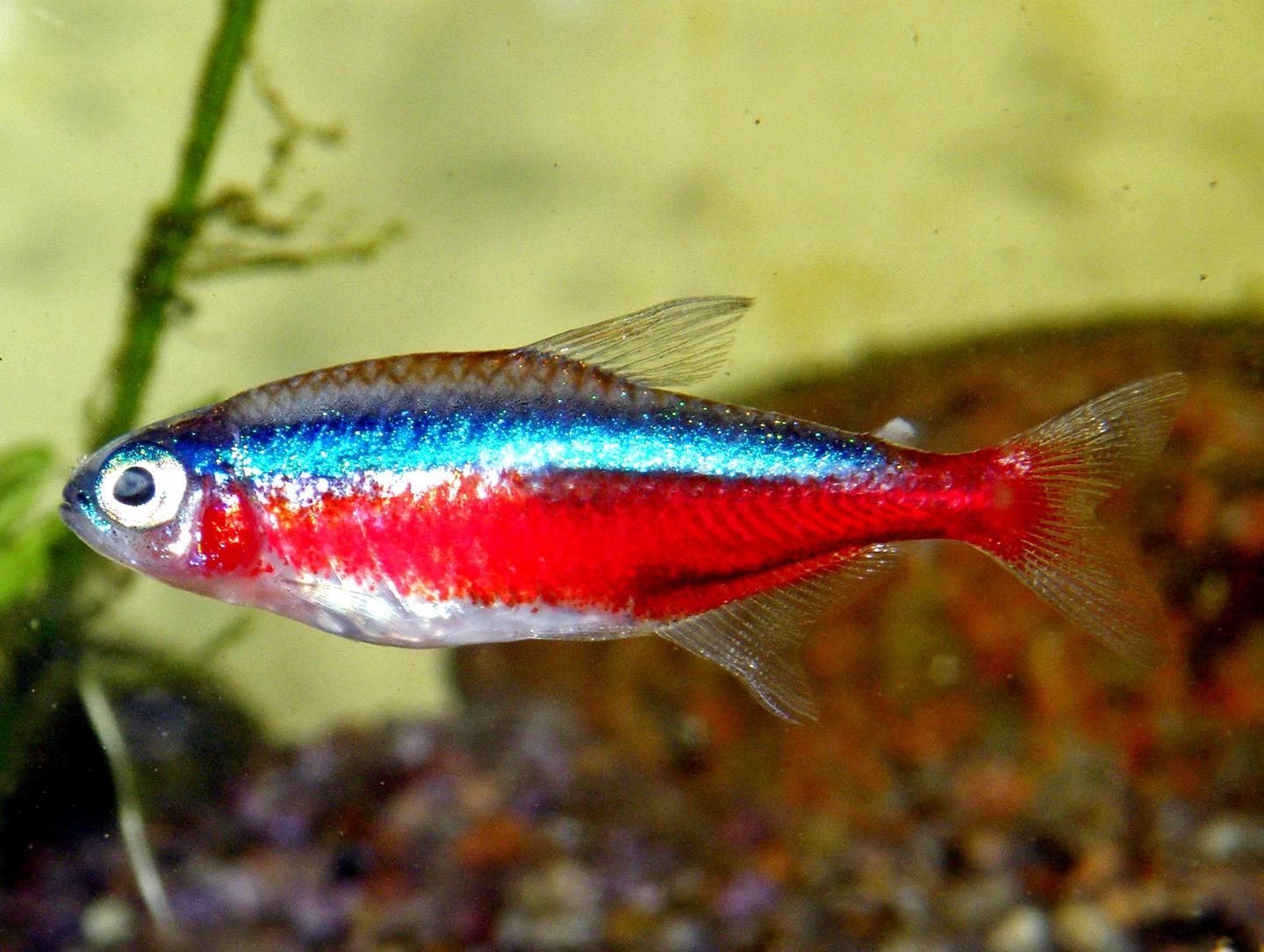
Cardinal tetras are small, social blackwater fish, but they need more than a small volume of water. Our conservative starting policy is a mature, filtered aquarium at least 60 cm long and about 60 litres, a group of 10 or more, a routine target of 24-27 °C, and water chosen from measured supplier and home values rather than a fixed UK tap-water recipe.
Maintain these water conditions for optimal health and vibrant colors
Gold Cardinal Tetra is the ornamental gold form of Paracheirodon axelrodi, the Cardinal Tetra. The older trade label uses Cheirodon axelrodi, a name that FishBase treats as a synonym; the accepted species name used throughout this page is Paracheirodon axelrodi. The gold wording describes a selectively produced colour form, not a separate species. Seriously Fish records gold and albino strains in the aquarium trade.
The species is native to the upper Orinoco and Negro River basins in South America. FishBase describes it as a pelagic fish that forms shoals in the middle water layers. That combination of open-water movement and group behaviour should guide the aquarium plan. The fish needs horizontal swimming room, the security of its own kind and planting or wood around the margins, rather than a small decorative vessel chosen only because the individual fish is short.
This parent listing carries three dispatch grades: 2–2.5 cm, 2.5–3 cm and 3–5 cm. One purchase supplies one live fish in the selected grade. The size you select is the size supplied, not the adult size. Scientific measurements use standard length, which excludes the tail, while a trade grade may use a different handling measurement. FishBase records a maximum of 3 cm standard length and Seriously Fish gives 3.5 cm standard length. The grade label and scientific adult record therefore should not be treated as interchangeable promises.
Sex is guaranteed only when the selected option explicitly states male or female. This Cheirodon axelrodi gold listing has no sex-guaranteed option. Seriously Fish notes that mature females are usually a little larger and rounder-bodied than males, but this is not a reliable purchase selection for juveniles. Choose the fish by species, ornamental form and dispatch grade rather than assuming sex from body shape or a gallery image.
| Suits | Needs reconsideration |
|---|---|
| A mature aquarium with a 60 × 30 cm base or larger | A small uncycled tank chosen for one fish |
| A planned shoal of 8–10 or more Cardinal Tetras | Keeping a single fish or a token pair |
| Peaceful, similarly sized neighbours in matching water | Predators, boisterous feeders or strongly different water needs |
| Keepers who test water and maintain stable filtration | Frequent abrupt changes to temperature or chemistry |
The species can suit a prepared beginner who understands cycling, shoal size and stable water, but the gold form should not be bought as a single ornament. The care task is the whole group. Before choosing livestock for a new aquarium, use the first tropical tank guide to establish filtration and confirm that ammonia and nitrite remain at zero.
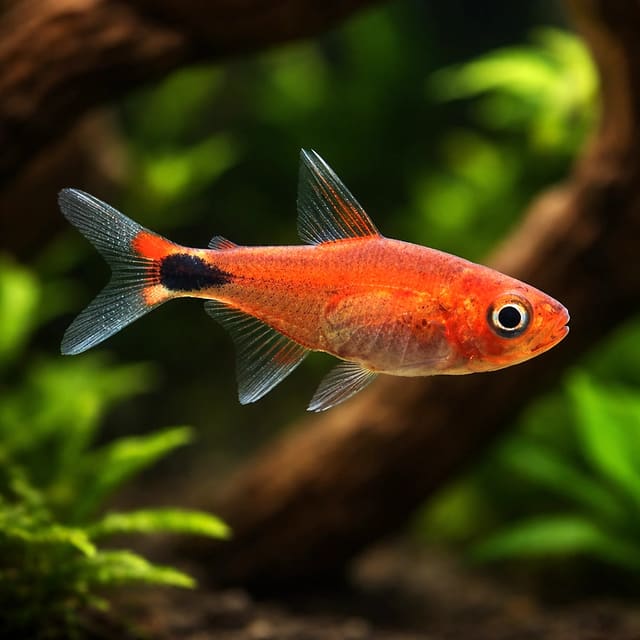
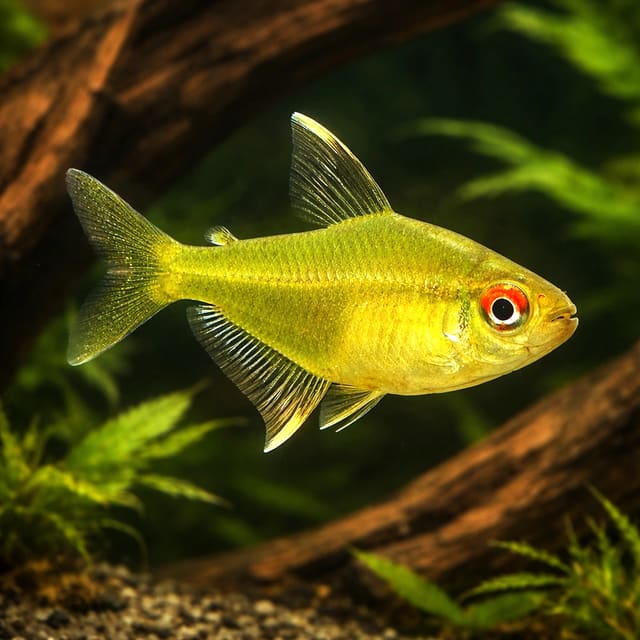
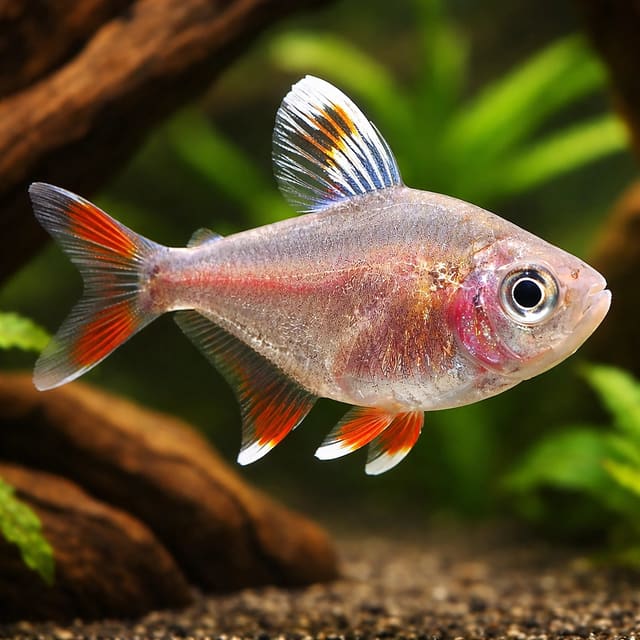
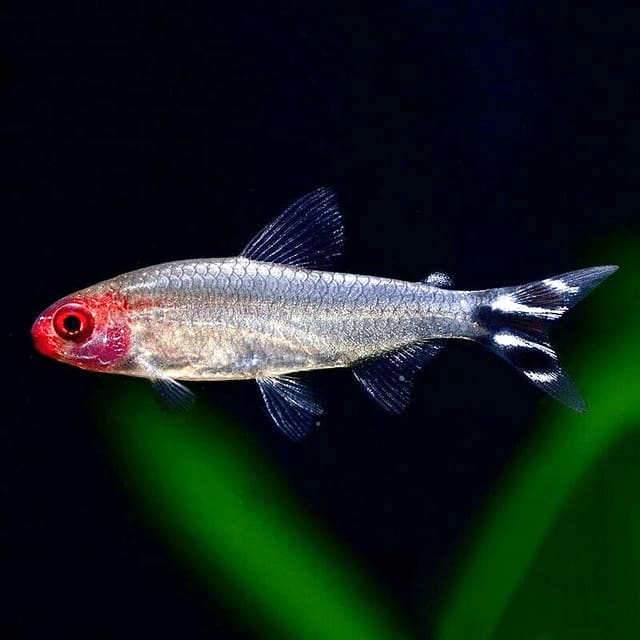
Gallery images have been digitally enhanced to improve image quality. Natural colour, pattern, size and maturity can vary between live animals. Gold intensity, the red body area, iridescence and apparent contrast can change with lighting, background, stress, maturity and the individual fish. The gallery does not guarantee one exact shade or marking.
Browse the tetra collection for separately listed species and ornamental forms. Product alternatives are useful for comparison, but they are not automatic companions and should not be used to assemble a mixed shoal. A Cardinal Tetra gains security from an adequate group of its own species.
A Cardinal Tetra is small, but its welfare requirement is collective. Count any existing Paracheirodon axelrodi, decide on the final group of 8–10 or more, and make sure the aquarium can carry that full number. One purchase quantity supplies one fish, so the quantity chosen across purchases must complete the social plan. A mixture of unrelated tetra species does not replace an adequate same-species group.
Use the dispatch grades to choose the size of the arriving individual, not to choose different care. Every grade needs the same mature, heated aquarium, shoal, swimming length and water assessment. When joining an existing group, consider feeding access and body-size difference. Do not place a much smaller arrival with fish that monopolise every food item simply because the species name matches.
Before the delivery date, test the destination, check filter and heater operation, and identify a safe introduction route that does not require dismantling the aquarium. Have fine food ready and retain access to a mature alternative space in case the community responds badly. The group should enter a stable plan, not become the test used to discover whether the aquarium is ready.
Seriously Fish recommends a base of 60 × 30 cm or larger, corresponding to roughly 54 litres. FishBase also gives a 60 cm minimum aquarium length. These species-level figures matter because a shoal uses open mid-water space collectively. A tall aquarium with a short base can hold a similar volume but offers less usable cruising length. Choose a rectangular footprint that allows the group to move together without meeting glass after only a few body lengths.
OATA's broad tetra guidance suggests at least 45 litres for a small shoal of a smaller species, but that group-level figure does not replace the species recommendation. Use 60 × 30 cm and roughly 54 litres as the starting point for this fish, then increase the aquarium for a larger shoal or a community. More water can improve stability, but only when filtration, stocking and maintenance are also appropriate.
Keep a clear middle-water route along much of the tank while using plants, driftwood roots and branches to frame it. A heavily planted or natural-style layout can work well. A sandy substrate and dried leaf litter can add visual structure and sheltered areas, and the decomposition of suitable leaves supports microbial life. Do not fill every part of the swimming lane with hardscape. The shoal should be able to change direction as a group without repeatedly splitting around obstacles.
Dimmer presentation can make the fish feel secure and show iridescence without exposing it under harsh light. Use floating or taller marginal plants if they fit the rest of the aquarium, while retaining a predictable day–night cycle. Place the aquarium away from direct sun, draughts, heat sources, loud vibration and sudden movement. Fit a secure lid and leave access for maintenance around the filter intake and heater.
Natural peat is unnecessary. Seriously Fish specifically notes that peat collection is unsustainable and environmentally damaging. If leaf litter or alder cones are used, choose aquarium-safe material and add it gradually. Botanical materials can change water colour and chemistry; they are habitat features, not a substitute for testing or for preparing source water that already fits the fish.
Seriously Fish gives 23–29 °C, pH 3.5–7.5 and 1–12 dGH for aquarium care, with wild fish doing better toward the acidic and softer end. FishBase reports 23–27 °C, pH 4.0–6.0 and 5–12 dH in the species' environmental record. The wider specialist aquarium range is used for the captive care field, while the wild record remains a habitat description rather than a command to push a home aquarium to an extreme.
The offered fish's rearing origin is not specified, so do not assume it is already adapted to the keeper's tap water. Measure temperature, pH, general hardness and carbonate hardness before purchase. The water chemistry guide explains what those values describe, and the water matcher helps compare measured aquarium water with the stated range. If the match is poor, prepare suitable water consistently rather than making a sudden correction after the fish arrives.
OATA's tetra sheet lists 22–27 °C, pH 6.5–8.0, 4–12 dGH and 3–10 dKH for captive-bred tetras as a broad group. Cardinal Tetras also appear in the trade as wild-caught fish, and FishBase reports a substantial wild-caught component. The group table cannot establish the origin of this exact fish or widen the species' needs by itself. Stable, tested water within the species profile is the safer planning basis.
Ammonia and nitrite must remain at zero. OATA advises keeping nitrate no more than 20 mg/l above the normal tap-water level in its group guidance. RSPCA guidance explains the biological filter's role: bacteria convert toxic ammonia to nitrite and then to the less harmful nitrate. This process must be functioning before the shoal enters, not expected to develop around newly added fish.
Seriously Fish suggests a turnover of about four to five times aquarium volume per hour for the reference 54-litre setup, equivalent to roughly 215–270 litres per hour. Rated flow is only a starting point; media, head height and maintenance change actual output. Arrange the return so oxygen exchange is adequate without forcing the shoal to fight a narrow high-speed jet. Sponge pre-filters can protect small fish around strong intakes when fitted without impairing safe filter operation.
Add livestock gradually so the filter can respond to increased waste. Test after any stocking change and whenever appetite or breathing alters. Never assume clear water is chemically safe. Ammonia and nitrite are invisible, and a newly disturbed or overloaded filter may fail before the aquarium looks dirty.
FishBase records worms and small crustaceans in the natural diet. Seriously Fish describes the species as likely omnivorous, taking small invertebrates, crustacea, filamentous algae and fallen fruit, and recommends a varied aquarium menu rather than dried food alone. Offer an appropriately small quality flake, granule or micro-pellet together with small live or frozen foods such as Daphnia, Moina, bloodworm or mosquito larvae.
Food size matters. A product can be nutritionally suitable but physically too large for a small tetra to take efficiently. Crush or select food so each fish can swallow it without repeatedly spitting it out. Distribute a small portion across the shoal rather than dropping one clump where only bold individuals feed. Watch the slower fish and confirm that the whole group participates.
OATA recommends only what the fish can consume within a few minutes, once a day, for its broad tetra guidance. Use that as an overfeeding safeguard rather than a demand for one rigid schedule in every aquarium. The appropriate amount depends on food density, group size, condition and the other inhabitants. Remove obvious leftovers and reduce the next portion. Continually adding food to make sure one shy fish eats can damage water quality for the entire shoal.
OATA strongly recommends a partial water change of about 25% at least weekly and testing at least weekly. Prepare replacement water with conditioner to neutralise chlorine or chloramine, and bring its temperature and chemistry close to the aquarium. Siphon exposed debris while preserving the intended layout. Refill slowly enough that the substrate, leaves and shoal are not blasted around the tank.
Check the filter for blockage and reduced flow. If biological media needs cleaning, do not run it under the tap. Rinse it lightly in aquarium water removed during the water change so the established bacterial community is not exposed to chlorine or chloramine. Avoid replacing every media component at once. If a cartridge contains both disposable chemical media and the filter's main biological surface, plan a safe overlap before replacement.
Record temperature, ammonia, nitrite, nitrate, pH and hardness at a consistent point in the maintenance cycle. Trends are more informative than isolated readings. A gradual rise in nitrate, a drift in hardness or a repeated temperature swing can be addressed before appetite and shoaling behaviour change. Re-test unexpected results with clean equipment rather than immediately applying a large chemical correction.
A healthy group should move through the middle water, feed promptly and retain intact fins and steady breathing. Watch for a fish separated from the group, hanging at the surface, sitting unusually low, flicking against objects, breathing rapidly, becoming markedly pale or dark, clamping fins or refusing food. These signs are not a diagnosis, but they justify immediate water testing and closer inspection.
A single weak fish can be masked by the movement of a large shoal. Count the fish during calm feeding and learn where each rests. Check the group after maintenance, after adding another species and during hot weather. If one fish is repeatedly excluded from food or driven away, assess stocking and compatibility rather than treating the problem as personality alone.
This page does not prescribe disease medication. If temperature and water quality are correct but abnormal signs persist, seek advice from an experienced aquatic retailer or veterinary professional. Do not combine treatments or expose invertebrates and sensitive fish to a product without checking its active ingredients and restrictions.
The relevant water is not just the reading in the tank on purchase day. Replacement water must remain close enough that regular maintenance does not cause a sharp swing. Test the household supply at different times when it is known to vary, and account for any water softener, remineralisation or reverse-osmosis blend. Keep the recipe simple enough to reproduce every week.
Adjust water outside the occupied aquarium where possible and verify it before use. Avoid using one large dose of acid or alkaline buffer to force a number rapidly. pH behaves in relation to carbonate hardness, so a reading can rebound or move unpredictably when the buffering capacity is not understood. Consistent source-water preparation is safer than repeatedly correcting the aquarium after a change.
Record how the shoal feeds and distributes itself alongside the numerical results. A stable-looking number does not excuse repeated isolation or surface breathing, and nervous behaviour does not automatically prove chemistry is wrong. The two kinds of information work together: test promptly when behaviour changes, then examine group size, neighbours, flow, temperature and maintenance if water remains within range.
FishBase says to keep Cardinal Tetras in groups of five or more, while Seriously Fish recommends a mixed-sex group of at least 8–10. OATA's broad guidance also says tetras should be kept in groups of at least five and that more is better; fish kept singly or in groups that are too small will often become stressed. For this listing, plan 8–10 or more of the same species. That number takes priority over adding several different one-or-two-fish attractions.
This listing supplies one fish per purchase. The buyer is responsible for selecting a purchase quantity and existing group that together meet the shoaling need. The three size grades describe individual dispatch size, not pack size. Avoid a group made from severely mismatched sizes if the smaller fish will lose feeding access, and never assume an ornamental colour form is a substitute group for every unrelated tetra.
Sex is not needed to build a welfare-focused shoal. Mature females can be rounder and a little larger, but this offer does not guarantee sex and the buyer should not try to construct a ratio from juvenile photographs. A sufficiently sized same-species group, adequate swimming length and low competition are the practical priorities.
Seriously Fish describes the species as generally peaceful and suggests similarly sized characids, hatchetfishes, pencilfishes, smaller callichthyid or loricariid catfishes and non-predatory small-to-medium cichlids in a carefully researched community. These are kinds to investigate, not a universal approval list. Each proposed species must share temperature, pH and hardness, remain appropriately sized, and leave enough swimming and feeding space.
OATA says smaller tetras should not be kept with fish large enough to eat them, and that tetras and pencilfish mix best with species of similar size and temperament. This provides a clear first exclusion: no predator or large opportunistic fish that could swallow a Cardinal Tetra. A fish does not have to be labelled aggressive to be unsafe if the tetra fits in its mouth.
Avoid boisterous feeders that take every small food item before the shoal can respond. Be cautious with persistent fin nippers, territorial fish that control the open middle water, and very active species that keep the shoal compressed into cover. Even a biologically compatible neighbour can make the aquarium unsuitable if the combined group leaves too little horizontal room.
A settled shoal may spread out when it feels secure and tighten when startled; constant tight clustering in one corner is not automatically a desirable display. Watch whether the fish use the full swimming lane, emerge for food and resume normal movement after a disturbance. Repeated hiding, rapid breathing, fin damage or one fish breaking away from the group deserves investigation.
Add new inhabitants slowly. A sudden increase in waste can challenge the filter, while a sudden increase in activity can change feeding access and perceived security. Test water after stocking and observe at more than one time of day. If the shoal stops feeding freely after a neighbour is introduced, reconsider the social arrangement even when no direct chase is seen.
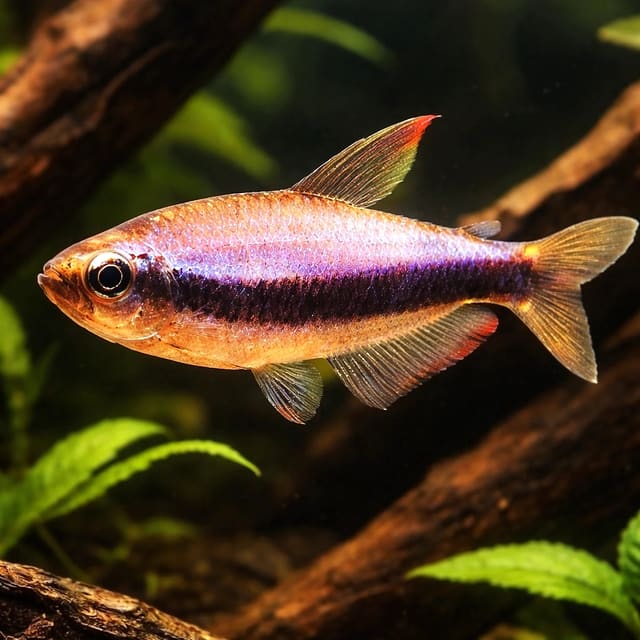
Alternative tetra products shown elsewhere on this page are comparisons, not directions to mix species. Neon Tetra and Black Neon Tetra have their own group and water requirements. Buying a few of each does not create one adequate Cardinal Tetra shoal, and sharing a retail category does not prove compatibility.
List every intended species with adult size, group size, swimming level, temperature, pH, hardness and feeding method. Calculate for the adult community rather than today's juvenile body sizes. Reserve the middle-water lane for the tetra shoal and identify where bottom fish, surface fish and territorial species will live. If several groups depend on the same space, the plan is crowded before the aquarium is stocked.
Count biological load as well as swimming room. A larger tank does not make ammonia harmless, and a strong filter does not create social space. The filter must process the combined waste while the physical layout lets each species perform normal behaviour. Increase aquarium size or simplify the species list when either requirement is marginal.
Cardinal Tetras take small food in mid-water. Large sinking pellets aimed at catfish do not replace appropriately sized tetra food, and a surface-feeding swarm can intercept everything before it reaches them. Offer a controlled spread of fine food and observe from both ends of the aquarium. Adjust placement or food form if only the bold front rank feeds.
Do not solve unequal feeding by continually overfeeding. Excess food increases waste and can conceal the original competition. It is better to change the neighbour mix, feeding position or flow pattern. A compatible community is one in which every group eats without frantic competition and water quality remains stable.
Even careful planning cannot predict every individual. Keep access to a mature, heated and filtered alternative space or a suitable divider. A bare uncycled container is not a safe fallback for a fish already weakened by conflict. The separation plan should preserve the same water range and allow close observation.
Intervene when a fish cannot feed, is repeatedly chased, develops fin damage or remains isolated. Rearranging décor may alter routes, but it cannot compensate for a predator, incompatible chemistry or insufficient shoal size. Sometimes the responsible solution is permanent separation rather than another decoration.
FishBase records Paracheirodon axelrodi to 3 cm standard length, while Seriously Fish gives 3.5 cm standard length. Standard length excludes the tail. The 2–2.5 cm, 2.5–3 cm and 3–5 cm labels on this listing are dispatch grades, not promises of one adult length.
Use a base of 60 × 30 cm and roughly 54 litres or larger for the shoal. FishBase also gives a 60 cm minimum aquarium length. Increase space for a bigger shoal or community, and preserve an open middle-water route alongside planted or wooded cover.
Plan 8–10 or more of the same species. FishBase gives five or more, while Seriously Fish recommends at least 8–10 and OATA says more than five is better for shoaling tetras. This listing supplies one fish per purchase, so choose a quantity that completes an adequate group.
It can suit a prepared beginner with a mature aquarium who can test water, maintain a proper shoal and keep chemistry stable. It is not suitable for an uncycled starter bowl or as a single display fish. Prepare the full adult community before purchase.
Offer an appropriately small quality flake, granule or micro-pellet and vary it with small live or frozen foods such as Daphnia, Moina, bloodworm or mosquito larvae. Spread small portions so every fish can feed, remove leftovers and avoid using extra food to compensate for competition.
The species aquarium profile gives 23–29 °C, pH 3.5–7.5 and 1–12 dGH, with wild fish toward the acidic and softer end. Keep ammonia and nitrite at zero and avoid sudden changes. Test the actual aquarium and source water rather than relying on tap-water assumptions.
It is generally peaceful and is not presented as a routine fin-nipper. Stress, inadequate group size and competition can still disrupt behaviour. Keep a proper shoal, provide swimming room and avoid boisterous or persistent fin-nipping neighbours.
Research similarly sized peaceful characids, hatchetfishes, pencilfishes, smaller callichthyid or loricariid catfishes, and non-predatory small-to-medium cichlids that share its water. Never house it with a fish large enough to eat it, and check adult size, group size and feeding pace for every neighbour.
Tropical Fish Co hand-packs live fish in an insulated box and uses a tracked, licensed live-animal courier for the confirmed delivery date. Be present to receive the parcel. Before opening, record one continuous unboxing video showing the sealed parcel, outer box and fish still in the sealed bag; this is required for a Live Arrival Guarantee claim. Float the sealed bag for 20–30 minutes, add small amounts of aquarium water over up to 20 minutes to adjust chemistry, then release the fish while adding as little bag water as possible. Contact Tropical Fish Co the same day if there is a problem. Read the current terms on the delivery page.
FishBase supplies the accepted species name Paracheirodon axelrodi, family Acestrorhamphidae, upper Orinoco and Negro basin distribution, shoaling behaviour, environmental record and 3 cm standard-length maximum. The supplier identity links the older Cheirodon axelrodi gold trade wording to this exact parent, while Seriously Fish confirms that gold is among the selectively produced ornamental strains. The trade form remains outside the scientific parentheses because it is not part of the binomial.
FishBase gives 3 cm standard length and Seriously Fish gives 3.5 cm standard length. Care specs use 3.5 cm as the conservative maximum across the two records. The retail grades extend from 2 to 5 cm and are preserved exactly because they describe supply choices, not a rewritten biological maximum. Standard length excludes the tail, and no conversion is made between the supplier's grading method and the scientific records.
Seriously Fish supplies the 23–29 °C, pH 3.5–7.5 and 1–12 dGH species aquarium range. FishBase supplies a narrower wild-environment record of 23–27 °C, pH 4.0–6.0 and 5–12 dH. OATA gives a broad captive-bred tetra range of 22–27 °C, pH 6.5–8.0, 4–12 dGH and 3–10 dKH. The care field retains the species aquarium range and states its scope; wild fish should be kept toward its acidic and softer end.
FishBase provides five or more fish and a 60 cm aquarium length. Seriously Fish raises the practical group recommendation to 8–10 and gives a 60 × 30 cm base of roughly 54 litres. Those species-level figures govern this page. OATA's broader five-or-more and 45-litre small-tetra guidance confirms the importance of a shoal but does not reduce the species footprint.
OATA supports the mature-tank checks, zero ammonia and nitrite, weekly testing, conditioned replacement water, 25% weekly water changes, filter-media handling, gradual introduction and small-food routine. RSPCA explains why established biological filtration is essential. Tropical Fish Co's delivery policy alone supplies courier, unboxing-video, arrival-claim and 20–30 minute floating steps. These store steps are kept distinct from long-term care.
Do not infer a guaranteed lifespan, sex, disease treatment, breeding outcome or universal companion list. The customer can act on the exact offer, shoal requirement, aquarium footprint, measured water range and named compatibility categories without turning uncertain details into promises.
The destination aquarium should already be mature, heated, filtered and tested. Confirm zero ammonia and nitrite, stable temperature, a suitable pH and hardness match, and enough open length for the intended shoal. Know the existing fish count and have small food ready. Acclimatisation cannot cycle a filter or turn incompatible water into a permanent match.
The store policy requires the recipient to be present and asks for one continuous unboxing video for a Live Arrival Guarantee claim. Begin with the parcel sealed, keep the outer box visible, show the opening and show the fish still in the sealed bag before anything is disturbed. Recording after the bag is opened cannot recreate that sequence.
The store says to float the sealed bag for 20–30 minutes before release. The full OATA introduction guidance then adds small amounts of aquarium water over up to 20 minutes to adjust chemistry. Release the fish while adding as little transport water as possible and monitor the group and water quality closely during the first week. If there is a problem, contact Tropical Fish Co on the day of arrival with the order number and continuous video.
If the purchase joins an existing group, count and observe that group beforehand. If several fish are being added, confirm the biological filter can accept the increased waste and test frequently afterwards. Do not split the shoal across temporary small containers simply to manage delivery day. The final aquarium and any contingency aquarium must both be heated, mature and suitable.
No reviews for this item yet. Bought one? Honest reviews only, good or bad.
What customers say about ordering from us
I have a small group of long finned mountain minnows. So was delighted to be able to order ten of this variety to increase the genetics in my tank . The ones I recieved are healthy but it’s to early to give a verdict on wether they are of a long finned type since they are small currently.
Gordon Walker · 23 Sept 2026
100% success travel and "installation". Pleased with quality of purchase. The Siamese fighter a bit "shy" so have not yet seen him at his best yet but looking good. Happy customer. GG
George E Garratt · 21 Sept 2026
Reviews of our shop, collected by Judge.me, an independent third-party review collector. Newest first.