Easy
Blue Moscow Female Guppy (Poecilia reticulata)
22–28°C · pH 7–8
£3.99

One live female Moscow Black Guppy per selected quantity, supplied at approximately 3-4 cm; dark colour varies and the gallery remains empty until an exact product image is available.
Adult size is the maximum length this species reaches at full maturity (scientific sources). The livestock you receive will be younger and smaller — pick a size variant above for the actual shipping size. Product-photo provenance and any image-specific limitations are stated on the listing.
Poecilia reticulata
Save when buying multiple fish. Each quantity is one fish; sex and pair formation are not guaranteed unless the selected variant explicitly states them.
Confirm your email, then we’ll send an availability message for this exact item if it returns within 180 days.
This request is only for this product—no newsletter or other promotions. A mail-provider retry may very rarely duplicate the same availability message. Unconfirmed addresses are removed after 48 hours. See our privacy policy.
One live female Moscow Black Guppy per selected quantity, supplied at approximately 3-4 cm; dark colour varies and the gallery remains empty until an exact product image is available.
Adult size is the maximum length this species reaches at full maturity (scientific sources). The livestock you receive will be younger and smaller — pick a size variant above for the actual shipping size. Product-photo provenance and any image-specific limitations are stated on the listing.
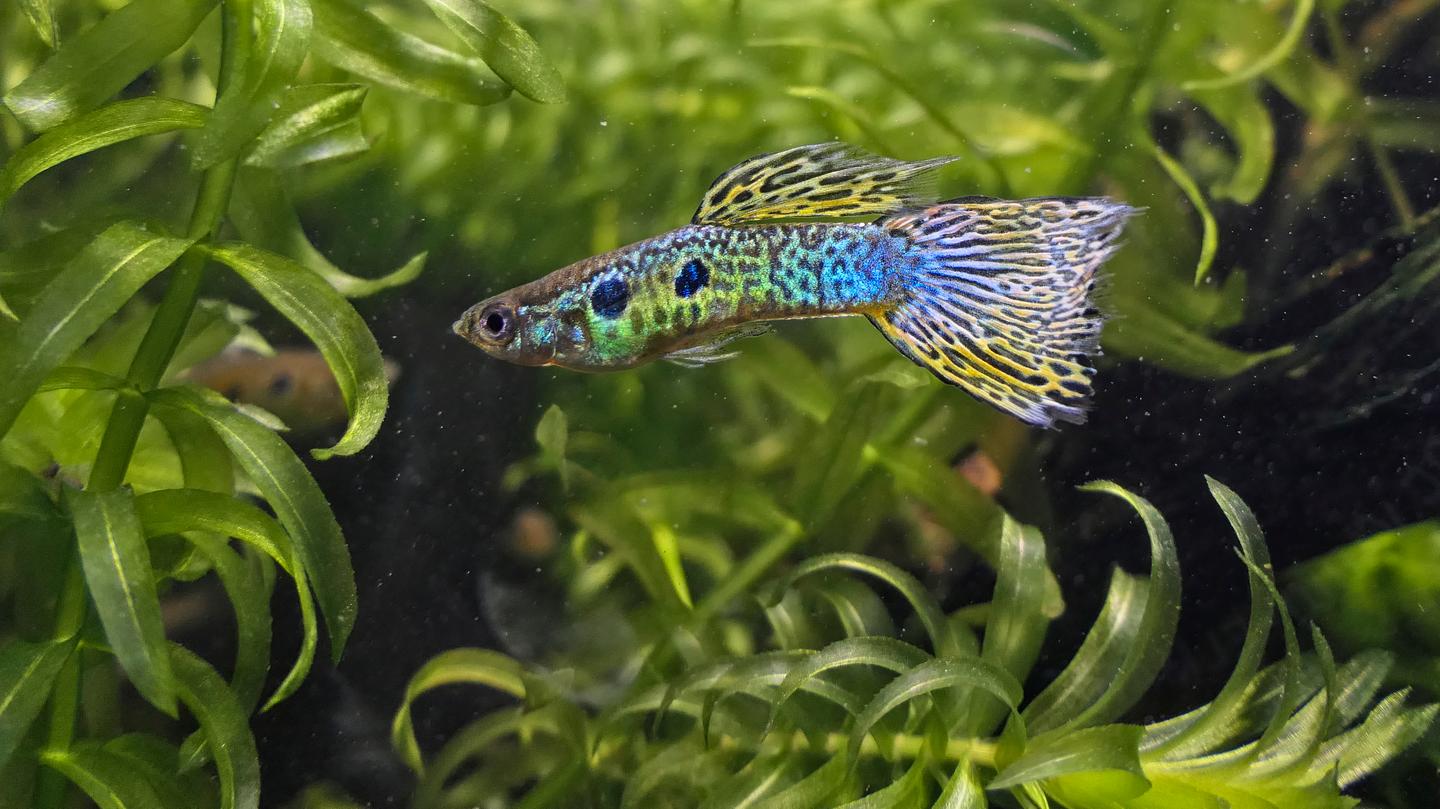
Guppies are social livebearers suited to a prepared beginner, not a fish-per-litre formula. Use a mature filtered aquarium, tested neutral-to-alkaline mineral-bearing water, deliberate sex and population planning, open swimming room, cover and a separation option.
Maintain these water conditions for optimal health and vibrant colors
Female Moscow Black Guppy (Poecilia reticulata) is a female fancy-guppy line selected for dark Moscow-strain colour. This listing is for one live female fish per selected quantity, supplied at approximately 3-4 cm. It is not a mixed-sex pair and it is not a generic assorted-guppy listing.
The female is an important distinction. Female guppies are normally larger-bodied and less ornate than males, and an individual sold under a Black Moscow strain name may show charcoal, smoky black or darker tail and body areas rather than the uniform jet-black finish often advertised on adult males. Colour depth and fin detail vary naturally, so choose this fish for the female Moscow line and its dark overall character, not for an identical pattern on every animal.
| Sale unit | One live female fish per selected quantity |
|---|---|
| Common name | Female Moscow Black Guppy, Black Moscow female guppy |
| Scientific name | Poecilia reticulata |
| Domestic form | Female Moscow Black fancy-guppy strain |
| Supplied size | Approximately 3-4 cm; this is not the adult maximum |
| Adult size | Usually around 5-6 cm for a female, with individual variation |
| Care level | Easy to moderate once the aquarium is mature and stable |
| Temperament | Active and generally peaceful; mixed-sex groups need careful ratio and cover |
| Minimum aquarium | 45 litres for a small group; 60 litres or more is the practical recommendation |
| Temperature | 20-28°C sourced range; a stable 23-26°C suits many communities |
| pH | 7.0-8.0 |
| General hardness | 8-18 dH; medium-hard, mineral-bearing water |
| Diet | Omnivore: quality flake or micro granule plus measured frozen or live foods |
| Tank region | Active through the upper and middle water |
| Social plan | Keep with other guppies; use at least two females per male in a mixed-sex group |
| Breeding | Livebearer; a female may produce fry and can store sperm for several months |
Each selected quantity represents one live female Moscow Black Guppy. The recorded dispatch grade is approximately 3-4 cm. That measurement describes the supplier size band rather than an exact nose-to-tail measurement for every fish, and females may continue growing towards roughly 5-6 cm under good care.
Sex is the defined feature of this product: the line is sold as female. Pregnancy status, previous mating, age, exact colour coverage, fin pattern, genetics and breeding performance are not guaranteed. Female guppies can store viable sperm after mating, so a female may later produce fry even when no male is present in the home aquarium.
| Feature | Female Moscow Black | Male Moscow Black |
|---|---|---|
| Body shape | Usually larger-bodied with a fuller abdomen | Usually smaller and more streamlined |
| Anal fin | Triangular female anal fin | Modified gonopodium |
| Colour expectation | Dark strain influence can be softer, patchier or more charcoal | Often selected for stronger, more continuous black colour |
| Fin display | Generally shorter and less ornate | Often larger and more decorative |
| Adult size | Commonly larger than the male | Commonly smaller than the female |
| Mixed-sex behaviour | Needs room and cover to move away from persistent attention | May court and chase females repeatedly |
This comparison is a realistic buying guide, not a promise that every individual will match a fixed template. Domestic guppy strains vary, and colour can change with age, condition, lighting and settling-in stress. The strongest reason to choose this listing is that you specifically need a female from the dark Moscow strain group.
A dark female guppy can add a quieter contrast to a planted livebearer display. Against fresh green plants, pale sand or brighter guppy strains, charcoal and black tones create depth without relying on the oversized tail display of a male. Females also give a breeding group the correct sex balance when the keeper has already chosen a compatible male.
This product can suit a female-only guppy group, a carefully planned mixed-sex group or an established community that already meets guppy water requirements. It is not a dependable choice for a tiny uncycled aquarium, a very soft acidic setup or a tank where a lone female would face constant pursuit from one or more males.
The Ornamental Aquatic Trade Association recommends at least 45 litres for a small group of guppies. We suggest 60 litres or more where space allows because the extra water volume is more stable, gives active females more swimming room and makes planting, filtration and social separation easier. Use a longer footprint rather than relying on a narrow decorative tank.
Provide a mature biological filter, thermostatic heater, separate thermometer and secure cover. Guppies use the upper and middle water and can jump, especially when newly introduced or startled. Aim the filter return so that the water is oxygenated without forcing the fish to swim against a hard current all day.
Plant the back and sides while keeping an open route through the centre. Fine-leaved stems, floating roots, broad leaves and a little branch or root structure give females places to pause and break line of sight. A 2025 controlled welfare study found better measured welfare indicators in guppies kept with richer environmental enrichment, but enrichment still needs to leave enough clear swimming space for the number of fish.
| Temperature | 20-28°C; keep the chosen value stable |
|---|---|
| Practical community target | Approximately 23-26°C with compatible tank mates |
| pH | 7.0-8.0 |
| General hardness | 8-18 dH |
| Carbonate hardness | 5-15 dKH |
| Ammonia | 0 mg/l |
| Nitrite | 0 mg/l |
| Nitrate | Keep controlled; OATA advises no more than 20 mg/l above the tap-water level |
Domestic guppies are often described as adaptable, but adaptability is not a reason to ignore mineral content or water quality. They generally suit neutral to alkaline, medium-hard water better than very soft, acidic conditions. Test your tap water before ordering and use our water matcher to compare measured parameters rather than trying to force the aquarium towards a number with rapid chemical adjustments.
Stability matters more than daily correction. Condition replacement water, match temperature, change a sensible portion regularly and keep a record of ammonia, nitrite, nitrate, pH and hardness. Never add this fish to an aquarium that has not completed its nitrogen cycle.
Poecilia reticulata is an omnivorous livebearer. FishBase records zooplankton, small insects and detritus in its natural diet, while OATA recommends a quality flake or granule with an algae component for aquarium guppies. Use a reputable small flake or micro granule as the staple and rotate in appropriately sized daphnia, brine shrimp, cyclops, small bloodworm or similar frozen/live foods for variety.
Feed measured amounts that the group can finish promptly. One or two small feeds can work, but the correct amount depends on fish number, food type, temperature and body condition. Overfeeding is not kindness: leftovers and excess waste raise the biological load and can undermine the clean water that fancy guppies need.
Watch the female at feeding time. A healthy settled fish should notice food and hold its place in the group. If she is consistently excluded, spits food, loses condition or isolates herself, check competition, bullying, mouth size, water quality and signs of illness.
Guppies need companionship. FishBase recommends groups of five or more, while OATA advises at least three and a ratio of at least two females to each male in mixed-sex groups. For a display with both sexes, use the female-biased ratio as a minimum and provide enough room that a female can move away from repeated courtship.
Do not add one female to a tank containing several males. Research on Trinidadian guppies shows that male sexual harassment can alter female habitat use, so persistent chasing is a welfare issue rather than harmless display. Dense planting at the edges, floating cover and broken sight lines help, but they do not compensate for an unsuitable sex ratio or overcrowding.
A female-only group avoids ongoing male courtship, although the fish still need space, clean water and observation. Individual females may establish a loose pecking order, particularly around food. Increase cover and feeding access if one fish is repeatedly displaced.
Guppies are livebearers: the female gives birth to formed fry rather than laying exposed eggs. If males and females share the aquarium, breeding should be expected. Plant growth can provide refuge for fry, but adult fish and community tank mates may still eat them.
A female can store viable sperm for several months. This means separating the sexes now does not guarantee there will be no future broods, and a newly purchased female should never be sold as certain not to be carrying or storing sperm. Have a humane plan for fry before building a mixed-sex group; repeated unplanned broods can quickly overload the aquarium and filter.
A small isolation box is not suitable as permanent accommodation for an adult female. If a fish needs separation for health or social reasons, use a mature, heated and filtered aquarium with enough swimming room and cover.
Choose peaceful fish that appreciate the same neutral-to-alkaline, mineral-bearing water. Other guppies, selected Endler-type livebearers where hybridisation is not a concern, platies and some peaceful bottom fish can work when aquarium size, temperature and hardness overlap. Tank-mate suitability must be checked species by species rather than assumed from the word "community."
Avoid confirmed fin nippers, aggressive cichlids, large predatory fish and tank mates that need very soft acidic water. Do not combine them with fish large enough to swallow an adult guppy. Small shrimp and shrimplets may also be investigated or eaten, so this is not a dependable shrimp-safe choice.
For more compatible strains and current availability, browse our guppies for sale in the UK hub. The full guppy care guide covers aquarium planning in greater depth.
| Female line | Visual direction | Useful when |
|---|---|---|
| This Moscow Black female | Dark charcoal-to-black Moscow strain influence | You want a darker female or need females for a Black Moscow group |
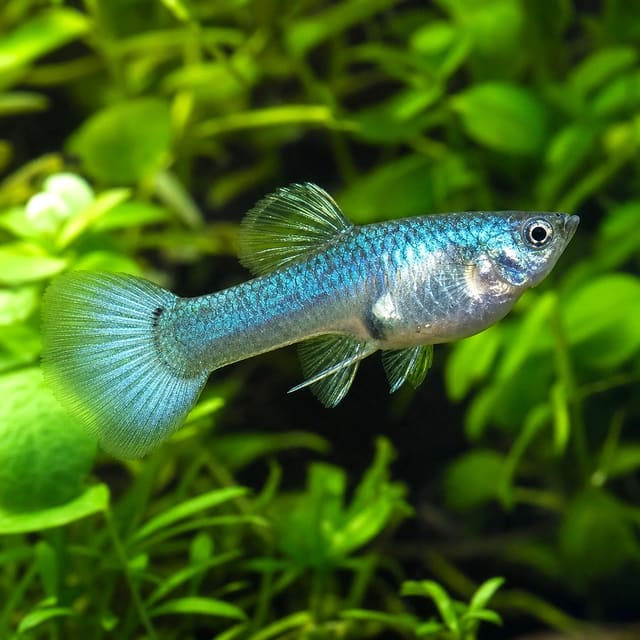
| Blue Moscow Female Guppy | Cool blue Moscow strain direction | You prefer a blue-toned female group |
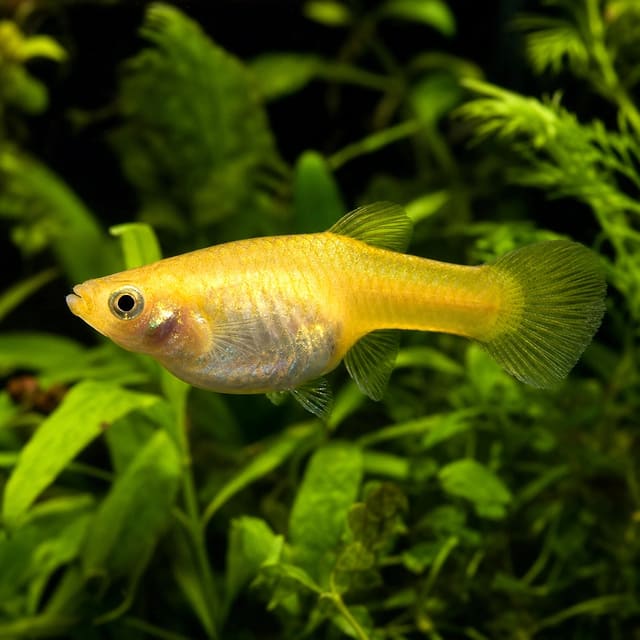
| Yellow Female Guppy | Brighter yellow colour direction | You want a lighter contrast against plants |
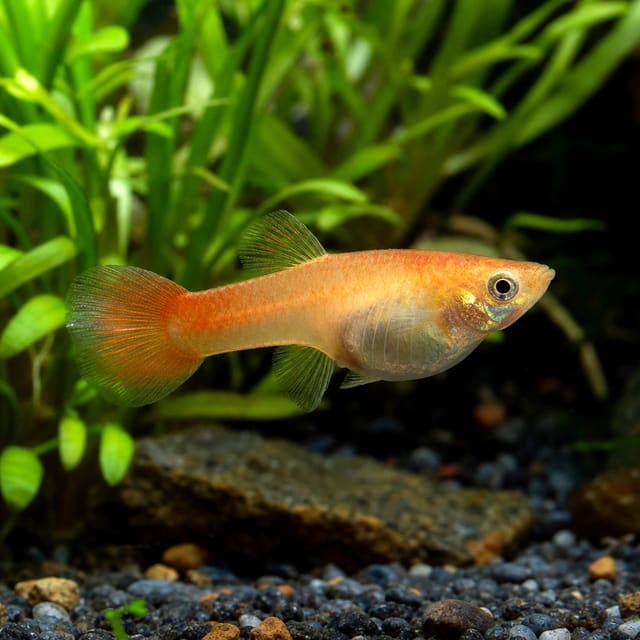
| Red Blond Female Guppy | Warm red/blond strain direction | You want a warmer, paler female form |
These are separate domestic strain listings, not guaranteed matched sets. Compare current sex, supplied size, stock and care details on each product page before combining fish.
Check the aquarium every day. Look for steady breathing, an upright swimming posture, open fins, normal interest in food and the confidence to use more than one small corner. A newly arrived fish can be subdued while settling, but persistent clamped fins, shimmying, flashing, rapid breathing, surface gasping, weight loss, white spots, damaged fins or isolation need investigation.
Test water first when behaviour changes. Confirm temperature, ammonia, nitrite, nitrate, pH and hardness, then assess oxygenation, recent maintenance, aggression and new arrivals. Quarantine equipment and a separate mature hospital setup are more useful than adding medication blindly to the display aquarium.
Maintain the filter without sterilising it. Rinse biological media gently in removed aquarium water rather than untreated tap water, and never replace all mature media at once. Regular partial water changes and restrained feeding are the foundation of long-term health.
Prepare the aquarium before dispatch: test the water, check the heater and filter, make sure the cover fits and leave a quiet planted area. On arrival, keep the lights low and follow the current acclimation instructions supplied with the order. Avoid adding transport water to the aquarium where practical, and do not combine a new fish immediately with an aggressive group.
Observe breathing and balance during acclimation, then allow the fish time to settle before offering a small meal. Eligible livestock orders are supported by our UK Live Arrival Guarantee when the current delivery, receipt, evidence and reporting terms are followed. New customers can use WELCOME10 for 10% off an eligible first order while the promotion and checkout conditions are active.
No verified product-specific image is currently attached to this listing. We have left the product gallery empty rather than show a borrowed fish, a photograph from a different colour line or an animal that could misrepresent what is supplied.
The written identity is still specific: this is the female Moscow Black line of Poecilia reticulata, supplied at approximately 3-4 cm. Natural colour, fin shape and markings vary between living fish, and no order is WYSIWYG unless a future listing explicitly says otherwise.
A good fit: a mature heated aquarium of at least 45 litres for a small group, preferably 60 litres or more; neutral-to-alkaline medium-hard water; peaceful companions; a planned female-only or female-biased mixed-sex group; and a keeper ready for the possibility of fry.
Choose something else: if the aquarium is new, very small, cold, very soft and acidic, strongly turbulent, occupied by fin nippers, or already contains too many male guppies. It is also the wrong listing if you need a guaranteed pair, a male with oversized fins, an exact jet-black individual or a photographed WYSIWYG fish.
One live female Moscow Black Guppy is supplied per selected quantity.
No. This is a female-only product. Selecting quantity two means two females, not a sexed pair.
The recorded supplier size is approximately 3-4 cm. Individual fish within a live size grade vary slightly.
Plan for roughly 5-6 cm, with variation between strain, age, condition and individual fish.
Not necessarily. The Moscow Black strain gives a dark colour direction, but females are often less uniformly black and less ornate than males. Charcoal, smoky and variable dark coverage should be expected.
There is currently no product-specific gallery image. The listing deliberately avoids a borrowed or generated substitute.
OATA recommends at least 45 litres for a small guppy group. We prefer 60 litres or more for better stability and usable swimming space.
Use stable water at 20-28°C, pH 7.0-8.0 and 8-18 dH, with zero ammonia and nitrite. A steady 23-26°C is practical for many compatible tropical communities.
Guppies need companionship. Plan a suitable group rather than keeping one permanently alone.
Use at least two females per male, with enough space and cover to reduce persistent attention. More females require a correspondingly larger aquarium and filter capacity.
Yes. Female guppies can store viable sperm for several months after mating and may produce later broods without a male currently present.
Offer a quality guppy flake or micro granule with an algae component, supplemented with measured small frozen or live foods such as daphnia, brine shrimp or cyclops.
They are generally peaceful, active livebearers. Watch food competition and mixed-sex chasing, and avoid aggressive or fin-nipping tank mates.
Small shrimp and shrimplets may be eaten, so the fish should not be marketed as reliably shrimp safe.
No fish should be added before the biological filter is mature. Wait until ammonia and nitrite remain at zero and the aquarium is stable.
Eligible UK livestock orders are covered when the current delivery and reporting terms are followed.
WELCOME10 gives an eligible first-time customer 10% off while the promotion is active and its checkout conditions are met.
The care ranges and welfare guidance on this page were cross-checked against FishBase, the UK Ornamental Aquatic Trade Association guppy care sheet, a 2025 peer-reviewed guppy enrichment study, research on male harassment and female habitat use, and published work on female sperm storage. Product identity and supplied size come from our stock records; unsupported care fields were not copied from it.
Max adult size is the length this species reaches at full maturity (from scientific sources). The livestock you receive will be younger and smaller — pick a size variant on the buy box for the actual shipping size. Product-photo provenance and any image-specific limitations are stated on the listing.
Observe actual behaviour. Planting and broken sight lines help, but they do not correct an unsuitable sex ratio, crowding or incompatible water.
Always research specific species before adding them to your tank. Consider:
No reviews for this item yet. Bought one? Honest reviews only, good or bad.
What customers say about ordering from us
I have a small group of long finned mountain minnows. So was delighted to be able to order ten of this variety to increase the genetics in my tank . The ones I recieved are healthy but it’s to early to give a verdict on wether they are of a long finned type since they are small currently.
Gordon Walker · 23 Sept 2026
100% success travel and "installation". Pleased with quality of purchase. The Siamese fighter a bit "shy" so have not yet seen him at his best yet but looking good. Happy customer. GG
George E Garratt · 21 Sept 2026
Reviews of our shop, collected by Judge.me, an independent third-party review collector. Newest first.