Easy
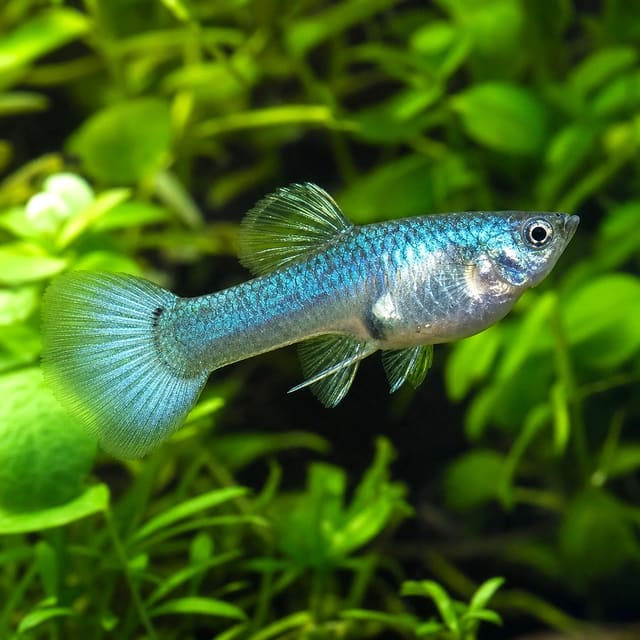
Blue Turquoise Female Guppy (Poecilia reticulata)
22–28°C · pH 7–8
£4.99
Photo coming soon
The size, price and care details on this page are for this listing.
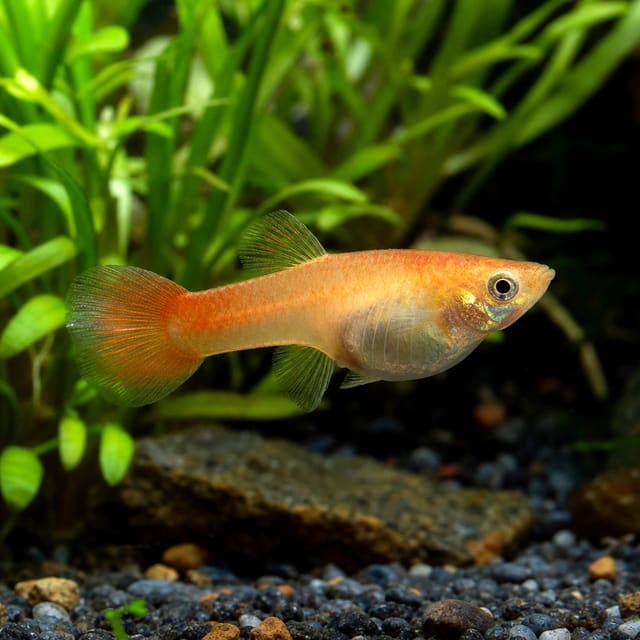
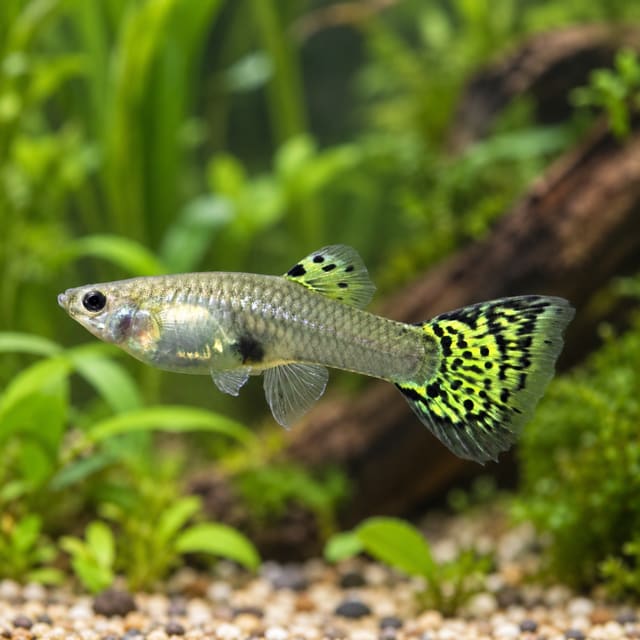
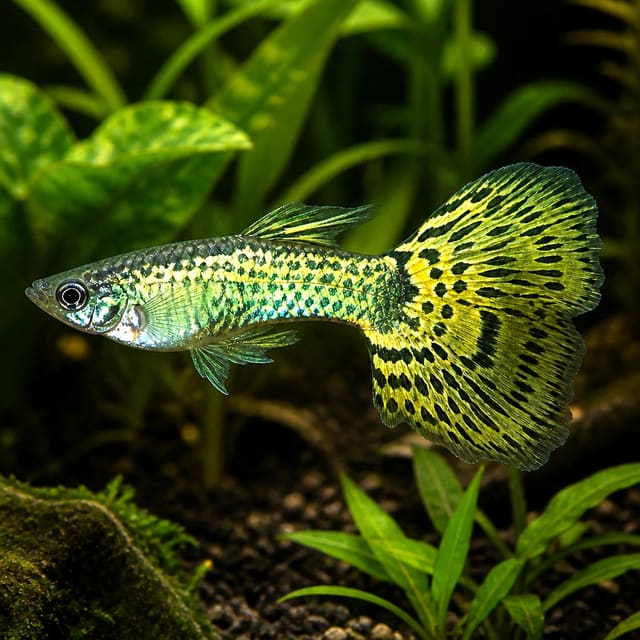
Tiger Female Guppy (Poecilia reticulata) is a peaceful livebearer from Venezuela, Barbados, Trinidad, northern Brazil and the Guianas that reaches 6 cm standard length. It suits a mature aquarium at least 60 cm long with a group of five or more guppies, at 22–28°C and pH 7.0–8.0, following our guppy care guide and OATA's group guidance. Sold as one live female guppy per purchase, dispatched at 3–4 cm.
Adult size is the maximum length this species reaches at full maturity (scientific sources). The livestock you receive will be younger and smaller. Product-photo provenance and any image-specific limitations are stated on the listing.
Poecilia reticulata
Shoaling fish: kept in a group they feel safer, stay calmer and show their best colour.
Minimum of 2 per order.
Tiger Female Guppy (Poecilia reticulata) is a peaceful livebearer from Venezuela, Barbados, Trinidad, northern Brazil and the Guianas that reaches 6 cm standard length. It suits a mature aquarium at least 60 cm long with a group of five or more guppies, at 22–28°C and pH 7.0–8.0, following our guppy care guide and OATA's group guidance. Sold as one live female guppy per purchase, dispatched at 3–4 cm.
Adult size is the maximum length this species reaches at full maturity (scientific sources). The livestock you receive will be younger and smaller. Product-photo provenance and any image-specific limitations are stated on the listing.

Guppies are social livebearers suited to a prepared beginner, not a fish-per-litre formula. Use a mature filtered aquarium, tested neutral-to-alkaline mineral-bearing water, deliberate sex and population planning, open swimming room, cover and a separation option.
Maintain these water conditions for optimal health and vibrant colors
The Tiger Female Guppy is a female of Poecilia reticulata, the guppy, a small livebearing fish in the family Poeciliidae. FishBase records its native range in Venezuela, Barbados, Trinidad, northern Brazil and the Guianas, and lists it as Least Concern on the IUCN Red List. Plan for an adult of up to 6 cm standard length.
It suits a keeper with a matured, filtered freshwater aquarium of hard, slightly alkaline water, and a community of other peaceful fish. It is a poor choice for an uncycled tank, soft acidic water or a community that includes fin-nipping species. Because this listing sells females, it also suits a keeper planning a calm female group, free of the constant pursuit by males that Seriously Fish describes in mixed groups.
Tiger is a trade name for the colour form, not a separate species. Guppies are among the most popular aquarium fish in the world, with many standardised aquarium varieties, and Seriously Fish notes that the wild form is seldom seen for sale. OATA's care sheet for guppies and mollies describes them as generally small, very colourful and peaceful, and notes that most in the aquarium trade are now captive bred.
The accepted scientific name is Poecilia reticulata Peters, 1859, and Eschmeyer's Catalog of Fishes records the type locality as the Guayre River at Caracas, Venezuela. The everyday name survives from Girardinus guppii, a later name now treated as a synonym. FishBase adds that the guppy is used in genetics research, and field studies in Trinidad have linked different predator communities with measurable differences in guppy life history, behaviour and body form, one reason no single number describes every guppy.
| Suits | Not suited to |
|---|---|
| A matured aquarium at least 60 cm long | A small bowl or a tank that has not been cycled |
| A group of five or more guppies | Keeping a single guppy on its own |
| Hard, slightly alkaline water at 22–28°C | Long-term soft, acidic water |
| Quiet communities of peaceful fish | Fin-nipping species such as tiger barbs |
Each purchase is one live female guppy, dispatched at 3–4 cm. Set the quantity to the number of fish you want: a quantity of five brings five females. The 3–4 cm figure is the fish's size when it leaves us; the 6 cm adult figure is what to plan the aquarium around.
Sex is guaranteed only when the exact product or selected option explicitly states male or female. This Tiger Female Guppy listing is sold as female. Buying females only is a common way to keep guppies without adding males to the aquarium, but it changes the planning rather than removing it, as the fry section in the care tab explains.
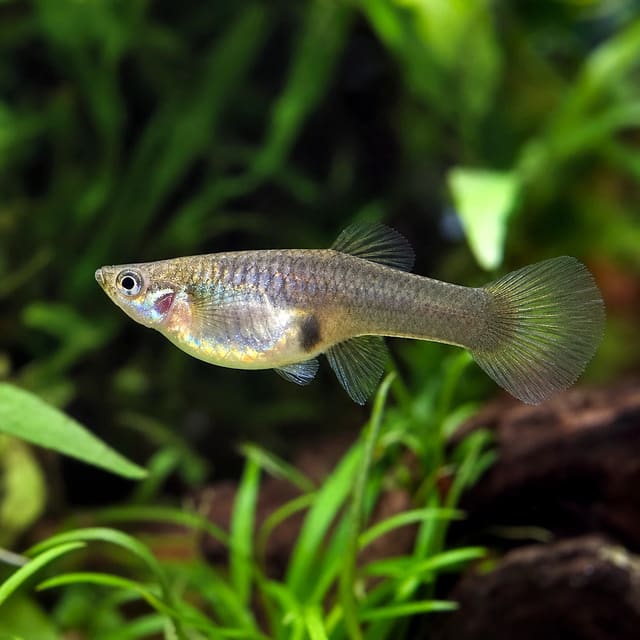
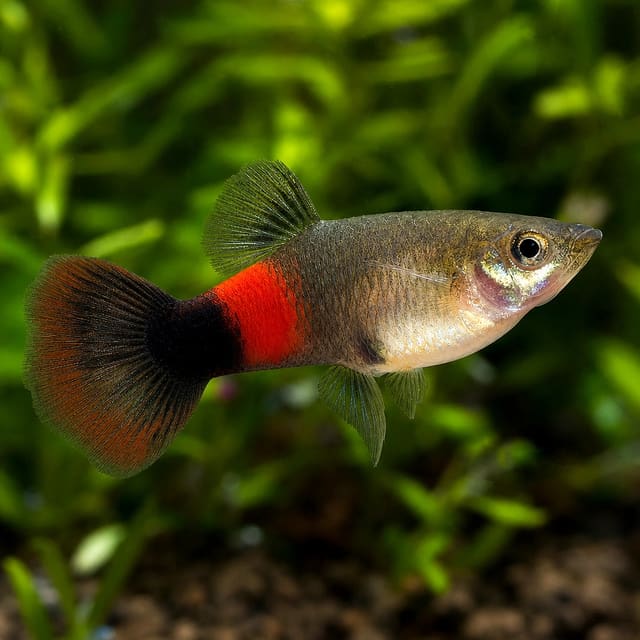
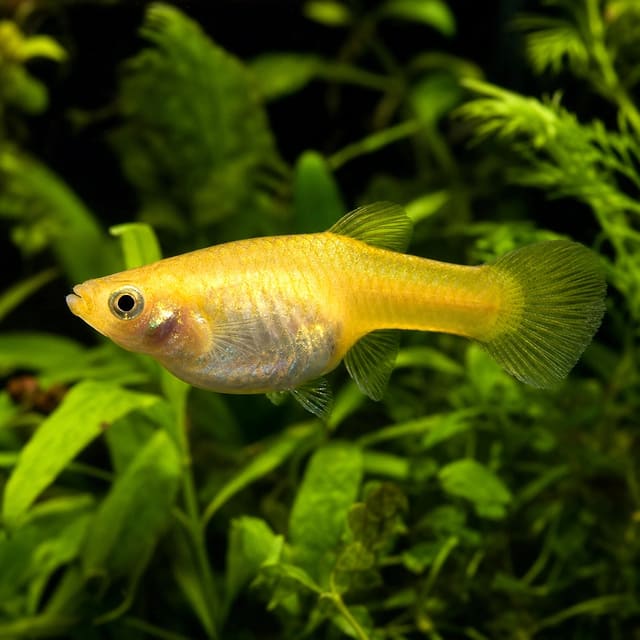
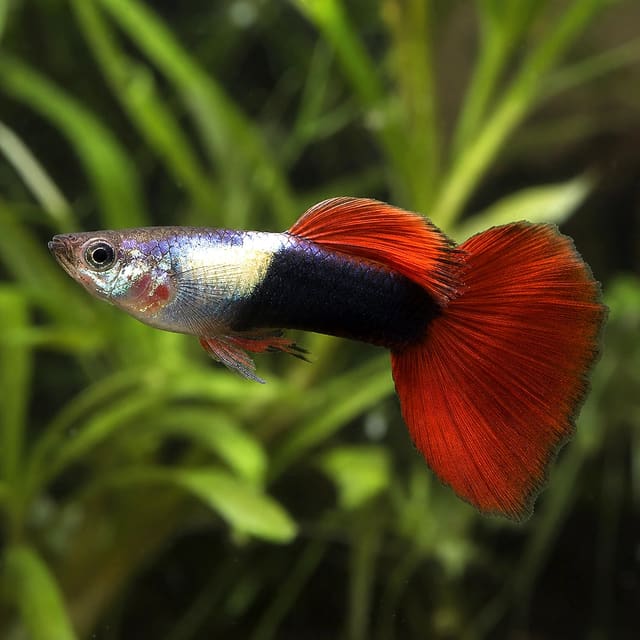
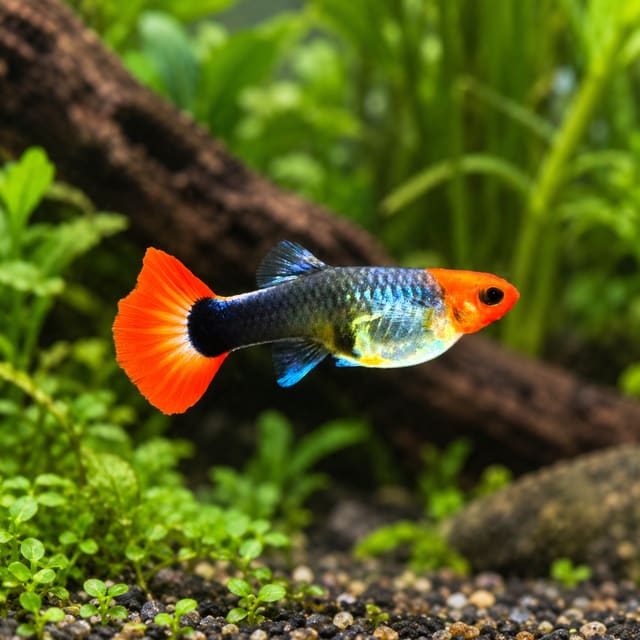
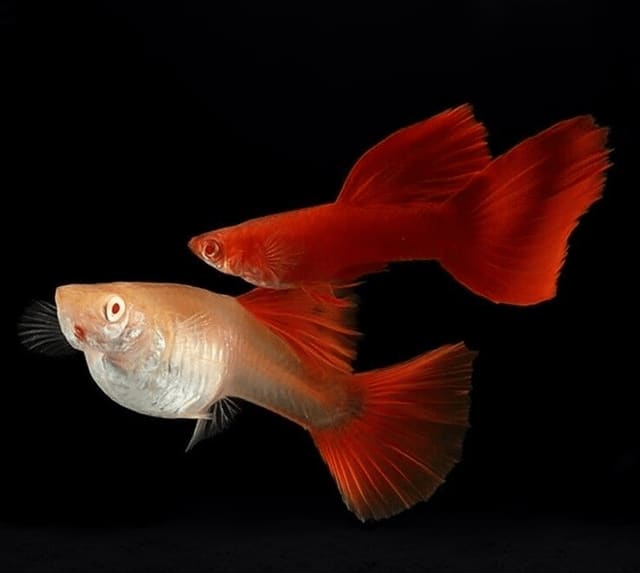
Gallery images have been digitally enhanced to improve image quality. Natural colour, pattern, size and maturity can vary between live animals. The tiger pattern is a trade description of the colour form, so expect individual fish to differ from the photograph and from one another.
Guppy trade labels such as Moscow, Cobra, Snakeskin, Tuxedo, Mosaic and Tiger describe selected colour or fin appearance. They are not separate species, and a label on its own says nothing about pedigree, health, temperament or breeding outcome. On this listing the female sex is part of the offer itself, not something read from the label or the photograph, and the care that follows is the same as for any healthy Poecilia reticulata.
Space for guppies is best judged by length and footprint rather than litres alone. FishBase gives a minimum aquarium size of 60 cm, and our own guppy policy uses a mature, filtered aquarium at least 60 cm long for one small group. OATA recommends at least 45 litres for a small group of the smaller livebearers, and Seriously Fish gives a tank base of 45 × 30 cm, roughly 41 litres. We use the most conservative of these, 60 cm, as the starting point because length gives a group room to swim and to get away from one another.
| Aquarium | How we would treat it |
|---|---|
| 20–25 litres | Usually shorter than 60 cm; not a permanent home for a guppy group |
| 45–50 litres | Meets OATA's litre floor only; it still needs the length, filter and water checks |
| Around 60 litres | A common choice if it is at least 60 cm long; five can be a conservative starting group |
| 90 litres or more | More stability and options, but no fixed number of extra fish |
OATA adds that the larger the aquarium, the more stable its temperature and water quality, and that the more groups you keep, the larger the volume required. Whatever the size, a filter is always essential.
Fish release toxic ammonia into the water, and RSPCA guidance describes how beneficial bacteria in a working biological filter deal with it, turning ammonia into nitrite, itself toxic, and finally into the safer nitrate. A new aquarium has too few of those bacteria to handle a group of guppies. Our guide to preparing a first tropical tank covers setting up and maturing the aquarium before livestock arrives.
In an ordinary UK home, use a thermostatically controlled aquarium heater wherever the room cannot keep the water in range, and check it with an independent aquarium thermometer rather than the heater dial. As a worked example, Seriously Fish suggests roughly 50 W to hold its range in a 41-litre tank in a room at about 20°C, and a filter rated 165–205 litres per hour, a turnover of four to five times the volume.
Keep the aquarium at 22–28°C, pH 7.0–8.0 and a general hardness of 8–18°dH. The temperature is the routine range in our guppy care guide; the pH and hardness come from OATA's guppy-and-molly sheet, which is broad group-level guidance rather than a species-specific optimum, and all three sit inside the ranges Seriously Fish gives for the species.
| Measure | Keep it at |
|---|---|
| Temperature | 22–28°C |
| pH | 7.0–8.0 |
| General hardness | 8–18°dH (medium to hard) |
| Carbonate hardness | 5–15°dKH (medium to hard) |
| Ammonia and nitrite | Zero mg per litre |
| Nitrate | No more than 20 mg per litre above your tap water |
You will see wider figures quoted. FishBase records the species at 18–28°C, pH 7.0–8.0 and 9–19 dH in the wild, and notes that it survives in a wide salinity range but needs fairly warm water of about 23–24°C and quiet, vegetated water. Seriously Fish gives 17–28°C, pH 7.0–8.5 and 8–30 dGH, and OATA 20–28°C. Treat the cooler ends as tolerated, not as the place to run the aquarium. FishBase also lists brackish water among the species' habitats, but that is no reason to add salt: keep it in fresh water unless there is a measured purpose that suits every animal and plant in the tank.
Seriously Fish calls the guppy a hard water fish that may manage in soft or acidic conditions but should be kept long-term in moderately hard or harder water. Test your tap for pH and hardness before buying: UK supplies differ between regions and can be blended or changed by the water company, so check a current water-quality report as well as testing the water you will actually use. Our guide to aquarium water parameters explains each test, and the water parameter matcher lets you compare your results with the ranges above.
The nitrate limit is relative to your supply. If your tap reads 10 mg per litre, keep the aquarium at or below 30; if it reads 25, the ceiling is 45. A figure that climbs towards the ceiling between water changes means the routine needs tightening.
Seriously Fish describes the guppy as unfussy about layout, though a planted tank with floating vegetation is appreciated and strong currents should be avoided. OATA recommends aquarium gravel or sand and, ideally, live plants to provide cover; where live plants are not used, plastic plants and suitable ornaments such as plant pots or model caves give the fish shelter.
More furnishing is not automatically better. A 2025 guppy experiment summarised in our care guide found improvements in several behavioural and stress-hormone measures under enrichment, but also more biting under high enrichment. Add structure, watch how the group uses it, and change the layout if one fish is still cornered or kept from food.
Dense cover also helps fry survive. That can be welcome if you want young, but it means more fish to house, so plan the numbers before you plant densely.
In the wild, FishBase records guppies feeding on zooplankton, small insects and detritus, and Seriously Fish describes wild fish as primarily insectivorous. Aquarium strains are far removed from their ancestors and, in Seriously Fish's words, will accept most foods offered.
Wild guppy diets vary from site to site and can include invertebrates, detritus, diatoms and filamentous algae. That is useful background rather than a menu to copy: use clean aquarium foods, store them as the label directs, and let the staple do the work of balancing the diet.
Portion for the group you actually have and watch the whole feed. In a busy community a shy female can be crowded out, so scatter food across the surface rather than dropping it in one spot, and check that every fish is taking some. Lift out anything left uneaten: OATA warns that a build-up of uneaten food breaks down and releases toxic waste into the water.
A worked example: for five females, start with a small pinch of flake, watch for a few minutes, and adjust the next day's amount up or down depending on whether food reached the gravel. If in doubt about amounts, feed less rather than more.
Our team hand-bags each guppy in pure oxygen and packs it in an insulated poly box, adding a heat pack when the weather calls for it, and a licensed live-animal courier carries the parcel on a tracked service. Tracking details and the confirmed delivery date arrive by email so you know when to be in. Full terms are on our delivery and Live Arrival Guarantee page. On the day:
OATA advises checking that ammonia and nitrite are at zero before adding any fish, and increasing numbers slowly, because the filter's bacteria need to grow each time fish are added and feeding increases. Stocking too quickly can cause 'new tank syndrome', when ammonia and nitrite reach unhealthy levels that may cause fish to become ill or die.
Over the first days, observe the newcomer quietly for steady swimming, regular breathing, open fins and normal balance. If condition or behaviour worries you, test the water and report it promptly rather than assuming continued distress is only the journey.
OATA strongly recommends a partial water change of 25% at least once every week, using a siphon to remove solid waste from the gravel, and testing the water at least once a week so ammonia and nitrite do not build up. OATA warns that guppies and mollies can be stressed by even the smallest amounts of ammonia, which is why the routine matters more than any single number.
| Aquarium | Weekly 25% change |
|---|---|
| 45 litres | About 11 litres |
| 60 litres | 15 litres |
| 90 litres | About 22 litres |
| 120 litres | 30 litres |
Bring replacement water close to the aquarium's temperature and treat it before it goes in, so each change keeps conditions steady instead of shifting them. Confirm the temperature with an independent thermometer rather than guessing by hand, and if your tap supply's pH or hardness has moved since you last tested it, find out before the next change rather than after.
Keeping a simple log pays off. A week-by-week record of nitrate shows whether feeding and water changes are in balance long before the fish show it, and it gives you real numbers to share if you ever need advice.
OATA describes healthy guppies as having clear bright eyes, undamaged fins, intact scales and no ulcerations or bumps. Learn what normal looks like for your group, then watch for changes in:
| A settled guppy | Warning signs |
|---|---|
| Swims steadily through open water | Hiding, loss of balance or erratic swimming |
| Breathes at a regular rate | Gasping at the surface |
| Holds its fins open and undamaged | Clamped fins, spots or wounds |
| Keeps a normal body profile | Sudden weight loss or swelling |
| Feeds consistently | A sudden change in appetite |
Test ammonia, nitrite, nitrate, pH and temperature straight away, then check the filter, heater, recent maintenance, food and any new arrivals. Note the signs with dates or photographs. These are warning signs, not a diagnosis, so do not choose salt, heat or medication from one symptom. Ask us for guidance, and for a diagnosis use OATA's directory of fish vets; the RSPCA's fish health advice also covers normal and concerning signs and when to involve a vet. In the UK, use lawful, labelled products under veterinary direction.
Seriously Fish cautions that many commercially bred guppies are not very hardy because of inbreeding and over-production, and can be prone to disease. A separate quarantine aquarium with its own equipment, a matured filter and regular testing protects the fish you already keep. The MSD Veterinary Manual recommends at least 30 days in quarantine, with longer isolation where indicated.
Guppies are livebearers: the female gives birth to live young rather than laying eggs. A female can store sperm from an earlier mating, and our care guide cites peer-reviewed work documenting storage for several months; Seriously Fish puts it at six months or more. A female bought on her own may therefore still produce fry in your aquarium, even if no male is ever added.
For mature fish, the anal fin is more reliable than colour. A male's anal fin is a narrow, stick-like gonopodium, while a female's is broader and triangular. Seriously Fish describes females as larger and plumper, usually duller, though aquarium varieties may show intense colour in the tail fin. A rounded belly or dark patch is not proof that a female is carrying young.
FishBase records the guppy as widely introduced beyond its native range, mainly for mosquito control, with rare to non-existent effects on mosquitoes and negative to perhaps neutral effects on native fishes. Never release guppies, fry, plants, snails or aquarium water into a pond, drain or waterway; rehome livestock responsibly instead.
Guppies are social and should never be kept alone. FishBase suggests aquarium groups of five or more, OATA advises at least three kept together with two females to each male, and our house recommendation is five or more where the aquarium and the sex plan allow. OATA adds that more can be kept together providing they are added in the same ratio.
| Group plan | What to expect |
|---|---|
| Females only | No new mating inside the group; stored sperm can still produce fry, and females can still compete for food and space |
| Mixed sexes | Courtship and fry; keep at least two females to each male, and expect chasing |
| Males only | No fry, but display and chasing between males can still become persistent |
With this listing, building a female group is straightforward: order the number of females you want and add them in stages as the aquarium matures. In a matured aquarium around 60 litres and at least 60 cm long, five females can be a conservative starting group; that is a starting point rather than a maximum, and tank mates, filtration and test results decide whether more can follow. If you would like males as well, browse our guppy collection and keep to OATA's two-females-per-male ratio. Watch for persistent pursuit, cornering, hiding or fin damage; those mean the plan needs changing, not another fish.
Seriously Fish describes the guppy as a very peaceful fish that does well in a quiet community tank with other livebearers, rasboras, corydoras, small loricariids and tetras. Keep it away from fin-nipping species: Seriously Fish names tiger barbs and serpae tetras, and OATA advises against any species that might nip a guppy's fins, such as barbs.
If you are unsure about a particular pairing, ask us before buying and give us the species and numbers already in your aquarium.
Plan for a fish of up to 6 cm standard length, the figure Seriously Fish gives for Poecilia reticulata; FishBase records 5 cm standard length. Standard length excludes the tail fin, and tail length varies between domestic guppies; Seriously Fish notes that females are the larger sex.
We recommend a mature, filtered aquarium at least 60 cm long for one small guppy group, in line with the 60 cm minimum FishBase gives. OATA's guppy-and-molly sheet sets a floor of at least 45 litres for a small group, and a larger aquarium keeps temperature and water quality more stable.
Keep a group, never a lone fish. FishBase suggests groups of five or more and OATA advises at least three; our house recommendation is five or more where the aquarium and the sex plan allow. Add fish gradually so the filter can keep up.
It can suit a prepared beginner. OATA describes most guppies as undemanding and easy to keep, but they still need a matured, filtered aquarium with ammonia and nitrite at zero, stable hard water and a weekly routine of testing and partial water changes.
Guppies are omnivores. Use a good quality flake or granule as the staple, which OATA suggests should have a high algae content, and add small live or frozen foods such as daphnia or small bloodworm. OATA's guidance is to feed only what the fish eat within a few minutes, once a day.
Keep it at 22–28°C, the routine range in our guppy care guide, with pH 7.0–8.0 and general hardness of 8–18°dH from OATA's guppy-and-molly guidance. Seriously Fish describes it as a hard water fish, so avoid soft, acidic conditions for long-term keeping.
No. Seriously Fish describes the guppy as a very peaceful fish, and the usual risk runs the other way: fin-nipping species can damage a guppy's fins. Males can pursue females persistently, so watch for chasing in any mixed-sex group.
Seriously Fish lists other livebearers, rasboras, corydoras, small loricariids and tetras as suitable company in a quiet community, provided each passes its own water and size checks. Do not keep it with fin-nipping species such as tiger barbs or serpae tetras.
Film the sealed parcel first: start a continuous unboxing video with the outer box visible and keep recording until the Tiger Female Guppy is seen inside the sealed bag. Someone must be home to receive the parcel. Then float the bag for 20–30 minutes before releasing the fish, never pour the bag water into your tank, and send the video and order number the same day if anything is wrong.
No reviews for this item yet. Bought one? Honest reviews only, good or bad.
What customers say about ordering from us
Easy website plenty of info on fish your buying great to pick a time slot
TRACEY DURRANT · 7 Oct 2026
Got some lovely fish thank you
Kevin Mackie · 7 Oct 2026
Reviews of our shop, collected by Judge.me, an independent third-party review collector. Newest first.