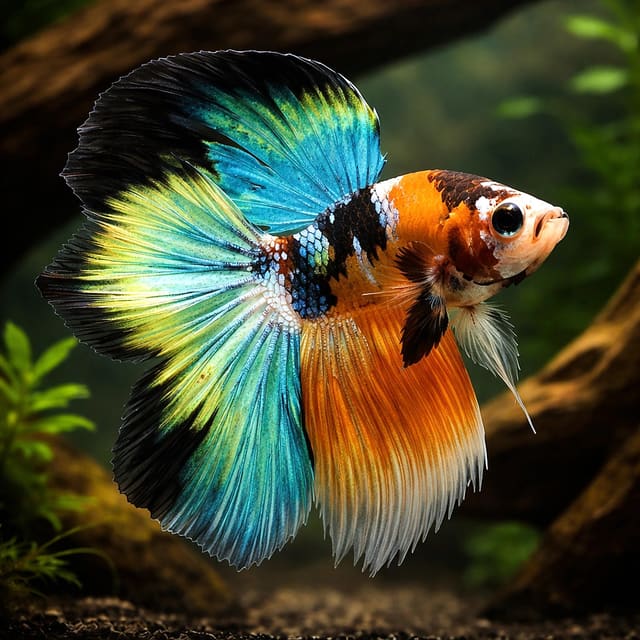
Moderate
Double Tail Male Betta Mix (Betta splendens) XL
24–27°C · pH 6–7.8 · 20L
£15.99

One live male Galaxy short-tail Betta (Betta splendens) per selected quantity in the XL grade; no exact length or fixed colour map is supplied.
Betta splendens
Save when buying multiple fish. Each quantity is one fish; sex and pair formation are not guaranteed unless the selected variant explicitly states them.
Confirm your email, then we’ll send an availability message for this exact item if it returns within 180 days.
This request is only for this product—no newsletter or other promotions. A mail-provider retry may very rarely duplicate the same availability message. Unconfirmed addresses are removed after 48 hours. See our privacy policy.
One live male Galaxy short-tail Betta (Betta splendens) per selected quantity in the XL grade; no exact length or fixed colour map is supplied.
24–27°C · pH 6–7.8 · 20L
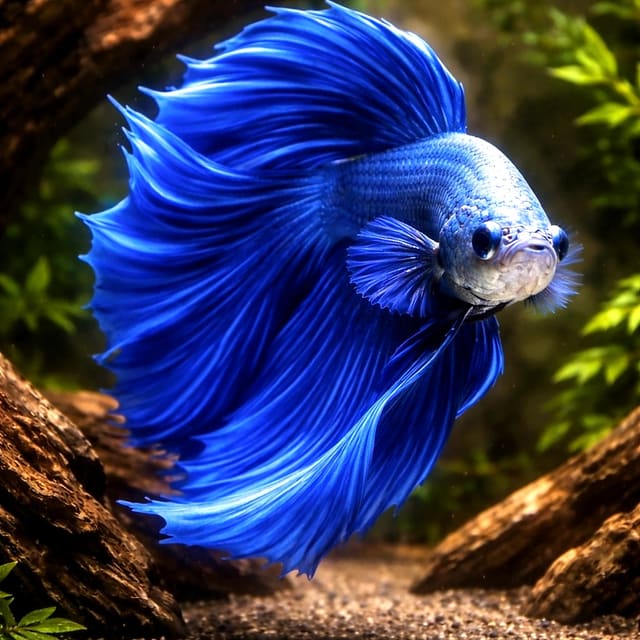
24–27°C · pH 6–8 · 20L
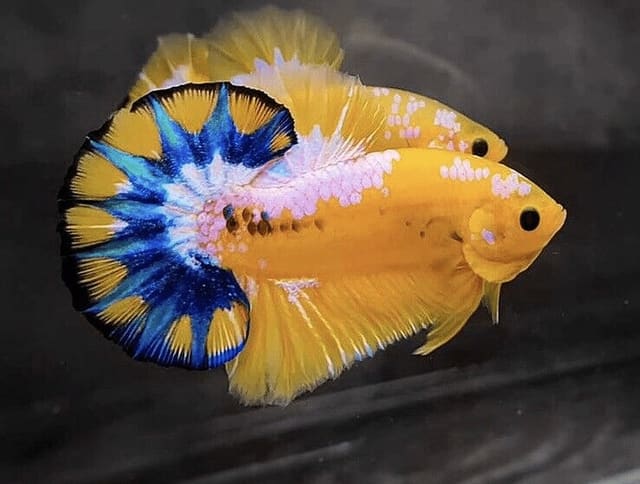
24–30°C · pH 6–8 · 20L
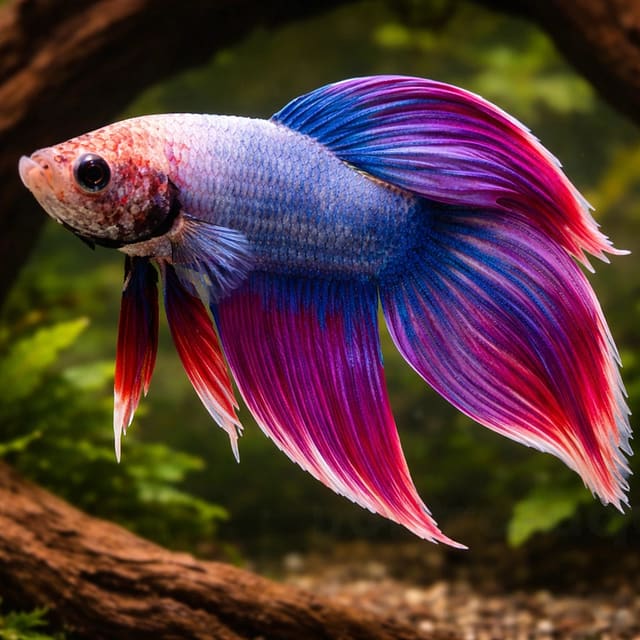
24–28°C · pH 6–7.8 · 19L
Maintain these water conditions for optimal health and vibrant colors
Each selected quantity supplies one live male Galaxy short-tail Betta in the XL grade. XL is a stock grade rather than a guaranteed centimetre measurement. The fish is selected from a living colour line, so its speckling, metallic coverage, base colour, fin colour and exact tail outline can differ from another male.
The Male Galaxy Short-Tail Betta is a domestic form of Betta splendens, also known as the Siamese fighting fish. It is best planned as one territorial male in a mature, heated and covered freshwater aquarium with gentle filtration, surface access, soft planting and places to rest.
Gallery transparency: no exact supplier or owner-approved image exists for this product, and this is not a WYSIWYG sale. We have left the gallery empty instead of borrowing a generic Galaxy Betta photograph or generating an image that might misrepresent the fish supplied.
| At a glance | Reviewed guidance |
|---|---|
| Product | Male Galaxy Short-Tail Betta |
| Scientific name | Betta splendens |
| Other common name | Siamese fighting fish |
| Sale unit | One live male per selected quantity |
| Dispatch grade | Supplier XL grade; no exact dispatch length supplied |
| Adult size guide | About 6.5-7 cm total length, with domestic fin form affecting outline |
| Care level | Easy to Intermediate when the aquarium is mature and heated |
| Temperament | Territorial male; one male per undivided aquarium |
| Minimum aquarium | 20 litres for one male; larger is more stable |
| Practical temperature | 24-26 C, stable |
| Practical pH | 6.5-7.5, stable |
| Water hardness | Soft to medium, approximately 4-12 dH |
| Flow | Gentle, filtered movement without a constant strong current |
| Diet | Quality Betta food plus measured small frozen or live foods |
Quantity one means one male fish. It does not mean a pair, breeding group or choice from several photographed individuals. If more than one can be ordered, each male needs a separate secure aquarium or a properly designed opaque divided system; they must not share open water.
The supplier labels this stock XL but has not supplied an exact body or total length. Grade can reflect the supplier's own stock grouping, and fin posture changes the apparent size of a Betta. Plan for an adult around 6.5-7 cm total length rather than treating XL as a fixed centimetre promise.
No age, lineage, exact colour map, show grade or individual photograph has been supplied. The male selected for dispatch should fit the named Galaxy short-tail line, but living ornamental fish vary. Lighting, posture and stress can also change how colour is perceived on arrival.
| The listing confirms | The listing does not promise |
|---|---|
| One live male Betta splendens | A pair, female or breeding group |
| Galaxy short-tail supplier line | One fixed arrangement of spots or colours |
| Supplier XL grade | An exact dispatch or adult length |
| Territorial male care | Guaranteed community compatibility |
| Eligible UK livestock delivery support | The fish pictured on a different product or category page |
Betta splendens is the accepted species name. Siamese fighting fish is the established common name, while Betta is the shorter aquarium name. Domestic ornamental lines have been selected for many colours, patterns, fin lengths and shapes, so they can look very different while sharing the same species-level care foundation.
Galaxy is a commercial colour and pattern description, not a single regulated colour code. Genomic research on domestic Bettas places Galaxy among several trade names used for mosaic phenotypes. On a live fish, the term may be expressed through contrasting patches, speckles or iridescent scale coverage, but this listing does not guarantee a particular palette.
Short tail is the supplier's fin-form description. It distinguishes this male from long-finned forms, but it does not certify a competition standard, exact caudal spread or formal Plakat subtype. The tighter outline can make body movement easier to observe; it does not remove the need for gentle flow, resting cover or individual temperament planning.
A category photograph, search result or another Galaxy male cannot establish what this individual will look like. Choose this product only if variation is welcome. If an exact colour map is essential, wait for a genuine individually photographed WYSIWYG listing rather than ordering from a graded colour line.
Our stock records contains no photograph, image identifier, image URL or extra gallery file. The site also has no product-owned original for this male. An image from another Betta listing would belong to a different animal or colour line and could create a false expectation.
We have not borrowed a competitor image, reused a different product's photograph or generated an idealised fish. An empty gallery is less decorative, but it is more accurate than showing anatomy, colour or fin form that the supplier has not documented.
Use the written sale-unit, grade and care evidence. Assume natural individual variation. The fish supplied should be assessed on live health, not on whether it reproduces a colour pattern seen elsewhere online.
FishBase records a maximum around 6.5 cm total length, and UK trade guidance uses about 7 cm. Domestic fin shape influences the silhouette, but the biological needs include more than body length: the fish patrols, rests, rises for air, explores cover and responds to activity outside the glass.
A mature aquarium of at least 20 litres is the practical minimum adopted on this page for one male. Both OATA and RSPCA welfare guidance support this scale. Recent behavioural research also found better activity and fewer abnormal behaviours in a furnished 19.3-litre aquarium than in smaller jars and containers.
A larger aquarium dilutes waste and usually changes temperature more slowly, provided it is correctly heated and filtered. Useful floor area, accessible surface, gentle flow and cover matter alongside headline volume. A tall ornamental vessel with little horizontal room is not made suitable by height alone.
The labyrinth organ lets the fish take atmospheric air; it does not replace clean water, dissolved oxygen or biological filtration. Small unheated vessels fluctuate quickly and offer little behavioural choice. This product should not be sold or planned as a desk ornament.
| Housing choice | Suitability | Reason |
|---|---|---|
| Furnished 20-litre heated aquarium | Practical minimum | Supports swimming, cover, filtration and stable heat for one male |
| Larger planted single-male aquarium | Often preferable | More stable and provides more layout choice |
| Community aquarium from 40 litres | Conditional | Only with calm compatible fish and a separation plan |
| Small bowl or unfiltered jar | Avoid | Insufficient stability, space, heat control and filtration |
| Open-top aquarium | Avoid | Bettas can jump and need warm accessible air under a secure cover |
Aim for 24-26 C and pH 6.5-7.5, held steadily. Broader references describe wider tolerated ranges, but the middle of the overlap is more useful for an ordinary home aquarium than repeatedly approaching an extreme. Match the source water and make any chemistry change gradually.
Approximately 4-12 dH is a practical hardness range from UK trade guidance. Stability and acclimation matter more than chasing a single ideal number with chemical products. Measure the actual tap and aquarium water before purchase, particularly if the local supply is very hard or a softening system is used.
Both should remain at 0 mg/l in a mature aquarium. A detectable reading means the biological filter is not keeping pace or has been disrupted. Stop adding livestock, check the test, identify the cause and protect the fish rather than masking the reading.
Nitrate should stay low and stable through sensible stocking, feeding, plants where appropriate and regular partial water changes. Compare it with the source-water baseline and watch the trend. Rising nitrate often signals that maintenance, feeding or stocking needs adjustment.
| Parameter | Working target | Decision rule |
|---|---|---|
| Temperature | 24-26 C | Use a heater and thermometer; avoid rapid daily swings |
| pH | 6.5-7.5 | Keep stable and acclimate to genuine source-water differences |
| General hardness | About 4-12 dH | Soft to medium; do not chase numbers abruptly |
| Ammonia | 0 mg/l | Any detection needs immediate investigation |
| Nitrite | 0 mg/l | Any detection is unsafe |
| Nitrate | Low and stable | Control through maintenance, feeding and stocking |
Record real readings with the water matcher before ordering. A matching number does not replace a mature filter or suitable aquarium.
UK room temperature is not a dependable tropical-water control. Fit a correctly sized aquarium heater and a separate thermometer, then check the actual daily range. Position equipment so the fish cannot become trapped or rest against an unsafe hot surface.
Bettas can jump. Cover cable gaps and feeding openings without sealing away gas exchange. A lid also helps retain warm humid air above the water, which is useful when the fish rises to use its labyrinth organ.
Keep a small gap between the water surface and cover. Do not fill the aquarium so high that the fish cannot reach air comfortably. Floating plants can provide security, but they must not form an unbroken mat across the entire surface.
Use a mature biological filter sized for the aquarium. Air breathing does not detoxify ammonia or remove organic waste. Sponge filtration, baffled outlets or an adjustable low-flow unit can work well when intake safety and maintenance are planned.
The fish should be able to hold position, feed at the surface and choose resting areas without being pushed continually across the tank. A short-tailed male may swim differently from a long-finned male, but supplier fin wording is not a licence to use a harsh current.
Make sure fins cannot be pulled against an intake. Use a suitable pre-filter if needed and check it regularly for blockage. Observe the individual after introduction; flow that looks mild in an empty aquarium can still dominate a resting fish.
Live plants, smooth silk plants, rounded wood and aquarium-safe caves create visual barriers and resting choices. Avoid sharp plastic seams, rough holes and abrasive rock that can catch fins or scales.
Broad leaves or a smooth purpose-made rest below the surface let the fish pause without travelling through the whole water column. Keep several routes to open air and enough open water for normal swimming.
A brief controlled mirror can prompt display, but constant reflection can maintain an unnecessary territorial response. Check glass angles, dark backing and room lighting if the male repeatedly flares at one panel.
Place the aquarium away from direct sun, draughts, loud vibration and repeated sudden movement. Use a regular day-night cycle. The goal is behavioural choice, not a bare tank in which the fish has nowhere to withdraw from view.
Feed a quality Betta pellet, micro granule or suitable flake that the fish can take easily. Wild species-level records include zooplankton and insect larvae; domestic fish benefit from a nutritionally complete prepared staple rather than a diet made from one treat food.
Small portions of daphnia, brine shrimp, bloodworm or another suitable frozen or live food can add variety. Thaw frozen food appropriately and avoid adding excess packing liquid. Live foods must come from a trusted source to reduce contamination risk.
Offer only what the fish consumes promptly, then remove leftovers. Adjust for pellet size, body condition, temperature and the food label rather than following a universal pellet count. Overfeeding can pollute a small aquarium quickly.
Compare the ingredients and feeding directions for Tropical Soft Line Betta Food and Tropical Betta Flakes. They are options, not a requirement to feed both together.
Male Bettas are territorial and can seriously injure one another. Do not keep two males together in an undivided aquarium, even when the tank is large or heavily planted. Transparent dividers can also permit constant visual stress.
Some males investigate every movement; others retreat into cover. Some tolerate carefully chosen companions while others patrol aggressively. The colour or short-tail label does not predict a guaranteed personality.
Surface visits are expected because this is a facultative air breather. Resting on a leaf can be normal. Persistent gasping, loss of balance, clamped fins, continuous hiding or an abrupt change in activity is different and should trigger water tests and a health assessment.
A planted single-male aquarium is not socially incomplete. It removes uncertainty around fin nipping, competition and territorial conflict while still allowing enrichment through space, structure, feeding and interaction with the environment.
For a carefully planned small community, start from at least 40 litres rather than the single-fish minimum. Choose peaceful fish that use different areas, do not resemble another male Betta and do not nip fins. Add cover and keep a separate mature backup home ready.
Do not combine this male with another male Betta, aggressive fish, persistent fin nippers or bright long-finned species likely to trigger display. Shrimp may be hunted. Even a commonly recommended companion can fail with a particular individual.
Chasing, torn or clamped fins, a fish unable to feed, continual hiding or repeated cornering means the arrangement is not working. Do not wait for injury to prove incompatibility.
| Potential companion | Guidance |
|---|---|
| Another male Betta | Never in the same undivided aquarium |
| Calm small bottom fish | Possible only in a larger compatible setup with observation |
| Small peaceful shoaling fish | Conditional; avoid nippy species and provide sufficient group space |
| Long-finned or Betta-shaped fish | Avoid because they may trigger territorial display |
| Shrimp | At risk of being hunted; not guaranteed safe |
| Snails | Often tolerated, but individual investigation or harassment is possible |
A Double Tail Male Betta, Delta Tail Male Betta and Halfmoon Plakat Male Betta differ in trade form and visual outline. Each still needs heated, filtered water, a secure lid, gentle flow and careful male-territory management.
Browse the Betta shop to compare current males, females and forms, or use the wider labyrinth fish and Betta category for catalogue context. Never transfer a colour, size or photo promise from one listing to another.
| Decision point | Galaxy short-tail male | What still needs checking |
|---|---|---|
| Visual priority | Mosaic Galaxy trade pattern with a shorter fin outline | Individual colour is not photographed or fixed |
| Social plan | One territorial male | Community compatibility remains individual |
| Flow | Gentle filtered movement | Observe whether the actual fish can rest and feed easily |
| Space | 20 litres minimum for one male | Use 40 litres or more for a cautious community attempt |
| Photo certainty | No exact image available | Choose only if natural variation is acceptable |
Measure ammonia, nitrite, nitrate, pH and temperature on a regular schedule and after unusual behaviour, filter disruption or a livestock change. Written trends are more useful than a single apparently good result.
Use regular partial water changes, commonly around 20-25% weekly as a starting routine, then adjust to measured nitrate, feeding and stocking. Treat replacement tap water for chlorine or chloramine and match temperature closely.
Rinse dirty filter media gently in removed aquarium water rather than untreated tap water. Do not replace all biological media at once. A clean-looking filter is not useful if its nitrifying bacteria have been stripped away.
Check heater operation, thermometer agreement, lid gaps, intake guards and flow. Remove trapped debris before it restricts circulation. Maintenance is also the time to inspect smooth decor for new sharp edges or unstable pieces.
Look for steady breathing, responsive movement, an ability to hold position, clear eyes, intact scales, open fins appropriate to the moment and a consistent feeding response. A healthy fish should be able to choose between exploring, resting and sheltering.
Clamped or fraying fins, white spots, fuzzy growth, swelling, ulcers, repeated scratching, loss of balance, rapid breathing, failure to eat or an abrupt colour and behaviour change needs investigation. Test the water first because poor water quality can imitate or worsen disease.
Identify the likely problem and check dose, aquarium volume, filter impact and compatibility before treatment. Some remedies damage biological filtration or are unsafe for other inhabitants. Contact an experienced aquatic retailer or fish veterinarian when the cause is uncertain.
The aquarium should already be cycled, heated, filtered, covered and furnished. Ammonia and nitrite must be zero, and temperature should have remained stable. A bottle of bacterial starter does not by itself prove readiness.
You should be comfortable receiving one male from the named colour line without an individual photograph or exact colour promise. Do not order in expectation of a specific blue, red, white, black or metallic arrangement.
There must be no second male in open water. If companions are planned, confirm their adult size, temperature, behaviour and group needs, then prepare a separate mature home in case the combination fails.
Have a water conditioner, liquid tests, heater, thermometer, suitable food, siphon and secure transport-day plan ready. Check the forecast and delivery arrangements before choosing a date.
Test the aquarium, dim the lights and confirm the heater, lid and filter. Keep a clean container and the acclimation timer ready. Avoid rearranging the aquarium once the fish has arrived.
Use the current livestock acclimation method supplied with the order because bag time and temperature matter. Do not add transport water to the aquarium. Keep handling and air exposure to a minimum.
Allow the fish to find cover and the surface. Keep lighting subdued and avoid heavy feeding. Check that the current is manageable and that the male is not reacting continuously to a reflection or visible neighbouring Betta.
If there is a problem, photograph the unopened bag and fish clearly, retain the packaging and follow the reporting window in the livestock delivery and Live Arrival Guarantee terms.
Species name, adult scale, air breathing, habitat, feeding ecology and male-male aggression are grounded in the FishBase Betta splendens account. The 20-litre minimum, essential filtration, gentle flow, heater, surface access and male separation follow the UK OATA Betta care sheet and align with RSPCA welfare guidance.
Space and enrichment advice is reinforced by the peer-reviewed Life beyond a jar study and the open-access Life in a fishbowl study. The distinction between species identity and broad Galaxy trade naming is supported by the genomic study The genetic architecture of phenotypic diversity in the Betta fish. Practical aquarium targets on this page are conservative husbandry decisions, not claims that one number guarantees welfare.
One live male Galaxy short-tail Betta splendens is supplied per selected quantity in the XL grade.
The supplier has not provided an exact dispatch length. XL is a stock grade, so plan for an adult around 6.5-7 cm total length without expecting a fixed measurement.
No.
Galaxy describes a mosaic trade phenotype. Speckling, patches, iridescence, base colour and fin colour vary, and no fixed palette is promised.
Not necessarily. Short tail is the supplier description; the listing does not certify a formal Plakat subtype or show-standard caudal shape.
Yes. Siamese fighting fish is the common name for Betta splendens.
No. Do not keep two males in the same undivided aquarium because territorial fighting can cause severe injury.
Use at least 20 litres for one male, with a larger furnished aquarium preferred where practical.
Yes. Maintain a stable practical range of 24-26 C with a thermostatic heater and separate thermometer.
Bettas can jump. A secure lid prevents escape and helps retain warm air, while a small accessible gap above the water supports surface breathing.
No. The labyrinth organ provides atmospheric air access; it does not process ammonia or replace biological filtration.
Aim for stable pH 6.5-7.5 and soft to medium water around 4-12 dH, with any adjustment made gradually.
Use a quality Betta pellet, micro granule or suitable flake as the staple, with measured small frozen or live foods for variety.
Sometimes, but temperament varies. Use at least 40 litres, choose calm non-nipping companions and keep a mature backup aquarium ready.
Shrimp may be hunted, so they are not guaranteed safe companions.
No. Use a mature heated, filtered, covered and furnished aquarium rather than a bowl or jar.
The guarantee covers qualifying UK live-fish deliveries when the current receipt, evidence and reporting conditions are met.
Eligible first-time customers can enter WELCOME10 for 10% off, subject to the active promotion and checkout terms.
Choose this male only when the aquarium is already mature, heated, gently filtered, securely covered and arranged for one territorial Betta. Confirm measured water conditions, accept natural Galaxy-pattern variation and prepare a separate plan for any proposed companions before selecting delivery.
Your Betta order can qualify for our UK Live Arrival Guarantee when you follow the live delivery and reporting conditions. At checkout, a qualifying first purchase may use WELCOME10 for a 10% saving under whatever promotion conditions are live that day.
No reviews for this item yet. Bought one? Honest reviews only, good or bad.
What customers say about ordering from us
I have a small group of long finned mountain minnows. So was delighted to be able to order ten of this variety to increase the genetics in my tank . The ones I recieved are healthy but it’s to early to give a verdict on wether they are of a long finned type since they are small currently.
Gordon Walker · 23 Sept 2026
100% success travel and "installation". Pleased with quality of purchase. The Siamese fighter a bit "shy" so have not yet seen him at his best yet but looking good. Happy customer. GG
George E Garratt · 21 Sept 2026
Reviews of our shop, collected by Judge.me, an independent third-party review collector. Newest first.