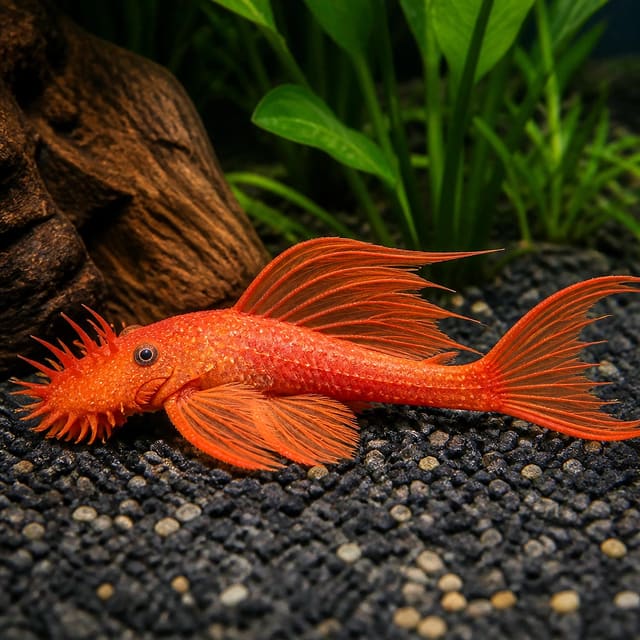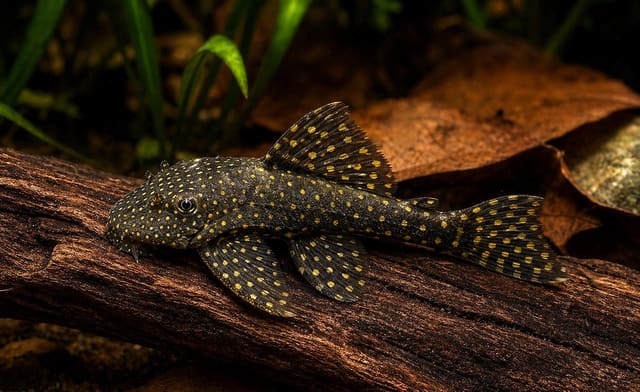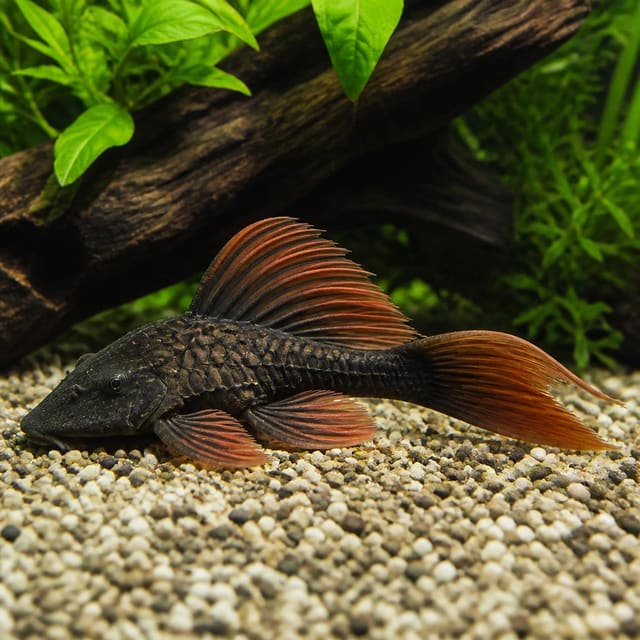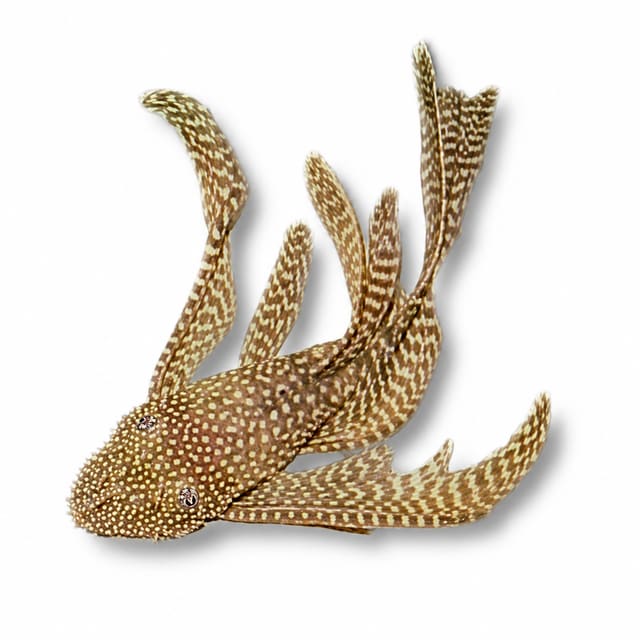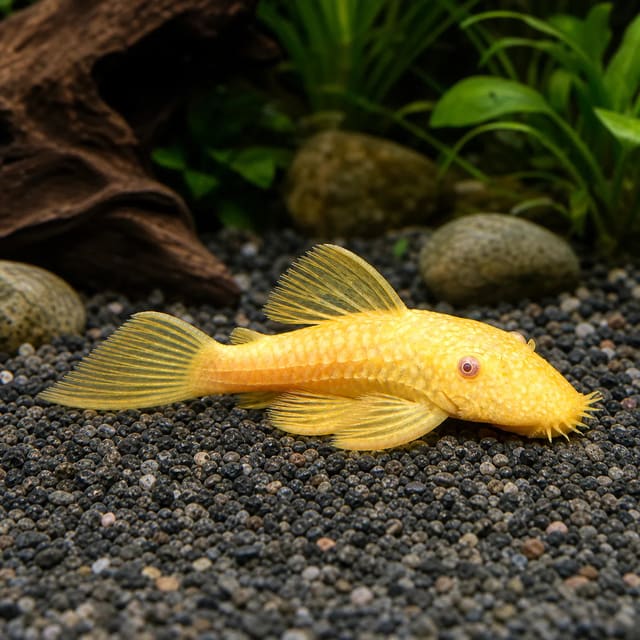
Albino Green Dragon Bristlenose Pleco (Ancistrus sp.)
22–27°C · pH 6–8
£42.99
The Green Dragon Bristlenose Pleco (Ancistrus sp.) is a freshwater loricariid catfish from South America and Panama. It suits a filtered aquarium with cover and wood; OATA’s bristlenose group guidance gives 22–27°C and pH 6.0–8.0. Sold individually in sizes from 2.5–3 cm to 5–7 cm.
Ancistrus sp.
Save when buying multiple fish. Each quantity is one fish; sex and pair formation are not guaranteed unless the selected variant explicitly states them.
The Green Dragon Bristlenose Pleco (Ancistrus sp.) is a freshwater loricariid catfish from South America and Panama. It suits a filtered aquarium with cover and wood; OATA’s bristlenose group guidance gives 22–27°C and pH 6.0–8.0. Sold individually in sizes from 2.5–3 cm to 5–7 cm.
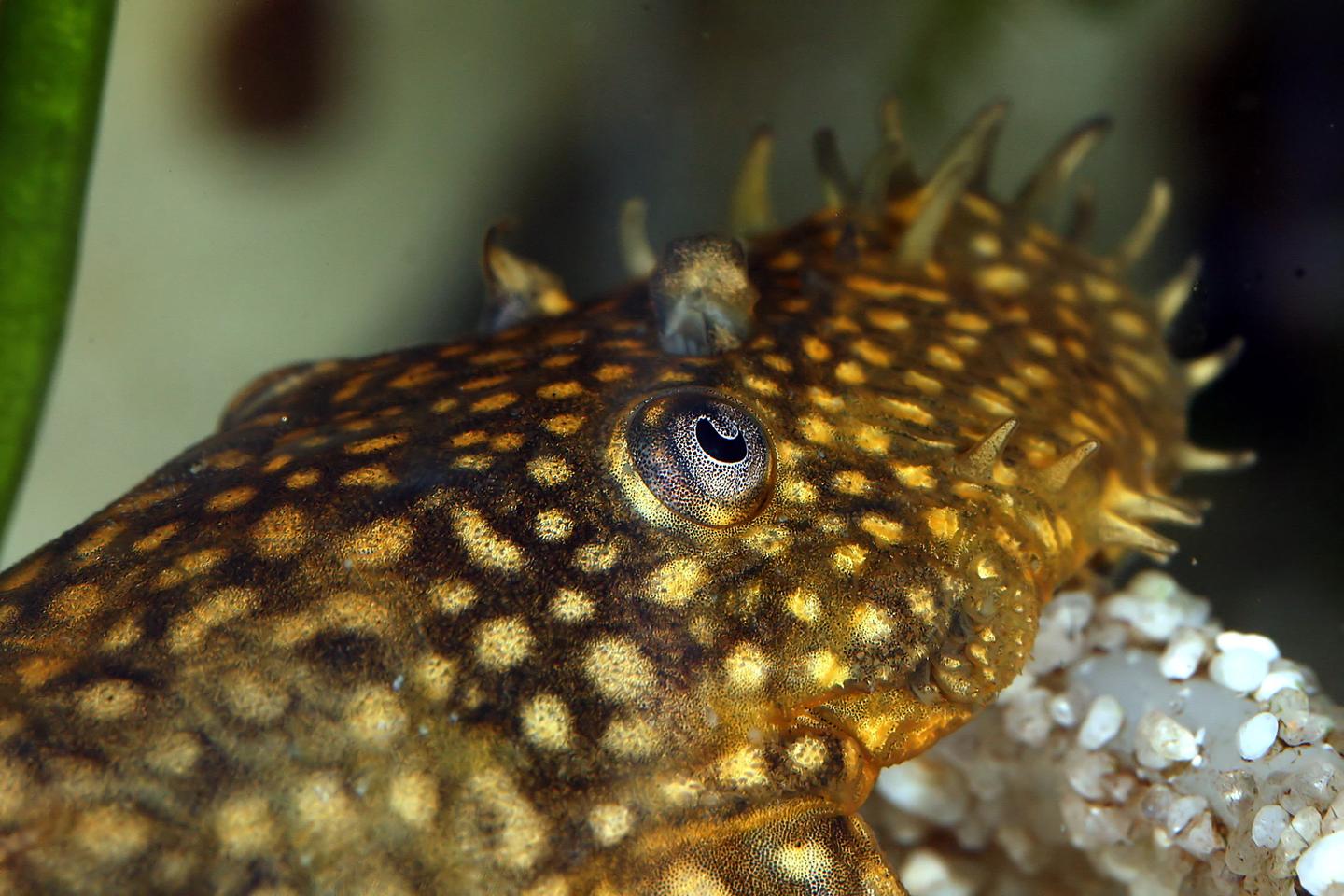
For one typical common bristlenose, start with a mature, filtered aquarium of at least 90 litres, useful floor area, wood and cover. OATA reports about 15 cm adult length, 22-27°C, pH 6-8 and 4-12 dGH. Confirm the exact trade identity before applying species-level claims.
Maintain these water conditions for optimal health and vibrant colors
Green Dragon Bristlenose Pleco is the trade name for a freshwater catfish labelled Ancistrus sp. The abbreviation “sp.” means that the fish has been identified to genus rather than to one named species. The accepted genus record places Ancistrus in the family Loricariidae and order Siluriformes. It suits a keeper prepared to provide a well-set-up filter, plenty of cover, at least one piece of wood and a complete supplemented diet.
Natural history described for the genus helps explain the aquarium layout. Ancistrus are nocturnal freshwater fish associated with South America and Panama, and bushynose or bristlenose catfish are established aquarium names for members of the genus. “Pleco” is widely used in the hobby, although it is also used as a broad catch-all name for several loricariid catfish.
Its nocturnal and secretive nature affects how it should be observed: daytime hiding can be part of its normal routine, so feeding and activity checks should include the periods when it chooses to emerge.
| Identity decision | What it means |
|---|---|
| Scientific label | Ancistrus sp. |
| Animal type | Freshwater loricariid catfish |
| Common-name group | Bristlenose or bushynose catfish |
| Daily rhythm | Nocturnal, with cover important for security |
One purchase quantity supplies one animal in the size selected. The live selector uses the labels “2.5-3 cm”, “3-4 cm”, “4 - 5 cm” and “5 - 7 cm”; use it to choose the dispatch size that fits your aquarium plan. The size you select is the size supplied, not the adult size. The exact species has not been identified, so the care advice here follows the genus Ancistrus and its care group.
A dispatch size describes the fish at the point it is sent. It does not change the space, filtration, feeding or long-term planning required for an adult bristlenose catfish. A smaller selection therefore needs the same long-term plan as a larger selection, even though the immediate fish is smaller.
Sex is guaranteed only when the selected option explicitly states male or female. This Green Dragon Bristlenose Pleco listing has no sex-guaranteed option.
Do not use body size, colour or the gallery fish to decide the sex of the animal being ordered. OATA’s bristlenose group guidance says it is usually best to keep only one male per group, while the selected fish is not sold with a sex guarantee.
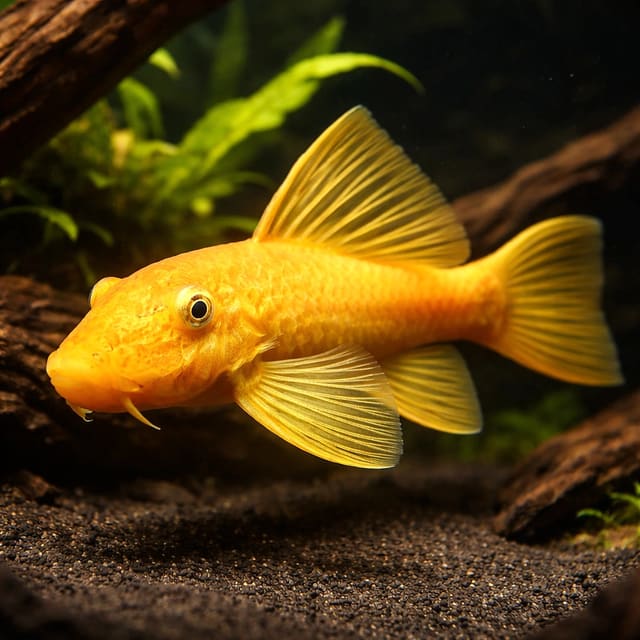
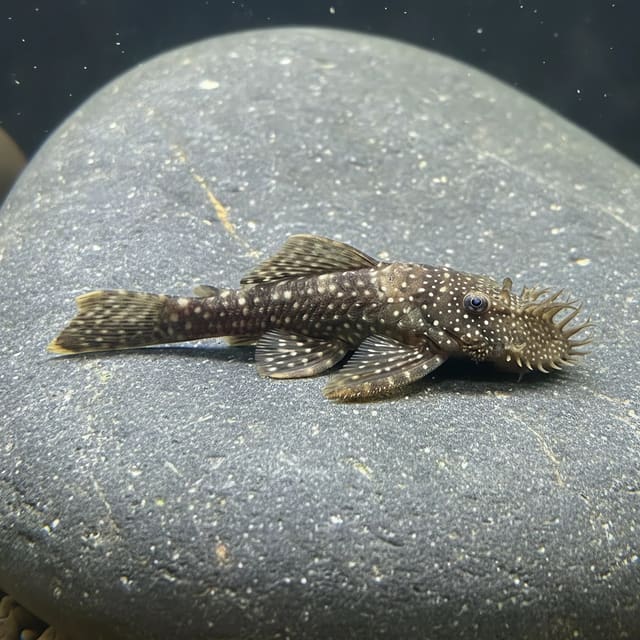
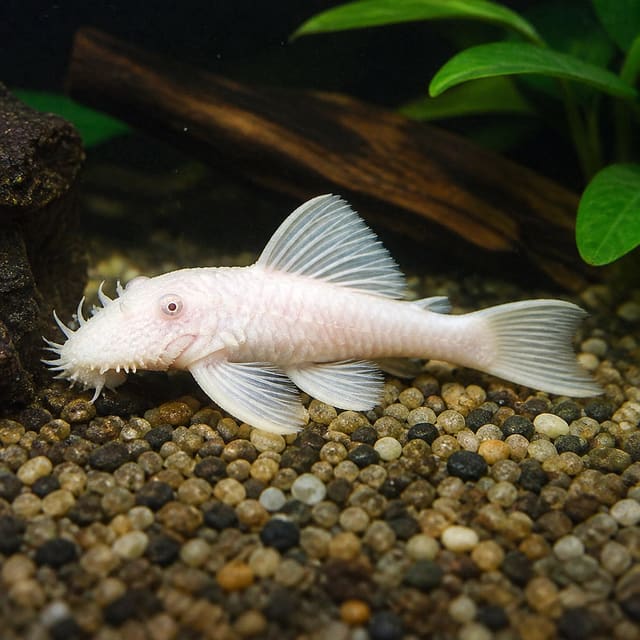
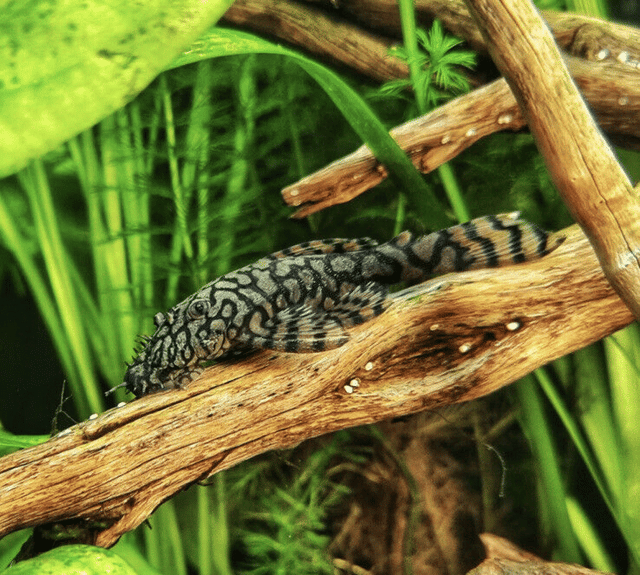
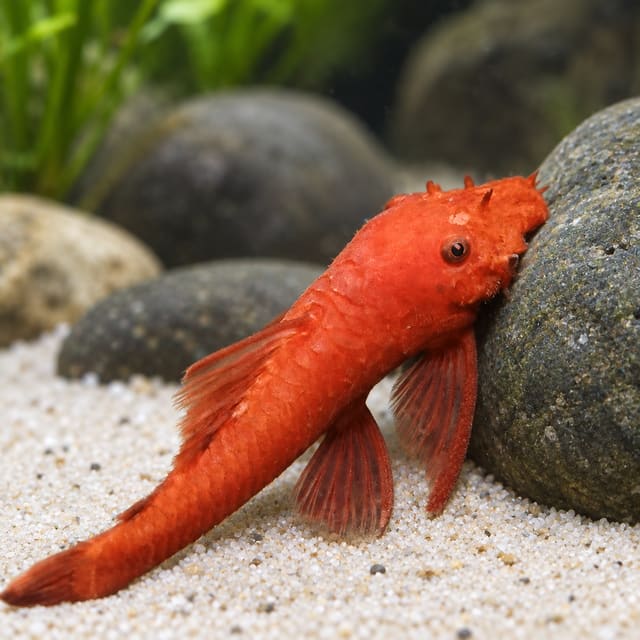
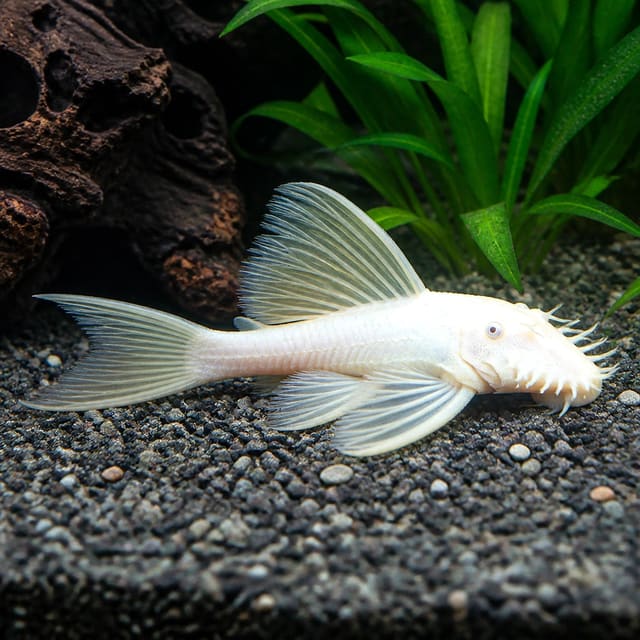
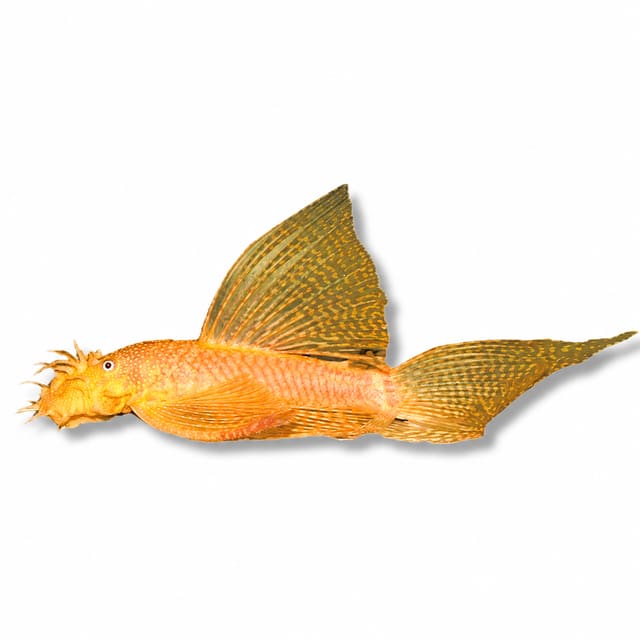
The gallery images are representative of this type of animal rather than photographs of the exact animal supplied, so colours can look slightly different from the live animal.
The gallery is useful for recognising the broad sucker-mouth head, olive-green appearance and pale spotting associated with this trade form. Purchase quantity, dispatch size and sex are controlled by the offer wording and live selector rather than by the number or appearance of animals shown in an image.
OATA’s tropical algae-eater guidance places bristlenose catfish at about 15 cm and gives 22–27°C with pH 6.0–8.0. These are care-group planning values for this unidentified Ancistrus, not a species-specific optimum.
Use the group’s adult figure to plan floor room, shelter access and filtration from the beginning. OATA advises choosing as large an aquarium as reasonably possible because larger aquariums give more stable temperature and water quality. The decisive setup is therefore one that can accommodate an approximately 15 cm bristlenose catfish with plenty of cover and at least one accessible piece of wood, not one selected only because a small dispatch fish fits today.
| Suits | Not suited to |
|---|---|
| A filtered aquarium kept at 22–27°C and pH 6.0–8.0 | An aquarium without a well-set-up and maintained filter |
| A layout with plenty of cover and at least one piece of wood | A bare layout without accessible shelter or wood |
| A supplemented algae-grazer feeding routine | A plan that relies on aquarium algae as the whole diet |
| A keeper who will test water every week | A setup where ammonia or nitrite remains above 0 mg/L |
Keep ammonia and nitrite at 0 mg/L and nitrate no higher than 20 mg/L. A single fish, pair or small group can be considered under the bristlenose guidance, but the amount of cover and usable room must increase with the stocking plan. If you are comparing this fish with other body shapes or adult sizes, browse the catfish and plecos collection before choosing.
Start with aquarium gravel or sand and build the layout around security. OATA recommends live plants where practical because they add cover. If live plants are not part of the design, plastic plants and suitable ornaments can perform the shelter role; plant pots and model caves are examples of structures that can create protected spaces.
Provide at least one piece of wood that the fish can reach and graze. Bristlenose catfish are described as secretive and likely to thrive where there is plenty of cover as well as wood. Place these features as long-term parts of the aquarium rather than occasional feeding accessories.
Arrange shelter with the approximately 15 cm bristlenose planning figure in mind. A tiny fish may enter a narrow gap today, but the permanent arrangement must remain usable as it grows. Check that ornaments do not consume all of the usable bottom area and that the fish can move between cover, wood and feeding places without the aquarium becoming crowded.
The recommendation to choose as large an aquarium as reasonably possible has a practical purpose: greater water volume tends to make temperature and water quality more stable. Use that principle together with the group’s adult figure, its need for floor-level structure and the total stocking plan. A nominal litre figure on its own does not describe whether wood, shelters and other residents will leave enough usable room.
Prepare the complete environment before arranging livestock. Our first tropical aquarium guide explains the preparation and maturation stage. The finished setup should already have its substrate, cover, wood and functioning filter in place, allowing water conditions to be checked before the fish enters.
| Layout check | Decision |
|---|---|
| Base | Use aquarium gravel or sand |
| Cover | Use live or artificial plants and suitable shelters |
| Wood | Include at least one accessible piece |
| Adult access | Keep routes and shelters usable for the bristlenose planning figure of about 15 cm |
| Stocking space | Leave enough usable room for every resident |
A filter is essential in every aquarium housing this fish. RSPCA aquarium welfare guidance explains that fish release ammonia, which is toxic, and that a functioning biological filter supports beneficial bacteria that process this waste. Ammonia is converted into nitrite, which is also toxic, and then into the safer end product nitrate.
The filter’s job is not merely to move water or collect visible debris. It must support the biological process that keeps ammonia and nitrite at 0 mg/L. Nitrate must then remain no higher than 20 mg/L under the bristlenose guidance. Regular test results show whether the aquarium and its maintenance are meeting those targets.
| Stage | Why it matters |
|---|---|
| Ammonia | Fish waste produces a toxic compound that must remain at 0 mg/L |
| Nitrite | The next toxic compound in the biological process must also remain at 0 mg/L |
| Nitrate | The safer end product must not rise above 20 mg/L |
| Biological filter | Provides a place for beneficial waste-processing bacteria |
Use a well-set-up and maintained filter from the start, and keep stocking appropriate to the aquarium. A fish chosen partly because it grazes algae still produces waste and still depends on biological filtration. Algae grazing never replaces the filter, water checks or routine aquarium maintenance.
Feeding and filtration are connected. Food left uneaten breaks down and releases toxic waste, so a portion that is consistently too large increases the burden on the aquarium. Control that burden at its starting point by offering measured portions, allowing extra grazing time for algae-based foods and reducing the amount if food remains.
If ammonia or nitrite appears above 0 mg/L, or nitrate rises beyond 20 mg/L, treat the result as a water-quality warning rather than as a reason to add another algae-eating fish. Correct the aquarium conditions and confirm the target readings again before relying on the setup for this catfish.
Set the aquarium to 22–27°C and pH 6.0–8.0. Keep ammonia at 0 mg/L, nitrite at 0 mg/L and nitrate no higher than 20 mg/L. Test the water once a week so a gradual change is found before it becomes a larger problem.
Begin with actual readings rather than an assumption based on the type of water in your area. Our water chemistry guide explains what the main readings represent, while the water matcher can be used to compare measured aquarium values with the working range on this page.
| Reading | Target |
|---|---|
| Temperature | 22–27°C |
| pH | 6.0–8.0 |
| Ammonia | 0 mg/L |
| Nitrite | 0 mg/L |
| Nitrate | Up to 20 mg/L |
| Test rhythm | Once each week |
For example, an aquarium at 25°C and pH 7.2 sits inside the working temperature and pH range. If its ammonia and nitrite are both 0 mg/L and nitrate is 15 mg/L, all four measured water-quality targets are also inside the guidance. The next decisions concern adult space, cover, wood, feeding and compatibility.
An aquarium at 28°C falls above the 27°C upper boundary even if its pH is suitable. Likewise, pH 8.2 falls above the pH range, and nitrate at 22 mg/L exceeds the 20 mg/L maximum. Bring the relevant value back within the working range and retest rather than treating one acceptable reading as compensation for another that is outside its limit.
Consistency matters because larger aquariums generally provide more stable environmental conditions. Choose the aquarium and total stocking level with that stability in mind, then record weekly readings in the same units each time. A simple sequence of dated results makes a developing trend easier to recognise than isolated tests performed only when the fish behaves differently.
Do not expect aquarium algae to form the whole diet. Bristlenose catfish are included among fish that graze algae, but OATA advises supplementing algae grazers with prepared food such as algae-based wafers or flakes and, ideally, fresh vegetables such as cucumber. Keep the permanent piece of wood accessible so the fish can also graze there.
Offer a measured amount and allow extra time for grazing on algal foods. Judge the portion by both the initial feeding response and what remains afterwards. If a regular portion leaves uneaten food, reduce the next portion instead of adding more.
Overfeeding creates a second problem beyond wasted food: uneaten material breaks down and releases toxic waste. Portion control therefore protects the fish twice, by providing a supplemented diet while limiting avoidable pressure on the filter and water quality.
| Feeding decision | Action |
|---|---|
| Prepared food | Use an algae-based wafer or flake |
| Fresh food | Offer cucumber or another suitable fresh vegetable |
| Vegetable preparation | Choose organic produce or wash it thoroughly |
| Portion | Offer a measured amount, allow extra grazing time and reduce it if food remains |
| Permanent grazing surface | Keep at least one piece of wood in the aquarium |
Fresh vegetables may carry pesticide residue that can harm fish or invertebrates. Use organic produce or wash vegetables thoroughly before they enter the aquarium. Cucumber is the named example in the guidance; it belongs alongside the prepared food rather than replacing it.
Watch the fish at the times it naturally emerges. A secretive, nocturnal catfish may not approach food in the same way as a fish feeding openly in the water column. Place food where it can be reached from its cover, then assess whether it is being consumed before changing the amount. Do not increase the portion simply because algae remains elsewhere in the aquarium.
This catfish belongs to a nocturnal genus and bristlenose catfish are described as secretive. Build observation around that behaviour instead of expecting continuous daytime activity. Check at a consistent time when the fish normally emerges, and use feeding, access to shelter and weekly water readings as the repeatable reference points.
| Checkpoint | What to do |
|---|---|
| After release | Confirm that the fish can reach cover and wood |
| First feed | Offer the planned portion and check that it can reach the food |
| After feeding | Reduce the next portion if food regularly remains uneaten |
| Weekly test | Record temperature, pH, ammonia, nitrite and nitrate |
| Group check | Confirm that each fish can use cover without the layout becoming crowded |
Daytime concealment on its own fits the secretive and nocturnal profile. A useful check compares the fish with its own established routine: whether it emerges at its usual time, reaches the feeding area and uses the cover and wood provided. This approach avoids judging a nocturnal catfish only during the brightest part of the day.
An algae-eating fish is not a substitute for regular maintenance or appropriate stocking. Persistent algae may indicate an underlying water-chemistry problem associated with incorrect maintenance. If algae continues to increase, review the measured water values, stocking and maintenance routine rather than adding more algae grazers or withholding the fish’s supplemented food.
Keep the weekly readings beside the feeding notes. A rising nitrate result and increasing uneaten food point to a different practical decision from normal test results with a fully eaten portion. In the first case, correct the feeding and aquarium conditions; in the second, continue the established routine without making unnecessary changes.
If the fish’s established feeding or activity pattern changes, test the water against 22–27°C, pH 6.0–8.0, 0 mg/L ammonia, 0 mg/L nitrite and no more than 20 mg/L nitrate. Contact us about continuing health changes rather than attempting a treatment that has not been matched to the problem.
Arrange for someone to receive the parcel because live fish must not be left unattended. The tracking email confirms the delivery date and lets you follow the parcel once tracking becomes active.
Prepare the aquarium before the parcel arrives: the filter should already be well set up, the water should already be inside 22–27°C and pH 6.0–8.0, and the wood and cover should already be positioned. Acclimatisation is not the point to begin rearranging an unfinished aquarium.
Read the delivery and Live Arrival Guarantee policy before the delivery date. It sets out the courier process, the need for someone to receive live fish and the steps associated with the guarantee. Follow the policy wording that applies to the order rather than relying on a shortened summary.
Once released, allow the fish to use its prepared shelter. Its genus is nocturnal and the bristlenose group is secretive, so immediate concealment can fit its normal behaviour. Check that it has physical access to cover and wood, then make the first feeding assessment during the established feeding routine instead of repeatedly disturbing the layout.
Continue with the same measurable targets used before delivery: ammonia and nitrite at 0 mg/L, nitrate no higher than 20 mg/L, temperature at 22–27°C and pH at 6.0–8.0. The first weekly test then becomes the starting point for comparing later results.
Bristlenose catfish can be kept alone, in pairs or in small groups. OATA advises that it is usually best to have just one male per group. Use that rule as the starting point for any multi-fish plan, together with plenty of cover, sufficient adult room and access to wood.
| Stocking plan | Decision to make |
|---|---|
| One fish | Provide the full long-term setup, including filtration, cover and wood |
| Pair | Allow enough usable space and cover for both fish |
| Small group | Plan around the advice that it is usually best to keep only one male in the group |
| Community | Screen water, adult room, shelter access and feeding before combining fish |
Every selected fish needs to be planned around OATA’s approximately 15 cm bristlenose figure, even when the chosen dispatch size is only 2.5-3 cm or 3-4 cm. Multiplying small dispatch lengths does not describe the finished demand on floor room, cover or filtration. Picture each fish at the group’s planning figure and check whether the permanent layout still leaves accessible shelter and wood.
Do not use a purchase of several small fish as a shortcut around the one-male guidance. Sex is not guaranteed for the selector choices on this product, so the later group composition needs careful planning. It is usually best not to build a bristlenose group around more than one male.
“Plenty of cover” is a functional requirement rather than decoration. A pair or group should not turn one piece of shelter into the only protected area. Assess the usable arrangement after wood, plants and ornaments are installed; an aquarium that looks large when empty may offer much less usable room once its structures and other residents are included.
For a stocking and compatibility assessment involving an existing group, ask us with the aquarium dimensions, measured temperature and pH, present livestock and intended number of bristlenose catfish. Those details allow the decision to be based on the actual aquarium rather than a universal stocking formula.
Compatibility remains conditional on the individual animals and the aquarium. Start by checking whether every proposed resident can share 22–27°C and pH 6.0–8.0. Then check adult room, cover, wood access, feeding and the filter’s ability to maintain ammonia and nitrite at 0 mg/L with nitrate no higher than 20 mg/L.
| Compatibility screen | Pass condition |
|---|---|
| Water overlap | All residents can live within 22–27°C and pH 6.0–8.0 |
| Adult room | The catfish and every other resident fit the completed layout |
| Shelter | Cover remains accessible after all fish and ornaments are included |
| Wood | At least one permanent piece remains accessible to the bristlenose |
| Feeding | The catfish can reach its supplemented algae-based food and vegetables |
| Water quality | The maintained filter and stocking plan hold all waste targets |
For a worked example, a proposed resident whose care range includes 24°C and pH 7.0 passes the initial overlap check when the aquarium is maintained at those values. That is not the end of the assessment: the adult animals must also fit, and the Green Dragon must still be able to reach cover, wood and food.
A proposed resident that requires 29°C does not overlap the 22–27°C working range, so do not combine it with this fish in an aquarium run at 29°C. Likewise, an animal whose required pH falls wholly above 8.0 or below 6.0 fails the water screen before temperament or appearance is considered.
Adding this fish solely to solve an algae problem is not a sound community decision. Persistent algae may indicate a maintenance or water-chemistry issue, and every additional fish increases stocking demand. Resolve the aquarium issue, then assess whether the catfish itself fits the water, space and group plan.
A community can be considered when all of these checks pass, but do not promise universal harmony from a name alone. Observe the established routine after introduction and reassess if the fish cannot reach shelter or its food.
Plan around OATA’s bristlenose care-group figure of about 15 cm; this is a group planning figure for an unidentified Ancistrus, not a species-specific adult maximum.
Choose as large a filtered aquarium as reasonably possible and plan the completed layout around OATA’s bristlenose group figure of approximately 15 cm, with plenty of cover and at least one accessible piece of wood.
OATA’s bristlenose guidance says they can be kept alone, in pairs or in small groups, and that it is usually best to keep only one male per group.
Choose it if you can provide a well-set-up and maintained filter, weekly water tests, plenty of cover, at least one piece of wood and a supplemented feeding routine.
Offer algae-based wafers or flakes plus thoroughly washed cucumber or another suitable fresh vegetable, using a measured portion and allowing extra grazing time for algal foods.
OATA’s bristlenose care-group guidance gives 22–27°C and pH 6.0–8.0, with ammonia at 0 mg/L, nitrite at 0 mg/L and nitrate no higher than 20 mg/L.
Compatibility is conditional on the animals and aquarium; provide enough adult room, cover, wood and feeding access, and remember that OATA says it is usually best to keep only one male per bristlenose group.
A carefully screened community can be considered when every resident can share OATA’s bristlenose care-group range of 22–27°C and pH 6.0–8.0 and the completed aquarium provides enough room, cover, wood and feeding access for every animal.
Start filming every delivery with the parcel still sealed, then record it being opened continuously with the fish still inside the sealed bag. Someone must be present to receive it; float the bag for 20–30 minutes before release and never pour the bag water into the aquarium.
No reviews for this item yet. Bought one? Honest reviews only, good or bad.
What customers say about ordering from us
Easy website plenty of info on fish your buying great to pick a time slot
TRACEY DURRANT · 7 Oct 2026
Got some lovely fish thank you
Kevin Mackie · 7 Oct 2026
Reviews of our shop, collected by Judge.me, an independent third-party review collector. Newest first.