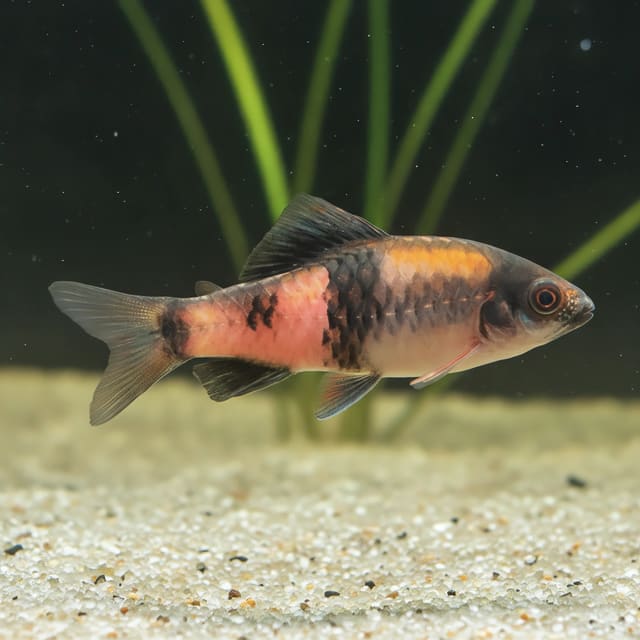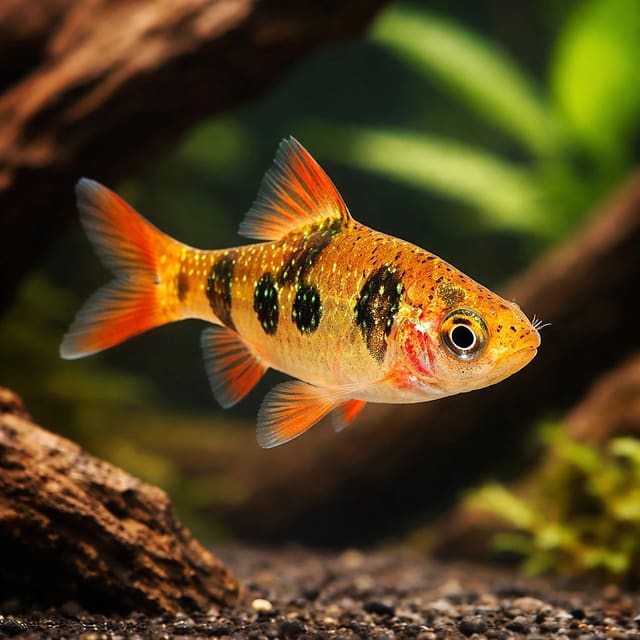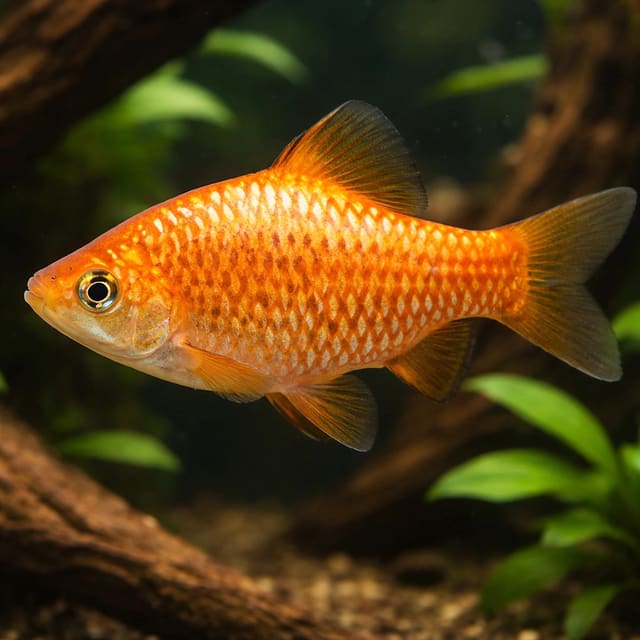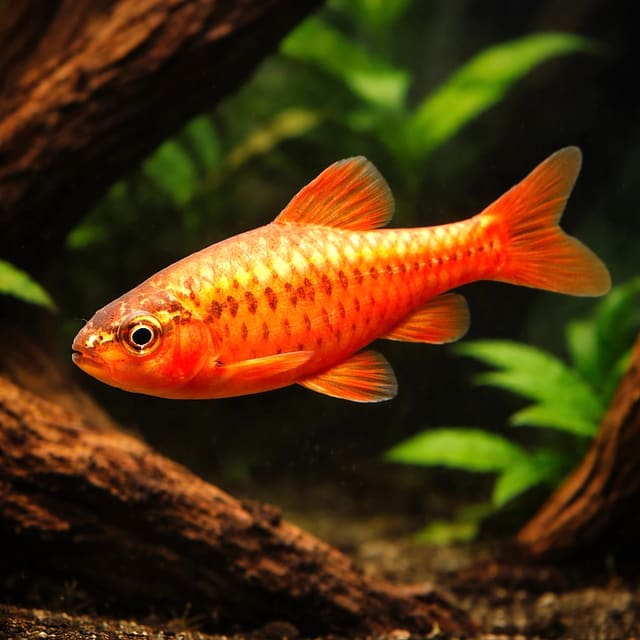
Easy
Cherry Barb (Barbus Capoeta titteya)
20–27°C · pH 6–8 · 54L
From £3.43Some sizes on sale

Eight-Banded Barb is a delicate, peaceful nano barb for mature soft-water aquariums with low light, plant cover and a proper shoal.
Adult size is the maximum length this species reaches at full maturity (scientific sources). The livestock you receive will be younger and smaller. Product-photo provenance and any image-specific limitations are stated on the listing.
Eirmotus octozona
Shoaling fish: kept in a group they feel safer, stay calmer and show their best colour.
Confirm your email, then we’ll send an availability message for this exact item if it returns within 180 days.
This request is only for this product—no newsletter or other promotions. A mail-provider retry may very rarely duplicate the same availability message. Unconfirmed addresses are removed after 48 hours. See our privacy policy.
Eight-Banded Barb is a delicate, peaceful nano barb for mature soft-water aquariums with low light, plant cover and a proper shoal.
Adult size is the maximum length this species reaches at full maturity (scientific sources). The livestock you receive will be younger and smaller. Product-photo provenance and any image-specific limitations are stated on the listing.
Maintain these water conditions for optimal health and vibrant colors
Eight-Banded Barb (Eirmotus octozona) is a very small, peaceful cyprinid for aquarists who enjoy quiet planted aquariums and soft-water species. It is not a bold, showy barb in the tiger-barb sense. Its appeal is more subtle: a slender body, fine vertical bars, gentle shoaling behaviour and a natural fit in a low-light blackwater aquascape.
| Common names | Eight-Banded Barb, Eight-Banded False Barb, Eightbanded Barb |
|---|---|
| Scientific name | Eirmotus octozona |
| Listed size | 2.5-3 cm on SKU 4078 |
| Adult planning size | Usually around 3-3.5 cm |
| Temperament | Very peaceful, shy and social |
| Best aquarium | Mature planted soft-water or blackwater-style setup |
Eirmotus octozona has a small, slightly transparent body with dark vertical bars that give the fish its common name. Aquarium Glaser describes it as a delicate dwarf barb from blackwater habitats, with males typically smaller than females and females becoming fuller bodied. In the right conditions the contrast of the bars improves, especially when the aquarium has subdued light, dark decor and humic substances from wood or leaves.
Because this is a tiny fish, do not expect instant impact from across the room. It rewards close viewing. In a planted nano or small community aquarium, a settled group can bring constant small movements through midwater and around cover without disturbing more reserved tank mates.
Reliable references connect Eight-Banded Barbs with soft, acidic blackwater or peat swamp environments in Malaysia, Borneo and nearby Southeast Asian regions. These habitats are usually shaded, plant-rich and influenced by leaf litter, wood and tannins. That background should guide the aquarium design more than generic barb care.
| Lighting | Low to moderate; floating plants help shy fish settle |
|---|---|
| Substrate | Fine dark sand or smooth fine gravel |
| Decor | Driftwood, leaf litter, mosses and shaded plant cover |
| Flow | Gentle but clean; avoid strong current blasting the shoal |
| Maturity | Best added to an established aquarium, not a new unsteady setup |
This species is often sold small and should not be treated as a hard-water community filler. Soft acidic water is important, while FishBase records the species as harmless and data deficient rather than a common mass-market aquarium fish. Keep the water stable, clean and gentle.
| Temperature | 23-27°C, with 24-26°C a sensible target |
|---|---|
| pH | Soft acidic conditions are best; aim around pH 5.0-6.8 where practical |
| Hardness | Soft water preferred, ideally below about 8 dGH |
| Minimum aquarium | 45 litres for a small shoal, larger if mixing with other species |
| Maintenance | Small regular water changes, careful feeding and mature filtration |
Eight-Banded Barbs should be kept in a group of six or more. A single fish or pair is more likely to hide, feed poorly and fail to show natural movement. In a proper shoal they remain peaceful and spend time in the middle and upper levels, moving between plants and open patches.
Their shy nature matters when choosing tank mates. They are not built to compete with large barbs, pushy livebearers or boisterous cichlids. A calm aquarium gives them time to feed and space to settle.
| Best group | Six or more individuals |
|---|---|
| Activity level | Gentle shoaling, most visible when settled |
| Aggression | Very low; mild display only |
| Stress signs | Constant hiding, thin body shape, clamped fins or missing food |
Use tiny foods. Seriously Fish and other specialist care notes recommend suitably sized dried foods but not as the only diet. Rotate small frozen or live foods such as daphnia, cyclops, baby brine shrimp, microworms and mosquito larvae. Feed small amounts and watch that every fish in the group gets a chance before faster tank mates clear the food.
| Staple | Quality micro pellets, powdered granules or finely crushed flake |
|---|---|
| Conditioning foods | Daphnia, cyclops, baby brine shrimp, microworms and mosquito larvae |
| Feeding style | Small portions once or twice daily |
| Avoid | Large pellets, heavy overfeeding and tanks where faster fish take everything first |
Good companions are small, peaceful species that appreciate similar water. Think tiny rasboras, calm soft-water tetras, small Corydoras in suitable conditions and other gentle nano fish. Avoid fin nippers, aggressive cichlids, large barbs, predatory fish and hard-water specialists.
If you are building a soft-water community, compare this species with Cherry Barb, Red Axelrodi Rasbora, Chili Rasbora, Pencilfish, Salt and Pepper Corydoras and other quiet planted-tank fish.
Published aquarium breeding information for Eirmotus octozona is limited. It should be treated as an egg-scattering barb that may require very soft, acidic water, fine plants or spawning mops and a separate breeding setup because adults may eat eggs. Conditioning with tiny live and frozen foods is likely helpful. This is a specialist breeding project rather than a guaranteed community-tank spawn.
Keep lights low when the fish arrives. Match temperature first, then acclimate gradually into stable soft water. Avoid adding the group to a bright new aquarium or directly into a tank with pushy feeders. Give them cover immediately, and offer the first small feed only once they have settled.
Choose Eight-Banded Barb if your aquarium is mature, peaceful and already close to soft-water conditions. New customers can use WELCOME10 for 10% off a first order where the code is eligible. Livestock packing and arrival support are explained on our Delivery & Live Arrival Guarantee page.
Care guidance here uses the existing Tropical Fish Co live record, Seriously Fish, FishBase and Aquarium Glaser. The page avoids claiming certainty where the trade and literature are limited.
No reviews for this item yet. Bought one? Honest reviews only, good or bad.
What customers say about ordering from us
I have a small group of long finned mountain minnows. So was delighted to be able to order ten of this variety to increase the genetics in my tank . The ones I recieved are healthy but it’s to early to give a verdict on wether they are of a long finned type since they are small currently.
Gordon Walker · 23 Sept 2026
100% success travel and "installation". Pleased with quality of purchase. The Siamese fighter a bit "shy" so have not yet seen him at his best yet but looking good. Happy customer. GG
George E Garratt · 21 Sept 2026
Reviews of our shop, collected by Judge.me, an independent third-party review collector. Newest first.