Glowlight Rasbora (Trigonostigma hengeli)
23–28°C · pH 5–7.5 · 54L
£3.99

Add the striking X Eyespot Rasbora to your aquarium. A peaceful, moderate-care tropical fish with unique eye markings. Buy online for UK delivery.
Adult size is the maximum length this species reaches at full maturity (scientific sources). The livestock you receive will be younger and smaller. Product-photo provenance and any image-specific limitations are stated on the listing.
Brevibora dorsiocellata
Shoaling fish: kept in a group they feel safer, stay calmer and show their best colour.
Confirm your email, then we’ll send an availability message for this exact item if it returns within 180 days.
This request is only for this product—no newsletter or other promotions. A mail-provider retry may very rarely duplicate the same availability message. Unconfirmed addresses are removed after 48 hours. See our privacy policy.
Add the striking X Eyespot Rasbora to your aquarium. A peaceful, moderate-care tropical fish with unique eye markings. Buy online for UK delivery.
Adult size is the maximum length this species reaches at full maturity (scientific sources). The livestock you receive will be younger and smaller. Product-photo provenance and any image-specific limitations are stated on the listing.
Maintain these water conditions for optimal health and vibrant colors
The Green Eye Rasbora (Rasbora dorsiocellata, today usually classified as Brevibora dorsiocellata) is an understated gem that experienced keepers often recommend for a peaceful, active planted community aquarium. It is also sold under the trade names eyespot rasbora and emerald eye rasbora. Named for the striking black "eye" marking on its dorsal fin, this elegant schooling species comes from acidic streams in Malaysia and Sumatra and combines a gentle temperament with lively midwater movement. Adults usually reach around 5-7 cm, can live up to 5 years, and are widely regarded as suitable tropical aquarium fish for keepers who want natural behaviour and subtle colour. If you are researching eyespot rasbora care or how to care for eyespot rasboras, this species deserves a close look.
The Green Eye Rasbora is popular because it suits a wide range of peaceful community tanks, shows well in groups, and adapts nicely to a blackwater-inspired aquascape or a soft, green planted layout. Our photos show the reflective silver body, olive-gold sheen, and signature dorsal spot. For anyone looking to buy live fish online in the UK, this is a smart balance of beauty, manageable care, and compatibility. In the right aquarium, Green Eye Rasboras become confident, social, and constantly interesting to watch.
The Green Eye Rasbora was long described in the aquarium trade as Rasbora dorsiocellata, and has since been reclassified as Brevibora dorsiocellata; both names refer to the same fish. Many fishkeepers still describe it broadly as a cyprinid, and in the hobby it sits alongside other small rasboras valued for peaceful schooling behaviour. It is appreciated as a community species but remains less overexposed than the harlequin rasbora, which makes it especially appealing to keepers who want something a little different.
The natural eyespot rasbora habitat is found in parts of Malaysia and Sumatra, where these fish live in slow-moving streams, shaded watercourses, and peat-influenced areas with soft, slightly acidic water. In the wild, leaf litter, roots, fallen branches, and overhanging vegetation create dim conditions and humic-stained water. This is why many successful keepers model their eyespot rasbora care guide around blackwater or lightly tannin-stained aquariums rather than bright, bare tanks.
Despite occasional confusion, these are not pond fish — they are true warm-water aquarium fish and need stable indoor conditions, so they are not suited to an outdoor pond. Keepers comparing wild-origin species often ask whether they are delicate; in this case they are adaptable once settled, but they still appreciate calm surroundings and consistent water chemistry.
In nature they feed on tiny invertebrates, insect larvae, zooplankton, and fine organic matter. That background helps explain why Brevibora dorsiocellata care works best when you offer a varied omnivorous diet and maintain gentle flow. Their native waters are usually low in dissolved minerals, though aquarium-raised stock often adapts well to moderate hardness if changes are gradual. A good care plan means soft planting, subdued lighting, and open swimming lanes between cover.
Mimicking the natural habitat with driftwood, leaf-litter tones, dark substrate, and floating plants often improves colour, reduces shyness, and encourages tighter schooling. Many keepers notice the dorsal eyespot looks bolder once the fish feel secure.
A proper eyespot rasbora tank setup starts with space for a group, not just a pair. Although the listed minimum tank size is 80 litres, a longer aquarium is better than a tall one because these fish use the middle level and appreciate horizontal swimming room. Treat 80 litres as the minimum and 100-120 litres as a more comfortable long-term eyespot rasbora tank size for a lively school.
The best group size is 8 or more, and many keepers prefer 10-12. If you are wondering how many eyespot rasboras to keep in a tank, an 80-litre aquarium can hold a starter group if filtration and maintenance are good, but larger tanks encourage better behaviour and less stress. Remember that active schooling fish need swimming length, not just litres on paper.
The ideal eyespot rasbora water temperature is 23-27°C, which fits the normal tropical community range; a day-to-day target of around 24-25°C works well. Stable water conditions matter more than chasing a precise number — sudden swings can trigger stress or suppress appetite.
Good eyespot rasbora water parameters include soft to moderately hard water, pH 6.0-7.5, and low nitrate. The species' water hardness tolerance is broader in captive-bred stock than in wild conditions, but softer water usually brings out the best colour and breeding behaviour.
A reliable internal or external filter is important. Green Eye Rasboras should not be kept in an unfiltered permanent setup; while they may survive short emergencies, long-term health, oxygenation, and waste control all depend on stable filtration. Choose a filter that gives gentle to moderate flow rather than a blasting current. If you keep them with other small schooling fish such as Glass Bloodfin Tetras - Prionobrama, even circulation across the tank helps both species stay active without being pushed around.
Dark sand or fine gravel works best. It reflects less light, deepens body colour, and makes the eyespot stand out. Eyespot rasboras in a planted tank do particularly well because plants break lines of sight and create a sense of safety. Good choices include Java fern, Cryptocoryne, floating Salvinia, and fine-leaved stems. When choosing aquarium plants, pick species that tolerate warm, slightly soft water and provide both cover and open lanes.
For algae management in a peaceful setup, a group of Golden Oto Otocinclus Affinis Golden Dwarf can work well once the tank is mature. Guppies such as the Albino Sky Blue Guppy or Red Black Guppy can also add upper-level movement in a mixed display, though water chemistry should be chosen carefully when combining soft-water rasboras with harder-water livebearers.
Moderate lighting is ideal. Very bright light with no cover can make them nervous, while subdued light with floating plants encourages stronger colour and more natural schooling. Aim for 6-8 hours daily in a low-tech setup or 8-10 hours if the aquarium is heavily planted and balanced.
Always cycle the aquarium for 4-6 weeks before adding fish. Many problems blamed on species sensitivity are actually caused by immature filtration, unstable pH, or overstocking too early after setup.
The best eyespot rasbora diet is varied, fine-textured, and offered in small portions. In nature they pick at tiny live foods and suspended particles, so in the aquarium they do best on quality micro pellets, crushed flakes, frozen cyclops, daphnia, and baby brine shrimp. A good feeding guide for this fish is "little and often" rather than one heavy meal.
A high-quality small pellet or fine flake should form the base of the diet. A balanced staple with enough protein for small omnivores and a particle size they can swallow easily makes the best tropical fish food for this species. Good options sink slowly or remain suspended briefly, allowing the school to feed naturally in midwater.
Frozen daphnia, cyclops, and baby brine shrimp help maintain condition and improve colour. Live foods such as live daphnia or baby brine shrimp are especially useful when conditioning adults for spawning. These fish are not algae-eating fish and they are not reliable snail-eating fish, so do not buy them expecting cleanup duties.
For Green Eye Rasboras, feeding once or twice daily is ideal, with only as much food as they finish in under two minutes — this answers the common questions of how often you should feed tropical fish and whether to feed tropical fish every day. If you travel, an automatic fish feeder can help with dry foods, but always test it before relying on it. Healthy adults can usually manage several days without food in an emergency, but regular fasting should not replace a proper routine.
| Time | Food | Amount |
|---|---|---|
| Morning | Fine micro pellet or crushed flake | Small pinch, eaten in 1-2 minutes |
| Evening | Frozen daphnia, cyclops, or baby brine shrimp | Very small portion |
What matters most in tropical fish food is freshness, suitable particle size, and nutritional balance — far more than where you buy it. For everyday tropical fish care, consistency beats gimmicks.
Overfeeding causes ammonia spikes, cloudy water, and digestive stress. Small schooling fish often beg for food, but that is not a reliable sign they need more. Feed lightly and keep water quality high.
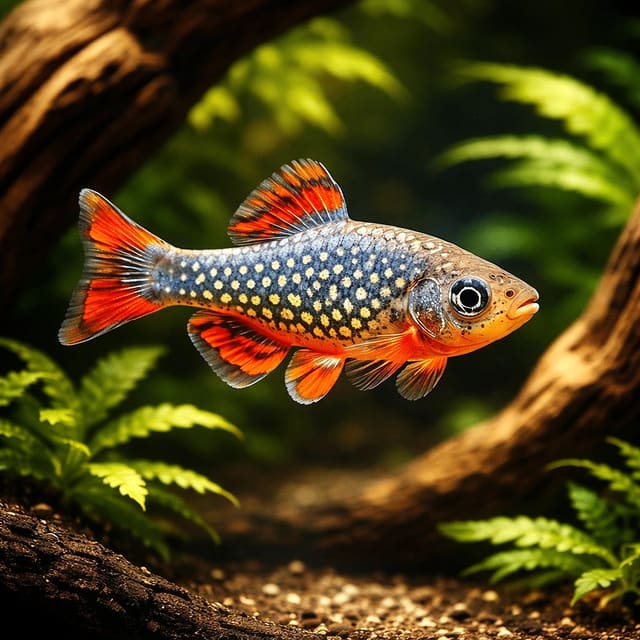
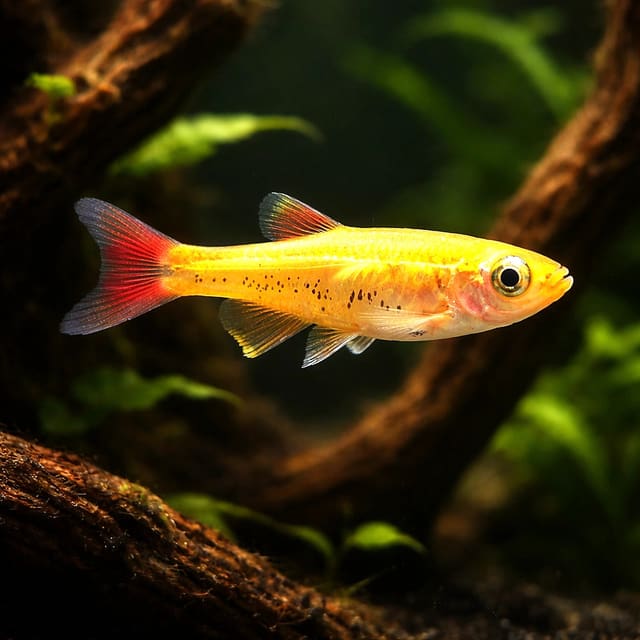
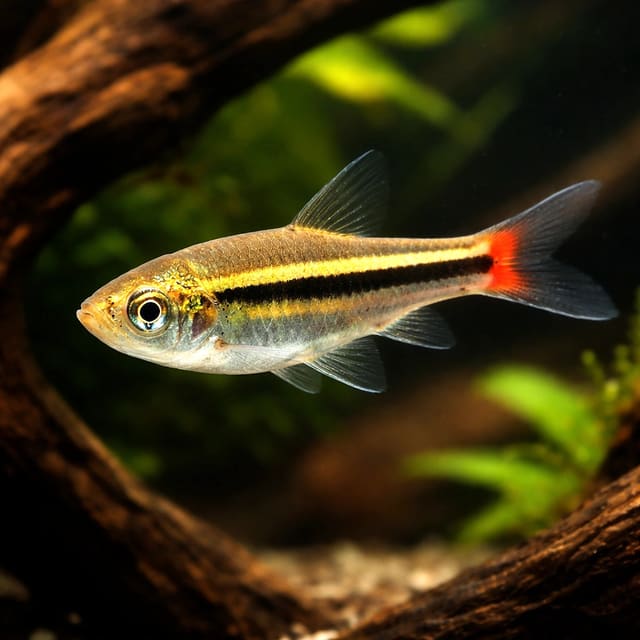
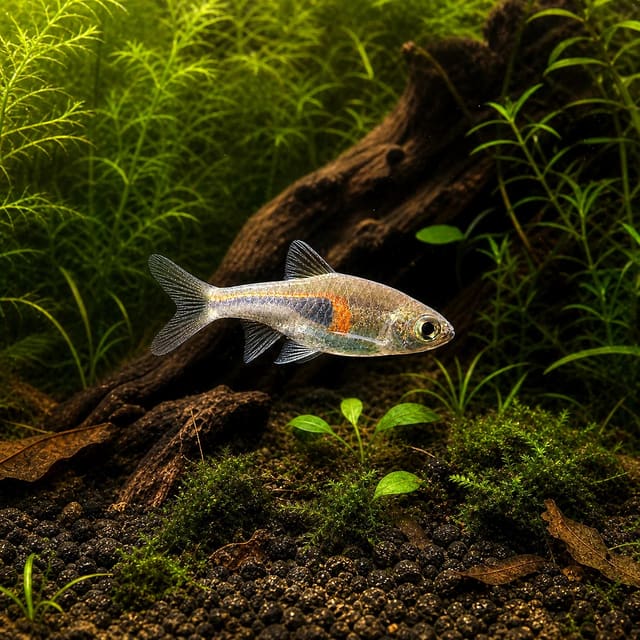
The defining feature of this species is the bold black oval marking on the dorsal fin, which looks like an eye and gives the fish its common names. The body is slender and streamlined, usually metallic silver with an olive-gold cast under reflected light, sometimes showing a faint warm blush along the underside in calm, well-maintained tanks. This makes it a subtle but elegant choice among colourful tropical fish.
Adult eyespot rasbora size is typically around 5-6 cm, though larger specimens may approach 7 cm. Brevibora dorsiocellata size depends on diet, space, and age. Their fins are mostly clear, which makes the dorsal spot even more dramatic. In a dark aquascape with floating plants, the fish can appear almost luminous, especially when the school turns together.
When sexing fish, eyespot rasbora male vs female differences are subtle. Females are usually slightly fuller-bodied, especially when carrying eggs, while males appear slimmer and sometimes a touch more refined in colour under good conditions. Our photos show the clean body line and dorsal ocellus clearly, helping you assess quality before ordering live tropical fish delivered in the UK.
One reason this species ranks among the best rasboras for a community tank is its peaceful nature. In most aquariums these are schooling, midwater cypriniform fish that thrive in groups and avoid confrontation. They are ideal community fish for any calm, planted tank, provided tank mates are similarly gentle.
The best eyespot rasbora tank mates are other peaceful species that enjoy similar temperatures and do not outcompete them at feeding time. Good options include Glass Bloodfin Tetras - Prionobrama for active midwater contrast, Golden Oto Otocinclus Affinis Golden Dwarf for gentle algae grazing, and carefully chosen guppies such as Albino Sky Blue Guppy or Red Black Guppy in mixed displays where water chemistry is managed sensibly.
For a peaceful planted aquarium, Green Eye Rasboras are a strong centre-school species. They also work well in species-focused groups, which often show the best behaviour. Eyespot rasboras with other fish tend to be confident when kept in numbers, but shy if understocked.
Aggressive or oversized tank mates to avoid include large cichlids, fin-nippers, predatory oddballs, and big gouramis. Fish such as Gold Giant Gourami, Piaractus Brachypomus - Red-Bellied Pacu -, Red-Bellied Pacu - Piaractus Brachypomus, or Polypterus Endlicherii are not suitable companions: some are too large, some become boisterous, and some may simply view smaller rasboras as food.
Adult shrimp may coexist in dense planting, but tiny shrimplets can be eaten. Peaceful snails are usually fine, although Green Eye Rasboras are not a control solution if you are looking for snail-eating fish, and they should not be chosen as algae-eating fish — that role is better filled by Otocinclus in a mature tank.
| Species | Compatible? | Notes |
|---|---|---|
| Glass Bloodfin Tetras - Prionobrama | Yes | Similar size and peaceful behaviour in midwater |
| Golden Oto Otocinclus Affinis Golden Dwarf | Yes | Excellent bottom and biofilm-grazing contrast species for planted tanks |
| Albino Sky Blue Guppy | With caution | Possible if water chemistry suits both species and feeding is balanced |
| Gold Giant Gourami | Avoid | Too large and potentially intimidating |
| Polypterus Endlicherii | Avoid | Predatory species, unsafe with small rasboras |
When planning livestock purchases, the most important compatibility point is to stock slowly, quarantine properly, and avoid impulse mixing of fish with very different adult sizes.
Always quarantine new arrivals for 2-4 weeks before adding them to a community tank. This reduces the risk of parasites, bacterial infections, and stress-related losses in established schooling fish.
Eyespot rasbora breeding is possible in captivity, but it is more reliable in soft, slightly acidic water and a quiet dedicated setup. This species is an egg scatterer, so yes, these rasboras do lay eggs — they usually release them among fine plants rather than guarding them.
A separate 30-45 litre breeding tank works well. For successful Brevibora dorsiocellata breeding, use soft water, subdued light, and fine-leaved plants such as Java moss; a spawning mop can also help. Condition adults with frozen and live foods for 1-2 weeks beforehand. Select the best pair or small group after observing eyespot rasbora male vs female body shape, with females fuller and males slimmer.
Spawning often occurs at first light. Slightly cooler water changes followed by stable warmth can trigger activity. Males chase females through plants, and eggs are scattered rather than carefully placed. The eggs are tiny, translucent, and easy to miss unless the tank bottom is bare or protected with mesh.
Remove the adults after spawning because they may eat the eggs. Gentle aeration helps, and hatching usually occurs within about 24-36 hours depending on temperature. Fry become free-swimming a few days later and need infusoria, liquid fry food, or very fine powdered foods before moving onto baby brine shrimp.
This species is rewarding to breed without being impossibly difficult. It is not the first fish most people breed, but it is a satisfying step up from very easy livebearers for hobbyists exploring different tropical fish to breed.
For the best spawning response, use aged soft water with a low mineral content, dim the lighting, and add a dense mat of Java moss. Breeding success often improves when adults are conditioned on live daphnia and baby brine shrimp for at least 10 days before introduction.
Comparison matters because many aquarists want a peaceful schooling fish but are unsure whether to choose rasboras, tetras, or livebearers. If you are deciding between eyespot rasbora vs neon tetra or eyespot rasbora vs ember tetra, the answer depends on the look and behaviour you want.
| Feature | Green Eye Rasbora | Neon Tetra |
|---|---|---|
| Max Size | 5-7 cm | 3.5-4 cm |
| Care Level | Easy/Moderate | Easy |
| Temperature | 23-27°C | 22-26°C |
| Best For | Natural planted community tanks | Bright colour contrast in classic community tanks |
| Feature | Green Eye Rasbora | Ember Tetra |
|---|---|---|
| Visual Style | Silver body with dorsal eyespot | Orange-red body |
| Schooling Look | Elegant and subtle | Dense and fiery |
| Best Tank Style | Blackwater or green planted aquascape | Nano planted aquascape |
| Temperament | Peaceful | Peaceful |
| Best For | Keepers wanting something less common | Keepers wanting stronger colour |
If you want one of the more unusual peaceful community choices, the Green Eye Rasbora is excellent. It is often a better pick than guppies for a softer-water, Southeast Asian-style planted tank, while tetras may suit those who want brighter colour. For keepers comparing species by behaviour rather than hype, this fish offers elegance, movement, and compatibility.
Good eyespot rasbora health starts with stable water, a proper school size, and low stress. Healthy fish swim actively in the middle of the tank, feed eagerly, hold their fins normally, and show a clean metallic sheen without clamped fins or laboured breathing. Because they are small schooling fish, they can hide early symptoms, so observation matters.
The most common eyespot rasbora diseases in home aquariums are not species-specific; they are the usual stress-linked problems such as white spot (ich), mild bacterial infections, fin damage from poor water quality, and wasting from internal parasites. Most outbreaks follow transport stress, temperature swings, or adding new fish without quarantine. This is why choosing where to buy tropical fish online should weigh health protocols above bargain pricing alone.
Maintain excellent water quality, keep nitrate low, and avoid sudden changes. If disease appears, move affected fish to a hospital tank when possible and treat according to diagnosis. Regular partial water changes, a varied diet, and calm companions do more to prevent illness than any bottled cure. Proper insulated packing and good fish condition on arrival matter far more than a delivery slogan.
Never medicate blindly. Many symptoms look similar, and unnecessary treatment can stress small rasboras further. If shrimp or snails are present, avoid copper-based medications unless you are absolutely sure the system is invertebrate-free.
Green Eye Rasboras are active, social midwater fish that feel safest in a group. Their behaviour is best described as schooling rather than tightly shoaling all day; they spread out when relaxed, then draw together when startled or excited by food. This makes them engaging fish to watch in a well-planned community aquarium.
They are generally peaceful, not territorial, and rarely bother tank mates. They are a fair choice for beginners, provided the keeper understands that schooling fish need numbers and stable water. In too small a group they may become nervous and washed out; in a proper school, eyespot rasboras with other fish show much more confidence and natural movement.
One of the nicest things about this species is how the group responds to aquascape design. Add shaded corners, open swimming lanes, and gentle current, and you will see smooth, coordinated movement through the middle of the tank. In a sparse setup they can look ordinary; in a planted blackwater-style aquarium they become genuinely striking.
Our Green Eye Rasboras are selected for active schooling behaviour, clean finnage, and clear dorsal spotting rather than being treated as just another mixed small-rasbora line. That matters with this species, because the appeal is in pattern quality and the way the group moves once settled. For anyone searching to buy tropical fish online in the UK, careful handling makes a real difference.
Before dispatch, fish are checked for feeding response, body condition, and normal swimming. We focus on steady acclimation so they arrive ready to settle into established community aquariums. Species-specific preparation and packing standards matter more than the size of a shop.
Each order is packed for safe transport with insulated materials and seasonal heat protection when needed, which is especially important for small schooling fish. In our experience, healthy, well-packed fish settle faster and cost less in the long run than poorly handled stock.
If you want a peaceful planted-aquarium fish with genuine character, order your Green Eye Rasboras today with confidence. They are a thoughtful choice for keepers who value behaviour, compatibility, and natural beauty over flashy but difficult species.
Build a balanced community around your Green Eye Rasboras with a few carefully chosen companions and contrasts. Glass Bloodfin Tetras - Prionobrama add bright, transparent movement in the midwater zone, while Golden Oto Otocinclus Affinis Golden Dwarf help round out a mature planted aquarium. If you want a splash of colour near the surface, consider the Albino Sky Blue Guppy or Red Black Guppy. Looking for more options in the same category? Browse our wider freshwater tropical fish collection for community-friendly species, larger oddballs, and standout display fish.
No reviews for this item yet. Bought one? Honest reviews only, good or bad.
What customers say about ordering from us
I have a small group of long finned mountain minnows. So was delighted to be able to order ten of this variety to increase the genetics in my tank . The ones I recieved are healthy but it’s to early to give a verdict on wether they are of a long finned type since they are small currently.
Gordon Walker · 23 Sept 2026
100% success travel and "installation". Pleased with quality of purchase. The Siamese fighter a bit "shy" so have not yet seen him at his best yet but looking good. Happy customer. GG
George E Garratt · 21 Sept 2026
Reviews of our shop, collected by Judge.me, an independent third-party review collector. Newest first.