Moderate
Acei Cichlid (Pseudotropheus sp. “acei”)
24–26°C · pH 7.5–8.5 · 300L
£7.99

The Snow White Electric Blue Hap (Sciaenochromis fryeri) is a Lake Malawi cichlid that reaches 11.5 cm standard length. It suits keepers able to provide about 304 litres and one male with several females; 24–27°C and pH 8.0–8.6 are the overlap between Seriously Fish and OATA guidance. Sold individually in dispatch sizes from 3–4 cm to 8–10 cm.
Adult size is the maximum length this species reaches at full maturity (scientific sources). The livestock you receive will be younger and smaller — pick a size above for the actual shipping size. Product-photo provenance and any image-specific limitations are stated on the listing.
Sciaenochromis fryeri
Save when buying multiple fish. Each quantity is one fish; sex and pair formation are not guaranteed unless the selected variant explicitly states them.
The Snow White Electric Blue Hap (Sciaenochromis fryeri) is a Lake Malawi cichlid that reaches 11.5 cm standard length. It suits keepers able to provide about 304 litres and one male with several females; 24–27°C and pH 8.0–8.6 are the overlap between Seriously Fish and OATA guidance. Sold individually in dispatch sizes from 3–4 cm to 8–10 cm.
Adult size is the maximum length this species reaches at full maturity (scientific sources). The livestock you receive will be younger and smaller — pick a size above for the actual shipping size. Product-photo provenance and any image-specific limitations are stated on the listing.
Cichlids are a family of roughly 1,800 accepted species, not one care type. Before buying, identify the exact species and source, then compare adult measurement, usable tank dimensions, social system, territory, tested water, diet and an exit plan. No family-wide minimum tank, water range or tank-mate list is safe.
Maintain these water conditions for optimal health and vibrant colors
The Snow White Electric Blue Hap (Sciaenochromis fryeri) is a freshwater cichlid from throughout Lake Malawi in Africa. FishBase places it in the family Cichlidae, records rocky coastal habitat at depths of 10–40 metres and gives a maximum length of 11.5 cm standard length. It suits a keeper prepared to build a spacious, hard-water Malawi aquarium and make selective compatibility decisions rather than assemble a general peaceful community.
This is a predatory hap whose wild diet consists of fish. Its natural history explains the need for open swimming room around substantial rock structure, as well as a diet chosen for a fish-eating cichlid. It should not be treated as an algae grazer, clean-up fish or plant-focused feeder.
Successful care starts with three linked decisions: provide a base around 150 × 45 cm and about 304 litres, hold hard alkaline water steady, and avoid combinations that encourage rivalry. Several females should accompany a male, while more than one male belongs only in a very large aquarium. Mbuna, similarly coloured fish and different colour morphs of S. fryeri should be avoided.
Keep the routine range at 24–27°C, pH 8.0–8.6 and 12–18 dGH. These values are the overlap between Seriously Fish’s aquarium ranges and OATA’s Malawi-cichlid group guidance. A mature biological filter, zero ammonia, zero nitrite and disciplined maintenance matter as much as the headline temperature and pH.
Plan around an aquarium of about 304 litres with a base around 150 × 45 cm. The Seriously Fish species-level aquarium profile pairs that footprint with networks of caves formed from rockwork, a sandy substrate and open areas for swimming. The length and width provide room to separate rock territories without turning every part of the aquarium into an enclosed cave.
Water should be hard and alkaline rather than soft and acidic. Keep the routine range at 24–27°C, pH 8.0–8.6 and 12–18 dGH; this is the overlap between Seriously Fish’s aquarium ranges and OATA’s Malawi-cichlid guidance. The aquarium must be filtered and biologically mature before stocking begins, and OATA recommends strong aeration for Malawi communities. A larger aquarium gives more room for swimming, rock placement and avoidance, but extra volume does not make an unsuitable companion safe.
| Suits | Not suited to |
|---|---|
| A base around 150 × 45 cm and about 304 litres | Compact aquariums that cannot provide the stated footprint |
| Hard, alkaline water held within the routine range | Soft, acidic community conditions |
| Rock caves with open swimming areas | A layout with no open water or territorial separation |
| Selective non-mbuna Malawi companions | Mbuna or similarly coloured fish |
| One male with several females | Several males unless the aquarium is very large |
Robust behaviour is part of the planning decision. Seriously Fish describes the species as not especially aggressive, although it is robust, and specifically warns against mbuna and similarly coloured fish. That makes the aquarium’s footprint, visual separation and sex structure practical welfare controls rather than decorative extras.
One purchase supplies one fish in the selected dispatch size. Use the live size selector to choose 3–4 cm, 5–6 cm or 8–10 cm. The size you select is the size supplied, not the adult size. Plan the permanent aquarium before choosing a smaller fish, because the aquarium, filtration and companions must suit the animal as it grows.
Sex is guaranteed only when the selected option explicitly states male or female. This Snow White Electric Blue Hap listing has no sex-guaranteed option. Mature males are electric blue and females much plainer, but juvenile fish are much harder to sex, so colour, dispatch size and gallery appearance must not be used as a promise of sex.
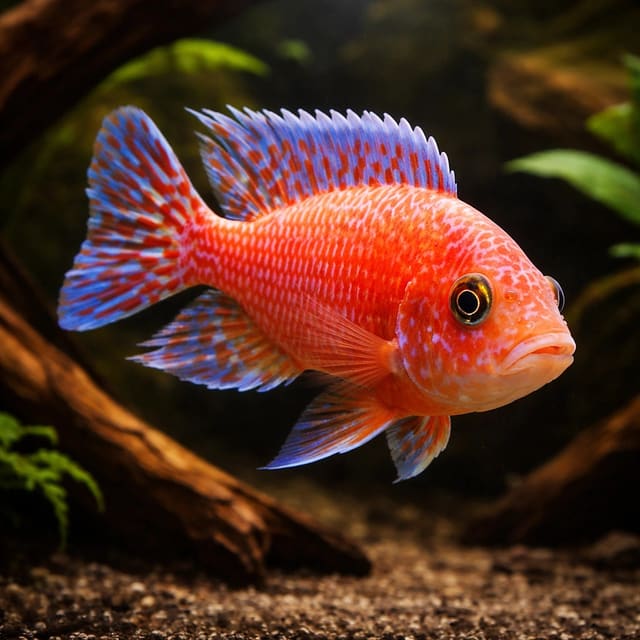
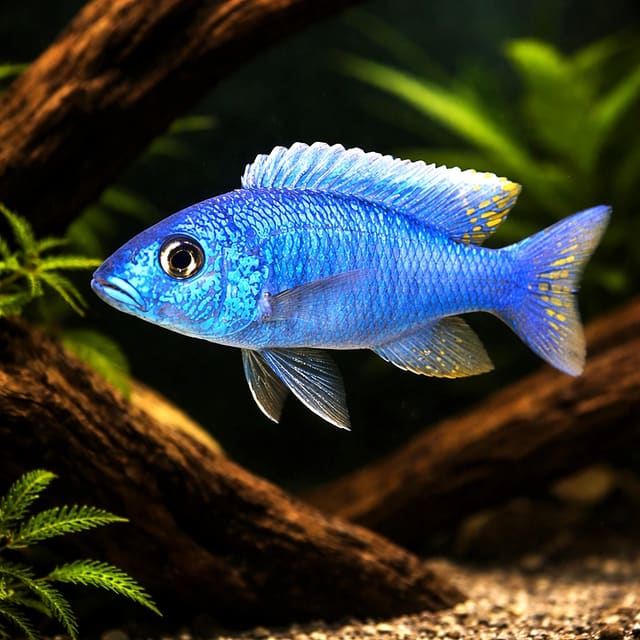
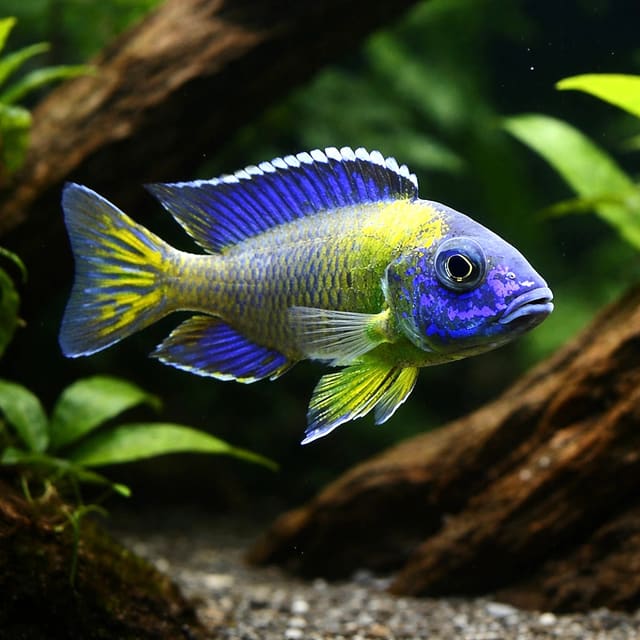
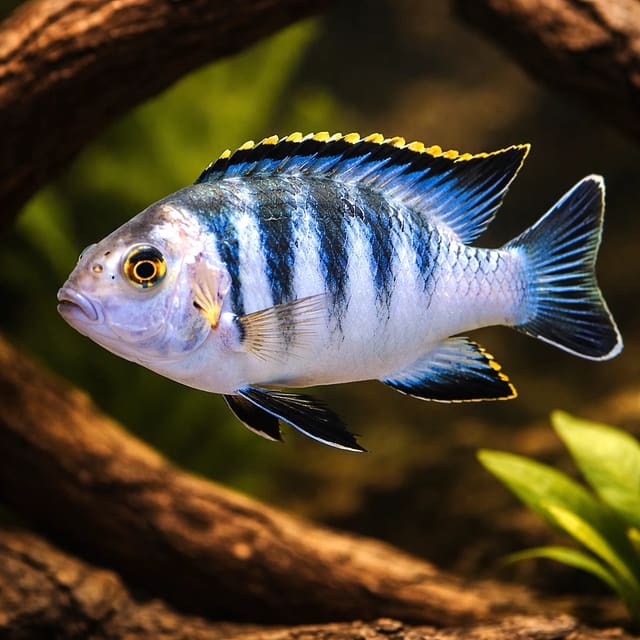
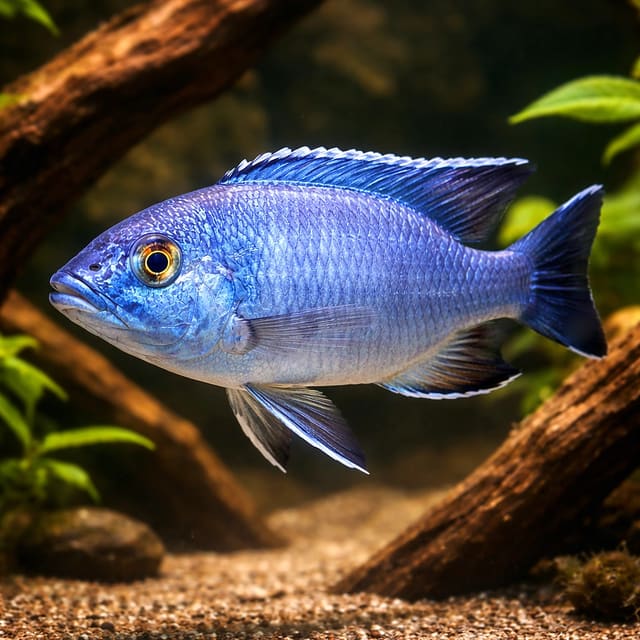
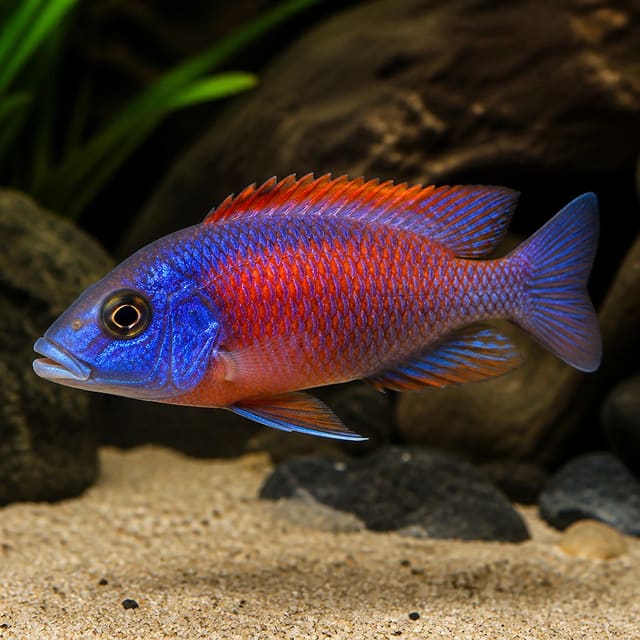
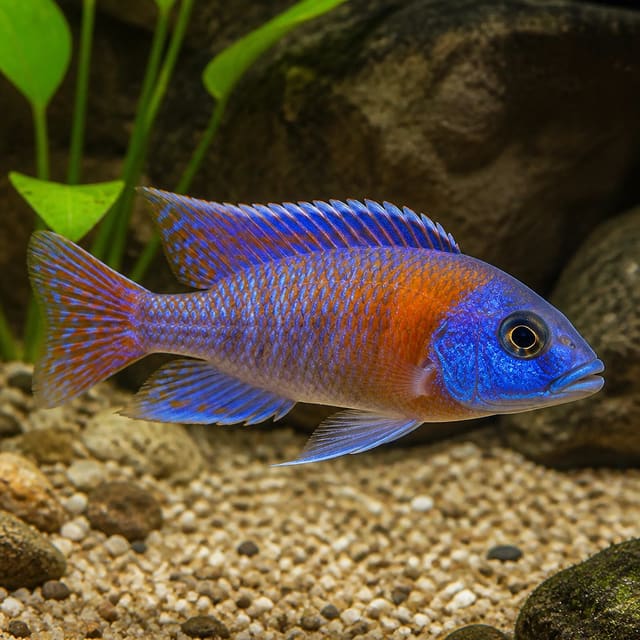
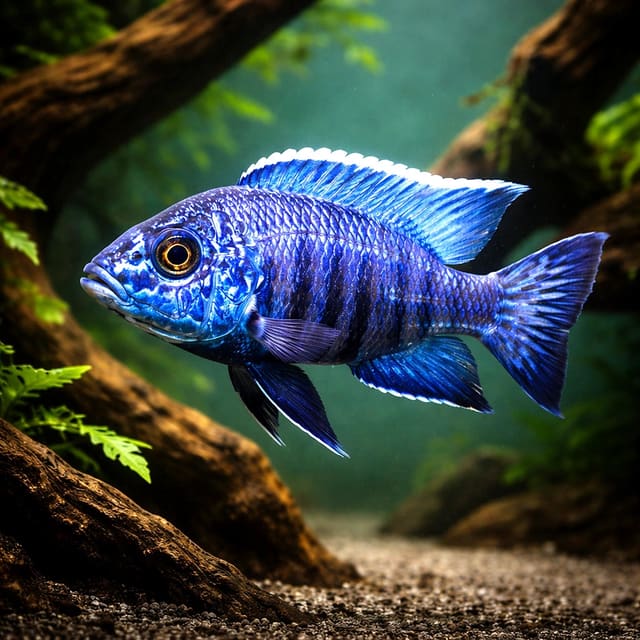
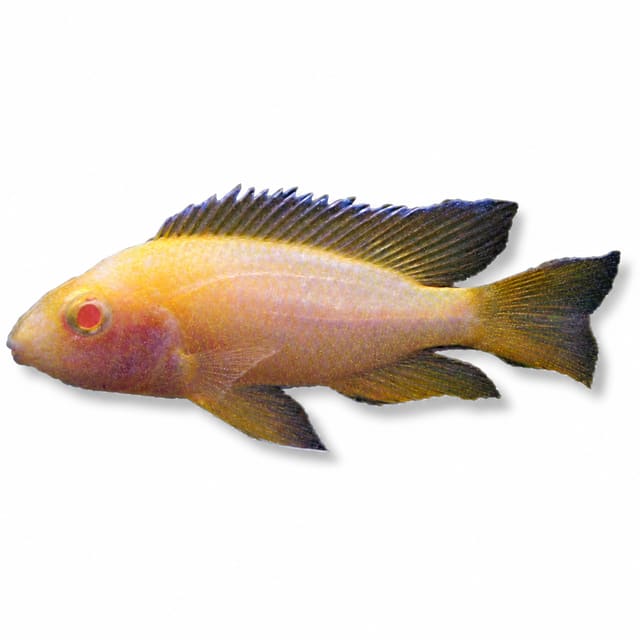
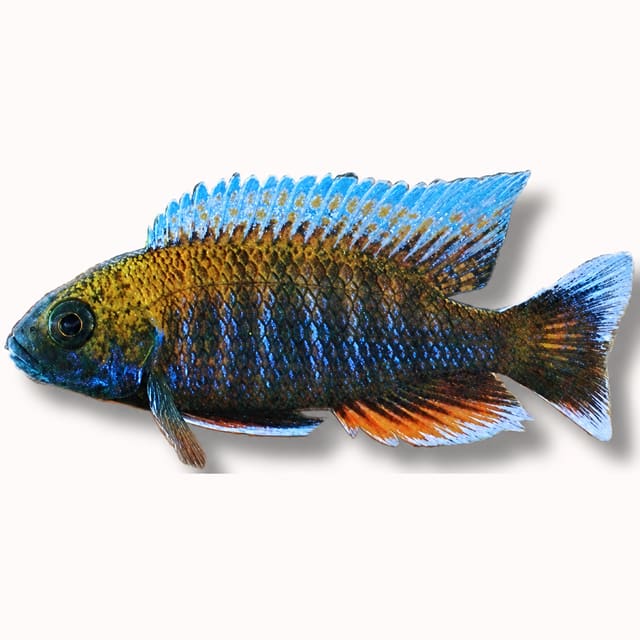
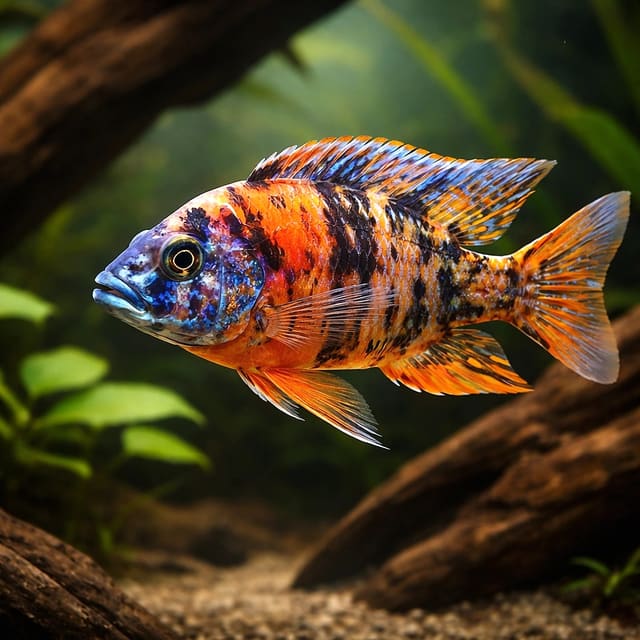
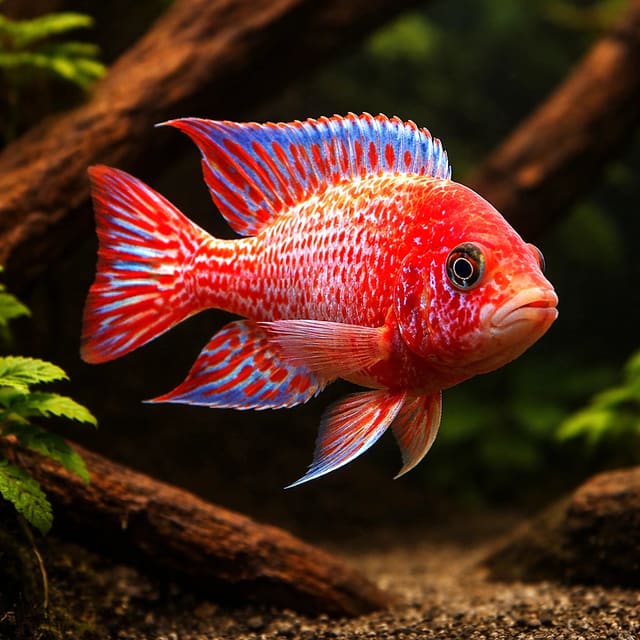
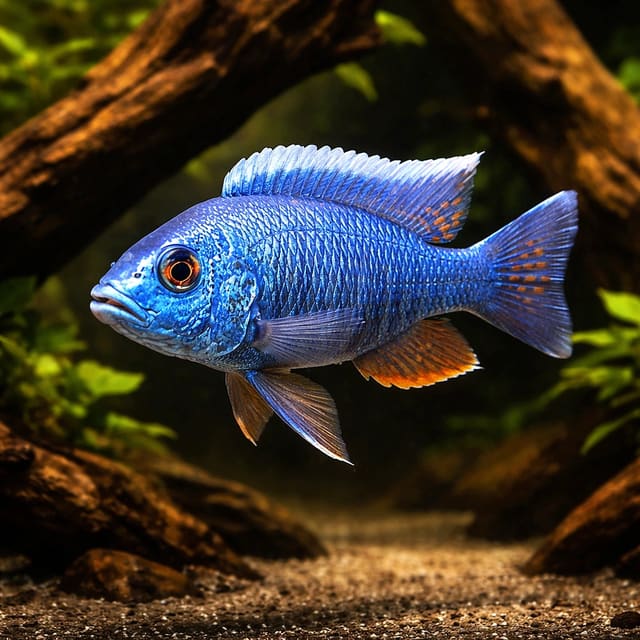
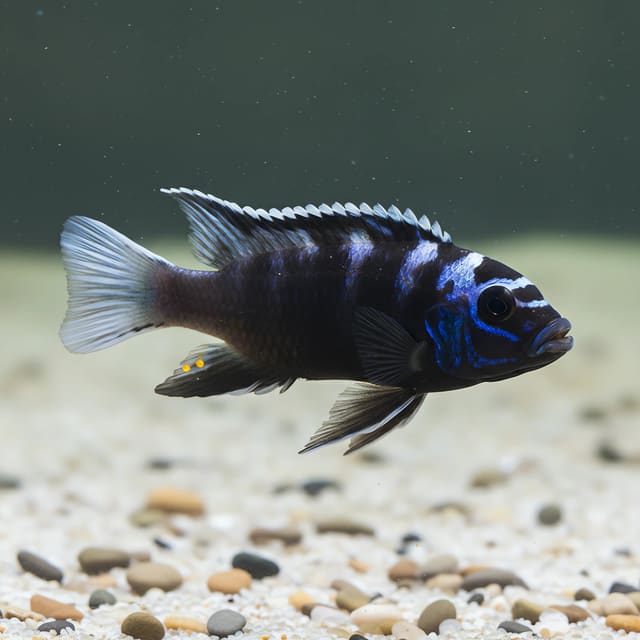
The gallery images are representative of this type of animal rather than photographs of the exact animal supplied, so colours can look slightly different from the live animal. Use the gallery to understand the general elongated cichlid shape and the Snow White colour form, while allowing for normal variation in colour intensity and markings.
Choose the dispatch size only after checking the existing fish and rock layout. A smaller arrival still needs protection from incompatible adults, while a larger arrival still needs the full footprint, hard alkaline water and carefully screened companions. The selector controls the supplied size; it does not change the species’ permanent care requirements.
Use 11.5 cm standard length as the recorded adult-size figure throughout your planning. FishBase gives that maximum for Sciaenochromis fryeri. Seriously Fish uses 20 cm standard length in its aquarium profile and pairs that larger planning figure with a base of 150 × 45 cm and a volume of about 304 litres. Follow the stated footprint and volume rather than trying to calculate a smaller aquarium from body length alone.
A 150 × 45 cm base allows distinct rock structures and open swimming areas to exist together. Build networks of caves through much of the aquarium, then preserve unobstructed lanes where the fish can move without repeatedly entering another fish’s shelter. A sandy substrate completes the recommended layout and accommodates normal digging associated with Malawi cichlids.
Mark out where caves, open water and equipment will sit before settling on a stocking plan. If rockwork consumes nearly the whole footprint, reduce the proposed population rather than sacrificing swimming room. If every cave entrance faces the same open area, adjust the structure so one fish cannot watch all shelters at once.
Use adult requirements for every fish in the proposed community. Compare each companion’s eventual size, water conditions, temperament and colour before counting it in the plan. About 304 litres is the species profile’s aquarium volume, not permission to combine every Malawi fish that shares alkaline water.
Watch whether one fish controls the open water, blocks access to caves or repeatedly corners another. Rearranging décor can make established fish find new territories, but it cannot compensate for an undersized base or an unsuitable species combination. Retain open swimming space whenever rocks are moved.
Keep the aquarium at 24–27°C, pH 8.0–8.6 and 12–18 dGH. These are overlaps between Seriously Fish’s aquarium ranges of 24–28°C, pH 7.6–8.8 and 10–25 dGH and OATA’s group guidance for Malawi cichlids. The overlap gives a practical routine target without moving outside either set of values.
Measure temperature, pH, general hardness, ammonia, nitrite and nitrate. Use our water chemistry guide to understand what each measurement means, then compare your readings with the target through the water matcher. Record results so a gradual shift can be distinguished from a one-off test error.
| Measurement | Routine decision |
|---|---|
| Temperature | Hold 24–27°C and check with a thermometer |
| pH | Keep within 8.0–8.6 |
| General hardness | Keep within 12–18 dGH |
| Ammonia | Maintain at 0 mg/l |
| Nitrite | Maintain at 0 mg/l |
| Nitrate | Keep no more than 20 mg/l above the normal tap-water level |
Stability comes from treating replacement water consistently and making measured adjustments. Test the tap-water baseline because the nitrate instruction is expressed relative to it. When a reading changes, check the test method, filtration, feeding and maintenance record before making several chemical changes at once.
Use a well-established biological filter and maintain strong water movement and aeration. The RSPCA explains that biological filtration supports bacteria that convert toxic ammonia to nitrite and then to safer nitrate. The filter therefore protects the fish through biological processing as well as by collecting visible waste.
For an aquarium of about 304 litres, Seriously Fish gives a turnover of four to five times the aquarium volume per hour and illustrates this with two filters rated at 610–760 litres per hour each. Check flow after media, hoses and intakes are installed, because the planned system must circulate water through the rock-filled aquarium rather than merely meet a label figure.
Mature the aquarium before livestock arrives and confirm ammonia and nitrite are both zero. Our first tropical aquarium guide explains how to prepare and mature the system. Add fish gradually so the beneficial bacterial population can adjust as waste production and feeding increase.
Seriously Fish estimates roughly 125–175 W across two heaters for a 304-litre aquarium when the room is around 20°C. Treat that as a sizing example for those conditions, then use an independent thermometer to confirm that the complete aquarium remains within 24–27°C, the overlap between Seriously Fish and OATA guidance. Position water outlets so warmed water circulates through open areas and around rock structures.
If ammonia or nitrite rises above zero, treat it as an immediate water-quality problem. Stop adding fish, check the filter for blockages and review feeding and maintenance. Increased fish numbers and heavier feeding raise the load on nitrifying bacteria, so changes should be gradual and followed by testing.
Make a quality dried food suited to a predatory cichlid the staple, then vary the diet with suitable live and frozen foods. FishBase records fish as the wild diet, while Seriously Fish describes Sciaenochromis fryeri as predatory and recommends a varied mixture of live, frozen and dried foods. OATA also notes that some larger utaka species may be more predatory and will require pellets with a higher animal content and frozen foods such as brine shrimp, prawns or cockles.
Seriously Fish advises against feeding animal meat of any kind. Choose prepared foods by their ingredients and suitability for predatory cichlids, not simply by an African-cichlid label. Vegetable matter is not required for this species, so its staple should follow the recorded fish-eating biology.
Feed twice a day and offer only what the fish can consume within a few minutes. Watch the whole group rather than judging the portion by the fastest individual. Stop adding food when feeding slows, and remove uneaten material where practical before it breaks down into waste.
| Observation | Feeding decision |
|---|---|
| Food remains after a few minutes | Reduce the next portion |
| One fish takes nearly every item | Distribute the portion across separate areas |
| Interest in food falls suddenly | Test water and check breathing, colour and behaviour |
| Waste or nitrate rises | Review both portion size and filter maintenance |
Variety means rotating appropriate food forms, not increasing meal size. A dried staple makes portioning consistent, while live or frozen foods provide variation. Keep the same twice-daily limit across the rotation and judge every meal by consumption within a few minutes.
Change 25% of the water at least once a week and test the aquarium at least weekly. Treat replacement tap water with conditioner to remove chlorine or chloramine before it enters the aquarium. Match the established temperature and preserve the hard, alkaline conditions rather than allowing each water change to create a large swing.
Use 24–27°C, pH 8.0–8.6 and 12–18 dGH as the routine overlap between Seriously Fish and OATA guidance.
Check filters for blocked intakes, restricted hoses and trapped debris. When media needs cleaning, rinse it lightly in aquarium water removed during the partial water change. Do not rinse it under the tap, because chlorine or chloramine may kill the beneficial bacterial population established in the media.
Siphon solid waste from accessible areas of the sandy substrate while leaving the rock layout stable. Feeding control, waste removal and filtration work together; increasing one task does not cancel persistent overfeeding or unsuitable stocking.
Write down the date, water-test results, water-change volume and any filter work. Also note appetite, breathing and aggression. A sequence of readings is more useful than memory when deciding whether the aquarium is stable or moving gradually away from its normal pattern.
Arrange for someone to receive the parcel because live fish cannot be left unattended. Fish are hand-bagged in pure oxygen, placed in an insulated poly box and packed with a heat pack when the weather calls for it. The current delivery and Live Arrival Guarantee policy explains the packing, tracking, receiving and claim requirements.
Add planned Malawi companions in groups rather than one fish at a time, as OATA advises, so no single newcomer receives unnecessary aggression as it settles in. OATA advises increasing aquarium populations slowly because beneficial bacteria must respond whenever fish numbers and feeding rise. Confirm ammonia and nitrite remain zero before proceeding with another addition.
Check whether the arrival can reach open water and shelter without being driven away repeatedly. A new territorial pattern may develop even when the species combination looked suitable on paper. If aggression concentrates on one individual, review the rock layout and the proposed sex structure rather than assuming the behaviour will resolve by itself.
During the following maintenance checks, compare appetite, colour, breathing and swimming with the fish’s settled pattern. Test the water promptly when any of these change. Arrival observation and water testing should be considered together because transport, a new territory and a changing biological load all meet during this period.
Expect a robust cichlid that uses open water and rock structure. FishBase associates the wild species with rocky Lake Malawi coasts, while the aquarium layout recommended by Seriously Fish combines cave networks with open swimming areas. Normal use of both areas is therefore more informative than expecting the fish to remain constantly inside a cave.
A fish may patrol open areas or hold a position near rockwork. Intervene in the stocking plan when one individual is repeatedly chased, excluded from shelter, prevented from feeding or confined to one part of the aquarium. Seriously Fish recommends several females per male to reduce male harassment and only one male unless the aquarium is very large.
Mature males are described as electric blue, while females are much plainer and juvenile fish are difficult to sex because they share similar colour. Mood can also change the intensity shown by mature males. Do not assign sex from dispatch size, a single colour impression or a representative gallery image.
Look for departures from the fish’s normal pattern: hanging at the surface, sitting on the bottom, erratic swimming, faster or slower gill movement, darker or paler colour, greater hiding, changing aggression, white spots, fluffy growths, damaged fins or scales, altered body condition and reduced feeding.
When a change appears, test ammonia, nitrite, nitrate, pH and temperature first and check whether aggression is restricting the fish. Contact us for further health guidance once you have the readings and a clear description of the change. Do not choose a treatment solely from one visual sign.
Sciaenochromis fryeri is a maternal mouthbrooder. Seriously Fish records it as a maternal mouthbrooder that will often spawn in the community aquarium. A mixed-sex community can therefore show courtship and increased male attention even when breeding was not the keeper’s aim.
Use one male with several females to spread male attention. For a dedicated spawning group, Seriously Fish gives one male with at least three females and uses a 60-inch aquarium, with larger preferred. It places spawning conditions around pH 8.2–8.5 and 25–26.5°C, both within the broader aquarium conditions described for the species.
Do not combine different colour morphs of S. fryeri, because Seriously Fish warns that they will hybridise. It also reports that males have spawned with females from other genera, particularly Aulonocara. This makes mixed-genus stocking a breeding and identity decision as well as a temperament decision.
Watch whether one female is chased repeatedly, loses access to food or remains confined behind rockwork. A larger footprint, several females and separated territories reduce pressure, but persistent harassment still requires a stocking response. Adding one isolated female to an established male is not equivalent to planning a stable group.
Keep routine feeding, water testing and weekly maintenance consistent when behaviour changes. Do not increase food simply because one fish is holding a territory, and do not change temperature or pH outside the routine range in an attempt to force behaviour. The permanent aquarium should remain suitable whether or not spawning occurs.
Avoid mbuna, similarly coloured fish and different colour morphs of Sciaenochromis fryeri. Seriously Fish makes these exclusions directly for this species. It is robust even though it is described as not especially aggressive, so sharing Lake Malawi water conditions is only the first compatibility test.
OATA’s Malawi-cichlid group guidance is to keep Malawi cichlids only with other Malawi cichlids or some species of Synodontis catfish.
Seriously Fish reports that it does well with Nimbochromis venustus, Cyrtocara moorii, Protomelas and Copadichromis. Treat these as named candidates for a suitably sized setup, not universal companions. Screen the exact combination for adult size, colour, sex structure, swimming room and the territory already occupied in the aquarium.
| Candidate | Decision |
|---|---|
| Mbuna | Avoid |
| Similarly coloured fish | Avoid |
| Different colour morphs of S. fryeri | Avoid |
| Nimbochromis venustus | Named as a suitable candidate |
| Cyrtocara moorii | Named as a suitable candidate |
| Protomelas or Copadichromis | Named as suitable candidates |
| Aulonocara | Use caution: Seriously Fish attaches reservations, including male S. fryeri spawning with female Aulonocara |
Do not transfer a compatibility decision from one aquarium to another without checking dimensions and existing fish. A combination in a very large aquarium may fail in a base around 150 × 45 cm, particularly when several males or visually similar fish compete for the same open area.
Use the African cichlid collection to compare identities and permanent requirements, then contact us with the aquarium dimensions, water readings and complete proposed stocking list for a compatibility assessment.
Keep several females per male and only one male unless the aquarium is very large. This species-specific structure reduces the chance that one female receives all male attention and avoids placing rival males into a footprint that cannot separate them.
Seriously Fish says Aulonocara can be kept with this species but attaches reservations. Avoid similarly coloured individuals, and account for reports of male S. fryeri spawning with female Aulonocara. Do not describe all peacock cichlids as automatic companions simply because they share Malawi water.
OATA advises adding Malawi cichlids in groups, putting more peaceful species in first and more aggressive species later. Increase the total population gradually so the biological filter can respond to the extra waste and feeding. Test ammonia and nitrite after additions and keep both at zero.
Rearranging aquarium décor can reduce established territorial control because fish must find new territories. Preserve the required cave network and open swimming space while doing this. Rock movement is a tool for resetting boundaries, not a substitute for adequate volume or a suitable companion.
Compatibility remains conditional because individual behaviour and aquarium layouts vary. The safe rule is to combine matching water requirements with adequate adult space, different visual roles and a workable sex structure, then continue observing the actual group.
FishBase records a maximum of 11.5 cm standard length, so plan its permanent aquarium and companions around an adult fish of that size.
Plan on an aquarium of about 304 litres with a base around 150 × 45 cm; build rock caves while retaining open swimming areas.
Keep one male with several females to reduce harassment, and keep only one male unless the aquarium is very large.
It needs about 304 litres, hard alkaline water, substantial filtration and selective Malawi companions, so it best suits a keeper prepared to test water and manage cichlid behaviour.
Feed a quality dried food for predatory cichlids with varied live and frozen foods; OATA’s Malawi guidance says to feed only what is eaten within a few minutes, twice daily.
Keep it at 24–27°C, pH 8.0–8.6 and 12–18 dGH; this is the overlap between Seriously Fish’s species range and OATA’s Malawi-cichlid guidance.
Seriously Fish describes it as not especially aggressive but robust; plan for territorial pressure and male harassment by providing space, several females per male and carefully screened companions.
Seriously Fish names Nimbochromis venustus, Cyrtocara moorii, Protomelas and Copadichromis as suitable candidates; avoid mbuna, similarly coloured fish and different colour morphs of Sciaenochromis fryeri, and treat Aulonocara with caution.
Film every delivery from the sealed parcel onward: show the sealed parcel with the outer box visible, open it in one continuous take and show the fish still in the bag before floating or releasing it; retain the video for any Live Arrival Guarantee claim. The fish is hand-bagged in pure oxygen and placed in an insulated poly box with a heat pack when weather calls for it, someone must receive the parcel, and you should float the bag for 20–30 minutes before releasing the fish without pouring bag water into the aquarium.
No reviews for this item yet. Bought one? Honest reviews only, good or bad.
What customers say about ordering from us
I have a small group of long finned mountain minnows. So was delighted to be able to order ten of this variety to increase the genetics in my tank . The ones I recieved are healthy but it’s to early to give a verdict on wether they are of a long finned type since they are small currently.
Gordon Walker · 23 Sept 2026
100% success travel and "installation". Pleased with quality of purchase. The Siamese fighter a bit "shy" so have not yet seen him at his best yet but looking good. Happy customer. GG
George E Garratt · 21 Sept 2026
Reviews of our shop, collected by Judge.me, an independent third-party review collector. Newest first.