Moderate
Acei Cichlid (Pseudotropheus sp. “acei”)
24–26°C · pH 7.5–8.5 · 300L
£7.99
The Fire Ahli Cichlid (Sciaenochromis sp.) is an African cichlid kept to Lake Malawi cichlid care, suited to a dedicated hard-water Malawi community rather than a mixed tropical tank. OATA’s Malawi guidance gives 23–27°C, pH 8.0–8.6 and hard water, and says these cichlids can be kept in groups of at least 15, slightly overcrowded to spread aggression. Sold as one fish per purchase in sizes from 3-4 cm to 7-9 cm.
Sciaenochromis sp.
Save when buying multiple fish. Each quantity is one fish; sex and pair formation are not guaranteed unless the selected variant explicitly states them.
The Fire Ahli Cichlid (Sciaenochromis sp.) is an African cichlid kept to Lake Malawi cichlid care, suited to a dedicated hard-water Malawi community rather than a mixed tropical tank. OATA’s Malawi guidance gives 23–27°C, pH 8.0–8.6 and hard water, and says these cichlids can be kept in groups of at least 15, slightly overcrowded to spread aggression. Sold as one fish per purchase in sizes from 3-4 cm to 7-9 cm.

Cichlids are a family of roughly 1,800 accepted species, not one care type. Before buying, identify the exact species and source, then compare adult measurement, usable tank dimensions, social system, territory, tested water, diet and an exit plan. No family-wide minimum tank, water range or tank-mate list is safe.
Maintain these water conditions for optimal health and vibrant colors
The Fire Ahli Cichlid (Sciaenochromis sp.) is an African cichlid of the family Cichlidae, sold under the trade name fire ahli and kept to the care of the Lake Malawi cichlids. WoRMS lists Sciaenochromis as an accepted cichlid genus, and everything about keeping this fish well follows the Malawi pattern: hard, alkaline water, a large and heavily filtered aquarium, and companions drawn only from that lake.
It suits a keeper who wants to build, or already runs, a dedicated Malawi community. It is not a fish to add to a general tropical tank. OATA’s care sheet for African Malawi cichlids describes the group as colourful, diverse and aggressive fish that should be mixed with caution, and adds that apart from this they are usually undemanding aquarium inhabitants that are easy to keep. Both halves of that description shape the plan. Once the tank is running, the water and the feeding are straightforward; the real skill lies in how you stock it.
Use this table to decide whether the fish fits your plans before you look at sizes or buy equipment.
| Suits | Not suited to |
|---|---|
| A dedicated Lake Malawi cichlid aquarium | A mixed community of fish from other regions |
| Hard, alkaline water, pH 8.0–8.6 in OATA’s group guidance | Soft or acidic water |
| A slightly crowded group of at least 15 Malawi cichlids | A small group, where Malawi cichlids will often fight |
| An aquarium of at least 200 litres with an oversized filter | A small or lightly filtered tank |
| Rockwork on a coral sand base | A delicate planted layout |
If the left-hand column describes your aquarium, the sections below cover what arrives, how to prepare the water and how to stock a group so that aggression is shared across many fish instead of falling on one.
Each purchase supplies one live Fire Ahli Cichlid of the size you choose: 3-4 cm, 4-5 cm, 5,5-7 cm (that is, 5.5 to 7 cm) or 7-9 cm. The size you select is the size supplied, not the adult size. Young fish keep growing after they arrive, so the aquarium, filter and group plan in this guide are built for adult Malawi cichlids from the first day, whichever size you pick.
The exact species has not been identified, so the care advice here follows the genus Sciaenochromis and its care group. In practice that means holding the fish to the Malawi cichlid values and stocking rules that OATA sets out for the whole group, without shortcuts. Where the care sheet allows that some specialist species manage in smaller aquariums, this guide does not lean on that exception for a fish whose species is unknown.
On a label, “sp.” after a genus name means the species has not been pinned down. Sciaenochromis sp. tells you the genus, while fire ahli is the name the fish is traded under, which is why the scientific name on this page stops at the genus.
Sex is guaranteed only when the selected option explicitly states male or female. This Sciaenochromis Fire ahli listing has no sex-guaranteed option. OATA notes that many Malawi cichlids only show differences between the sexes once they become adults, and that the main differences are colour or egg spots on the male’s anal fin. Plan any group on the basis that the sex of each young fish is unknown when it arrives.
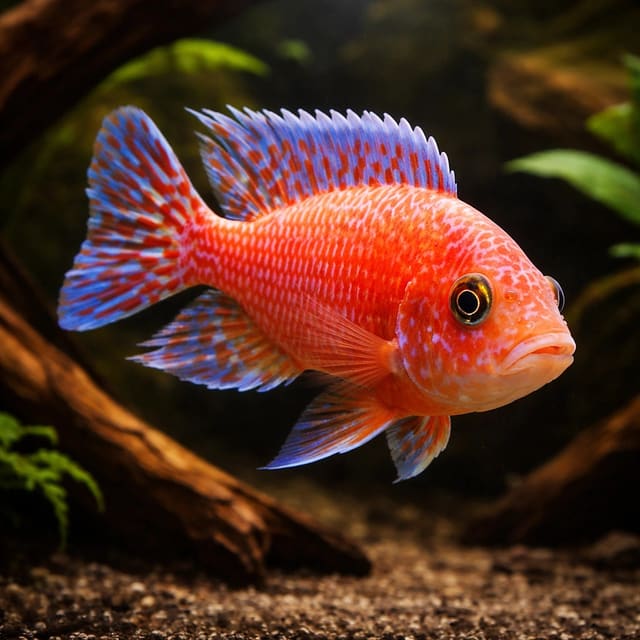
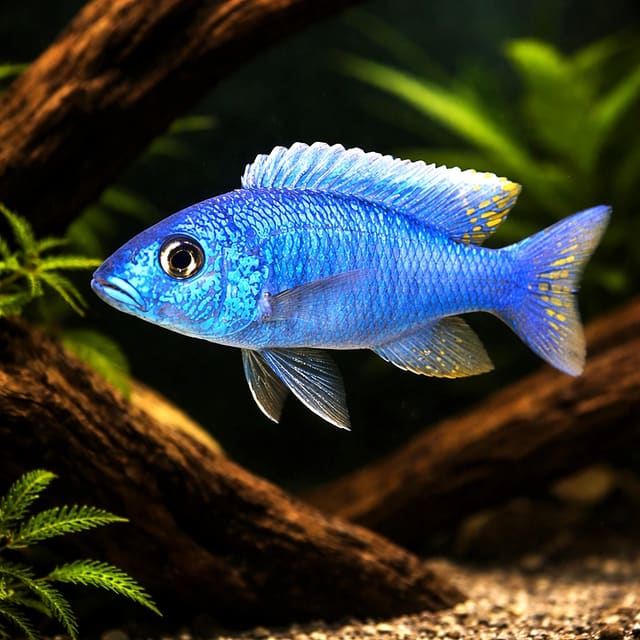
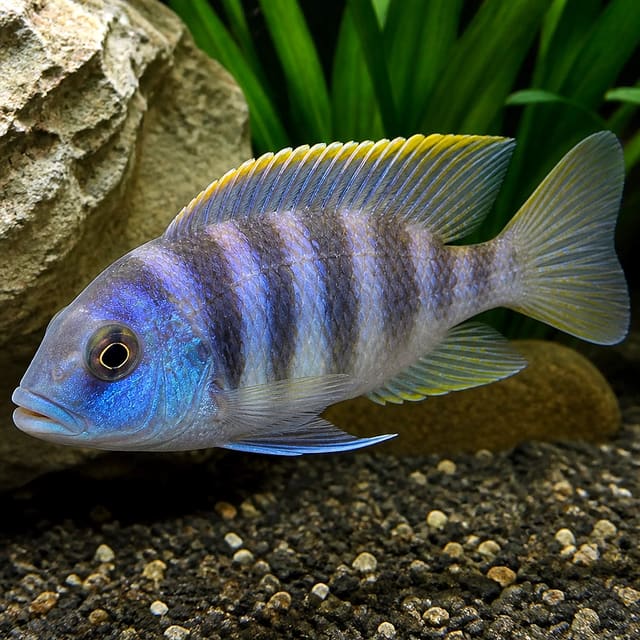
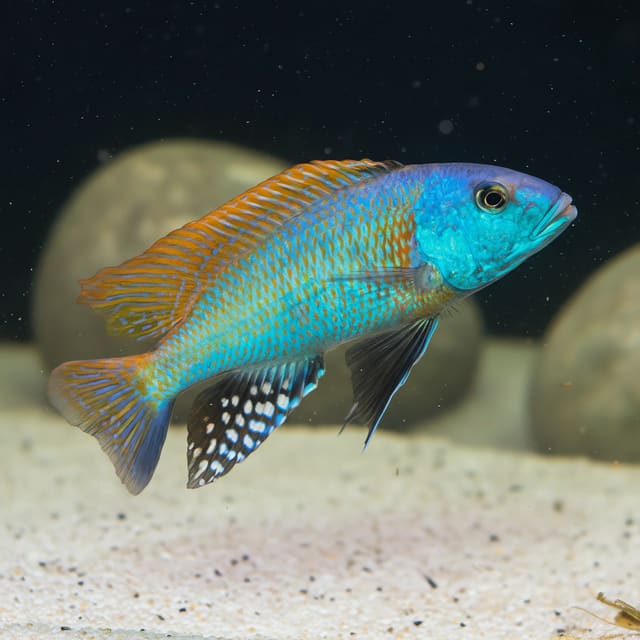
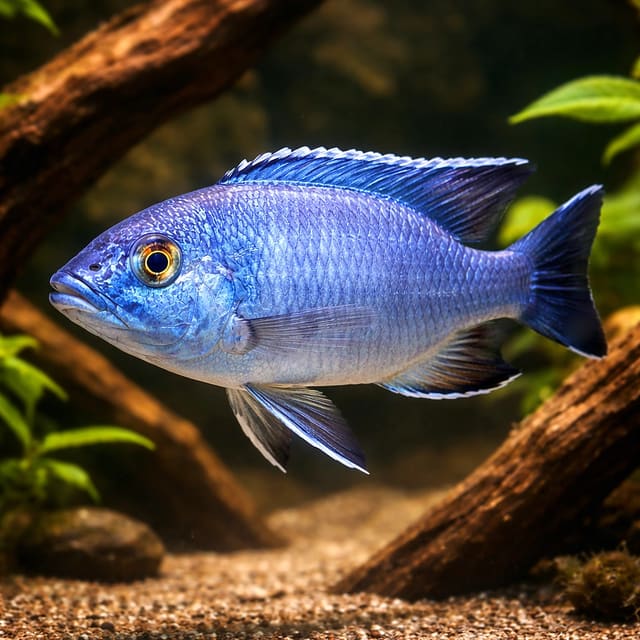
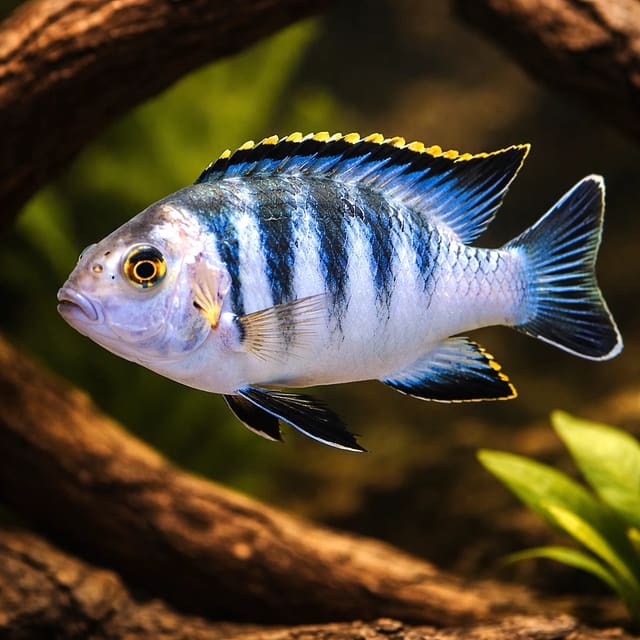
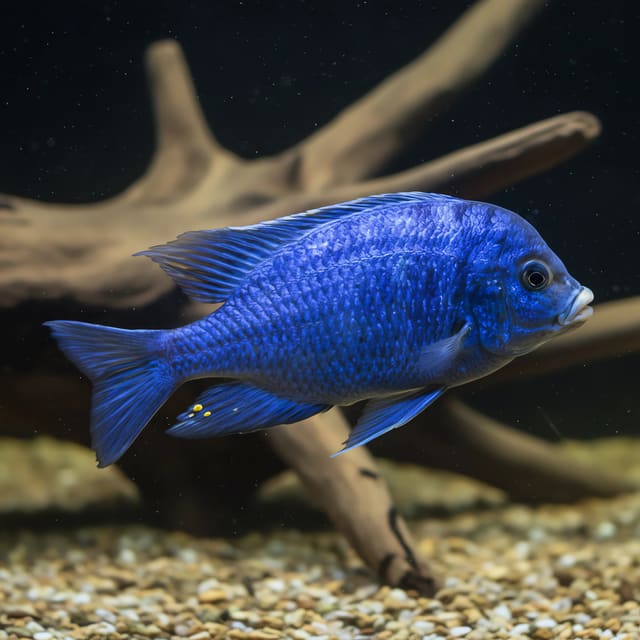
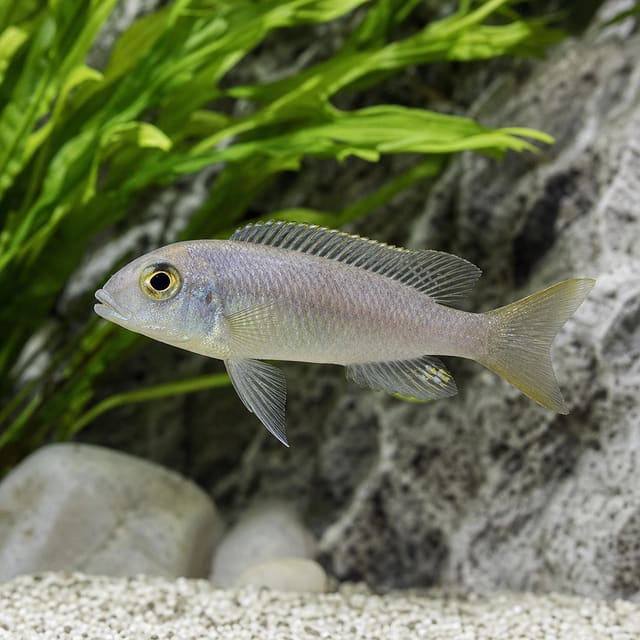
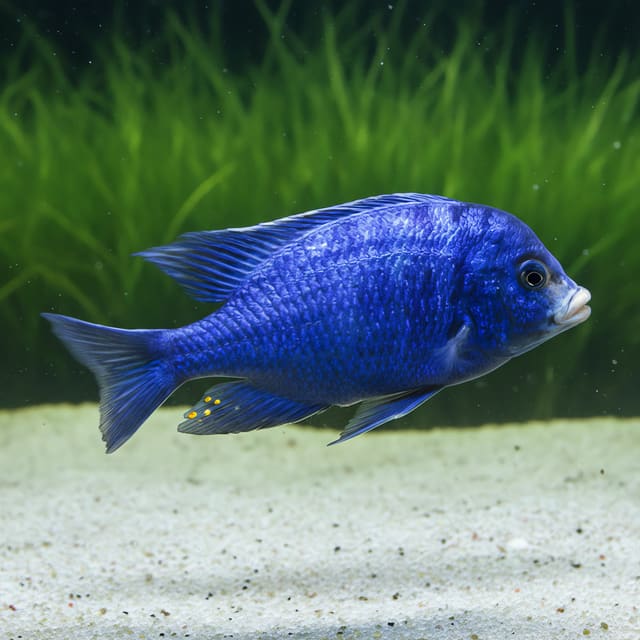
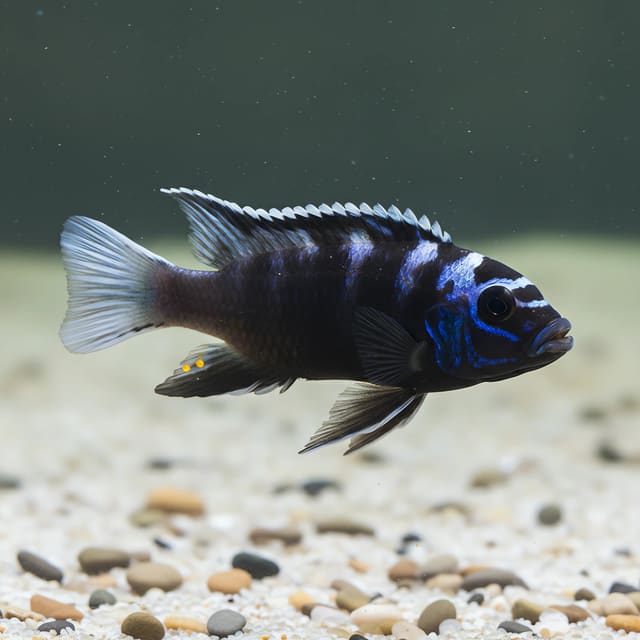
The product photograph shows a single blue fish with gold-flecked flanks swimming over a rock. Gallery images have been digitally enhanced to improve image quality. Natural colour, pattern, size and maturity can vary between live animals. Because colour is one of the main ways Malawi cichlids differ between the sexes, and those differences appear with adulthood, a juvenile can look quite unlike a mature, fully coloured fish.
Start with the largest aquarium you can reasonably house. OATA’s Malawi cichlid guidance is to buy an aquarium as large as possible within reason, and it recommends at least 200 litres for a reasonable sized community of fish. Plan a Malawi community that includes Fire Ahli around at least 200 litres, and treat anything larger as the better choice.
A larger body of water keeps temperature and water quality more stable, which is the main reason OATA gives for going large. Malawi cichlids add a second reason: the group is stocked slightly crowded on purpose to spread aggression, and every extra fish adds waste. More water dilutes that waste between maintenance days and gives the fish more floor on which to re-form territories when the décor is moved.
A filter is always essential, and OATA recommends an oversized one for Malawi communities because of the crowded conditions they need. It pairs that with aggressive aeration so that there is enough dissolved oxygen for the whole group. In practice, choose a filter rated for a bigger tank than yours and add dedicated aeration, for example an air pump, running around the clock.
Use coral sand or a similar substrate, which OATA recommends because it helps buffer the water towards the hard, alkaline conditions this fish needs. Expect it to be moved about: Malawi cichlids will often dig and rearrange the substrate, which will uproot any plants present, so only the hardiest plants are worth trying. Because of that digging, stand the lowest stones of any rockwork directly on the tank base before the sand goes in, so that excavation cannot undermine a stack, and keep décor robust rather than delicate.
Keep the aquarium at 23–27°C and pH 8.0–8.6, with hard water of 12–18°dH general hardness and 10–15°dKH carbonate hardness. These are the group values from OATA’s water requirements for Malawi cichlids, a general guide rather than a species-specific optimum, and with the exact Sciaenochromis species unknown they are the values to hold this fish to.
| Measure | Target |
|---|---|
| Temperature | 23–27°C |
| pH | 8.0–8.6 |
| General hardness | Hard, 12–18°dH |
| Carbonate hardness | Hard, 10–15°dKH |
| Ammonia | Zero mg per litre |
| Nitrite | Zero mg per litre |
| Nitrate | No more than 20 mg per litre above your tap water |
The ammonia and nitrite rows are not ranges. Any reading above zero tells you the filter is not keeping up with the waste in the tank, and Malawi cichlids can be stressed by even the smallest amounts of ammonia. Treat a positive reading as a reason to act that day, not a figure to watch.
Nitrate is judged against your own tap. If your tap water reads 10 mg per litre nitrate, the aquarium should stay at or below 30 mg per litre; if the tap reads 25 mg per litre, the ceiling is 45. Test the tap once, write the figure down and you have the number to work from for every later test.
Hard, alkaline water needs planning before any fish are bought. OATA pairs these values with a coral sand substrate because it helps buffer the water, and the weekly water change keeps conditions from drifting. Test your tap water before you buy any fish, compare the readings with the table using our water parameter matcher, and if your tap falls well short of the targets, settle how you will raise and hold them before the fish arrive. Our guide to aquarium water parameters explains what each test measures and why it matters.
| Reading | First response |
|---|---|
| Ammonia or nitrite above zero | Stop adding fish, feed less, check the filter for blockages and make a partial water change with conditioned water, then test again the next day. |
| Nitrate above your tap reading plus 20 mg per litre | Add an extra partial water change that week and trim feeding portions until the figure is back under the ceiling. |
| pH or hardness below the targets | Check that the substrate is coral sand or similar, and correct the replacement water before the next change. |
| Temperature outside 23–27°C | Check the heater and thermometer, and bring the tank back into range. |
No fish should be kept in a tank without a well set up and maintained filter, as the RSPCA’s aquarium welfare guidance puts it. Fish release ammonia, which is toxic. A working biological filter grows beneficial bacteria that break that ammonia down into nitrite, which is also toxic, and then into nitrate, which is safer. That bacterial population is what the zero readings in the water table depend on.
Before any Fire Ahli goes in, confirm that ammonia and nitrite both read zero. OATA then asks keepers to increase fish numbers slowly, because the bacteria established while the filter matured need to increase every time more fish are added and feeding increases. Overstocking, or stocking too quickly, can lead to ‘new tank syndrome’: too few nitrifying bacteria to cope with the extra waste, unhealthy levels of ammonia and nitrite, and fish that may become ill or die.
Malawi keeping asks for two things that pull against each other: a densely stocked community, and a filter that is never overwhelmed. The way through is to reach the final group in planned stages, adding each stage as a group and letting the filter catch up before the next.
A staged plan also makes problems easier to trace. If a reading rises after a new group goes in, you know the cause and can hold back further additions until the filter has caught up.
Base the diet on a specialised Malawi cichlid food. OATA points out that Malawi cichlids differ in what they need: the smaller mbuna species are more herbivorous and appreciate specialised Malawi cichlid feeds with a high algae content alongside fresh vegetables, while some of the larger utaka species may be more predatory and need pellets with a higher animal content, plus frozen foods such as brine shrimp, prawns or cockles.
With this fish identified only to the genus Sciaenochromis, which of those two feeding styles it follows is the one decision to settle before you stock up on food. Ask us when you order and we will tell you which way to lean; until then, a specialised Malawi cichlid food is the sensible base, because it is made for the group this fish is kept with.
Feed only what the fish can eat within a few minutes, twice a day. OATA warns against overfeeding because uneaten food breaks down and releases toxic waste into the water, adding to the load on a filter that is already working hard for a crowded group.
A well-judged diet shows up in steady growth and good condition across the whole group, and in clean test results between water changes.
At least once every week, carry out a partial water change of 25%, using a siphon to lift solid waste from the substrate. OATA strongly recommends this routine for Malawi cichlids, together with testing the water regularly, at least once per week, so that ammonia and nitrite do not build up.
For a 200-litre aquarium, 25% is 50 litres each week; for a 300-litre aquarium it is 75 litres. Bring the replacement water close to the tank’s temperature and hardness before adding it, so the change refreshes the aquarium without unsettling the fish.
Keep a simple log of each week’s readings and the volume changed. Over a month it shows whether the routine is holding the tank steady, and it gives you real figures to share if you ever need help with a problem.
Your Fire Ahli is hand-bagged in pure oxygen by our team and packed in an insulated poly box, with a heat pack when the weather calls for it. We email the tracking number and your confirmed delivery date so you know exactly when to be in, and a licensed live-animal courier carries the parcel. The full terms are on our delivery and Live Arrival Guarantee page.
Film every delivery this way. The Live Arrival Guarantee requires someone to be at the address to receive the parcel, the parcel to be opened and inspected the same day it arrives, and a continuous unboxing video showing the parcel still sealed. Our courier may ask for that continuous evidence when a claim is raised, and it makes claims quicker, clearer and fair for genuine customers.
OATA’s introduction advice sits alongside those steps. Check that ammonia and nitrite are zero in the aquarium before adding fish, and make sure the tank is an appropriate size for the number of Malawi cichlids you plan to keep. OATA describes a healthy fish as having clear, bright eyes, undamaged fins, intact scales, no ulcerations or bumps and appropriate swimming behaviour, which gives you a baseline to compare against in the days after arrival.
All fish vary slightly in behaviour and appearance, so spend the first weeks learning what normal looks like for your group. OATA lists the changes worth watching, because spotting them early helps you deal with a problem before it becomes a real health issue.
If you see any of these, test the water first. That is OATA’s advice when you are concerned about the health of your fish, and in a crowded Malawi tank the readings quickly show whether the filter and routine are coping. Then contact us with your results and a description of what you have seen, and we will help you work through it.
In a Malawi community, a fish that suddenly hides more than usual deserves a closer look at how the group is behaving around it. Rearranging the décor, as described under compatibility, is OATA’s suggested way to reduce aggression as fish find new territories.
The first weeks show whether a new group has settled and whether the filter is coping with the extra fish. Use these checkpoints alongside the routines above.
After the arrival steps, offer only a small first feed and siphon out anything still uneaten after a few minutes, because uneaten food breaks down into toxic waste. Note how each fish looks and swims, so that you have a baseline to compare with later.
Watch the group at each feed against the list of changes in the section above. Test ammonia and nitrite at least once this week, and more often if you can, because the filter’s bacteria are still catching up with the waste of the new fish. Any reading above zero means holding back on food and following the first response in the water table.
Settle into the weekly routine and keep the log going. When ammonia and nitrite have read zero at every test and every fish is feeding, the tank is ready for you to plan the next stage of stocking, if there is one.
OATA’s rule for Malawi cichlids is clear: they should only be kept with other Malawi cichlids, or with some species of Synodontis catfish, which also naturally inhabit Lake Malawi. Treat the Fire Ahli the same way. Fish from other regions are not suitable companions, however robust they look, and species that need soft or acidic water cannot share the hard, alkaline conditions this community needs.
All Malawi cichlids are aggressive and should be mixed with caution, so a workable community depends on numbers, order of introduction and space as much as on species. When you browse our African cichlid collection for companions, keep to Lake Malawi fish and plan the whole community before buying the first group: which species, how many of each and in what order they go in. Tell us what you already keep and the size of the tank, and ask us for a stocking check before you order; with a fish identified only to its genus, that is the most useful single step you can take.
If you add Synodontis catfish, choose species that naturally inhabit Lake Malawi, as OATA specifies, and count them into the stocking plan and the filter’s load exactly as you would another cichlid. They share the same water and the same crowded tank, so they belong in the same staged plan.
Malawi cichlids are not social fish and can be highly aggressive, yet OATA explains that they can be kept in groups of at least 15 and slightly overcrowded to limit aggression. Malawi cichlids kept in small groups will often fight. That slight overstocking spreads aggression evenly through the population, so that no single fish becomes the constant target.
Where possible, OATA also advises keeping more females than males of each species, to stop males harassing one individual female. That is hard to arrange when buying juveniles, because many Malawi cichlids only show differences between the sexes as adults and this listing does not sell fish by sex. Plan the group size and the tank with that in mind rather than counting on a particular mix of males and females.
Say you are adding six Fire Ahli to an established Malawi tank. Order all six together, check that ammonia and nitrite read zero, and move some of the rockwork just before they go in, so that the resident fish have to re-form territories alongside the newcomers. Watch closely over the following days for any one fish being singled out, and keep feeding portions small while the group settles.
Plan for at least 200 litres, and larger if you can house it. OATA recommends an aquarium of at least 200 litres for a reasonable sized community of Malawi cichlids, run with an oversized filter and strong aeration, because these fish are kept in slightly crowded groups and a larger volume keeps temperature and water quality more stable. A small fish at dispatch still needs the full-sized aquarium as it grows.
Plan it as part of a Malawi cichlid community rather than a small group. OATA says Malawi cichlids can be kept in groups of at least 15 and slightly overcrowded to limit aggression, and that those kept in small groups will often fight. Add the fish together as a group so that no single newcomer takes the brunt of the aggression.
It suits a keeper who is ready to run a dedicated Malawi cichlid aquarium rather than a first mixed community, and we rate it intermediate. OATA describes Malawi cichlids as usually undemanding and easy to keep apart from their aggression, so the skill lies in the set-up and stocking: hard, alkaline water, a large tank with an oversized filter, and a group of compatible Malawi fish added in stages.
Use a specialised Malawi cichlid food as the base, offering only what the fish can eat within a few minutes, twice a day. OATA explains that the smaller mbuna species are more herbivorous and appreciate high-algae Malawi foods and fresh vegetables, while some larger utaka species may be more predatory and need pellets with more animal content plus frozen foods such as brine shrimp, prawns or cockles. As its exact species is unidentified, confirm which pattern to follow when you order.
Keep it at 23–27°C and pH 8.0–8.6, in hard water of 12–18°dH general hardness and 10–15°dKH carbonate hardness. These are OATA’s general values for Malawi cichlids as a group, not a species-specific optimum; the same care sheet asks for zero ammonia and nitrite, and nitrate no more than 20 mg per litre above your tap water.
Yes. OATA describes all Malawi cichlids as aggressive fish that should be mixed with caution. The aggression is managed rather than avoided: keep this fish in a slightly overcrowded Malawi group, add newcomers as a group, introduce the more peaceful species before the more aggressive ones and rearrange the décor when new fish go in.
Only other Lake Malawi cichlids, or some species of Synodontis catfish, which also naturally inhabit Lake Malawi. OATA advises keeping Malawi cichlids only in that company, so leave out community fish from other regions and any species that needs soft or acidic water, and plan the whole group and its stocking order before buying.
Start filming before the parcel is opened: a continuous unboxing video showing the sealed parcel, the opening and the fish still in the sealed bag is needed for any Live Arrival Guarantee claim, and someone must be at the address to receive the parcel and open it the same day. The fish is hand-bagged in pure oxygen, packed in an insulated poly box with a heat pack when the weather calls for it, and carried by a licensed live-animal courier with tracking. Float the bag for 20–30 minutes before releasing the fish, and never pour the bag water into your tank.
No reviews for this item yet. Bought one? Honest reviews only, good or bad.
What customers say about ordering from us
Easy website plenty of info on fish your buying great to pick a time slot
TRACEY DURRANT · 7 Oct 2026
Got some lovely fish thank you
Kevin Mackie · 7 Oct 2026
Reviews of our shop, collected by Judge.me, an independent third-party review collector. Newest first.