Lampeye (Aplocheilichthys normani)
22–26°C · pH 6.5–7.2
£3.99

Specialist annual killifish from southern Brazil and Uruguay. Supplied at 3-5 cm; best kept species-first in a cool, covered planted aquarium with live or frozen foods.
Adult size is the maximum length this species reaches at full maturity (scientific sources). The livestock you receive will be younger and smaller. Product-photo provenance and any image-specific limitations are stated on the listing.
Cynopoecilus melanotaenia
Shoaling fish: kept in a group they feel safer, stay calmer and show their best colour.
Confirm your email, then we’ll send an availability message for this exact item if it returns within 180 days.
This request is only for this product—no newsletter or other promotions. A mail-provider retry may very rarely duplicate the same availability message. Unconfirmed addresses are removed after 48 hours. See our privacy policy.
Specialist annual killifish from southern Brazil and Uruguay. Supplied at 3-5 cm; best kept species-first in a cool, covered planted aquarium with live or frozen foods.
Adult size is the maximum length this species reaches at full maturity (scientific sources). The livestock you receive will be younger and smaller. Product-photo provenance and any image-specific limitations are stated on the listing.
Maintain these water conditions for optimal health and vibrant colors
Fighting Gaucho (Cynopoecilus melanotaenia) is a small, specialist annual killifish from southern Brazil and Uruguay. It is supplied here at approximately 3-5 cm, so the fish you receive may already be close to adult size; FishBase records adult males to about 4.3 cm standard length, with females smaller. This is not a throwaway community-fish listing. It is a cool, seasonal-pool killifish for keepers who enjoy careful species-first husbandry, live or frozen foods, and quiet planted aquariums with a secure lid.
This listing now uses the current, source-backed name Cynopoecilus melanotaenia consistently.
Choose Fighting Gaucho if you want to work with a characterful annual killifish rather than simply add movement to a mixed tank. It suits keepers who enjoy observing territorial display, conditioning fish with small live foods and managing a quiet setup. It is a poor match for tanks that run hot, bright and busy, and it should not be sold as a beginner community fish. A patient keeper with a mature aquarium will get far more from it than someone looking for a low-effort impulse buy.
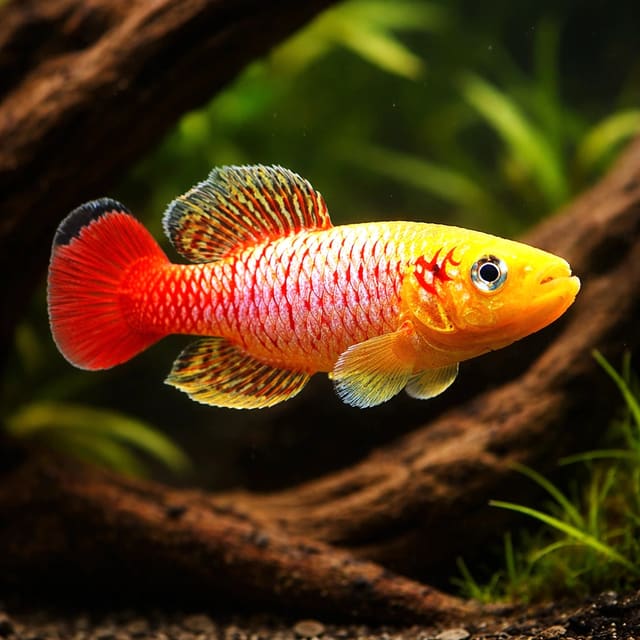
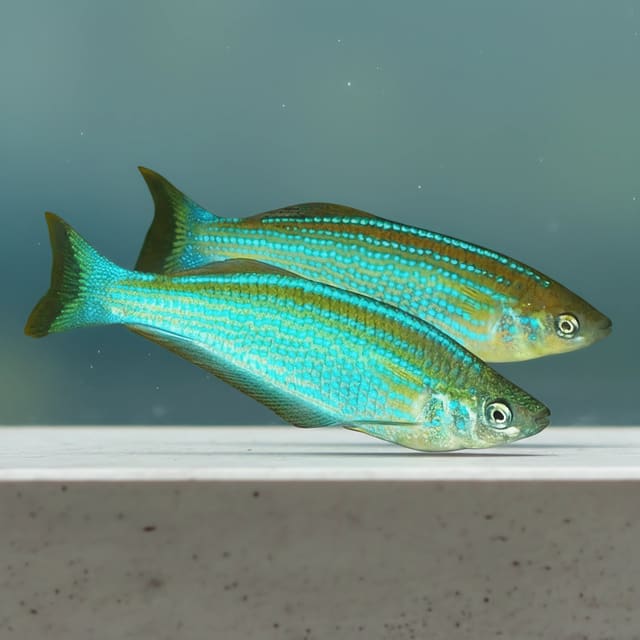
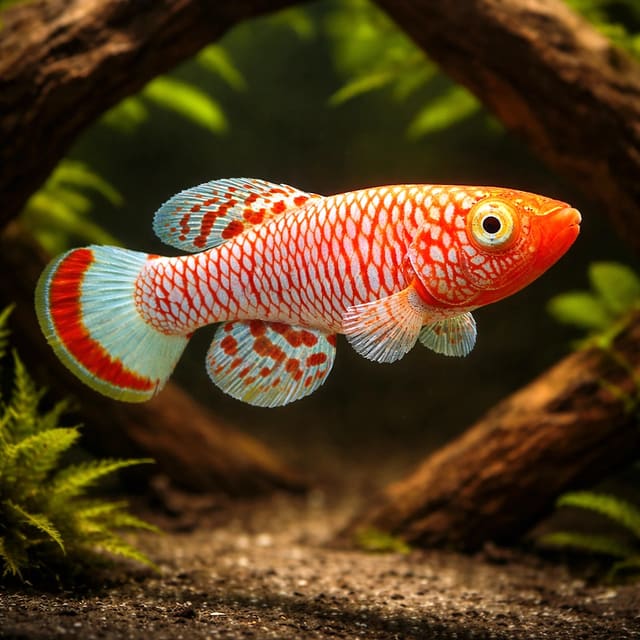
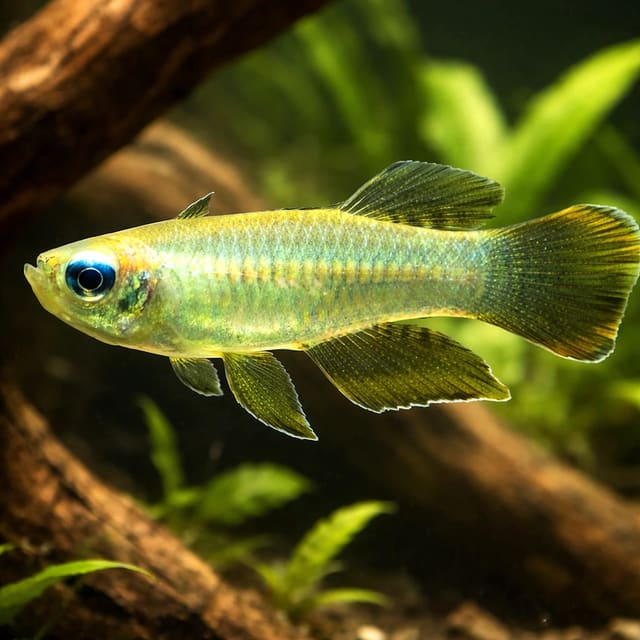
Fighting Gaucho males are valued for the contrast between a slim body, darker lateral markings and flashes of green, gold and blue under calm lighting. Females are smaller and plainer, as is normal for many annual killifish. The original reference photo is a small, bright reference image, so it should be read as a stock-reference photo rather than a polished display portrait. In a settled planted aquarium with darker substrate, subdued lighting and floating cover, the fish normally shows much more character than a white-background supplier thumbnail can capture.
Cynopoecilus melanotaenia belongs to a group of seasonal South American killifish associated with temporary pools and shallow freshwater habitats in southern Brazil and Uruguay. These habitats are not fast-flowing rivers. They are quiet, plant-rich and often temporary, with mud, leaf litter and fine organic material on the bottom. That background matters for care: the aquarium should be stable, covered, gently filtered and arranged around shelter rather than open swimming space.
Use a mature, species-first aquarium with fine sand or smooth substrate, leaf litter if you use botanicals confidently, mosses, fine-leaved plants, floating plants and several visual breaks. A sponge filter or very gentle internal filter is better than strong flow. Keep the lid tight because annual killifish are capable jumpers. For a pair or small trio, around 40 litres gives more stability and more line-of-sight breaks than a tiny desktop tank. If two males are kept together, expect display behaviour and be ready to separate them if one fish is pressured.
If you are keeping a pair, give the female several places to move out of direct sight. Moss clumps, floating-root curtains, low caves made from botanicals and dense stems all help. For a trio, use one male with two females rather than multiple males in a cramped tank. The fish is small, but its behaviour is intense enough that aquascape structure matters more than raw litres alone.
For day-to-day care, keep the water cool and clean: 20-24°C is the safer target, with the supplier's upper range of 25°C treated as a short-term ceiling rather than a warm-tank goal. A pH of 6.0-7.5 is suitable. Aim for soft to moderately hard water, roughly 5-12 dGH where possible, and avoid sudden changes. As with all small specialist fish, ammonia and nitrite must be zero. Small, regular water changes are better than large swings, especially if the fish are being conditioned for breeding.
This species is carnivorous and should be fed like a specialist killifish, not like a general flake-only community fish. Offer small live and frozen foods such as daphnia, brine shrimp, bloodworm, mosquito larvae and finely sized insect-based foods. Some individuals may learn to take quality micro pellets, but live and frozen foods are the reliable route for condition, colour and breeding readiness. Feed lightly, watch the body shape and remove uneaten food quickly.
The safest setup is species-only. Fighting Gaucho can be territorial, especially males, and busy community fish will outcompete or stress them. Avoid fin nippers, boisterous tetras, large fish, predatory fish and other territorial killifish. Robust snails may be tolerated, but very small shrimp can be treated as food. If your goal is to see the fish behave naturally, give them a quiet aquarium built around cover, sight breaks and calm feeding.
FishBase records this species as a bottom spawner with an incubation period around two months. In practice, that means experienced keepers often provide peat, coir, fine spawning mops or plant cover and then manage eggs separately. Condition adults with live and frozen foods, keep the water stable and watch male pressure carefully. Fry are small and need appropriately tiny first foods, followed by newly hatched brine shrimp as soon as they can take it.
Because this is an annual species, eggs and fry are often the most rewarding part of keeping it. Do not rush the process. Keep notes on collection date, moisture level and incubation timing, then hatch only when you can feed tiny fry several times a day. That sort of careful routine is exactly why this fish appeals to serious killifish keepers.
Fighting Gaucho is shipped by live-animal courier when conditions are suitable. Every order is packed around livestock welfare, weather and route timing, and covered by our Live Arrival Guarantee. Because this is a specialist annual killifish, please have the covered, mature aquarium ready before dispatch day rather than trying to improvise after the fish arrives.
No reviews for this item yet. Bought one? Honest reviews only, good or bad.
What customers say about ordering from us
I have a small group of long finned mountain minnows. So was delighted to be able to order ten of this variety to increase the genetics in my tank . The ones I recieved are healthy but it’s to early to give a verdict on wether they are of a long finned type since they are small currently.
Gordon Walker · 23 Sept 2026
100% success travel and "installation". Pleased with quality of purchase. The Siamese fighter a bit "shy" so have not yet seen him at his best yet but looking good. Happy customer. GG
George E Garratt · 21 Sept 2026
Reviews of our shop, collected by Judge.me, an independent third-party review collector. Newest first.