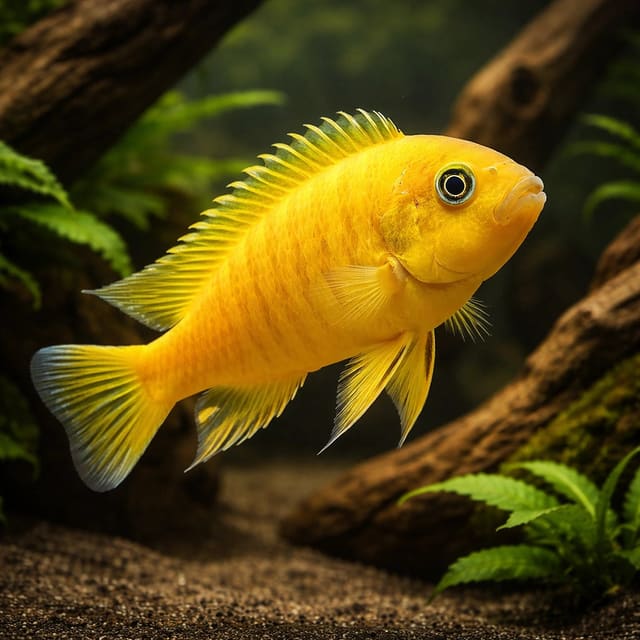
−10%
Moderate
Daktari Mbuna (Maylandia sp. 'daktari')
23–27°C · pH 8–8.6
£16.19£17.99

Blue Burundi Cichlid (Xenotilapia bathyphilus) is an advanced-care Lake Tanganyika cichlid recorded to 10.3 cm TL, supplied as one unsexed fish in a 3–6 cm or XL size grade. It suits an established hard-water aquarium with open sand, a social group and calm companions.
Adult size is the maximum length this species reaches at full maturity (scientific sources). The livestock you receive will be younger and smaller — pick a size above for the actual shipping size. Product-photo provenance and any image-specific limitations are stated on the listing.
Xenotilapia bathyphilus
Save when buying multiple fish. Each quantity is one fish; sex and pair formation are not guaranteed unless the selected variant explicitly states them.
Blue Burundi Cichlid (Xenotilapia bathyphilus) is an advanced-care Lake Tanganyika cichlid recorded to 10.3 cm TL, supplied as one unsexed fish in a 3–6 cm or XL size grade. It suits an established hard-water aquarium with open sand, a social group and calm companions.
Adult size is the maximum length this species reaches at full maturity (scientific sources). The livestock you receive will be younger and smaller — pick a size above for the actual shipping size. Product-photo provenance and any image-specific limitations are stated on the listing.
Cichlids are a family of roughly 1,800 accepted species, not one care type. Before buying, identify the exact species and source, then compare adult measurement, usable tank dimensions, social system, territory, tested water, diet and an exit plan. No family-wide minimum tank, water range or tank-mate list is safe.
Blue Burundi Cichlid is the trade name used here for Xenotilapia bathyphilus, a cichlid associated with Lake Tanganyika. FishBase currently lists the species as Xenotilapia bathyphila and treats X. bathyphilus as a synonym. This listing keeps the exact supplier identity while making the current scientific context clear.
FishBase describes the species as endemic to Lake Tanganyika, living over sandy bottoms and forming schools. That short natural-history record tells you more about the aquarium plan than a generic “African cichlid” label: broad sand, social space and calm access to food are central, while a dense wall of territorial rockwork misses the habitat emphasis.
| Suits | An experienced keeper building a mature, stable hard-water aquarium around a social sand-associated cichlid |
|---|---|
| Sold unit | One unsexed live fish in the chosen size grade |
| Dispatch grades | 3–4 cm, 4–5 cm, 5–6 cm and XL |
| Recorded adult length | 10.3 cm TL male/unsexed in FishBase |
| Natural setting | Lake Tanganyika, over sandy bottoms, in schools |
| Care assessment | Advanced |
The advanced assessment is deliberately conservative. The fish is not described as large or predatory, but it asks the keeper to manage stable mineral-rich water, social structure, open lower-level space and companions without relying on a copied Malawi formula. It is best chosen for a purpose-built Tanganyika-style plan rather than added as a decorative extra to a mixed community.
Think through the whole group before buying the first fish. The aquarium must provide enough open sand for adults to move and feed together, yet still offer calm margins where an individual can leave the active zone. Filtration must support the complete biological load without producing a current that sweeps the floor. Companions should be selected for the same water and a restrained feeding style, because a fish can be stressed without visible fighting if it is repeatedly displaced from food or space.
This is therefore a fish for a keeper who enjoys observing group position, feeding access and water trends. Its slender adult length does not turn it into a small-tank novelty. The social footprint and habitat are the real purchase decision.
One quantity buys one fish, not a pair or a group. The size choices are 3–4 cm, 4–5 cm, 5–6 cm and an XL grade. The size you select is the size supplied, not the adult size. XL has no stated centimetre conversion, so it remains XL rather than being translated into a guessed measurement.
Sex is guaranteed only when the selected option explicitly states male or female. This Blue Burundi Cichlid listing has no sex-guaranteed option. A customer building a social group should therefore plan around unsexed individuals and avoid promising a pair, a sex ratio or future breeding behaviour.
FishBase records a maximum length of 10.3 cm TL male/unsexed. Total length includes the tail, so the figure is not interchangeable with an unlabelled body measurement.
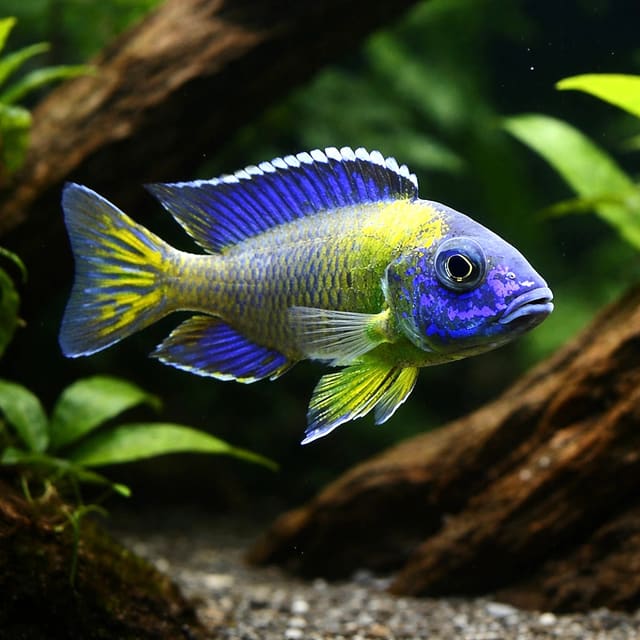
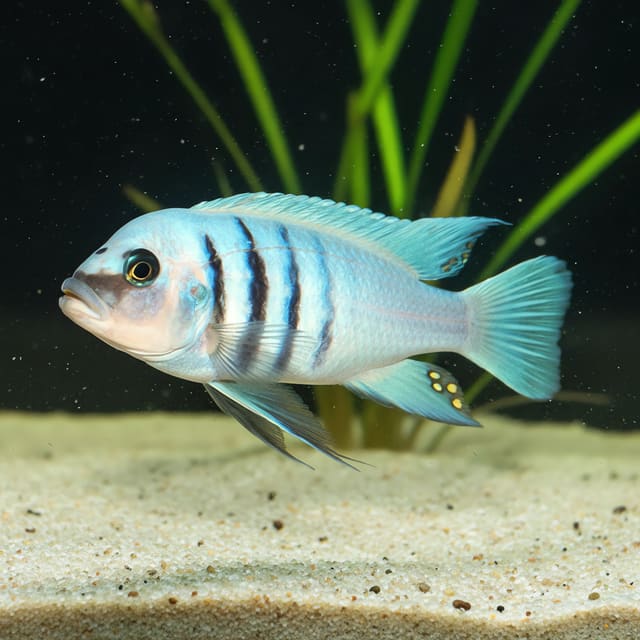
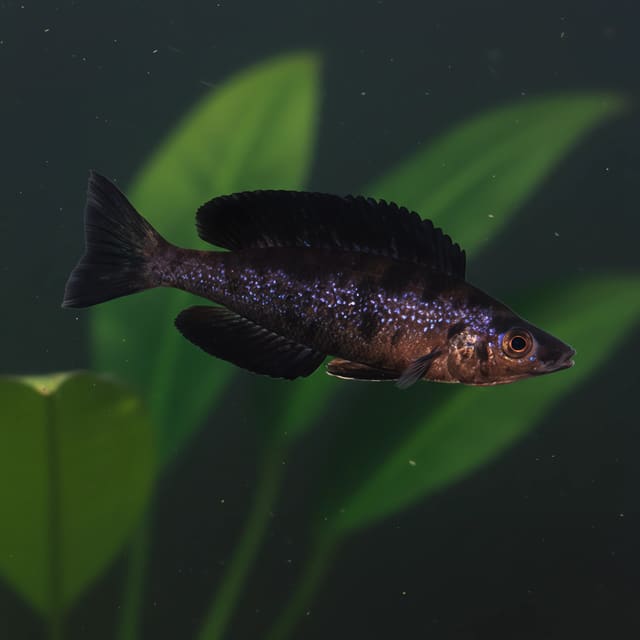
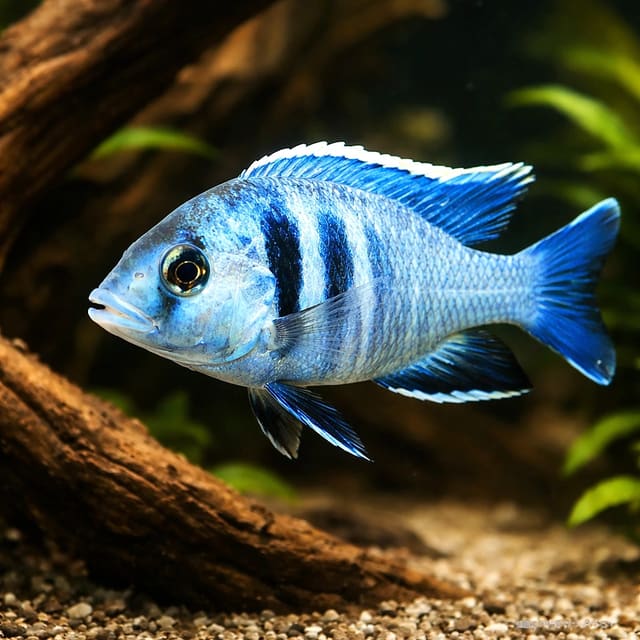
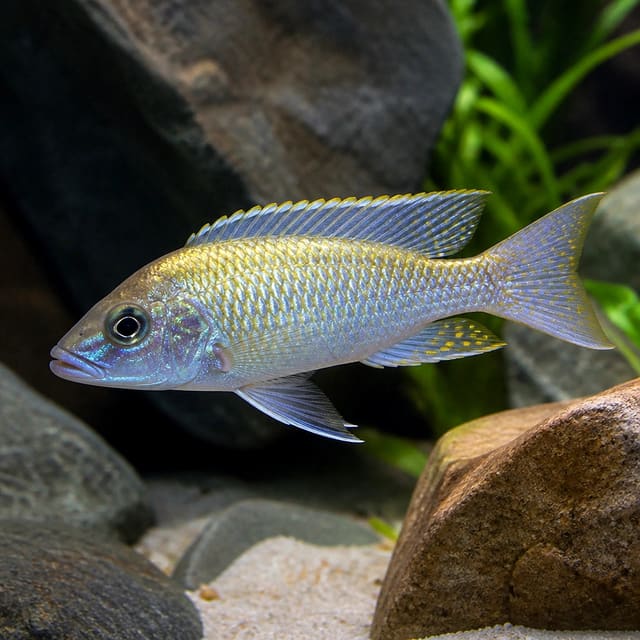
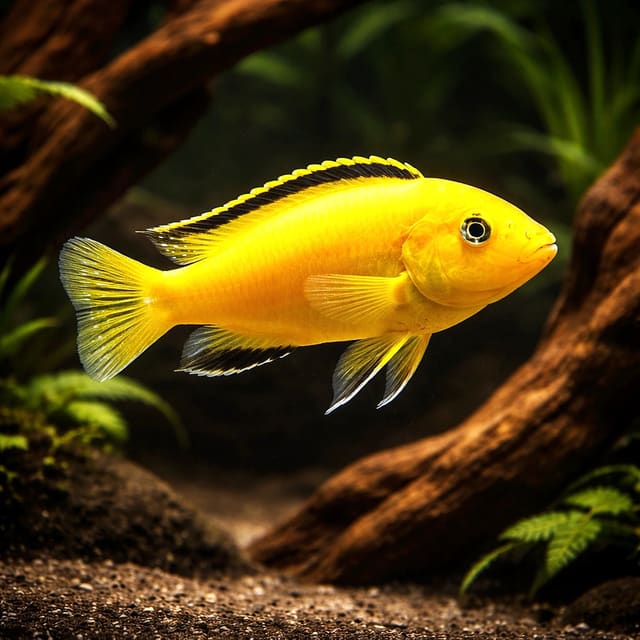
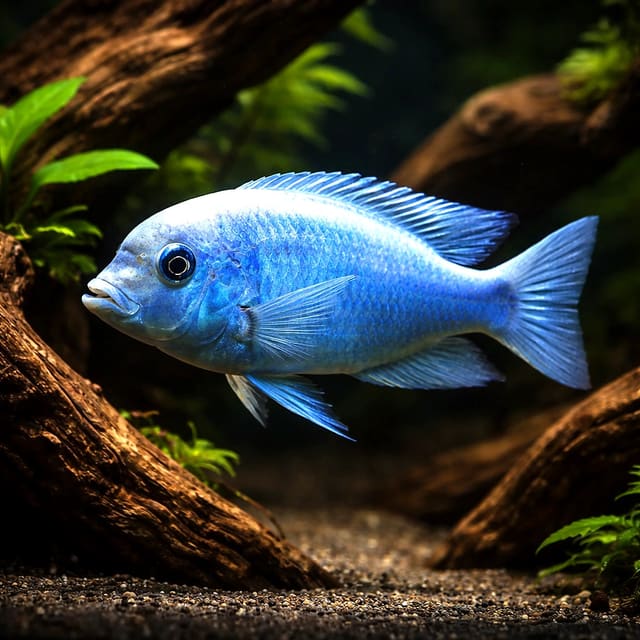
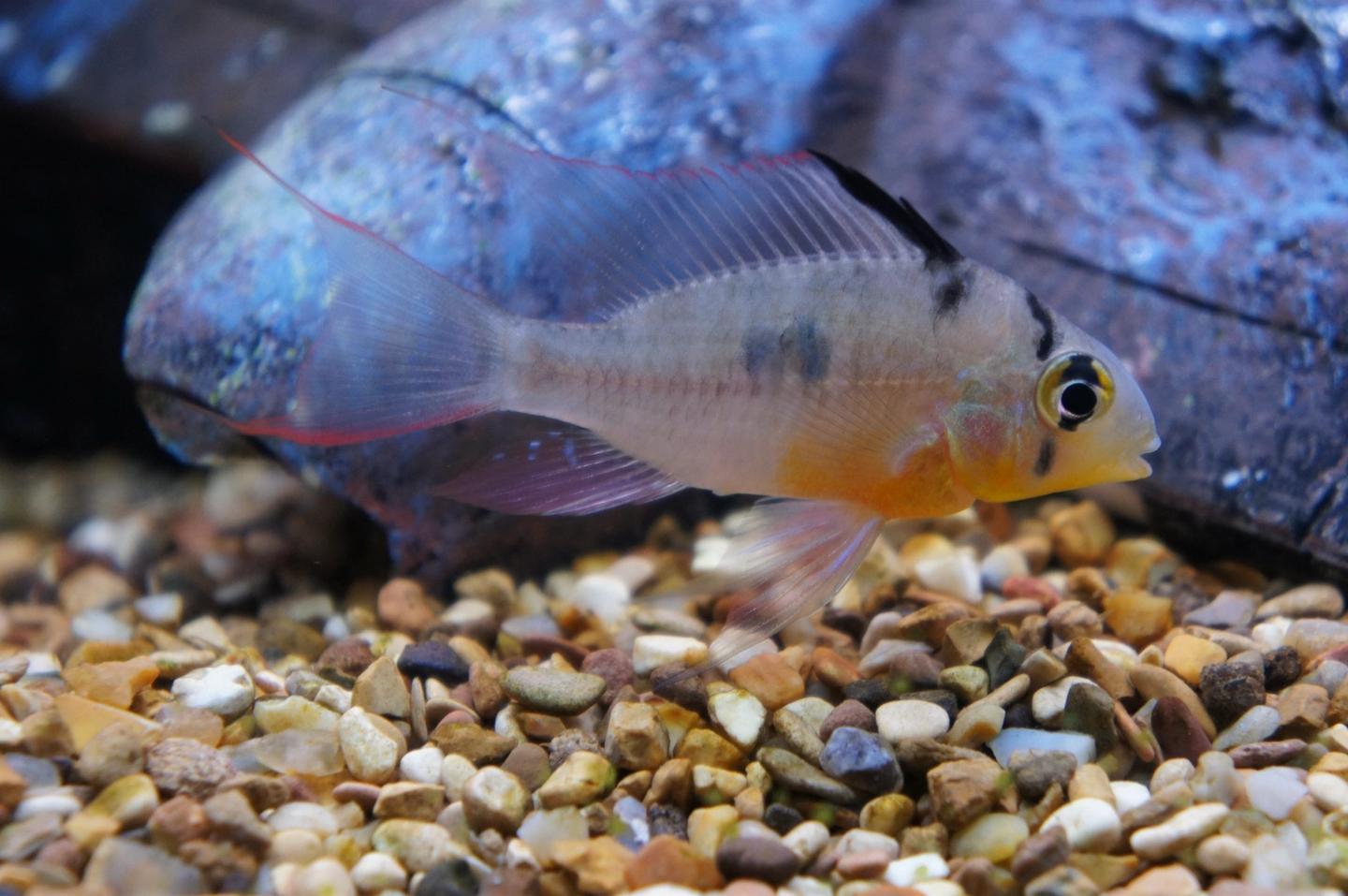
Gallery images have been digitally enhanced to improve image quality. Natural colour, pattern, size and maturity can vary between live animals. The current image shows one slender fish over pale sand, but image appearance cannot establish sex or exact supplied markings.
For this species, the useful aquarium starts at the bottom. FishBase and the species summary both place it over sandy substrates and describe it forming schools. Use fine, smooth aquarium sand across a generous part of the footprint so fish can move and feed without navigating sharp gravel or a maze of territorial obstacles.
Rockwork can still provide shelter and visual structure, but place it mainly around the back or ends and stabilise it before adding fish. The goal is to create calm edges and more than one retreat without sacrificing the open lower-water zone. FishBase records the species as demersal, so preserve open lower-level access across the group’s floor area. Avoid piles with narrow gaps that a startled fish can enter but not turn inside.
Floor area matters more than a decorative litre claim. A tall, narrow aquarium can hold substantial water yet offer poor schooling and feeding space. Conversely, a useful footprint must still have enough total water and filtration to keep conditions steady for the final number of adult fish. Plan those parts together.
Plants may be used if they tolerate the intended hard-water conditions and do not take over the sand, but a planted appearance is not a care requirement established by the species record. Choose vegetation for function—soft visual cover, secure roots and maintainable access—rather than to reproduce the product image.
Before livestock arrives, complete the first tropical aquarium setup and confirm that the biological filter is processing waste. Clear water is not proof that ammonia and nitrite are under control.
Lake Tanganyika fish belong in a stable, mineral-rich hard-water plan. OATA's numerical care sheet is written for Malawi cichlids, so its exact figures should not be copied across the continent and presented as a species prescription for Xenotilapia bathyphilus.
Start with measured tap water and the current holding conditions supplied at the time of transfer. Use the aquarium water chemistry guide to understand pH, general hardness, carbonate hardness, ammonia, nitrite and nitrate as separate measurements. The water parameter matcher can help compare figures, but the safe objective is a stable overlap rather than a rapid chase toward a remembered lake number.
| Ammonia | Zero mg/l |
|---|---|
| Nitrite | Zero mg/l |
| pH and hardness | Stable hard-water conditions appropriate to the exact Tanganyika setup, confirmed against current holding water |
| Temperature | Confirm the current holding temperature and move gradually rather than assigning a guessed number |
| Nitrate | Control through sensible stocking, feeding and regular maintenance |
The RSPCA explains why filtration is essential: fish release toxic ammonia, and established biological media supports bacteria that convert it through nitrite to nitrate. Choose a filter that maintains strong biological capacity and gas exchange without blasting the fish continuously across the open sand.
Stability is an active practice. Treat replacement water for chlorine or chloramine, keep changes in temperature and mineral content modest, and test after any unexplained behavioural change. If water needs mineral adjustment, prepare it consistently outside the aquarium rather than correcting the display tank with abrupt additions.
FishBase records copepods and small shrimps in the diet. That points toward small animal-rich food rather than large chunks or a diet designed for algae-grazing mbuna. In the aquarium, select fine foods that stay available long enough for every fish to feed without burying the sand in leftovers.
A high-quality fine cichlid pellet or granule can provide a consistent prepared base when its ingredients and particle size suit the fish. Appropriate frozen foods can add variety, but use items small enough to take cleanly. The natural record supports the type of prey; it does not create a fixed household menu or feeding frequency.
Small shrimps and copepods are also a compatibility warning. Decorative shrimp and similarly small invertebrates should not be treated as safe companions merely because the cichlid has a slender profile. A natural food item remains a plausible food item in an aquarium.
Feeding response is one of the clearest routine observations available to a keeper. A fish that suddenly stops joining the group at meals deserves a water test and a social check. Look for crowding, persistent displacement, rapid breathing or an individual held away from the open sand before changing foods repeatedly.
Do not use excess food to make a shy fish more confident. Improve access by spreading the portion, reducing disturbance and reassessing companions. More uneaten food increases the filter's work and can turn a social problem into a water-quality problem.
The species record says these fish form schools. That supports group keeping, but it does not state one universal aquarium number. The right group must fit the adult footprint, filtration, companion plan and the keeper's ability to respond if one fish is excluded.
One purchase supplies one fish, so a social group requires deliberate planning across multiple fish rather than assuming the product is a pack. Build the aquarium for the complete intended group before ordering. Adding individuals slowly to an established group can also create uneven social pressure, so introductions need observation and a safe fallback.
Respond to patterns, not a single chase. First verify ammonia, nitrite, temperature and filter operation, then assess available floor space, cover and companion behaviour. A divider or separate mature aquarium is far more useful when prepared before it is urgently needed.
Do not infer a pair or sex ratio from colour, fin shape or the product image. The offer carries no sex guarantee, and the approved records do not establish a visual sexing rule for this listing. Keep the group plan workable regardless of the sexes supplied.
Calm surroundings help observation. Site the aquarium away from repeated knocks and sudden movement, provide a secure cover appropriate to the setup and keep a regular light cycle. These measures do not replace correct group space, but they reduce avoidable disturbance while the fish settle.
General cichlid and fish-welfare guidance is useful for system care even when it does not prove a species-specific water range. Test ammonia and nitrite regularly, track nitrate in relation to your source water, and make partial water changes often enough to keep the aquarium stable. Record the figures so gradual drift is visible.
For the cichlids it covers, OATA strongly recommends that at least once every week a partial water change of 25% is carried out. Use that as broad maintenance context, then adjust the routine to measured waste, stocking and source-water chemistry.
If a fish hangs at the surface, sits apart, breathes rapidly, loses appetite or changes colour, test the water and review social pressure promptly. Those signs can have several causes; water and equipment checks provide a factual starting point before any treatment decision.
Keep notes on new fish, food changes, filter work and unusual behaviour. When advice is needed, a timeline and test results are more useful than a single photograph. If abnormal signs persist after environmental checks, seek informed aquatic or veterinary advice rather than trying a sequence of random remedies.
Quarantine procedures depend on the keeper's facilities, but the principle is straightforward: any observation tank must itself be mature, heated and suitable for hard-water livestock. A small, unstable container is not made safe simply by calling it quarantine.
Build the equipment plan around the final adult group, not the smallest dispatch grade. A social fish can outgrow a temporary arrangement through combined waste and floor-space demand even when each individual remains modest in length. Choose filtration, heating, aeration and test capacity for the complete aquarium.
The filter needs enough biological media to keep ammonia and nitrite at zero, plus flow that reaches the whole aquarium without sweeping fish continually off the sand. Arrange the outlet for gas exchange and even circulation. If decor creates sheltered pockets, check that they do not become places where uneaten food accumulates.
Measure replacement water before routine changes so hardness and pH do not vary unpredictably between buckets. If mineral preparation is used, follow the same measured recipe each time and verify the result. Consistency matters more than repeatedly correcting the display aquarium after values have moved.
Plan for a power cut or equipment failure. Know how quickly the aquarium cools, keep simple backup aeration available, and avoid servicing all biological media at once. After filter maintenance, confirm that normal flow has returned and continue watching ammonia and nitrite.
Make the aquarium easy to maintain. Leave room around the filter, heater and hardscape so the keeper can inspect them without dismantling the social layout. A design that is hard to siphon or test encourages delayed care, while a practical open-sand plan makes waste, food access and fish behaviour easier to see.
A shared African origin is not a compatibility test. Blue Burundi Cichlids come from Lake Tanganyika and use open sandy areas; the broad OATA sheet concerns Malawi cichlids with different ecological and aggression patterns. Choose companions only when adult size, water requirements, feeding pace and use of the lower aquarium overlap.
The most promising companions are calm fish that do not monopolise the sand or food and that suit the same stable hard-water system. Even then, the aquarium must provide more than one calm area and enough footprint for the complete adult group. Avoid forceful fish that keep these cichlids in retreat.
The African cichlid collection provides category context, not an automatic tank-mate list. Research each candidate at species level and reject a combination when either fish would have to live outside its appropriate water or social conditions.
Monitor introductions over days, not minutes. A fish can appear calm while it is simply avoiding the active area. Check where each individual rests, whether it crosses the sand freely and whether it feeds without repeated displacement.
Have the aquarium fully cycled, stable and at its intended conditions before ordering. Confirm the current holding water close to dispatch and plan gradual transfer rather than trying to remake the aquarium on arrival day. Check that sand, shelters, filter and cover are secure and that established companions cannot immediately control the whole lower zone.
Read the current delivery and Live Arrival Guarantee policy. Someone must be present for live fish. If a claim may be needed, begin one continuous unboxing video while the parcel is still sealed, show the outer box, opening and fish still inside the sealed bag, then contact the store the same day with the order number. The recording protects the claim; it is not a husbandry requirement after the fish is in the aquarium.
Once claim evidence is secured, follow the current policy's acclimation instruction: float the sealed bag for 20–30 minutes before release and do not add transport water to the aquarium. Keep the receiving process organised and calm so the fish moves into prepared conditions promptly.
The presence of several size choices does not change the welfare sequence. A smaller dispatch grade still needs the adult social and habitat plan, while an XL fish still needs careful transfer and protection from incompatible companions.
FishBase records a maximum length of 10.3 cm TL male/unsexed. TL means total length to the end of the tail; the 3–6 cm and XL labels on this listing are dispatch grades, not adult-size promises.
Use a long aquarium with a broad sandy floor sized for the full adult social group. There is no universal litre rule; judge the plan by adult footprint, open sand, filtration and calm retreat space rather than a generic badge.
The species forms schools, so plan a social group rather than a solitary display fish. There is no universal count; the final group must fit the adult footprint, filtration and companion plan.
It carries an advanced store assessment. The keeper needs to manage a mature hard-water aquarium, open sand, group access to food and calm companions without relying on generic Malawi care numbers.
FishBase records copepods and small shrimps. In an aquarium, use suitably fine animal-rich foods and a quality small prepared food, distribute modest portions across the group and remove leftovers.
Confirm the current holding temperature, pH and dGH before transfer, then use stable hard-water conditions appropriate to the Tanganyika setup. Change values gradually; generic Malawi figures are not a substitute for matching the fish's holding water.
Plan conservatively rather than relying on a simple peaceful label. Provide a broad sand zone, calm companions, visual retreat and close observation so persistent chasing, exclusion or feeding pressure is addressed early.
Choose calm hard-water fish whose adult size, feeding pace and aquarium zone overlap without dominating the sand. Avoid small shrimps and similar invertebrates that match its natural food, along with boisterous or predatory fish.
Fish are hand-bagged in oxygen, packed in an insulated box with a heat pack when needed and sent by a licensed live-animal courier on the confirmed delivery date. Be present, start a continuous unboxing video while the parcel is sealed, inspect it the same day and contact the store promptly with the order number if a Live Arrival Guarantee claim is needed.
The title follows the exact identity Xenotilapia bathyphilus; FishBase currently accepts X. bathyphila and treats the title spelling as a synonym.
No reviews for this item yet. Bought one? Honest reviews only, good or bad.
What customers say about ordering from us
I have a small group of long finned mountain minnows. So was delighted to be able to order ten of this variety to increase the genetics in my tank . The ones I recieved are healthy but it’s to early to give a verdict on wether they are of a long finned type since they are small currently.
Gordon Walker · 23 Sept 2026
100% success travel and "installation". Pleased with quality of purchase. The Siamese fighter a bit "shy" so have not yet seen him at his best yet but looking good. Happy customer. GG
George E Garratt · 21 Sept 2026
Reviews of our shop, collected by Judge.me, an independent third-party review collector. Newest first.