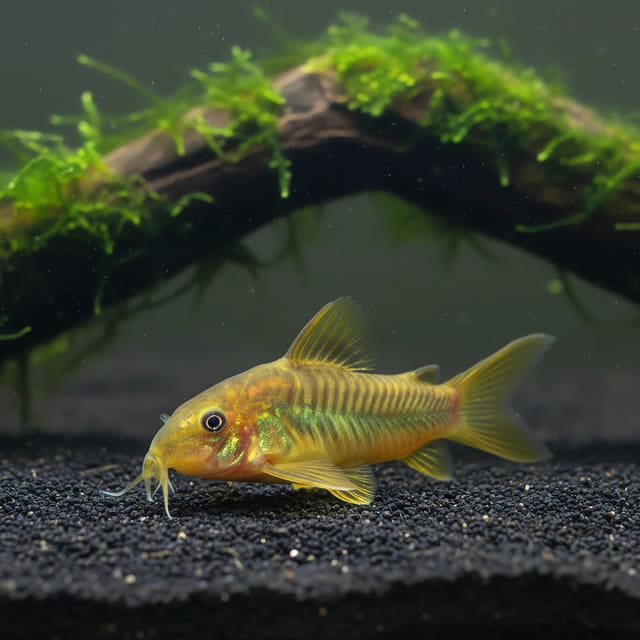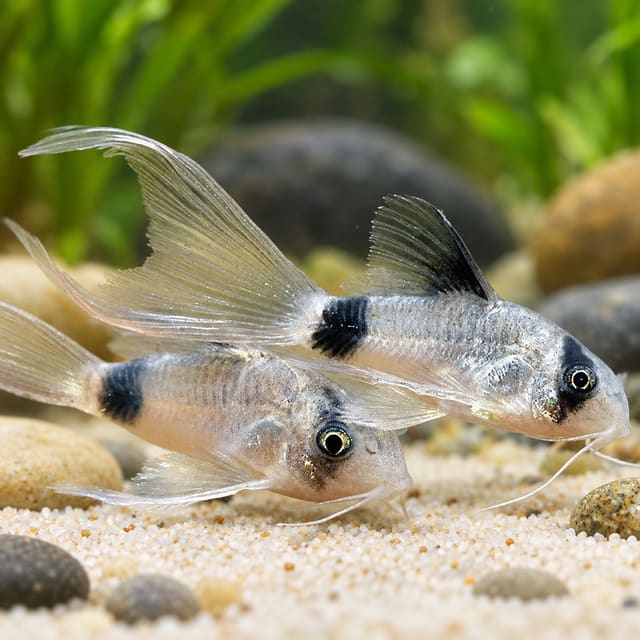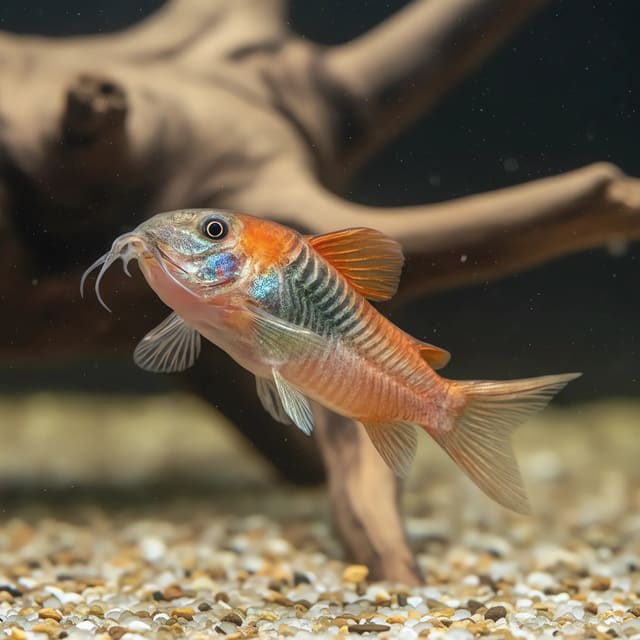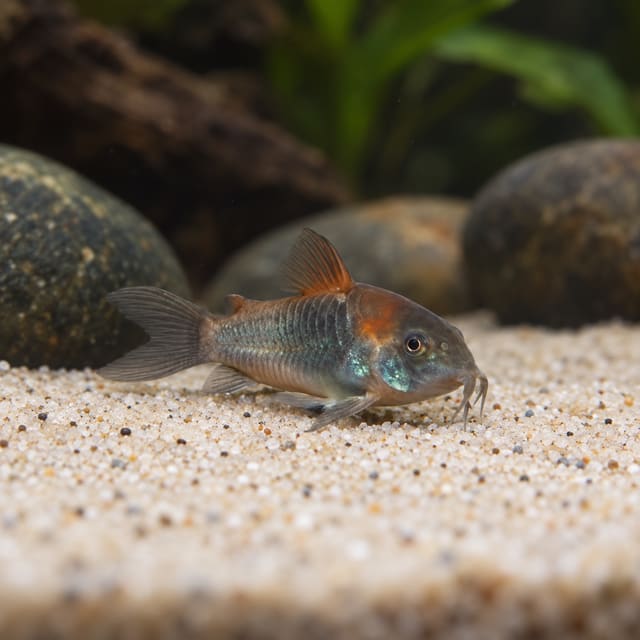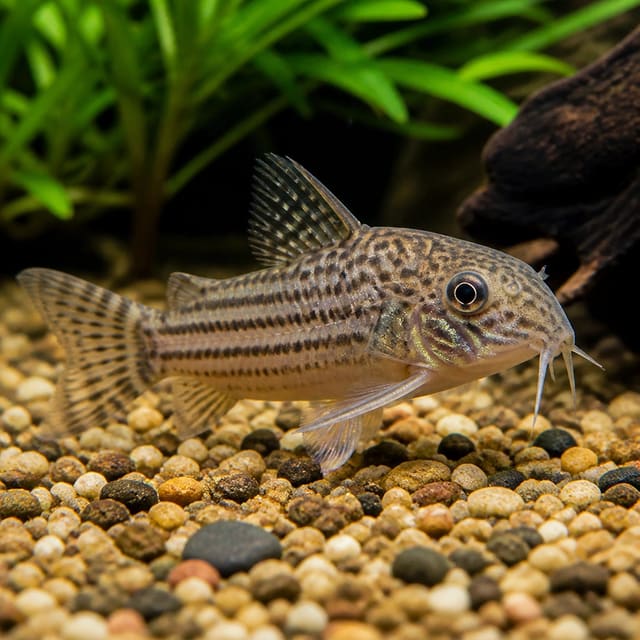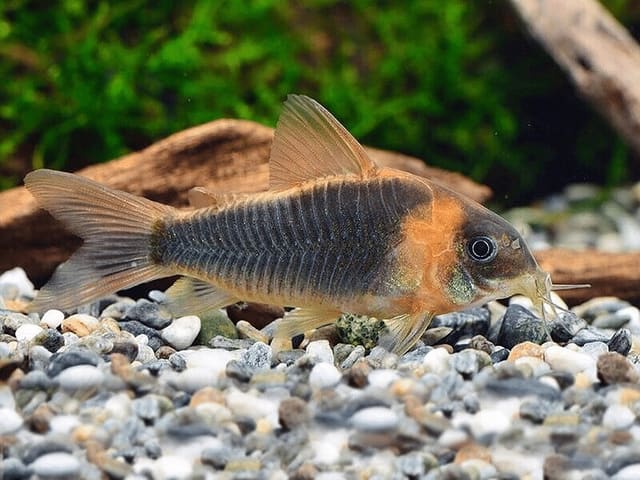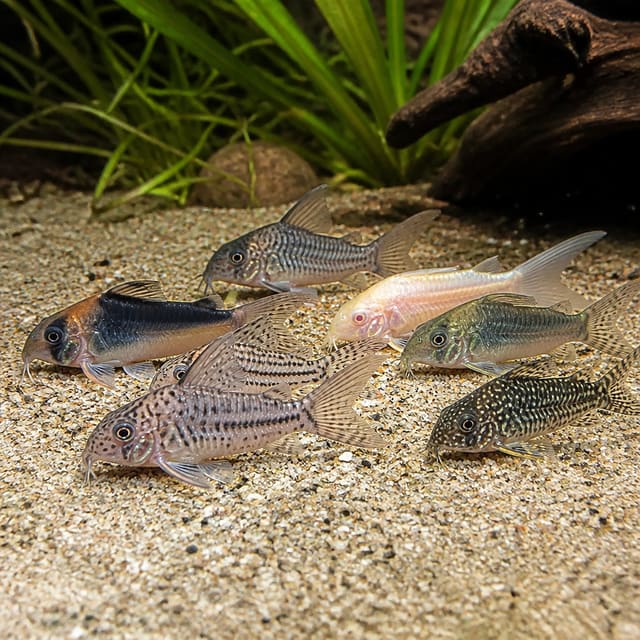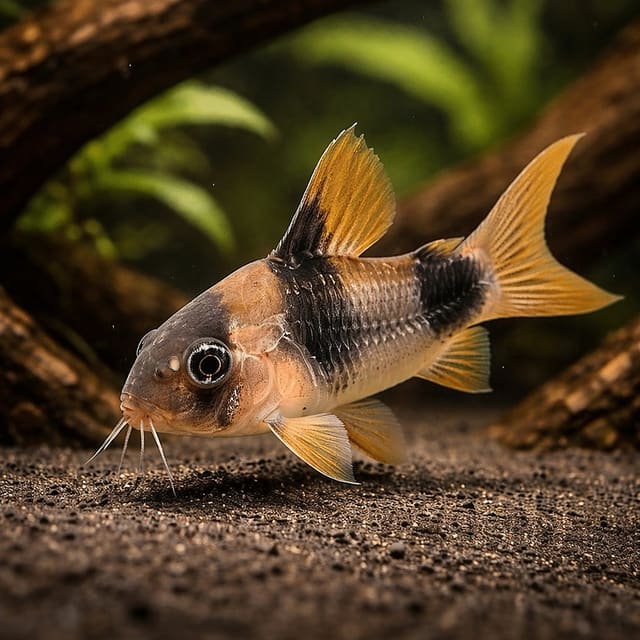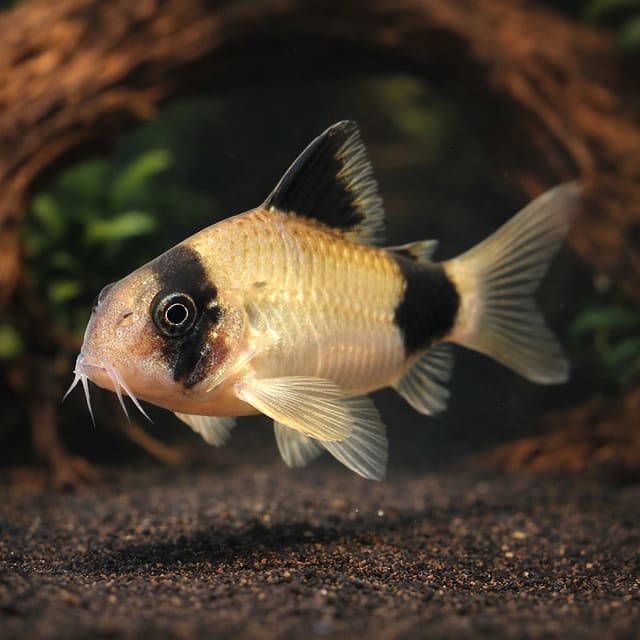
Panda Cory Catfish (Corydoras panda)
22–25°C · pH 6–7.4
From £8.69Some sizes on sale

Banded Cory / Bearded Cory (Scleromystax barbatus) is a large cory-type catfish from coastal south-eastern Brazil. It suits an established cooler aquarium with a generous 120 × 45 cm base, fine sand, strong biological filtration and deliberate sinking meals; mature males need particular space and cover.
Adult size is the maximum length this species reaches at full maturity (scientific sources). The livestock you receive will be younger and smaller — pick a size above for the actual shipping size. Product-photo provenance and any image-specific limitations are stated on the listing.
Scleromystax barbatus
Shoaling fish: kept in a group they feel safer, stay calmer and show their best colour.
Banded Cory / Bearded Cory (Scleromystax barbatus) is a large cory-type catfish from coastal south-eastern Brazil. It suits an established cooler aquarium with a generous 120 × 45 cm base, fine sand, strong biological filtration and deliberate sinking meals; mature males need particular space and cover.
Adult size is the maximum length this species reaches at full maturity (scientific sources). The livestock you receive will be younger and smaller — pick a size above for the actual shipping size. Product-photo provenance and any image-specific limitations are stated on the listing.
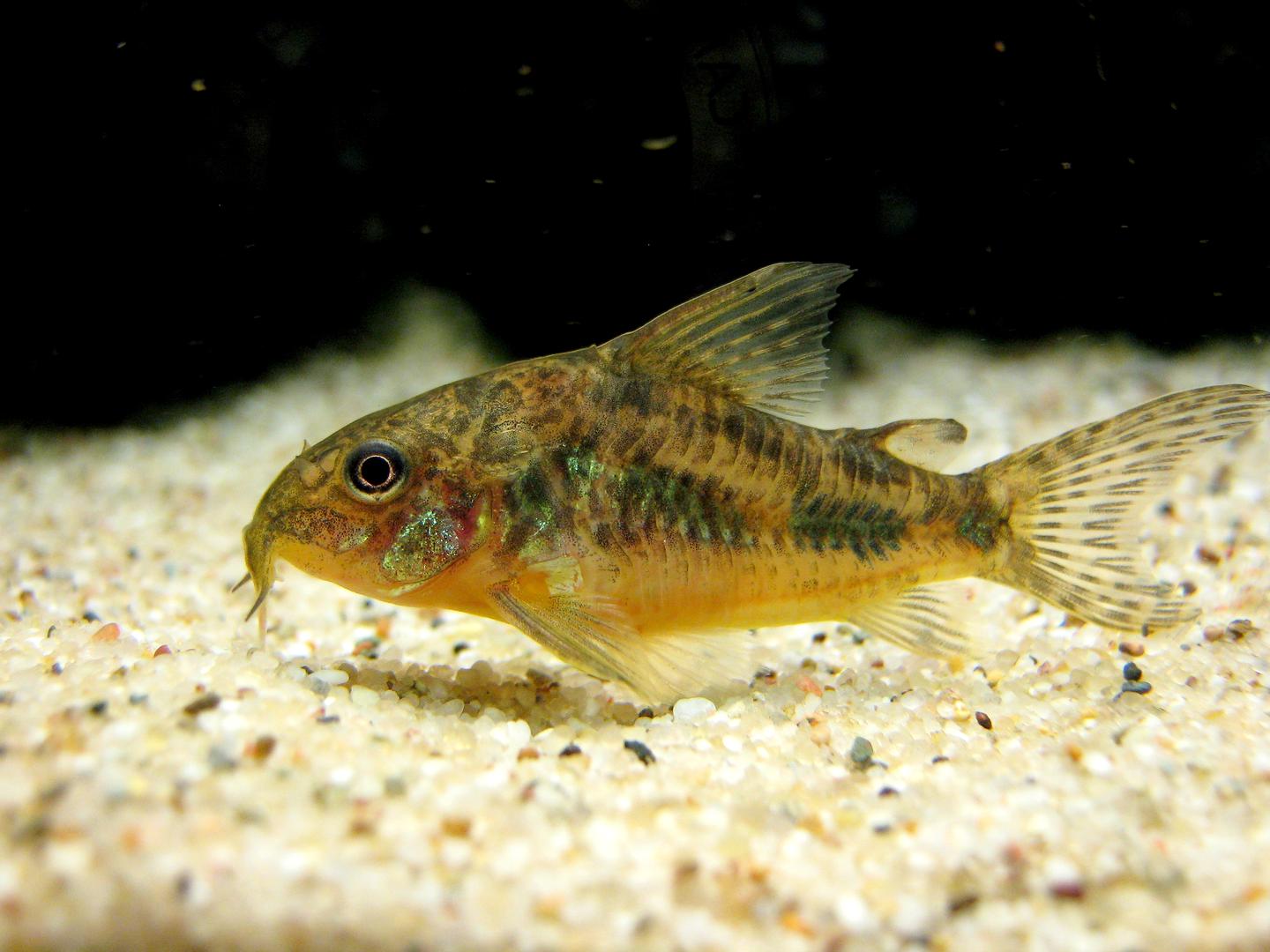
Identify the exact cory catfish before choosing care. Our starting policy for many common medium species is six compatible conspecifics, a mature 60 x 30 cm aquarium of about 60 litres, smooth fine sand and measured species-appropriate water.
Maintain these water conditions for optimal health and vibrant colors
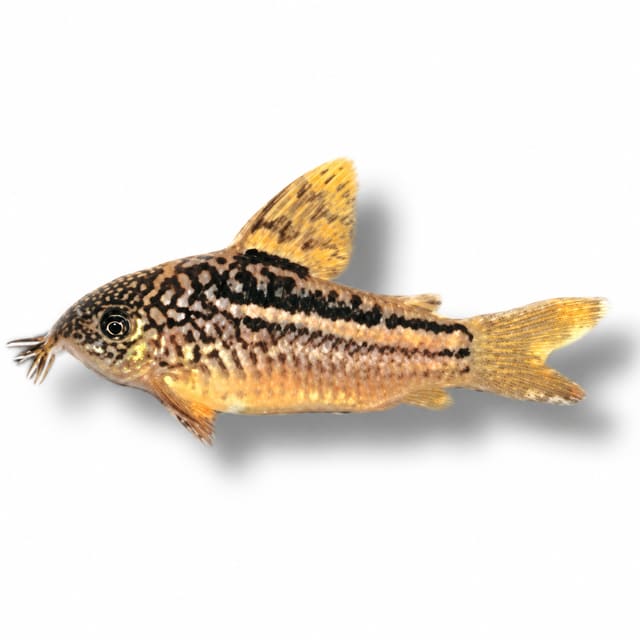
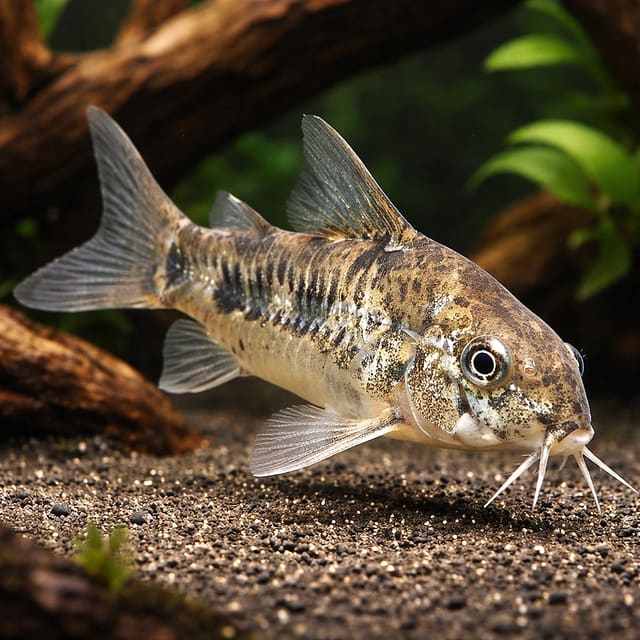
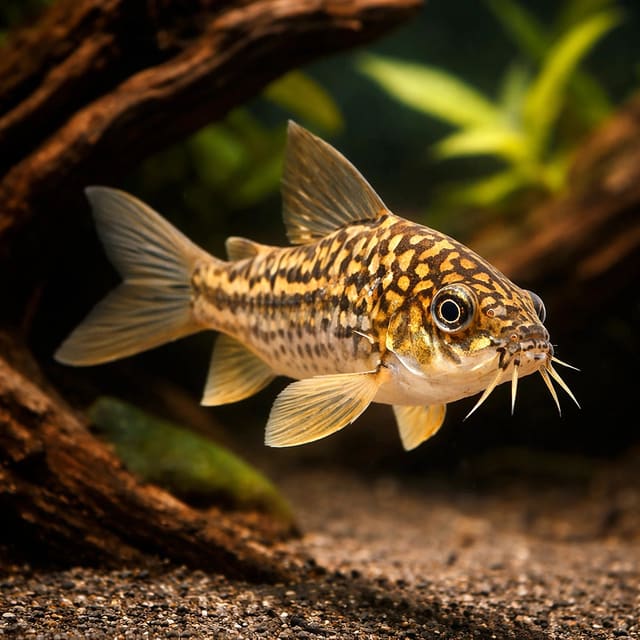
The Banded Cory / Bearded Cory (Scleromystax barbatus) is a distinctive South American armoured catfish with a dark, broken lateral band, pale spotting over the head and shoulders, a tall patterned dorsal fin and sensory barbels around the mouth. It comes from coastal drainages between Rio de Janeiro and Santa Catarina in south-eastern Brazil. Although suppliers and many aquarists still use Corydoras barbatus, the accepted name used throughout this page is Scleromystax barbatus. The older combination is useful for recognising the same animal, not a reason to treat two names as different species.
This is not one of the tiny corys commonly chosen for a compact warm community. FishBase records 9.8 cm standard length and the species aquarium profile gives 10 cm standard length, so an adult needs appreciably more floor space than the young dispatch grades suggest. The size you select is the size supplied, not the adult size. The live product retains 2.5–3 cm, 3–4 cm and XL grades, and one purchase supplies one live fish in the chosen grade. The XL label is preserved without assigning a centimetre measurement to it.
| Suits | An aquarist with a mature, cooler freshwater aquarium, a base of at least 120 × 45 cm, fine sand, dependable filtration and room to manage mature-male territory. |
|---|---|
| Less suitable for | A small warm tank, an immature aquarium, a crowded bottom zone or a setup where the fish is expected to survive on food missed by others. |
| Adult record | 9.8 cm standard length in FishBase; the species aquarium profile rounds this to 10 cm standard length. |
| Routine aquarium range | 16–24 °C, pH 5.5–7.5 and 1–12 dGH from the species profile. |
| Temperament | Peaceful towards other species, with strong territorial behaviour possible between mature males. |
The familiar “bearded” name refers to the more developed cheek bristles seen on mature males; it does not mean that a young fish can be sexed safely from a sales photograph. Mature males may also show stronger head patterning and extended fins, while females tend to be fuller-bodied, but the product is not sold with a sex guarantee. Sex is guaranteed only when the selected option explicitly states male or female. This Banded Cory / Bearded Cory listing has no sex-guaranteed option.
Colour and pattern change with age, condition, posture and lighting. The dark side band can look continuous in one view and more broken in another, while the head may appear spotted or reticulated. Buy for the verified identity, adult needs and behaviour rather than expecting every animal to reproduce one gallery pose. Gallery images have been digitally enhanced to improve image quality. Natural colour, pattern, size and maturity can vary between live animals.
If you are comparing this fish with smaller relatives, browse the current corydoras collection, but compare adult footprint, temperature and male behaviour rather than choosing on colour alone. A Panda or Bronze Cory is an alternative product to investigate, not an automatic tank mate recommendation for this cooler, larger species.
The best buyer is prepared for the adult fish from the beginning. That means choosing the footprint before choosing the juvenile grade, reserving accessible bottom-feeding areas, and accepting that several unknown-sex youngsters may need more separation as they mature. It also means checking that every proposed companion can share the cooler range. A handsome young catfish can appear undemanding for months, but the mature body, territorial exception and deliberate feeding requirement are the lasting commitments.
The species aquarium profile recommends minimum base dimensions of 120 × 45 cm or equivalent, associated with roughly 243 litres. Treat that as a floor-space requirement rather than converting it into a permission to use any tall aquarium with a similar nominal volume. Scleromystax barbatus spends much of its time moving, pausing and feeding over the substrate. A longer base separates feeding areas, creates retreat space and lets décor divide territories.
Build the layout around open feeding lanes and sheltered edges. Fine sand is ideal because it allows natural probing without trapping coarse debris around the mouth. Rounded gravel can be used only when it is genuinely smooth and kept scrupulously clean. Sharp stone, dirty pockets and neglected food residues work against the fish’s constant contact with the bottom. Place wood, smooth rock and robust planting so there are several shaded resting areas without turning the entire floor into a maze that cannot be siphoned.
Cover matters particularly when more than one mature male may be present. Use wood, plants and changes of level to separate territories, while keeping enough open base for all fish to reach food. Apply the explicit warning about adult males rather than importing a generic cory shoal number. Start with the 120 × 45 cm footprint, allow more space for a more complicated social mix and never rely on the sales grade to estimate final stocking.
Add this fish only to a biologically mature aquarium. A filter must already be processing ammonia to nitrite and nitrite to nitrate before livestock is introduced. The RSPCA’s general aquarium welfare guidance explains why a functioning biological filter is essential; neither clear water nor a recently installed filter proves that the nitrogen cycle is established. The first aquarium guide is a useful preparation checklist before the fish is ordered.
Test ammonia and nitrite whenever a tank is newly established, after a disruption or when behaviour changes. Both should remain at zero. Check nitrate in the context of the source water and maintenance routine, and use regular partial water changes to prevent dissolved waste from accumulating. Replace water with conditioned water at a close temperature, avoid abrupt chemistry swings and clean filter media gently in removed aquarium water when maintenance is needed.
Bottom cleanliness deserves special attention because sinking food and faeces settle exactly where this catfish explores. Siphon exposed patches without stripping every surface or disrupting all beneficial biofilm at once. A feeding dish can help on sand, but it does not replace substrate inspection. If food repeatedly disappears into deep gravel or inaccessible décor, change the feeding layout rather than simply adding more.
For aquarium care, use 16–24 °C, pH 5.5–7.5 and hardness 1–12 dGH from the species profile. FishBase records a broader wild pH range of 6.0–8.0, hardness of 2–25 dH and an upper temperature value of 28 °C, but wild environmental records are not the same as a recommended everyday aquarium target. A stable value within the species husbandry range is more useful than moving the aquarium towards an outer record.
The cooler temperature requirement affects the entire stocking plan. Do not keep S. barbatus permanently at the hot end needed by a different species simply because both are sold as tropical fish. At the other end, do not cool the aquarium abruptly. Choose a set point that all inhabitants can share, check seasonal room-temperature changes and verify that the heater or cooling strategy can hold the chosen value consistently.
Measure the tap water and aquarium rather than guessing from regional labels such as “soft-water area”. The water chemistry guide explains the practical tests, and the water matcher can help compare actual readings with the stated range. If the source water sits outside the plan, make gradual, measurable adjustments and avoid unstable mixtures that change at each water change.
FishBase identifies this species as an obligate air-breather, so leave unobstructed access to the surface. An occasional deliberate rise to gulp air is different from an entire group breathing rapidly or repeatedly crowding the top. The latter should prompt immediate checks of temperature, oxygen, ammonia, nitrite, filter flow and any recent chemical or maintenance event.
The species profile uses a filter-turnover example of four to five times the aquarium volume per hour for its 243-litre illustration. Treat that as a planning example, not a demand to blast the fish with one harsh jet. Spread flow across the aquarium, keep the surface moving and retain calm places near the substrate. Warm water holds less oxygen, which is another reason not to maintain this cooler species at unnecessarily high temperatures.
Protect all filter intakes and inspect them during maintenance. Flow loss can be gradual as media clogs, so observe the outlet rather than assuming a running motor means normal performance. Never wash established biological media under the tap. Chlorine or chloramine can damage the bacteria that make the filter biologically useful.
Scleromystax species are foraging omnivores. Use good sinking dried food as the dependable base and rotate small live or frozen items such as chironomid larvae, commonly sold as bloodworm, and Tubifex. Variety supports condition, but portion size must fit the fish and the aquarium. Large frozen lumps that lodge under wood create a water-quality problem rather than a richer diet.
Watch at least several meals from start to finish. Fast mid-water fish can intercept food before it reaches the bottom, while a shy new arrival may remain behind cover. Distribute small portions across more than one clear area so every catfish has a realistic chance to feed. Remove food that is still untouched once the fish have had a fair opportunity, and adjust the next meal rather than letting waste accumulate.
These catfish browse and sift, but they are not substitutes for maintenance. The species profile explicitly warns against expecting them to survive on leftovers or clean the aquarium. Algae, detritus and fallen flakes do not form a complete ration. A fish that is losing condition despite food entering the tank needs closer observation of competition, mouth condition and feeding access.
With other species this catfish is described as peaceful. The important exception is male-to-male territoriality: mature males can be aggressively territorial and cannot be maintained together in smaller aquaria. Chasing around a single boundary, one fish being excluded from food, fin damage or repeated hiding all indicate that floor space and visual separation need attention.
Do not use juvenile calmness as proof that several males will share a cramped adult setup. Sex differences become clearer with maturity, but this offer does not promise a sex. Plan the aquarium so that cover can be added, territories can be separated and an individual can be moved if the social arrangement deteriorates. A spare mature holding tank is safer than trying to improvise after serious conflict begins.
Surface gulps can form part of normal air-breathing behaviour, while rapid gill movement, loss of balance, prolonged surface crowding or refusal of food demand investigation. Test the water first, confirm temperature and flow, then review what changed. Avoid adding medication simply because a behaviour looks unusual; diagnosis and treatment fall outside routine listing care.
Before opening the parcel, be ready at the delivery address and have the mature aquarium prepared. Record one continuous unboxing video beginning with the parcel still sealed and showing the fish in the sealed bag before anything is disturbed. This preserves the evidence required by Tropical Fish Co’s Live Arrival Guarantee policy. Inspect the fish on the day it arrives and keep the order number to hand.
After the unboxing evidence has been recorded, float the sealed bag for 20–30 minutes as the store policy states, then release the fish without pouring bag water into the aquarium. Keep the process calm and avoid feeding a heavy meal immediately. The complete current conditions are on the delivery and Live Arrival Guarantee page; contact the shop the same day if there is a problem.
During the following days, verify that each fish reaches sinking food, that breathing is steady and that the substrate remains clean. Keep temperature within the planned cooler range and avoid several changes at once. A stable mature system, modest food and careful observation give a newly transported bottom-dweller a clearer path to settling.
Make maintenance predictable enough that problems are noticed early. Record temperature, pH and hardness when the aquarium is first stabilised, then test again when source water, décor or season changes. Check ammonia and nitrite after any filter interruption, unexplained breathing change or significant increase in stock. A log does not need to be elaborate; dated readings are more useful than a memory that the water is “usually fine”.
Before each water change, look across the substrate for trapped food and note where the fish spend time. Siphon exposed debris, but leave established plants and useful surfaces intact. Check the impeller, outlet and intake guard, then clean only what needs attention. Treat replacement water before it enters the aquarium and avoid changing temperature, hardness and pH sharply in one maintenance session.
Review the floor plan as the fish grow. A hide that fitted a 3 cm juvenile may become a bottleneck for a near-10 cm adult, and a feeding lane can narrow as plants spread. Rearranging everything at once can remove familiar boundaries, so make purposeful changes and observe the result. Add cover where territories overlap, but preserve enough open sand for feeding and easy cleaning.
Healthy condition is more informative than one moment of bright colour. Compare body fullness, barbels, fins, breathing and appetite among individuals. A fish that hangs back at every meal, loses weight or rests away from the others may be facing competition, territorial pressure or a water-quality problem. Confirm the environment before attributing a change to personality.
Barbels should remain intact and the mouth area should not be continually rubbed against sharp or dirty material. If several fish show the same deterioration, inspect substrate hygiene and water first. If one fish alone is affected, also examine its access to food and shelter. The listing cannot diagnose disease, but it can steer routine care towards the conditions most directly under the keeper’s control.
Growth changes the balance of the aquarium. Recalculate stocking and feeding from adult bodies rather than the initial dispatch grades, and remember that an XL option has no frozen centimetre value in this packet. Weigh the fish’s visible condition and adult record against the actual footprint instead of trying to convert a sales label into a biological measurement.
Seasonal room temperature also deserves a plan. Check the coolest winter nights and warmest summer afternoons rather than relying on one daytime reading. A heater may be necessary to prevent a cold swing even for a subtropical fish, while summer heat may require more surface movement and active temperature management. Make changes gradually, retain access to the surface and confirm the result with a reliable thermometer. The aim is a steady value within 16–24 °C, not repeated correction after the aquarium has already crossed the chosen limit.
Review the plan before holidays or other periods when observation changes. Pre-measure food, confirm that the filter and heater are stable, and arrange competent care rather than adding a large “holiday” meal. A brief reduction in feeding is usually easier for a mature filtered aquarium to absorb than excess food decaying on the sand. On return, test and observe first; avoid combining a large clean, a new companion and a sudden diet change in one day.
A good companion shares the 16–24 °C species aquarium range, tolerates the same pH and hardness, is peaceful towards bottom-dwellers and does not monopolise every meal. This is a conditional test, not a universal list. An animal described as peaceful can still be unsuitable when it requires warmer water, grows large enough to prey on the catfish or competes too forcefully over the substrate.
Consider the whole adult community. Compare adult size, temperature overlap, mouth size, feeding position, activity and floor-space use. Mid-water animals may reduce direct territory competition, but only if they leave sinking food for the catfish. Other bottom-dwellers can work in a large, well-structured aquarium, yet they also increase pressure on the same shelters and feeding patches.
| Potentially suitable | Peaceful species with an overlapping cooler-water range and a feeding style that leaves deliberate sinking meals accessible. |
|---|---|
| Use caution | Other bottom-dwellers, fast feeders and any plan containing more than one mature male. |
| Avoid | Predators, aggressive fish, animals requiring permanently warmer water and overcrowded arrangements with no way to divide territory. |
The species profile’s strongest compatibility warning concerns mature males. Provide the full recommended footprint, divided cover and multiple rest areas, then observe rather than assuming the layout has solved the problem. If one fish is persistently driven away, adding another cave to the same cramped corner may not be enough.
Because the product has no sex guarantee, buyers cannot build a precise male-to-female plan from the selected grade. That uncertainty makes spare capacity important. Avoid combining a tight floor plan, several bottom species and multiple unknown-sex Banded Corys with no alternative accommodation.
Compatibility includes nutrition. A visually calm community is not successful if the catfish receives only crumbs. Feed in more than one place, allow sinking food to reach the substrate and watch the slower individuals. Do not add extra food blindly; redirect it to the animals that need it and remove persistent leftovers.
Very small ornamental invertebrates and fry may be treated as food by many omnivorous fish, so a breeding colony deserves its own risk assessment. Equally, do not buy a different cory from the related-products field on the assumption that it shares identical temperature, adult size or social behaviour. Compare each species’ adult requirements independently.
A combination that looks calm at juvenile size can change when the Banded Cory approaches its adult body length or a male begins defending space. Recheck shelter entrances, feeding distribution and the route to the surface. Remove assumptions based on the word “cory” and respond to the actual species-level behaviour described here.
When adding any later companion, quarantine and treatment decisions should follow suitable professional advice, while the community decision can still be made from observable needs: adult size, shared water range, feeding pace and territorial use. Introduce no fish merely to fill an empty-looking zone. Leave capacity for growth, maintenance error and the possibility that one mature male needs additional room.
Scleromystax barbatus reaches 9.8 cm standard length in the FishBase record, while the species aquarium profile gives 10 cm standard length. Plan for a substantial bottom-dweller rather than treating the dispatch grade as its adult size.
Use a base of at least 120 × 45 cm or an equivalent footprint; the species profile associates that footprint with about 243 litres. Bottom area, cover and feeding space matter more than height alone.
Base the plan on the explicit adult-male warning: mature males are aggressively territorial towards one another and should not be kept together in smaller aquaria, so plan the floor space and sex mix conservatively rather than applying a generic number.
It is better classed as intermediate because it grows relatively large, prefers a cooler species-level range of 16–24 °C and needs careful management of bottom cleanliness, oxygenation, feeding and mature-male territory.
Offer a varied omnivorous menu built around sinking dried foods, supplemented with suitably sized live or frozen foods such as bloodworm and Tubifex. It must be fed deliberately and should never be expected to live on leftovers or clean the aquarium.
For routine aquarium care, the species profile gives 16–24 °C, pH 5.5–7.5 and hardness 1–12 dGH. FishBase records broader wild environmental values, so do not use those extremes as a routine target.
It is described as otherwise peaceful, but mature males are aggressively territorial towards one another and cannot be maintained together in smaller aquaria. Provide cover and avoid crowding the bottom.
Choose peaceful animals whose temperature, water chemistry and feeding pace overlap with this species. Avoid a combination that forces it into permanently warmer water or allows faster fish to take every sinking meal.
Tropical Fish Co hand-packs live fish in oxygen with insulation and a heat pack when conditions call for it, then uses a licensed live-animal courier. Be present and record one continuous unboxing video from the sealed parcel before opening it. Inspect the fish the same day, then contact the shop promptly with the order number if a Live Arrival Guarantee claim is needed.
Species aquarium values are kept separate from broader wild records. Retail grade, quantity and gallery controls remain tied to the current product rather than inferred from public biology pages.
No reviews for this item yet. Bought one? Honest reviews only, good or bad.
What customers say about ordering from us
I have a small group of long finned mountain minnows. So was delighted to be able to order ten of this variety to increase the genetics in my tank . The ones I recieved are healthy but it’s to early to give a verdict on wether they are of a long finned type since they are small currently.
Gordon Walker · 23 Sept 2026
100% success travel and "installation". Pleased with quality of purchase. The Siamese fighter a bit "shy" so have not yet seen him at his best yet but looking good. Happy customer. GG
George E Garratt · 21 Sept 2026
Reviews of our shop, collected by Judge.me, an independent third-party review collector. Newest first.