Advanced
Gunther's Zanzibar Gold Nothobranch (Nothobranchius guentheri)
22–25°C · pH 6–7
£10.99

A specialist Venezuelan annual killifish supplied around 5-6 cm. Best for experienced keepers who can provide warm stable water, covered tanks, live/frozen foods and annual-killifish breeding care.
Adult size is the maximum length this species reaches at full maturity (scientific sources). The livestock you receive will be younger and smaller. Product-photo provenance and any image-specific limitations are stated on the listing.
Austrofundulus transilis
Save when buying multiple fish. Each quantity is one fish; sex and pair formation are not guaranteed unless the selected variant explicitly states them.
Confirm your email, then we’ll send an availability message for this exact item if it returns within 180 days.
This request is only for this product—no newsletter or other promotions. A mail-provider retry may very rarely duplicate the same availability message. Unconfirmed addresses are removed after 48 hours. See our privacy policy.
A specialist Venezuelan annual killifish supplied around 5-6 cm. Best for experienced keepers who can provide warm stable water, covered tanks, live/frozen foods and annual-killifish breeding care.
Adult size is the maximum length this species reaches at full maturity (scientific sources). The livestock you receive will be younger and smaller. Product-photo provenance and any image-specific limitations are stated on the listing.
Maintain these water conditions for optimal health and vibrant colors
Venezuelan Killifish (Austrofundulus transilis) is a specialist annual killifish from the Orinoco River basin in Venezuela. It is best chosen by aquarists who already understand delicate seasonal killifish, live and frozen feeding, secure covered aquariums and careful water-quality control.
This SKU is supplied at around 5-6 cm. FishBase records the species at up to 10 cm total length, so the supplied fish should be treated as a developing adult-size fish, not a tiny beginner nano species.
| Scientific name | Austrofundulus transilis |
|---|---|
| Common name | Venezuelan Killifish |
| Supplied size | Approx. 5-6 cm |
| Adult size | Up to about 10 cm total length according to FishBase |
| Minimum aquarium | 60 litres or larger for a pair/trio; more space for groups |
| Temperature | 24-30 C practical aquarium range; FishBase gives tropical 24-32 C |
| pH | Soft to neutral/slightly alkaline water, kept stable |
| Temperament | Peaceful with unsuitable fish, but males can be territorial with killifish rivals |
| Diet | Protein-rich live/frozen foods plus accepted quality prepared foods |
| Care level | Advanced / annual killifish specialist |
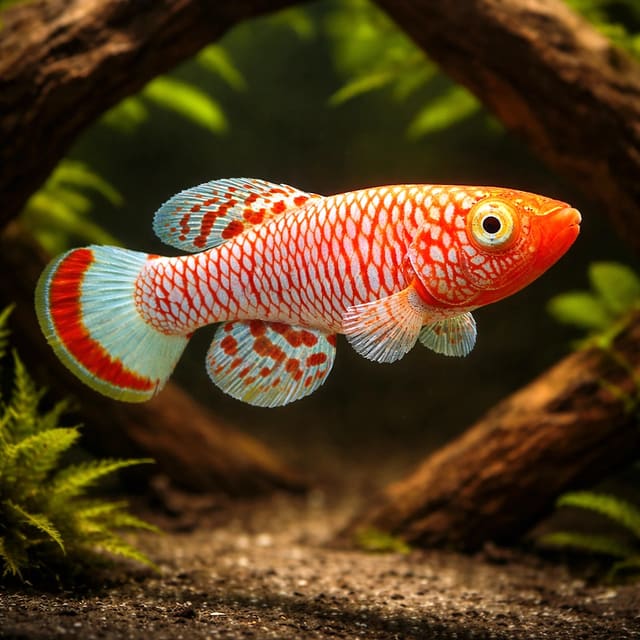
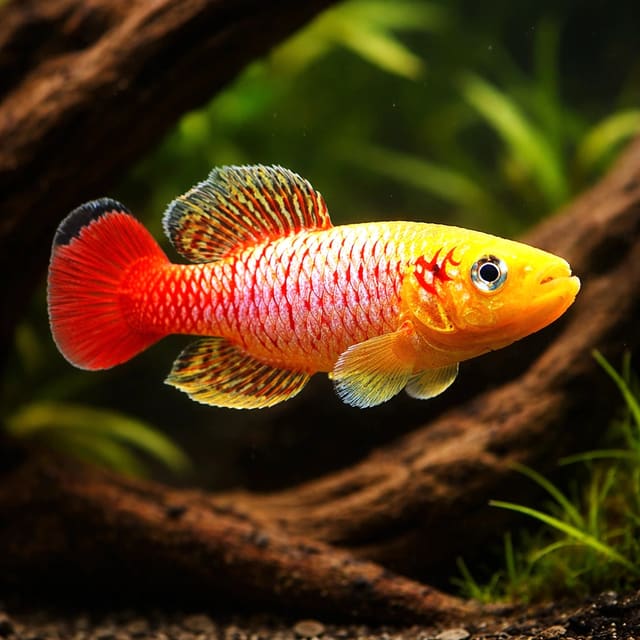
The reference photograph shows the kind of colour that makes this group so appealing: warm golden body tones, blue edging in the fins and strong male display colour when the fish is settled. Females are usually plainer and fuller-bodied, which is useful when planning a pair or trio.
Colour is heavily linked to condition. Warm stable water, good cover, a varied meaty diet and low stress will do more for colour than bright lighting. A dark base, floating plants and gentle side lighting usually show the fish better than a bare pale tank.
Austrofundulus transilis belongs to the South American rivuline killifish group. These fish are linked with seasonal waters rather than permanent high-flow rivers. In nature, annual killifish complete much of their life cycle around temporary pools: adults grow and spawn while water is present, and eggs can survive a dry period in the substrate before hatching when rains return.
That life history is the reason the species should not be sold as a casual community fish. It can be peaceful, but it is still a specialist animal with different priorities from tetras, barbs or standard livebearers. A secure, calm, species-focused setup is the safest route.
FishBase places Austrofundulus transilis in South America, specifically the Orinoco River basin in Venezuela. Seasonal killifish habitats are often shallow, warm, plant- or mud-influenced waters that can change dramatically through the year.
In the aquarium, imitate the stable part of that habitat rather than the dangerous extremes. Use warm clean water, subdued lighting, botanicals, roots, floating cover and a dark substrate. Peat or fine spawning media can be offered if breeding is intended, but do not allow old organic matter to foul the water.
This is a good choice for the keeper who enjoys observing specialist behaviour: courtship, substrate investigation, quick feeding responses and the intense colours of a well-conditioned male. It is a poor choice for a mixed beginner aquarium where the goal is simply to add another peaceful fish.
Before ordering, make sure the receiving aquarium is already mature, covered and warm. Have suitable food ready, ideally including frozen or live foods small enough to be eaten comfortably. If you intend to breed the fish, prepare spawning media before the fish arrive rather than improvising later.
Use a mature, covered aquarium of at least 60 litres for a pair or trio. More space is better if keeping extra females or more than one male. Provide broken sight lines using plants, floating cover, wood, leaf litter and spawning mops or suitable soft substrate areas. A bare tank may be easier to clean, but it rarely gives annual killifish enough security.
Filtration should be reliable but not violent. A sponge filter or guarded intake is useful, especially if breeding is attempted. The tank must have a tight lid because killifish are excellent jumpers, particularly during feeding, courtship, maintenance or sudden disturbance.
If using peat or coconut fibre for spawning, keep it contained and maintained. The goal is a clean spawning medium, not decaying debris across the whole aquarium. Many keepers use removable containers so eggs can be collected without dismantling the tank.
A practical aquarium target is 24-30 C with stable, clean water. FishBase lists the species as tropical at 24-32 C, so the previous local 18-24 C guidance was too cool for the source evidence. Avoid sudden shifts in temperature, pH or hardness.
Soft to moderately hard water can be used if it is stable and clean. Keep ammonia and nitrite at zero, nitrate low, and make small regular water changes. If you are conditioning fish for breeding, water quality and food quality matter more than chasing a single exact number.
Because annual killifish often come from seasonal waters, it is tempting to think they tolerate unstable aquariums. In the home tank, the opposite approach is safer: give them clean, predictable conditions while using habitat cues such as cover, substrate and food to encourage natural behaviour.
Feed a protein-rich killifish diet. Daphnia, mosquito larvae, bloodworm, black mosquito larvae, brine shrimp, grindal worms and similar frozen or live foods are all useful. Some specimens may accept high-quality micro-pellets or granules, but live and frozen foods should remain the foundation.
Offer small portions once or twice daily and remove uneaten food. Annual killifish can be eager feeders, but rich foods can pollute a small aquarium quickly if overused.
Conditioning foods should be varied. Repeating only bloodworm, for example, can leave gaps in nutrition and may foul the water if overfed. Rotate daphnia, brine shrimp, mosquito larvae and fine prepared foods, and watch the body shape of both males and females.
Venezuelan Killifish are best kept species-only or in a very carefully chosen specialist setup. Males can be assertive with each other, and females need places to get away from constant courtship. A trio or carefully structured group is usually easier than a cramped pair in a bare tank.
Avoid fast boisterous fish, fin nippers, large predators, hard-water species and anything that will outcompete the killifish for food. Small shrimp and fry may be eaten. If tank mates are used, choose calm fish of similar size and similar water needs, and watch feeding closely.
Male rivalry is the main social issue. A male may look spectacular when displaying, but that display can turn into chasing if the tank is too open. Dense cover and multiple visual barriers help females and subordinate fish rest.
Annual killifish are famous for their egg stage, but adult care is still the foundation. Keep adults in good condition, avoid stress, and do not assume every pair will spawn immediately. Some fish need time to settle, build body condition and accept the aquarium routine.
If you are not breeding, you can still keep the species well as a display fish. Just be realistic about lifespan and care: this is a specialist seasonal fish, not a long-lived community centrepiece.
FishBase identifies Austrofundulus transilis as a bottom spawner and notes difficult aquarium maintenance, with egg incubation around four months. That is classic annual-killifish territory: eggs are normally deposited into soft substrate or peat-like media and require a managed incubation period before wetting and hatching.
Breeding should be attempted only by keepers ready to collect, store and monitor eggs. Fry require very small live foods and excellent water quality from the first days. For most customers, the key is to keep the adult fish healthy, well fed and unstressed.
Label any stored eggs carefully with date, species and expected checking window. Annual killifish eggs are living material: too wet, too dry, too warm or forgotten containers can all lead to losses.
Dim the lights, float the sealed bag to equalise temperature, then add small amounts of aquarium water gradually. Because annual killifish can be sensitive after transport, avoid rushing the chemistry change and avoid adding transport water to the aquarium where practical.
Offer food only after the fish are settled and breathing normally. Live or frozen foods are often the best first meal after shipping.
Choose Venezuelan Killifish if you want a colourful, unusual annual killifish and you are prepared for specialist care. It is not the right fish for a general beginner community aquarium, a cool-water setup, or a tank with uncovered gaps.
When available, eligible livestock orders from Tropical Fish Co are packed carefully and supported by our Live Arrival Guarantee when the delivery and acclimation terms are followed.
No reviews for this item yet. Bought one? Honest reviews only, good or bad.
What customers say about ordering from us
I have a small group of long finned mountain minnows. So was delighted to be able to order ten of this variety to increase the genetics in my tank . The ones I recieved are healthy but it’s to early to give a verdict on wether they are of a long finned type since they are small currently.
Gordon Walker · 23 Sept 2026
100% success travel and "installation". Pleased with quality of purchase. The Siamese fighter a bit "shy" so have not yet seen him at his best yet but looking good. Happy customer. GG
George E Garratt · 21 Sept 2026
Reviews of our shop, collected by Judge.me, an independent third-party review collector. Newest first.