Aulonocara sp. 'Firefish' - Tropical Fish for Sale UK
24–28°C · pH 7.5–8.5 · 200L

Nothobranchius eggersi
A striking blue annual killifish from Tanzania, prized for its vivid color, compact size, and fascinating life cycle. Moderate care, semi-aggressive. 22-26C, pH 6.5-7.5.
Maintain these water conditions for optimal health and vibrant colors
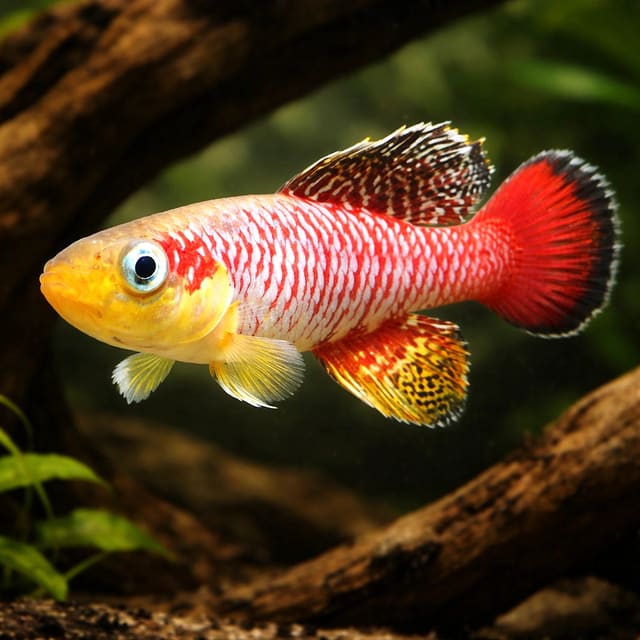
Egersi's Notobranch (Nothobranchius eggersi), also known as the orchid nothobranch, is a stunning, short-lived annual killifish endemic to the lower Rufiji River basin in Tanzania. This small, brilliantly colored species reaches just 3.5 cm in length and is prized by specialist killifish enthusiasts for its extraordinary color forms (including blue and red varieties) and fascinating life history. As an annual killifish, N. eggersi has evolved to complete its entire life cycle within a single rainy season, producing drought-resistant eggs that can survive extended dry periods in moist substrate before hatching when rains return. This unique biology, combined with breathtaking male coloration and relatively straightforward captive breeding, makes Egersi's Notobranch a rewarding species for experienced aquarists willing to embrace the challenges and rewards of annual killifish husbandry. Available for sale UK from specialist suppliers, this species is ideal for dedicated killifish keepers.
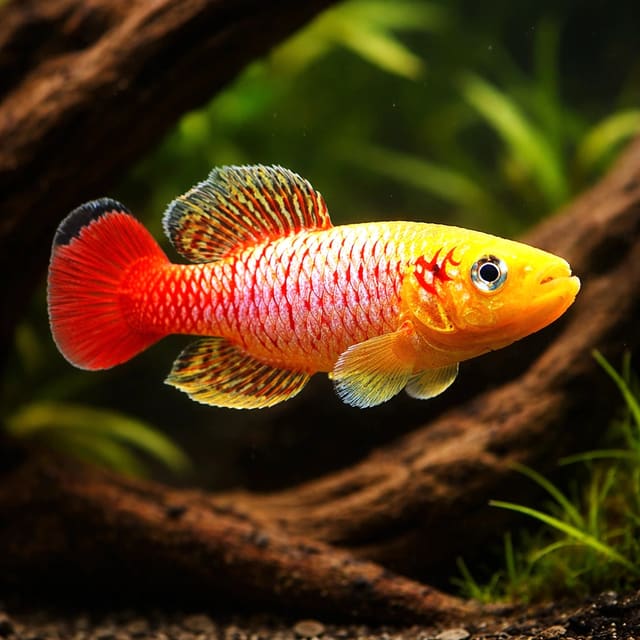
Nothobranchius eggersi exhibits extreme sexual dimorphism, with males displaying some of the most intense and varied coloration in the genus. Males are available in two primary color forms: the blue form displays a base color of electric blue to turquoise with red to orange-red markings on the flanks and fins, while the red form shows intense red to crimson coloration with blue iridescent highlights. Both forms possess ornately patterned unpaired fins—the dorsal, anal, and caudal fins are elongated, rounded, and edged with contrasting colors (often red, white, or yellow). The body is deep and laterally compressed, and the scales have an iridescent sheen that shimmers under subdued lighting. Females are far plainer, displaying a brownish-gray to olive coloration with minimal patterning and short, rounded fins. Males in breeding condition intensify dramatically in color, becoming almost luminescent. Color intensity varies with locality, diet, water quality, and individual genetics.
Nothobranchius eggersi is endemic to the lower Rufiji River basin in southeastern Tanzania, where it inhabits temporary pools, swamps, and floodplains that fill during the rainy season and dry completely during the dry season. These ephemeral habitats are shallow (often just 10-30 cm deep), heavily vegetated, and characterized by soft, acidic to neutral water with a substrate of mud, silt, and organic detritus. Water temperatures can be warm (24-28°C), and oxygen levels may fluctuate due to decomposition and dense vegetation. As an annual killifish, N. eggersi hatches with the onset of rains, grows rapidly, reaches maturity in 6-8 weeks, spawns continuously, and dies as pools dry up. Their eggs remain dormant in the dried substrate for months, surviving extreme conditions until the next rainy season triggers hatching. Understanding this life cycle is essential for successful captive breeding.
A minimum aquarium capacity of 40 liters is suitable for a small group or pair of Egersi's Notobranch, though dedicated species tanks of 20-40 liters are ideal for breeding. The tank should be moderately planted with fine-leaved species such as Java moss, Cabomba, or Myriophyllum, supplemented with floating plants to diffuse lighting and provide cover. A substrate of fine sand or peat (for egg collection) is recommended, though bare-bottom tanks are easier to maintain and monitor. Include driftwood and dried leaves (Indian almond or oak) to replicate the natural tannin-rich environment. Filtration should be very gentle—sponge filters or air-driven box filters are ideal to avoid strong currents that stress these calm-water species. Lighting should be subdued; these fish are most comfortable in dimly lit environments. A tight-fitting lid is absolutely essential, as killifish are excellent jumpers.
Egersi's Notobranch require soft to moderately hard water with neutral to slightly acidic chemistry. Maintain temperatures between 22-26°C, with 24°C being ideal; avoid prolonged exposure to temperatures above 27°C, as annual killifish have relatively short lifespans that can be further shortened by heat stress. The pH should range from 6.0-7.5, with neutral (pH 6.5-7.0) being optimal. Water hardness can vary from soft (3-8 dGH) to moderately hard (up to 12 dGH), providing some flexibility. Stability is critical—avoid sudden fluctuations in temperature or chemistry. Maintain zero ammonia and nitrite at all times, and keep nitrates below 20 ppm through regular small water changes (20-30% weekly). Excellent water quality is essential for these short-lived fish to reach their full potential and display peak coloration and breeding activity.
Nothobranchius eggersi is a strict carnivore, feeding in nature on small aquatic invertebrates, insect larvae, and microcrustaceans. In captivity, live and frozen foods are essential for maintaining health, color, and breeding condition. Offer daily feedings of small live and frozen foods such as daphnia, cyclops, baby brine shrimp, mosquito larvae (black and white), grindal worms, microworms, and vinegar eels. Bloodworms can be included 2-3 times per week but should not dominate the diet. High-quality micro pellets may be accepted, but live and frozen foods are strongly preferred and essential for breeding. Feed small portions 2-3 times daily, as these small fish have high metabolisms and benefit from frequent small meals. Remove uneaten food promptly to maintain water quality, and provide variety to ensure complete nutrition and vibrant coloration.
Egersi's Notobranch are classified as semi-aggressive, though their behavior is more accurately described as assertive and breeding-focused. Males are territorial toward one another, especially in smaller tanks, displaying to rivals with spread fins and vibrant color flashes. Serious physical aggression is rare if space and cover are adequate. A pair or small group with multiple females per male (1 male to 2-3 females) is ideal to distribute male attention and reduce stress on individual females. These fish are most active during daylight hours, constantly on the move exploring, feeding, and breeding. Males spend considerable energy displaying to females and pursuing spawning opportunities, which is a key part of their annual life strategy. They are not schooling fish but appreciate the presence of conspecifics. Due to their assertive nature and specific requirements, they are best kept in species-only setups.
Nothobranchius eggersi are best kept in dedicated species tanks where their unique needs, short lifespan, and breeding behavior can be fully accommodated. If tankmates are absolutely desired, they must be very small, peaceful, and non-competitive—however, even the most suitable companions (such as microrasboras or small peaceful tetras) can outcompete these slow, deliberate feeders for food. Avoid all large or boisterous fish, fin-nippers, aggressive cichlids, fast competitive feeders, and very hard-water species. Most shrimp and very small invertebrates will be eaten. The safest and most rewarding approach is a species-only tank where Egersi's Notobranch can be the sole focus, allowing full observation of their behavior, breeding, and stunning coloration without competition or stress.
Nothobranchius eggersi is an annual killifish that spawns continuously in captivity once mature, making breeding both rewarding and essential for maintaining the species. Condition breeding pairs or groups with high-quality live foods for 1-2 weeks, then house them in a breeding tank (20-40 liters) with soft to moderately hard water (pH 6.5-7.0, temperature 24°C), gentle sponge filtration, and dim lighting. Provide a substrate of fine peat moss, coconut fiber, or spawning mops as egg deposition media. Pairs will spawn daily, with the male courting the female and leading her to the substrate where eggs are deposited and fertilized. Eggs are collected weekly by sifting through the peat or removing mops and rinsing eggs into a container. Incubate eggs in moist (not wet) peat or substrate in a sealed container at room temperature (20-22°C) for 6-12 weeks, checking regularly for fungus. After the diapause period, flood the eggs with soft, cool water (20-22°C) to trigger hatching. Fry are relatively large and can accept newly hatched brine shrimp immediately. Feed 3-4 times daily and perform regular small water changes to support rapid growth. Fry reach maturity in 6-8 weeks and will begin spawning shortly thereafter.
Tropical Fish Co is the UK's trusted specialist source for rare and unusual killifish species, including healthy, line-bred Egersi's Notobranch in both blue and red color forms. Every fish is carefully conditioned on live and frozen foods, quarantined, and health-checked before dispatch to ensure you receive vigorous, disease-free specimens ready to thrive and breed. Our expert team provides detailed care guides, breeding advice, and ongoing support to help you successfully maintain and propagate these fascinating annual killifish. We offer a live arrival guarantee on all orders, backed by secure, insulated packaging and next-day courier delivery to your door. Whether you're new to annual killifish or an experienced breeder, our commitment to quality, ethical sourcing, and customer service ensures you receive the finest livestock available. Order your Egersi's Notobranch today and experience the unparalleled beauty and rewarding challenge of one of Tanzania's most spectacular aquarium species.
Healthy, vibrant fish from trusted suppliers
Detailed care guides and support
Your fish arrives healthy or we'll replace it
Properly quarantined and ready for your tank

24–28°C · pH 7.5–8.5 · 200L


24–28°C · pH 7.5–8.5 · 500L

24–28°C · pH 5.5–7 · 60L

22–28°C · pH 6.5–8 · 20L

22–26°C · pH 6–7.5 · 30L

22–28°C · pH 6–7.5 · 60L

24–28°C · pH 7.5–8.5 · 150L

22–28°C · pH 7.5–8 · 40L
22–28°C · pH 7–8.5 · 100L

22–27°C · pH 6–7.5 · 80L

24–28°C · pH 6–7.5 · 40L

24–28°C · pH 6–7.5 · 80L

24–28°C · pH 6.5–7.5 · 2000L
22–28°C · pH 7–8.5 · 60L

24–28°C · pH 7.5–8.5 · 200L