Moderate
Spotted Skiffia (Skiffia multipunctata)
18–24°C · 60L
£18.99

A tiny, peaceful South American livebearer ideal for planted nano aquariums and species-focused community setups. Moderate care, peaceful. 18-26C, pH 6.5-8.0.
Adult size is the maximum length this species reaches at full maturity (scientific sources). The livestock you receive will be younger and smaller. Product-photo provenance and any image-specific limitations are stated on the listing.
Cnesterodon decemmaculatus
Shoaling fish: kept in a group they feel safer, stay calmer and show their best colour.
Confirm your email, then we’ll send an availability message for this exact item if it returns within 180 days.
This request is only for this product—no newsletter or other promotions. A mail-provider retry may very rarely duplicate the same availability message. Unconfirmed addresses are removed after 48 hours. See our privacy policy.
A tiny, peaceful South American livebearer ideal for planted nano aquariums and species-focused community setups. Moderate care, peaceful. 18-26C, pH 6.5-8.0.
Adult size is the maximum length this species reaches at full maturity (scientific sources). The livestock you receive will be younger and smaller. Product-photo provenance and any image-specific limitations are stated on the listing.
Maintain these water conditions for optimal health and vibrant colors
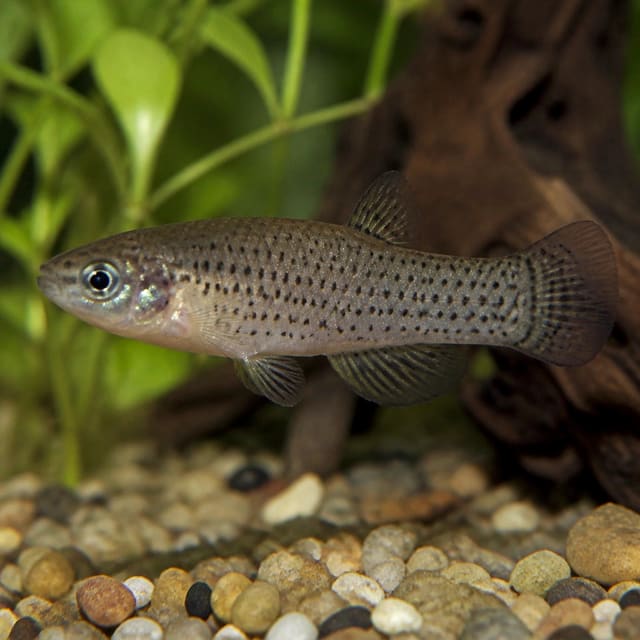
Ten-spotted Livebearer (Cnesterodon decemmaculatus) is a tiny South American poeciliid livebearer for planted, species-focused aquariums and calm nano-community setups. The fish supplied under SKU 6003 are normally around 1.5-2 cm, so this is a delicate small-fish choice rather than a bold centrepiece. Its appeal is subtle: a slim olive to silver body, clear fins, a pointed head and the dark flank markings that give the species its common name.
FishBase and Eschmeyer's Catalog of Fishes both support Cnesterodon decemmaculatus as a valid Poeciliidae species, with freshwater and brackish habitat use in southern South America. FishBase lists a small maximum size, up to about 3.6 cm standard length in males/unsexed fish and 4.5 cm total length in females, so adult planning should not be based on the 1.5-2 cm supply size alone.
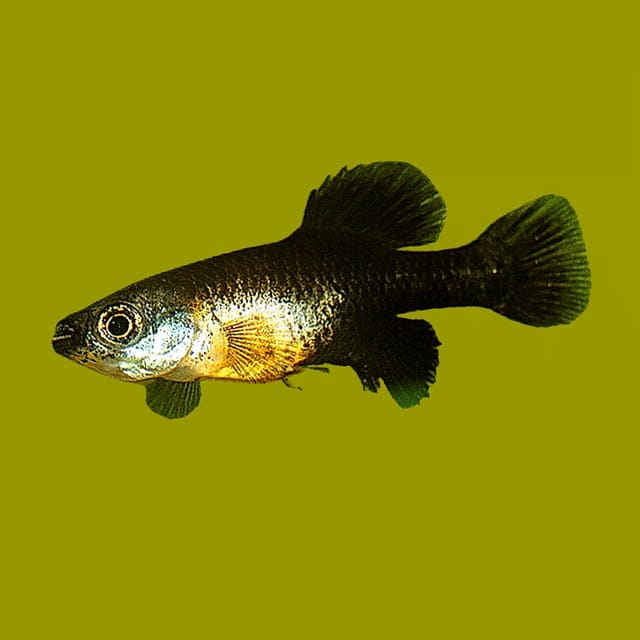
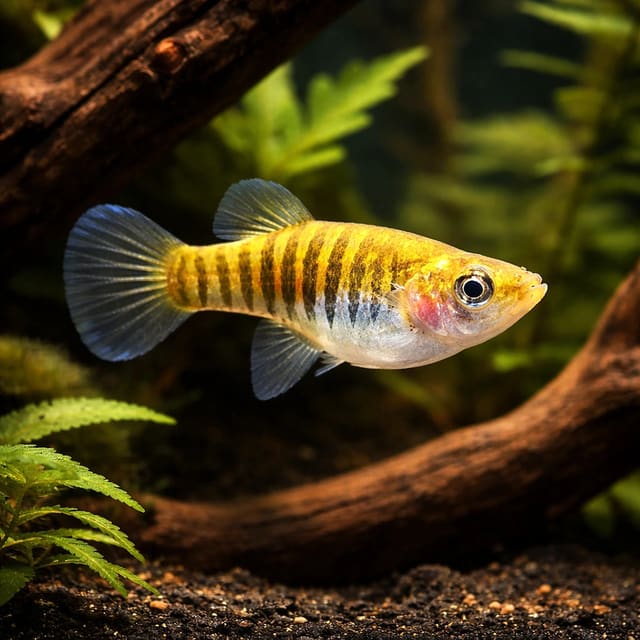
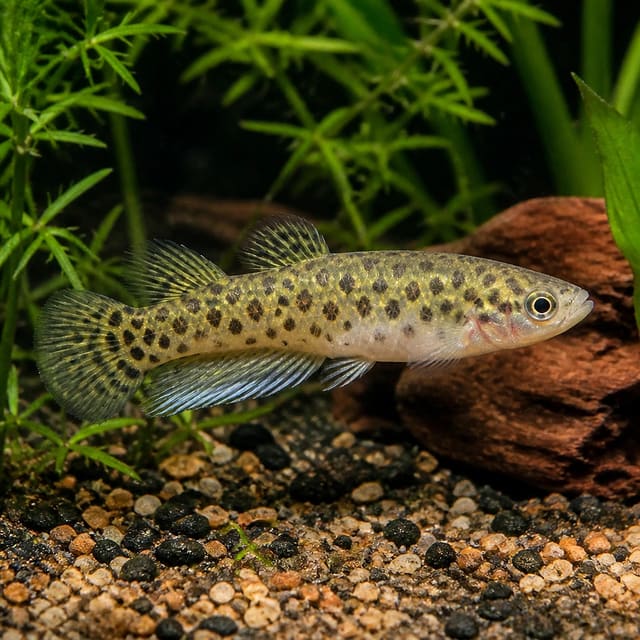
This page now includes the original reference photo for SKU 6003 alongside the existing aquarium-scene images. The source photo shows the slender livebearer profile, translucent fins, warm olive base colour and dark midline marks much more clearly than a decorative tank scene can.
The Ten-spotted Livebearer is not a heavy-bodied guppy or platy type. It is much finer, with a narrow body, small mouth and dark vertical to blotched markings running along the side. Colour is usually understated: olive, yellowish or silvery tones, clear fins and a soft sheen when the fish is settled. Females are usually larger and rounder, especially when gravid, while males remain smaller and show the modified anal fin typical of livebearers.
Because the fish is so small, condition is seen in details rather than dramatic colour. Look for clear eyes, an even body line, intact fins and steady grazing behaviour around plants. In a bright bare tank it can look pale and nervous; in a planted aquarium with a darker background and floating cover, the markings become easier to see and the group behaves more naturally.
Scientific references place Cnesterodon decemmaculatus in South America, including Argentina, Uruguay and southeastern Brazil, with FishBase listing lower Uruguay, Laguna dos Patos, Negro and Salado River basin records. Eschmeyer's Catalog also notes freshwater and brackish habitat. In practical aquarium terms, this means a hardy little livebearer that still benefits from mature, stable water, plant cover and careful acclimation.
This is best thought of as a temperate-to-low-tropical species rather than a fish for very hot community tanks. A stable room-temperature or gently heated aquarium is usually more appropriate than chasing high tropical temperatures. Avoid sudden swings, poor oxygenation and dirty water; small fish have small reserves, and weak water quality shows quickly.
A planted aquarium of around 60 litres or more is a sensible, stable starting point for a group. The species is small enough for compact aquariums, but the extra water volume gives better temperature and chemistry stability, which is more important than squeezing the fish into the smallest possible tank. Use fine substrate, live plants, floating cover, leaf litter or roots, and gentle filtration that keeps the water clean without pushing the fish around.
Good plants for this style of setup include Java moss, Java fern, Cryptocoryne, water sprite, hornwort and floating plants. Dense growth gives females and fry places to break line of sight, and it gives the group more feeding surfaces. Keep the tank covered, avoid boisterous tank mates, and leave open areas at the front so the fish can be observed without constant stress.
This is an omnivorous micro-feeder. Use a fine crushed flake, micro pellet or powdered prepared food as the staple, then rotate tiny frozen and live foods such as baby brine shrimp, daphnia, cyclops and mosquito larvae when available. The mouth is small, so large flakes and chunky frozen foods can be wasted and may pollute the aquarium before the fish can eat them.
Feed lightly once or twice daily and watch the group finish the food. A little natural algae and biofilm grazing is useful, especially in planted tanks, but it should not be the only food source. Overfeeding is a bigger risk than underfeeding with this species, because a small livebearer in a small planted aquarium can be affected quickly by ammonia, nitrite or rising nitrate.
The Ten-spotted Livebearer is peaceful, active and social, but it should not be treated as a general mixed-community filler. Keep it in a group so males spread their attention and the fish have confidence. Good companions are similarly tiny, calm species that will not outcompete them at feeding time: small peaceful livebearers, tiny rasboras, small killifish with compatible temperatures, peaceful snails and adult dwarf shrimp in a well-planted tank.
Avoid angelfish, larger tetras, cichlids, barbs, large gouramis, active danios and anything big enough to view a 2 cm livebearer as food. Also avoid mixing it into high-energy tanks where fast fish take every meal before the livebearers have settled. A quiet planted layout will show the species much better than a busy community aquarium.
Like other poeciliids, this species is viviparous: females give birth to live, free-swimming young rather than laying eggs. In good conditions, breeding is possible, but the fry are very small and need fine cover and tiny foods. Dense moss, floating plant roots and mature biofilm make a real difference. Adults may eat fry, so a separate rearing space is useful if you want to raise numbers reliably.
Do not buy this species only because it is small and breeds. The best results come from a stable group, careful feeding and patient observation. If you enjoy natural behaviour, subtle markings and small livebearers with a more unusual identity than the common guppy or platy, this is a rewarding specialist choice.
Order when your aquarium is fully cycled, stable and ready to receive small fish. Tropical Fish Co ships livestock with insulated packing, heat or cool control when required, and a Live Arrival Guarantee. New customers can use WELCOME10 for 10% off their first order where the code is eligible. If local weather is unsuitable for dispatch, we prioritise the fish and hold shipment until the route is safer.
No reviews for this item yet. Bought one? Honest reviews only, good or bad.
What customers say about ordering from us
I have a small group of long finned mountain minnows. So was delighted to be able to order ten of this variety to increase the genetics in my tank . The ones I recieved are healthy but it’s to early to give a verdict on wether they are of a long finned type since they are small currently.
Gordon Walker · 23 Sept 2026
100% success travel and "installation". Pleased with quality of purchase. The Siamese fighter a bit "shy" so have not yet seen him at his best yet but looking good. Happy customer. GG
George E Garratt · 21 Sept 2026
Reviews of our shop, collected by Judge.me, an independent third-party review collector. Newest first.