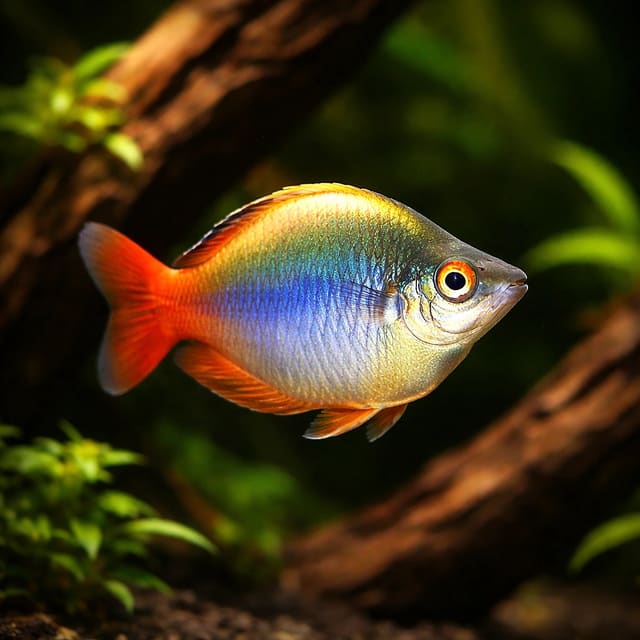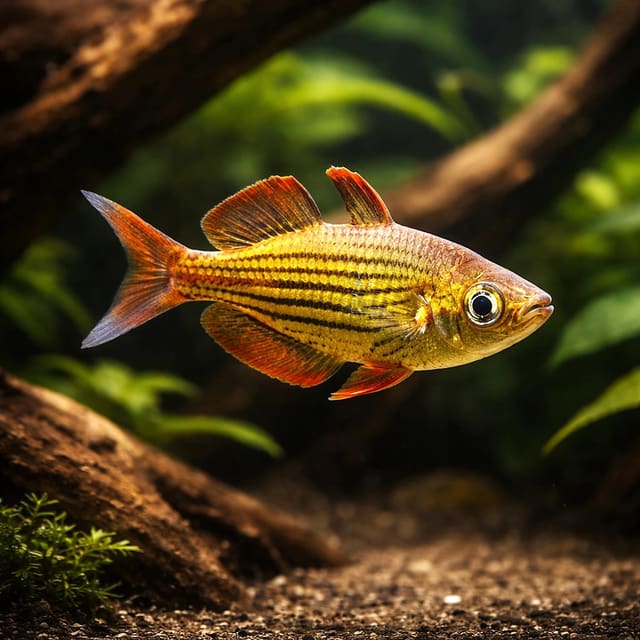
Forked-Tail Rainbowfish (Pseudomugil furcatus)
24–28°C · pH 7–8 · 54L
£5.99

A lively, brilliantly colored small rainbowfish that thrives in a peaceful shoal and adds constant movement to a planted community aquarium. Moderate care, peaceful. 22-26C, pH 6.5-7.8.
Adult size is the maximum length this species reaches at full maturity (scientific sources). The livestock you receive will be younger and smaller. Product-photo provenance and any image-specific limitations are stated on the listing.
Popondetta conniae
Shoaling fish: kept in a group they feel safer, stay calmer and show their best colour.
Confirm your email, then we’ll send an availability message for this exact item if it returns within 180 days.
This request is only for this product—no newsletter or other promotions. A mail-provider retry may very rarely duplicate the same availability message. Unconfirmed addresses are removed after 48 hours. See our privacy policy.
A lively, brilliantly colored small rainbowfish that thrives in a peaceful shoal and adds constant movement to a planted community aquarium. Moderate care, peaceful. 22-26C, pH 6.5-7.8.
Adult size is the maximum length this species reaches at full maturity (scientific sources). The livestock you receive will be younger and smaller. Product-photo provenance and any image-specific limitations are stated on the listing.
Maintain these water conditions for optimal health and vibrant colors
Popondetta Blue-eye Rainbowfish (Pseudomugil connieae) is a small, lively blue-eye rainbowfish from eastern Papua New Guinea. It is also traded as the Popondetta Rainbowfish, Connie's Blue-eye and, in older supplier lists, Popondetta connieae. The accepted scientific name is now Pseudomugil connieae, so this listing uses the current name while keeping the older trade wording where it helps customers recognise the fish.
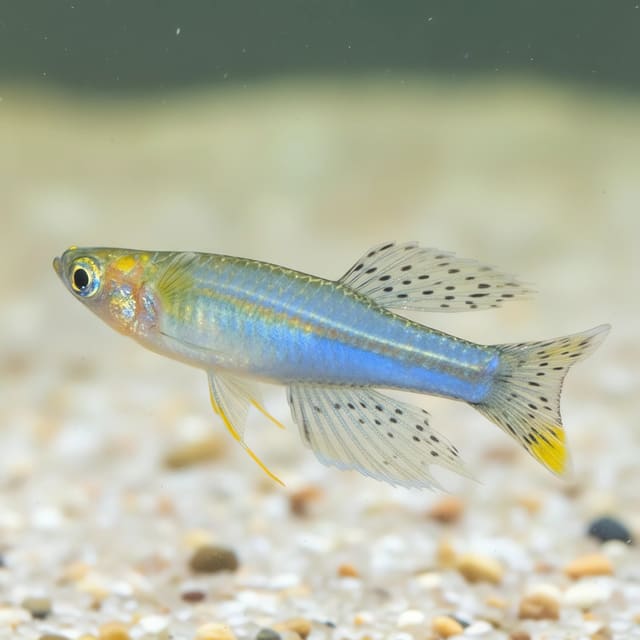
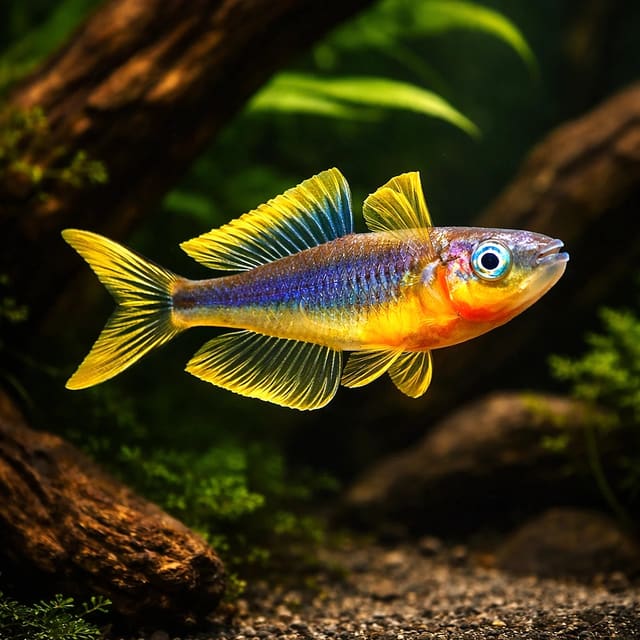
This is a bright, fast-moving species for a mature planted aquarium. Adult males show a slim golden body, a dark lateral stripe, clear blue eyes and yellow fins edged with black. Females are usually smaller and subtler, but the whole group looks best when kept together because the males display naturally without becoming rough. Our current size is approximately 2.5-3.5 cm.
Pseudomugil connieae is a restricted-range fish from the Popondetta area of eastern Papua New Guinea. Source references describe it from clear, moderate to fairly rapid streams, including shaded rainforest sections and more open, sunlit stretches. Those habitats are warm, oxygen-rich and usually have plant cover, leaf litter, sand or gravel, and enough current to keep the water fresh.
That background is useful in the aquarium. This is not a fish for a new, unstable tank or stagnant water. It does best when the aquarium is mature, clean, well-filtered and planted, with open swimming room in the centre and cover around the edges. Floating plants can soften bright light, but leave some surface access because blue-eyes feed confidently in the upper and middle water.
The Popondetta Blue-eye is a small fish, but it is not plain. A healthy male has a streamlined body, a dark horizontal stripe, yellow to golden fin colour and black markings through the dorsal, anal and tail fins. The blue eye is one of the main reasons this group of fishes is called blue-eyes. Under good aquarium lighting the body can show subtle gold and green highlights rather than the heavy block colour seen in larger rainbowfish.
Colour depends on age, sex, condition and stress level. Newly arrived fish may look paler at first, especially after transport. Once settled into a planted group, males usually colour up during feeding and display. A mixed group gives the most natural behaviour and prevents one male from placing constant attention on a single female.
Use a planted layout with a dark or natural substrate, fine-leaved plants, mosses, roots or smooth wood, and a clear swimming lane. The tank should have good oxygenation and gentle to moderate flow. A small internal filter, external filter or sponge-filter setup can work as long as the water stays clean and does not blast the fish around the tank.
A secure lid is strongly recommended. Small rainbowfish and blue-eyes can jump when startled, during feeding, or when males are displaying near the surface. Keep the aquarium fully cycled before adding them, then maintain steady water quality with regular water changes and careful feeding. They are small fish, so uneaten food breaks down quickly if portions are too large.
Popondetta Blue-eyes are omnivores that do best on small, varied foods. Use fine high-quality flakes or micro pellets as the staple, then rotate in frozen or live foods such as cyclops, daphnia, baby brine shrimp, microworms and finely chopped bloodworm. Their mouths are small, so crush larger foods rather than expecting them to tear pieces apart.
Feed lightly once or twice a day. The best routine is small portions that are eaten quickly, with extra live or frozen foods used to condition the group and bring out colour. A varied diet supports fin quality, breeding condition and stronger display behaviour in males.
This is a peaceful, active shoaling fish. It suits calm community aquariums with other small species that will not outcompete it at feeding time. Good companions include small rasboras, gentle tetras, small Corydoras, Otocinclus, other peaceful blue-eyes or small rainbowfish, and peaceful snails. Adult dwarf shrimp can work in a well-planted tank, but very small shrimplets may be eaten.
Avoid large predatory fish, fin-nipping barbs, aggressive cichlids, boisterous livebearers and anything likely to dominate the upper water. The group is quick and alert, but it is still a small species that relies on cover and numbers for confidence.
Popondetta Blue-eyes are egg scatterers that attach small eggs to fine plants, moss or spawning mops. Adults do not guard the eggs and may eat eggs or fry, so breeders usually move eggs to a separate rearing container or use a dense planted colony tank where some fry can survive. Newly hatched fry are tiny and need very small first foods before moving onto baby brine shrimp.
Breeding is possible, but the priority for most keepers should be a stable adult group: clean water, varied food, plant cover and low stress. When those basics are right, display and spawning behaviour often follow naturally.
Every live-fish order is packed for courier travel and covered by our Live Arrival Guarantee when the delivery instructions are followed. First-time customers can use WELCOME10 at checkout where the promotion is active. Please check your local water, tank maturity and tank mates before ordering; this species rewards careful preparation with constant movement and beautiful natural display.
No reviews for this item yet. Bought one? Honest reviews only, good or bad.
What customers say about ordering from us
I have a small group of long finned mountain minnows. So was delighted to be able to order ten of this variety to increase the genetics in my tank . The ones I recieved are healthy but it’s to early to give a verdict on wether they are of a long finned type since they are small currently.
Gordon Walker · 23 Sept 2026
100% success travel and "installation". Pleased with quality of purchase. The Siamese fighter a bit "shy" so have not yet seen him at his best yet but looking good. Happy customer. GG
George E Garratt · 21 Sept 2026
Reviews of our shop, collected by Judge.me, an independent third-party review collector. Newest first.