Easy
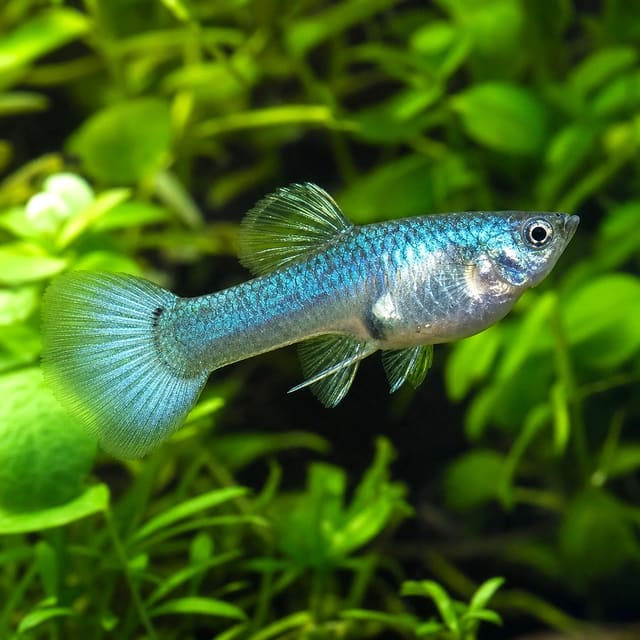
Blue Moscow Male Guppy (Poecilia reticulata)
22–28°C · pH 7–8 · 45L
£4.09
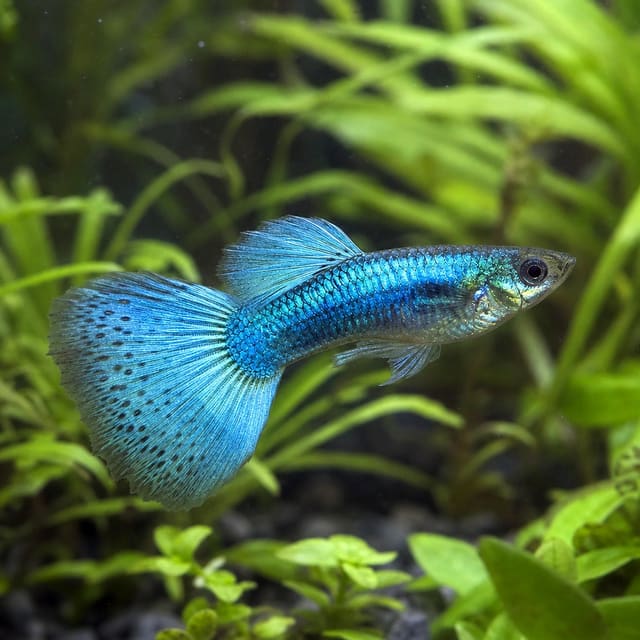
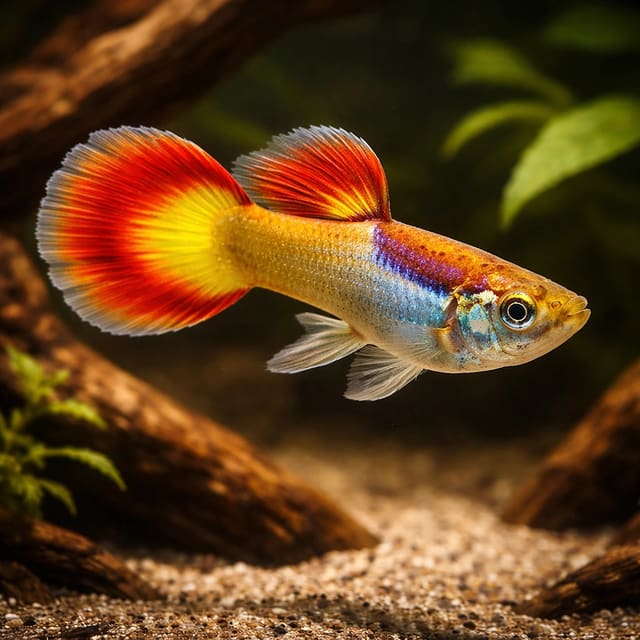
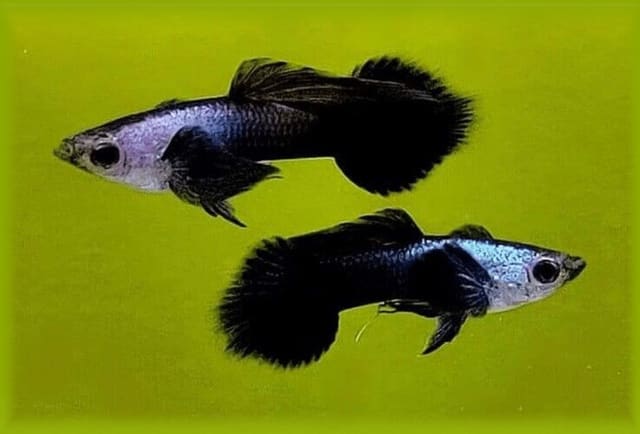
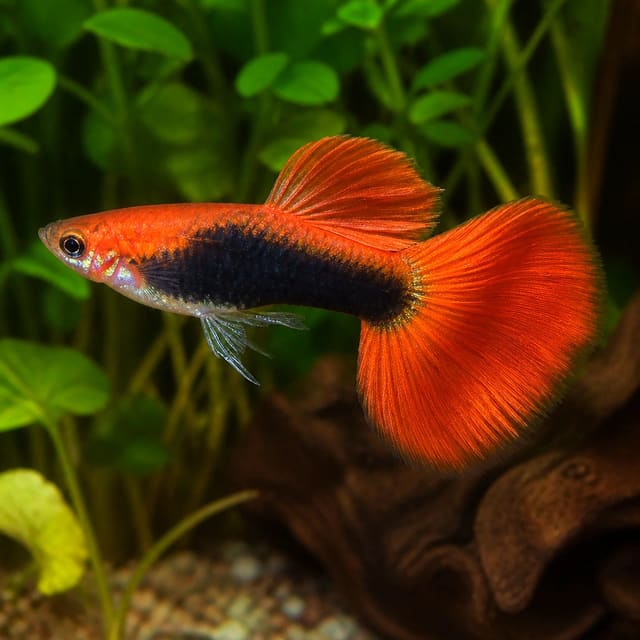
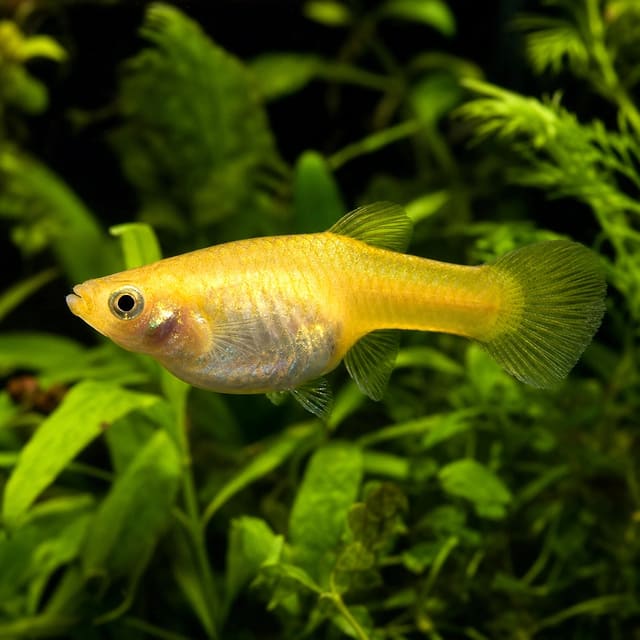
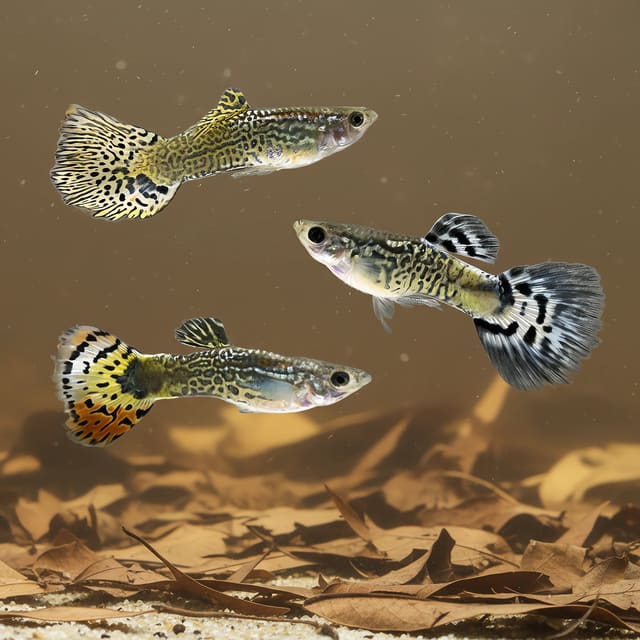
Blue Mix Guppy (Poecilia reticulata) is a colourful male guppy with blue tones and long, flowing fins, sold as one male per purchase at about 3–4 cm. It suits a mature, peaceful community aquarium at 22–28 °C with neutral to alkaline, medium-hard water, well away from fin-nipping fish.
Shoaling fish: kept in a group they feel safer, stay calmer and show their best colour.
Minimum of 2 per order.
Blue Mix Guppy (Poecilia reticulata) is a colourful male guppy with blue tones and long, flowing fins, sold as one male per purchase at about 3–4 cm. It suits a mature, peaceful community aquarium at 22–28 °C with neutral to alkaline, medium-hard water, well away from fin-nipping fish.

Guppies are social livebearers suited to a prepared beginner, not a fish-per-litre formula. Use a mature filtered aquarium, tested neutral-to-alkaline mineral-bearing water, deliberate sex and population planning, open swimming room, cover and a separation option.
Maintain these water conditions for optimal health and vibrant colors
The Blue Mix Guppy is a male of Poecilia reticulata, the common guppy, chosen for blue colouring and the long, flowing fins that make male guppies the showier sex. Each purchase supplies one male, graded at about 3–4 cm. Guppies are peaceful, active livebearers for a mature community aquarium with neutral to alkaline, medium-hard water, and their fins make them a target for fin-nipping fish, so choose the neighbours with care.
| Suits | A prepared beginner or experienced keeper with a mature, peaceful community aquarium |
|---|---|
| Sold as | One male per purchase, about 3–4 cm |
| Adult size | Males up to 5 cm standard length; females grow larger |
| Water | 22–28 °C, pH 7.0–8.0, 8–18 dGH |
| Tank | At least 60 cm long for a small group |
| Group | Five or more, as an all-male group or with at least two females per male |
| Avoid | Fin-nippers such as tiger barbs and serpae tetras |
Guppies come from warm, weedy waters in Venezuela, Trinidad, Barbados, northern Brazil and the Guianas, where they thrive in a remarkable range of habitats. Their toughness in the wild does not carry over to every bred line: Seriously Fish notes that many commercially bred guppies are less robust because of inbreeding and over-production, so a stable, mature aquarium matters from the first day.
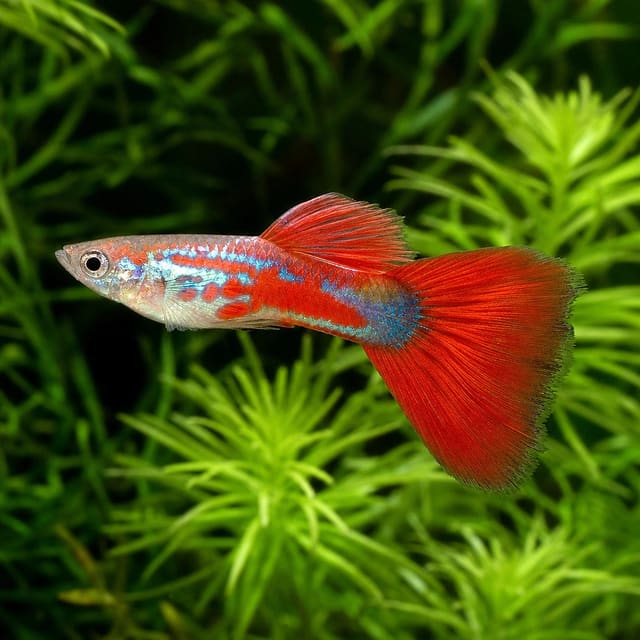
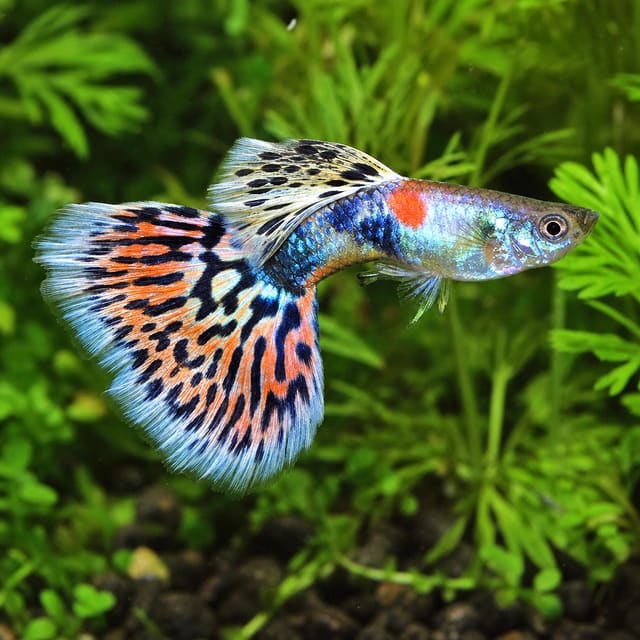
Blue Mix is a trade colour label rather than a fixed strain. Like Moscow, Cobra, Tuxedo or Delta, it describes how the fish looks, not a separate species or a pedigree, so the exact shade, spotting and tail shape vary from one male to the next. Selectively bred guppies take the wild male's colour and elongated finnage to extremes, which is why aquarium males look so different from the wild-type fish.
Male guppies are the easier sex to recognise. A mature male has a gonopodium, a narrow, stick-like anal fin used in breeding, while the female's anal fin is broader and triangular; females are also larger and plumper. Sex is guaranteed only when the exact product or selected option explicitly states male or female. This Poecilia ret. male blue mix listing is sold as male.
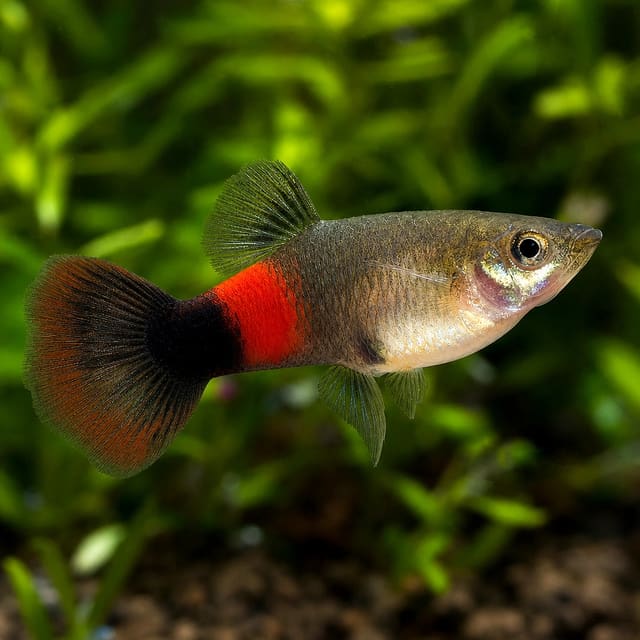
Gallery images have been digitally enhanced to improve image quality. Natural colour, pattern, size and maturity can vary between live animals. Colour can also look deeper or paler as a fish settles into new water.
Buying males lets you decide the shape of your group rather than leaving it to chance.
Male guppies are the smaller sex, and FishBase records them up to 5 cm standard length, so their long fins shape their care more than their size does: calm water, smooth decor and peaceful neighbours matter most.
Our full guppy care guide covers the species in depth, and the guppy range shows the other colours and sexes we stock.
FishBase records the guppy as a native of Venezuela, Barbados, Trinidad, northern Brazil and the Guianas, in the family Poeciliidae. Wild guppies live in an unusually wide range of places: warm springs and their outflows, weedy ditches and canals, turbid ponds in the lowlands and clear mountain streams higher up, usually in small streams and densely vegetated water where predators are few. FishBase notes that they need fairly warm temperatures, around 23–24 °C, and quiet vegetated water to survive, and that they feed on zooplankton, small insects and detritus.
The accepted scientific name is Poecilia reticulata Peters, 1859, with its type locality recorded as the Guayre River at Caracas in Eschmeyer's Catalog of Fishes. The everyday name guppy survives from Girardinus guppii, a later name now treated as a synonym.
The guppy is one of the most popular aquarium fishes in the world, with many standardised varieties, and it is used in genetics research. Males mature at about two months of age and females at about three. Wild fish are mainly insect-eaters, but modern tank-bred fish are far removed from their ancestors and accept most foods. The wild form is seldom seen in the aquarium trade.
Guppies have been released widely outside their native range, mainly for mosquito control. FishBase reports rare to non-existent effects on mosquitoes and negative to perhaps neutral effects on native fishes, which is one reason the release rule in this guide matters.
The published figures for guppy tanks differ, so it helps to see them side by side.
| Figure | What it covers |
|---|---|
| 45 × 30 cm base, about 41 litres | Seriously Fish minimum for the species |
| At least 45 litres | OATA, for a small group of the smaller livebearers |
| 60 cm minimum length | FishBase aquarium note, with a group of five or more |
We plan on the most cautious of these: a mature, filtered aquarium at least 60 cm long for one small guppy group. Length gives long-finned males room to swim, and litres alone cannot tell you whether a tank suits a particular group, its sex mix or its tank mates. The more groups you add, the larger the aquarium needs to be, and a bigger tank holds its temperature and water quality more steadily.
A filter is essential in every aquarium. For a 41-litre tank, Seriously Fish suggests a filter rated around 165–205 litres per hour, turning the water over four to five times an hour, and a heater of roughly 50 W in a room at about 20 °C. In an ordinary UK home, use a thermostatically controlled heater wherever the room cannot keep the water in range, and check the water with a separate aquarium thermometer rather than trusting the dial. If the aquarium is new, our guide to setting up and maturing a first tropical tank explains how to cycle the filter before any fish arrive.
| Value | Routine target |
|---|---|
| Temperature | 22–28 °C |
| pH | 7.0–8.0 |
| General hardness | 8–18 dGH |
| Carbonate hardness | 5–15 dKH |
| Ammonia and nitrite | Zero |
| Nitrate | No more than 20 mg per litre above tap water |
The temperature is the routine range in our guppy care guide. The pH, hardness and nitrogen figures come from OATA's care sheet for guppies and mollies together, which is broad guidance for the group rather than a guppy-only optimum. The Seriously Fish guppy profile adds the most useful practical point: this is a hard-water fish, and although it may manage in soft or acidic water, it should be kept long term in moderately hard or harder water.
Seriously Fish gives 17–28 °C, pH 7.0–8.5 and 8–30 dGH, and FishBase records 18–28 °C, pH 7.0–8.0 and 9–19 dH across the places wild guppies have been found. Those ranges show how tough the species is, not where to set your heater. The cool end in particular is a tolerance, not a routine target.
Our guide to which water values to test and why explains each reading, and the water parameter matcher compares your own results with these targets.
Much of what makes a male guppy special also makes him vulnerable. Selective breeding has pushed male finnage to extremes, and those fins need a little extra thought.
A male in good condition carries his fins open and spread. Clamped or ragged fins are worth investigating the same day.
Guppies are omnivores that will take most food types, so a good diet is simple: a quality staple with some variety alongside it.
OATA advises feeding guppies only what they can eat within a few minutes once a day. Treat that as a starting point and adjust to the fish in front of you: different ages, foods and filtration can call for a different rhythm, and our guppy guide deliberately avoids one fixed timetable. What matters every time is that no food is left to rot, because uneaten food breaks down and releases toxic waste into the water.
In a mixed community, check that the long-finned males get their share before quicker tank mates clear the food, and lift out anything left over once feeding is done.
Guppies can be stressed by even the smallest amounts of ammonia, so good husbandry is the heart of their care. The OATA guppy and molly care sheet keeps the routine short.
| Task | When and how |
|---|---|
| Partial water change | 25%, at least once every week, siphoning waste from the gravel |
| Water test | At least once a week, for ammonia and nitrite in particular |
| New water | Always treated with tap water conditioner first |
| Filter | Checked for blockages; media rinsed lightly in old tank water, never under the tap |
Tap water can carry chlorine or chloramine, which can kill the helpful bacteria living in the filter media. Those bacteria are the aquarium's waste system: as the RSPCA explains, fish release toxic ammonia, bacteria convert it to nitrite, which is also toxic, and then to nitrate, which is safer.
The bacteria grow to match the waste they are given. Add fish a few at a time and let the filter catch up between additions; stocking too fast leads to new tank syndrome, when ammonia and nitrite climb and fish can become ill or die. This matters even more with guppies, because a mixed group can add fry to the load without warning.
Get the aquarium ready before you order: mature, filtered, at a steady temperature and testing at zero ammonia and zero nitrite. We hand-pack each fish in a bag of pure oxygen inside an insulated box, adding a heat pack when the weather calls for it, and a licensed live-animal courier carries it on a tracked service. You receive the tracking number and confirmed delivery date by email. Our delivery and Live Arrival Guarantee terms set out the full conditions.
Watch quietly for the signs of a healthy guppy: clear bright eyes, undamaged fins, intact scales, no ulcers or bumps, and normal swimming. If a new male hides constantly, clamps his fins or gasps at the surface, test the water straight away rather than putting it down to the journey.
A settled guppy swims steadily, breathes regularly, holds its fins open and undamaged, keeps a normal body shape and feeds every day. Because bred lines vary in robustness, it pays to know the warning signs and act on them early.
These are signs, not a diagnosis. Test ammonia, nitrite, nitrate, pH and temperature at once, check the filter, heater, recent maintenance and any new arrivals, and note what you see with dates or photos. The RSPCA fish health guidance covers normal and concerning signs, and OATA keeps a directory of UK fish vets for a proper diagnosis. Do not reach for salt, heat or medication on the strength of one symptom; in the UK, use lawful labelled products and follow veterinary direction.
If you already keep fish, a separate quarantine tank with its own equipment and a matured filter protects them. The MSD Veterinary Manual recommends at least 30 days of isolation, longer where needed.
Guppies are livebearers and breed very easily. A male on his own cannot start a family, but the moment he shares a tank with females, fry become likely.
Decide where young fish will live, what they will eat and who will take them before adding females to a male group. A nursery should be a separate, filtered and tested system, not a small uncycled container. Letting adults or tank mates eat the fry is not a population plan.
Despite the enormous range of colours, OATA points out that guppies are only ever one of two species. The traditional guppy, Poecilia reticulata, is the larger at about 5 cm. Endler's livebearer, Poecilia wingei, is the smaller species at around 2.5 cm and was formally described as a distinct species from the Paría Peninsula of Venezuela.
The two can interbreed: laboratory research has produced hybrids through the first and second generations. Keep them in separate aquariums if you want either line to stay true, and remember that a hybrid is not a pure example of either parent.
Strain names work the same way for both. Blue Mix, Moscow, Cobra, Snakeskin, Tuxedo, Mosaic, Delta and Sword describe selected colour or fin shapes, and none of them is a separate species or a promise of pedigree, sex or temperament. For guppies, only the listing itself confirms the sex, which for this fish is male.
Guppies have been introduced far beyond their native range and have become established in many places outside it. Never release guppies, fry, plants, snails or aquarium water into a pond, stream, surface-water drain or any natural waterway. Rehome unwanted fish through another keeper or a shop, and dispose of old water and substrate where nothing living can reach a watercourse.
Seriously Fish describes the guppy as a very peaceful fish that does well in a quiet community tank. OATA's rule is short: guppies should not be kept with any species that might nip their fins, such as barbs, and a male's long tail is an obvious target.
| Companion | Guidance |
|---|---|
| Other livebearers | Good company in a quiet community |
| Rasboras and peaceful tetras | Good choices when they do not nip fins |
| Corydoras and small loricariid catfish | Good choices for the lower levels |
| Bettas | Caution: display, territorial and long-fin interactions vary by individual |
| Small shrimp | Caution: small shrimp and young may be eaten |
| Tiger barbs, serpae tetras and other fin-nippers | Avoid |
| Fish big enough to swallow or injure a guppy | Avoid |
Platies, mollies and corydoras are often suggested as guppy companions, and some pass in a suitably sized aquarium, but check each species' own adult size and needs rather than relying on a family name.
No species name guarantees a peaceful match, so run through these points before adding anything:
Guppies need companionship. OATA suggests at least three kept together, and FishBase gives groups of five or more for aquarium keeping. Our own advice is five or more wherever the tank, the filter and the sex plan allow.
| Group | What to expect |
|---|---|
| All male | No new mating inside the group, but display and chasing can become persistent and long fins can be damaged |
| Mixed sexes | Natural courtship and likely fry; OATA suggests two females to each male, and more fish only in the same ratio |
Repeated pursuit, hiding, missed meals or fin damage mean the plan needs to change. Adding another fish is rarely the answer.
FishBase records a maximum of 5 cm standard length for male guppies, measured to the base of the tail, so a long-finned male looks larger overall. Females are the bigger sex, and Seriously Fish gives 60 mm standard length for the species.
Seriously Fish gives a tank base of 45 × 30 cm, about 41 litres, and OATA recommends at least 45 litres for a small group of the smaller livebearers. FishBase suggests a minimum aquarium length of 60 cm, and that more cautious figure is the one we use for a small guppy group in a mature, filtered tank.
Guppies need company. FishBase suggests groups of five or more and OATA at least three. With males you can keep an all-male group, which avoids new breeding but still needs watching for chasing, or add at least two females for every male and plan ahead for fry.
It suits a prepared beginner. OATA describes most guppies as undemanding and easy to keep, but they still need a fully cycled, filtered aquarium with zero ammonia and nitrite, a steady temperature, a planned group and a plan for chasing, illness or fry.
Guppies are omnivores that take most foods. Use a good-quality flake or granule with a high algae content as the staple, add small live or frozen foods such as daphnia or small bloodworm, and feed only what the group eats within a few minutes once a day, as OATA suggests.
Keep it at 22–28 °C, the routine range in our guppy care guide, with pH 7.0–8.0 and general hardness of 8–18 dGH from OATA's broad guidance for guppies and mollies. Seriously Fish describes it as a hard-water fish best kept long term in moderately hard or harder water.
No. Seriously Fish calls the guppy a very peaceful fish, and the risk usually runs the other way: its long fins attract fin-nippers such as tiger barbs. Males can still chase females or each other persistently, so check that every fish can feed and rest.
Seriously Fish lists other livebearers, rasboras, corydoras, small loricariid catfish and tetras as good company in a quiet community tank, provided none of them nips fins. Avoid fin-nippers such as tiger barbs and serpae tetras, and anything big enough to swallow or injure a guppy. Small shrimp and fry may be eaten.
It is hand-packed in a bag of pure oxygen inside an insulated box, with a heat pack when the weather calls for it, and carried by a licensed live-animal courier on a tracked service. Someone needs to be in to receive it, and the parcel must be opened and inspected the same day. Film one continuous unboxing video from the sealed parcel to the fish in its bag, then float the bag for 20–30 minutes before releasing the fish, never pouring the bag water into your tank. For a Live Arrival Guarantee claim, contact us that same day with your order number and the video.
Independently collected by Judge.me from customers who bought this item. All reviews are shown.
Slowly acclimatised them like with shrimp, majority have caught white spot, and now spread to my existing fish, the conditions in my tanks are perfect. Its been a nightmare trying to keep under control, not sure if il be buying from this place again.