Moderate
Somalia Nothobranch (Nothobranchius patrizii)
23–26°C · pH 6–7
£7.99

East African annual killifish supplied at 2.5-3.5 cm. Best species-first with small live/frozen foods, soft spawning media and planned egg incubation.
Adult size is the maximum length this species reaches at full maturity (scientific sources). The livestock you receive will be younger and smaller. Product-photo provenance and any image-specific limitations are stated on the listing.
Nothobranchius palmqvisti
Save when buying multiple fish. Each quantity is one fish; sex and pair formation are not guaranteed unless the selected variant explicitly states them.
Confirm your email, then we’ll send an availability message for this exact item if it returns within 180 days.
This request is only for this product—no newsletter or other promotions. A mail-provider retry may very rarely duplicate the same availability message. Unconfirmed addresses are removed after 48 hours. See our privacy policy.
East African annual killifish supplied at 2.5-3.5 cm. Best species-first with small live/frozen foods, soft spawning media and planned egg incubation.
Adult size is the maximum length this species reaches at full maturity (scientific sources). The livestock you receive will be younger and smaller. Product-photo provenance and any image-specific limitations are stated on the listing.
Maintain these water conditions for optimal health and vibrant colors
Palmquist's Nothobranch (Nothobranchius palmqvisti) is a compact East African annual killifish supplied here at approximately 2.5-3.5 cm. It is a vivid, specialist species with a short natural life cycle, bright male colour and a breeding strategy built around seasonal pools that dry and refill. The scientific spelling is palmqvisti, with qv, even though the common-name spelling is usually written Palmquist's Nothobranch.
FishBase lists Nothobranchius palmqvisti from Kenya and Tanzania, reaching about 5 cm total length, and occurring in temporary pools in floodplains, swamps and temporary ditches. It is a bottom spawner, with eggs hidden in the substrate and incubated for roughly 2-4 months. That annual-killifish biology is the core of the listing: this fish is not just a colourful community extra, it is a seasonal-pool species best kept by aquarists who enjoy specialist care and breeding projects.
Choose Palmquist's Nothobranch if you want a small fish with strong colour, fascinating breeding behaviour and a real project behind it. It suits keepers who can provide a quiet species-first aquarium, small meaty foods, gentle filtration, a tight lid and a plan for eggs if they want to keep the line going. It is not the right choice for a busy mixed tank where fast feeders take all the food, or for anyone expecting a long-lived community fish.
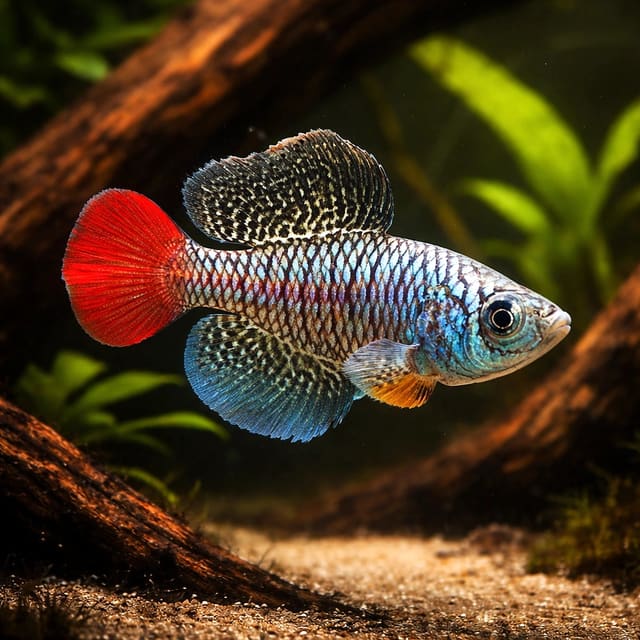
The original reference photo has been added as an additional image for this SKU. It shows the classic male notho look: a compact body, metallic blue-green sheen across the front half, red patterning through the body, spotted unpaired fins and a strong red tail. Females are normally plainer, tan to grey-brown, and should not be judged against the colour of a mature male.
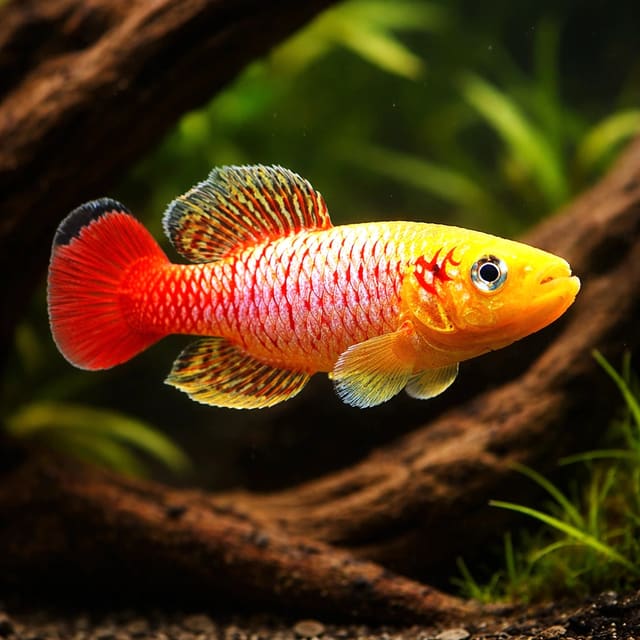
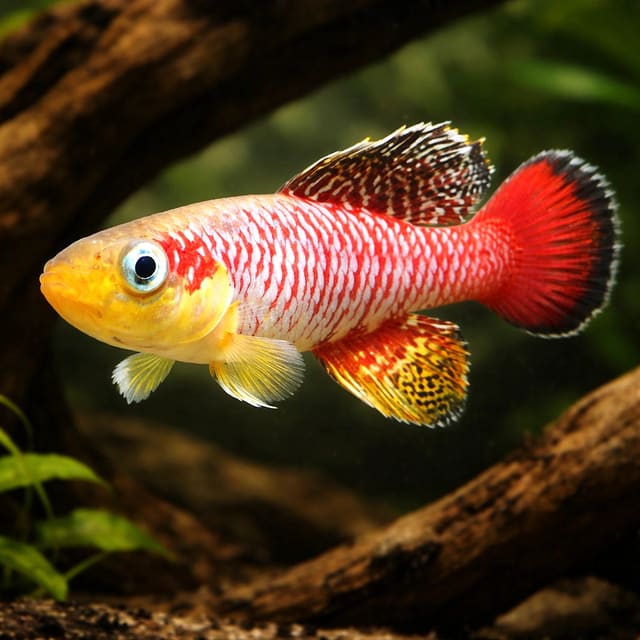
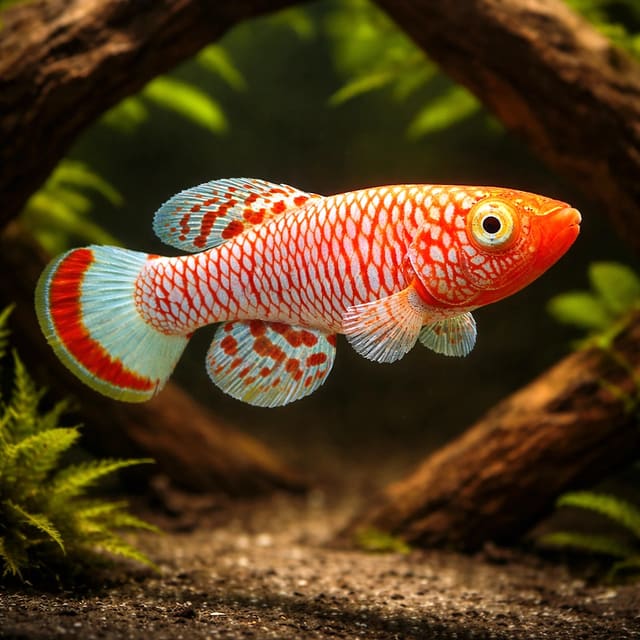
The existing planted-aquarium gallery images remain in place as supporting presentation images. They help show aquarium context and scale, while the source photo anchors the listing to the actual supplier line.
Nothobranchius palmqvisti comes from East African seasonal waters. These pools and ditches appear with rain, hold fish for a brief wet period, then dry again. Adults live fast, feed heavily and spawn into the bottom. The eggs survive in damp substrate while the adult fish disappear with the drying water, then hatch when rain returns.
In aquarium terms, that means the fish should be given a calm, mature setup, not a high-flow display tank. It appreciates cover, a soft spawning area, dimmer corners and steady water quality. The fish may be easy to maintain once settled, but breeding and keeping the line going require specialist attention.
A 40 litre aquarium can work for a pair or trio, but a larger tank gives more stability and room for groups. Use gentle filtration, a secure lid and a layout with Java moss, floating plants, fine-leaved cover and a removable spawning container. Many keepers use peat, coir, fine sand or a similar soft medium so eggs can be collected and incubated separately.
Keep lighting moderate rather than harsh. Darker substrate and plant cover help males show better colour and reduce stress. Avoid strong current; this is a temporary-pool fish, not a river specialist. The tank should be mature before the fish arrives, with zero ammonia and nitrite and a regular small-water-change routine.
Use 20-24 C as the practical routine range. FishBase field-guide data gives pH around 6.5-7.0 and hardness around 4-10 dH, while hobby breeding reports show the species can breed across neutral to moderately hard water when conditions are stable. The safest advice is to avoid extremes and sudden swings. Stable, clean water matters more than chasing a narrow number.
Nothobranchius have a fast metabolism and benefit from frequent small feeding, so do not let waste accumulate in a small aquarium. Siphon lightly around feeding areas and spawning containers, refresh water in small steady changes, and keep the filter mature. If using peat or botanicals, rinse and prepare them sensibly so the water does not swing suddenly.
This is a carnivorous annual killifish. Offer small live and frozen foods such as daphnia, baby brine shrimp, adult brine shrimp, mosquito larvae, grindal worms, white worms in moderation and finely chopped bloodworm where appropriate. Quality micro pellets can be used as a supplement if accepted, but live and frozen foods are far better for condition and breeding.
Feed small portions once or twice a day and remove leftovers. The fish is not built for competing with fast tetras, barbs or livebearers in a busy community, so a species-first setup makes feeding much easier.
Palmquist's Nothobranch is generally peaceful toward unrelated fish, but males can display strongly to each other and may harass females if the tank is too bare or the sex ratio is poor. Groups work best with cover and more than one resting place. A trio or group with extra females is usually easier than keeping two males in a small, open tank.
The short lifespan is not a fault; it is part of the annual-killifish strategy. Plan to enjoy the adults while they are in colour, and decide early whether you want to collect eggs. Without a breeding plan, the aquarium population will not naturally continue for long.
The best setup is species-first. If community keeping is attempted, choose only very calm, small fish that do not outcompete them at feeding time and that share the same water and temperature needs. Peaceful bottom dwellers may compete for the same lower zone, so choose carefully.
Avoid large fish, aggressive fish, fin-nippers, fast food-competitive fish and most shrimp. Tiny shrimp and fry are natural prey-sized items. A calm specialist tank gives better colour, better feeding response and a much higher chance of breeding success.
This species is a bottom-spawning annual killifish. FishBase notes eggs hidden in the substrate and an incubation period of roughly 2-4 months. Specialist keepers usually provide a spawning box with peat, coir or similar soft medium, then remove and store the damp medium until the eggs are ready to hatch.
Incubation time varies with temperature, moisture and population, so do not treat one date as absolute. Check eggs periodically, keep the medium damp rather than wet, and hatch fry in clean shallow water when the eyes are ready. Fry normally need very small live foods at first, then newly hatched brine shrimp as soon as they can take it. Breeding is the main reason this fish is marked as advanced care.
This page was checked against FishBase for size, habitat, substrate-spawning and incubation notes; Catalog of Fishes for valid taxonomic status and Kenya/Tanzania distribution; specialist killifish resources for practical incubation and community-keeping caution; and our stock records for supplied size and exact source media. Care guidance is written for the species, not as a generic killifish template.
Palmquist's Nothobranch is shipped by live-animal courier when weather, route timing and livestock condition are suitable. Orders are packed around oxygen, temperature and journey time, and livestock is covered by our Live Arrival Guarantee. Please have a mature covered aquarium ready before dispatch day, with small frozen or live foods and a spawning plan if you want to preserve the line.
No reviews for this item yet. Bought one? Honest reviews only, good or bad.
What customers say about ordering from us
I have a small group of long finned mountain minnows. So was delighted to be able to order ten of this variety to increase the genetics in my tank . The ones I recieved are healthy but it’s to early to give a verdict on wether they are of a long finned type since they are small currently.
Gordon Walker · 23 Sept 2026
100% success travel and "installation". Pleased with quality of purchase. The Siamese fighter a bit "shy" so have not yet seen him at his best yet but looking good. Happy customer. GG
George E Garratt · 21 Sept 2026
Reviews of our shop, collected by Judge.me, an independent third-party review collector. Newest first.